




Abstract
Cognitive radio sensor networks (CRSN) have the potential to vastly improve spectrum utilization among heterogeneous applications for smart grid. To date, there has been little queueing theoretic modeling conducted of such systems that provide a quantitative estimate of the benefits from CRSN. We propose a novel queuing model which incorporates service rate and functional heterogeneity on the servers and implement preemptive priority among the varying service classes. Initially, we present a continuous-time Markov chain for performance analysis of CRSN for two colocated cognitive systems with various priority classes and bandwidth requirements. Closed form results for spectrum utilization, blocking probability, and optimal traffic intensities are then derived for the scenario of two heterogeneous secondary systems. A channel packing scheme is then proposed to pack smaller bandwidth users into clusters of adjacent channels to alleviate blockage of users requiring larger bandwidth requirements. Based on the numerical results of benefits of our scheme, we propose a feasible application for smart grid.
1. Introduction
Several recent studies on wireless spectrum usage have highlighted (temporal) underutilization of licensed spectrum as a key malaise. To improve spectrum utilization, the Federal Communications Commission (FCC) has suggested cognitive radio (CR) [1] as a broad policy to encourage new (cognitive or secondary) users to utilize licensed bands, provided their transmissions do not cause harmful interference to the authorized (primary) users. In addition, both ITU and Chinese government [2, 3] are pushing CR techniques into real application. Clearly, a key component of the CR etiquette places the burden of sensing network status on the secondary users, so as to proactively avoid causing excessive interference to existing users.
By their very definition, CRSN are largely heterogeneous in nature; that is, the colocated primary and secondary users will use different radio technologies. As such, there is great need for developing models for coexistence of such heterogeneous networks, yet almost all existing CRSN models focus exclusively on homogeneous networks (systems of like nodes). Consider the IEEE 802.22 standard that proposes reuse of the 52–862 MHz spectrum, part of which (in both VHF and UHF bands) is allocated for licensed TV broadcast. Since most of electricity utilities are lacking wireless spectrum resources, CRSN technologies significantly attract them for the low cost in construction and convenience in mobility.
Our work is not scenario specific in the sense that the models derived herein consider a suite of future possibilities. For example, since over-the-air TV broadcast schedules are largely deterministic, these licensed spectra are potential candidates for opportunistic sharing among heterogeneous secondary user networks when the primary user is off-air, which is known. Potential secondary users like new ultra-wideband (UWB) condition maintenance devices in smart grid, using 500 MHz channels, can coexist in such VHF bands along with Walkie Talkie (that operates at 400–470 MHz) over 200 KHz channels. In addition, FCC has permitted unlicensed devices to operate in certain parts of the abovementioned spectrum previously licensed, notably the military (267–322 MHz) and aeronautical radio navigation (322–328.6 MHz) bands [4]. Since the user occupancy in these underutilized licensed bands is stochastic, these are well-suited for coexistence of primary and secondary users. Our models encompass both these cases and concentrate on system modeling that reflects the bandwidth heterogeneity inherent in such scenarios.
In this paper, a queuing theoretic model is developed for CRSN in two disparate scenarios: (i) coexistence of one primary and one secondary user network and (ii) coexistence of two cognitive heterogeneous secondary networks. The complexity of our model is enhanced due to varying bandwidth requirements, also termed in our paper as bandwidth heterogeneity, from primary and secondary users. Next, class-based service is assumed in which arriving users are immediately served based on server availability, subject to preemptive priority assigned to primary users. We have assumed no buffering for simplicity in mathematical analysis, derived from the underlying concept of Queuing theoretic modeling of critical aspects of CRSN using bandwidth heterogeneity, functional heterogeneity, and service rate heterogeneity along with preemptive priority for primary users. Channel packing: this novel scheme [5] encouraging packing of users with smaller bandwidth requirements to adjacent subchannels, so as to improve spectrum utilization. Closed form derivations of blocking probability and spectrum utilization for two secondary systems and for a special case of coexisting primary and secondary systems. Numerical results of blocking probability and spectrum utilization for different sensing schemes in heterogeneous networks. Feasible applications of this CRSN technique for smart grid.
The rest of this paper is organized as follows. Related works are introduced in Section 2. The following Section 3 describes the system model and the formulation of CRSN for heterogeneous systems. Channel packing scheme is then proposed in Section 4. After that, Sections 5–7 provide the continuous-time Markov chain (CT-MC) channel model for one primary system and one secondary system in different scenarios; the performance analysis is also given in terms of spectrum utilization and blocking probability. Numerical results of coexisting multiple primary and secondary systems are shown in Section 8 in terms of various sensing schemes. A feasible application for smart grid is then provided in Section 9. The paper concludes with Section 10.
2. Related Work
The inclusion of bandwidth heterogeneity (with respect to primary and secondary user channel access) marks a clear distinction from the existing literature in cognitive radio networks, where performance modeling concentrated exclusively on the homogeneous case. For example, Chou et al. [6] provided the basic
Moreover, existing research in queuing theory has considered service rate and functional heterogeneity separately and not together. For example, in [12], Dharmaraja considered only service rate heterogeneity, that is, a system consisting of servers with varying service rates. The varying service rates are utilized in serving jobs from a single queue to minimize delay and increase system throughput. In [13], Lippolt et al. considered service rate heterogeneity and functional heterogeneity as separate cases for two classes of services. The authors claimed that compared to service rate heterogeneity, functional heterogeneity has a substantial impact on the system performance.
3. Modeling with Heterogeneous Primary and Secondary Networks
3.1. Heterogeneous Systems
In our system model shown in Figure 1, we consider opportunistic sharing of the licensed spectrum in heterogeneous networks. Channel allocation depends on the bandwidth requirements for heterogeneous systems and specific search schemes, which will be discussed in Section 4. In this paper, we assume that the available system bandwidth

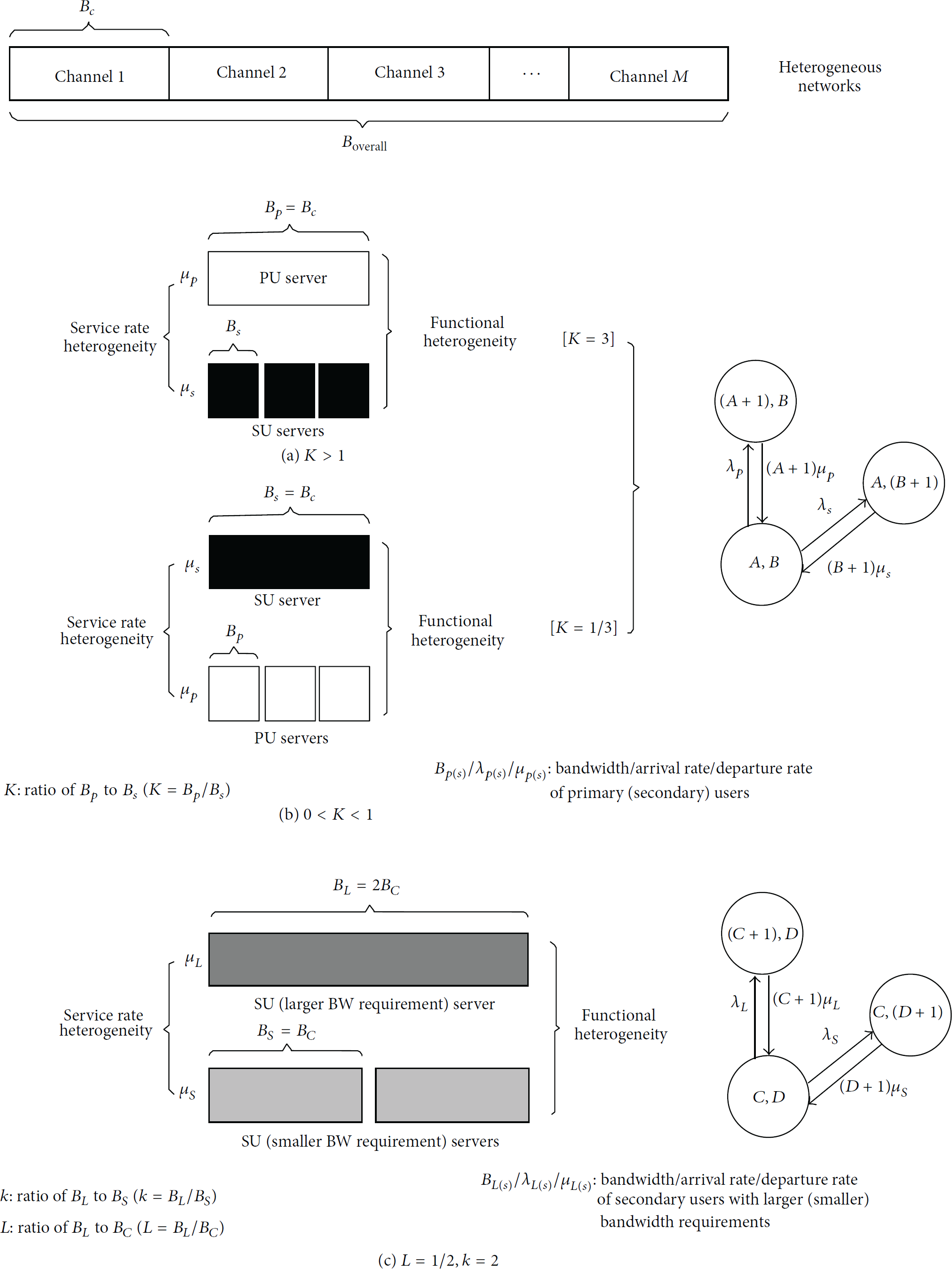
Left side: bandwidth heterogeneity of spectrum access in heterogeneous networks with (a) one primary system and one secondary system,
First, we consider the case of two colocated systems, one primary and the other secondary, and the channel bandwidth demand for the systems satisfies

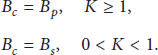
Further, we also consider the case of two different secondary systems. The channel bandwidth for the two secondary systems satisfies


3.2. Markov Chain Modeling of CRSN
Detailed Markovian models will be presented in Sections 5-6, and we just show basic examples of Markov chain models in Figure 1. Since primary users have prioritized access to the spectrum compared to secondary users, they are unaware of secondary users' occupation of the spectrum. Thus, the arrival rate of primary users into the network is independent of the presence of secondary users. The primary users' arrivals follow Poisson distribution with rate
Spectrum sharing among the queued primary and secondary users is interpreted via Markovian description, shown in Figure 1. The possible state transitions include the following: (i) with rate
For the scenario of two different secondary systems, we assume that users with larger bandwidth requirements arrive with Poisson process of rate
3.3. Heterogeneous Systems: Formulation
Multiple radio systems are presumed to operate in the band of interest in the presence of a master node that serves as the access controller for arbitration among heterogeneous systems. The rules of spectrum occupancy for the different types of users are defined below. Note that a primary user can only be blocked by other primary users but a secondary user can be blocked by other secondary and primary users.
Rule 1.
Arrival of a primary user wishing to access a channel currently occupied by secondary user(s) will cause the secondary user(s) to immediately vacate those occupied spectral resources.
Rule 2.
The secondary user that vacates a channel (or subchannel) due to the arrival of a primary user will occupy other available spectral resources in a very short transition time
Rule 3.
An arrival of a secondary user wishing to access a channel (or subchannel) currently occupied by another secondary/primary user will cause blockage of the new secondary user.
4. Channel Packing Scheme
As can be understood from Section 3, efficient channel sensing impacts the overall performance in heterogeneous CRSN, generally speaking. While the choice of (optimal) sensing schemes in CRSN is a new direction of research [14–18], none of the cited work actually integrates the role of channel sensing into the analysis of heterogeneous system performance. To alleviate the problem encountered in serial search (SS) or random search (RS) sensing in heterogeneous networks, that is, unnecessary secondary user blocking, we introduce a novel noncooperative sensing scheme called channel packing scheme (CPS).
CPS comprises two steps: in the first step, an incoming user with smaller bandwidth requirement identifies a channel that includes subchannels already occupied by other users of the same type. At the next step, the first available subchannel in sequence is allocated for this new primary (secondary) user. We assume that each channel is composed of r subchannels. The scheme is described as below:
Serially search and identify a channel with some subchannels already occupied by users of the same type. If such a channel exists, use serial search to occupy an available subchannel inside it. Otherwise, repeat step (1). If such a channel is not found over the whole spectrum, serially search for any available subchannel from the first channel of the band. If a user of the same type finishes the occupation and leaves a spectrum hole, the last user in sequence moves to this spectrum hole.
In CPS, step (3) occurs when the targeted channel is fully occupied either by primary or by secondary users. In this case, all subchannels inside this targeted channel are all unavailable, and thus the incoming users will serially search for the next channel which contains available subchannels. The number of trials to repeat step (1) depends on occupancy of users and successful detection probability. For example, we assume N existing users with larger bandwidth requirement are identically independently distributed among these M channels, which means that there are
CPS avoids unnecessary blocking from traditional noncooperative sensing schemes, because users with smaller bandwidth requirements will be packed in clusters by step (1). Thus an incoming user with larger bandwidth requirement will not be blocked if the remaining available spectrum resource is sufficient. The primary reason we use serial instead of random search in CPS is that SS can pack users with smaller bandwidth requirements in clusters while RS results in dispersed subchannel occupation. At the same time, SS has the same mean time to detect a free channel

5. One Primary System and One Secondary System,
We first analyze the performance of two colocated systems, one primary and the other secondary, in both single-channel (
5.1. Markovian Analysis for Single-Channel (
) Scenario
We first note that since primary users will not be impacted by the presence of secondary users, the behavior of primary system can be modeled straightforwardly as


CTMC diagram of one primary system and one secondary system in the single-channel scenario,
Solving the above equations, we get

In this scenario, the average spectrum utilization of primary and secondary systems is

A primary user coming into the spectrum is blocked only if there is another primary user occupying the channel. On the other hand, a secondary user is blocked if the channel is already occupied either by a primary user or by K secondary users. Thus, the blocking probability of the primary and secondary users is

For the special case of

5.2. Case Study:
,
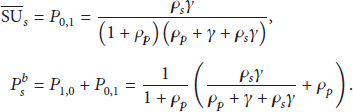
Solving the steady-state equations (7) by applying

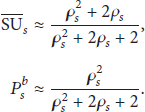
The spectrum utilization and blocking probability for secondary users in this single-channel scenario are given by

5.3. Multichannel (
) Scenario
With the same set-up as before, the state transition diagram for the case of M-channel, K subchannels in each channel, is illustrated in Figure 3. Note that if a new primary user arrives and evicts K secondary users, state (


Multichannel scenario of primary and secondary users coexisting with different bandwidth requirements,
The spectrum utilization and blocking probability are thus given by

We assume that the processing rate is proportional to the serving bandwidth, implying that

Overall spectrum utilization for different values of M.
6. One Primary System and One Secondary System,
In this scenario, the whole band can support at most

6.1. Markovian Analysis for Single-Channel (
) Scenario
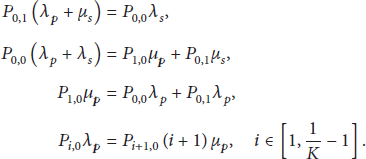
Similarly as we draw the CT-MC diagram in Section 5, the steady-state equations are given by


6.2. Multichannel (
) Scenario
Although different sensing schemes do not impact system performance for
Applying CPS, the CT-MC diagram for this multichannel scenario is shown in Figure 5. Note that state


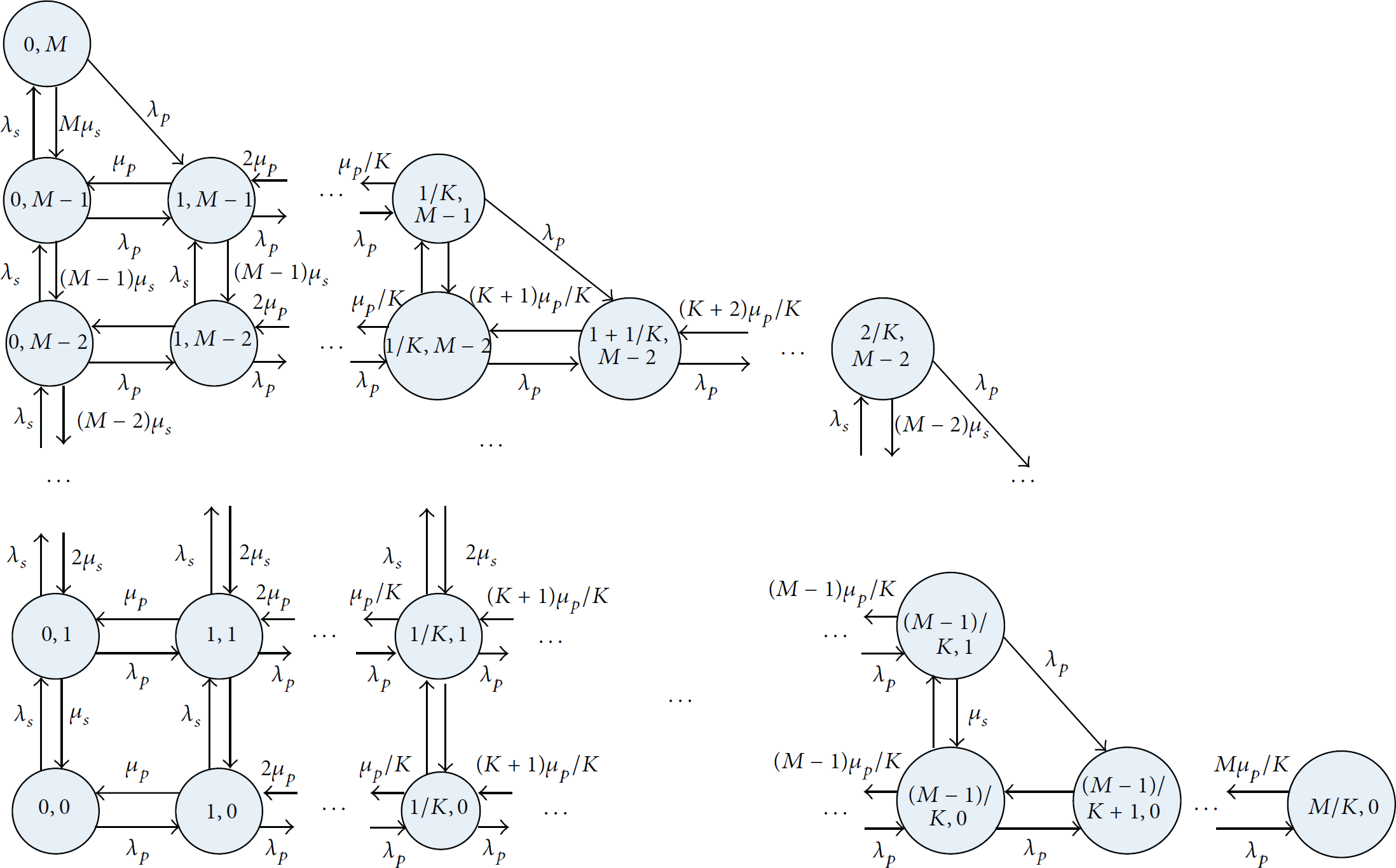
Multichannel scenario of primary and secondary users coexisting with different bandwidth requirements,
6.3. Comparison with Other Sensing Schemes
Because it is difficult to describe the CT-MC diagram for different sensing schemes such as RS or SS for the general multichannel scenario, we consider a specific case of

Blocking probability of secondary users and overall spectrum utilization:
We continue with this case to investigate the performance of CPS vis-à-vis the conventional sensing schemes. Figure 6 shows that CPS has a much lower blocking probability than both SS and RS. Moreover, CPS has higher spectrum utilization than both conventional schemes. When
7. Two Secondary Systems
The primary user occupancy is stochastic in major sections of the spectrum under consideration (
As before, we investigate the Markovian performance of two heterogeneous secondary systems in an M-channel band, where M is the number of unused channels by the primary system. We assume that two secondary systems have same priority, and one uses k times the bandwidth of the other (
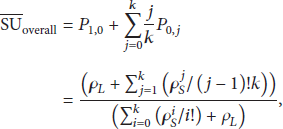
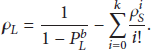
We introduce a new parameter for spectrum utilization as a function of the blocking probability, termed as average effective spectrum utilization or

7.1. Markovian Analysis for
We start from the simplest scenario, where the whole band can support at most one secondary user with larger bandwidth. Let state




The overall blocking probability is given by




7.2. General
Scenario
The generalized case to formulate the heterogeneous networks of two different secondary systems is that


CTMC diagram of two heterogeneous secondary systems for generalized
In addition, the equations above also satisfy

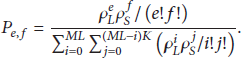
The blocking probability and average effective spectrum utilization are then given by

7.3. Comparison with Other Sensing Schemes
In order to show the advantage of CPS over other conventional sensing schemes, we analyze the performance of RS and SS in the multichannel scenario for heterogeneous secondary networks. Because the CTMC diagrams of RS and SS are very complex for the large values of
Figures 8-9 demonstrate the performance of three sensing schemes. It can be noticed that SS has lower blocking probability and higher average effective spectrum utilization than RS, although the gain is not significant. The lower probabilities of these two states result in less unnecessary blockage of secondary users with larger bandwidth requirements, hence leading to better performance. On the other hand, these two states will not happen in CPS. Therefore CPS has around
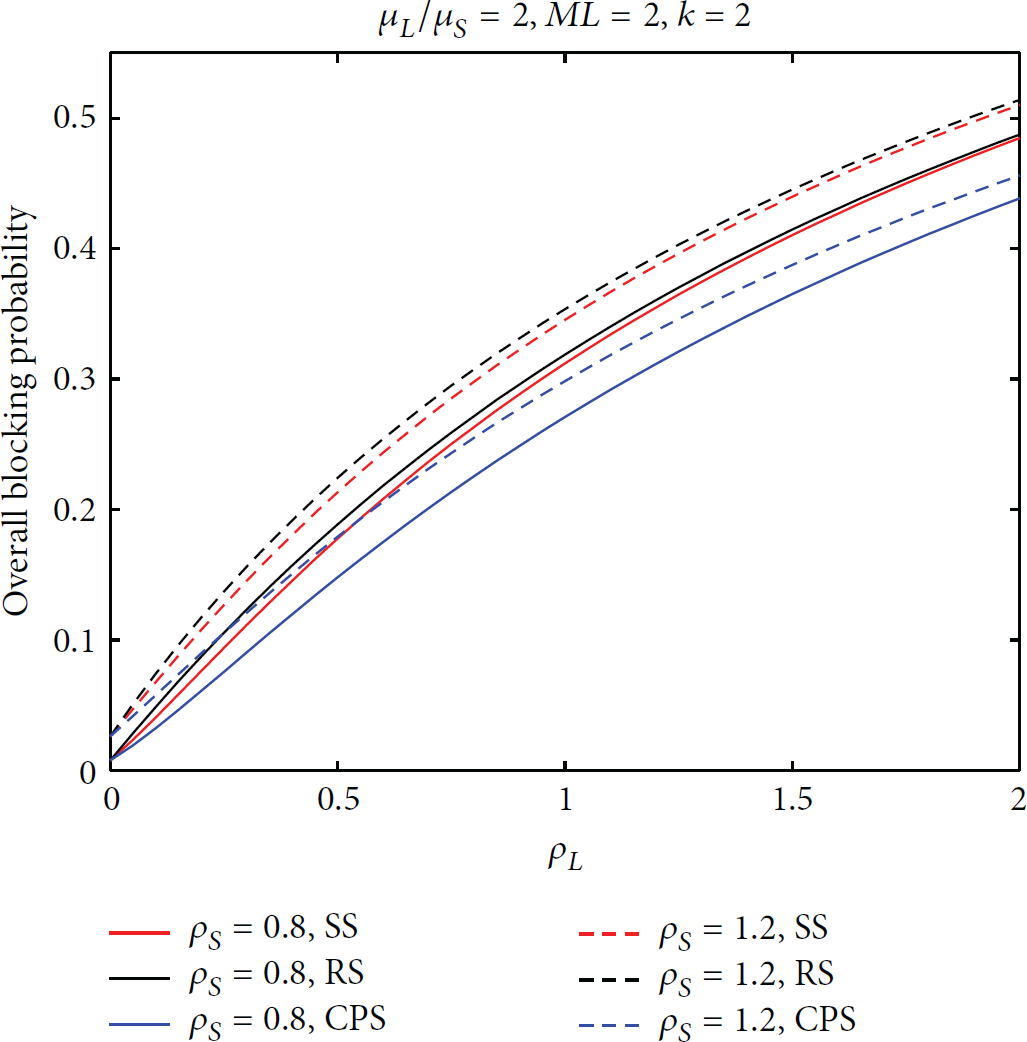
Overall blocking probability;
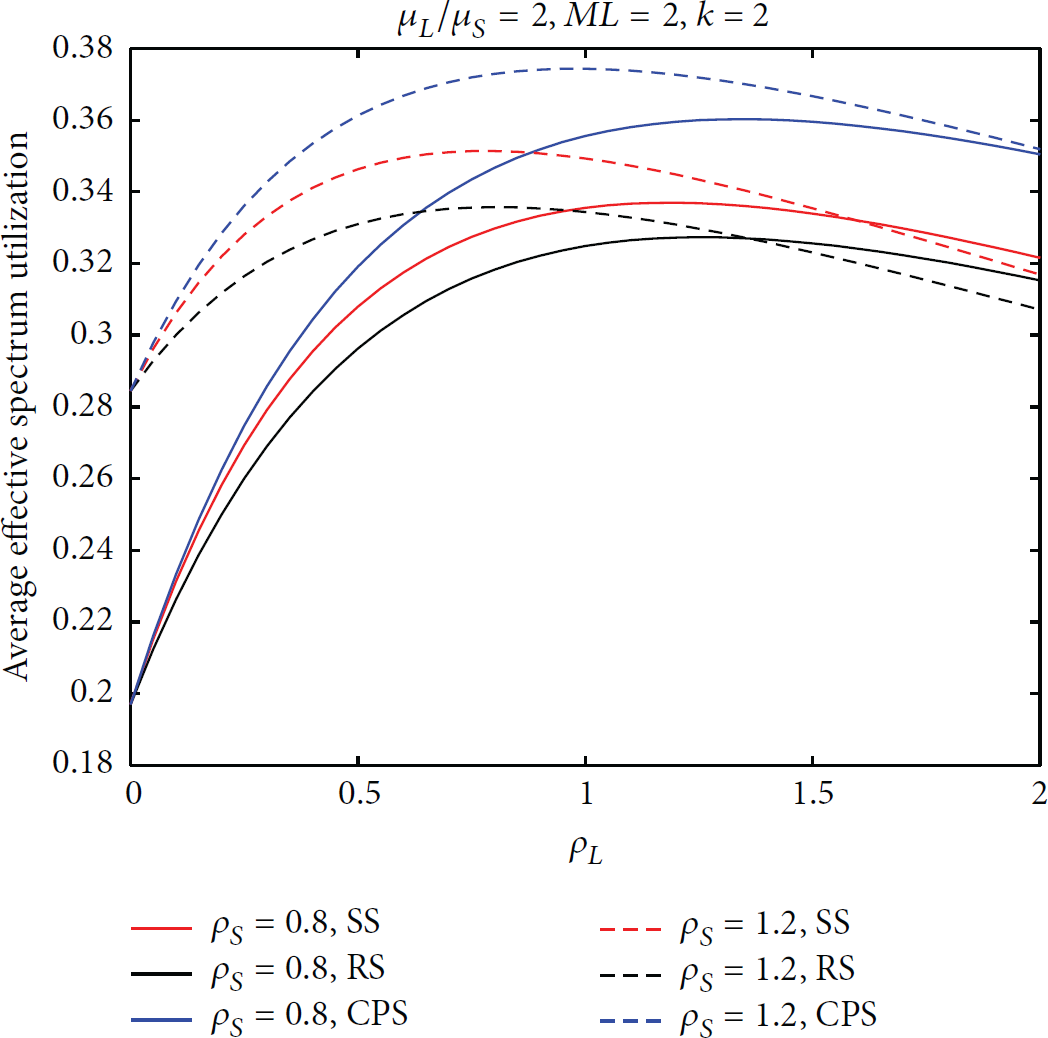
Average effective spectrum utilization;
8. Numerical Results of Multiple Heterogeneous Networks in Multiband Scenario
The generalized heterogeneous network can support multiple types of primary systems and secondary systems simultaneously operating in the same band. However, it is very difficult to describe the CT-MC diagram in a multidimensional plane and obtain the closed form analytical derivations; we then evaluate the performance of conventional RS and our CPS scheme in numerical results for a three-system scenario via Matlab. Here we assume that the primary system and the secondary system with larger bandwidth requirements will occupy a channel per access. The other secondary system with smaller bandwidth requirements will occupy a subchannel per access. We assume no buffers for queueing and
When the band is not fully occupied, any incoming cognitive secondary user with smaller bandwidth requirement will find an available subchannel in a very short time even though the first try fails, no matter via CPS or RS. If some secondary users with smaller bandwidth requirements are forced to terminate by primary users, they can also locate the available subchannels in a very short transition time. Thus the gain of CPS mainly comes from the benefit on the secondary system with larger bandwidth requirements. It can be noticed from Figure 10 that applying CPS leads to
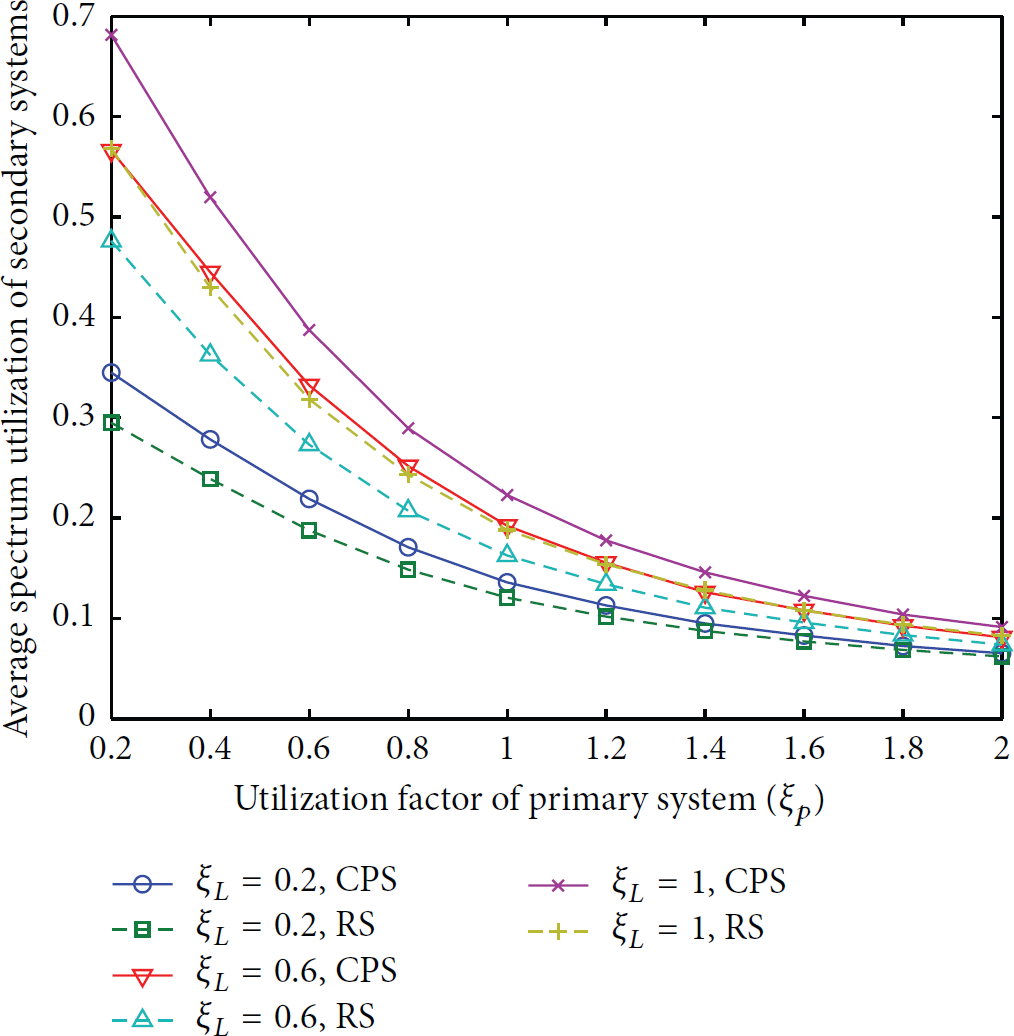
Average spectrum utilization of secondary systems.
9. Feasible Applications for Smart Grid
In view of smart grid, the communication infrastructure is divided into three parts: wide area network (WAN), neighbor area network (NAN), and home area network (HAN) [22]. Multiple applications with heterogeneous communication methods will be applied in data transmission among power plants, substations, and users for controlling and monitoring. For example, some of sensors are using UWB technologies for condition monitoring while other sensors, such as remote terminal units (RTU), are using Zigbee techniques for controlling. Meanwhile, the technicians are likely to apply Walkie Talkie or FM radios which are operating at the same band at the same place. Figure 11 shows the scenario of such a situation where heterogeneous CRSN methods are applied in smart grid. In this scenario, intelligent electronic devices (IED) are connected to the control center by fiber wired communications at the transmission substations while wireless methods are required at the distribution substations and for home users due to the cost of constructions.

A feasible application of heterogeneous CRSN for smart grid.
Because most of the electricity utilities are lacking wireless spectral resources, the mobile sensors applied heterogenous CR technologies are then working at NAN and HAN to provide data transmission, where the QoS is not as high as data communications at the transmission substation side. For example, monitoring sensors can be seen as the primary users because of the security for the core data of utilities. On the other hand, smart meters can be assumed as secondary users since the data shared between home consumers and electricity utilities required low level of QoS. The different techniques and interfaces used by monitoring sensors and smart meters lead to different serving bandwidth in the same communication environment, which perfectly satisfies our heterogeneous model. We apply our CRSN approach on these IEDs so that they are able to perform efficient channel sensing in the smart grid scenario with all kinds of various equipment of distinct serving bandwidth.
10. Conclusions
CT-MC models of CRSN in heterogeneous networks for smart grid have been presented in this paper. By targeting cases of colocated primary and secondary systems with different bandwidth requirements, the analysis in the single-channel scenario provides the closed form derivations of the blocking probability and spectrum utilization for some special cases. In addition, a noncooperative channel packing scheme is proposed to alleviate the unnecessary blockage. Numerical results show that our CPS scheme can significantly decrease the blocking probability and increase the spectrum utilization, compared with traditional sensing schemes such as random search and serial search. A feasible application of heterogeneous CRSN for smart grid is then provided.
Footnotes
Conflict of Interests
The authors declare that there is no conflict of interests regarding the publication of this paper.