




Abstract
Mobile multimedia streaming services provide rich-content visual resources for the mobile users via ubiquitous access to Internet. The video resource sharing focuses on the matching of appropriate resource supplier for the resource requesters and is a key issue for P2P-based video system scalability and user quality of experience. In this context, leveraging social-driven interaction between mobile users enables the discovery of common interests to improve video content sharing efficiency. In this paper, we propose a novel energy-efficiency social-inspired video sharing solution in wireless networks (ESVS). By the analysis of historical request behaviors of users, ESVS designs an estimation method of relationship between videos and groups the videos into a chain-based tree structure. Based on the constructed video tree, ESVS designs a hybrid resource lookup algorithm including push and pull and a communication quality-aware selection strategy of video suppliers, which improves the communication capacities between requesters and suppliers and reduces the network bandwidth consumption. Simulation results also show how ESVS achieves higher resource lookup success rate, lower startup delay, less packet loss rate, and lower maintenance cost than another state-of-the-art solution.
1. Introduction
Increasing wireless bandwidth and developmental network technologies such as cellular networks, wireless mesh networks, wireless local networks, and mobile ad hoc networks support the deployment of mobile multimedia streaming services for the mobile users via ubiquitous access to Internet [1]. The video streaming is one of most popular multimedia services in Internet and contributes huge network traffic [2]. The increase in the user scale and the demand of watched quality leads to severe consumption of network bandwidth and influences scalability and quality of service (QoS) of multimedia systems. Peer-to-Peer (P2P) technologies construct the logical link between mobile clients to achieve the resource sharing, which relieves the load of media server to improve the system scalability [3–7]. On the other hand, the deployment of P2P-based video systems in wireless networks also needs to address the problems of video delivery performance caused by the mobility of mobile nodes. A key issue is how to improve the scalability and communication capacities of P2P networks in wireless networks in order to promote the quality of experience (QoE) and energy endurance of mobile users [8–12].
The existing P2P multimedia streaming solutions in wireless mobile networks still use the traditional structures to manage the video resources. For instance, in QUVoD [13], the nodes which store available resources are grouped into a chained Chord structure where these resources are deployed in 4G networks. QUVoD relies on the DHT-based structure and the similarity of stored resources between nodes to achieve fast location of video content. However, QUVoD does not address the problems of system scalability caused by the increase in the number of mobile nodes. RACOM in our previous work [14] built a mesh overlay network. Each node maintains the state information of multiple nodes in terms of playback state reliability and prediction results of playback content to achieve fast resource search. Although RACOM does not employ flooding search in the whole P2P networks and avoids the high lookup delay, the redundancy link between nodes increases the maintenance cost of nodes and wastes network bandwidth.
The video content has very important influence for the user lookup behaviors [15]. For instance, the popular videos attract the large number of users to access them; the videos in the TV series have high access probabilities. Making use of the relationship between videos to group the resources in P2P networks can promote the performance of resource sharing. Finding relationship between videos and regulating the relationship in real time when the user interests change reduces the “distance” between requesters and desired content, which is very important for improving communication capacities of P2P networks.
Social networks are emerging technologies, which build the relationship between users in terms of the similarity in the values and interest and family [16–19]. The interaction in social networks mainly includes searching, forwarding, and attention [20]. The searching denotes that the users actively search the content from other contacted users. The forwarding denotes that the users receive and forward the content generated by other contacted users. The attention denotes that the users are willing to receive the content from other users. Obviously, the content sharing in social networks is classified as pull and push (searching is an active pull, and forwarding and attention are the passive push) [21]. The hybrid searching pattern including pull and push speeds up the content dissemination and improves the content sharing efficiency.
In this paper, we propose a novel energy-efficiency social-inspired video sharing solution in wireless networks (ESVS). By estimation of similarity between video content and the analysis of request behaviors of users, ESVS calculates the contact levels between videos and clusters the videos into a chain-based tree structure in order to accurately push interested content to the users. ESVS designs a hybrid resource lookup strategy, which makes use of video tree structure to fast search the resource suppliers and accurately push content in terms of user request, which reduces the lookup “distance” between requester and suppliers. Further, by monitoring the communication quality in video data transmission path, the nodes in ESVS dynamically make the switchover between suppliers in order to obtain high video delivery capacities and improve utilization efficiency of network bandwidth. Extensive tests show how ESVS achieves higher resource lookup success rate, lower startup delay, less packet loss rate, and lower maintenance cost than another state-of-the-art solution.
2. Related Work
Recently, some solutions focus on the video sharing in wireless mobile networks by making use of content similarity. For instance, QUVoD in [13] makes use of the distributed hash table (DHT) to cluster the nodes which store the same or similar video chunks into a hybrid group-based DHT structure. Therefore the request nodes can obtain the video resources in intragroups instead of the whole DHT structure, which reduces the number of forwarding request messages. However, because the video resources stored by the intragroup nodes are sequential, the request nodes still need to use the DHT structure when they search the chunks which have long “distance” with current played chunks. Moreover, all nodes are grouped into the DHT structure so that the increase in the number of nodes brings high maintenance cost and limits QUVoD's scalability. In SURFNet [22], the nodes with long online time form an AVL tree and store the superchunk (relatively long length). The other nodes store short video chunks relative to the superchunk and form the chains which are attached to the corresponding nodes in the AVL tree in terms of the similarity with the superchunk. SURFNet makes use of the hybrid structure to improve lookup performance of video content and balance the node load. However, SURFNet also has the same problem with QUVoD for the system scalability; namely, the increase in the number of nodes in overlay networks brings huge maintenance cost of overlay networks. RACOM [14] enables the nodes to build the logical link in terms of the contact level between video chunks. Because the nodes implement the autonomous management for the logical link, the system has high scalability. However, the increase in the number of nodes leads to fast rise in the number of the logical links (including the large number of redundancy links), which brings high maintenance cost for the link and causes the overload of nodes. QUVoD, SURFNet, and RACOM make use of the similarity between content to construct the P2P networks and obtain high gains for the resource lookup. However, these solutions only estimate the content similarities between chunks in the same video but do not address the similarities between videos.
Some social network-based content (video) sharing solutions address the estimation of similarity between content well. SPOON [23] extracts the keywords from the name of files stored by the mobile nodes to construct interest vectors of nodes. The nodes make use of the vector angle cosine to calculate the similarity level of interests between nodes. SPOON further makes use of the common interest and interaction to estimate the contact level between mobile nodes and constructs the node communities. SPOON assigns the role for the community members in order to address the resource request. However, SPOON does not mention the estimation method of interaction in detail. Moreover, the calculation of interest similarity between nodes only relies on the keywords of file name. It is difficult to ensure high accuracy of interest similarity estimation, which leads to fragile community structure and brings negative influence for system scalability and resource lookup performance. SocialTube estimates interest similarity level according to the number in the intersection of watched videos between source nodes and users [24]. A source node and multiple users which have high interest similarity level form a node group where the users are classified into follower and nonfollower according to the similarity level. The source nodes push some video content to the users, which promotes the resource sharing efficiency. However, SocialTube employs the similarity estimation method based on the number of watched videos. It is difficult to capture real common interests, which leads to the low resource push success rate. The relationship between source nodes and users is easily influenced by the change of the video content of source nodes and dynamic user interests; namely, the fragile member relationship also brings high maintenance cost of member state and low efficiency of content sharing. NetTube considers that the users which request and download the same video have common interests and form a node community (swarm) [25]. When the members in community change current watched videos, they move to another community. The construction cost is low for the community structure, and the relationship estimation and state maintenance of members have low complexity. However, NetTube also has some disadvantages, such as high maintenance cost of contacts between communities and low efficiency of resource lookup.
Based on the above analysis, the estimation method of relationship between nodes is very important for the stability of community structure and the efficiency of resource sharing. Another key issue is how to handle the change of user interests. This is because the change causes the reconstruction of P2P network topologies and the assignment of suppliers, which consumes the large number of network bandwidths and resources of computing and storage of nodes. Therefore, we investigate the content-based similarity between videos and the playback behavior of users to estimate the contact levels between videos. Making use of accurate relationship between videos can construct the stable P2P network topologies, ensuring resource sharing efficiency (e.g., high success rate of video lookup and push reduces the number of forwarding request messages, which improve the utilization efficiency of network bandwidth) and system scalability (e.g., low maintenance cost). Moreover, the estimation of communication quality in the data transmission path can also achieve bandwidth-saving (e.g., the decrease in the retransmission of data for TCP protocol) and low startup delay, which improves the energy utilization of mobile nodes.
3. ESVS Detailed Design
The media server has strong capacities of computing, storage, and high bandwidth relative to the nodes in P2P networks and uses stored original video resources
3.1. Analysis of User Lookup Behavior
The interest drives the users to request different video content, so there is the relationship between content and user interest. Let

The similarity for other feature items of

Except the relationship between videos based on the content similarity, the user request behaviors also describe the potential contact between videos. After a user has watched current video, she/he requests another video; namely, the request behaviors are considered as an access path. For instance, let


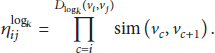
Further, the cumulative sum of tight level in all logs which include

The cumulative sum of distance and transitive similarity of

3.2. Video Clustering-Based Node Community
The video clustering actually is to build a resource distribution mode in order to obtain optimal resource lookup performance. Before the video clustering, ESVS preprocesses the videos by a self-learning process. A video may keep the contact with multiple videos in other video sets. For instance,
Rule 1.
If
By the elimination of noise contact according to Rule 1, any video
Rule 2.
If
By the iteration of set mergence in terms of Rule 2, the merged sets meet the requirement: the union set of all items (including head items) in merged sets is equal to


Chain-based binary tree.
The node communities at the high layers have high levels in popularities and access probabilities of video content and rely on short logical distance in tree to achieve fast resource location.
3.3. Hybrid Searching
The node communities have one or multiple broker members according to the number of contacts between communities. If a community When the mobile nodes request When the members in If the members in
If a community has multiple broker members, these broker members have different task. For instance,
Once the request nodes become new members, they record the information of broker members in current communities in order to search other resources. If the request nodes are interested in pushed videos, they send the request messages to corresponding broker members and prefetch the video content into local prefetching buffer and also become the members of communities corresponding to the prefetched videos. Because any node may become the member of multiple communities and record the information of broker members of these communities, it bridges these communities and acts as the associate broker member of communities. The associate broker members share responsibility for the load of broker members (e.g., forwarding request messages and maintaining members), which further improves the scalability and resource sharing efficiency of systems [26]. Moreover, the request nodes also calculate the push success rate according to


In order to reduce the calculation load, the server calculates the access probability among all videos according to the period time
The change of played content causes the movement of nodes from a community to another community, namely, the mapping relationship between the members and a community changes to another community. For instance, when a member
4. Testing and Test Results Analysis
4.1. Simulation Settings and Scenarios
We compare the performance of ESVS with a state-of-the-art solution SURFNet [22]. ESVS and SURFNet are deployed in the wireless network whose settings are described in Table 1. The two solutions are modeled and implemented in NS-2. The media server stores 100 video files and the length of each file is set to 100 s. The initial target location and speed of 300 mobile nodes are randomly assigned. When the mobile nodes arrive at the assigned target location, they continue to move according to the reassigned target location and speed. We generate the information of 100 videos (including name, actor, and introduction) and 20,200 playback logs (including played video ID and watched time) where the video information and 20,000 playback logs are used to calculate the access probabilities between videos. 200 mobile nodes join the system following Poisson distribution and play video content following generated 200 logs where the popularities of played content meet the Zipf distribution and 50 nodes play 4 video files during the whole simulation time. When any node finishes the playback, it quits the system. In ESVS, the value of threshold
Simulation parameter setting for wireless network.

4.2. Performance Evaluation
The performance of ESVS is compared with that of SURFNet in terms of average resource lookup success rate (ARLSR), startup delay, packet loss rate (PLR), and maintenance cost, respectively.
( 1) ARLSR. The event-request nodes send the lookup messages and successfully obtain the video content from the P2P network which is defined as a success lookup. The ratio between the number of successful lookups and the total number of lookups denotes the resource lookup success rate. The mean values of resource lookup success rate during a time interval of 50 s and the process of node joining the system are shown in Figures 2 and 3, respectively.
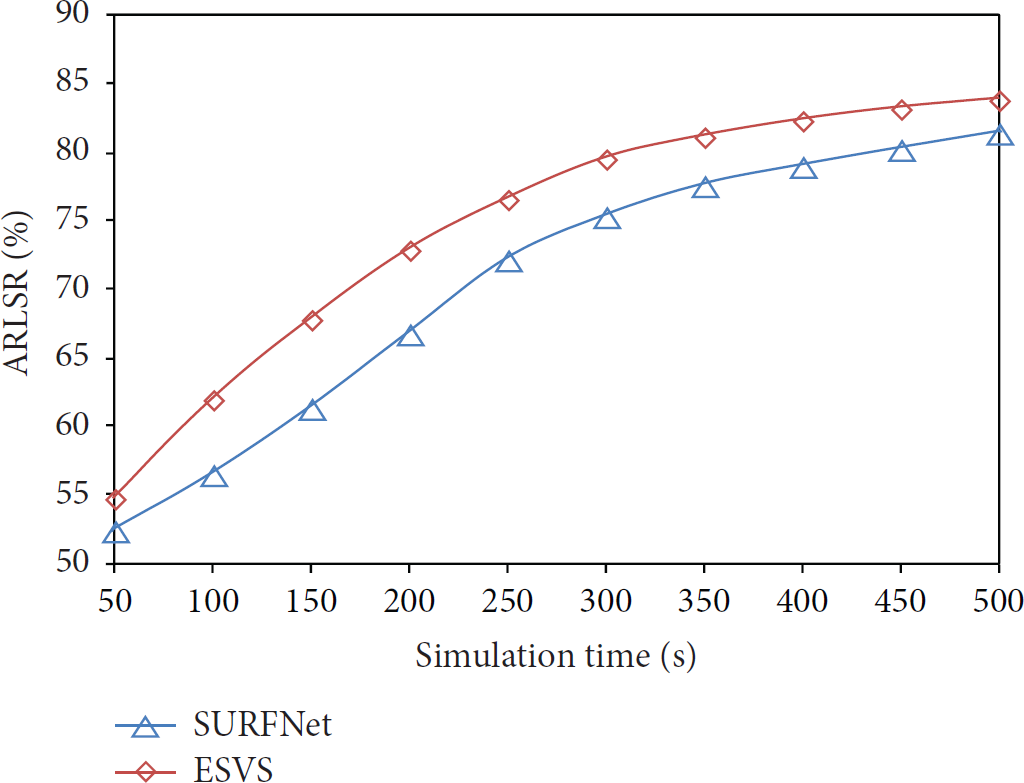
ARLSR against simulation time.

ARLSR against number of nodes.
As Figure 2 shows, the two curves corresponding to the results of ESVS and SURFNet have a fast increase trend during the whole simulation time. SURFNet curve keeps fast rise from
Figure 3 also shows the increase trend of two curves with increasing number of nodes. The blue curve of SURFNet maintains a fast rise during the process of node joining the system, but it also has an obvious fluctuation. ESVS curve keeps higher levels than that of SURFNet and has larger increment and peak value than those of SURFNet.
In SURFNet, the nodes with long online time are grouped into an AVL tree and the other nodes which store the same videos with the nodes in tree form the chain and attach the tree. In initial simulation, the nodes which have joined the system firstly form the AVL tree and obtain the video resources from the media server. Therefore, the values of SURFNet ARLSR keep the low levels. The increase in the number of nodes provides the relatively enough available resources for the new system members so that the values of SURFNet ARLSR maintain fast rise. The change of user interests for the video content brings the uncertainty of resource demand; namely, some nodes still do not obtain the requested resources from the P2P network and only receive the video data from the server. Therefore, the ARLSR results of SURFNet keep a stable slight increment after the fast increase. ESVS groups the videos into a chain-based tree structure and enables the nodes to form the communities corresponding to the played videos. Moreover, the nodes prefetch the videos of interest into local buffer and make use of prefetched resource to serve other nodes; namely, the prefetched content increases the available resources in the P2P network. Therefore, the curve corresponding to the results of ESVS ARLSR keeps the fast rise and has higher increment than that of SURFNet.
( 2) Startup Delay. The difference values between the time of sending request message and receiving first video data are defined as the startup delay. The mean values of startup delay during a time interval 50 s and the process of node joining the system are shown in Figures 4 and 5, respectively.

Startup delay against simulation time.

Startup delay against number of nodes.
As Figure 4 shows, the two curves corresponding to ESVS and SURFNet have two fluctuation processes during the whole simulation time. The blue curve of SURFNet experiences a slight fluctuation from
Figure 5 shows the variation process of two curves with increasing number of nodes. The curve of SURFNet has a rise trend with relatively severe fluctuation and reaches peak value (2.95 s) when the number of nodes is 160. The curve of ESVS also has severe fluctuation in the rise process but keeps lower level than that of SURFNet and has lower peak value (2.53 s) than that of SURFNet.
In SURFNet, forwarding the request message relies on the nodes in the AVL tree; namely, the nodes in tree make use of the predefined parent-child relationship to relay the request messages. The more the number of relay nodes is, the longer the startup delay is. SURFNet can obtain low lookup delay by making use of the AVL tree structure. With the increase in the number of nodes, the amount of video streaming in network also quickly increases, which leads to the network congestion. Therefore, the startup delay results of SURFNet show a fast rise trend from
( 3) PLR. The ratio between the number of packets lost in the process of video data transmission and the total number of packets sent denotes PLR. The mean values of PLR during a time interval 50 s and the process of node joining the system are shown in Figures 6 and 7, respectively.

PLR against simulation time.

PLR against number of nodes.
As Figure 6 shows, the blue curve of SURFNet has a fast rise from
Figure 7 illustrates the variation of two curves corresponding to ESVS and SURFNet with increasing the number of nodes. The curve of SURFNet keeps the fast trend with two fluctuations and reaches the peak value (0.43) when the number of nodes is 160. Although the red curve corresponding to the ESVS results also experiences the fluctuation, it shows a stable increase process relative to that of SURFNet and the increment and peak value (0.369) are lower than those of SURFNet.
The nodes in SURFNet do not consider the communication quality in the data transmission path. The performance of data transmission easily is subjected to the severe negative influence due to the change of wireless mobile network topologies. For instance, the network congestion leads to fast increase of PLR results of SURFNet (the curve of SURFNet keeps high level from
( 4) Maintenance Cost. The messages used by maintaining the P2P network such as nodes joining, leaving, and searching are considered control messages. The occupied bandwidth per second of control messages is defined as the maintenance cost.
Figure 8 illustrates the variation of maintenance cost results of ESVS and SURFNet with the increase in the simulation time. The blue curve corresponding to SURFNet results keeps the fast rise with severe fluctuation from

Maintenance cost against simulation time.
The maintenance cost of SURFNet mainly includes the exchange of state messages of nodes in the AVL tree, the state management of members in the chain attached to tree, forwarding and handling the request messages of resources, and the assignment of suppliers. The nodes in the tree have longer online time than those of nodes in the chain; the maintenance cost for the tree is low relative to the chain. In initial simulation, the maintenance cost of SURFNet keeps the slight increase. With the increase in the number of nodes and corresponding resource demand, the maintenance cost of SURFNet quickly increases. Because some nodes quit the system, the decrease in the number of request messages and node state lead to the fast fall of the maintenance cost of SURFNet. The dynamic change of node state is mainly the reason for the maintenance cost level of the system. The frequent change of state of nodes in the tree leads to the increase in the frequency of tree reconstruction, which results in the increase in the tree maintenance cost. The resource lookup failure indicates that the request nodes find that the resource demand cannot be met after the traversal of request messages in the whole tree, which enables the request messages to consume the large number of network bandwidth. Although ESVS also employs the chain-based tree structure, the tree scale (height and weight of tree) keeps low level. This is because the chain includes the videos which have close contact with the videos in the tree. Flattening tree structure reduces the maintenance cost of tree and the negative influence caused by the state churn of nodes in tree, which also reduces the number of forwarding request messages. Some node communities have multiple broker members or associate broker members, which increases the message cost of state maintenance. However, the small scale of (associate) broker members relative to the community members only results in the slight rise of maintenance cost. These (associate) broker members not only share responsibility for the maintenance cost of the whole P2P network and improve system scalability, but also speed up the resource lookup process and reduce the number of forwarding request messages. Moreover, sharing prefetched resources between community members promotes the resource lookup success rate, which further reduces the number of forwarding request messages. Therefore, the performance of ESVS maintenance cost is better than that of SURFNet.
5. Conclusion
In this paper, we propose a novel energy-efficiency social-inspired video sharing solution in wireless networks (ESVS). ESVS builds a model to estimate the access probabilities between videos in terms of the similarity of video content and user playback behaviors. ESVS makes use of the access probabilities to cluster videos into a chain-based tree structure and group the nodes into the communities corresponding to the videos in the chain-based tree. In order to improve the sharing efficiency of video content, ESVS designs a hybrid resource lookup algorithm including push and pull and makes use of the sharing of prefetched content to improve the shortness of available resources in P2P networks. ESVS further enables the receivers of video data to dynamically regulate the suppliers in terms of the communication quality in the data transmission path, which not only improves QoE and energy endurance of mobile nodes, but also reduces the consumption of network bandwidth. Simulation results also show that ESVS obtains higher resource lookup success rate, lower startup delay, less packet loss rate, and lower maintenance cost than SURFNet.
Footnotes
Conflict of Interests
The authors declare that there is no conflict of interests regarding the publication of this paper.
Acknowledgments
This work was supported in part by the National Natural Science Foundation of China (NSFC) under Grant nos. 61501216, 61502219, 61402303, and 61522103, the Beijing Natural Science Foundation (4142037), and the Science and Technology Key Project of Henan province (152102210331 and 152102210332).