




Abstract
We propose a method to compensate the effects of multiple carrier frequency offsets (CFOs) for orthogonal frequency division multiplexing (OFDM) systems. The multiple CFOs, we considered, are caused by several spatially separated frequency-unsynchronized transmitters as in amplify-and-forward relay communication networks or wireless ad hoc sensor networks. Despite its appealing features, OFDM is extremely sensitive to CFO, especially to multiple CFOs. At the receiver, the residual CFO which appears due to incomplete compensation of multiple CFOs destroys orthogonality among subcarriers and brings interchannel interference (ICI). In the proposed scheme, we compensate the CFOs of the received signal by the predesigned value, which results in cancellation of the opposite ICI by each other. This is based on the property that the spectrum of ICIs shown in a subcarrier has similar magnitudes and opposite signs from the fact that spectrum shapes of the ICI are of sinc function. Simulation results are shown to demonstrate the effectiveness of the proposed method.
1. Introduction
In cellular communication systems, the improvement of communication quality of subscribers who are located at the edge of the cell is important to enhance the total quality of service (QoS) [1, 2]. To achieve that, some network schemes like relay communication network and wireless sensor network are proposed.
The cooperative relay communication system [3, 4] reduces a radio shadow area by installing some relays in the middle of cell. The relay communications networks are proposed to accomplish the goal for the advanced long term evolution (LTE-A) system [5].
The wireless sensor network [6, 7] consists of autonomous nodes that can be deployed in an area. Sensor nodes are generally equipped with a radio transceiver. Therefore, these nodes help to maintain strong links between transmitter and receiver. Therefore, the researchers have envisioned a wide variety of applications, such as environment monitoring, field surveillance, and structure monitoring.
In these schemes, a subscriber receives the same signal from several transmitters and sensors simultaneously, and multiple carrier offsets (CFOs) may appear at the receiver because the oscillators of transmitters and receiver have different oscillation frequencies each other. Doppler effect also brings the CFO in mobile environments.
Orthogonal frequency division multiplexing (OFDM) has many advantages such as high spectral efficiency and ability of eliminating the effects of multipath propagations [8]. Because of its advantages, OFDM or orthogonal frequency division multiple access (OFDMA) is used in several wireless communication or broadcasting systems such as IEEE 802.11n wireless local area network (WLAN) [9] and IEEE 802.16e [10] systems.
In OFDM systems, the performance depends mainly on how well the orthogonality among the subcarriers is kept at the receiver. Typically, the CFO breaks the orthogonality. The destruction of orthogonality causes interchannel interference (ICI) from adjacent subcarriers. Since the carrier frequency of the recent communication systems is on the order of GHz, CFOs are commonly on the order of kHz with an oscillator accuracy of a few ppm. Considering the subcarrier spacing of an OFDM system, the order of the CFOs is critical enough to determine the performance of the system. Therefore, mitigating the influence is very challenging in OFDM systems.
There have been many researches to mitigate the effects of CFO in OFDM systems [11–13]. In [11], Moose proposed a method to estimate the CFO by using repetitive preambles. Then, the received signal is multiplied by the inverse rotation factor to compensate the estimated CFO. In [12], Zhao and Häggman proposed a self-cancellation scheme of ICI. The method can be regarded as a precoding approach which adopts a codeword having low ICI. Since the coding rate is less than one, the spectrum efficiency is reduced. Hou and Chen proposed a method which uses a parallel interference cancellation (PIC) scheme to eliminate the ICI in frequency domain [13]. The scheme may be considered as a frequency domain equalizer which consists of a set of prefilters for initial decision and a set of ICI cancellation filters to cancel the ICI. In the scheme, however, the performance may deteriorate severely when the initial decisions are not correct. Furthermore, the scheme increases the system complexity because the PIC needs much additional operations.
Under the condition where the multiple CFOs exist, it is difficult to apply the previously proposed scheme to eliminate the effects of multiple CFOs. The method of [14] can compensate only one CFO, so the residual ICI generated by the other CFOs still exists. Furthermore, to cancel the residual ICI, the complex PIC scheme of [13] is required.
In [14] we proposed an ICI cancellation method for a cooperative communication system where the received signal comes from two transmitters simultaneously with different CFOs. The ICI caused by multiple CFOs is to be self-cancelled by time domain processing. In the method, we assumed that the two signals have same path gains.
In this paper, further to the previous study [14], we propose a multiple-CFO compensation scheme for OFDM systems when the paths have different gains. In this condition, the compensation value for CFO, which leads to self-cancellation of ICI, should be changed according to the gain difference. To find the optimal compensation value, we define an object function which maximizes a signal to ICI power ratio (SIR) of received signal.
2. System Model
We consider an OFDM system with N subcarriers, where same signals are transmitted by two spatially separated transmitters simultaneously as amplify-and-forward relay communication network as shown in Figure 1 [3]. The system consists of 3 nodes, a source, a relay, and a destination. Data are transmitted from the source to the destination with the aid of the relay, and the transmission process is accomplished in two time slots. In the first time slot, the source broadcasts the signal to the relay and destination. In the second time slot, source transmits the same signal transmitted in the first time slot to the destination, and relay transmits the signal received in the first time slot to the destination at same time. Then, the destination node (receiver) receives same signals simultaneously with different CFOs.

An amplify-and-forward relay communication network.
We assume that timing synchronization is perfectly achieved and the CFOs are previously estimated completely through the methods of, for example, [15, 16], by using the training sequence at the receiver. Without loss of generality, we consider only one OFDM block of signal.
After inverse discrete Fourier transform (IDFT) of data symbols and guard interval insertion, the transmitted time domain baseband signal is represented as


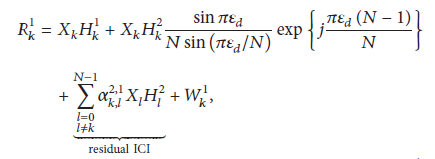
The first term on the right-hand side of (7) represents the effects of the CFO on the desired kth subcarrier symbol, which are attenuation in magnitude and rotation in phase of the symbol. The last term is the DFT of the received AWGN. The second term means ICI introduced into the kth subcarrier from the other subcarriers. The factor

Figure 2 shows the subcarrier spectrum of the received signals from two transmitters with different CFOs. As shown in kth subcarrier frequency, there are ICIs from both received signals of transmitters 1 and 2 as represented in (7).

The subcarrier spectrum of two OFDM signals with different CFOs.
3. Proposed Self-Cancellation Scheme
In this paper, we assume that all the CFOs are known to the receiver and smaller than the subcarrier spacing (this means that the coarse estimation and correction of a CFO is not necessary or is done already [17]).
For a single CFO case, one step of time domain CFO compensation is sufficient if the CFO estimate is known a priori. The compensation is accomplished by shifting the carrier frequency of the receiver by the CFO. Although all the CFOs are known, however, it is impossible to compensate the received signal completely for a two-CFO case by simply matching the carrier frequencies.
For example, if we compensate for the CFO



The subcarrier spectrum of two OFDM signals with compensation of a single carrier frequency offset
In [14], we proposed method, to compensate the received signal for the average value of the two CFOs in time domain. Then, the ICIs are almost cancelled themselves and any additional process may not be required in frequency domain.
Since the shape of the spectrum of a subcarrier is of the sinc function, the sign of the sidelobes appeared alternately as the subcarrier index increases or decreases. This is the key motivation point to propose our method.
If we compensate the received signal with the mid value of

The subcarrier spectrum of two OFDM signals with compensation of
If we rotate the received signal by the inverse of the phase caused by the average CFO


In this case, (14) does not hold anymore as illustrated in Figure 5 and needs to select new CFO compensation value. To obtain an optimal compensation value with different path gains, we define signal to interference power ratio (SIR) as an object function to be maximized as follows:


The spectrum of the subcarriers of the two OFDM signals with different CFOs and different path gains.
4. Simulation Results
Through this section, we verify the effectiveness of the proposed ICI cancellation method. The following results are based on the modulation of quadrature phase shift keying (QPSK) and DFT size N of 128. All the CFOs are assumed to be estimated a priori.
Figure 6 shows the SIR curves of (15) with a different g where the CFOs of two signals are

SIR curves of (15) where
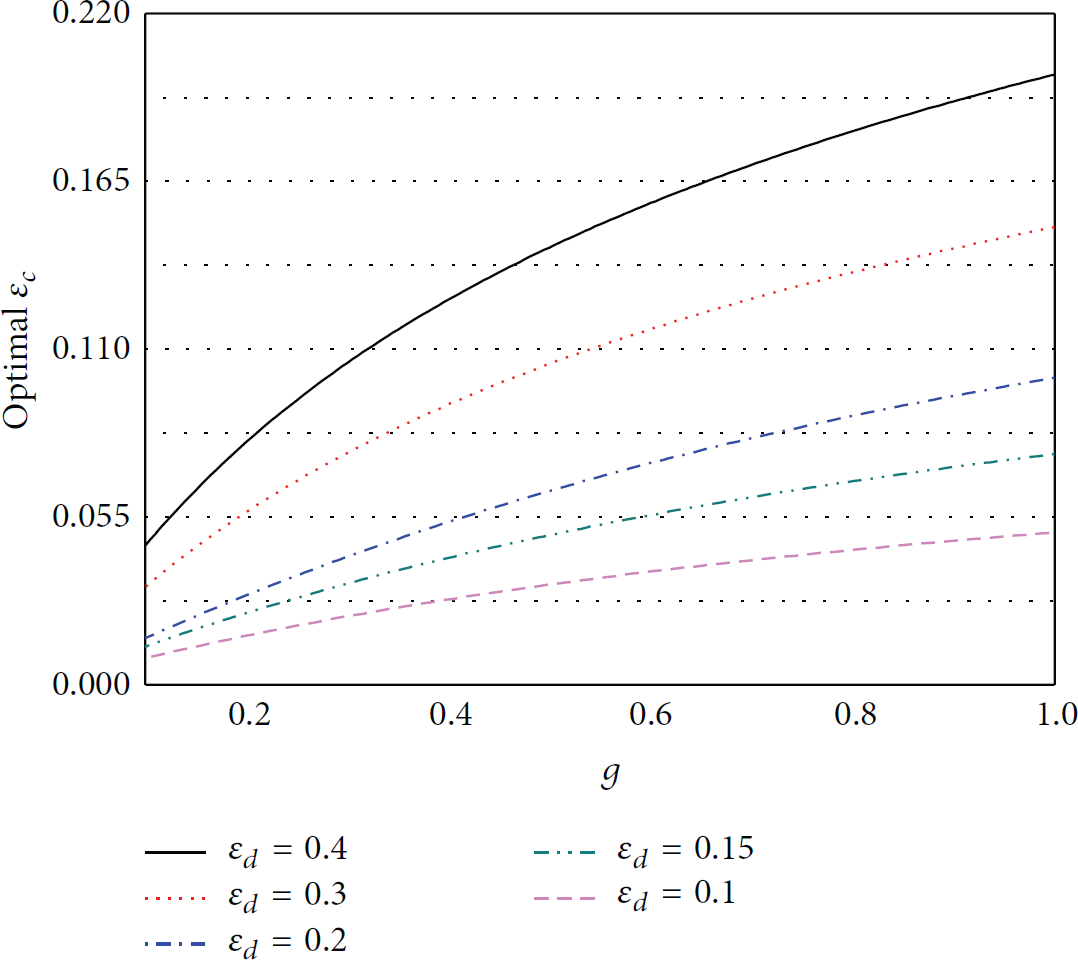
Figure 7 illustrates the curves which link between the optimal CFO compensation values that maximize the (15) with a different
The curves of optimal CFO compensation value
Figures 8 and 9 show comparisons of the bit error rate (BER) performance of proposed method with the mid-value compensation scheme of [14].

BER performance comparison of the proposed optimal CFO compensation value that maximizes

BER performance comparison of the proposed optimal CFO compensation value that maximizes
Figure 8 represents the BER under the condition when
Figure 9 indicates the BER under the condition when
From Figures 6 and 9, we have verified that it is possible to effectively estimate the optimal CFO compensation value in any CFOs and path gains by using the object function of (15).
In Figures 10 and 11, the graphs show the BER performance comparison between the proposed scheme with the method that compensates only by


BER performance comparison of the proposed method with CFO compensation by only

BER performance comparison of the proposed method with CFO compensation by only
Then the DFT output becomes
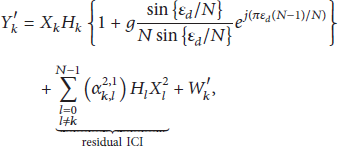

Figure 10 illustrates the performances in the case of
Figure 11 is the case of
Figures 12 and 13 show performances in the multipath channel which is nonfading and 20-path randomly generated. In a transmitter, we adopted a precoding scheme for channel equalization, and then the frequency selectivity of a channel can be considered as a flat-fading.

BER performance comparison of the proposed method with CFO compensation by only

BER performance comparison of the proposed method with CFO compensation by only
In Figure 12, the graph represents the performance where
In Figure 13, performance is shown in case of
5. Conclusions
In this paper, we propose a simple ICI self-cancellation method for OFDM systems with multiple CFOs resulting from the discrepancies of oscillator frequency of the two transmitters and receiver. In the previous work of author, we compensate the CFO of the received signal with the mid-value of two CFOs. To deal with the received signal with different path gains, in this paper, we use the compensation value maximizing the SIR in time domain processing. Simulation results show that the proposed method can effectively cancel the ICI introduced by multiple CFOs.
Footnotes
Conflict of Interests
The authors declare that there is no conflict of interests regarding the publication of this paper.
Acknowledgments
This work was supported by the National GNSS Research Center program of Defense Acquisition Program Administration and Agency for Defense Development.