




Abstract
Distributed beamforming can significantly improve the reliability of the link and the capacity and the coverage of wireless networks. Using a subset number of nodes from a network of sensors, they collectively transmit a common message to an intended destination. In distributed beamforming, the maximum channel capacity could be changed according to the number of cooperating source nodes and the distance (between the average source nodes and destination). Therefore, the scheme is necessary to guarantee the required channel capacity. However, it is difficult to adapt the practical environment due to signal fading, interference, and low quality of sensor nodes in WSNs. Therefore, we studied about the channel characteristic and required transmission power according to the number of cooperating nodes and the distance theoretically to overcome these problems. As a result, we propose an Intelligent Transmission Power Allocation (ITPA) algorithm to guarantee the required channel capacity considering dynamic channel statement, the number of cooperating source nodes, and the distance between the average source nodes and destination with simplicity computation. In addition, ITPA distinguishes noise data (using an exponential weighted received power average) from the estimated original data. From that the system can satisfy requirements of the user without wasting power by itself.
1. Introduction
The techniques of the ad hoc wireless sensor networks have quickly emerged as an interesting research topic due to recent advancements in both size and power performance. It is now possible to cover large networks by relatively small devices distributed over the large area with limited power and coverage and guarantee low power to spare for long haul links [1–4]. A lot of researches have been done in an effort to improve the capacity, coverage, and reliability to transfer data from the individual nodes in a network to the final destination [5–9]. In particular signal fading and interference are among the major problems encountered in wireless sensor communications. In an effort to further improve and optimize utilization in wireless sensor network, the use of distributed beamforming has been studied as a method for nodes to collaborate in their transmissions.
In wireless communication systems, distributed beamforming is defined as a technique that cooperating source nodes transmit a common radio frequency signal over an antenna with aligning the phases of its transmission; after propagation, the received signals combine constructively at the destination [10]. The concept of distributed beamforming is shown in Figure 1.
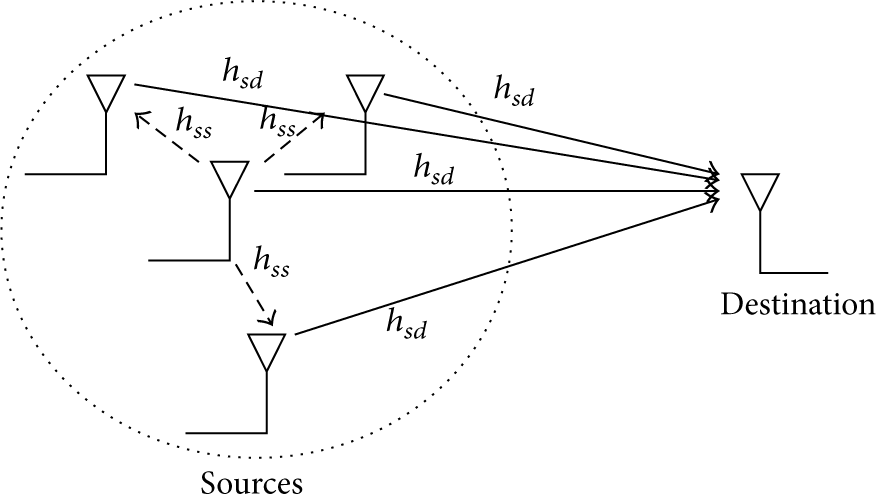
Distributed beamforming system.
Conventional transmit beamforming scheme can be emulated in distributed environment using a network of cooperative single-antenna source nodes. In case the source nodes agree on a common message, transmit it simultaneously, synchronize their carrier frequencies, and control their carrier phases to combine constructively.
In transmit beamforming systems, it is known that distributed beamforming has advantages compared to single-antenna transmission. It can achieve increased N2-fold rate or increased power efficiency (an N-fold decrease for a fixed desired received power). Therefore gain can be presented by formula (1); see [11]:


In general, each node of wireless sensor networks is power limited hardware. The source, which broadcasts common messages, consumes power more rapidly than the other source nodes in the distributed beamforming system. Furthermore, there are various unexpected situations that make source nodes inoperable in practical environments. In case parts of source nodes cannot transmit signals, the data rate of the system is decreased. In particular, it causes problems where the system supports multimedia services. Therefore, it is very useful if the distributed beamforming system is able to adapt to the changeable environment and satisfy requirements of the system by itself.
2. Related Works
The potential of cooperative communication [4, 12] has been shown as a promising technique that can significantly improve the coverage, link reliability, and the capacity of wireless networks. In one kind of the cooperative communication scheme, a group of cooperative nodes can emulate an antenna array by transmitting a common message signal from a source. In addition, timing synchronization and distributed carrier synchronization should proceed [10]. The transmissions of multiple sources are focused in the direction of intended destination which are combined coherently at the destination. This cooperative communication scheme, referred to as distributed beamforming, is studied in a lot of researches.
There are a number of challenges to improve the feasible availability of distributed beamforming in the practical networks. Detailed protocols must be designed for both cooperating sources and communication between the sources and the destination. Until recently, a lot of schemes for information sharing, timing synchronization, carrier frequency synchronization, and carrier phase alignment are proposed. There is, of course, a trade-off between the gain and the overhead to implement these schemes.
Also, power control is one of the essential research topics to increase the throughput and reduce the interference in distributed beamforming [13, 14]. Jing and Jafarkhani [15] studied controlling the power resource at each relay in order to maximize the signal-to-noise ratio at the destination. In [15], each relay does not transmit at its maximum power to achieve the maximum SNR depending on its own bidirectional channels and other relays’ channels. The study provides the condition for determining the optimal transmission power at each relay. Also, there are statistical approaches. Havary-Nassab et al. proposed distributed beamforming with second-order statistics of the channel state information in [16]. Multiuser multirelay approaches were also considered and studied in [17–23]. Krishna et al. [17] proposed relay strategy to minimize the mean-square error between the source and destination. D. H. Nguyen and H. H. Nguyen [18] proposed optimal power allocation for multiuser multirelay networks with full channel state information. Recently, the approach of two-way relay networks has also been the focus of several studies. In [19–23], the researchers deal with the optimal relay selection and user power control for two-way relay networks where two end-users exchange information through multiple relays.
However, a large amount of signaling overhead is required when each node needs computation of channel statement continually. These information sharing processes increase the system complexity. In addition, previous schemes [15–29] which are based on channel statement information cannot achieve performance improvement largely because the estimated channel state has noise generally in the practical environment [30]. In the wireless sensor networks, sensor data which are measured at the destination are subject to several different sources of errors. Generally, these sources of errors can be classified as either systematic errors (bias) or random errors (noise). We are particularly interested in decreasing the effect of these errors on sensor readings since they may seriously affect the distributed beamforming schemes which are based on the channel statement information.
As mentioned above, distributed beamforming is useful to upload multimedia such as image/video data or summaries of sensor data gathered over days or even months. It is important to guarantee the required data rate for these applications where performance of data rate is critical. If the system cannot guarantee the required data rate in these applications, the system is useless. In addition, the excessive improvement transmission power to guarantee the required data rate causes waste power. We have to recognize the WSNs are power constrained networks. However, previous studies for power allocation of distributed beamforming did not consider degradation of channel capacity when the number of cooperating source nodes is decreased. Moreover, there are no literatures to apply the concept of self-optimization for the distributed beamforming systems.
Therefore, we propose an Intelligent Transmission Power Allocation (ITPA) algorithm which is able to control the transmission power considering the changeable channel state, number of cooperating nodes, and the distance between the average source nodes and destination. Also ITPA is able to decrease the effect of errors on sensor readings efficiently. Thus, ITPA not only guarantees the required channel capacity, but also improves the network life span time largely by a suitable power allocation.
3. System Model
We consider the scenario where sensors are deployed on the ground with low-power single-antenna. We also assume the environment is LOS (line of sight) between sensor fields and destination. In addition, we assume all the deployed nodes have the same power and each node knows the number of source nodes that are cooperative before they transmit common information to the destination. One of the sources (master source) collects data such as image/video and broadcasts to the source nodes (slave source). After timing synchronization and distributed carrier synchronization, cooperating source nodes transmit these data to the destination by their distributed antenna which uses beamforming. Thus, it would enable uploading multimedia such as image/video data or summaries of sensor data gathered over days or even months. This application also can be modified easily in other interesting applications as low-power soldier radios in battlefield communication or monitoring rural and disaster environment where longer range might be required.
It is known that the N2-fold power gain is achieved from distributed beamforming. However there is also a path loss in terms of wireless propagation. Using the Friis formula for free-space propagation, the received signal power of distributed beamforming at the destination considering that N source nodes are deployed can be presented as follows:

As well known, signal-to-noise ratio (often abbreviated SNR or S/N) is a measure used in communication theory that indicates the level of a desired signal to the level of background noise. Thus, we can define the SNR at the receiver as
From the SNR at the receiver, SNR (signal-to-noise ratio) of the destination can be represented as follows:


Phase of distributed beamforming system.
We consider a distributed deployment with N nodes (including master node) which seek to collaboratively transmit a common baseband message signal
Also, we assume that channel model of the system is Rician channel model, so that we can denote the channel model by

The circular Gaussian variable has the following form:



In our system model (which is called master-slave open-loop carrier synchronization system), master node sends a common reference signal
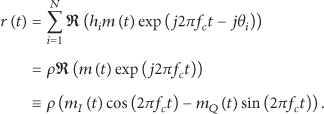
It is important to construct the signal

Time-slot model for synchronization.
Training signals which include the reference signal
During the “broadcast” phase, where a signal X is sent by the master source node, the received signal at slave source nodes

In our study environment, Johnson-Nyquist noise and receiver noise have a lot of parts in the noise. Therefore, we focus on both of them. Johnson-Nyquist noise can be represented as

By using formula (9), noise power in dBm at the temperature T is presented as


Also, we consider receiver noise which is caused by components in a radio frequency (RF) signal chain, which can give us

4. Intelligent Transmission Power Allocation Algorithm
Algorithm 1 shows our proposed Intelligent Transmission Power Allocation algorithm. Note that we assume our distributed beamforming system synchronizes the sources by open-loop master-slave synchronization, one source node plays a role as the master, and the remaining source nodes play role as slaves. Through our power allocation algorithm, we are able to allocate suitable transmission power according to the environment when sensor nodes are deployed considering the maximum transmission power of the nodes. Also source nodes are able to communicate continually with the destination when some of source nodes are inoperable. Furthermore, it can overcome the problem that master node consumes power rapidly by changing the master periodically according to the residual energy level. As a result, it can improve the network life span time.
receive antenna gain
Count = 0
Heartbeat = (Node ID ∪ Residual Energy level)
Broadcast its Heartbeat
Determine the number of neighbor active nodes, N = the number of neighbor active nodes
To be the Master node itself
Mater node = M
Set to be Slave node except node M
Transmission power = [Maximum transmission power]
Transmission power =
Count = count for next Heartbeat
Master send its data to the slave nodes
Source nodes transmit as a distributed beamformer
Subtract 1 to Count
We estimated RSSI (received signal strength indicator) by practical wireless sensor nodes on the LOS (line of sight).
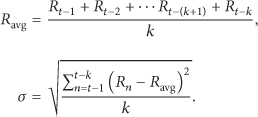
Figure 4 shows the result of the test. It is shown that there are noisy data due to various reasons, such as the low quality of sensor nodes and random effect of external environments [24]. How to remove the noisy data and achieve clean data is the key issue for the proposed Intelligent Transmission Power Allocation algorithm since our Intelligent Transmission Power Allocation algorithm is based on periodic estimated environment parameters. We proposed the scheme to get the clean received power data. Thereby we achieved the representative received power value from

Estimated RSSI at the receiver.
Step 1.
Compute
Step 2.
Get an estimated sample
Step 3.
Calculate
Step 4.
If
Step 5.
If

Step 6.
Calculate the parameter value

Figure 5 shows the received power data after removing the noisy data. Our proposed scheme is able to eliminate the noise and more weightage to the present estimated data efficiently. As shown by the result, we are able to achieve clean received power data using our proposed scheme.

Estimated RSSI with
5. Performance Evaluation
For the specific numerical performance evaluation, the circuit-related parameters need to be defined first. Our performance evaluation parameters are shown in Table 1.
Performance evaluation parameters.

For generality, we compared our proposed ITPA with other distributed beamforming schemes, MAX-SINR [24, 25, 29], MMSE [26, 27, 29], Weighted MMSE [26, 28, 29], which do not consider degradation of channel capacity when the number of cooperating source nodes is decreased, to evaluate the transmission power, channel capacity, and network life span time performance.
As shown in Figure 6, SNR versus number of source nodes, if parts of cooperating source nodes cannot transmit signals, SNR is decreased regardless of schemes. Thus, it causes degradation of channel capacity because N2-fold power gain is decreased when the number of cooperating source nodes is decreased. In addition, it is also shown that acquired channel capacity is decreased exponentially when the distance between the average source nodes and destination increases, because of path loss in terms of wireless propagation. It is essential that each source node increases transmission power to compensate the degradation of power gain to guarantee the required channel capacity considering the number of cooperating source nodes and the distance between the average source nodes and destination.
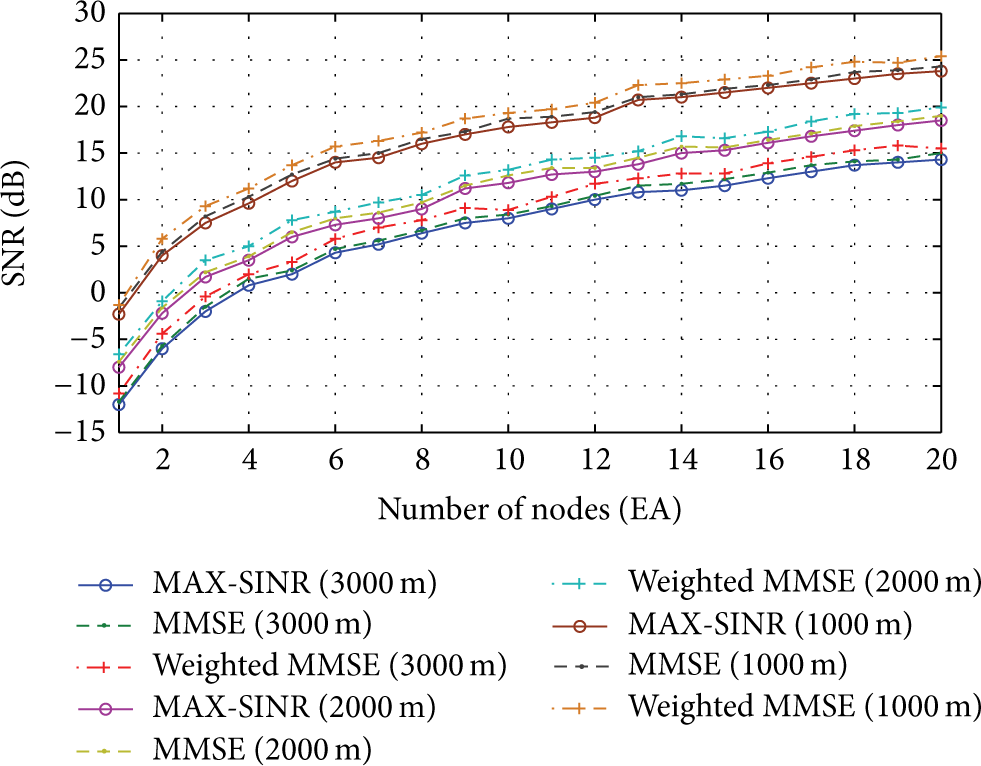
SNR versus number of source nodes.
Figure 7 shows the transmission power versus source nodes that guarantee the channel capacity (50 Mbps) of the system. ITPA required transmission power about −18.62 dBm at 1000 m, −12.50 dBm at 2000 m, and −9.38 dBm at 3000 m, respectively, to guarantee the channel capacity when the number of cooperating source nodes is 20. Each source node should increase transmission power cooperatively to compensate degradation of channel capacity, as shown in Figure 6, considering the maximum transmission power (0 dBm), when the number of cooperating source nodes is decreased. Since allocating over the maximum transmission power is, physically, impossible. And an excessive increase in transmission power leads to the performance degradation of network life span time. ITPA algorithm avoids these problems and allocates an appropriate transmission power to the source nodes based on its computation. On the other hand, the system with previous distributed beamforming schemes is not capable of power control considering the number of cooperating source nodes. MAX-SINR does not provide power control. Thus, it just transmits by default transmission power (−10 dBm). MMSE provides power control which only adapts channel statement. And Weighted MMSE also provides power control and it computes additionally for sum rate objectivity compared with MMSE. Therefore, Weighted MMSE could improve the channel capacity performance compared with MMSE. However, as mentioned above, these previous schemes have limitations, since they cannot adapt to the number of cooperating source nodes and the distance between the average source nodes and destination.
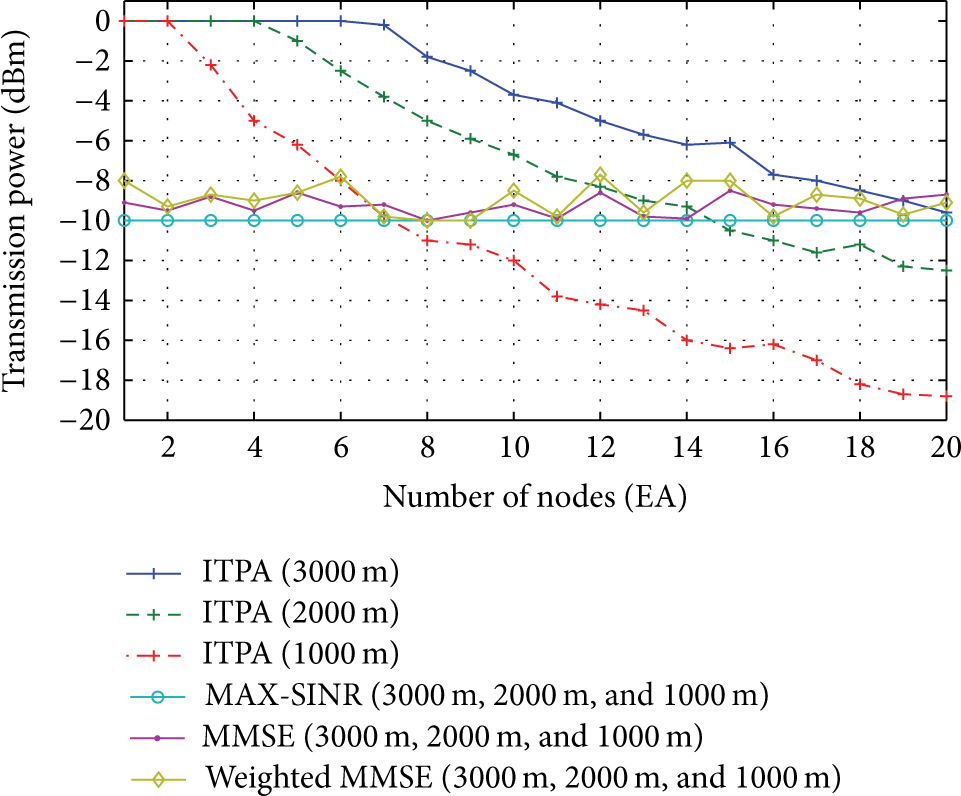
Transmission power versus number of source nodes.
Figure 8 shows the channel capacity versus the number of source nodes. Channel capacity is decreased rapidly with previous schemes (MAX-SINR, MMSE, and Weighted MMSE) when the number of cooperating source nodes is decreased. On the other hand, the channel capacity is guaranteed (50 Mbps) with ITPA since ITPA can control transmission power of each source node according to the number of the cooperating source nodes and the distance between the average source nodes and destination. However ITPA also cannot guarantee the channel capacity when the required transmission power is over the maximum transmission power. In the section where the number of source nodes is 0~6, as shown in Figure 8, we can find this problem. Therefore, it is important to study the minimum number of source nodes for the required channel capacity when ITPA is used.

Channel capacity versus number of source nodes.
As shown in Table 2, ITPA guarantees the required channel capacity with the fewer source nodes than the other previous beamforming schemes (MAX-SINR, MMSE, and Weighted MMSE). At 1000 m, the number of cooperating source nodes, that ITPA needs, is 1, 2, 3, and 5, to guarantee the channel capacity of 10 Mbps, 30 Mbps, 50 Mbps, and 70 Mbps, respectively. And at 2000 m, the number of cooperating source nodes is 1, 3, 5, and 9, to guarantee the channel capacity of 10 Mbps, 30 Mbps, 50 Mbps, and 70 Mbps, respectively. At 3000 m, the number of cooperating source nodes is 2, 4, 7, and 14, to guarantee the channel capacity of 10 Mbps, 30 Mbps, 50 Mbps, and 70 Mbps, respectively. The minimum number of source nodes is increased when the distance between the average source nodes and destination is increased or the required channel capacity is increased, since each source node cannot transmit over its maximum transmission power.
Minimum number of source nodes for the required channel capacity.

Figure 9 shows ITPA's minimum number of cooperating source nodes versus distance to guarantee the channel capacity. As mentioned above, each node has a limit of maximum transmission power in the practical nodes of WSNs. Thus we studied the minimum number of cooperating source nodes when the maximum transmission power is 0 dBm, in theory. The minimum number of cooperating source nodes is different according to the required channel capacity and the distance between the average source nodes and destination. From that result, we are able to improve ITPA feasibility in practical WSNs.
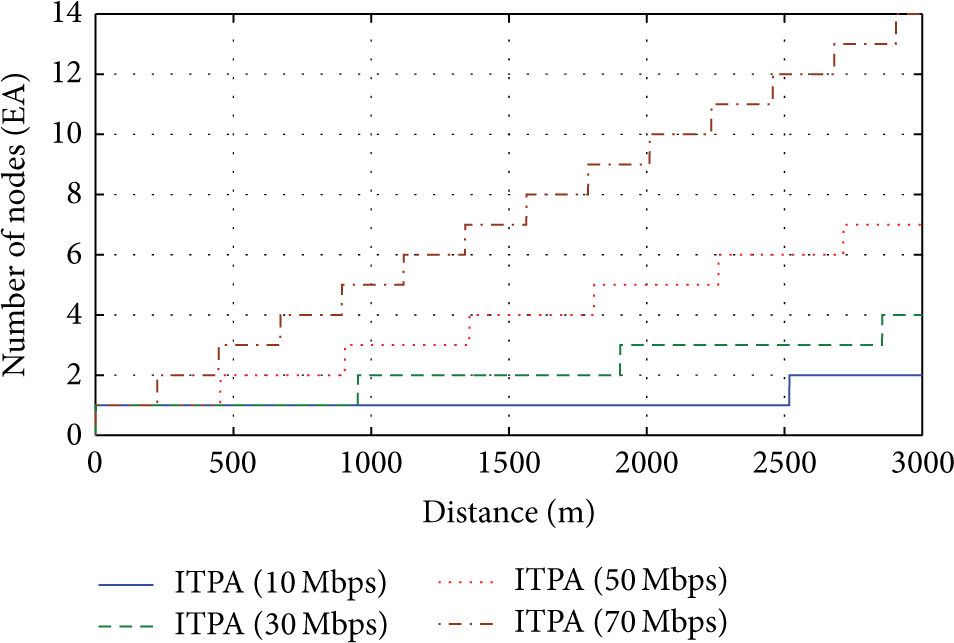
ITPA's minimum number of source nodes versus distance.
Figure 10 shows the network life span time versus the number of nodes when the required channel capacity is 50 Mbps. We assume the environment where the number of power constrained sources is 20 at first. Our proposed ITPA algorithm has more networks life span time compared with previous schemes (MAX-SINR, MMSE, and Weighted MMSE) at 1000 m, 2000 m, since ITPA can allocate suitable transmission power (under −10 dBm) to guarantee the required channel capacity considering the number of cooperating source nodes and the distance between the average source nodes and destination. Moreover ITPA changes the master node periodically based on the residual energy of the source nodes. Thus, it can decrease the transmission power and save the energy of cooperating source nodes. At 3000 m, it is impossible theoretically to guarantee the channel capacity with default transmission power (−10 dBm) where the maximum number of sources is 20. However the other schemes just allocate around −10 dBm transmission power. On the other hand, ITPA allocates the transmission power which is over the default transmission power. As a result, ITPA consumes little more power than without ITPA at 3000 m. However the other schemes cannot guarantee the required channel capacity. Moreover ITPA has more network life span time than the other schemes if there are the unexpected situations that make source nodes inoperable.
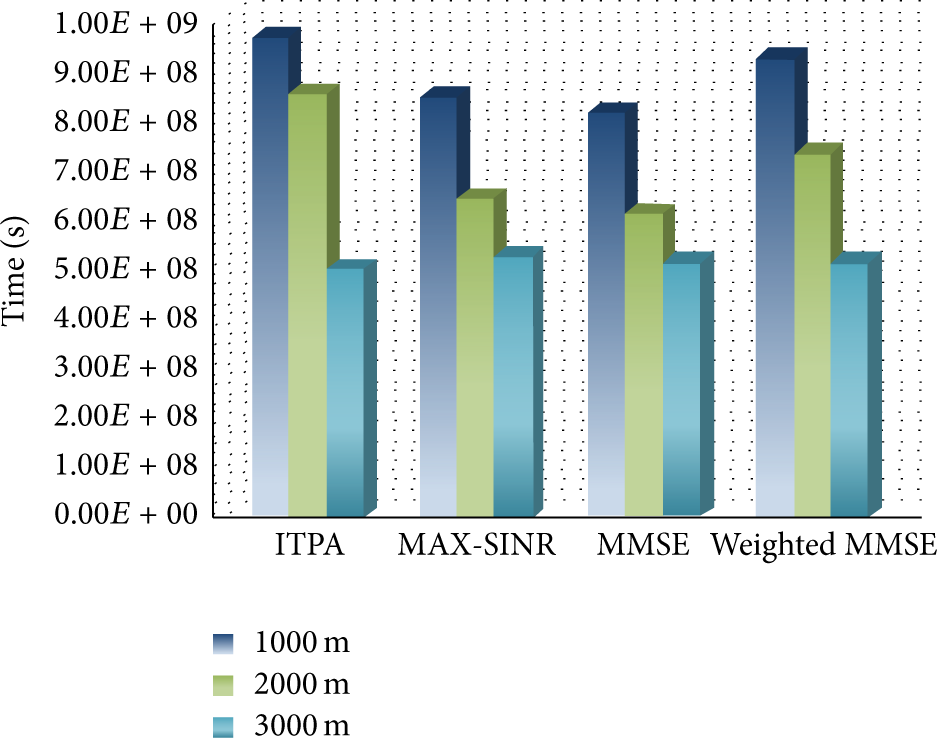
Network life span time versus number of nodes.
6. Conclusion
Distributed beamforming can achieve the transmission gain by emulating an antenna array of a source. However, there are problems because of the source nodes which are deployed in distributed manner. We focused on the channel capacity of the system which is decreased when the parts of source nodes cannot transmit signal. It causes a critical problem when the system supports multimedia services. Therefore, we propose ITPA algorithm considering the changeable channel state, the number of cooperating source nodes, and the distance between the average source nodes and destination. ITPA can allocate suitable transmission power to the source nodes by adapting the changeable environment by itself. Thus, it can guarantee the required channel capacity and improve the network life span time largely. It will be useful in the practical environment where the distributed beamforming systems should be operated by the sources themselves.
Footnotes
Conflict of Interests
The authors declared that there was no conflict of interests regarding this paper.