




Abstract
In order to reduce the energy consumption of the cluster members in WSNs, this paper proposes a random compressive sensing data acquisition scheme for airborne clustering WSNs. In this scheme, hardware resource limited cluster members sample the input signals with random sampling sequence and then transmit the sampling signals to the cluster head or Sink to reconstruct. Aimed at improving the reconstruction performance of this scheme, this paper puts forward a new MP reconstruction method based on composite chaotic-genetic algorithm, which combines the excellent local searching characteristics of chaos theory with the powerful global search ability of genetic algorithm. The experimental result shows that this scheme is very suitable for the hardware resource limited clustering WSNs. On the one hand, the reconstruction precision of the composite chaotic-genetic MP method can reach a magnitude of 10−15, and the average search speed is about 37 time that of the MP reconstruction method, which can effectively improve the reconstruction performance of the cluster head or Sink; on the other hand, by diminishing the sampling frequency to 1/8 of the original sampling frequency, the random compressive sensing technique can dramatically reduce the sampling quantity and the energy consumption of the cluster members, with the reconstruction precision reaching a magnitude of 10−7.
1. Introduction
Airborne Clustering WSNs System. Recently, the research on airborne data acquisition system based on wireless sensor networks (WSNs) has attracted increasing attention in the world [1–7]. As we know, subsystems such as the engine, fuel, and cockpit environment in the existing general aircraft are distributed into their respective regions, so airborne WSNs should use clustering network architecture [4]. Each subsystem or respective region of aircraft forms one or more clusters. Cluster head and sensor nodes in each cluster use star topology. Airborne data acquisition system based on clustering WSNs is shown in Figure 1.
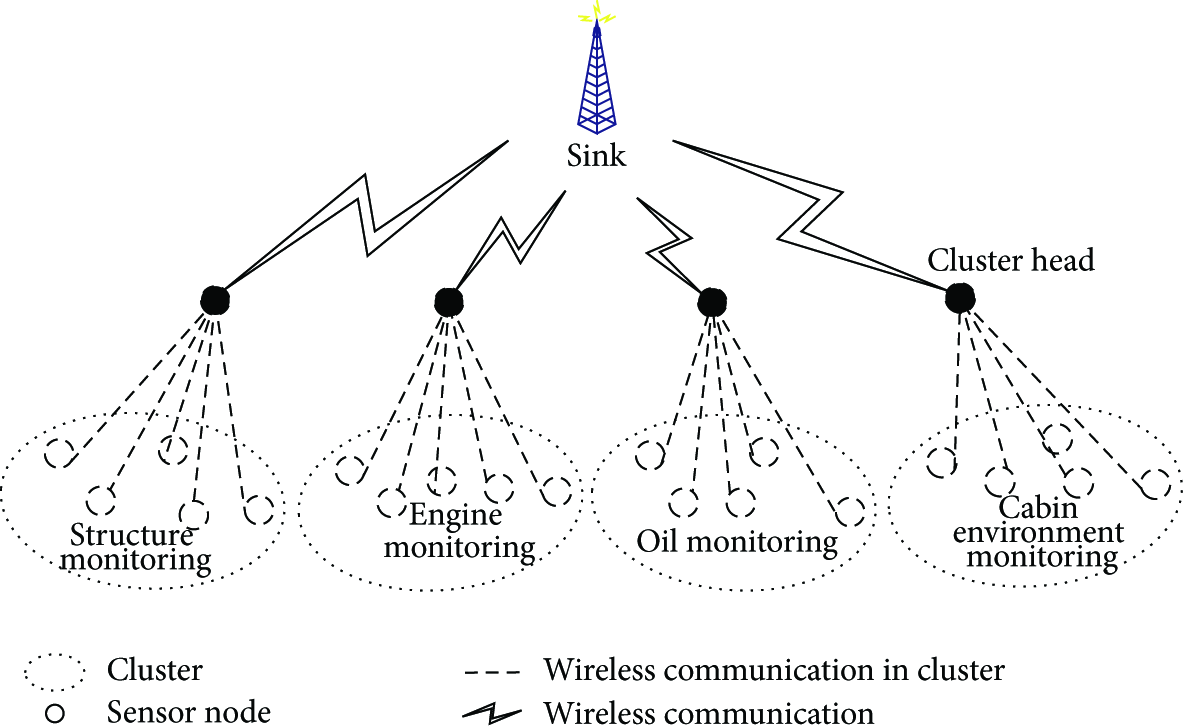
Airborne clustering WSNs system.
Airborne WSNs provide a flexible, lightweight, and reliable data collection means for aircraft condition monitoring. It has the following features: firstly, the sensor nodes in the physical space are vicinity arranged according to the sensor layout scheme. This means that the locations of a majority of, even all of, the sensor nodes in the monitoring network are relatively fixed. Secondly, as the relatively fixed position, all the cluster heads should be continuously supplied with the airborne power system and can configure high performance storage, processing, and communication devices. Thirdly, because of the limited physical space, some cluster member nodes, for example, the embedded sensor nodes in the engine monitoring system cannot be supplied with the airborne power system. These cluster member nodes have limited energy, processing, and communication capabilities. They have to collect and transmit large amounts of raw sensing data collected by the Nyquist sampling rate to the cluster head. This leads to the manifest reduction of cluster members’ service life and the overall network's performance. Obviously, this “asymmetric” data acquisition mode is unreasonable.
The Application of CS in WSNs. Compressive sensing (CS) technology utilizes signal sparsity, sampling signal far below the Nyquist sampling rate. It can shift the complex signal processing from the data collection terminal to the decoder, reduce the energy consumption of the data collecting side, and improve the performance requirements of the decoder. This fits well with the frame characteristics of WSNs, because, on the one hand, a large number of hardware resource limited cluster members achieve low-rate sampling and, on the other hand, the cluster head or Sink with sufficient energy, strong data storage, and processing capabilities realizes the complex signal reconstruction process, which can provide new ways for the realization of practical wireless sensor networks.
Currently, the research on the application of CS technology in WSNs has three main directions: the application of CS technology in WSNs data fusion [8, 9]; the application of CS technology in WSNs data acquisition and reconstruction [10–13]; and the application of CS technology in WSNs data transmission and routing [14, 15]. These studies lack the practical consideration of the hardware implementation difficulty and simply apply CS theory to the process of WSNs data acquisition, processing, and transmission. The reason is that the realization of basic compressive sensing technology is harder than the traditional sampling methods on the hardware requirements [16]. Aiming at this issue, [17, 18] proposed a new random compressive sensing method that can realize the compressive sensing techniques in hardware resource limited WSNs.
Contributions and Paper Organization. In this paper, we have two unique contributions. The first one is the data acquisition scheme based on random compressive sensing for airborne clustering WSNs. The second contribution is a new CS reconstruction method based on the composite chaotic-genetic MP algorithm.
The remaining part of this paper is organized as follows. In Section 2, we introduce the basic theory about compressive sensing technology. In Section 3, we show the principle of random compressive sensing and present the specific steps of random compressive sensing based clustering WSNs signal acquisition method. In Section 4, through combining chaos theory with genetic algorithm, we present a composite chaotic-genetic MP reconstruction method. In Section 5, we prove the effectiveness of our scheme through experiment. Finally, we provide the conclusions and future works in Section 6.
2. Overview of Compressive Sensing
The traditional signal acquisition process is shown in Figure 2(a). The full information acquisition method needs to transfer large amounts of sensory data, resulting in high computation and communication load. So it is unfit for node hardware resource limited WSNs. Compressive sensing theory suggests that as long as the signal is sparse or can be sparse representation in some kind of transformation, the original high dimensional sequences can be projected onto a low dimensional space by a measurement matrix which is irrelevant to the sparse transformation basis. Then, the original data can be reconstructed from a small amount of projection with high probability by solving an optimization problem [19]. Figure 2(b) is the signal acquisition process of CS.

Flow chat of (a) traditional signal acquisition and (b) compressive sensing.
Compressive sensing theory includes three main parts: the sparse representation of the signal; the measurement matrix design; and the signal reconstruction method [20, 21].
2.1. Sparse Representation
The prerequisite of compressive sensing is that the signal is sparse or can be sparse representation under some kind of transformation. Common signals are generally nonsparse in time domain. Therefore, before applying compressive sensing technology to a specific signal, we must select the most suitable sparse transform domain for the best sparse representation. Set
2.2. Measurement Matrix Design
After sparse transformation, signal

We can see that
2.3. Signal Reconstruction
Known

It is an NP hard problem to solve (2) directly. The solutions for this problem include the greedy tracking algorithm, the convex relaxation method, and the combination algorithm. The most representative method is the matching pursuit- (MP-) like algorithm. Thinking of iteration at each time to find nonzero coefficients can provide an effective method for the approximate solution of minimum
Compared with Figure 2(a) conventional sampling method, compressive sensing technology can compress and sample data at the same time, which is more suitable for WSNs in which the node hardware resource is constrained.
3. Random Compressive Sensing Technique for Clustering WSNs
Adopting effective dimension reduced projection on sparse signal. Compressive sensing technology can realize compressive sampling with much lower frequency than classical Nyquist sampling. Although this method reduces the sampling rate, it increases the demands on hardware resources. Because compressive sensing must generate a set of random numbers before signal collection and the random signal generator needs to work at the Nyquist frequency to generate random numbers, thus, it is inapplicable to the clustering WSNs in this paper.
Random compressive sensing technique samples the original signal

The principle of (a) random compressive sensing and (b) traditional equal interval sampling.
Random compressive sensing process in clustering WSNs is that the timer in the cluster member controls the

The principle of random compressive sensing in clustering WSNs.
To configure random number register in the cluster members can avoid the problem in the traditional compressive sensing that needs high frequency random number generator. The sampling sequence is calculated by correlation and sent to the cluster members by cluster head or Sink. After sampling by the sampling sequence,
In contrast to the classical compressive sampling method in (1), random compressive sensing method can be expressed by (3). In [16], the author validates that the random compressive sensing meets the RIP and irrelevance property by simulation. Consider

The specific steps of clustering WSNs signal acquisition method based on random compressive sensing are as follows.
Step 1.
Determine the sparsity degree k based on the prior information.
Step 2.
Calculate the number of random samples M.
Step 3.
Calculate the correlation; then generate a random sampling sequence
Step 4.
Send the generated random sampling sequence
Step 5.
Cluster members sample the signal randomly according to the sampling sequence (random sampling frequency is the ratio of sampling number to the time required to complete this sample); then send the
Step 6.
In the cluster head or Sink, expand the
Step 7.
Reconstruct the signal in the cluster head or Sink.
As can be seen from these 7 steps, the cluster members only need to receive and store sampling sequence, complete
In [18], the authors proposed using the existing reconstruction algorithms to reconstruct signal; they did not explain the specific reconstruction method, but the most widely used method currently is the MP-kind algorithms. These algorithms which either have poor accuracy or are slow cannot meet the practice requirement. Therefore, Section 4 in this paper proposes an improved matching pursuit reconstruction method based on chaotic-genetic algorithm.
4. Composite Chaotic-Genetic MP Reconstruction Method
4.1. Problem Description
From the mathematics analysis, minimum


Genetic algorithm (GA) is an adaptive global optimization search algorithm. It only needs the optimized object to provide the calculation standard and the parameters bound of the objective function, and then it can seek the optimum parameters in the global space quickly to meet the requirements. MP algorithm has already given the range of discretization atomic parameter
However, on the one hand, the less the difference of GA initial individual fitness value, the lower the search speed at the later period of GA algorithm; on the other hand, the great difference of GA initial individual fitness value will lead to the “premature” phenomenon. Chaos has the capability of initial value sensitivity, the ergodicity, and the randomness. The “randomness” here is caused by the internal characteristics of the system. It can traverse all states within a certain range without repetition according to their own regularity. What is more, not only can it have high efficiency but also it can avoid the local optimal effectively. Therefore, to combine excellent local searching characteristic of chaos with powerful global searching capability of GA can improve the search ability of the system effectively [24, 25].
Most of existing chaotic-genetic algorithms use the Logistic mapping in the genetic algorithm to generate chaotic sequences as the initial group or add chaos random disturbance in mutation operation phase to improve the performance of the algorithm. However, they still have the shortage of large searching blind area and slow convergence speed [26]. This paper puts forward a composite chaotic mapping method based on Tent mapping and Logistic mapping. This composite process can improve the randomness and sensitivity of the chaotic mapping, remedy the deficiency of low accuracy, and slow speed by only using Logistic mapping efficiently.
4.2. Composite Chaotic Searching Algorithm
Logistic mapping is defined as

The distribution character of this iterative sequence is “high in two poles, low in the middle.” To solve the optimization problem, the efficiency of the algorithm will drop when the optimal value of target function falls in the middle part.
Tent mapping is defined as

The iterative speed of Tent mapping is faster than that of Logistic mapping, but its iterative sequence is easy to fall into cycle in small period and unstable periodic points.
Lyapunov index can describe the separation speed of adjacent points effectively in the projection or the sensitivity of the orbit to initial conditions in the strange attractor. The greater Lyapunov index indicates that the mapping is more sensitive to initial conditions. It is defined as

Calculating the Lyapunov index of Logistic mapping and Tent mapping, respectively, by (8), we knew that the Lyapunov index of Tent mapping has the maximum value while

The composite mapping in (9) is similar to parabolic type. Only when

The basic idea of chaotic search is to map the optimization variable into chaotic variable through the chaotic mapping and then use the ergodicity of chaotic variable to search the optimal solution and finally convert the optimal solution to the original optimization space by a linear transformation.
Set (10) as the constraint condition of the
Step 1.
Let
Step 2.
Set
Step 3.
Map chaotic variable
Step 4.
Evaluate the quality of decision variable
4.3. MP Reconstruction Method Based on Composite Chaotic-Genetic Algorithm
MP algorithm has a large amount of calculations because every step of this algorithm should complete the optimization problem in (4). Now, we use the proposed composite chaotic-genetic algorithm to optimize MP reconstruction method. As atoms are generated from
The specific steps of composite chaotic-genetic MP reconstruction method are as follows.
Step 1.
Get signal
Step 2 (encode the parameter
).
We need to note that because the upper and lower values of atomic parameters s, u, ν, and w are very complex, they cannot be directly used for the initial population of genetic algorithm. Therefore, s, u, ν, and w are discretized like this:
Step 3.
Generate the initial population
Step 4 (calculate the fitness value).
The MP reconstruction process is seeking the maximum value of
Step 5 (selection).
We directly replace the minimum ρ fitness individuals with the maximum ρ fitness individuals and then generate a new population
Step 6 (crossover and mutation).
After operating crossover and mutation to population

Step 7.
Perform chaotic disturbance to the former
Step 8.
Project the residual
Step 9.
According to each iteration result, we obtain the optimal reconstruction signal
The process of composite chaotic-genetic MP reconstruction method is shown in Figure 5.

Flow chart of composite chaotic-genetic MP reconstruction.
5. Experiment and Analysis
5.1. Composite Chaotic-Genetic MP Reconstruction Algorithm Performance Simulation
The configuration of the experimental computer is as follows: AMD Athlon (tm) II X2 255 processor 3.11 GHz, RAM 2 GB, the operating system being Windows XP sp3 by using Matlab7.10 programming. The length of the original signal is 512. The signal is from the superposition of four single-frequency signals: 50 Hz, 100 Hz, 200 Hz, and 400 Hz. The sampling frequency is 800 Hz, as shown in Figure 6. The observation matrix is the random Gaussian matrix. The parameters of our composite chaotic-genetic MP reconstruction method are as follows: the original population size


The original signal wave in (a) time domain and (b) frequency domain.
Figure 7 is the reconstruction result of the original signal using our composite chaotic-genetic MP reconstruction method; the iteration number is 161. The average reconstruction error calculated by (12) is approximately

The reconstruction signal wave in (a) time domain and (b) frequency domain.
To analyze and verify the performance of our new reconstruction method, we compared with the performance of these five reconstruction methods: Method 1 is the basic MP reconstruction method, Method 2 is the MP reconstruction method based on genetic algorithm (GA-MP), Method 3 is the chaotic-genetic MP reconstruction method based on Logistic mapping (L-GA-MP), Method 4 is the chaotic-genetic MP reconstruction method based on Tent mapping (T-GA-MP), and Method 5 is our composite chaotic-genetic MP reconstruction method based on Logistic mapping and Tent mapping (LT-GA-MP). Table 1 shows the iteration number and the relative speed of these five methods when the reconstruction error
The performance of different reconstruction algorithms when

Seen from Table 1, the reconstruction effect of the basic MP reconstruction method is the best; its average iteration number is only 9 when the reconstruction error
5.2. Random Compressive Sensing Experiments for Clustering WSNs
The experiment process of the random compressive sensing for clustering WSNs is as follows: original signal is sampled by the cluster members which are equipped with CC2430 chip. And then the cluster members send the samples to the cluster head or Sink which is composed of one computer and one coordinator. Computer computes the projection matrix according to prior information and generates the random sampling sequences (Sample) by Matlab. After that, send the random sampling sequence to the cluster members by the coordinator in wireless mode; the latter can store the sampling sequence. When the cluster members receive the signal acquisition command sent by the coordinator, their timers control
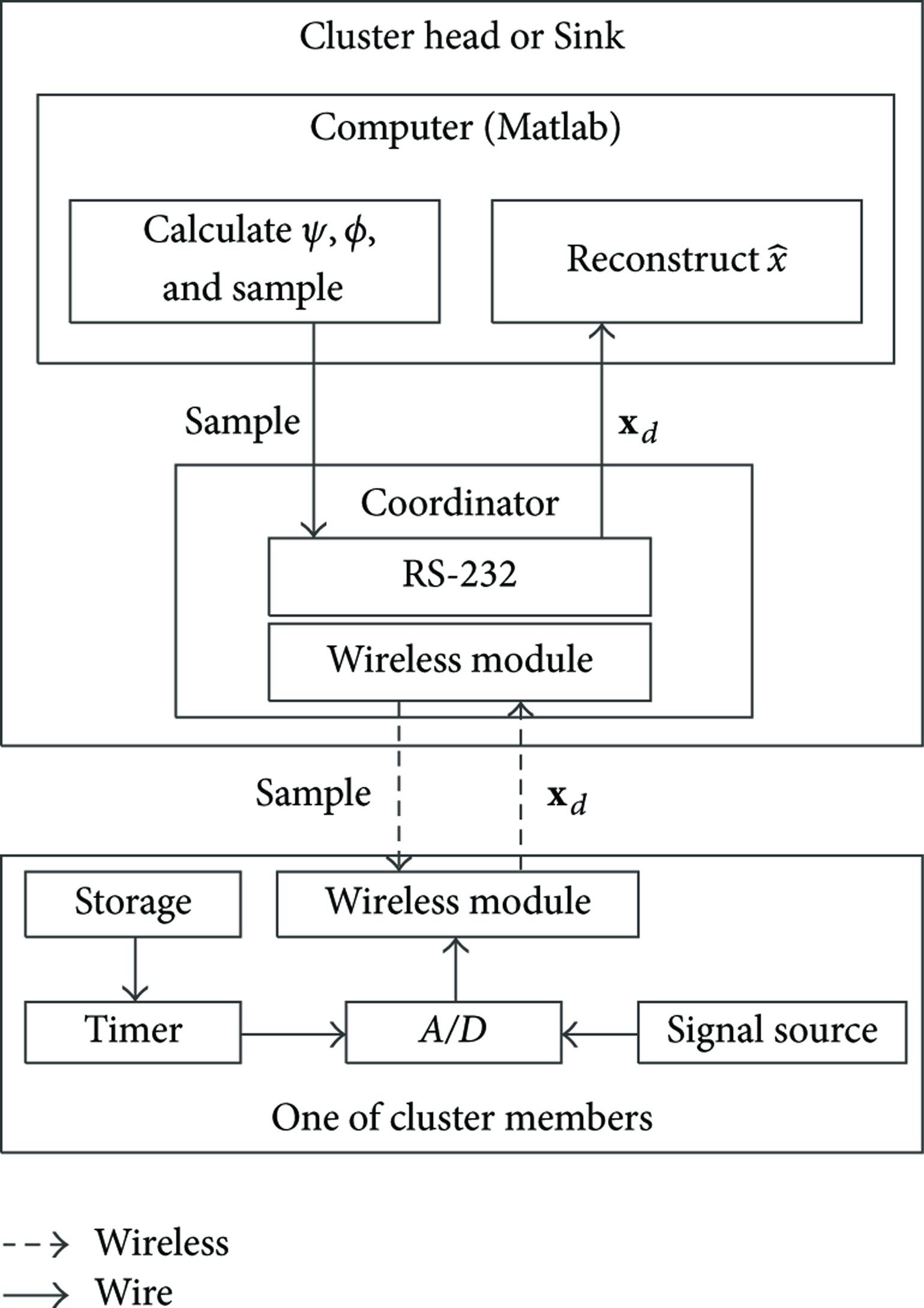
The process of our experiment.
We set a sine signal generated by the signal source as the original signal; the frequency is 1 kHz. The length of the signal is 512, as shown in Figure 9. After calculation, we set the random sampling number

The original 1 kHz signal wave in (a) time domain and (b) frequency domain.
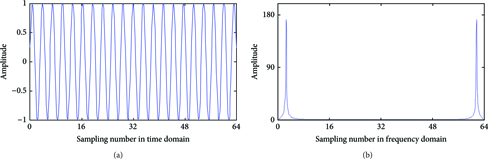
Random sampling result of original 1 kHz signal: (a) time domain wave and (b) frequency domain wave.

The reconstructed signal based on random sampling result: (a) time domain wave and (b) frequency domain wave.
As we can see, the signal acquisition scheme based on random compressive sensing technique in this paper is fit for the hardware resource limited clustering WSNs. On the one hand, the cluster members only need sample 1/8 of the original signal data quantity, namely, 64 points, to greatly reduce the amount of data which is sent to the cluster head, saving the finite energy of cluster members enormously. On the other hand, the sampling frequency of the cluster members is only 1/8 of the original sampling frequency, which greatly reduces its hardware resource requirements. From the experiment results, we find that although there is a gap of the reconstruction error between our random compressive sensing scheme (a magnitude of 10−7) and the classical compressive sensing technique (a magnitude of 10−15), it can still meet the actual requirements. Compared with the reconstruction error about a magnitude of 10−5 in [18], the reconstruction error of our method can reach a magnitude of 10−7, which is improved obviously.
5.3. Energy Consumption Analysis
In order to compare the communication energy consumption between our random compressive sensing scheme and the traditional sampling scheme in WSNs, we set the experiment as follows: the traditional sampling mode is a 5 kHz equal interval sampling. The wireless communication energy consumption is E, the sending energy consumption is
The communication energy consumption of one single jump in WSNs can be expressed as

In Z_Stack, the longest length of PHY protocol data frame is 128 B. Therein, the data length of synchronized frame head, frame tail, and frame structure is 11 B; the data length of order frame is 5 B; and the rest 112 B is the available length of PHY protocol data frame.
Suppose there are 512 double byte pieces of data in each sampling; the traditional sampling scheme needs 10 times to transmit these data. As the cluster members only need sample 1/8 data quantity in every sampling, namely, 64 double byte pieces of data, our random compressive sensing scheme only needs 2 times to transmit these data. Calculated with (13), we can get that the traditional sampling scheme needs
The simulation result of the communication energy consumption is shown in Figure 12. We can see, on condition that these two schemes have the same transmission distance, along with the increasing sampling times, the communication energy consumption of the traditional sampling scheme is much larger than our random compressive sensing scheme.

The comparison of communication energy consumption between the traditional sampling scheme and our random compressive sensing scheme.
Figure 13 is the local magnifying effect of Figure 12. We can see that the communication energy consumption of our random compressive sensing scheme is not 0 at the beginning, because the cluster member node should receive the random sampling sequence from the cluster head.

The local magnifying of Figure 12.
6. Conclusion and Future Work
Finite energy of cluster members is one of the most important factors to restrict the development of airborne clustering WSNs. In order to reduce the energy consumption of cluster members, we put forward a kind of random compressive sensing scheme. Aiming at the low signal reconstruction accuracy in [18], we propose a composite chaotic-genetic MP reconstruction method based on Logistic mapping and Tent mapping. The experiment results show the following.
Our composite chaotic-genetic MP reconstruction method combines the excellent local searching characteristics of chaos theory with the powerful global search ability of genetic algorithm, which can realize the complementary advantages and greatly improve the overall performance of the algorithm. Compared with [18], our method highly improves the reconstruction accuracy. What is more, the average search speed is about 37 times as fast as that of the MP reconstruction method. Our random compressive sensing scheme may lose some useful information, but the sampling sequence is calculated with correlation of the prior information; the reconstruction error can still reach a magnitude of 10−7. Our method can reduce the amount of sampling data and the sampling frequency of cluster members at the same time and finally reduce the hardware resource requirements of the cluster members directly. The communication energy consumption of the traditional sampling scheme is nearly 7.4 times our random compressive sensing scheme.
Therefore, our random compressive sensing scheme is very suitable for airborne clustering WSNs. Due to the length limitation, this paper does not consider the noise problem, which will be studied in the next step.
Footnotes
Conflict of Interests
The authors declare that no conflict of interests exists.
Acknowledgments
The National Natural Science Foundation of China under Grant 51201182 supported this research. The authors gratefully acknowledge the support.