




Abstract
The increase in mobile communications has led to advanced educational methods and technologies through accepting new technologies. A lot of studies have tried to overcome temporal and spatial limits on using personal mobile devices and have tried to increase learning effectiveness using various efficient educational methods. In this paper, U-CLASS, an interactive learning management system that provides interactive communications between a professor and students, is proposed and implemented. Monitoring of academic achievement after a real experiment with the proposed system and analysis of educational activities during the experimental class are important points. In order to achieve that, the proposed system was used in a practical class at a university, and educational activities from the classroom were gathered and analyzed. The data on the educational activities include frequency of questions, attendance rate, and seat positions of the students. Analysis results show that the average distance between professor and student in the classroom is strongly related to the grade of the student. Students who have a higher attendance rate and who ask more questions commonly show higher achievement.
1. Introduction
In recent years, a lot of methods that use personal mobile communication devices and wireless Internet technology to overcome the constraints of time and space of a classroom have been produced. With the emergence of ubiquitous technology, there have been many changes in educational environments in which students can learn according to their individual needs. A typical example of such technology is the Clicker system [1], which enables student and professor to interact in the class using radio frequency identification nodes and a server. The system enables students to confirm their attendance automatically and answer multiple-choice questions from the professor by pressing buttons on the wireless Clicker node. Although this system has excellent performance and reliability, there are some problems in terms of cost and operation method, because it has to use an additional proprietary terminal unit.
On the other hand, with the introduction of these learning support tools, research that attempts to promote educational effectiveness through a variety of teaching methods has been promoted. In addition, research on the factors that influence the academic performance of students has been conducted.
In this study, a U-CLASS system, a learning management system (LMS) that can aid interactions between professors and students via personal mobile devices, is proposed. The proposed system is applied to a class environment, and data on educational activities that occurred in that environment are gathered and analyzed to determine the major factor promoting learning effectiveness. In particular, in this paper, we examine the relationship between performance (i.e., grade) and attendance rate and between performance and seating position of the student.
In Section 2, related works are reviewed. In Section 3, the proposed system is introduced. In Section 4, the performance experiment for the proposed system is discussed and the data from educational activities is analyzed. Finally, conclusions from this study are provided in Section 5.
2. Related Works
2.1. Learning Management Systems and Mobile Learning
An LMS is a software application for the administration, documentation, tracking, reporting, and delivery of e-learning education courses or training programs [2]. An LMS can be implemented and applied in e-learning environments. E-learning can be defined as the use of computer technology primarily over an intranet or through the Internet, to deliver information and instruction to individuals [3]. Many LMSs have been implemented to support efficient education environments in higher education institutions. And many studies on the application of LMSs and effectiveness analyses have been conducted over the past decade. Weaver et al. [4] presented findings from an institutional survey investigating the use of WebCT by academic staff and students in their learning and teaching at a large Australian university. They investigated what students and academic teachers require from an institutional LMS. As a result, they showed that teachers are more concerned with technical aspects and workload issues and students are more concerned with the quality of the online teaching. Cavus et al. [5] made a highly interactive virtual teaching environment created by the Moodle LMS [6] with their collaborative learning tool, GREWPtool. Through an experiment, they found out the success rate of students who used an advanced and collaborative tool in learning the Java programming language. They showed a higher success rate when an LMS system is combined with an advanced collaborative tool during the teaching of programming languages. Paechter et al. [7] conducted a survey to find out which aspects of e-learning students are considered important for their learning achievement and course satisfaction. They showed that, with regard to their expectations, students' achievement goals are the best predictors for success, and with regard to their experiences, students' assessments of the instructor's expertise in e-learning combined with her/his counseling and support are the best predictor for achievement in learning.
With the advances in mobile technologies, many studies on interoperation between a learning management system and mobile technologies have been conducted. The educational environment in which the mobile technologies are used can be defined as m-learning. M-learning means an environment in which someone can learn anywhere at any time without a permanent physical connection to a cabled network [8]. The study by Andronico et al. [9] is an example showing the integration of mobile devices and a learning management system. They proposed a recommender system for educational contexts for a variety of mobile device users from existing information in an LMS. The study can be evaluated as an initial study that extended an LMS to mobile technologies. A study by Penalvo et al. [10] is also an example of the integration of a mobile environment and a learning management system. They argue that the LMS must be open, should allow the integration of other tools, and must be centered on the user. Therefore, they proposed the Wookie widgets container, which has interoperability specifications for a mobile environment to communicate with an informal and personalized LMS. Bogdanovic et al. [11] discussed the problem of using and delivering educational content from a learning management system to mobile devices. They investigated students' habits, motivations, and technical possibilities, in order to incorporate mobile learning activities through a mobile quiz experiment. The result of the study shows that integration of the mobile quiz application into an LMS improves students' results and increases satisfaction and motivations for using mobile devices in their learning process. Park [12] showed a representative pedagogical framework for mobile learning and categorized educational applications of mobile technologies into four types. In addition, there are a number of studies [13–15] that show the integration of mobile technologies with a learning management system.
2.2. Previous Studies about Academic Achievement
The advanced studies [16–18] that predict academic achievement of college students mainly used admission grades, psychological characteristics, and social backgrounds of students as predictor variables. But the results of these studies showed that the admission grade of a student has low predictive power as to their academic achievement but showed the predictive power of psychological characteristics and social backgrounds of students [19]. From an analysis of sophomore students in a university, Shin [19] also showed that the grade of a scholastic ability test does not affect academic achievement. Huang et al. [20] examined the relationship between a student's learning style and e-learning performance. The result of the study shows that the sensory/intuitive dimension of learning style predicts learning performance indirectly and other types of learning style do not affect online participation. Michinov et al. [21] showed a relationship between procrastination tendencies and performance in an online learning environment. The study appears to show that high procrastinators are less successful online learners than low procrastinators and it is partly due to their lack of participation in discussion forums during the learning process.
By the way, university instructors commonly experience the fact that important parameters that affect students' academic achievement are fulfillment of their major and their interest in the class rather than their admission grade of the past. For example, students who achieve high grades sit primarily in front of the classroom, and more female students than male students get high grades, in general [22]. The importance of nonverbal activities in the classroom has long been pointed out. Among them, Daly and Suite [23] and Koneya [24] said that the seating position of a student has a significant impact on the learner's academic achievement. Morrison and Thomas [25] showed that students who have low self-efficiency take places primarily at the back of a classroom and students who have superior imagination and a desire to know sit at the front of the classroom.
In addition, Kim [26] asserts that class attendance ratio is a crucial factor for achievement in a college student. The factors for high achievement comprise attendance ratio, the degree of task performance, attention to lectures, interest in the subject, and seat position. In particular, the class attendance ratio has a statistically significant correlation with academic achievement [27, 28].
3. The Proposed U-CLASS System
3.1. U-CLASS System
An interactive U-CLASS system in which students can confirm their attendance and interact with professors using a smart phone or a personal cell phone is proposed and implemented. The educational activities of the professor and the students in the classroom can be accumulated in a system database. Figure 1 shows an overview of the proposed system. Table 1 shows the functions of the proposed system.
Functions provided by the proposed system.

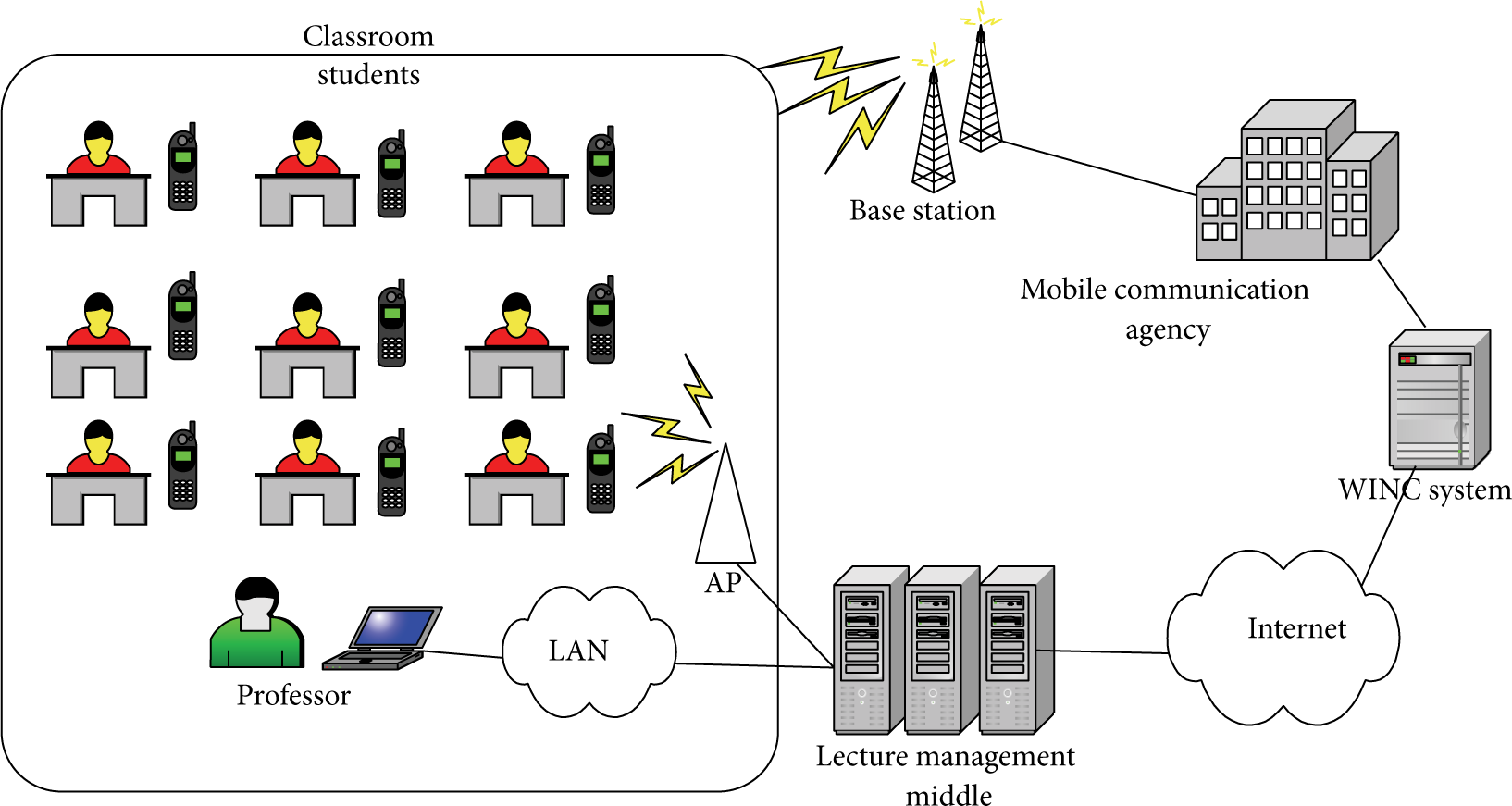
Overview of the proposed U-CLASS system.
In the proposed system, students can confirm attendance and answer the professor's questions using a variety of mobile devices. Also the professor can monitor students' educational activities and check a variety of student data, such as personal information and attendance statistics. The operational data of the system, such as seating position and the number of questions from the student, can be used in real time to reference student activities.
3.2. System Architecture
When students get into the classroom, they have to send their ID number and seat number to the U-CLASS system using their personal device. Then, the U-CLASS middleware gets the information from students, merges it with other information in the database, and provides a variety of information to the professor in real time. This system supports a wide range of networks, such as code division multiple access (CDMA), third generation (3G), long term evolution (LTE), wireless fidelity (Wi-Fi), and local area network (LAN) [29, 30]. Most colleges are well equipped with free Wi-Fi networks to support the increase in smart phones. Therefore, students can access the network easily through the nearest access point.
Figure 2 shows the structure and implementation environment of the proposed system. The U-CLASS system consists of U-CLASS middleware, MYSQL server, libraries, and clients. The U-CLASS middleware processes a variety of client pieces of information from mobile phones (wireless markup language (WML) browsers, multipurpose Internet mail extensions (MIME) hypertext markup language (mHTML) browsers), smart phones (phone browsers), notebooks (HTML browsers), and desktops (HTML browsers) using browser access manager under HTTP/HTTPS communications.

Structure of the proposed system.
The middleware provides four controllers, such as MemberControl, LectureControl, AttendControl, and MessageControl, according to the functions of the system. Each of them plays a role in processing user information, class information, attendance information, and memo information. The controllers access the database server using the database (DB) manager (DB Manager), and they process new additions, deletions, and changes to the database [31, 32]. Library import manager loads external libraries required to dynamically process some modules in the middleware system from mobile clients.
Figure 3 details the structure of the middleware in the proposed system. The U-CLASS system provides a variety of user-centric services, such as login (Login_info), monitoring the class (Monitoring), showing class information (Class_info), showing student information (Class_member), showing attendance information (Attend_history), and taking notes (Class_memo).

Middleware of the proposed system.
The service modules in the user interface area of the proposed system provide the required information to users in conjunction with four controllers (MemberControl, LectureControl, AttendControl, and MessageControl) in the DB processing area. For example, the monitoring service module uses three controllers: LectureControl, AttendControl, and MessageControl, as seen in Figure 3.
3.3. Interaction Procedure and Implementation
Figure 4 shows the login process of the proposed system.

Processing student's attendance.
As shown in Figure 4, the login process consists of the following detailed processes.
Student connects to the U-CLASS system (middleware) using mobile devices. Student enters ID number and seat number and sends them to the middleware. The middleware processes the registration of the student using ID number and current time. The middleware enters the student's attendance in the attendance database. When the attendance is processed normally, the middleware transmits attendance confirmation information to students' mobile devices. Student confirms the attendance check by using a mobile device.
One of the important features of this system is that it enables a professor to check students' seat positions at a glance in real time. Therefore, the professor can check student attendance easily, and students focus on the class without a face-to-face attendance check. The data of seat position and attendance of students is accumulated in a database in the proposed system and is processed in a variety of educational information functions. Figure 5 shows a part of the attendance check process in the proposed system. The resulting web page can be viewed in a browser on a PC or the screen of a mobile device. We use Visual Basic for Applications (VBA) to implement the system.

Part of the attendance process in the proposed system. You can access to the web pages with the following address: http://waterone.yu.ac.kr/teacher-check-attendance-name.html. http://waterone.yu.ac.kr/student_check_attendance.html.
4. Experiments and Data Analysis
4.1. Educational Application of the U-CLASS System
The system was applied in a practical educational environment. Two sophomore classes in the computer science department of a university agreed to a performance analysis of the proposed system, including some characteristics of educational activities of the students. Each experiment was conducted for one semester, and the operational data was accumulated in the system. In this experimental environment, some multimedia tools and a whiteboard were also used in the classroom.
Table 2 shows the experimental classes. As shown in the table, this experiment was conducted in two classes (data communications and network and practice courses) during four semesters. Subject A and Subject B in the table are both sophomore courses, with Subject A being a prerequisite for Subject B. Therefore, in the first semester, the experiment was applied to Subject A, and, in the second semester, the experiment was applied to Subject B. Figure 6 shows the desk layout of the experimental classroom. R# shows the position from the presentation screen. The numbers for the desks are needed to confirm seat positions.
Overview of experimental classes.

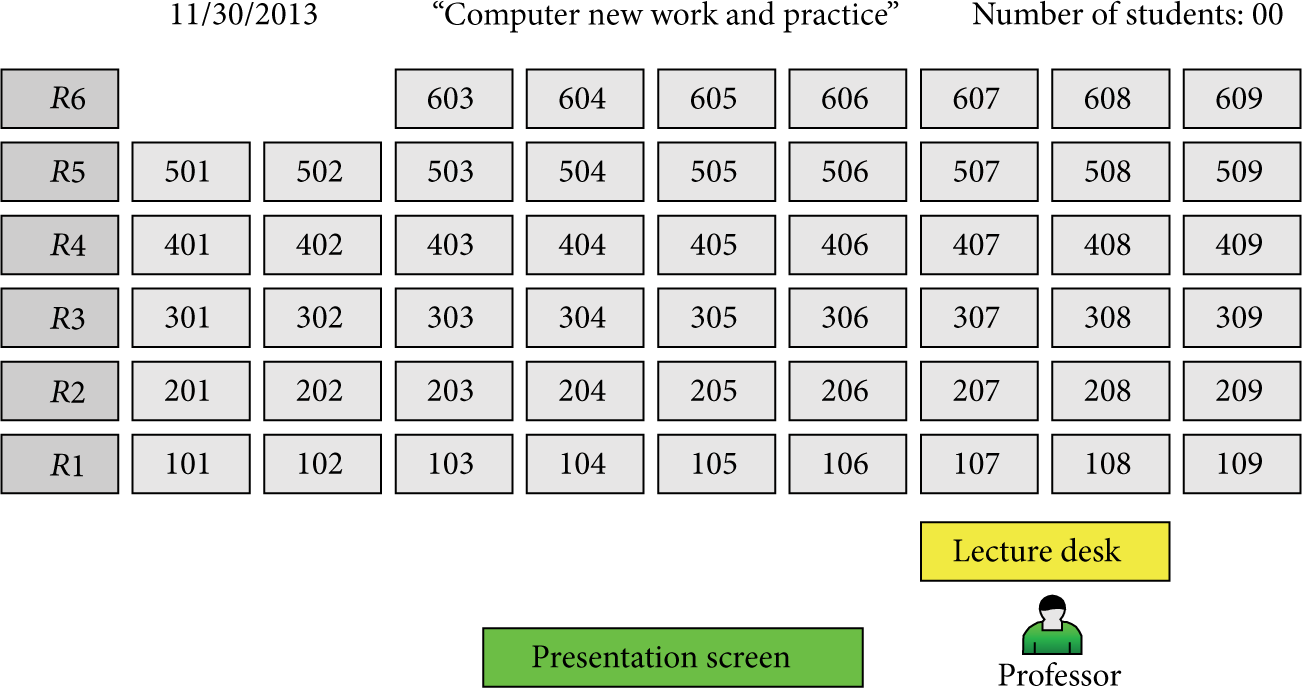
The desk layout of the experimental classroom.
4.2. Analysis of Educational Activities of the Students
First, the relationship between a student's grade and the student's seat position was analyzed. The data for seat position of each student were used to calculate the average distance (AD) to the professor. The average distance of a student is calculated with

By (1), the average distances for three sample students in Figure 7 are calculated as follows:
Student 1: Student 2: Student 3:
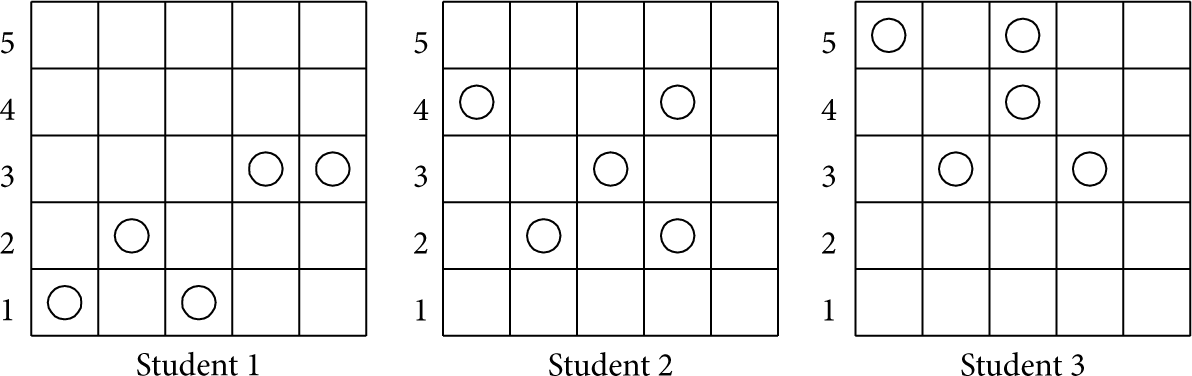
Examples of seat positions for three students.
By (1), the average distances for each student during four semesters are calculated. Figure 8 shows the relationship between the student's grade and the student's seat position. As shown in the figure, the students who have an average distance of less than 2.0 got more A's than the others. The students who have an average distance of more than 5.1 got more C's than the others. Therefore, we can say that students who got a better grade usually preferred a seat closer to the professor. And we find that the students who got lower grades do not have a consistent pattern.

Student's grade versus average distance.
Second, the relationship between a student's grade and a student's absence ratio was analyzed. Figure 9 shows the relationship between a student's grade and the absence ratio during the four semesters. The result shows that the absence ratio of the students who got a better grade is lower than the others. On the other hand, the absence ratio of the students who got a lower grade is high, relative to the others. Figure 9 also shows that higher-grade students tried more eagerly to attend during the third and fourth semesters.

Student's grades versus absence ratios.
5. Conclusions
In this study, a learning management system (a U-CLASS system that can aid interactions between professors and students via personal mobile devices) is proposed and implemented. The proposed system was applied in a real educational environment, and the data from educational activities in that environment were gathered and analyzed to determine the major factors promoting learning effectiveness. In particular, relationships between a student's achievement and a student's activities, such as attendance rate and seating position, are examined. As a result, we reached the following conclusions. First, as to the relationship between a student's grade and average distance from the lecturer, the average distance of the students who got a better grade is shorter than the others. On the other hand, the average distance from the lecturer for students who got a lower grade is greater than the others. Second, as to the relationship between a student's grade and his/her absence ratio, the absence ratio of the students who got a better grade is lower than the others.
Footnotes
Conflict of Interests
The authors declare that there is no conflict of interests regarding the publication of this paper.
Acknowledgments
This research was supported by a Yeungnam University research grant in 2014. Also this research was supported by the BK21+ Program of the National Research Foundation (NRF) of Korea.