




Abstract
Multipoint relays (MPRs) are used for flooding topology control messages and finding the shortest paths for unicast communications in the optimized link state routing protocol (OLSR). In this paper, we propose a method for achieving more efficient MPR selection in moderately dense wireless multihop networks (including sensor networks) than the conventional MPR selection. First, we analyze moderately dense networks to show that a node close to the two-hop border has little probability of being a two-hop neighbor. Second, we explain that there is a chance of the node's MPRs being shared with its neighbors.
To maximize this chance, we propose using shared MPR sets. These sets minimize the MPR ratio, which is defined as the number of nodes selected as MPRs by at least one neighbor divided by the total number of nodes in the network. Simulations are used to confirm the efficiency of using shared MPR sets. A centralized heuristic algorithm shows an MPR ratio redundancy in moderately dense networks that is about 10% of that obtained through conventional MPR selection.
1. Introduction
Multipoint relays (MPRs) [1, 2] support the efficient flooding of topology control (TC) messages in the optimized link state routing protocol (OLSR) [3] and are used to find the shortest path to any pair of nodes for unicast communications in OLSR. Although OLSR is designed as a routing protocol for mobile ad hoc networks (MANETs), it can also be used for sensor networks. OLSR is a proactive routing protocol on which each node regularly exchanges topology information with other nodes.
MPR is the key concept used in OLSR. Each node selects a subset of its neighbors as its MPR set. According to the RFC 7181 [4], the MPR set is selected to satisfy two properties: (1) if a node v sends a message and that message is successfully forwarded by all MPRs of v, then all 2-hop neighbors of v will receive that message and (2) keeping the MPR set small ensures that the overhead of the protocol is kept at a minimum.
The nodes that have been selected as MPRs have two roles: generating and forwarding TC messages into the entire network and acting as routers. Each TC message generated by a node w advertises the link state information between itself and a node v during v's selection of w as one of its MPRs. In contrast, non-MPR nodes (none of which is selected as an MPR by a neighbor) do not generate or forward TC messages except to enable an OLSR redundancy option called
We analyze the density of MPRs in moderately dense wireless multihop networks including sensor networks and present two issues that arise with conventional MPR selection: high MPR density and redundancy. First, the high MPR density issue implies that many TC messages are generated and flooded. Wu et al. [5] have already proven the asymptotic property that the average number of MPRs in a finite region is infinite when the network is extremely dense. However, we analyze moderately dense networks for additional insight into their nonasymptotic properties. Our concern is the distance from a node to its two-hop neighbor.
The second issue—redundancy of the conventional MPR selection—causes redundancy in dense networks because it minimizes the number of MPRs selected by each node using a fully distributed manner. Therefore, we propose a concept called “shared MPR sets” to reduce routing overhead. Through a simulation with a heuristic shared MPR selection algorithm, which is not distributed, we confirm the redundancy of conventional MPR selection in moderately dense networks.
For sensor networks, it is important to conserve the spectrum and energy. A way to achieve this is to improve the efficiency of OLSR by reducing TC messages. Our goal is to explain the following properties of moderately dense wireless multihop networks.
In this paper, we only discuss the existence of shared MPR sets with a centralized algorithm (the effectiveness of this method is shown through simulations); we do not discuss a feasible algorithm for finding shared MPR sets in a distributed manner. A preliminary version of this study appeared in [6]. Developing an efficient distributed algorithm is our main goal for future work. Several distributed heuristic algorithms have been proposed by Yamada et al. [7], Maccari and Lo Cigno [8], and ourselves [9]. However, the efficiency of those proposed algorithms has not yet been fully analyzed.
The rest of the paper is organized as follows. Related work is described in Section 2; this includes studies regarding OLSR, MPRs, and connected dominating sets (CDSs). In Section 3, we analyze the distance from a node to its two-hop neighbor, which is associated with conventional MPR selection, and introduce the concepts of MPR sharing and shared MPR sets. In Section 4, we provide a heuristic algorithm for shared MPR selection and provide the simulation results for dense wireless multihop networks. Based on those results, we confirm that routing overhead is reduced when shared MPR sets are used. Finally, we conclude this paper in Section 6.
2. Related Work
2.1. OLSR
OLSR [3] is a proactive routing protocol for MANETs. OLSR maintains neighborhood information and topology information in each node and can find the shortest path between any pair of nodes with relatively less control traffic.
We briefly review these two types of information and two types of messages. We denote a node by v, w, or u. Regarding neighborhood information, node v stores the partial two-hop information
Neighborhood information is updated when node v receives a HELLO message. HELLO messages are broadcasted by all nodes periodically but are never forwarded. When node v receives a HELLO message from node w, v recognizes that w is a one-hop neighbor of v and adds w to
The HELLO message of w includes one-hop neighbors
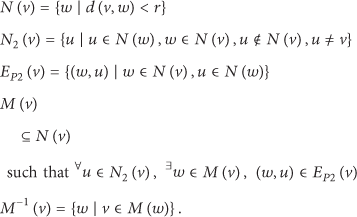
The topology information for each node, denoted by u, is a directed subgraph of the network G. The directed subgraph, denoted by
The routing table of node u is constructed using
OLSRv2 [4] has already released in April 2014. Therefore, the discussion here is applicable to OLSRv2. In OLSRv2, nodes can freely interoperate regardless of whether they use the same MPR selection algorithm; an example algorithm for calculating MPRs is available in appendix B of OLSRv2 [4]. OLSRv2 defines two MPR sets (flooding MPR and routing MPR) and adopts neighborhood discovery protocol (NHDP) [10] to acquire neighborhood information.
2.2. Multipoint Relays
Multipoint relaying has been proposed by Qayyum et al. [1, 2] for efficiently flooding broadcast messages in mobile wireless networks. The concept of multipoint relaying is to reduce the number of duplicate retransmissions while forwarding a broadcast message.
Each node v selects a small subset of its neighbors
In MANETs, for proactive and reactive protocols, flooding is used to find a path to the destination. OLSR [3] also adopts the use of MPRs to disseminate TC messages.
Qayyum et al. [2] analyze MPRs and propose a heuristic MPR set selection algorithm. They prove that the following MPR problem is NP-complete: given a network (i.e., the set of one-hop neighbors for each node), a node v of the network, and an integer k, is there a multipoint relay set for v of size less than k?
The heuristic algorithm proposed by Qayyum et al. provides a near-optimal MPR set. They prove that the MPR set computed by that heuristic contains at most Start with an empty MPR set First, select as MPRs those one-hop neighbors in While there still exists some node in
For each node in Add the node of
Jacquet et al. [11] have analyzed OLSR MPR flooding in two network models: the random graph model and the random unit disk graph model. These two models are used for indoor and outdoor networks, respectively. In the two-dimensional random unit disk graph model, Jacquet et al. prove that the average size of the MPR sets tends to be smaller than
Busson et al. [12] have analyzed the conventional MPR selection in random unit disk graphs. They did not analyze sharing MPRs with neighbors; however, they do show that approximately 75% of MPR sets are selected in step 2 of the heuristic algorithm above, which implies that only the remaining 25% have a chance of sharing MPRs with their neighbors. The starting point of their analysis also uses (4), shown in Section 3.2 below. Our analysis in Section 3.2 is similar to theirs; however, unlike their research, we go on to analyze MPR sharing (Sections 3.3 and 3.4).
The motivation behind Maccari and Lo Cigno's research [8] is the same as ours. They describe the size of the global MPR set
2.3. Connected Dominating Set
A connected dominating set (CDS) is a subset of nodes. Each node in a CDS has a path only through other nodes in the CDS, and every node in the network has at least one node in the CDS as a neighbor.
A small CDS is another candidate to reduce the number of forwarding nodes during the flooding process [13]. Instead of MPRs, a CDS can be used to flood messages to the entire network, and the nodes that are not there in CDS do not need to relay messages to flood. A small CDS will have less control traffic than MPRs. Furthermore, if the shortest path for every node is not a mandatory routing requirement, a small CDS can also be used for routing instead of MPRs.
A CDS does not have the (1) property of MPR sets that is described in Section 1. In other words, the use of MPRs guarantees the shortest path between any pair of nodes; CDS does not guarantee it. Furthermore, the time and message complexities of CDS schemes are slightly higher than those of MPR schemes. Perhaps for these reasons, unfortunately, CDSs are not currently employed in major MANET routing protocols.
Wu et al. [5] have explained several extensions designed to generate smaller CDSs using complete two-hop information. The complete two-hop information of node v is denoted by

Wu et al. have proved that the extended MPR has a constant local approximation ratio rather than the logarithmic local ratio associated with the original MPR [5].
3. Analysis of MPRs in Dense Networks
3.1. Notation
We model a network as a unit disk graph
Our analysis assumes that nodes are placed uniformly in a two-dimensional region. The expected number of nodes in a one-hop region is denoted by

3.2. Distance to Two-Hop Neighbors
Suppose that there are two nodes v and u such that

Determining whether u is a two-hop neighbor of v.
The region W is defined as

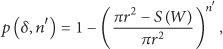
We try to expect the number of two-hop neighbors of v in various densities. First, we denote the expected number of nodes in


Figure 2 shows the numerical results of

The expected number of two-hop neighbors in a disk of radius x.
To ensure the rareness of two-hop neighbors close to the border of
The radius x of a disk that covers q% of two-hop neighbors on various density

3.3. Conventional MPR Selection of a Node
Here, we review OLSR's conventional MPR selection in which any node selects its MPR set independently of its neighbors’ MPR sets. Understanding the symmetric property of this conventional selection will be helpful in understanding how MPRs can be shared as described in Section 3.4.
Suppose that there are two nodes

Covering two two-hop neighbors.
The regions 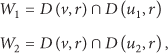
The following discussion assumes that there are multiple nodes in
If there is at least one node w in
We denote
In the first case, two nodes
In the second case, if there is at least one node
In the third case, if the optimal or heuristic MPR selection algorithm selects a node
The number of MPRs of node v changes by selecting the second case. Each iteration of step 3 in the heuristic greedily adds a node in
3.4. Sharing an MPR with a Neighbor
Considering the symmetric property of conventional MPR selection (see Section 3.3), we explain how sharing MPRs with a neighbor is possible. Suppose that there are two nodes
First, we discuss the condition in which sharing MPRs is not allowed. As shown in Figure 4(a), if

Covering two two-hop neighbors.
However, if there is a node u such that u is a two-hop neighbor of both
The sharable condition discussed above is symmetrical to the second case of conventional MPR selection, which is described in Section 3.3. However, the optimal and heuristic MPR selection described in Section 2.2 does not consider such sharing.
Note that the two-hop coverage of
3.5. The Proposed Shared MPR Sets
The concept of shared MPR sets was first introduced by Yamada et al. [7]. They call the concept an MPR selection “redundancy,” which is defined as follows: for a combination of MPR sets of all nodes, if the number of MPRs in the network is greater than that of other combinations of MPR sets, the combination of MPR sets is redundant.
We define the MPR ratio to measure the degree of sharing. The ratio for shared MPR selection will be less than that for conventional MPR selection. We also define the number of MPRs per node to compare the average size of each node's MPR sets; this number will be constant for shared and conventional MPR selections. The MPR ratio and number of MPRs per node are defined as follows:
To compute 


To achieve the smallest MPR ratio, we need to find the smallest subset of
Let
The computational complexity of finding the shared MPR sets that minimize the MPR ratio is expected to be NP-complete, because the basic structure of the problem is the same as the MPR problem [1] described in Section 2.2. Then, we use a heuristic shared MPR selection algorithm, which is discussed in the next section.
4. Experiments of Sharing MPRs with Neighbors
4.1. A Heuristic Shared MPR Selection Algorithm
We use the following algorithm in our experiment to show that shared MPR sets can reduce the routing overhead, especially the number of TC messages; however, note that because it is a centralized algorithm, it is not directly applicable to OLSR or other MANET routing protocols.
The algorithm adopts the greedy heuristic proposed by Qayyum et al. [1]. The primary difference between it and the conventional OLSR algorithm is that this algorithm runs on a whole network (i.e., is nondistributed) rather than on each node. Only the final step (4) runs on each node.
The input of this algorithm is Start with an empty global MPR set First, select, as global MPRs, those nodes in While there exists at least one pair in
For each node in Add the node of For each node v, run the heuristic described in Section 2.2 to compute
4.2. Metrics and Method
We use five metrics to explain our simulation results. The first two metrics concern the number of MPRs: the MPR ratio and the number of MPRs per node (described in (9)).
The remaining three metrics concern the routing protocol's communication overhead: the number of TC messages, the number of OLSR packets, and the total size of OLSR packets (in bytes). These three metrics are measured at the data link layer using a simulator log and are normalized by dividing the number of nodes and the simulation duration. Note that we count TC messages that are generated by a node and are forwarded by other nodes.
Moreover, to clearly show the redundancy of conventional MPR selection, the MPR ratio and number of TC messages in conventional MPR and shared MPR selections are compared. We define the MPR redundancy of conventional MPR selection as 

We use the ns-2 simulator (ver. 2.29) with UM-OLSR v0.8.8 [14]. The simulation is set so that each node has an IEEE 802.11 interface, the transmission range is
For the simulation, we assume that nodes do not move. We show the results of conventional MPR selection adopted in OLSR as well as shared MPR selection (which are described in Section 4.1). The number of nodes n in the network varies from 20 to 300. For each number of nodes, fifty different node topologies are simulated; the average results are shown in Section 4.3. Note that some topologies with small numbers of nodes are not fully connected graphs.
Regarding communication overhead, we describe how OLSR is modified to evaluate the heuristic shared MPR selection algorithm. Communication overhead caused by aggregating
We assume that the wireless multihop network is moderately dense (meaning that each node has about 5 to 10 one-hop neighbors). Statistically, the number of one-hop neighbors for each node, except for those close to the border of the
4.3. Simulation Results
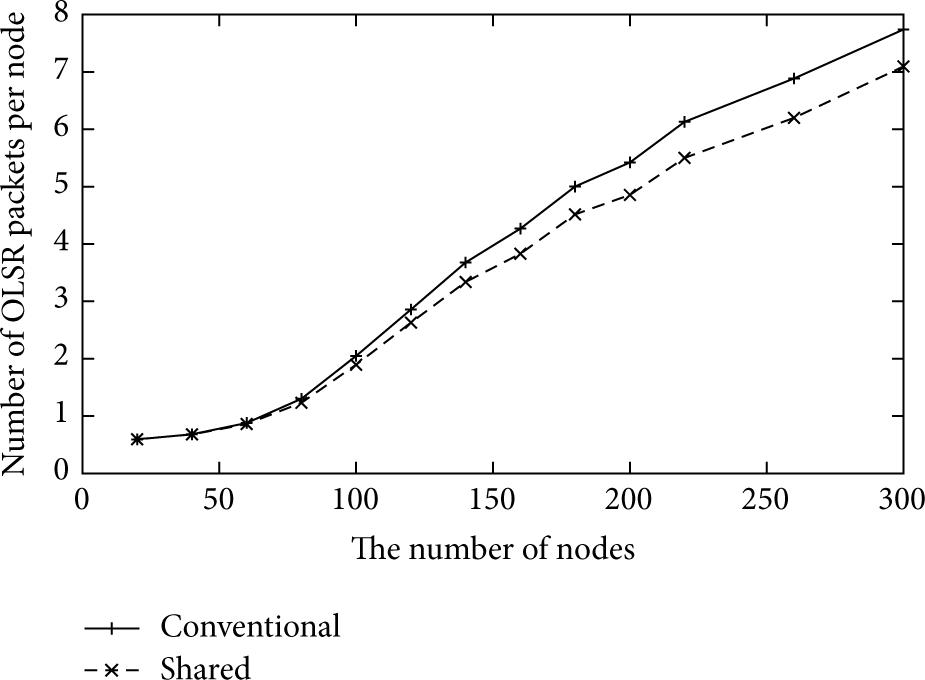
Figures 5–10 show the simulation results for each metric. In each figure (except Figure 6), the results of conventional MPR selection and shared MPR selection are shown with the labels “Conventional” and “Shared,” respectively.

MPR ratio.

MPR and TC message redundancy.

Number of MPRs per node.

Number of TC messages per node per second.
Number of OLSR packets per node per second.

Size of OLSR packets (in bytes) per node per second.
The plot in Figure 5 shows that the MPR ratio for conventional MPR selection increases as the number of nodes increases (which is also discussed in Section 3.2). Wu et al. [5] have proved that this ratio will eventually increase to 1; however, the speed of increase shown in Figure 5 is rather slow.
By comparing the MPR ratios of conventional MPR selection with those of shared MPR selection (in Figure 5), we see that conventional MPR selection has over 10% redundancy in networks containing 100 or more nodes. Figure 6 charts MPR redundancy, which is defined in (13), thereby showing the redundancy more clearly. Based on the results shown in Figure 6, we determine that there is little redundancy in the low density networks of less than 50 nodes and large redundancy in moderately dense networks of over 100 nodes. In other words, when the average number of one-hop neighbors is greater than 5 (
Figure 7 shows the average number of MPRs per node. Conventional MPR and shared MPR selection have almost the same results. The number of MPRs increases slowly when the number of nodes in the network increases. Even when
Figures 8 to 10 show the routing overhead results. These results are averaged per node and per second. Comparing conventional MPR selection to shared MPR selection, we find that, in all three metrics, shared MPR selection is able to reduce routing overhead in networks with 100 or more nodes.
When the number of nodes is greater than or equal to 80, the reduction ratio of shared MPR selection relative to conventional MPR selection is around 9%–12% in the number of TC messages (see Figure 8). More importantly, when the number of nodes is between 140 and 260, the reduction ratio is around 11%-12%. These results are also shown as TC message redundancy (defined in (14)) in Figure 6. From Figure 6, we observe that TC message redundancy is nearly proportional to MPR redundancy in networks of less than 200 nodes; however, we observe a different trend in networks of over 200 nodes. The reason for this different trend in high-density networks cannot be clearly explained, but it is possible that TC message redundancy decreases as networks increase in density. Future studies will examine this trend in greater detail to determine its cause.
Shared MPR selection also reduces the number of OLSR packets, depicted in Figure 9, and the reduction ratio here is even lower than that of the number of TC messages. Most likely, the ability to piggyback several messages into one packet causes the number of packets to decrease. The reduction ratio is around 9%-10% when the number of nodes is between 140 and 260 and around 5%–9% when the number of nodes is between 80 and 120.
Shared MPR selection also decreases the total size of OLSR packets (in bytes), as depicted in Figure 10, and the reduction ratio here is even lower than that of the number of TC messages and the number of OLSR packets. Although the headers of UDP, IP, and MAC will affect these results, the reduction ratio is around 7% when the number of nodes is between 140 and 260 and 4%–6% when the number of nodes is between 80 and 120.
To summarize the simulation results, we see that the MPR ratio increases slowly as the number of nodes in the network also increases, shared MPR selection maintains smaller MPR ratios and less routing overhead than does conventional MPR selection, and conventional MPR selection has room for improvement.
4.4. Comparison with CDS
To compare the MPR ratio with the CDS ratio, we refer to some results reported by Wu et al. [5]. Their evaluation simulates CDS within a
In high-density networks (e.g., in our simulation, networks of 300 nodes), the MPR ratios of conventional MPR and shared MPR selection are 72% and 64%, respectively, and the CDS ratio of the corresponding network is only 30%. Thus, both MPR ratios in Figure 5 are higher than the CDS ratio.
In moderately dense networks of 200 nodes (see Figure 5), the MPR ratio of conventional MPR selection is 65% (that of shared MPR selection is 57%), and the CDS ratio is 40% in a network of similar density.
When the network is not so dense, the difference between the MPR and CDS ratios is small. In low-density networks (e.g., in our simulation, the network of 120 nodes (
Consequently, if there is a feasible solution for calculating a CDS in a distributed manner and the network is dense, then the CDS will perform better than MPRs; however, the CDS does not guarantee the shortest path between any pair of nodes. Therefore, the next best choice is to find a feasible method for calculating shared MPRs in a distributed manner.
Comparing the MPR ratio with the CDS ratio, we see that the CDS achieves the smallest ratio and that shared MPR selection achieves the next smallest ratio.
5. Discussion
There are several distributed heuristic algorithms for calculating shared MPR sets, such as those put forth by Yamada et al. [7], Maccari and Lo Cigno [8], and ourselves [9]. However, in those studies, the sharing mechanism of MPR is not well analyzed and no bound is shown.
In Section 4, we simulate only a static environment; that is, nodes do not move in the simulation area. This limitation is the result of the high computational complexity associated with the centralized algorithm described in Section 4.1, which exists because the structure of the problem solved by the centralized algorithm is the same as the local MPR computation, which is an NP-complete problem [1]. Furthermore, the problem size increases; for example,
We employ the unit disk graph model for analysis and simulation. This model is valuable for theoretical discussions but does not represent the real environments of wireless communication. For an explanation of the differences between the model and real environments, we refer to the communication gray zones introduced by Lundgren et al. [15]. These zones are defined as areas where data messages cannot be exchanged—although HELLO messages indicate neighbor reachability—for various reasons including bit error rate, variable transmission rate, packet size, and different MAC layer handling between broadcast and unicast packets. To create simulations close to real environment, Chen et al. [16] and Pei and Henderson [17] have redesigned or tuned the IEEE 802.11 WLAN simulation model. More realistic evaluations can be performed with these models than with previous models. Furthermore, when we evaluate urban environments in our future study, obstacles should be modeled; for example, Sommer et al. [18] have proposed an empirical model of IEEE 802.11p path loss, including the attenuation of obstacles. For more realistic simulations, especially with mobile scenarios, these models will be valuable.
If nodes are allowed to move, then node mobility will be another important aspect to be considered in wireless multihop networks. Maccari and Lo Cigno [8] have proposed a stability-driven MPR choice strategy to minimize changes in the MPR selector sets in mobile scenarios. Minimizing these changes implies reducing the routing table calculation in each node. Musolesi and Mascolo [19] have also proposed a mobility model; theirs is based on community such as family members sharing a home or colleagues sharing an office. When mobile nodes are carried by humans, the community structures of humans strongly affect the dynamics of the mobile nodes. Therefore, the model put forth by Musolesi and Mascolo assigns each square area to a community. They have compared their mobility model with the Intel trace [20] and random waypoint mobility model in terms of intercontact times and contact durations. Our future work will include finding a suitable mobility model for evaluation.
6. Conclusion
In this paper, we explored MPR selection in moderately dense wireless multihop networks.
We have analyzed the distance to a two-hop neighbor in moderately dense networks and explained that nodes close to the border of a two-hop disk
We have also demonstrated the redundancy of conventional MPR sets and described a definition of shared MPR sets that minimizes the MPR ratio. We then provided a heuristic algorithm to select shared MPR sets. This heuristic is not applicable to the OLSR protocol, because it is not a distributed algorithm; however, the heuristic is valuable for showing the redundancy of conventional MPR selection. With this heuristic, we simulated some network topologies and measured the MPR ratio and routing overhead. Simulation results show that the redundancy in the number of TC messages, the number of OLSR packets, and the total size of OLSR packets is up to 12%, 10%, and 7%, respectively. We will continue to explore the feasibility of shared MPR selection as well as CDS schemes.
Footnotes
Conflict of Interests
The authors declare that there is no conflict of interests regarding the publication of this paper.
Acknowledgment
This study was partially supported by KAKENHI (23500092 and 26330107).