




Abstract
We propose a linear alternating variable step-size adaptive long-range prediction (AVSS-ALRP) scheme to predict fading signals which is especially suitable for a versatile two-state land mobile satellite (LMS) channel model at S-band. A three-step design procedure is presented to optimize the prediction performance. Firstly, we establish the Gilbert-Elliot channel model based on first-order Markov chain for satellite communication downlink and take advantage of smoothing average to obtain channel observed values. At a second stage, eigenvalue decomposition method is applied to predict future long-range channel state instead of weighted prediction. Finally, combining variable step-size least mean squares and adaptive long-range prediction, we introduce the VSS-ALRP algorithm to predict LMS channel fading signals in the case of “good” state, and the obtained prediction results would be revised based on the linear prediction of error when shadowing condition is in the “bad” state. Simulation results show that the proposed scheme can not only offer an accurate prediction for long-range channel state and fading signals over the two-state Gilbert-Elliot channel model and greatly enhance the fading signals’ autocorrelation, but also have considerably better performance than long-range prediction (LRP) algorithm from the results of mean square error (MSE) and correlation coefficient.
1. Introduction
As an important part of land mobile satellite (LMS) communication systems, the LMS channel will affect the reliability of transmitted signal distorted by multipath, shadowing, or obstacles between satellite and receiver when mobile terminal is in the situation of fast movement. In order to achieve a good trade-off between power efficiency and spectral efficiency for LMS communication systems, domestic and foreign scholars take advantage of the accurate channel information which is fed back to the transmitter to adjust the parameters of adaptive coded modulation and multiple-input multiple-output (MIMO) [1–3]. However, the predicted information would be inaccurate and rapidly outdated due to the abrupt change of shadowing state, blocked behavior, and large propagation delay of LMS channel in the case of fast movement. To ensure the reliable adaptive transmission for LMS communication systems, the fading signals need to be accurately predicted in advance. The main work in this paper is to study the long-range prediction of LMS fading signals including two aspects; that is, one is to model a flexible LMS channel at S-band and make it effective in the different shadowing conditions and the other is to provide a reliable prediction scheme for the fading channel.
The existing algorithms are practical and effective for short delay prediction of terrestrial wireless mobile fading channel, such as long-range prediction (LRP) with least mean square filter [4, 5], adaptive long-range prediction (ALRP) [6], and Kalman filter [7]. Nevertheless, the drawbacks of such algorithms applied to LMS fading signals are as follows: the sum of sinusoid model is established based on the physical scattering mechanism, and the prediction performance decreases quickly when the future long-range prediction is much longer than the correlation time of observed values.
In recent years, a survey of the state-of-the-art modeling methods concerning the LMS channel is provided in [8]. The long-range fading signals are difficult to be predicted for LMS channel when the channel is in the condition of larger propagation delay and variable shadowing with travelled distance. A linear prediction based FIR channel estimator is proposed based on Loo channel model [9]. Zhou and Cao analyzed the predictability of LMS channel and presented a linear long-range prediction algorithm by combining the weighted prediction and LRP algorithm [10]. The nonlinear autoregressive integrate moving average (ARIMA) and smooth-ARIMA prediction algorithms were proposed based on LTE-compatible low earth orbit (LEO) and geosynchronous orbit (GEO) mobile satellite communication systems [11, 12]. An ALRP of fading signals over three-state LMS channel was presented by [13]. The above-mentioned prediction schemes are inflexible and complex caused by fixed propagation parameters in channel model and transition among three states as well as multistep prediction. Meanwhile, the prediction performance is degraded because of a relative low correlation, error propagation, autoregression (AR) model stationary parameters, and fixed step-size. Up to now, the practical prediction scheme for solving the above problem has not been discussed yet. In this paper, a linear alternating prediction scheme is considered instead.
Aiming at the above-mentioned problems, we directly obtain the observed values of fading signals through a versatile two-state LMS channel model which has the outstanding advantage in flexibility about selection of propagation parameters and universality application for more scenarios and then introduce smoothing average method to prevent the received signals’ correlation from decreasing. In addition, a novel linear alternating variable step-size adaptive long-range prediction (AVSS-ALRP) algorithm inspired by [14] is proposed by combining with eigenvalue decomposition [15] to improve prediction performance.
The rest of the paper is organized as follows. Section 2 introduces the structure of two-state Gilbert-Elliot channel model with variable propagation parameters briefly. Section 3 expounds the proposed scheme in detail including the eigenvalue decomposition prediction, variable step-size adaptive long-range prediction (VSS-ALRP) algorithm, error prediction, and computational complexity analysis. Simulations are discussed in Section 4. Finally, we conclude the paper in Section 5.
2. Two-State Gilbert-Elliot Channel Model
To reduce the complexity of state transitions and increase the randomness of channel fading signals compared with other models in the literature [16–19], we use a two-state Gilbert-Elliot channel model to characterize the changes of shadowing conditions with travelled distance for the LMS channel. The shadowing conditions are divided into “good” and “bad” states that represent a range of LoS-to-moderate shadowing and deep-to-blocked shadowing, respectively, according to the fading of line-of-sight (LoS) [20]. The implementation block diagram of fading signals is illustrated in Figure 1, which consists of state sequence generator (SSG), propagation parameter generator (PPG), and small-scale fading generator (SSFG).
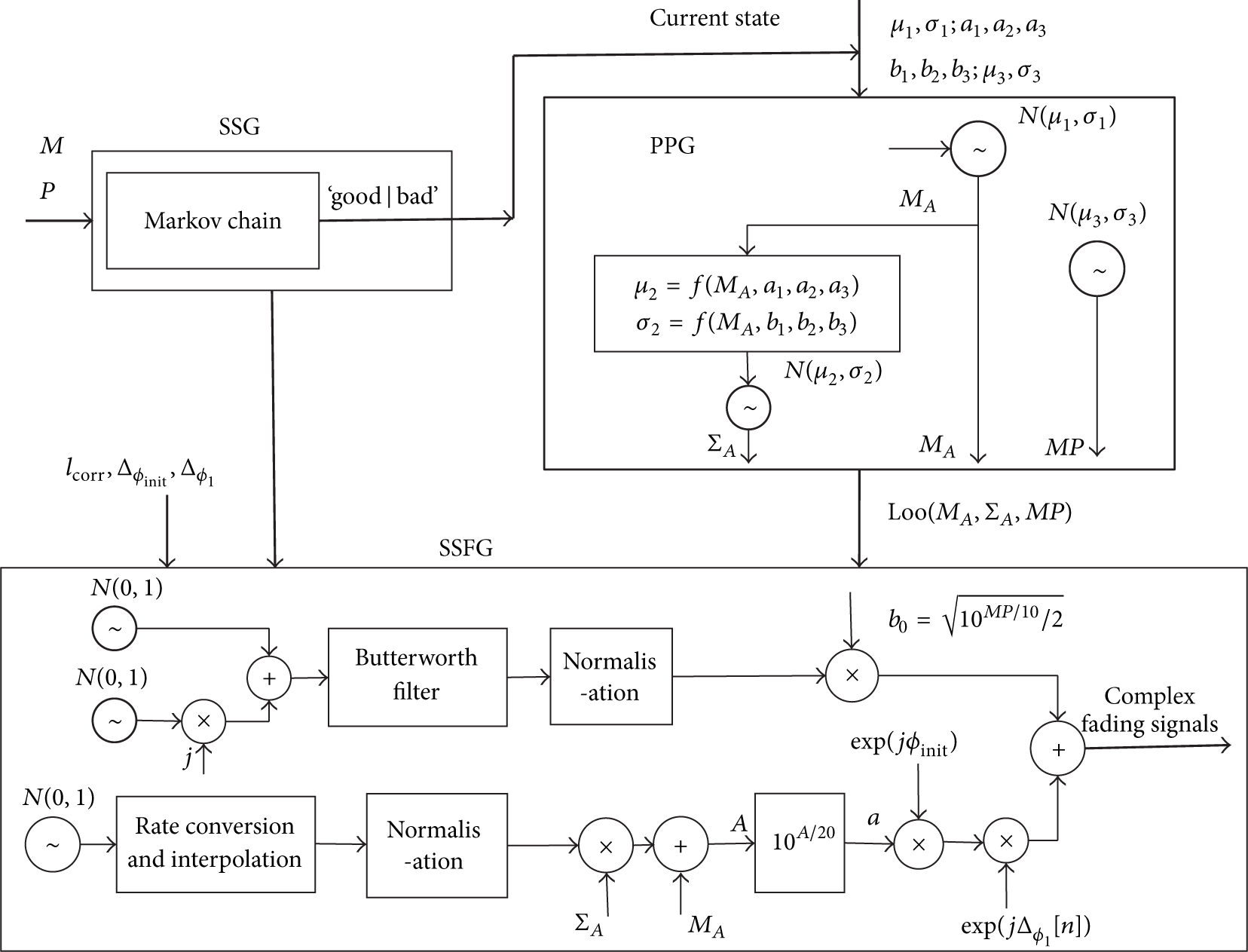
Implementation block diagram of fading signals.
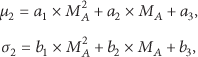
The complex fading signals are composed by multipath and shadowing fading within each state as shown in Figure 1. The probability density function of the envelope is denoted as a stationary Loo distribution [21]. Each time a new state is reached, a Loo parameter triplet is updated by the joint probability distribution, which can be expressed as

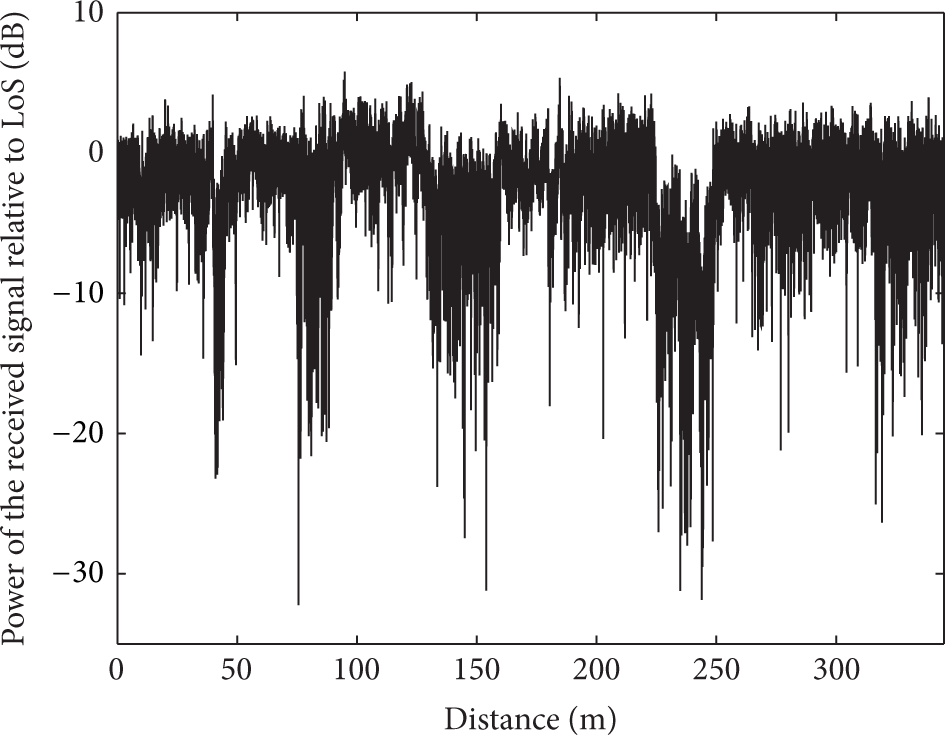
Fading signals generated by the two-state LMS channel model.
3. ALRP of LMS Fading Channel
Because of long transmission delay (about 266.66 microseconds) at S-band and time-varying shadowing conditions as well as the abrupt deep shadowing state, LMS communication systems will result in the performance degradation of channel prediction. For the sake of achieving a more accurate prediction performance, we firstly predict channel shadowing state by using eigenvalue decomposition method and then adopt the smoothing average to obtain the observed values of fading signals. Finally, the future fading signals are predicted based on linear VSS-ALRP algorithm if the current shadowing condition is in the case of “good” state; otherwise the predicted results will be modified by combining with linear prediction of error within “bad” state.
3.1. Prediction of Future Channel Shadowing State
The eigenvalue decomposition method rather than weighted prediction is chosen to improve the prediction accuracy of channel shadowing state for avoiding the twice sampling of channel observed values and reducing state prediction error. According to state frame or minimum state length of 3~5 m at S-band indicated by [16], Figure 3 shows the state transitions model governed by a first-order discrete-time Markov chain.

State transitions model based on Markov chain.
In Figure 3,

The eigenvalues of (3) are



Through (3), (4), and (6), the transition probabilities matrix
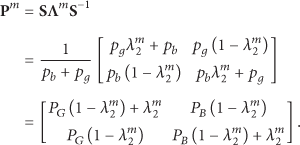
The prediction error of channel shadowing state in the

The prediction error can be derived from the state transition probabilities; that is,

It is observed that
3.2. Alternating Variable Step-Size Adaptive Long-Range Prediction Algorithm
The LMS channel has the nature of long transmission delay and fast time-varying fading compared with the terrestrial wireless mobile channel, which will cause a decrease in prediction performance. So a desired ALRP algorithm for LMS channel is necessary to compensate the outdated problem and improve the prediction performance. There are two main problems to be solved in the process of applying ALRP algorithm into two-state LMS channel—high prediction error during “bad” state duration and AR model instability parameters. They can be solved to some extent by updating the step-size parameter according to correlation of the latest observed values in the tracking model and predicting the error of ALRP algorithm. Based on the above-mentioned fact, a novel linear AVSS-ALRP algorithm, which uses a variable step-size parameter in the update equation, is proposed. In this algorithm, the channel fading signals are predicted by applying VSS-ALRP in the case of “good” state, and the obtained prediction results would be revised based on the linear prediction of error if shadowing condition is in the “bad” state.
We consider 1-step linear prediction of the future channel fading signals. The prediction of

The reduced correlation of channel fading signals over time, the assumption of fixed coefficients throughout the state duration, and the error propagation caused by previously predicted values make the prediction performance decrease. So, the initial coefficients of state i are estimated by using the minimum mean square error approach in the nontracking mode, and the coefficients are updated by using the variable step-size adaptive iterative method [26] in the tracking mode. Let us consider

At time

Subsequently, the update equation of coefficients can be determined using K previous observed values to follow the channel fading variations as

The LMS channel is nonstationary during a short period after the appearance or disappearance of “bad” state. The proposed VSS-ALRP algorithm could take a relative long convergence time which will result in a bad performance due to a big step-size. To obtain a good prediction performance, the prediction results of “bad” state are revised by utilizing the linear error prediction of ALRP. Similar to (10), the prediction of future long-range error based on AR model with maximum order q (



3.3. Algorithm Complexity Analysis
The complexity analysis of ALRP algorithm for three-state LMS channel model has been considered in [13]. Table 1 shows the computation complexities of AVSS-ALRP algorithms at time
Computation complexities of AVSS-ALRP algorithms.

4. Simulation Results
In order to test the validity of the proposed scheme, we employed Monte Carlo simulations to evaluate the performance of the proposed scheme based on the two-state LMS channel model. Correlation coefficient and mean square error (MSE) between the fading signals of predicted results and actual values (channel envelopes or gains) are used as prediction evaluation standard. A comparative analysis between the results predicted by the proposed algorithm and the existing scheme [10] is presented for intermediate tree-shadowed (ITS) environment at S-band and
Propagation parameters for 60° elevation in its environment at S-band.

4.1. Prediction Performance of Channel Shadowing State
In this paper, the fading signals directly obtained through the proposed channel model are smoothed to get the prediction observed values; that is, smoothing average method is performed over the observation period with rate of

Correlation coefficient of channel observed values.
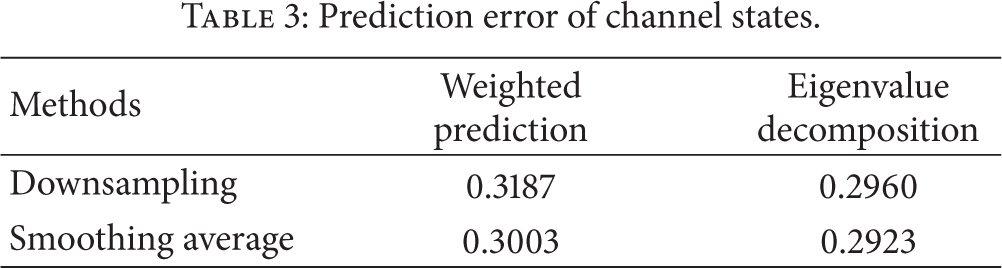
The comparison of the channel shadowing state prediction errors of different methods is given in Table 3. Here, the mobile speed is fixed at
Prediction error of channel states.
4.2. Prediction Performance of Fading Signals
The correlation coefficient of SD and DW combined with the classical LRP algorithm [5] is given in Figures 5 and 6 under different signal-to-noise ratio (SNR) and mobile speed conditions. The fading signals’ correlation properties are directly related to the MSE performance; namely, MSE performance is improved with the increasing of correlation coefficient.
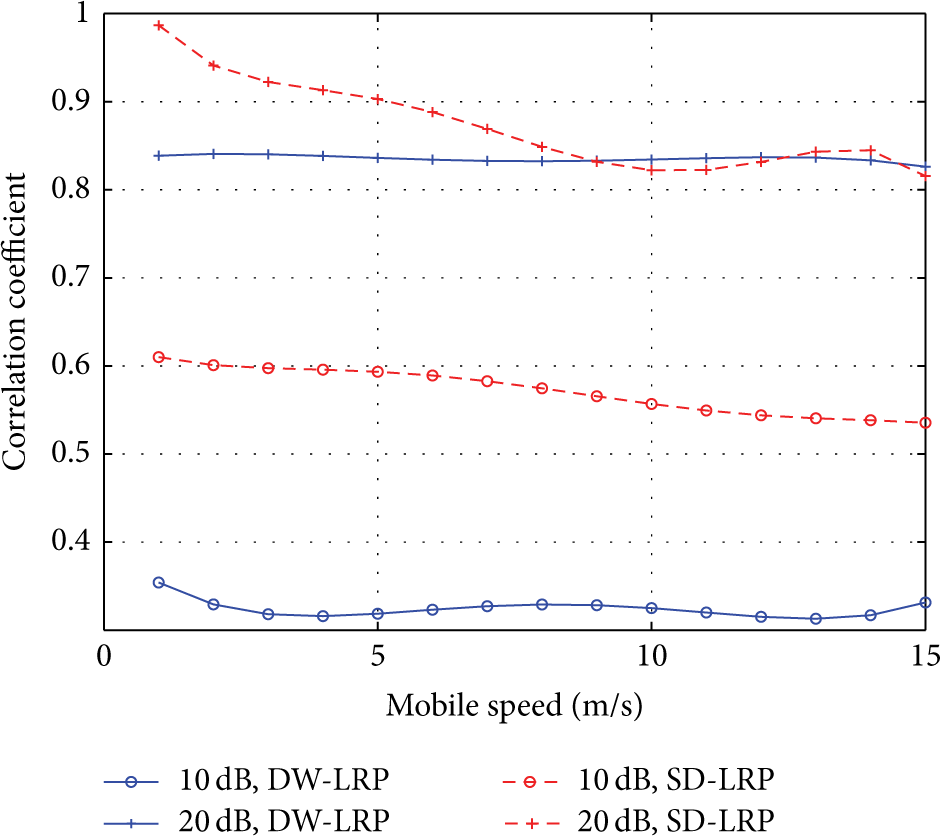
Correlation coefficient of various schemes with mobile speeds.
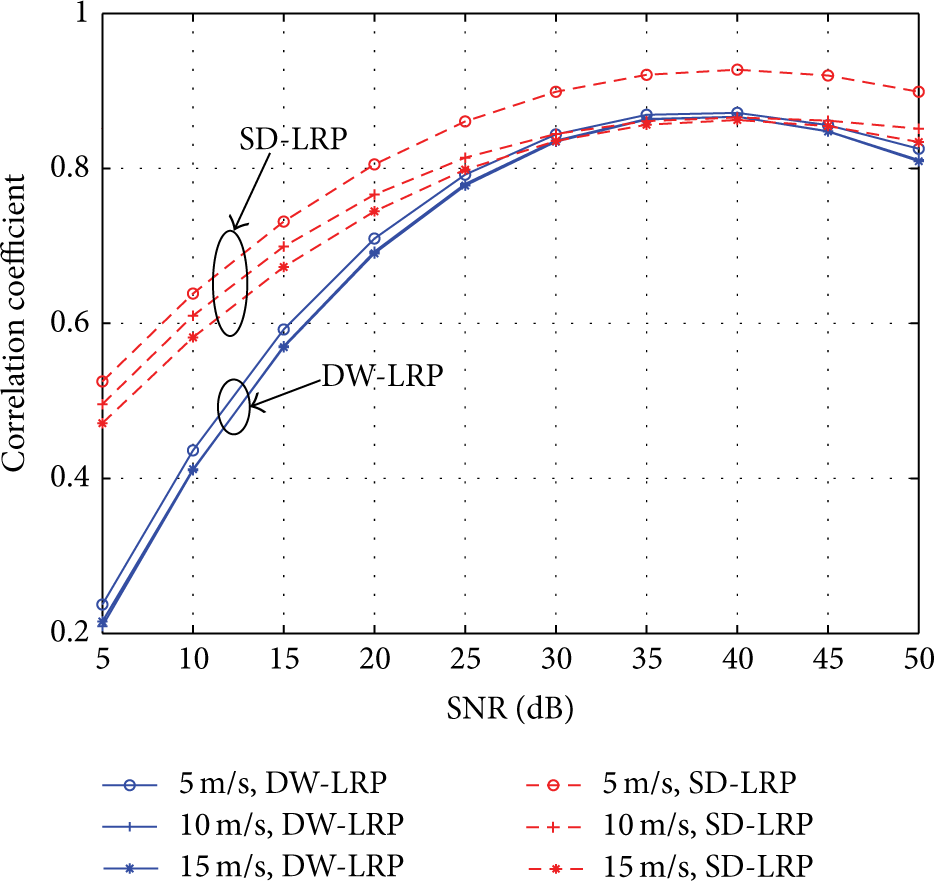
Correlation coefficient of various schemes with SNR.
In the two figures we observe that the correlation coefficient in all schemes is significantly improved with the increasing of SNR and tends to be convergent when the SNR is larger than 30 dB. We see that the correlation coefficient based on SD-LRP always outperforms DW-LRP in low to medium SNR region or very slow/moderate movement (approximately the range of 1~10 m/s in our simulation). In addition, the improvement of different schemes is insignificant in fast mobile and high noise conditions. As shown in Figure 6, SD-LRP is a more effective scheme to enhance the correlation than DW-LRP in case of mobile conditions. So the proposed SD method is feasible and meaningful to be applied in LMS channel prediction process.
The future long-range fading signals are predicted according to the K latest observed values using SD-AVSS scheme and shown in Figure 7. In this Figure, the first half is the latest observed values plotted with dash line, and the second half is the observed true fading signals labeled by solid line. The results indicate that the predicted fading signals approximate the observed values in dotted lines, and therefore the proposed scheme can accurately predict the future long-range channel state and fading signals based on the two-state LMS channel model with variable propagation parameters.

SD-AVSS prediction of two-state LMS channel (v = 12.5 m/s, SNR = 25 dB).
In this paper, we maintain the MSE under a certain threshold to guarantee the overall channel prediction performance (see [7] for reference). The correlation properties and MSE performance related to the channel prediction of the DW-LRP, DW-AVSS, and the proposed SD-AVSS schemes are obtained for the mobile speeds of 5 m/s and 10 m/s and given in Figures 8 and 9, respectively.

Prediction performance of different schemes with SNR at 5 m/s.
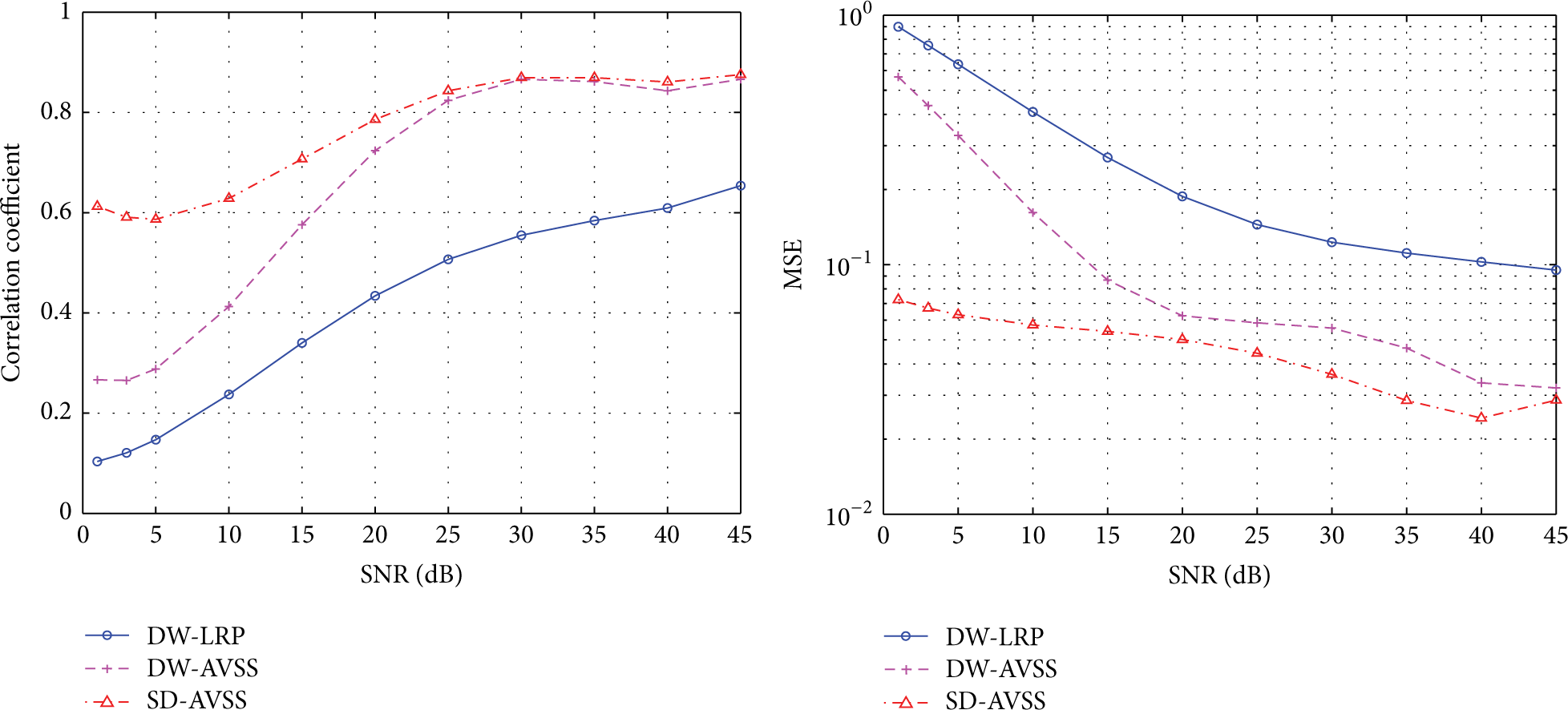
Prediction performance of different schemes with SNR at 10 m/s.
It is obvious that the proposed scheme has faster correlation convergence and better MES performance than DW-LRP scheme, and the MES performance is improved by approximately one order of magnitude. The correlation properties of the AVSS using approximate observed values obtained by smoothing average are superior to DW-AVSS but finally converge to the same level when SNR is higher than 25 dB. Besides, the prediction performance of slow movement is better than that of fast movement. The BER performance curves of the three schemes decline gradually with the increasing SNR. The reliability performance improvement of the proposed scheme is very significant at the cost of slightly higher computational complexity brought by error prediction.
5. Conclusion
A novel linear AVSS-ALRP scheme of LMS fading signals over the two-state channel model with variable propagation parameters has been proposed as a solution to the problem of prediction error and slow convergence in the classical LRP algorithm. Aiming at channel fading signals’ correlation and long transmission delay, we present the prediction of long-range channel shadowing state based on SD method. Simulation results under different conditions show that the proposed scheme could not only predict the future long-range channel state and fading signals accurately and have a better performance in the aspects of MSE and correlation properties compared to the DW-LRP, but also have superiority in universal applicability over the LRP algorithm at the expense of increasing acceptable complexity. Moreover, the scheme in this paper can be extended to the prediction of single- and multisatellite LMS narrowband channel at S-band and is extremely applicable for the analysis of adaptive transmission performance in LMS communication systems.
Footnotes
Conflict of Interests
The authors declare that there is no conflict of interests regarding the publication of this paper.
Acknowledgments
This paper is supported by the National Natural Science Foundation of China (Grant no. 61403093), Science Foundation of Heilongjiang Province of China for Returned Scholars (Grant no. LC2013C22), Assisted Project by Heilongjiang Province of China Postdoctoral Funds for Scientific Research Initiation (Grant no. LBH-Q14048), and China Fundamental Research Funds for Central Universities (Grant no. HEUCF140807).