




Abstract
Wireless sensor networks have often been used to monitor environmental conditions, such as temperature, sound, and pressure. Because the sensors are expected to work on batteries for a long time without charging their batteries, the major challenge in the design of wireless sensor networks is to enhance the network lifetime. Recently, many researchers have studied the problem of constructing virtual backbones, which are backbones used for different time periods, to prolong the network lifetime. In this paper, we study the problem of constructing virtual backbones in dual-radio wireless sensor networks to maximize the network lifetime, called the Maximum Lifetime Backbone Scheduling for Dual-Radio Wireless Sensor Network problem, where each sensor is equipped with two radio interfaces. The problem is shown to be NP-complete here. In addition, rather than proposing a centralized algorithm, a distributed algorithm, called a Dominating-Set-Based Algorithm (DSBA), is proposed for a wide range of wireless sensor networks to find a backbone when a new one is required. Simulation results show that the proposed algorithm outperforms some existing algorithms.
1. Introduction
Wireless sensor networks are composed of many wireless sensors deployed in a wide range of areas, where each sensor is able to communicate with others through intersensor wireless communication [1–5]. The wireless sensor networks are able to collect, process, and store environmental information [6–8]. In wireless sensor networks, the batteries are the main energy sources of sensors, while the sensor nodes are expected to work in batteries for a long time without charging their batteries. Therefore, energy efficiency in wireless sensor networks is the main issue that we address in this paper.
Backbone is a well-known technique for various aspects of wireless sensor networks, such as routing, multicasting, and broadcasting [9, 10]. In the backbone technique, some nodes in the backbone always turn on their radio to maintain the activation of the network, and the rest of the nodes turn off their radio to save energy. Recently, many research studies are mostly designed to minimize the size of the backbone to, therefore, reduce the energy consumption in the network. In [11], an energy-efficient backbone construction algorithm is proposed for mobile ad hoc networks with adjustable transmission ranges. In [10], an algorithm was proposed to construct a backbone in the wireless sensor network such that the cost of routing would be reduced. In [12], Chuang and Chen proposed a novel heuristic-based backbone algorithm, called SmartBone. In SmartBone, two steps are required to form a backbone to improve energy saving in the network. The first step is to find backbone nodes by the proposed flow-bottleneck preprocessing method, and the second step is to reduce the number of redundant nodes by the proposed dynamic density cutback method. In [13], Zhang et al. proposed an algorithm to construct a connected backbone in the wireless sensor network such that the network achieves much higher throughput and delivery ratio and much lower end-to-end delay and routing distance.
Recently, some researchers focused on prolonging the network lifetime while using the backbone technique. The network lifetime is often determined by the time span from when the network is active to when one node in the backbone runs out of energy. In [14], Torkestani introduced an extended version of the connected dominating set problem for modeling the energy-efficient backbone formation problem in wireless sensor networks. In addition, an algorithm of constructing the network backbone was proposed to maximize the lifetime.
Because the nodes in the backbone are always active, their energy is depleted quickly so that the backbone is easily broken. Therefore, to prolong the network lifetime, some researchers studied scheduling nodes to become backbone nodes during some periods of time and nonbackbone nodes during other periods. In [15], Zhao et al. studied the problem of finding multiple backbones and scheduling the backbones to work for different time periods such that the network lifetime would be maximized. Hereafter, the multiple backbones used for different periods were called virtual backbones. The problem is shown to be NP-hard in [15]. In addition, centralized algorithms are proposed to find and schedule virtual backbones to maximize the network lifetime. However, centralized algorithms are often not feasible in a wide range of wireless sensor networks [16, 17].
In wireless sensor networks, sensors can be equipped with multiple radios to promote the capacity of wireless sensor networks, such as simultaneous data transmission and reception, and operations on different frequency bands. Several researchers study minimizing total energy consumption while using sensors having multiple radios [18–20]. In this paper, to maximize the network lifetime, we study the problem of scheduling virtual backbones for a dual-radio wireless sensor network such that the network lifetime is maximized. This Maximum Lifetime Backbone Scheduling for Dual-Radio Wireless Sensor Network problem occurs when each node in the network is equipped with two radio interfaces, including small-range radio and large-range radio. We first show that the problem is NP-complete, which implies that no polynomial time algorithm exists for the problem unless
2. System Model and Problem Definition
2.1. System Model
In dual-radio wireless sensor networks [21–23], each sensor is equipped with two radios whose ranges are r and R, respectively, where

Example of dual-radio wireless sensor networks, where the number close to a node denotes the node's energy. (a) The network topology
Many applications in wireless sensor networks use backbone techniques to provide the benefits of routing, reducing signal interference, and energy saving [13, 15, 24]. A backbone is formed by some nodes in the networks and has the following two properties. The first is that the backbone is a connected subnetwork; that is, it is a connected subgraph
To reduce the energy consumption of sensors, we assume that each sensor in the networks is duty-cycled and has the same working cycle [15, 25, 26]. That is, the state of each sensor in the same working cycle is either in an active or sleep mode. If a sensor is in an active mode, the sensor turns on the radio for forwarding or receiving messages; otherwise, it turns off the radio to save energy. For simplicity, a working cycle is assumed to be one unit of time. To prolong the lifetime of wireless sensor networks, sensors are selected in turn to become backbone nodes for a number of working cycles. The backbones working in different periods of time are also called virtual backbones hereafter [9, 15]. When a virtual backbone is determined to work for some period of time, the nodes in the backbone are in an active mode, and the others are in a sleep mode in the period. Take Figure 1, for example. Let
In the networks, each node v is associated with an energy power
When the wireless sensor network is initialized, we assume that each sensor can then periodically use small-range and large-range radios to associate with other sensors. Therefore, each node can have the information of nodes within its radio range r (or R), including the identification (ID) and residual energy power. Hereafter, the set of nodes within u's radio range r (or R) is denoted by
2.2. Problem Definition and Its Hardness
When we are given a dual-radio wireless sensor network, our problem is to find a schedule of virtual backbones, that is, a set of 2-tuples INSTANCE: the dual-radio wireless sensor network; QUESTION: does there exist a schedule of virtual backbones in the network, that is, a set of 2-tuples
In this paper, the Maximum Lifetime Backbone Scheduling problem [15] is used to show the hardness of the Maximum Lifetime Backbone Scheduling for Dual-Radio Wireless Sensor Network problem, as shown in Theorem 1. The Maximum Lifetime Backbone Scheduling problem is illustrated as follows:
INSTANCE: the single-radio wireless sensor network; QUESTION: does there exist a schedule of virtual backbones in the network, that is, a set of 2-tuples
Theorem 1.
The Maximum Lifetime Backbone Scheduling for Dual-Radio Wireless Sensor Networks problem is NP-complete.
Proof.
The Maximum Lifetime Backbone Scheduling for Dual-Radio Wireless Sensor Networks problem clearly belongs to the NP class. In addition, because the Maximum Lifetime Backbone Scheduling problem [15] is NP-hard and is clearly to be the subproblem of the Maximum Lifetime Backbone Scheduling for Dual-Radio Wireless Sensor Networks problem, the proof is therefore completed.
3. The Dominating-Set-Based Algorithm (DSBA)
Because the Maximum Lifetime Backbone Scheduling for Dual-Radio Wireless Sensor Networks problem is NP-complete, it is hard to find an exact solution in polynomial time. Rather than finding a list of backbones working for different periods of time, our idea is to find a backbone for any given dual-radio wireless sensor networks when a new backbone is required for the networks. That is, when the network is initialized or one node in the backbone is going to run out of energy, we will find another new backbone for sustaining the network lifetime. For the problem, we propose a distributed algorithm, called a Dominating-Set-Based Algorithm (DSBA), to find a backbone for any given dual-radio wireless sensor network, where each backbone node has an energy power greater than zero. The DSBA contains three steps. In the first step, the DSBA finds a dominating set in the wireless sensor network such that the nodes in the set have much energy power, which is illustrated in Section 3.1. Here, a dominating set for a graph
Definition 2.
Given a set of nodes S in a dual-radio wireless sensor network, node
3.1. Construction of Dominating Set
In this step, our goal is to construct a dominating set for a given dual-radio wireless sensor network such that the nodes in the set have enough energy power to be the backbone nodes and can dominate all nodes in the network. Although the dominating set problem has been studied by many researchers [29, 31, 32], they do not consider the energy power while selecting nodes to be included in the dominating set. Therefore, in the subsection, we propose a distributed algorithm to construct the dominating set D for the network, called the distributed dominating set algorithm (DDSA), such that the nodes in D have enough energy to be the backbone nodes.
Let the nodes included in the dominating set be called dominating nodes. In the DDSA, our idea is to let the sink node be a dominating node first because the sink node is a powerful node. Then, if a node v has no energy power or has a dominating node within v's radio range r, v is not considered to be the dominating node; otherwise, v is considered to be a dominating node. Algorithm 1 shows the DDSA executed by every node in the network.
(1) (2) (3) v is marked as gray. (4) v uses a small-range radio to locally broadcast the (5) (6) (7) v is marked as black. (8) v uses a small-range radio to locally broadcast the (9) (10) (11)
Initially, every node v is marked as white. The sink node s is then marked as black and uses a small-range radio to locally broadcast the
Take Figure 1(b), for example. Initially, every node in the network is white. The sink node s first marks itself as black and locally broadcasts a
3.2. Establishment of Backbone
In this subsection, we propose a distributed backbone algorithm (DBA) to establish a backbone according to the dominating set constructed by the DDSA. In the DBA, the idea is first to treat the sink node as the smallest connected subnetwork having only one node. Then, the subnetwork gradually merges its nearby black nodes and suitable gray nodes that are obtained by the DDSA to form a larger connected subnetwork until a backbone of the network is established. After applying the DBA, the nodes in the network are either backbone nodes represented by the blue nodes or nonbackbone nodes represented by the yellow nodes and gray nodes. Algorithm 2 shows the DBA executed by every node in the network.
(2) v is marked as blue and uses a large-range radio to locally broadcast the (3) v uses a small-range (or a large-range) radio in the backbone. (4) (5) v marks u as blue (or yellow) in its local information if m is a (6) (7) v uses a large-range radio to locally broadcast the (8) v is marked as yellow and uses a small-range radio in the network. (9) (10) v is marked as blue and uses a large-range radio to locally broadcast the (11) (12) v uses a small-range radio in the backbone. (13) (14) v uses a small-range radio in the backbone and sends a (15) (16) v uses a large-range radio in the backbone and sends a (17) (18) v uses a large-range radio in the backbone and sends a (19) (20) (21)
In the DBA, every node is initially a black or gray node after applying the DDSA. The sink node s is then marked as blue and uses a large-range radio to locally broadcast the
Take Figure 1(b), for example. Assume that after applying the DDSA, the nodes c, f, s, and k are black nodes, and the others are gray nodes. In the DBA, the sink node s first marks itself as blue and locally broadcasts a
3.3. Refinement of Backbone
When the DBA is completed, the nodes in the network are classified into backbone and nonbackbone nodes, where the blue nodes are backbone nodes, and the gray nodes and yellow nodes are nonbackbone nodes. In the next step, we provide a refinement for the generated backbone to minimize the size of the generated backbone or reduce the energy consumption of backbone nodes, where the refinement contains two rules mentioned in the following paragraph.
From the observation of the generated backbones, we discover that if a backbone node v can change its large-range radio to a small-range radio such that the backbone is still connected, the energy consumption of v for being a backbone node is reduced. Take Figure 2, for example. In Figure 2(a), backbone nodes u, v, x, and y use a large-range radio, but the distance between u and v is smaller than the radio range r. If we can change v's large-range radio to a small-range radio, as shown in Figure 2(b), the backbone is still connected, and the energy consumption of v for being a backbone node is, thus, reduced. Therefore, the first rule is to change one backbone node's radio in such case, as described in Rule 1.

An example of reducing the energy consumption of backbone nodes. (a) Nodes u, v, x, and y use a large-range radio in the backbone. (b) Node v uses a small-range radio, and the others use a large-range radio in the backbone.
Rule 1.
Given a backbone B, let v be any node that uses a large-range radio in B. Assume that
To minimize the size of the generated backbone, some nodes can be pruned from the backbone if they are redundant. That is, if all the neighboring nodes of a backbone node v having a small-range radio in the backbone are dominated by another backbone node u, v is considered as a redundant backbone node and can be pruned. Take Figure 3, for example. In Figure 3(a), nodes u and v are backbone nodes. It shows that the set of the neighboring nodes of a backbone node u is

An example of pruning redundant backbone nodes. (a) The network has a redundant backbone node v. (b) Node v is pruned from the backbone, shown in (a).
Rule 2.
Given a backbone B, let v be any node that uses a small-range radio in B. Node v can be pruned from the backbone if there exists another backbone node u such that
4. Analysis of the DSBA
Assume that the dual-radio wireless sensor network is connected when every sensor uses a small-range radio. Also assume that every sensor has energy power greater than zero. Theorem 6 shows that the DSBA constructs a backbone for the network by Lemmas 3–5.
Lemma 3.
In the DDSA, the set of the black nodes in the dual-radio wireless sensor network forms a dominating set.
Proof.
Here, we first show that (S1) any white node v in the network that receives a
Next, we prove that (S2) if there exists a node x that does not mark itself as gray or black in the DDSA, all nodes in
For the proof, because a node w marks itself as gray only if there exists a black node in
Lemma 4.
The DBA constructs a backbone for the dual-radio wireless sensor network.
Proof.
According to Lemma 3, the set of the black nodes forms a dominating set. In addition, because the black nodes become blue nodes in the DBA, it suffices to show that the blue nodes used to construct the backbone are connected. Assume that there exists a blue node v not connected to the sink node s. We know that any node x, except the sink node, becomes a blue node only if x is a black node that receives a
Lemma 5.
After applying the refinement of a backbone, the remaining backbone nodes construct a backbone.
Proof.
Here, we first prove that (S1), after applying Rule 1, the backbone is still connected and can dominate all nodes in the network. Because no node is pruned from the backbone, it suffices to show that the backbone is connected. Assume that there exists a backbone node v such that the backbone is disconnected after applying Rule 1. Let v's all neighboring nodes in the backbone be
Next we prove that (S2), after applying Rule 2, the backbone is still connected and can dominate all nodes in the network. Assume that there exists a backbone node v pruned from the backbone such that the backbone is disconnected or some node cannot be dominated after applying Rule 2. Let node u be the backbone node such that
According to S1 and S2, we, therefore, can conclude that after applying either Rule 1 or Rule 2, the backbone nodes are connected and can dominate the nodes in the network.
Theorem 6.
The DSBA constructs a backbone for the wireless sensor network.
Proof.
By Lemma 4, the DBA constructs a backbone for the dual-radio wireless sensor network. By Lemma 5, the remaining backbone nodes construct a backbone after applying the refinement of a backbone. Therefore, we conclude that the DSBA constructs a backbone for the wireless sensor network.
5. Performance Evaluation
Here, simulations were conducted to evaluate the performance of the DSBA. In the simulation, sensor nodes were randomly distributed in a square area with side length
5.1. Network Lifetime
Figure 4(a) shows the simulation results for the network lifetime versus the number of network nodes ranging from

The network lifetime versus the number of network nodes ranging from
Next, we evaluate the network lifetime when the energy consumption of backbone nodes using a large-range radio is β times of that using a small-range radio, where β ranges from
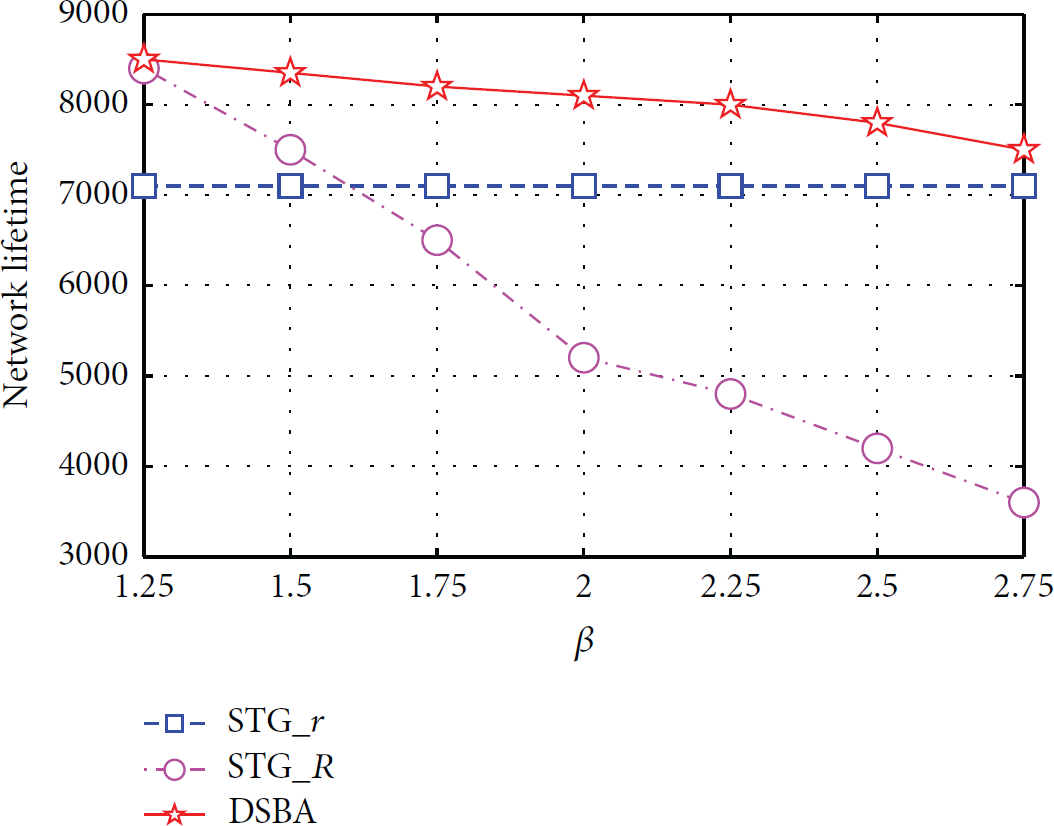
The network lifetime versus β, where the backbone nodes using a large-range radio (or small-range radio) consume β (or
5.2. Size of Virtual Backbone
Figure 6(a) (or Figure 6(b)) shows the simulation results concerning the average nodes of virtual backbones in the networks when the initial energy of each sensor is

The average size of virtual backbones versus the number of network nodes ranging from
5.3. Residual Energy
Figure 7(a) (or Figure 7(b)) shows the simulation results in terms of the average residual energy of all nodes in the networks when the initial energy of each sensor is

The average residual energy of all nodes in the networks versus the number of network nodes ranging from
5.4. Number of Virtual Backbones
Figure 8(a) (or Figure 8(b)) shows the simulation results in terms of the average number of virtual backbones when the initial energy of each sensor is

The average number of virtual backbones versus the number of network nodes ranging from
6. Conclusion
In this paper, while considering sensors each equipped with two radio interfaces, including small-range and large-range radios, a new problem, called the Maximum Lifetime Backbone Scheduling for Dual-Radio Wireless Sensor Network problem, is introduced for finding virtual backbones to prolong the network lifetime. The Maximum Lifetime Backbone Scheduling for Dual-Radio Wireless Sensor Network problem proved to be NP-complete. Moreover, because centralized algorithms are not feasible in a wide range of wireless sensor networks, we propose a distributed algorithm, called the Dominating-Set-Based Algorithm (DSBA), to find a backbone when a new backbone is required for the network. In the DSBA, three steps are required. In the first step, the distributed dominating set algorithm (DDSA) is proposed to construct a dominating set for a given dual-radio wireless sensor network such that the nodes in the set have enough energy power to be the backbone nodes and can dominate all nodes in the network. In the second step, the distributed backbone algorithm (DBA) is proposed to establish a backbone according to the dominating set constructed by the DDSA. In the third step, the refinement for the generated backbone is proposed to minimize the size of the generated backbone or reduce the energy consumption of backbone nodes.
In the simulations, we compared our proposed method with the STG [15] that is a centralized algorithm and is used to find the virtual backbones in the network with sensors each having a single radio. The STG that used a small-range radio (or large-range radio) to construct virtual backbones was adopted and denoted by STG
Planned future research will include research in routing in multiradio mobile wireless sensor networks. Other future research will study the routing in three-dimensional multiradio wireless sensor networks.
Footnotes
Conflict of Interests
The authors declare that there is no conflict of interests regarding the publication of this paper.
Acknowledgement
This work was supported by the Ministry of Science and Technology under Grants MOST 103-2221-E-151-002 and MOST 104-2221-E-151-014.