




Abstract
The title of this paper may suggest such topics as routing, networking, and data mining, but we focus on new research angles regarding the Internet of Things (IoT) as the theme of this paper. These research angles come from other disciplines and are in the process of being adopted by the IoT. Our paper serves a key purpose: from the perspective of correlative technologies based on time, to review the evolutionary process of the IoT and depict the relations between the correlation techniques which are largely missing in current literature in which the focus has been more on the introduction and comparison of existing technologies and less on issues describing evolutionary process of the IoT. We consider that the latter is crucial to understanding the evolution of the IoT. Through generalizations of particular focus in different stages of each technology, we can better understand the current phase of the IoT and therefore predict future challenges. This paper aims to bridge this gap by providing guidance in terms of the evolutionary process of the IoT and gives readers a panoramic view of the IoT field without repeating what is already available in existing literature so as to complement the existing IoT survey papers which have not covered the evolutionary process of the IoT.
1. Introduction
The concept of the Internet of Things (IoT) originated in the Auto-ID Center at the Massachusetts Institute of Technology in 1999 [1]. The Auto-ID Center envisions a world in which all electronic devices are networked and every object, whether physical or electronic, is electronically tagged with information pertinent to that object. The underlying aim of this concept is the achievement of pervasive connections between the Internet and objects around us; that is, extending the current Internet to include interconnected physical objects and devices (i.e., Things).
The International Telecommunication Union in Tunisia formally identified the concept of the IoT at the World Summit on Information Society and released ITU Internet reports [2] that gave an in-depth introduction to the IoT and its effect on businesses and individuals around the world in 2005. It contained information on key emerging technologies, market opportunities, and policy implications. In the report, the IoT is described as follows: connections will multiply and create an entirely new dynamic network of networks—that is, the IoT.
IoT is neither science fiction nor industry hype but is instead based on solid technological advances and visions of network ubiquity that are zealously being realized. Since its introduction, the IoT received considerable attention from around the world. IBM has been working with companies, cities, and communities around the world to build a Smarter Planet for over five years. The following three primary characteristics of the IoT were generalized by IBM in its smarter planet plan: instrumented, intelligent, and interconnected [3]. So far, as shown in Figure 1, the IoT has been launched as demonstration applications in different fields, including intelligent industry [4, 5], intelligent agriculture [6], intelligent logistics [7], intelligent transportation [8], smart grid [9], environmental protection [10], security protection [11, 12], intelligent medical care [13–16], smart home [17], and smart cities [18–20].

IoT applications applicable in different fields.
The motivation of this paper is as follows. We aim to review the evolutionary process of the IoT. We conducted this from the perspective of correlative technologies and present the process in a chronological order. Through generalizations of particular focus in different stages of each technology, we can better understand the current phase of the IoT, and therefore predict future challenges. Information on evolving the IoT into the Web of Things is missing in the current literature. It focuses more on the introduction and comparison of existing technologies and less on the evolutionary process of the correlative technologies. We feel that the latter is crucial to understanding the evolution of the IoT.
The rest of the paper is organized as follows: In Section 2, we generalize the evolutionary process (in chronological order) of the IoT from the perspective of correlative technologies and depict the relations between the correlation techniques which are largely missing in current literature. In Section 3, some research angles regarding technologies, applications, architecture, platforms, prototypes, existing problems, and future challenges of the IoT are summarized in existing researches. We conclude our paper in Section 4.
2. Evolving IoT into Web of Things
From the birth of ENIAC, the first computer, in 1946 to the present day, a period of almost seventy years, the rapid development of information and computing technologies has experienced an evolution from traditional mainframes to modern microcomputers. Furthermore, since 1969, based on ARPANET, which is considered to be the original Internet, an evolution from centralized high-performance computing to a distributed computing model and a distributed architecture has occurred. Nowadays, the constant expansion of the Internet leads to more extensive network coverage. In addition to raising the level of the integrated circuit manufacturing process, modern wireless communication technology has steadily improved. Many electronic devices have a communication function, and research on wireless sensor networks (WSNs) began in the late 1990s in the United States and other countries. Today, the number of devices able to access network continues to increase. With the tendency of fast growth, we see the future of the IoT tentacles to be extended to all aspects of people's lives.
In the subsections that follow, we review the chronological development of the IoT from the perspective of correlative technologies. Through generalizations of particular focus in different stages of each technology, we can better understand the current phase of the IoT and foresee the challenges to be faced in the future. Discussion of evolution of the IoT into the Web of Things is missing in the current literature, which instead has focused on the introduction and comparison of existing technologies and less on the development process of the correlative technologies, which are crucial to understanding the evolution of the IoT.
2.1. Machine-to-Machine Communication
Machine-to-Machine (M2M) Communication refers to the interconnection and interoperability between machines. As shown in Figure 2, M2M communication is typically achieved by data exchange through wireless network transmission and back-end content servers. The sensory data is collected by sensors fixed in device, transmitted by various types of network, and then processed in M2M applications as illustrated in Figure 2 in which the dataflow is from right to left side of the figure. From the perspective of M2M communication, the machine can automatically complete the communication process without human intervention. In this field, many organizations perform relevant work and develop standards, for example, the 3rd Generation Partnership Project (3GPP); however, at this stage, standards have just been completed or remain partially completed, for example, the definition of M2M, service requirements, and functional structure. In 2010, 3GPP launched the radio access network for M2M communication. Heterogeneous networks consisting of M2M communication appear in many application areas. In the future, 3G and 4G wireless technologies will play an important role by virtue of their higher data transmission rates, satisfying the needs of more M2M application services.
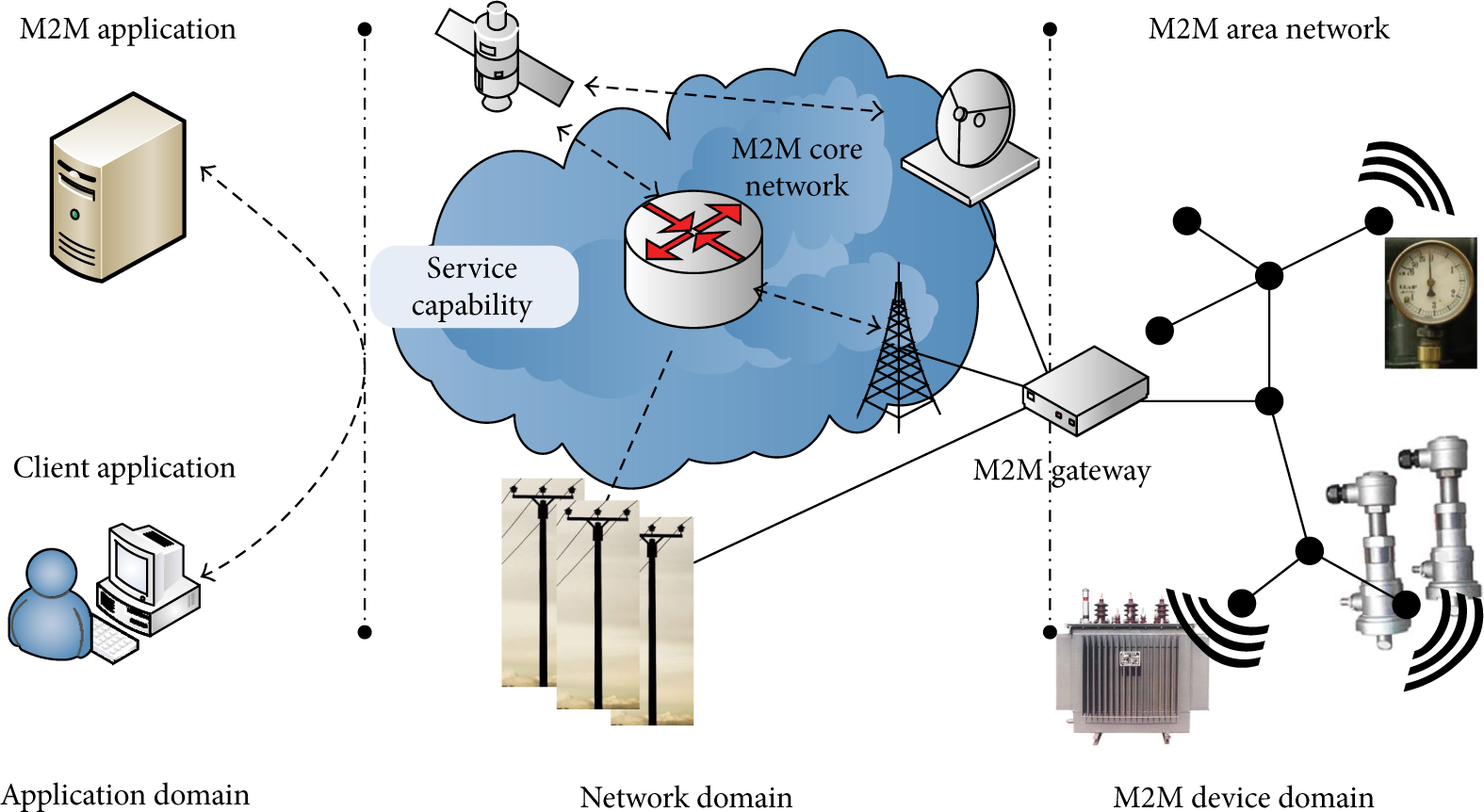
Machine-to-Machine (M2M) communications system.
M2M communications can be realized separately within various wireless networks, such as mobile cellular networks, wireless local area networks, and WSNs [21]. One of the most important components of M2M communication is WSN, described in the next subsection.
2.2. Wireless Sensor Networks
As shown in Figure 3, a WSN is composed of a large number of self-organizing sensor nodes that are deployed in free space by a given distribution. The sensors work together to complete the monitoring of specific surrounding environmental conditions, including temperature, humidity, chemical composition, pressure, sound, displacement, vibration, and contamination particles [22]. The primary goal of collecting data from the surrounding environment is for us to understand the given conditions and enable applications to better make automatable decisions with the assistance of specified rules.

Wireless sensor network (WSN).
2.3. Sensor Web Enablement and Sensor Web
In 2001, the Open GIS Consortium (OGC) produced services-based architecture and standards for multiple heterogeneous sensors—that is, the sensor web enablement (SWE) architecture—that included languages for describing sensors, their capabilities and measurements, and other relevant aspects of the surrounding environments. In SWE, the geographic information of the sensor is a fundamental attribute. With the integration of sensor data and geographic information published on the web, developers are able to implement a variety of applications in order to meet the different needs of users by accessing and using all types of network sensors via the web or other networks. At this stage of the research, further integrated sensor data is linked to the web. This research has generally been called sensor web (SW).
SW can be considered an extension of general sensor networks (SNs). It is generally used for large-scale distributed environments that are primarily distributed in different locations and composed of nonfixed network structure sensor platforms called pods. Pods transmit data using wireless communication methods. Each pod knows all the data measured by other pods in the current measurement cycle.
Recently, the “E-Skin of Earth” concept was proposed [23]. It refers to covering the surface of the earth to collect, via SW, real-time information for various geographic activities to form a huge information network of such data. With the development of SNs, SW has become an emerging field of study that represents real-time information systems with spatial dimensions, and related projects are already underway, such as University of California's “JPLSensor Web” project [24] and Microsoft's “Sensor Web” project [25]. The goal of the JPLSensor Web project is to establish a sensing platform for real-time monitoring of the environment. Similarly, in their Sensor Web project, Microsoft hopes to implement the concept of Earth's electronic skin through real-time monitoring of the entire earth. Further, as shown in Figure 4, Microsoft also established an online platform called the “Sensor Map,” where users can obtain real-time information by taking advantage of the different types of sensors.

Example of Microsoft's “Sensor Web” project.
2.4. Web of Things
With the development of the Web, the traditional Web 2.0 will inevitably evolve to cope with the heterogeneity of data, networks, and devices. The concept of the Web of Things (WoT) has been proposed and developed. The WoT not only enables smart devices to share information and interoperate with the web but also introduces numerous electronic devices or sensors as services on the web.
The WoT shortened the distance between the virtual and physical worlds by complementing the conventional web with physical sensors. The WoT uses a standardized application protocol (HTTP) instead of a transport mechanism to provide a means for sensors to connect with the Internet. The WoT [26] started with smart gateways running a web server that provided access to different devices in a RESTful manner [27].
Above the level of transmission data, the WoT depicts data streams from the physical world as Web Service (WS) [28]. By interacting with conventional WS, we can discover, compose, and execute different WS in different application development. There are two optional methods for integrating with the web: direct and indirect integration [29]. The direct integration approach requires devices to have good hardware performance so that the devices can be addressed as IP-enabled with a web server embedded directly in the device. Kovatsch et al. proposed an architecture called Actinium, providing a runtime container that supports the RESTful programming model by using the constrained application protocol (CoAP) [30]. In Actinium, applications can be created by simply mashing up resources provided by CoAP servers on devices and classic WS.
Using the indirect approach to integrate with the web, devices are resource-constrained and are not powerful enough to run a web server. In such cases, an intermediate proxy is established between the devices and web. The proxy is used as a web server gateway to communicate with other web servers. Using the proxy, we can also integrate heterogeneous data as WS, such as from RFID or sensor data.
2.5. Semantic Sensor Networks
With the scale of WSNs increasing, the compositions of such networks change more rapidly. Furthermore, an increasing number of types of sensors are being added to these networks. To solve the problems of variability and heterogeneity in WSNs, some researchers have proposed a new field of study called semantic sensor networks (SSNs).
The approach with SSNs is to abstract the data and explain its meaning. To better understand the meaning of sensor data, semantic technologies and ontologies have been introduced into this field, thus improving semantic interoperability and integration. This also facilitates automated reasoning and classification tasks not addressed in the OGC standards.
Sensors were abstracted and described in ontologies with results to be organized, managed, queried, understood, and controlled via high-level specifications. From 2009 to 2011, the W3C Semantic Sensor Network Incubator Group produced ontologies that define the capabilities of sensors and sensor networks. The group also developed semantic annotations of a key language used by services-based sensor networks. In the final report of the W3C Semantic Sensor Network XG [31], published in June 28, 2011, a set of ontologies have been developed and studied to describe sensors and sensor networks for use in sensor network and sensor web applications.
Recommended methods were proposed and adopted as extensions to the ontology to semantically enable applications according to the available standards, such as SWE standards. The semantic sensor network ontology is the core content of SSNs, with use cases and ontology modules, as shown in Figure 5. The figure represents semantic sensor network ontology classes in rounded rectangles and use cases in underlying (and larger) rectangles. In future, the ontology must be standardized in a linked sensor data context and bridge the IoT and the Internet of Services with the ontology in the SSN. Semantic web technologies require establishment of a complete ontology definition in advance; however, in practice, due to the different emphasis of different scenarios, it is often difficult to create a unified ontology to describe the physical world.
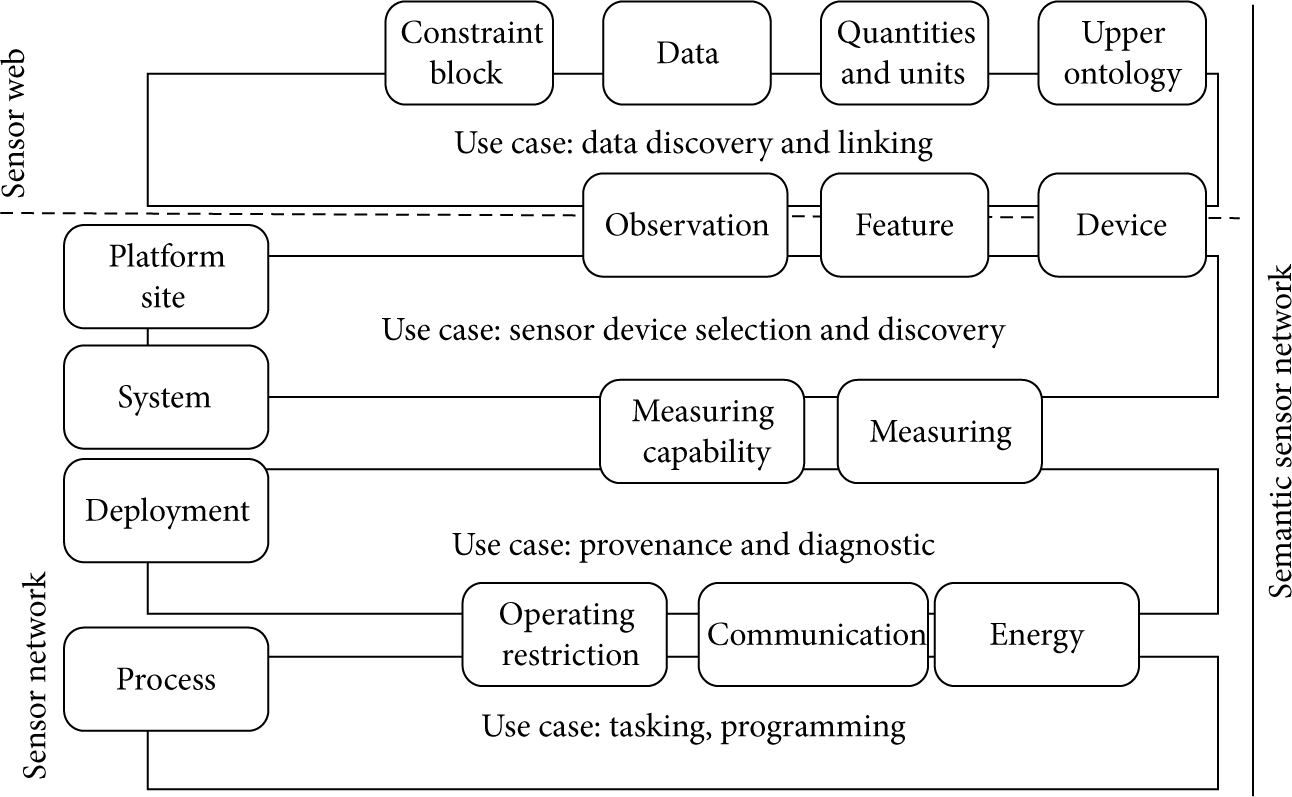
Differences in sensor web (SW), sensor network, and semantic network.
The IoT is a virtual connected network, as shown in Figure 6, which is fundamental to the web [32, 33]. Applying semantic web technologies and WS, virtual representation of things can be connected, queried, and integrated. The semantic vision [34] addresses data management issues that arise in the context of vast amounts of information exchanged by smart objects and the resources available through the web interface. The idea here is that standardized resource descriptions are critical to enabling of the interoperability of the heterogeneous resources available through the WoT. More specifically, semantic vision is the separation of the meaning of data from the actual data. The basic concept is that the semantics of objects are stored separately from the data and effective tools exist to manage this information.

IoT data management of semantic vision.
A variety of measurement data from multiaccess networks are collected to monitor things. To abstract and integrate the massive amounts of heterogeneous multisource IoT data, some researchers have proposed unified description models with which everyone would need to comply. The Open Geographical Consortium (OGC) model [35] provides a high-level overview and architecture that focus on sensors, SNs, and SW. As noted above, this OGC model focus area is known as the SWE and provides some standard tools, including the Observations and Measurements XML, SWE Common Data Model Encoding Standard, SWE Service Model, Sensor Model Language Encoding Standard, Sensor Observation Service Interface Standard, Sensor Planning Service Interface Standard, PUCK Protocol Standard, Sensor Alert Service, and Web Notification Service.
The OGC model is a comprehensive high-level description; however, because it has been developed in XML, machines cannot alone understand it or perform automated inference or reasoning. Another high-level description based on ontologies is required. The World Wide Web Consortium (W3C) developed the SSN ontology [36] to model sensor devices, systems, processes, and observations. The SSN ontology enables expressive representation of sensors, sensor observations, and the environment. The SSN ontology is encoded using OWL and has started to achieve a wider adoption within the IoT community. Not only does it offer good high-level sensing descriptions but it also supports interoperability between machines.
2.6. Evolution among Technologies
The evolution of sensors, SNs, SWs, WoT, and SSNs is illustrated in Figure 7. These technologies come from other disciplines and are in the process of being adopted by the IoT based on time, to review the evolutionary process and depict the relations between the correlation techniques which are describing evolutionary process of the IoT.

Evolution of Sensors, SNs, SWs, the WoT, and SSNs.
In Figure 7, the first row presents corresponding standards belonging to the technologies; the second row specifies every technology in chronological order; the third row details diverse core concerns of every stage. The standards are promoted by different standardizing bodies which change from communication technology domain to information technology domain.
The fundamental difference in core concerns of every stage lies in finer granularity processing and more sufficient utilization of data. The change of core concerns illustrated in the third row of Figure 7 is elaborated further as extend gradually to incisive connotation of data. We can grasp the meaning of development trend in the perspective of data levering by Figure 8 in which preliminary stage is at the bottom and current stage is at the top. In preliminary stage that is comprised of the first two columns in Figure 7, namely, sensor devices and sensor network, it addresses the major issue of encoding of raw sensory data; therefore we name the formatted raw sensory data as data in Figure 8. In the next stage that is comprised of the third and fourth columns in Figure 7, namely, sensor web and the Web of Things, it annotates the raw sensory data with various labels and tags. After that, the data possess the ability of self-explanation and interactivity with context; therefore we name the data as information in Figure 8. In the current stage that is comprised of the fifth column in Figure 7, namely, Semantic Senor Network, it establishes broader and more comprehensive relationship with massive data which is generally from heterogeneous sources; therefore we name the data as knowledge in Figure 8.
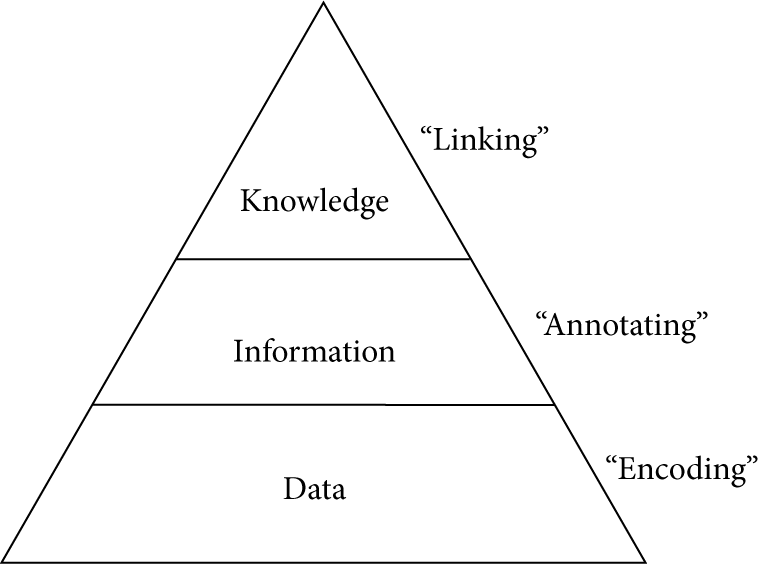
Development trend of core concerns of every stage in the perspective of data.
IoT is neither science fiction nor industry hype but is instead based on solid technological advances and visions of network ubiquity that are zealously being realized. A onefold technology cannot satisfy the IoT requirements; we consider that the IoT is convergence of the six emerging technologies at least. The relations between M2M communication, SSNs, the WoT, the IoT, SNs, SSW, and SW which are the constitutive elements of the IoT are depicted in Figure 9. In [37], Atzori et al. summarized these relations as three visions of the IoT; they are things-oriented, semantic-oriented, and Internet-oriented visions.

Relations between M2M communication, SSNs, the WoT, the IoT, SNs, SSW, and SW.
3. Other IoT Surveys in a Nutshell
For completeness purpose, these aspects that have been covered by existing literature are briefly summarized with explicit references to the corresponding survey papers. This section gives readers a panoramic view of the IoT field without repeating what is already available in the literature.
Miorandi et al. [38] provided an overview of key technologies, applications, impact areas, related ongoing initiatives, and security for the IoT. Gubbi et al. [39] also summarized IoT technologies and applications, pointing out future challenges and directions; however, they focused on a cloud-centric vision and presented Aneka, a user-centric cloud-based model based on interactions within private and public clouds. Atzori et al. [37] reported different visions of the IoT paradigm and reviewed related enabling technologies. Gluhak et al. [40] identified requirements for the next generation of IoT experimental facilities, giving a taxonomy of applications. This taxonomy had nine requirements, which were scale, heterogeneity, repeatability, federation, concurrency, experimental environment, mobility, user involvement, and impact. After comparing between different IoT applications, Gluhak et al. found that these applications did not fully satisfy the requirements.
With the development of the Web, the traditional Web 2.0 will inevitably evolve to cope with the heterogeneity of data, networks, and devices. The WoT survey papers [29, 41, 42], referring to the WoT, discussed the inevitability of the appearance of the WoT and proposed their views regarding the architecture and key enabling technologies. Inspired by the material cycle of the physical world, Zhong et al. [42] proposed the concept of the Wisdom Web of Things (W2T), which aims for a harmonious coexistence of humans, computers, and smart things in the emerging world. Zeng et al. [29] noted the trend of viewing the IoT as the WoT with open web standards supporting information sharing and device interoperation.
Context awareness has been a practical solution for helping us understand the raw data produced by large numbers of IoT devices. Perera et al. [43] surveyed context awareness from an IoT perspective, provided an in-depth analysis of context lifecycle, and evaluated a subset of 50 projects from 2001 to 2011 based on their own taxonomy.
As pointed out in [32, 44–46], semantic technologies may help solve the problem of interoperability among heterogeneous embedded devices in the IoT. Hence, they reviewed recent developments in applying semantic technologies to the IoT, including information modeling, ontology design, and semantic data processing.
The IoT emphasize connecting every object around us by leveraging a variety of wireless communication technologies. These objects are typically referred to as “smart objects.” Several middlewares were proposed for smart objects. In [47], the authors present a review of middlewares for smart objects and compare them according to the most important general and specific requirements that have been identified in the literature so far.
In 2014, an interesting study [48] analyzed the opportunity of integrating the concept of social networks into the IoT. In this paper, the researchers presented major ongoing research activities and classified three evolutionary stages of the objects comprising the IoT.
4. Conclusions
The reaches of the Internet have extended to all aspects of people's lives and drastically changed how we live. The IoT is considered as the next big leap ahead in the ICT sector, because it does not merely include the connectivity of smart things but it focuses more on the interactions and interoperations between things and people. Through the massive deployment of embedded devices, the IoT may see the vision of “anytime, anywhere, anything” communications realized. The IoT aims to seamlessly merge the real and virtual worlds such that tomorrow's world will be a fusion of human life and information.
The IoT is the combination of multiple techniques; a onefold technology cannot become the IoT. In this survey paper, we summarized the development of the IoT from the perspective of correlative technical development according to time. Through generalizations of particular focus for different stages in the study of each technology, we can better understand the current development stage of the IoT and predict key points of its future development. We consider core concern of the loT in future which is to facilitate utilization of data in finer granularity.
We hope that this survey has served to be useful to researchers and practitioners in the field, helping them to understand the history and motivation of the IoT. Predictably, the IoT will grow into information infrastructure in people's future lives. Therefore, more efforts to tackle these challenging issues must be made from both industry and academia to promote the progress and realization of the IoT.
Footnotes
Conflict of Interests
The authors declare that there is no conflict of interests regarding the publication of this paper.
Acknowledgments
This work is funded by European Framework Program (FP7) under Grant no. FP7-PEOPLE-2011-IRSES, National Natural Science Foundation of China under Grants no. 61073009 and no. 61103197, National High Tech R&D Program 863 of China under Grant no. 2011AA010101, National Sci-Tech Support Plan of China under Grant no. 2014BAH02F03, National Sci-Tech Major Projects of China under Grant no. SinoProbe-09-01-03 & 2012ZX01039-004-04-3, Key Sci-Tech Program of Jilin Province of China under Grant no. 2011ZDGG007, the Key Scientific and Technological Project of Jilin Province of China under Grant no. 20150204035GX, and the Fundamental Research Funds for the Central Universities of China under Grant no. JCKY-QKJC46.