




Abstract
A method of Doppler frequency spread (DFS) estimation algorithm is discussed which is suitable for high-mobility Orthogonal Frequency Division Multiplexing (OFDM) systems. DFS is a main factor which may mitigate the performance of system. The proposed method is based on autocorrelation function algorithm of received signal which utilizes cyclic prefix (CP) to estimate Doppler spread. The estimation algorithm uses least square (LS) method between the autocorrelation function of received signal and the zero-order Bessel function which is approximated by the expansion of power series. Then the estimation bias is analyzed and using polynomial fitting method can effectively correct estimation error at different DFS, respectively. Compared with the previously proposed method, the estimation performance of DFS in the proposed method has better performance. Simulation results show that when sufficient elements are used, the proposed scheme can effectively estimate DFS and can be applied into high-mobility OFDM systems.
1. Introduction
The Orthogonal Frequency Division Multiplexing (OFDM) which is regarded as a key technology has been applied for the fourth generation wireless communication systems. Because of its advantages, such as antifrequency selective fading, resistance to strong narrowband interference, and high spectrum efficiency [1], OFDM has a wide application prospect in the Time Division Long Term Evolution (TD-LTE) mobile communications systems [2].
The TD-LTE mobile communication systems need to support mobile communication systems with terminals moving at speed of up to about 350 km/h [3]. When we employ OFDM technology in TD-LTE mobile communication systems, the high speed between transmitters and receivers can cause some bad effects; one of the main drawbacks is DFS which can destroy the orthogonality between subcarriers. Besides, it also brings intercarriers interference (ICI) which will cause the degradation of BER performance for OFDM communication systems [4, 5]. If Doppler spread can be estimated at the receiver, we can improve the performance of the communication systems. Therefore, estimation of DFS is inevitable for the application of OFDM systems in high-mobility environment.
In the existing technical literatures, researchers have proposed several Doppler frequency estimation methods for OFDM systems; the main DFS estimation methods can be classified as follows. In [6], a method based on the maximum-likelihood is employed in time-varying multipath channels. This method requires amounts of data and complexity computation. Another method based on the level crossing rate (LCR) method is presented in [7, 8] whose estimation accuracy is based on the complexity of estimator. Channel estimation is used to estimate DFS which is very perfect in lower Doppler frequency in [9]. But if the channel estimation is bad, it will reduce the accuracy of DFS. A conditional method of autocorrelation function of received signal is displayed in [10]; the estimation results show that the deviation between estimated value and real value is big; in addition, the method does not reflect high-mobility environment. In [11], this paper proposes a parametric spectrum estimation of DFS which considers two-ray arriving at the receiver. The DFS is estimated by angle of arrival which can be obtained from signal space decomposition. A method of DFS dependent on phase difference is used in [12]. In [13–15], the autocorrelation of channel response can also be used to estimate Doppler spread in both time domain and frequency domain. Although these methods can estimate DFS to some extent, all of these channel response methods need pilot information and complexity computation for accurate DFS.
This paper proposes a method based on cyclic prefix for OFDM systems in time-varying fading channel to achieve the accurate Doppler frequency spread. The proposed method utilizes LS method between autocorrelation function of received signal and approximated zero-order Bessel function of first kind, and then method of quadratic polynomial fitting can reduce the error between the real Doppler spread and the estimated Doppler spread. Compared with the conditional method, the proposed scheme can improve the accuracy of DFS. The remainder of the paper is organized as follows. Section 2 presents the OFDM system model. Section 3 discusses the proposed DFO estimation algorithm in detail. The results of computer simulations are described in Section 4. Finally, the paper concludes with a short summary in Section 5.
2. System Model
We consider the scenarios of high mobile communication, such as communications between high-speed train and the base stations in the mountainous environment. The high-speed train receives the downlink signals from the base station (BS). As shown in Figure 1, without loss of generality, let N be the number of orthogonal subcarriers; the original signal is modulated by N-point inverse Fast Fourier Transform (IFFT). In order to avoid intersymbol interference (ISI), a copy of the last samples which is longer than the length of the maximum channel delay is inserted at the front of the useful symbol's time. We make it as the guard interval between two adjacent symbols. Figure 2 is the cyclic prefix structure. An integrated OFDM symbol is composed of useful signal and cyclic prefix.

Rayleigh channel model for high-mobility communication.

Cyclic prefix structure.
Frequency domain signal is denoted by

Figure 3 is the block diagram of DFS estimation process [16]. At first, at the transmitter, random input data is modulated by quadrature phase shift modulation (QPSK), and then the serial information sequence undergoes the serial-to-parallel (S/P) conversion. After IFFT, the output signals of the OFDM transmitter will be orthogonal with each other. A cyclic prefix is appended in order to mitigate the multipath effects and is regarded as a guard interval between two adjacent symbols. Then the data is converted by parallel-to-serial conversion, after transmitting over Rayleigh fading channels. AWGN and Doppler frequency spread are superimposed on the data. Then the autocorrelation function of cyclic prefix signals can be calculated and DFS can be estimated by LS estimation. Polynomial fitting can mitigate the DFS estimation error.
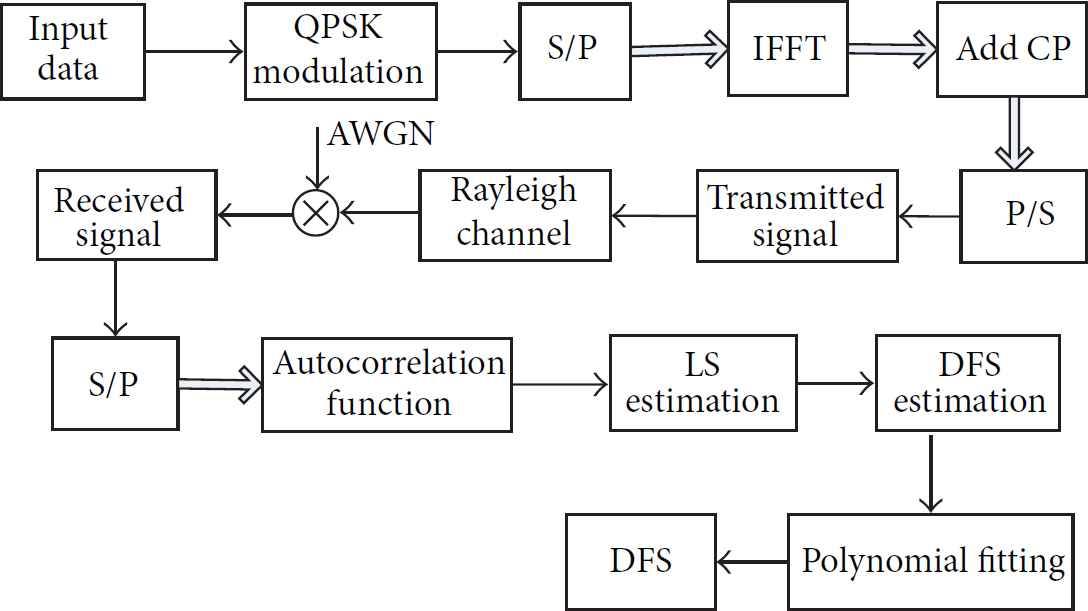
The block diagram of Doppler spread estimation process for OFDM systems.
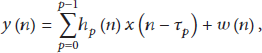
In this paper, the environment we consider is high-mobility train in the mountainous environment; the obvious features of wireless channel are frequency selective fading and time selective fading. We consider a communication system employing a single transmit and receive antenna. In the mountainous environment, we assume the channel is Rayleigh channel and the signal has propagated through p different limited paths with each having independent phase shift, attenuation, and delay. So in the paper the channel transfer function which is based on time-varying multipath can be defined as [17]


After passing through multipath channels, the received signal is the superposition of all multipath components at the output of the received antennal. So the mth received time-domain OFDM signal

3. DFO Estimation
3.1. Algorithm Principle
Every received signal can be described as a sequence of complex and the form of discrete sampling points can be expressed as

After joining cyclic prefix, integrated OFDM symbol contains two same parts, so Doppler frequency spread can be estimated based on these two same parts. Assuming that OFDM's synchronization has been reached and the received signal is transmitted over a correlator, the autocorrelation function of the kth cyclic prefix symbol can be described as

Based on Central Limited Theorem, the autocorrelation function of received signal can also be calculated and displayed as [10]


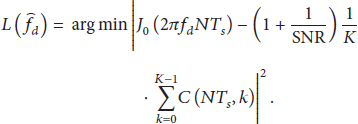
Form the analysis of theory, normalized autocorrelation function has a relationship with zero-order Bessel function of the first kind. By calculating the autocorrelation function, Doppler frequency shift can be estimated by least square:
3.2. Correct Estimation Error
Although Doppler frequency spread


By (12), the estimated error is mitigated and the corrected DFS is more accurate.
3.3. The Feature of Bessel Function
Based on the characteristic of Bessel function, it can be seen that Bessel function is not a monotonic curve and is a nonlinear curve. Therefore, these two aspects can affect the accuracy of the simulation. Because inverse Bessel function is also not a specific formula, we can use look-up table (LUT) method to obtain the Doppler frequency spread. Bessel function and its inverse function graphs are shown in Figure 4; we can see from the figure that zeroth Bessel function of the first kind is not a monotonic function. So choose an appropriate N to ensure that

Based on the explanation above, the property of Bessel function is nonlinear. So the independent variable of zeroth Bessel function of the first kind in (10) should be located in the estimated monotonic range; that is, it must be limited between 0 and

Approximation of Bessel function.
4. Simulating Results
Computer simulation is performed to evaluate the DFS. In this section, we will validate the performance of modified scheme in high-mobility OFDM communication systems. The main parameters of the investigated OFDM systems are set. We assume an OFDM system with
The reference model of multipath channel.

Figure 6 shows the performance of the proposed Doppler frequency spread estimation method under different SNR as 6 dB, 15 dB, and 20 dB when the order

Estimated
The normalized mean square error (NMSE) is employed in the evaluation of accuracy for the modified estimation method to display the performance of the proposed method:

Figure 7 shows the comparison about NMSE of Doppler frequency spread between the conventional cyclic prefix algorithm in [10] and the modified method. As we can see from this figure, when the relative Doppler frequency spread is small, the conventional cyclic prefix method is not suitable and the NMSE is higher than the proposed method. Although at some point the performance of proposed method is poor, from the entire graphics view, the NMSE of the method in this paper is lower than conditional cyclic prefix method. The proposed MSE is below 1% when DFS is 1 kHz.
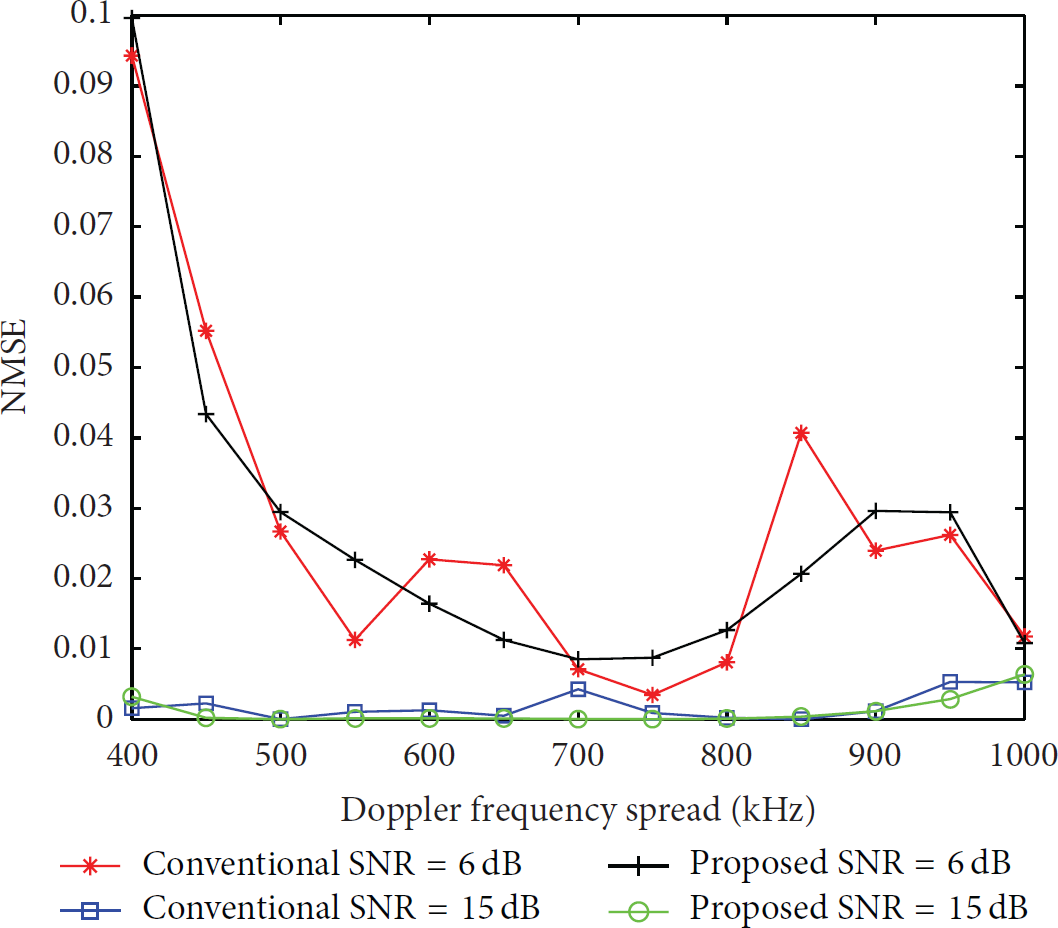
NMSE comparison between modified and conventional method.
Figure 8 shows the comparison of estimation accuracy between the conventional cyclic prefix algorithm and the modified method with changing the real Doppler frequency shift from 0.1 kHz to 1 kHz. In this figure, it can be observed that the deviation value of the modified method is smaller than conditional cyclic prefix algorithm. Although simulation results are not stable, from the entire graphics view, the modified DFS estimation method has better performance.

Comparison between conventional and modified method based on different SNR.
5. Conclusion
A new Doppler frequency spread estimation method used in high-mobility OFDM communication systems is displayed in this paper which has a large estimation range in high-mobility situation. The proposed method is based on autocorrelation algorithm of received signal which utilizes cyclic prefix to estimate Doppler spread. By comparing the ideal autocorrelation function value with the estimated autocorrelation function of the received signal, we can use LS method to estimate Doppler frequency spread. However, error exists in estimated DFS; in order to mitigate the estimation bias, polynomial fitting method we used can effectively correct estimation error. The modified DFS is used for minimizing the impact of DFS on the BER performance. The estimation error analysis and the simulations results show that the proposed scheme has better performances and can be applied into high-mobility OFDM communication systems.
Footnotes
Conflict of Interests
The authors declare that there is no conflict of interests regarding the publication of this paper.
Acknowledgments
This research was supported by the National Natural Science Foundation of China (nos. 61172055 and 61471135), the Open Research Fund of Guangxi Key Lab of Wireless Wideband Communication & Signal Processing (no. 12106), and the Innovation Project of Guangxi Graduate Education (no. YCSZ2014144).