




Abstract
Wireless sensor networks (WSNs) are widely used in many different fields. Even in the public sector, various services using WSN are offered. One of the key issues is how to control and manage heterogeneous devices of WSN devices. Devices Profile for Web Services (DPWS), a standard of Web services, has been adopted to solve the problems of interoperability between WSN devices. In order to evaluate WSN services in the public sector, this paper presents a method to evaluate Web services, a base technology of sensor network services. This paper presents a value analysis methodology assessing tangible and intangible benefits of Web services in the public sector. We classify stakeholders of Web services as a government, citizens, and agents (businesses) and selected the metrics for each stakeholder's benefit. After that, we determine the weight of each metric through AHP. The result shows that social value was the most important benefit in the construction of Web services in the public sector. We expect that the main contribution of this paper is the development of a value assessment framework that reflects the unique characteristics of Web services in the public sector.
1. Introduction
Wireless sensor network (WSN) is used in many various fields recently [1, 2]. As a result, various studies are carrying out and, in particular, it became necessary to control and manage heterogeneous devices of WSN. Web services have been adopted to solve the problems of interoperability between devices, and a variety of services using WSN with Web services were developed [3–7]. In the private sector as well as in the public sector, services including waste management, disaster management, and traffic information were offered by using WSN. Most of services offered by the smart city use Web services [3, 4, 6, 8, 9]. As Web services became widely used in terms of both aspects of technology and service, there is a growing need to consider proper use of Web services, when evaluating WSN in the public sector.
The smart city concept is used in many countries as a strategy to implement e-government and a lot of cities such as Vienna, Amsterdam, Dubai, and Yokohama provide various services for the smart city [10–12]. E-government becomes an enabler for countries to achieve national competitiveness for the sake of development and wellbeing of their citizens [13–15]. In that sense, Web services became one of the catalysts that could promote better communication between government agencies and citizens [16–19]. Many countries adapted Web services for their e-government IT systems [10, 20]. Moreover, Web services provide standards for enterprises and governments to integrate an application infrastructure cost effectively. The standards also help to compose new service-oriented businesses and make third party software marketplaces.
However, research about evaluation of the proper use and construction of Web services in the public sector is insufficient [21, 22]. Therefore, we suggest an evaluation method for Web services in the public sector. The most important issue of our research is the fact that Web services in the public sector have different characteristics about stakeholders compared to the private sector.
It is a noticeable characteristic that all of the stakeholders (government, agency, business, and citizen) can get benefits, respectively, through Web services in the public sector. Therefore, we develop metrics for each stakeholder's benefit. We expect that the social value would be the most important value in our framework while it was not significantly considered in most previous studies that focused on the private sector.
2. Related Work
2.1. Wireless Sensor Networks and Web Services
A wireless sensor network (WSN) means a device of sensors autonomously monitoring physical or environmental conditions distributed in a certain space, such as temperature, pressure, and sound, and cooperatively passing their data to a main location through the network. WSN is a group of wireless sensor nodes. Wireless sensor node is a tiny independent device with the capability of wireless communication, sensing, and computing [23, 24]. A numerical increment of devices requires managing device interaction and interoperability simple way. Web services handled interoperability issue. Web services are the international standard technology supporting the interoperability between different kinds of operating systems, networks, and development programming language [25]. The first proposal version of the Devices Profile for Web Services (DPWS) was released in 2004 [7]. The DPWS specify a minimum set of constraints on the implementation on devices with limited resources. It enables secure Web services messaging and dynamic Web services discovery and description. The SIRENA (Service Infrastructure for Real-Time Embedded Networked Applications) project developed the first framework adapting DPWS [26]. DPWS are currently an OASIS standard [7], which is chosen as a suitable subset of Web services protocols for machine-to-machine (M2M) communication. As Web services technologies have widespread use in the WSN, it is important to assess the web services.
2.2. Wireless Sensor Networks in the Public Sector
WSNs have an important impact on multiple fields such as environmental change detection, health care monitoring, and supply chain management. In particular, in the public sector, waste management, disaster management, facilities management, health care, educational services, cultural tourism services, rental services, traffic information, illegal parking management, and structure monitoring are utilizing WSN.
Such services put all together can be defined as the smart city. The aim of smart city is to make better connection of important city infrastructure components (city administration, education, healthcare, public safety, real estate, transportation, and utilities) and services [27]. In Harrison et al.'s study, a smart city is defined as an instrumented, interconnected, and intelligent city [8]. Instrumentation enables acquiring and integrating live real-world data by utilizing systems of sensors, meters, and software in IT systems. Interconnection means the integration of information acquired from instrumented systems through public and private networks in the city and the communication of such information across multiple processes including exchange of public services by various city agencies. Intelligent refers to analysis, optimization, and making decisions based on interconnected information for operational efficiency and improvement of quality of citizen's life.
2.3. Review on Public Service Value Measurement Methodologies
Recently, a considerable amount of efforts has been undertaken to develop concepts and methodologies to capture the value creation of Information and Communication Technology (ICT) projects in the public sector. The following list provides some examples:
While these methodologies have various approaches to value measurement, most of them attempted to apply private sector metrics, such as traditional Return on Investment (ROI) measures, to the public domain.
Compared to other methodologies, the Value Measuring Methodology (VMM) model is noticeable due to its diversity of evaluation value factors, including the social value considered in this study. Therefore, we selected the VMM model for the base evaluation framework in this study. VMM [34, 35] is a methodology for measuring the values of e-services developed by the Social Security Administration and the General Services Administration in the USA.
2.4. Theoretical Framework: Value Measuring Methodology
Value Measuring Methodology (VMM) is an evaluation model that helps decision-makers weigh tangible and intangible values when making a decision or observing benefits. Other methods to calculate the Return on Investment (ROI) have been used for many years, but there was no widely formal method to provide grounds for decisions on the basis of intangible values. For decision-makers, it was difficult to keep a balance between intangible benefits and costs, especially in case where corporations make a plan of long-term investments, and governments and nonprofit institutions that are primarily interested in intangible values make a plan of using funds within limited budget. VMM includes the perspectives of stakeholders concerned with the initiative, including direct users and government partners. VMM shows the gap between current tools and satisfies the necessity for a new different analysis methodology of planning, proposal, investment, management, and assessment.
The application of VMM starts from developing a structure of values, such as costs, risks, tangible benefits, and intangible benefits, and then giving importance to each factor in the structure. If an agreement on the relevant importance of each type of values is made, it enables decision-makers to review alternatives, consent decisions in an objective and repeatable way, and compare respective values in a project. The quantitative application of the VMM permits analysis of the contribution in total to a certain value across a range of projects. VMM was developed through the project Evaluation on Values of Electric Service in 2001 jointly conducted by Social Security Administration's Office (SSA) and General Services Administration (GSA) of the United States federal government. Booz Allen Hamilton and Harvard University's John F. Kennedy School of Government published the results from this project in a report, Building a methodology for measuring the value of e-service. In October 2002, the Best Practices Committee of CIO (The Federal Chief Information Officer) Council published a guidebook of VMM titled Value Measuring Methodology: How-To-Guide [35]. Other countries and nongovernment organizations adapted the documents from the guidebook. Accordingly, the VMM model was developed to evaluate both the quantitative and qualitative values of the government's research and development program.
3. Design of Evaluation Model
3.1. Stakeholders of Web Service in the Public Sector
The aim of Web services in the public sector is to provide benefits to government agencies and citizens. Therefore, the stakeholders of Web services in the public sector are classified as the government (government ministries initiating the Web services project), the government agencies (agencies conducting the Web services project), business (Web services system development vender), and citizens (see Figure 1).

Stakeholders of Web services in the public sector.
When the government initiates a project order with a Web services provider and IT service provider, values occur at the time that the Web services provider offers services to IT service providers (e.g., cost saving). When the Web services provider offers its services to citizens, citizens can get benefits (e.g., citizens can save time by using the Web services).
3.2. Definition of Value Structure
As discussed in the previous sections, benefits from Web services in the public sector differ depending on stakeholders, and so existing information system evaluation models are not appropriate for the public sector. After comparing evaluation models, the VMM model was selected for the basic evaluation framework because it covers the widest range of stakeholders considered.
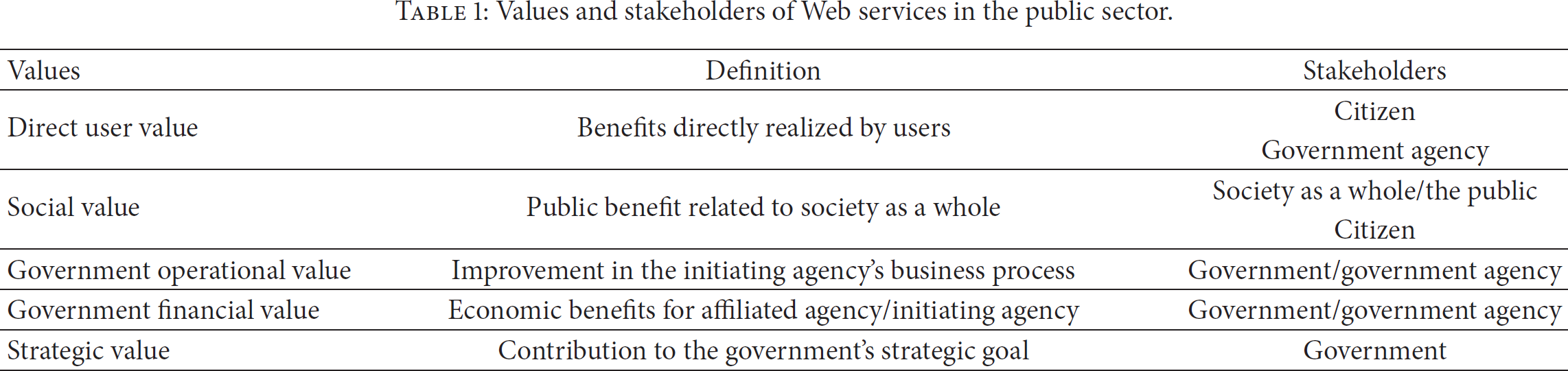
The value structure of VMM was designed to evaluate the following five value factors: (i) direct user value–value to a direct user of the information system; (ii) social value–value to society as a whole, generated by the information system; (iii) government financial value–financial value to the government; (iv) government operational value–value associated with the improvement of government operations; and (v) strategic value–value to the government in terms of policy implementation. Table 1 shows the definitions and corresponding stakeholders of the values.
Values and stakeholders of Web services in the public sector.
3.3. Benefits of Using Web Services
Web services technology provides many potential benefits. In order to evaluate public Web services, we conducted a literature review for identifying the benefits obtained by introducing Web services. After project completion, the finished project should be assessed to determine whether or not the stakeholders actually benefited from the project. This study examined the benefits of introduction of Web services by reviewing numerous papers. A summary of work by Chen [38, 39], Chen et al. [40], Ciganek et al. [41, 42], Hailstone and Perry [43], Lee [44], and Wilkes [45] is presented as shown in Table 2.
Benefits from Web services adoption.

4. Prioritization of Values and Measures
Although our framework considers exactly necessary factors for the public sector, there are priorities of factors in decision-making processes. In our proposed framework, this prioritization process was done by using an Analytic Hierarchy Process (AHP), which establishes rankings by comparing each value factor against the others. AHP is a decision-making technique developed by Thomas L. Saaty, a professor at the University of Pittsburgh in the United States [46]. In case where the evaluating criteria for the decision goal are complex and multiple, AHP is used to decompose the structure of the decision into multilevel hierarch and to establish priorities of factors through pairwise comparison of such factors.
This study used the following 4 steps of AHP generally applied.
(Step 1) Structure the decision hierarchy. (Step 2) Collect judgments data through pairwise comparison of factors. (Step 3) Measure relative weights. (Step 4) Calculate relative total weights.
We established a decision hierarchy to determine values of web services according to AHP as in Figure 2. The decision goal is the value of web services and 5 value factors were selected as the evaluation criteria in the 1st level. Each value factor has 3 or 4 subfactors as the evaluation criteria in the 2nd level.
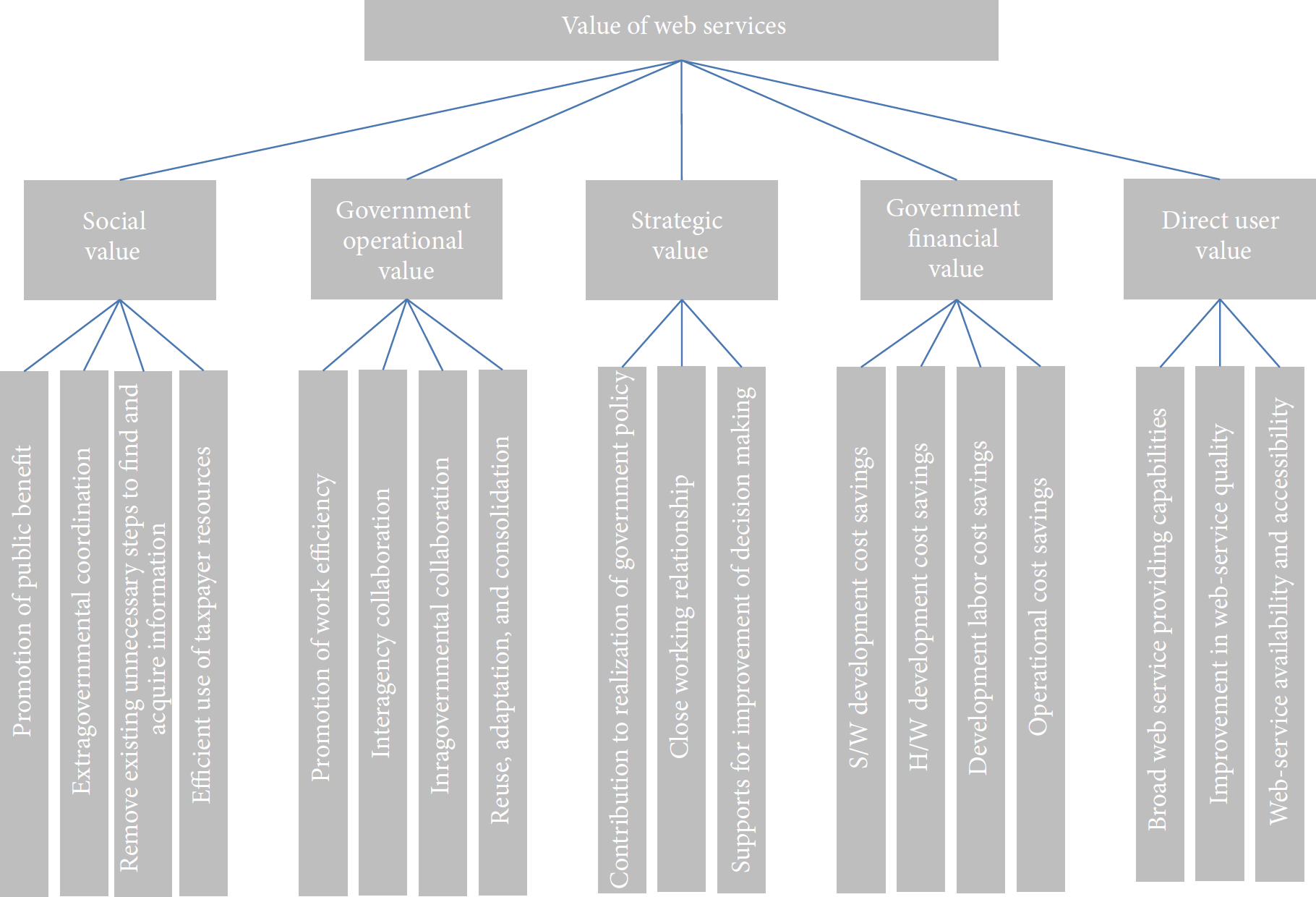
Value tree of Web Services.
After structuring the decision hierarchy, we developed AHP survey questionnaires and organized evaluation questionnaires for pairwise comparison based on 9-point scale. For AHP survey, we selected 22 professionals and the professional group participating in this AHP survey is composed of 5 professors, 14 graduate students whose major is diagnosis of IT project, 1 public e-service provider, and 2 researchers of the government department related to the public e-service. After the design of value factors and metrics, AHP analysis was performed by a group of professionals to determine the relative importance of individual values and details of metrics. In this process, this study used only the results below 0.2 of consistency ratio in order to judge the logical consistency of individual responses. Thereby, we calculated the weights for each factor reflecting expertise of professionals. The survey described in Table 3 shows that the stakeholders set a high value on the social value relatively to others.
Weighted value and measures of the web services in the public sector evaluation model.

5. Conclusion
In order to evaluate WSN services in the public sector, this paper presented a method to evaluate Web services, a base technology of sensor network services. We proposed an evaluation model for Web services in the public sector by adapting the Value Measuring Methodology as our base framework. We suggested evaluation model reflecting benefits of stakeholders of Web services in the public sector and weighted each metric by utilizing AHP analysis. As the result, we found that social value has the highest weight. This implies that social value should be preferentially considered when designing and assessing Web services in the public sector. We expect that the findings in this study can be used as reference to assess Web services in the public sector. Moreover, it suggested that the social value should be considered important in the evaluation of Web services. This model we designed has been applied to evaluation in practice and used for policy data.
Footnotes
Conflict of Interests
The authors declare that there is no conflict of interests regarding the publication of this paper.