




Abstract
This paper investigates the bit-error-rate (BER) and maximum allowable data throughput (MADTh) performance of a novel low-power mismatched Rake receiver structure for ultra wideband (UWB) wireless monitoring sensor networks in underground mine tunnels. This receive node structure provides a promising solution for low-power and reliable communications in underground mine tunnels with more than 90% reduction in power consumption. The BER and MADTh of the proposed receive nodes are investigated via Monte-Carlo simulations in UWB line-of-sight (LOS) and non-line-of-sight (NLOS)
underground mine tunnels. The proposed mismatched receive nodes achieve a MADTh and BER performance approaching the corresponding optimal nodes with ≈1 dB and 1.5 dB
BER performance degradation in LOS and NLOS scenarios,
respectively. The mismatched PRake (M-PRake) receiver model with
1. Introduction
Underground mines are characterized by their hazardous and complex nature. In particular, they are characterized by being flammable environments, and thus they require reliable networking and communication systems for safe operation. Due to this tough nature, transmission power and power consumption are two main limitations for communications in such environments [1, 2]. Typically, wireless sensor monitoring networks are crucial in underground mine channels, and they are mostly used for emergency response in critical cases. Thus, low-power communication techniques that provide reliable transmission are essential for safe and productive working conditions in underground mines [3–5].
Ultra wideband (UWB) technology has been proposed in the literature as one of the efficient data transmission techniques in underground mines. In particular, it has been proposed for communications in critical cases, such as worker safety, remote control, and wireless monitoring networks [5–9]. Typically, UWB technology provides high data-rate, low-power, and robust communications in dense multipath environments. These advantages make it an attractive candidate for the application in underground mines [10–12].
The design of a power efficient UWB receiver that provides robust performance is a challenging task, as reduced power consumption is generally traded for bit-error-rate (BER) performance degradation. Ideal all-Rake (ARake) coherent receiver is the optimal detector in multipath environments, which typically captures the energy in all multipath components. However, the robust BER performance is traded for high complexity and high power consumption of this receiver structure. Other low-complexity Rake receiver alternatives have been proposed in the literature for UWB communications, such as partial-Rake (PRake) and selective-Rake receivers. However, the analog-to-digital converter (ADC) power consumption and template generation remain as the bottleneck of the power-consumption reduction [13, 14].
On the other hand, noncoherent receivers, such as transmitted reference (TR) and energy detection (ED) receivers, do not require the generation of template pulses; thus they are less complex as compared to Rake receivers. But, again low-power consumption is traded for BER performance degradation. The receiver structures studied in the literature for UWB communications in underground mine channels included TR and ARake receivers, but both receivers have limitations for operation in underground mine channels. ARake receivers require high power consumption, and TR receivers do not provide sufficiently reliable communications required in such hazardous environments [15, 16].
Intuitively, coherent detectors seem more promising for operation in underground mines, but they require efficient power-consumption reduction techniques. In this paper we propose and investigate the performance of low-power UWB-based Rake receiver structures that provide low-power consumption with minimal BER performance degradation as compared to the optimal detectors in underground mine channels and compare them to the optimal Rake and suboptimal noncoherent detectors in underground mine tunnels. The proposed receiver structure is based on analog wavelet template-based correlators, which consume less power as compared to the commonly used Gaussian template-based detectors. Yet, they provide an approaching performance to the optimal detectors.
In [17], we provided theoretical analysis of BER and data-throughput of green-radio receiver model for in-mine communications. In this paper, we provide a comprehensive study and comparison of the models proposed in the literature, namely, optimum rake receivers and low-power transmitted receiver model, in addition to novel Rake receivers based on low-power analog correlation with suboptimal templates and finding the optimum solution for both reliable communications and low-power consumption in wireless monitoring sensor networks in underground mine tunnels in line-of-sight (LOS) and non-line-of-sight (NLOS) scenarios. More specifically, low-power wavelet template-based Rake receiver models, namely, partial rake (P-RAKE) and selective-rake (S-RAKE) receiver models, are considered. We assume binary equally probable pulse position modulation (EC-BPPM) scheme. The performance of these models is studied and compared to the optimal highly complex A-Rake and corresponding PRake and SRake receivers models with Gaussian templates. We further compare the performance to the suboptimal TR receiver, which was proposed in the literature for communications in underground mines. The rest of the paper is organized as follows. Section 2 introduces the system model and proposed receiver structure. Section 3 describes the UWB-based mine channel model for LOS and NLOS scenarios. Section 4 introduces the BER and MADTh performances of the receivers under investigation. Section 5 provides numerical results, and Section 6 gives the paper conclusions.
2. System Model
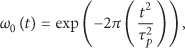
This Section describes the system model. Typically, the most commonly used pulse in UWB systems is the Gaussian pulse. The zeroth order Gaussian pulse is defined as [18]:


Underground mine tunnels are complex environments, which are rich in multipath components. The optimum detector in complex multipath channels is the optimum ARake receiver, where it captures the energy present in all multipath components. However, for UWB communications, the channels become highly frequency selective, and the number of resolvable paths is huge. Thus, such a receiver structure requires a very large number of Rake fingers. Alternate low-complexity Rake structures have been proposed in the literature, such as PRake and SRake receivers. Ultimately, these receivers save power and complexity as compared to ARake receiver [20]. However, low-complexity is traded for performance degradation [21]. Noncoherent receiver alternatives, such as TR and ED receivers, save power, but at the expense of highly degraded performance.
Communications in underground mine channels on the other hand require not only low-power consumption, but also a reliable performance. More specifically, the implementation technique of the receiver will have a great impact on the power consumption.
The main implementation categories proposed in the literature for UWB receivers are all-digital, analog, and partially-analog implementation techniques [22, 23]. The most power demanding approach is the the all-digital implementation approach, where the complexity is directly affected by the high sampling frequency of UWB signals, which is typically on the order of tens of Gigahertz. This in turn will put high restrictions on the ADC power consumption and will consequently present a major challenge for UWB system power consumption. Typically, for UWB systems the analog approaches are more convenient due to the ultra wide bandwidth, which reduces the minimum required sampling rate and consequently the power consumption [23, 24]. An ADC used in the all-digital implementation approach with a figure of merit of approximately 4e11 requires a power consumption of ≈160 mW for 4-bit and 4 GSample/sec sampling rate [24]. Typically, for low-power approaches, a simple template is preferred in correlator receivers [13, 14].
Considering the analog implementation approach of correlator receivers, the analog Gaussian pulses are generally hard to generate in the analog domain and require high power consumption. For instance, the power consumption reported in the literature for the fifth order Gaussian pulse in the analog domain is 95 mW [25]. On the other hand, wavelet UWB pulses can easily be generated in the analog domain and consume much less power as compared to Gaussian pulses, on the order of 1 μW, which leads to more than 90% power saving [26, 27]. In addition, with the careful selection of the pulse parameters, they can ultimately resemble the Gaussian monocycles. Analog wavelets are typically implemented using a single scale of the continuous-wavelet transform by constructing a linear system of the impulse response which matches a time reversed and shifted Gaussian wavelet function [26, 27].
The impulse-response of the linear filter is given by [27]:

In this paper, we investigate a mismatched Rake (MRake) receiver structure for reliable communications in underground mine tunnels, line-of-sight (LOS) and non-line-of-sight (NLOS) scenarios. The MRake receiver basically employs the low-power wavelet pulse
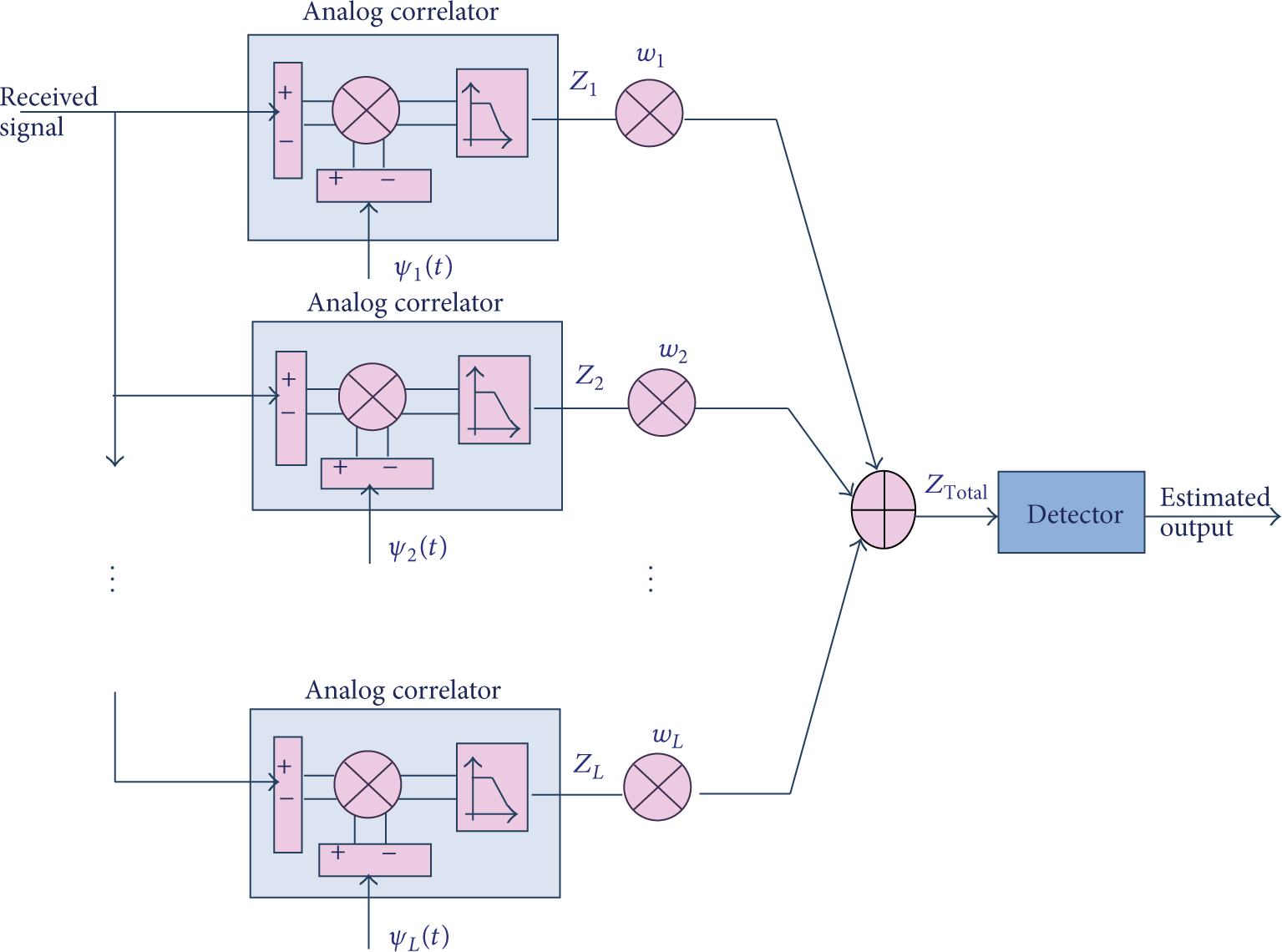
Block diagram of the mismatched Rake-based receive node.
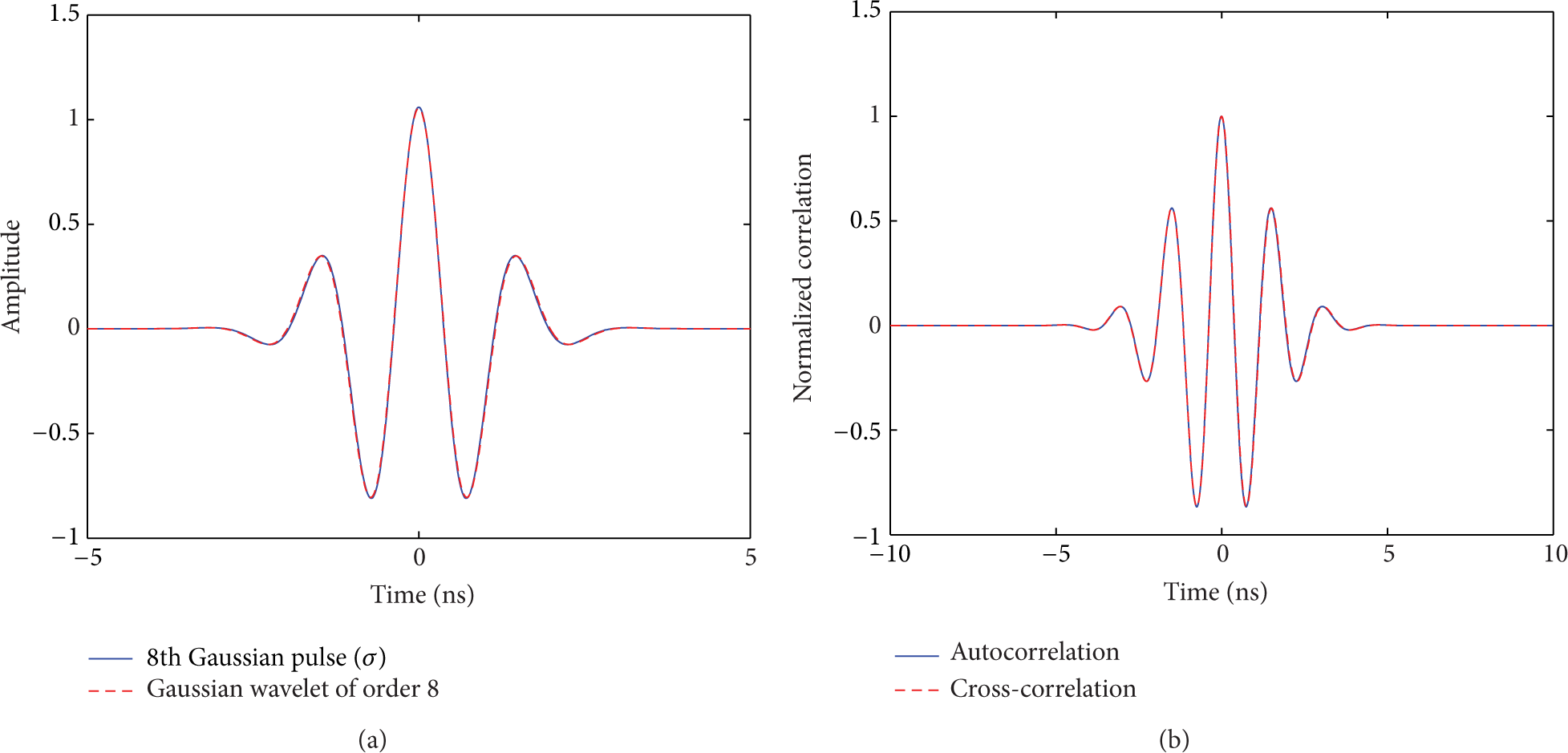
(a) Eighth order Gaussian pulse and Gaussian wavelet pulse. And (b) the corresponding cross-correlation and autocorrelation of the eighth Gaussian pulse.
The normalized autocorrelation function


3. Channel Model
Recently, many measurement campaigns have been conducted in order to characterize the UWB mine tunnel channel. Most of these measurement campaigns were conducted in the Canadian Centre for Minerals and Energy Technology (CANMET), which represents a physical environment for unground mine channels. In these measurement campaigns, both fading statistics and propagation loss were modeled. According to [3, 4, 30] the path-loss model was found to be normally distributed on the decibel (dB) scale; that is, the large-scale fading has a lognormal distribution. The path-loss is modeled as follows [4, 31, 32]:

For LOS scenario, the mean path-loss at reference distance
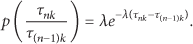
On the other hand, for small-scale fading characterization, UWB mine tunnels are dense multipath channels, in which many obstacles are present that cause the signal to be reflected. Mine UWB channels follow the IEEE 802.15.3a channel model with special parameters. According to the IEEE 802.15.3a channel model, it is characterized by being based on the cluster approach proposed by Saleh and Valenzuela (S-V) model. The S-V model is based on the fact that multipath contributions generated by the same pulse arrive at the receiver grouped into clusters. The time of arrival of cluster is modeled as a Poisson arrival process with rate Λ, and it is given by [15, 33]:

The IEEE 802.15.3a channel impulse response is given by [15, 33]:
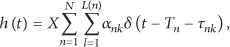
The distribution of arrival times is the modified Poisson distribution, and
4. BER Performance and Maximum Allowable Data Throughput
In this section, we investigate the performance of ARake receiver structure. For optimum correlator, The probability of bit error of EC-PPM in additive-white-Gaussian-noise (AWGN) channel is given as



The BER performance of mismatched correlator receiver assuming binary EC-PPM (EC-BPPM) scheme is given by





BER performance comparison of EC-BPPM modulation in AWGN channel for the eighth order Gaussian pulse with optimal and mismatched template correlation receivers.
For the mismatched correlator receiver, the corresponding union bound on the error performance is as

In dense multipath channels, The BER is hard to evaluate. Usually, it is estimated via averaging the BER performance obtained via Monte-Carlo simulations over

Maximum throughput is the maximum achievable data-rate for specific modulation technique, transmit power, and target BER [38, 39]. The maximum allowable data throughput (MADth) for a specific modulation scheme as given in [38] is

5. Numerical Results
This section provides numerical results based on the analysis introduced in Section 4 as well as Monte-Carlo simulations of the system under investigation in UWB-based underground mine tunnels for LOS and NLOS scenarios. First, we compare the BER performance of ARake receivers assuming optimal template (O-ARake) and mismatched wavelet template (M-ARake) in LOS scenario as shown in Figure 4. As can be seen, the O-ARake receiver outperforms the corresponding M-ARake with ≈0.5 dB for a target

BER performance of O-ARake and M-ARake receive nodes in LOS underground mine tunnels for EC-BPPM modulation scheme.
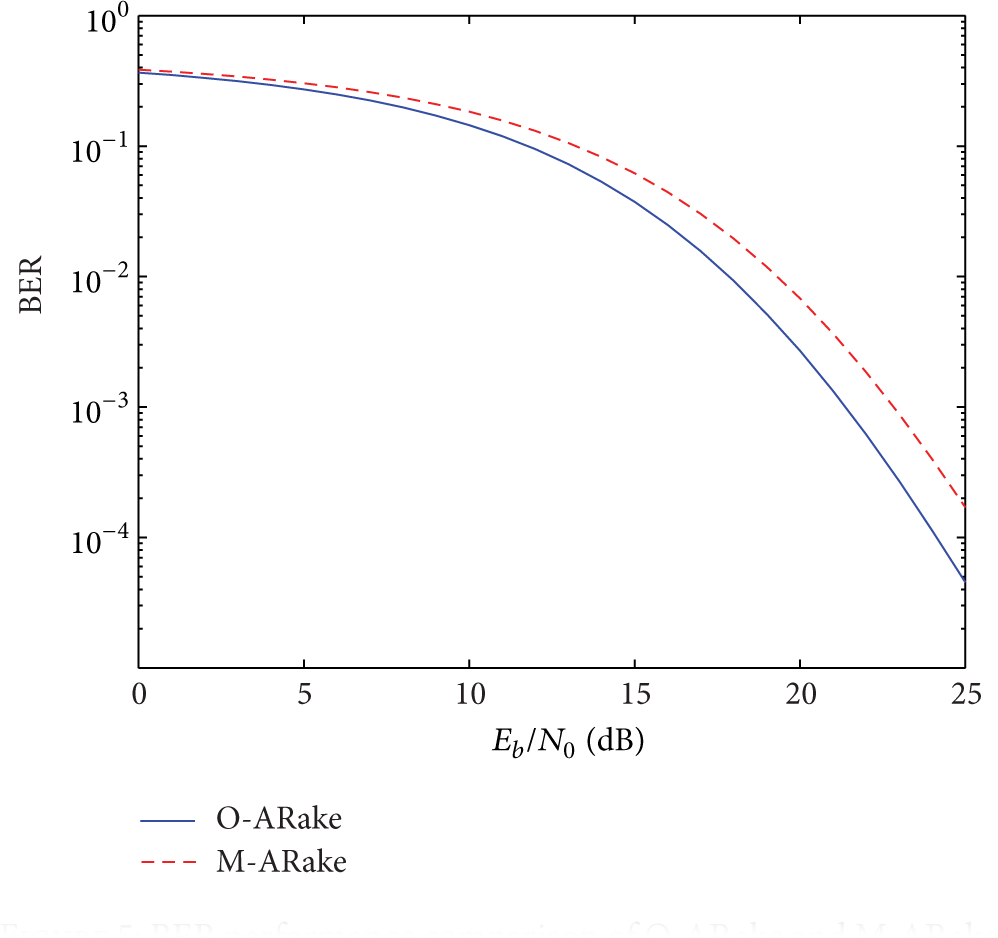
BER performance comparison of O-ARake and M-ARake receive nodes in NLOS underground mine tunnels for EC-BPPM modulation scheme.
Then, we consider the low-complexity receiver alternative SRake receiver, which combines the instantaneously strongest

BER performance of O-SRake and M-SRake receive nodes in LOS underground mine tunnels for EC-BPPM modulation scheme.

BER performance comparison of O-SRake and M-SRake with
Also, we investigate the BER performance of the low-complexity alternative PRake receiver model, which captures the first arriving

BER performance of O-PRake and M-PRake with
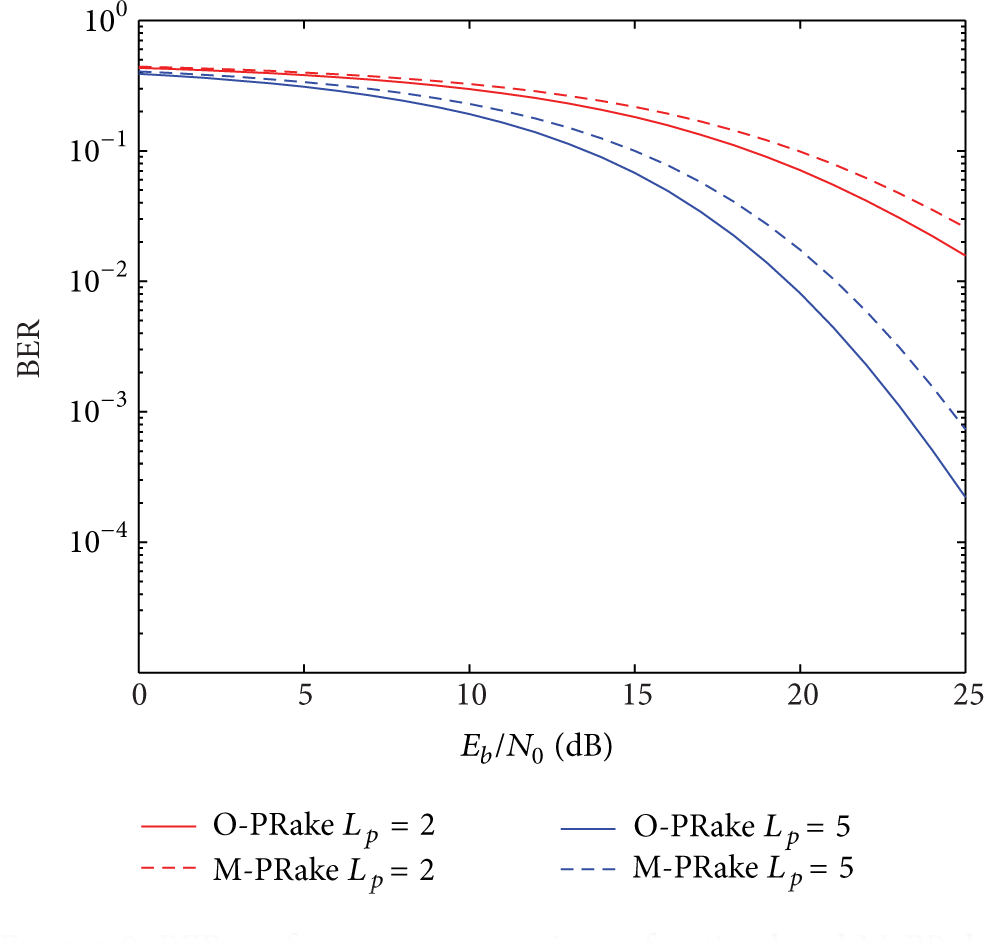
BER performance comparison of optimal and M-PRake assuming
Then, we compare the BER performance of all the aforementioned receiver models to the noncoherent TR receiver, which was investigated in the literature for operation in underground mine tunnels. The TR receiver model, shown in Figure 10, transmits the reference signal along with the information data instead of locally generating it at the receiver [15]. Figure 11 shows a BER performance comparison of all optimal template-based receivers and TR receiver in LOS channel model. As can be seen Rake receivers outperform the TR receiver. Also, O-SRake and O-PRake with 5 fingers give an approaching performance to the O-ARake model. Figure 12 shows a BER performance comparison of the same receiver models in NLOS scenario. Also, Rake receiver models outperform the TR receiver. O-PSake and O-PRake give approaching performance to O-ARake with performance degradation of ≈0.5 dB and 1.5 dB, respectively. Whereas, the performance degradation caused by the TR model is ≈9 dB as compared to the O-ARake model. Similarly, Figures 13 and 14 compare the BER performance of all mismatched Rake receiver models to the TR model in LOS and NLOS channel, respectively. Also, all mismatched Rake models outperform the TR receiver in both scenarios, and M-SRake and M-PRake with 5 fingers achieve an approaching performance to the M-ARake model. The performance degradation of the M-SRake as compared to M-ARake receiver is ≈0.5 dB and 0.1 in LOS and NLOS scenarios, respectively. The corresponding degradation in performance caused by M-PRake receiver with

Block diagram of TR receiver [10].

BER performance of O-SRake and O-PRake with 2 and 5 fingers, O-ARake, and TR receive nodes in LOS underground mine tunnels for EC-BPPM modulation scheme.

BER performance of O-SRake and O-PRake with 2 and 5 fingers, O-ARake, and TR receive nodes in NLOS underground mine tunnels for EC-BPPM modulation scheme.

BER performance of M-SRake and M-PRake with 2 and 5 fingers, M-ARake, and TR receive nodes in LOS underground mine tunnels for EC-BPPM modulation scheme.

BER performance of M-SRake and M-PRake with 2 and 5 fingers, M-ARake, and TR receive nodes in NLOS underground mine tunnels for EC-BPPM modulation scheme.
Finally, we compare the MADTh of all receiver models under investigation for the same target

Maximum allowable data throughput of O-ARake, O-PRake, and O-SRake in LOS underground mine tunnels for EC-BPPM modulation scheme.

Maximum allowable data throughput of O-ARake, O-PRake, and O-SRake in NLOS underground mine tunnels for EC-BPPM modulation scheme.
Considering the proposed mismatched receiver architectures, Figures 17 and 18 compare the MADTh of the all mismatched Rake models and TR receiver. As can be seen from figures, all mismatched Rake models achieve an approaching MADTh to the optimal Rake models in both LOS and NLOS scenarios with an average degradation of 5 Gbps in LOS scenario and 10 kbps in NLOS scenario.
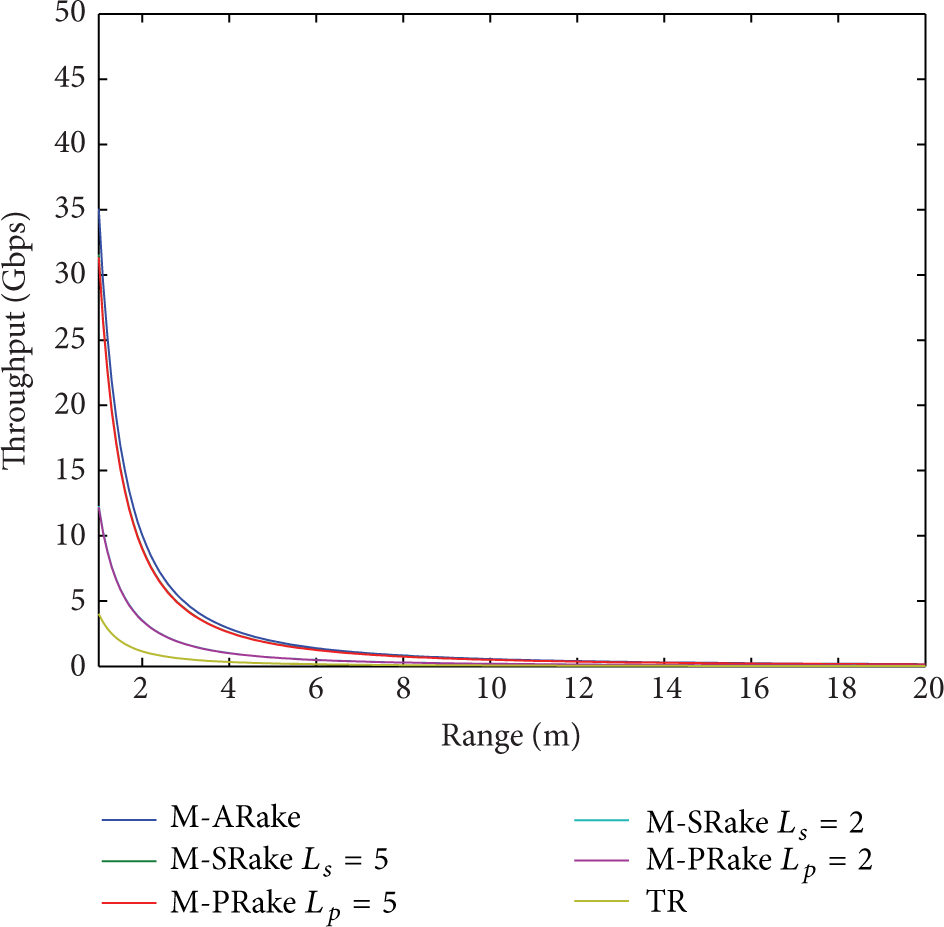
Maximum allowable data throughput of M-ARake, M-PRake, and M-SRake in LOS underground mine tunnels for EC-BPPM modulation scheme.

Maximum allowable data throughput of M-ARake, M-PRake, and M-SRake in NLOS underground mine tunnels for EC-BPPM modulation scheme.
Based on the results obtained from both the BER and MADTh performances, the M-PRake receiver model with
6. Conclusions
This paper investigated the BER and MADTh performance of a low-power mismatched Rake UWB-based receive nodes for reliable communications in wireless sensor monitoring networking in underground mine tunnels. The proposed structure was investigated for ideal, partial, and selective Rake receivers and was shown to achieve an approaching performance to the corresponding optimal receiver structures with minimal performance degradation. It was also compared to the TR receive nodes proposed in the literature for communications in underground mines. Generally, the mismatched Rake receiver structure was shown to achieve an approaching performance to the optimal Rake and outperform the TR receiver structure. Based on the trade-off between performance on power consumption, the M-PRake structure with
Footnotes
Conflict of Interests
The authors declare that there is no conflict of interests regarding the publication of this paper.