




Abstract
Wireless body area networks (WBANs) are important branches of wireless sensor networks (WSNs). They promise unobtrusive ambulatory health monitoring for real-time updates of patients' medical records that have aroused extensive attention in various fields. In recent years, one can find a lot of researches related to WBANs that have appeared in these literatures. But there are still many key issues that need to be further investigated. This paper briefly introduces the architecture and features of WBANs. In this attempt, we focus mostly on energy acquisition, data integration and data sharing, and collaboration of WBANs, from the viewpoint of energy harvesting development, the social network and smartphone application in WBANs, and the integration of WBANs and cloud system networks computing to analyze related issues of WBANs. Finally, we put forward concluding remarks with several future research directions.
1. Introduction
Recently the technological advances in WSNs have led to successful integration in the realm of healthcare application and telemedicine. They can be used to monitor physical activity in normal activities of daily life as well as in hospital clinics [1, 2]. Wireless body area networks (WBANs) are multidisciplinary and intersectional technology for mobile healthcare industry. A linking of several smart miniaturized devices are either worn or implanted within the patient in WBANs for continuous ambulatory monitoring of vital physiological signs. The wearable and implanted physiological devices with integrated wireless communication capability in the innovative system can measure the physical properties of human body and convert physical signal into an electrical signal and then the devices collect data to a base station or transmit further the data to hospital or clinic, to provide the ability of remote patients' vital signs monitoring and diagnosis, thereby improving the quality of smart healthcare information monitoring [3]. Figure 1 shows a health monitoring system based on WBANs.
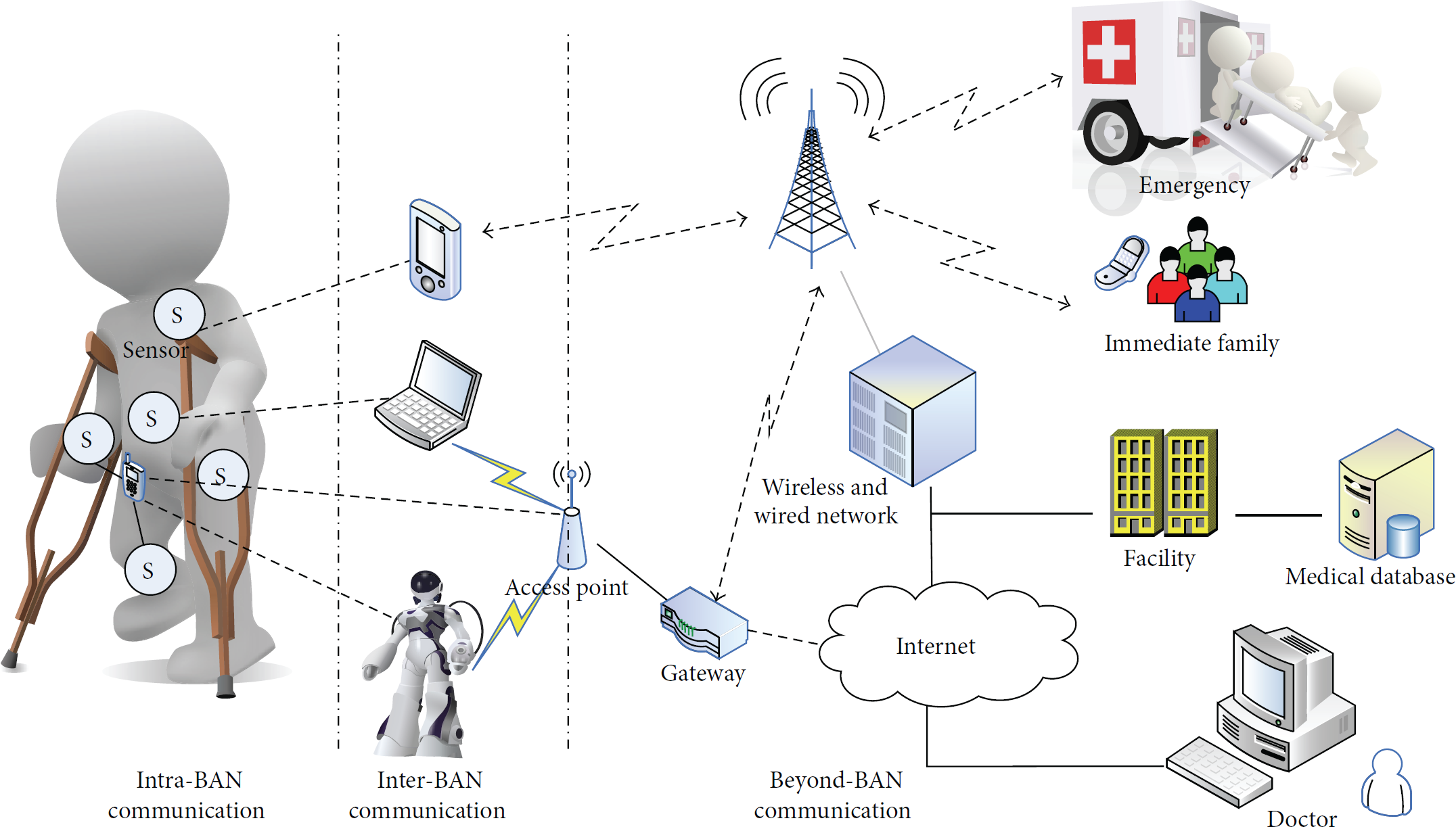
Health monitoring system based on WBANs.
The WBANs communication architecture is divided into three parts: the intra-BAN communication, the inter-BAN communication, and the beyond-BAN communication [4]. The intra-BAN communication refers to wireless communication within 2 meters around the person. It is possible to realize the communication between the sensors and make the body sensor and personal server communicate. The WBANs are different from WSNs; they are less likely to work independently, so the inter-BAN communication refers to the communication between a PS (personal server) and an AP (access point). That is, the interconnection between BANs is realized by a common network, such as Internet and mobile communication network. The beyond-BAN communication is mainly used in the implementation scope of metropolitan area connectivity. The communication is designed according to the concrete application and the user's specific requirements.
WBANs are the extension of WSNs application, but there are obvious differences between WBANs and WSNs. Compared with traditional wireless networks, WBANs have some unique features.
(1) Node Deployment and Density. WBAN nodes are deployed on the human body or hiding under the clothes. WSNs are often deployed where the user is not accessible. WBANs do not solve the lost node problem by adding redundant nodes that are different from common WSNs design. Next, these implanted sensor nodes are difficult to replace and charge. The replacement of wearable sensor nodes is also invasive to the human body and introduces some human body discomfort [5].
(2) Limited Energy. WSNs are mainly used for transaction monitoring, and the occurrence of these transactions interval is irregular. By contrast, WBANs are used to record the body's physiological activities; they usually occur periodically, so the data flows show relatively stable rate. Each node of WBANs will carry out different target parameters' acquisition and send them in different frequency and data transmission rate, so it requires higher energy consumption. Next, signal transmission attenuation is large because of the specificity of the body tissue structure and the shadow effect. This can cause a large path loss of a transmitted signal [6]. So, WBANs communication requires more energy than other networks under the same size.
(3) Delay. The delay may be related to the stability and energy consumption. It is difficult to replace batteries because the environmental influences after the nodes are deployed in WBANs. And the power control is more difficult due to the energy consumption requirements of nodes; the communication coverage of WBANs nodes is much shorter than mobile cellular phones. So increasing the battery lifespan is necessary, even at high delay.
(4) Mobility and Security. WSN nodes are often thought of as stationary; the node of WBANs will move with the user activity. The wireless signal spreads in the body or on the body surface; it needs to consider the safety, reliability, and long-term operational ability of human body.
At present, some literatures retrospectively analyzed and briefly summarized the energy consumption [7], power-efficient MAC protocols [8, 9], sensor devices [10], data security and privacy [11], and power-efficient communication [12] of WBANs. The relationship between the publications and the critical problems in WBANs is shown in Figure 2 according to the literatures from South China University of Technology Library. The WBANs study focuses mostly on the MAC protocol, transceiver, routing protocol, antenna, energy efficient, and so on. But the middleware, access mechanism, error control, sleep scheduling, and energy harvesting of WBANs are rarely mentioned. And there are little references that pay close attention on the scientific analysis and summary of the energy harvesting and data collecting and sharing. So we first introduce the researches on WBANs. Then, we discuss the related activities in WBANs energy harvesting in Section 2. Section 3 describes the social networks and smartphones used in WBANs for collecting data. In Section 4, the cost-effective data sharing of WBANs with the help of cloud computing is discussed in detail. A lot of challenges and obstacles of WBANs are given in Section 5. Finally, Section 6 concludes the paper.

The relationship between the publications and critical problems in WBANs.
2. WBANs with Energy Harvesting
WBANs always use a power-limited battery as its energy supply, but the battery has a limited lifetime because of the size limitation of sensor nodes. And it is generally unpleasant to maintain; the replacement is inconvenient in complex environment. So, it is critical that the lifetime of wireless devices, the limitation of the current technology, and the performances of node that implant into the human body are directly related to its power source [13]. In order to make WBANs more practical, worldwide efforts are ongoing to solve the energy supply problems with more efficient and reliable energy sources. To realize self-powered for wireless devices, one of these effective ways is to harvest ambient energy from the environment with the development of environmental energy harvesting technology. Figure 3 shows the collection and employment of energy in the environment. There are all kinds of potential and available energy sources in the material space, such as the solar (light) energy and wind energy, to name a few. Energy harvesting and storage units collect and store all kinds of available energy from the node's environment. When a node needs energy, the energy from a storage unit is transformed to get the power required. This can ensure the power supply needed of the sensor and most probably can provide a long-term and effective energy supply.
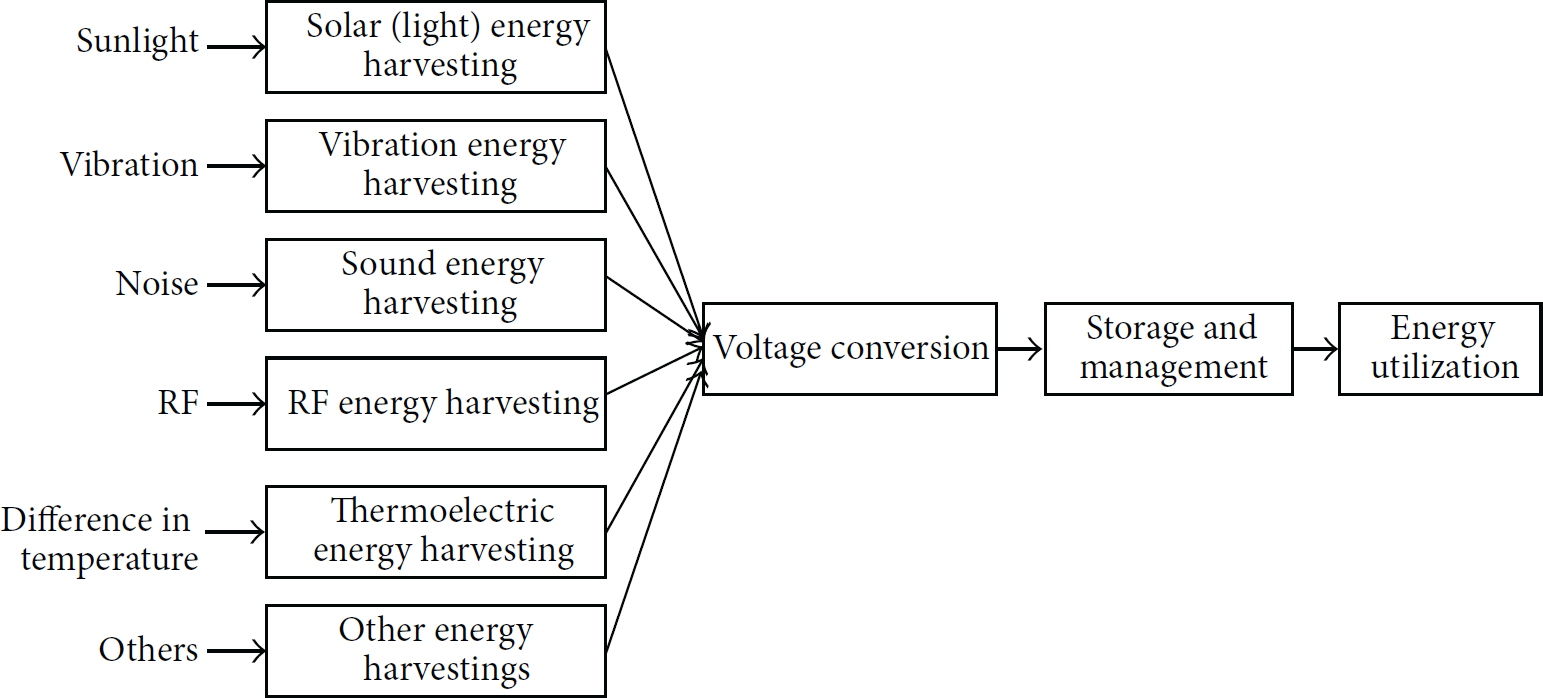
The collection and utilization of energy in the environment.
2.1. Battery Energy
In general, the sensor nodes of WBANs rely mainly on battery power. However, batteries are troublesome due to the fact that they have a limited lifetime. They only allow very low energy consumption of tiny devices which have weaker processing capacity and less memory capacity for a while. Although ongoing dynamic power management development such as dynamic voltage scheduling can increase operative time of electronic integrated circuits for a given power supply. However, the power expended of some portable devices has been growing quickly, and the growth rate of battery capacity is not equipped to meet the current demand. That is, the slowest improvement of the mobile technology revolution is the battery revolution at the moment. If the networks attempt to operate for several years, they need to ensure abundant energy autonomy through enlarging the size of the battery. But it would not satisfy the system desired portability and the operational cost is frequently over budget. For instance, the transmission power of wireless transceiver chip will reduce with the loss of the battery; the node communication distance will be affected. If the wireless nodes employ an external power source, many advantages of WSNs will disappear [14]. Therefore, a small-sized rechargeable battery (a super capacitor or a thin-film rechargeable battery) is the alternative solution to achieve the network energy autonomy throughout the entire network lifetime. So far, the exciting wearable medical devices are introduced in the thin-film and printed batteries [15]. WBANs have enabled a broad range of battery-powered handheld, wearable, and even implantable devices because silicon-based electronics have high energy density and continuously decreasing power consumption. It also could extend battery life and simplify WBANs usage.
In addition to this, harvesting energy from the ambient environment has been proposed as an attractive solution. It is designed as an alternative to battery as it can provide an almost green energy supply. It also has many potential benefits such as lower system costs and environmental impact. And it is easy that the highly efficient hybrid solution makes the devices transparently integrate into the environment because they can be embedded [16]. Therefore, we will introduce several different perpetual green energy supplies in the following sections.
2.2. Solar Energy or Light Energy
For Earth, solar energy or light energy is a kind of widely recognized renewable and clean energy sources. The solar energy harvesting principle is to absorb a large number of photons to provide electrical power through photovoltaic conversion. Because this power harvesting is strongly influenced by the illumination condition, the optical components of a generic solar energy harvesting module must be placed in good lighting conditions to obtain more power. Optical devices can be connected to generate the required continuous voltage in the sunshine. Solar energy or light energy harvesting for WBANs has become a reasonable technical option when manufacturing costs of optoelectronic components are declining.
Recently a number of solar energy harvesting prototypes for WSNs are presented. For demonstration, a solar panel provides up to 15 mW per square centimeter in full outdoor sunlight and 10 mW in indoor lighting for the same area [14]. In solar energy harvester of the HaLOEWEn (Hardware accelerated Low Energy Wireless Embedded Sensor Node), the energy harvested by small solar panels is used to charge the Li-ion battery of a capacity of 4.6 AH. The power consumption of the platform is low enough for autonomous WSNs operation, and a solar panel with different light conditions is different for a while as described in [17]. The limitation of solar energy that is only available during daytime or office hours and the efficiency can be low because of the influence of natural conditions. For example, sun exposure is very low on cloudy days, and the output voltage of solar cells will be influenced by season, geographical latitude and altitude, and light intensity. The node energy consumption and supply are different; there will be heterogeneous nodes [18]. So energy must be harvested from other sources when sunlight is not available. In [19], the thermoelectric power generation was used in addition to solar panels making it hybrid. Accumulated heat can be converted to charge the sensor node battery in electrical energy enough at the same time.
In addition, it is difficult that these bulky and rigid energy harvesting solutions can conform human body. To overcome these above shortcomings, a wearable body sensor node incorporating indoor photovoltaic energy harvesting is designed flexibly [20]. The self-sustainable flexible energy harvesting is equipped with an ultralow power circuitry. The flexible power management circuit can transfer near maximum electrical power from the PV panel to store in the supercapacitor for supplying power to the node. So, it is gradually solved for wearable, biomedical applications in the near future. Then, it is important to note that the health and safety risks associated with solar energy. The poorly maintained and old panels may release crystalline silica dust to the environment which is a human carcinogen and may increase risks of developing lung cancer. So the safety and reliability further studies of solar panel need to be done.
2.3. Vibration Energy
In the currently available potential energy, the best development is to use solar energy from a sun/light supply, followed by the design of vibration energy harvesters, picking up vibration energy in the environment to power the nodes. Vibrations comprise one of the considerable sources of microenergy in the human body, deriving from human motion during walking. Piezoelectric energy harvesting, that is, the best candidate among them by converting mechanical vibrational energy into electrical energy, has attracted much interest. Many theoretical analyses and experimental measurements are available on mathematical modeling and piezoelectric energy converter applications [21–23]. The application of ambient vibration research has been given by Anton and Sodano [24]. Enough energy at the resonance frequency of the vibrating body can be accumulated to power these nodes; it was used on animals [19]. Some simple directions of vibration energy harvesting are given.
In [25], a vibration energy harvester architecture based on MsM (magnetostrictive materials) was proposed, and Metglas 2605SC was designed to reduce the harvester size. A vibration energy harvester system using ME transducer can produce an output power density of 0.472 mW/cm3 at the acceleration of 1 g at 51 Hz [26]. The vibration energy harvesting based on nonlinear bistable converters was excited with white-noise mechanical vibrations [27]. And the topology structure, piezoelectric material, and harvester frequency of vibration harvester were analyzed to improve energy harvesting. Piezoelectric materials as active elements are configured under different ways to maximize the voltage generated by the power harvesting devices. The better geometric designs of piezoelectric materials lead to a better utilization. The different beam shapes for piezoelectric energy harvesters were analysed [28]; these experiments with rectangular beams and triangular beams are validated; that is, the rectangular beams are more effective. A study of model and parameters design was performed to improve the performance of piezoelectric energy harvester that was used by Mo et al. [29]. A segment-type harvester was used to generate electric power which utilizes multiple modes [30], and the optimal configuration was determined by a stochastic design optimization.
Topology optimization design of vibration has been studied to optimize design layout in the past two decades. The method and application of piezoelectric devices topology optimization design for energy harvesting devices have been reported. For example, the topology optimization method has been applied to energy harvesting devices for maximizing the conversion factor of energy [31]. A multiobjective function is defined for the topology optimization formulations that are developed by Nakasone and Silva [32] to maximize energy conversion of the transducer and these structures were designed to have a resonance frequency. To address the energy harvester performance issue, the topology optimization-based method [33] was designed for the layout of piezoelectric material and location of mass layer. The optimal layout of piezoelectric energy harvesting devices and the optimal position of mass loading were determined simultaneously to maximize the energy harvesting performance within a range of vibration frequency.
Then, vibration energy harvesting devices are focused more on how these devices can determine the dominant resonance frequency by the device material properties and the component part dimensions. For these, energy harvesting devices are used in commercial purposes; they have to operate over a wide range of operating frequencies without sacrificing the power output. Several solutions have been proposed in these literatures about tunable resonance frequency of vibration energy harvesting [34–36] and widening of the working bandwidth techniques [37–40]. In active/passive tuning resonance frequency method, the easiest way to do that is to alter the mass, length, or thickness of the vibrating structure. The resonant frequency of the harvester was tuned continuously to match the source's driving frequency by providing a force that is proportional to velocity, acceleration, and displacement. Because the vibration energy still suffers from limited bandwidth, this is what we need to solve. The report about serial connection among cantilevers of the array was introduced to turn to the frequency and expand the frequency bandwidth in ambient low frequency vibration [37, 38]. Available energy was obtained by nonlinear behavior from more complex excitation amplitudes over a frequency range; this efficacy of the approach was demonstrated in some papers [39, 40].
Broadband vibration energy harvesting using ME (magnetoelectric) transducers of few researchers has been reported in the literatures. ME generators can produce large power outputs and high mechanical stress that are due to the high energy density and strong magnetomechanical coupling in magnetostrictive material. Huang et al. [41] used high sensitivity magnetic field sensors that are made of magnetostrictive material and ceramic PZT-5 to harvest vibration energy. 30 Hz vibrations using Terfenol/PZT/Terfenol sensor can produce more than 10 mW of electrical power with an acceleration of 0.5 g. The piezoelectric array within the midsole of the shoe can extract energy [42], but this shoe contains the generator; the prototype is big and heavy. Power output is measured for four subjects in three gait patterns. Walking experiments produces an average power of
A lot of research effort has gone into vibration energy harvesting from the human body; those works have made special emphasis in the potential of the human body as a power source and the development of vibration-based energy harvesters optimized for low frequencies. The transducing mechanism of a harvester works on the principle of frequency up-conversion that is widely used to harvest low frequency vibration more efficiently and uses a piezoelectric beam and magnetic coupling [43]. MEMS- (microelectromechanical system-) based ambient vibration energy harvesters which convent mechanical energy into electrical energy for low frequency self-powered continuous structural health monitoring are designed and built by using nickel electroplating technique [44]. And then, the study of vibration-based energy harvesting has shown that the hip and foot instep is the most optimal point to place the device for both generation efficiency and wearability [45]. A miniaturized device with an overall size similar to that of a wristwatch is introduced. There is still work to do when the harvesters are not the best suited type for the low movement frequency, random motion of humans, movement amplitude, the wearable size, and so on.
2.4. Thermal Energy
Another particularly interesting way of energy harvesting is thermoelectric generation. The sensor node is powered by the thermal energy harvested from human warmth. According to Stark [46], thermal energy harvesting with Thermo Life based on the development of thin-film technology for the deposition of highly efficient thermoelectric materials is designed in Germany. The energy released by the metabolism mainly depends on the amount of muscular activity. The devices convert heat energy directly into electrical energy through its thermocouples using the Seebeck effect. It is unique, very small, and compact energy source, but it needs to be stored in a rechargeable battery or supercapacitor. In [47], energy harvested by thermoelectric generator is stored in an energy storage device. The experimental test results that the accumulated energy is around 1.369 mJ, and it powers the loads comprising of sensor, RF transmitter and its associated electronic circuits. Besides, when the sun directly heats one side of the generator, creating a potential difference large enough to contribute to the charging of the sensor node battery, if we can describe the temperature difference relationship between the body and air, the electric voltage is generated. The performance of overall thermal energy harvesting system is achieved. These critical factors are taken into considerations during the design and development of the thermal energy harvesting system.
A novel structure of the thermoelectric microgenerator has been designed which use readily available MEMS technologies, fabricated in BESOI technology [48]. ZnO nanowires were used to build thermoelectric devices based on nanowire bundles for energy harvesting [49]. The “Human++” monitoring application was discussed in [50]; the highly miniaturized and energy autonomy of sensor nodes allow people to wear their own WBANs. For longer autonomy systems, the research also studies thermoelectric generators with power conditioning using commercial thermopiles and applies to this project. In 2006, a wireless pulse oximeter was developed. The device is completely dependent on the patient's body temperature to provide energy to work. Seiko watches make the mechanical parts work that used ten thermoelectric modules to produce sufficient amounts of energy. The energy comes from the hot gradient difference between body heat and environment temperature completely. So the thermal energy is widely used at present because it has many advantages including highly reliable, long lifetime and continuous operation, and it can use widely in harsh environment.
2.5. Others
The human body itself is a complex of energy. It produces different types of energy, such as thermal energy, chemical energy, and kinetic energy. As a result, these ideas are generated using the body's own energy that is obtained through the use of human daily life activities. Then, it is converted to electricity through some kinds of devices. In [51], the effective way of producing usable electric power is the sound energy. It is a kind of vibrations. Scientists design and manufacture a kind of membrane-type receiver or piezoelectric microphones and piezoelectric pickups to produce electricity. Another promising technology is biological catalyst fuel [52] in which the body sensor node power supply can get by breaking down the body's glucose.
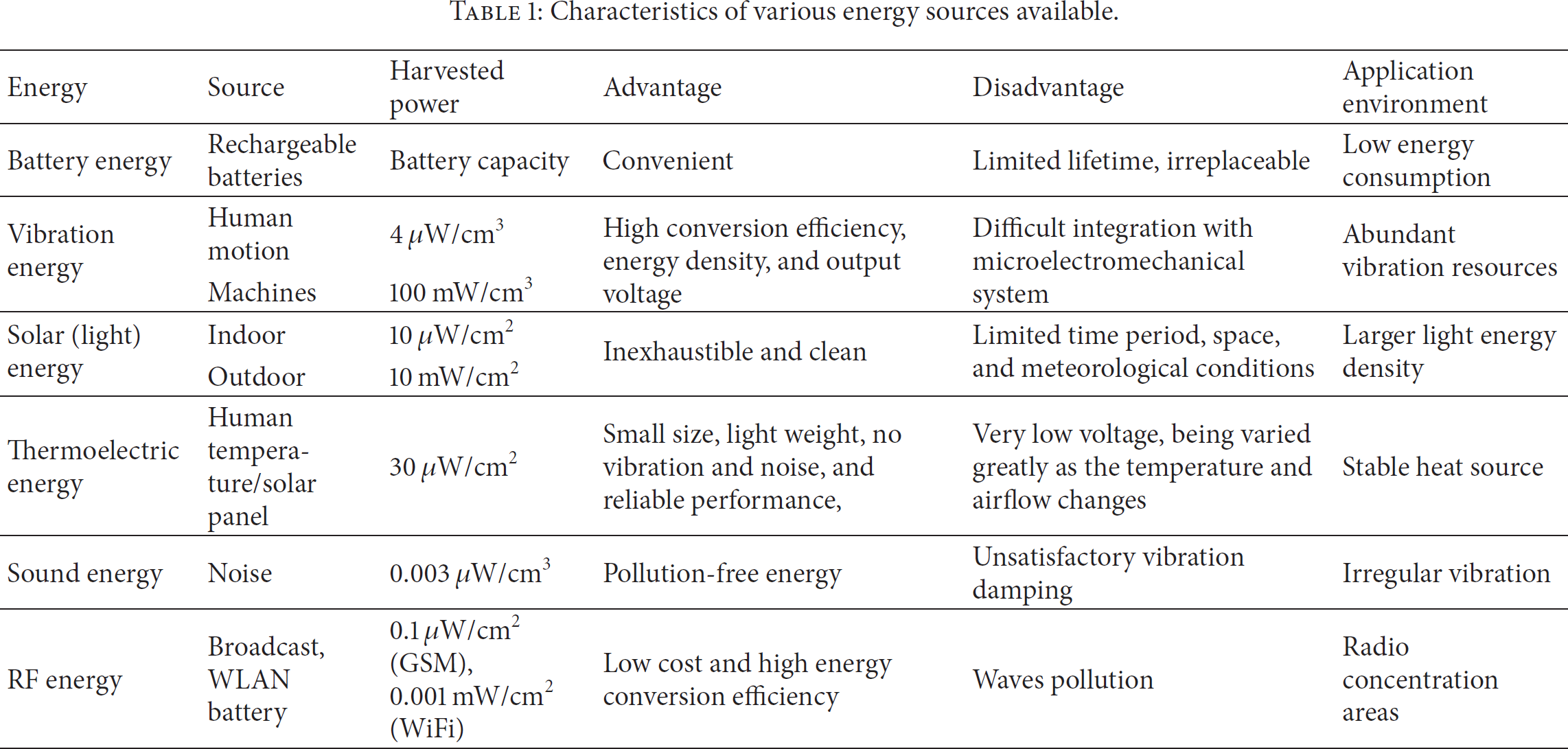
More than 75% of node power budget is dedicated to wireless communication; RF energy that is so widely spread across the world is absorbed in the form of signals transmitted from radio and mobile base stations. It can yield power levels of 0.1 μW/cm2 for wireless medical devices. In [53], two ultralow power ISM band RF transceivers are presented for WBANs. But some technical hurdles need to be solved such as small-sized harvesting devices and low transmission. Energy harvesting using power broadcast from a base station such as smartphone in wirelessly powered, near-threshold, multinode WBAN system was designed [54]. The each near-threshold SoC harvests energy broadcasts wirelessly from a base-station to node at 431.16 MHz to node; it eliminates the need for a battery. Table 1 indicates that the harvested power is dependent on all kinds of energy. Different environments exist in different forms of energy.
Characteristics of various energy sources available.
2.6. Hybrid Energy
Energy harvesting that depends on a single energy source is not reliable. In order to obtain energy as much as possible, it is designed with hybrid energy harvesting system which can collect various kinds of energy from environment. For example, the energy harvesting for indoor wireless sensor extends the lifetime of nodes by the solar and thermal EH system [74]. In [75], the mechanical harvesting system and piezoelectric harvesting system was designed in shoes to generate electricity through walking. The crystalline silicon PV cells and thermobattery can capture energy from the environment, realize the long lifetime of the wireless sensor node through supercapacitor and Li-ion battery of energy storage devices and low consumption of energy management strategy [76]. Thermoelectric and solar energy was mentioned in a single system. An example is that the light and temperature for a solar panel was used to maximize the power output [19].
3. WBANs with Social Network and Smartphones
WBAN is a rapidly growing industry. It has a very important role in our lives and the impact on our lives will only increase. In addition, social networks' industry is also growing rapidly. It was estimated that in 2010, the market for social networking sites increased by 250% [55]. There is a growing market for mobile devices, particularly mobile phones; more and more people have access to a mobile phone. Social networks provide a new way of communication, to gain information. In this way, mobile devices become the gateway of global information network. However, WBANs have not been studied from the perspective of social networks over the past decade. Nobody seriously thought about using social networks as a tool that can monitor the physical parameters of the medium.
The paper in [77] shows how social networks can be used in the context of WSNs several years ago. Authors of [78] have given the experiment with the placement of the connection using social network to indicate when we are getting close to a robust, efficient topology and have shown the routers to follow social rules. It motivated us to think of wireless networks as social networks. Beyond that, it was effective to use the spread of mobile devices and increase the number of users that have access to social networks from mobile devices to solve the data integration of WBANs. A cross-platform solution with cross-platform SD card and a middleware named uSinkWare for smartphone-based mobile sink can communicate with wireless sensor nodes [59]. Hence, we use social networks as a tool to help collect data for WBANs.
Figure 4 illustrates the architecture of WBANs connected to a mobile network by a smartphone. In Figure 4, WBANs contain small intelligent sensors and/or actuator nodes attached on or implemented in the body which are communicating wirelessly with a personal local processing unit (LPU), for example, a PDA or a smartphone. In this way, the smartphone acts as a mobile gateway for the remote and local management of WBANs. Patients can move between mobile access gateways seamlessly as long as network connectivity to connect to mobile network, allowing for real-time remote or local management of WBANs [58]. Therefore, it is a good idea of WBANs to use a mobile device as a WBAN node. If a WBAN is considered as a single network, and mobile phones have some sensors that can sense the context data and deliver it among the network. For example, Padmanabh et al. studied the communication about these wireless nodes in social network and used the closeness algorithm of social network in the context of sensor networks to get lower communication cost and memory requirements of embedded nodes and better utilization of the network [79]. A specific social rule has been applied to show significant performance improvement. In addition, if a mobile device is used as a WBAN node, it can use social networks for WBANs for free. Besides, most of the mobile phones have speakers and microphones which could send and receive acoustic waves. So it is convenient to exploit the acoustic signal processing techniques along with the Bluetooth technology to measure the physical distance among the mobile phones which play as a gateway for the remote and local management of the WBANs. It is possible to engineer such a network into a mobile network.

The architecture of WBANs connected to mobile network by a smartphone.
In respect of project study, Healthwear has been developed by the MIT Medica Lab [80], the MIThril system uses a wide range of commercially available wearable sensors for continuous biomedical sensing based on healthwear. But MITHril is not a real WBAN because it is modular, distributed, clothing-integrated design based on a unified wired power/data bus. Then, MITHril 2003 extends the previous MITHril architecture to a wireless application. It is comprised of the wireless Zaurus PDA and physiological sensor, utilizing cell phone modems, Bluetooth, and WiFi function to get real-time distributed wearable computing platform for multimodal and context-aware applications. A research project (MIMOSA) [81] that has a modular and freely scalable architecture platform for implementing mobile-phone-centric ambient intelligence was developed. It defines four types of entities, terminal devices (mobile phones such as Nokia 6630) with built-in sensors, sensor radio nodes, wireless remote-powered sensors, and back-end servers, and employs phone to connect the MIMOSA hardware as the user-carried interface device. The monitoring system in [82] consists of on-body sensor integrated nodes that monitor user's vital signs and a PDA/smartphone device that interfaces WBAN nodes to aggregate, process, and transmit physiological signals. The framework could be applied to the medical domain such as vital cardiac arrest rehabilitation or hypertension signs monitoring. Then the KNOWME platform is a mobile operating system [83] that integrates biosensors with a Nokia N95 mobile phone to real-time continuously monitor individual's health and analyze the biometric signals of a subject. KNOWME consists of three-tier architecture; there are sensor layer, mobile phone (Nokia N95), and a back-end server; Nokia N95 communicates with sensors using Bluetooth in KNOWME. The smartphone performs the coordination, processing, and computation tasks.
In [56], two currently available smartphones, the Symbian-based Nokia N95 and the Linux-based Openmoko Neo Free Runner, are applied to implement a prototype of Horatio. It reduces suspend latency by saving virtual machine state to the phone. And two smartphone-based (Amoi E72 Microsoft Windows Mobile 5 smartphone and HTC Microsoft Windows Mobile 6 smartphone) wearable cardiovascular disease detection platforms were proposed; an enriched interface was also provided [60]. In [62], the dozen internal smartphone sensors were used in medical application; four models of smartphones video camera (HTC HD2, iPhone4, Samsung Galaxy SII) were applied to measure the photometric-based plethysmogram (PPG) signal. In [63], the author emphasizes that in-person interactions with others over their smartphones intrinsically involve multiple participants by smartphone (HTC One V) and on-body inertial sensors (TEMPO nodes).
The remote health monitoring system “vNurse” using virtualization on mobile phones and virtual mobile network sensors was shown in [57]; it can permit 24-hour patient monitoring whether they travel outside or stay within the home. The Home Agent at Home Network uses mobility protocols such as Mobile IP and NEMO to achieve this architecture, and it is an inexpensive, unobtrusive, and unsupervised monitoring system for patients. In [61], a mobile health (mHealth) system prototype with smart wrist-worn device and HTC that runs the Android 2.2 mobile OS was designed, and Bluetooth protocol was used. A real-time wearable system, HealthGear, consists of a set of physiological sensors wirelessly connecting via Bluetooth to a Bluetooth-enabled cell phone and monitors the user's physiological data while sleeping [84]. The design encompasses communication protocols like ZigBee stack for intercommunication within the WBAN and links the WBAN with the smartphone by Bluetooth and WiFi communication between the smartphone and the medical server and so on. A well-being and chronic disease management with wellness diary (WD) for personal wellness management were presented, and the concepts were designed for improving WD. The BAN sensors were used to control and collect data to the environment [85]. And some authors [86] focus on the full interface and biofeedback data visualization using a Java-enabled and Bluetooth-enabled phone for WBANs. The architecture of suitable mobile system with mobile and smartphones for biofeedback monitoring was developed [87]. Some sensors are placed in the monitoring architecture, a sink node that is a PDA or smartphone coordinates the mobile devices using Bluetooth. The four smartphone platforms such as Symbian, Windows Mobile, Android, and iPhone are used. As case study, a sensing health with intelligence modularity, mobility, and experimental reusability (SHIMMER) platform can collect, visualize, and monitor data in both real-time and offline modes.
The smartphone based on Android has been chosen because Android SDK has excellent documentations and Android apps make life easier and are easy to understand. Android apps empower people to try new things and use apps in inventive new ways, such as the information using Android supports for Bluetooth low energy [64]. A comprehensive ubiquitous healthcare system [88] which includes wearable ECG devices and smartphone based on the Android was proposed. This provides better connectivity than Bluetooth to support transmission. The gateway is responsible for spreading ECG vital signs from wearable health shirt embedded with ECG devices to an external IP network. In [65], the main WBAN online monitoring architecture based on two different WBANs connected to an Android smartphone was designed to collect physiological data. The first one is smart and energy-efficient sensor nodes based on ZigBee to perform signal processing, analysis, and transmission. The second sensor is connected via Bluetooth to an embedded system based on Android. It is better for Android smartphone because it is powerful and Java-based development kit. In there, HTC Desire HD with Android 2.3.5 and Samsung Nexus S with Android 4.03 smartphones are used to collect and visualize the WBAN data. Beyond that, smartphones have a variety of different sophisticated applications and high speed data services. It makes mobile services become programmable, ubiquitous, and versatile; people have access to the capabilities of “cloud computing.” In mobile health system, mobile communication with smartphone can be used to increase the effectiveness of community health worker, create new mobile diagnostics, and improve the collection of public health data [89]. To maintain the nodes' accessibility, the ubiquitous handover mechanisms for wireless sensors mobility and real-time continuous connectivity solution were proposed on healthcare and biofeedback solutions in [90]. It can optimize the node battery lifetime in opposition to the energy consumption of access points. Then, the authors surveyed the handover and intramobility approaches with a detailed comprehensive analysis according to the recent literatures and pointed out the comparison between available intermobility solutions [91]. Based on these descriptions, these analyses for the relevant literatures are shown in Table 2.
Analyses for the relevant literatures.

Although smartphones play a favorable part between WBANs and the Internet, there are many practical issues to consider as well. For instance, smartphones possess moderate computing power and the cellular networks are able to provide them with much communication bandwidth. Most of them are equipped with other essential gadgets such as global positioning system (GPS), digital camera, and Bluetooth wireless interface. Unfortunately, the growth in battery technology has not kept pace with the rapidly growing energy demand of these smart devices [92]. In addition, due to energy and space requirements, it is not feasible to equip the handheld devices with full-featured hardware components. This is negative for WBANs. Next, the size of smartphones leads us into trouble when we do some physical exercise in a real world application. Besides, we must turn off the smartphones where we are in oil depot, gas stations, and chemical plant, so these problems needs to be solved.
4. Cloud Computing with WBANs
WBANs have restricted energy resources and limited network capacity, memory, and computation, but the real-time processing and data storage in WBANs need more powerful computing capability, system reliability, and reasonable storage infrastructure for online and offline data analysis. Beyond that, it is too expensive that the medical systems rely only on their data centers to store or process data [93]. Cloud computing is poised to become an emerging and promising technology. It is a model for conveniently accessing a shared pool of computing resources, which plays a significant role in limitless functionality and services for resilient Internet computing, broad network access, secure storage, and information sharing in a scalable and virtualized manner at low cost [94]. So WBANs can provide life care to people anywhere and anytime with relatively lower cost and lesser complexity using the powerful, flexible, and cost-effective infrastructure [70], and the cloud storage server is also an important component to maintain the patient's medical history. The cloud computing for WBANs ensures a seamless and continuous healthcare monitoring for millions of people; it will obtain the optimum and real-time medical care and medical consultation and reduce medical healthcare costs across the cloud.
Figure 5 illustrates the architecture of WBANs integrated with a cloud; it belongs to beyond-BAN communication. These smart biological devices in WBAN can sense and process one or more continuous vital information and communicate faultlessly to integrate into wireless body networks for patient's health monitoring. So, researchers can use the cloud environment to access and analyze the health information resources, track remote synchronous biomedical signals, and provide appropriate care services with different geographically distributed sites that belong to different divisions of organization. The seamless integration of WBANs and cloud computing impacts the development of cost-effective, reliable, scalable, and high speed healthcare systems, which realizes long-term chronic disease monitoring and best clinical data analysis in different environments.

WBANs integrated with cloud architecture for healthcare application.
Recently, these growing research efforts about the integration of WBANs and cloud computing have been continually mentioned in the literatures. In late 2010, Microsoft hosted a workshop that leaders in the European Medical Community as well as health organizations involved in innovative telemedicine projects in Brussels. The workshop explained and shared the benefits and challenges about cloud computing application for e-Health. Some issues and stumbling blocks for e-Health developing were addressed such as supporting aging population with growing chronicle diseases and providing new types of diagnostics, information records, and remote care [95]. Chowdhary et al. also analyzed and examined the applications that cloud computing gains access to data sharing and collaboration and provided optimum healthcare with the help of cloud computing [96]. Many research works focus on medical sensor and energy harvesting, but the cloud is a set of complicated system that contains hardware and software infrastructure. Currently, there is no proficient architectural solution to support the integration of WBAN to cloud. There are many existing challenges in building a cloud network-based structure for health monitoring.
So far, the work in [66] proposed a medical imaging analysis research framework based on cloud computing and toolkits for improving researchers and clinicians efficiency capability; the knowledge grids and image toolkits were available to identify bowel cancer images, and multitouch and interactive surfaces enhanced cancer imaging. Xiao Yunpeng team proposed a new wireless web access mode based on cloud computing; the web page adaptation engine and distributed web page blocks management based on cloud computing infrastructure were designed, where mobile devices used processing power of cloud to parser HTML page [67]. The authors designed the cloud-enabled WBANs architecture to improve the ambulatory monitoring of healthcare services on three types of scenarios (home, hospital, or outdoor environment) using different mobile cloud computing. QoS improvement in cloud-enabled WBAN platforms includes the development of temperature, cross-layer routing protocols, cloud resource allocation, semantic interactions, and data security and privacy mechanisms to support efficient data transmission to the clouds [68]. Two-level modeling of electronic health record (EHR) based on cloud systems, cloud health information system technology architecture (CHISTAR), was presented to achieve the semantic interoperability; two key functions about the data storage and integration engine architecture were designed. And the data integration engine architecture of CHISTAR makes the system get more effective and efficient patient care from disparate data sources [97]. The advantages of interoperability, scalability, maintainability, and portability are embedded in CHISTAR. For this exploration that sensor networks are integrated to data centers “cloud” model, authors in [69] proposed a content-based pub-sub model which sensor data came through gateways to a pub/sub broker. It simplifies the integration of sensor networks with cloud-based community-centric applications and an efficient and scalable event matching algorithm called Statistical Group Index Matching (SGIM) which targets range predicate case. It shows clearly that the SGIM algorithm performs better than existing techniques in terms of efficiency and scalability through experiments.
Innovative and low-cost healthcare institutions design integrated medical devices, the telemedicine environment that automates the process from data gathering to information delivery to monitor physiological data using utility computing and WSNs in the cloud [71]. So that medical staff or other institutions can access and use services to monitor patients in software as a service (SaaS) model. The work in [72] puts forward a healthcare integration service platform architecture based on cloud computing environment. The bottom captures physiological parameters combined with WSNs, through Internet to the cloud platform, allowing users to monitor personal health information through a mobile device. This technology platform reduces one-third of the construction and maintenance cost about the back-end environment deployment, makes system that can be extended and deployed dynamically, and makes resources achieve optimization, and uses the cloud computing power to reduce the client end hardware resource depletion. This technique cannot consume more than 80% of system resources and it can carry more than one user access and maintain services stable operation. Carestream Health [98] launched new cloud-based e-Health Managed Services (eMS) in 2010 and was available in early 2011. The new e-Health portal service enables healthcare providers that use the company's remote e-Health Archive Services access to data by any authorized users anywhere and anytime. This new service provides cost-effective data sharing and collaboration among healthcare providers, imaging centres, radiologists, referring physicians, and other clinicians or staff. Research work focuses on building a cloud-based networks structure to develop and deploy information-based services for examining data collection. Authors in [73] also develop an architectural solution that integrates WSNs and cloud computing to create a stage for e-healthcare applications. This architecture provides cost-efficient model to manage real-time data from various sensor and share various data in three different hospitals with mote kits having transceiver operating at 2.4 GHz, and the USB gateway that is attached with the central server was used to realize data storage, real-time data display and analysis in the distributed databases. A wearable physiological monitoring system based on WSNs and e-textile was proposed [99]. The overall system that can support up to 10 patients was composed of four subsystems: the healthcare monitoring subsystem, the location subsystem, the WSNs subsystem, and management subsystem. The LOBIN hardware/software healthcare IT platform is used to monitor several physiological parameters. In there, a wearable data acquisition device such as smart shirt based on e-textile is transmitted through a low-cost WSN infrastructure. The result indicates that the automated secure framework with community cloud provides increasingly cheaper health services. Based on these descriptions, these analyses for the relevant literatures are shown in Table 3.
Analysis for the relevant literatures.

With the support of cloud computing, WBANs can be significantly enhanced for massive deployment of pervasive healthcare applications. However, several technical issues and challenges are associated with the integration of WBANs and cloud computing. Such as security, interoperability, power computing, and routing. Thereinto, security is one of the important challenges from initial data acquisition to final data storage and sharing in WBANs. The secure and dependable distributed data storage is an indispensable component of WBANs. And, the data generated from WBANs should have secure and limited access. WBANs gather and move data in networks using plug and play monitoring device across short distance transmission standards, such as Bluetooth, ZigBee, UWB, and provide a platform of independent data exchange in healthcare cloud for continuous and seamless health monitoring. The serious consideration of WBANs needs to have scalable networks, improve data portability, privacy, and security, and offer uninterrupted connectivity [100]. The security problems of WBANs are different from that of the traditional network because of the characteristics of WBANs. So many scholars have explored the security mechanisms from different perspectives such as framework, confidentiality, privacy, authentication, and integrity. In [101], a hybrid security structure was proposed for security requirements combining symmetric and asymmetric cryptographic algorithm. Liu et al. [102] used an anonymous certificateless authentication protocol based on CL-PKC (certificateless public key cryptography) to allow remote users to access WBAN services with negligible computational cost. In electrocardiogram blocks application, Alsadhan and Khan [103] used an LBP- (local binary pattern-) based key management technique to shield individual information. In [104], a lightweight and confidential data discovery and dissemination protocol that contains system initialization, packet preprocessing, and packet verification was proposed to solve security vulnerabilities. Next, reliable routing protocols for WBANs will support multihop communication and provide low end-to-end delay, low packet drop rate, and low energy consumption. It is important for WBANs that because patients' conditions change continuously and many patients may cause massive mobility issues, so new routing protocols should offer numerous methods to solve these issues. Last, WBANs require a good shielding ability of electromagnetic interference based on human health considerations. So, there are a lot of work to do because WBANs are complicated problems.
5. Challenges and Obstacles
WBANs gradually become the frontier and hot topics about information research fields. It plays an important role in supporting high quality medical treatment and healthcare services. However, it is also clear that a lot of challenges and obstacles need to be tackled. In the following, a nonexhaustive list of challenges that need to be addressed is given.
Each node in WBANs must get energy to complete the data acquisition, processing, transmission, and so forth. So the design of high capacity minirechargeable battery or energy harvesting from the surrounding environment is the first challenge of WBANs. First, the characteristics of WBANs must make the size of these nodes be as small as possible in order to meet these requirements of the human body comfort, and the size of the node directly determines the size and capacity of power battery. Therefore, various energy collection components must meet the strict size requirement of sensor network nodes. Second, all kinds of energy harvesting technologies and methods are not yet mature at present. Researchers need a large number of innovative ideas to come up with to make this technology viable. Due to environment energy in the heterogeneous characteristics of spatial distribution and since the environment energy does not fit the expected spatial and temporal distribution and network application, it might not be able to achieve the design that uses energy harvesting system for permanent use. Once there is a lack of this energy in the environment, a node will not be able to work reliably for a long time. So, it is necessary that all kinds of energy harvesting technologies are applied and energy harvesting components can be coordinated at work. Third, quality of service (QoS) is a fundamental demand and some considerations must be taken into account to maintain an acceptable level of QoS in WBANs. A power-QoS control scheme (PEH-QoS) was developed to achieve optimal management of energy harvesting [104], but the different energy harvesting and location of nodes must be developed for the optimal management in more complex networks. Finally, it is important to study the corresponding network protocol and task scheduling to supplement evenly network energy, opening up new possibilities for energy acquisition. We have no doubt that WBANs would have wide distribution in the near future and also would be embedded in our everyday use. Social network is one of the fastest growing industries today. We think that social networks will determine WBANs usefulness in the future. With a sufficient spread of smartphones, it makes the contact of WBANs with the outside world become easier. But the research of social networks with WBANs is still in its infancy. Many critical issues must be discussed such as the integrating sensors with mobile devices, data filtering algorithm. WBAN sensors and terminals are placed on the human body or surface provided that it is safe and causes no damage to human tissue. In addition to the safety of the material, all kinds of radiation influence of the communication process on the human body must be taken into account. Then, the good radio interface and the optimization strategy design are necessary to consider the node data transmission with the personal data terminal. We feel that it is important that the low power consumption performance of the sensor nodes is promoted to operate safely. Continuous and comprehensive data acquisition will produce a large amount of data. It will be a big problem for the development of WBANs to know how to filter and integrate useful data and eliminate redundant information. Cloud computing environments have been proven more effectively. WBANs integration service based on cloud computing environments makes resource usage achieve optimization. But in order for this technology to be successful in the future, several problems such as protocol conversion middleware are worthy of being investigated. Future research should pay more attention to the protocol itself, service availability, data privacy, and data transmission bottleneck.
6. Conclusion
WBANs are widely used in healthcare to improve the level of people's health. In this paper, related research status is studied from these perspectives of WBANs energy harvesting, data collection, and interoperability between the networks at different levels. We made a relatively comprehensive introduction from energy harvesting principle, characteristics to practical application and analyzed the data communication, exchange, and resource sharing of WBANs using the perception and wireless communication capabilities of portable devices, coupled with the contact of social networks and cloud computing application. Finally, their contributions and deficiencies in WBANs applications were presented.
Footnotes
Conflict of Interests
The authors declare that there is no conflict of interests regarding the publication of this paper.
Acknowledgments
This work is supported by the Guangdong University of Petrochemical Technology's Internal Project no. 2012RC0106, Educational Commission of Guangdong Province, China, Project no. 2013KJCX0131, 2013 Top Level Talents Project in “Sailing Plan” of Guangdong Province, 2013 Special Fund of Guangdong Higher School Talent Recruitment, Fault Diagnosis of Petrochemical Process and Informatization Control Engineering Open Fund in Guangdong University no. 512030, and the Science and Technology Program of Maoming City no. 0010041110629036.