




Abstract
Information overload and privacy protection become critical issues with blogs. This paper presents the ontological subscription and blocking system (OSBS) using policies, ontologies, and rules to subscribe interesting posts and block unwanted posts. This system also uses rules for automatic conflict detection between polices. The effectiveness of two subscription systems, OSBS and RSS (rich site summary) reader, is compared. The experimental results reveal that the perceived privacy benefits on the novel OSBS are better than the existing RSS reader. The novel OSBS is as good as existing RSS reader from perceived information overload alleviation perspective.
1. Introduction
Blogs, which are popular social media, allow net surfers to create and exchange user-generated content in their online social networks based on Web 2.0 technology [1–3]. The main characteristics of blogs include separation of content from presentation, templates, indexing, and syndication. When more and more net surfers use blogs, information overload becomes a serious problem [4]. Information overload means that readers receive too much information which cannot be processed appropriately and timely by readers within a specific time period [5]. Persons may get a feeling of losing control in information overload phenomenon [6–8]. Thus a mechanism to mitigate the information overload problem is necessary.
Privacy protection is one of the critical issues for blog users. Privacy protection means that the individual can control who can contact him or her and what type of interaction it will be [9]. Blogs should provide a blocking mechanism for unwanted messages mechanism to decrease privacy violation risks and increase the privacy protection level [10].
Two approaches can mitigate online information overload and control received messages for privacy protection: subscription and blocking. Subscription approach helps readers to subscribe interesting content. Readers use a subscription mechanism to express their message needs and publishers deliver published content to readers that have specified interest in it [11, 12]. Using author name and website address lists to subscribe content is popular in social media, such as rich site summary (RSS) readers in blogs and The Wall in Facebook. Blocking approach helps readers to decide which kinds of messages are unwanted and do not deliver to readers. However, inconsistent conflicts are evitable between subscription and blocking policies.
Ontology is format for representation of shared conceptualization [13, 14]. Kind, composition, and antonym are common semantic relationships in ontology. Ontology can provide meanings and semantics to aggregate user-generated content in social media [13]. In this study, ontology is a useful theoretical foundation to enhance subscription and blocking approach in meaningful ways.
This paper presents the ontological subscription and blocking system (OSBS). The OSBS approach uses the ontologies and rules to provide interesting blog posts as well as blocking undesired blog posts. The paradigm of ontologies and rules has been used in the prior works, such as cloud service access control [15], blog access control [15], and software requirements analysis [16, 17]. The semantic technique has been applied in several works [18–21]. The OSBS approach can detect conflicts between policies automatically. This study also uses the experimental method to evaluate the effectiveness of two blogs subscription systems: OSBS and RSS reader. The effectiveness of subscription systems is measured by four concepts: perceived privacy benefits, perceived information overload alleviation, perceived ease of use, and intention to use.
The remainder of this paper is organized as follows. Section 2 summarizes related works. Section 3 introduces the process and prototype of OSBS. Section 4 reports the experimental results. Finally, Section 5 is the conclusion.
2. Related Works
Table 1 summarizes the existing works addressing online message subscription and blocking. Several existing solutions focus on data security and privacy protection, and some studies have focused on information overload management. Facebook provides a mechanism that can block incoming messages and add-friend requests. Users can allow everyone or friends of friends to request that the user adds him/her as a friend, and users can allow everyone, friends of friends, or only friends to send a user a message. However, Facebook does not currently provide a mechanism that manages all incoming messages according to content characteristics, such as tags. Besides this current work, one work [26] in Table 1 uses ontologies to find knowledge in blogs and no study has developed an ontology-based approach for blocking message.
Related works about information subscription and blocking.
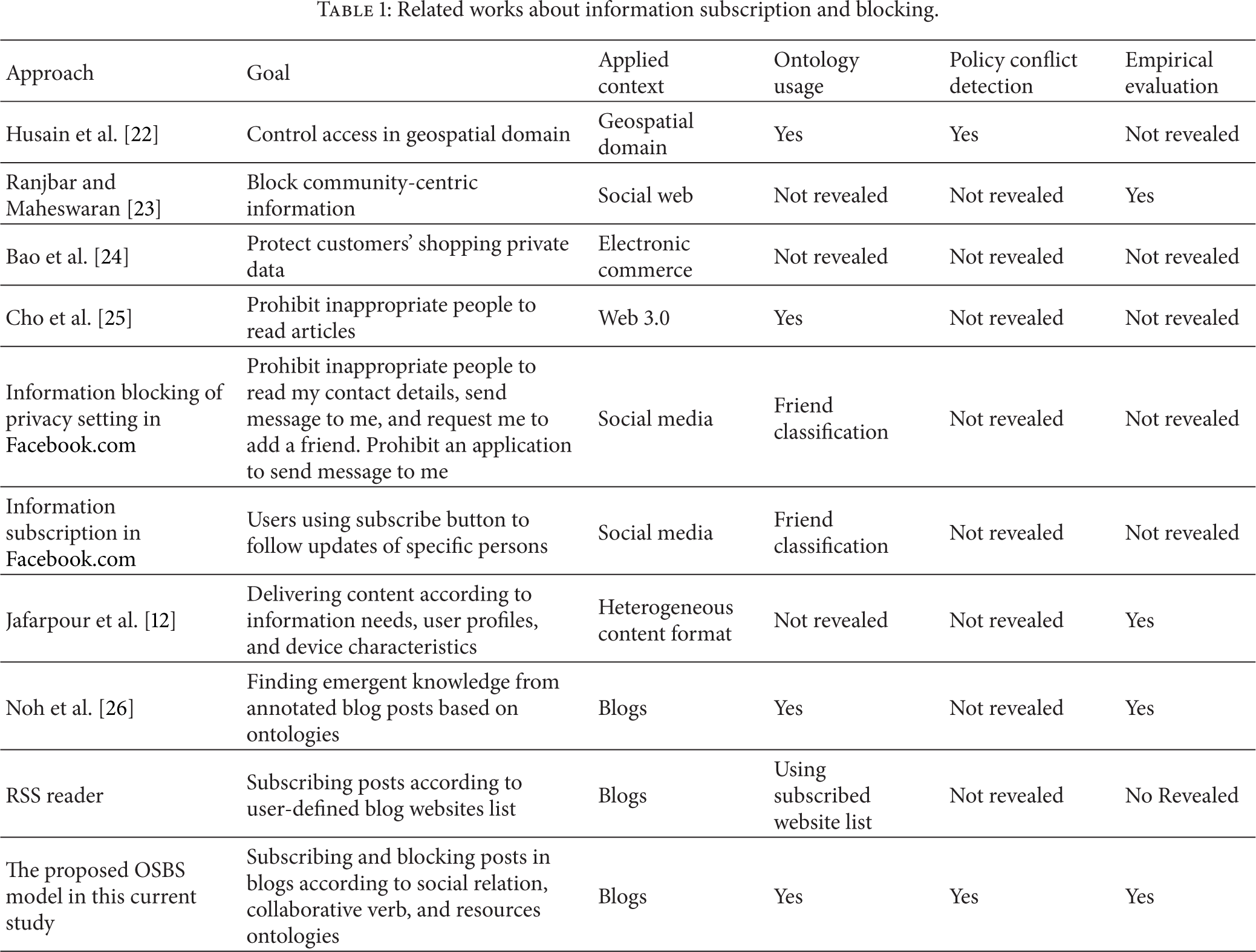
Four of the existing works focus on subscription mechanisms. Facebook provides the subscription function and Jafarpour et al. [12] propose a novel subscription systems. Facebook's subscription function allows users to subscribe someone's new posts. Jafarpour et al. [12] deliver content in appropriate format to subscribers. Noh et al. [26] uses semantic rules to find emergent knowledge, for example, top 20 most discussed books in blogs. RSS reader utilizes user-defined blog websites list to subscribe blog posts. On the contrary, the proposed OSBS approach uses ontologies to subscribe interesting posts, block inappropriate posts, and detect policies conflicts automatically according tags and collaboration activities. And this study uses experiment method to empirically evaluate the OSBS approach. Only three prior works in Table 1 use empirical data to evaluate subscription and blocking systems.
3. Blog Subscription Systems
This study evaluate the effectiveness of two subscription systems for blogs: the proposed OSBS mechanism and the existing RSS reader (named Google Reader). The two systems are introduced as follows.
3.1. Ontological Subscription and Blocking System
The OSBS mechanism manages policies and delivers posts in four steps (Figure 1). The four steps of the OSBS process are introduced as follows.

OSBS process.
(1) Modeling Prior Knowledge. This step models essential prior knowledge, which is the minimum knowledge to describe subscription and blocking policies. The prior knowledge consists of social relations, collaborative verbs, and resources ontologies used to specify policies. The OSBS provides useful basic concepts in the ontologies. The basic concepts in social relations ontology are someone, friend, close friend, family, famous blogger, and classmate. The main basic collaborative verbs concepts are request, give, express, decide, and declare. The basic resource ontologies are provided by a blog service provider. Users can add new concepts and relationships to maintain their personal ontologies. And administrators of a blog service provider can maintain the organizational ontologies which are used by all users.
(2) Specifying Policies. The major purpose in this step is to use concepts in the prior knowledge to specify new policies. Ontologies can store terms representing concepts that describe new policies. The screenshot of the module in supporting the specifying policies step is shown in Figure 2. In Figure 2, five subscription policies exist in Lily's OSBS: (1) Intimate (Social Relation)
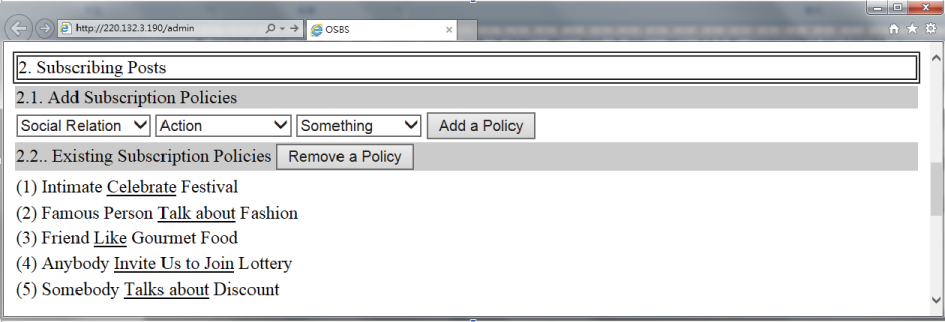
Screenshot of specifying subscription policies in OSBS prototype.
(3) Detecting and Resolving Conflicts. This step detects conflicts between policies based on the data produced in the above two steps. Rules are also used to detect policy conflicts. If a conflict is found, users should prioritize inconsistent policies to resolve the conflict. The prioritization information determines which policy has higher priority than the other during policies execution. Inconsistent policies can be executed after the prioritization information is given.
Figure 3 describes the metadata of policy conflict. The upper part in Figure 3 is blocking policy BP1 or subscription policy SP. The lower part in Figure 3 is blocking policy BP2 or subscription policy SP2. Four relationships between the upper part and lower part are
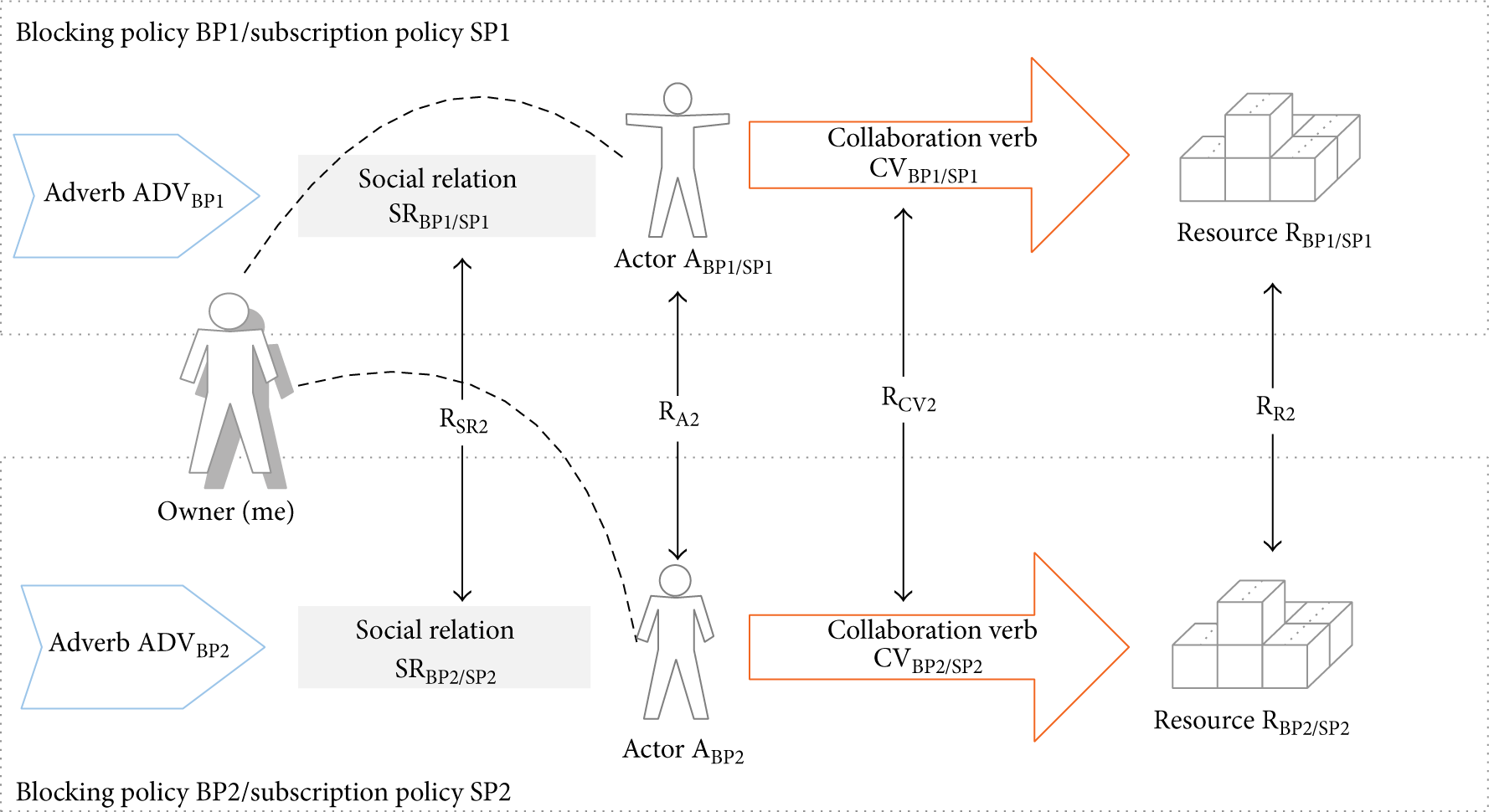
Policy conflict metadata.
This module uses the policy conflict detection rules to detect conflict automatically. This work proposes six rules in Table 2. In Table 2, “∨” denotes “or,” “¬” denotes “not,” K means “is a kind of”, Eq presents “is equal to,” A means “is an antonym of,” P denotes “is a part of,” and H denotes “is hostile to.” Four relationships and two adverbs in Figure 3 are considered in these rules in Table 2. Ontology provides semantics, such as kind, composition, and antonym, to identify four relationships (
Policy conflict detection rules.
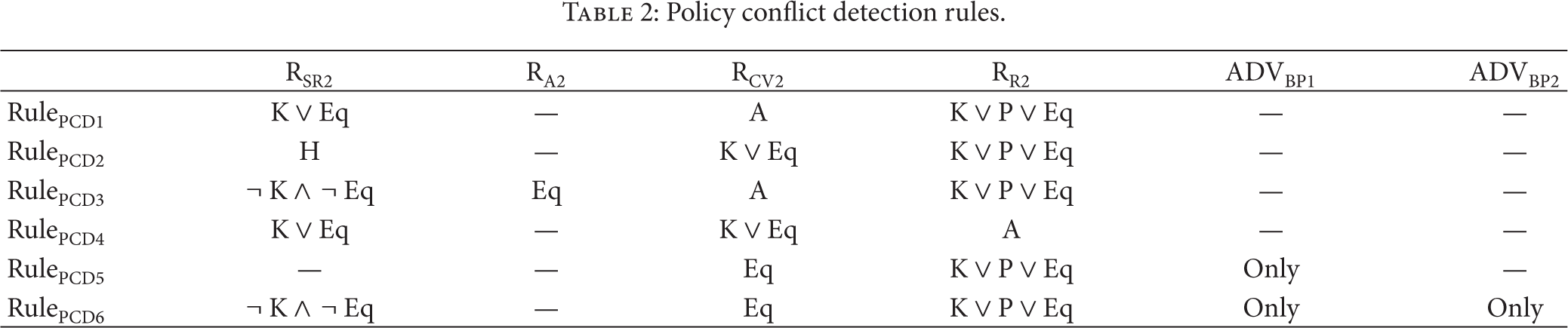
Figure 4 shows an example including two blocking policies and a conflict. Blocking policy (1) is as follows: Inhibit “Somebody

Screenshot of specifying blocking policies and managing conflicts in OSBS prototype.
This module uses the policy conflict metadata (in Figure 3) and policy conflict detection rules (in Table 2) to analyze blocking policy (2) and subscription policy (3). In Lily's OSBS, blocking policy (2) (BP1) is as follows: “Somebody (
(4) Delivering Subscribed and New Posts. A major task in this step is delivering posts to users according to policies, ontologies, and prioritization information. Users receive subscribed posts based on subscription and blocking policies. Users also receive new posts without unwanted posts based on blocking policies.
The subscribed post delivery rule involving semantic relationships between subscription policy and collaborative information of blog posts in Figure 5 is as follows: If social relation
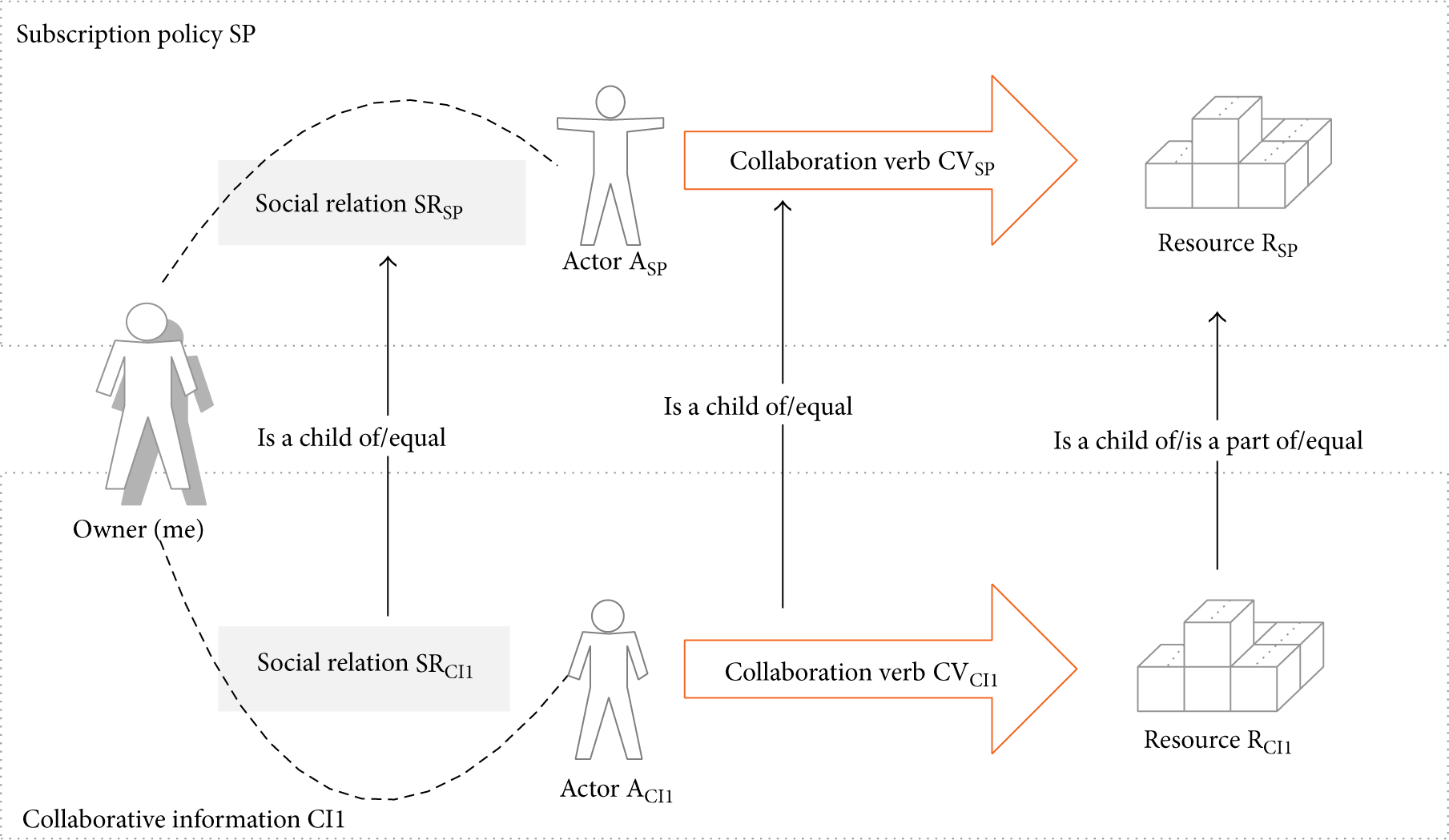
Subscribed post delivery rule.
For example, Lily's intimate (
This module uses the post blocking rules (in Table 3) to block undesirable posted messages. The metadata of the post blocking rules is depicted in Figure 6. Blocking policy in Figure 6 comprises adverb, social relation, actor, collaboration verb, and resource. Collaborative information in Figure 6 consists of social relation, actor, collaboration verb, and resource. Four semantic relationships between blocking policy and collaborative information are
Post blocking rules.

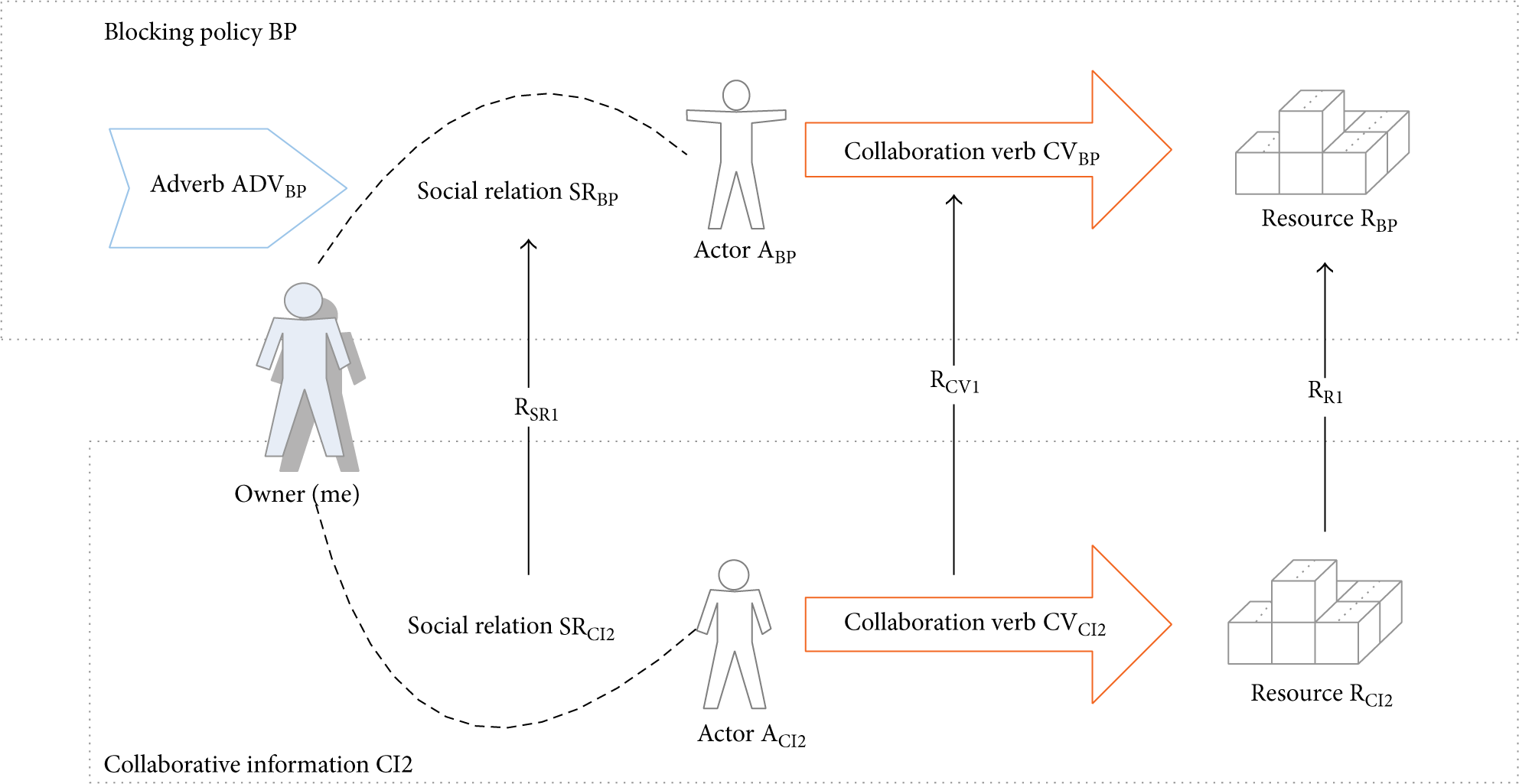
Post blocking rule metadata.
A post is blocked if all conditions in each rule in Table 3 are satisfied. In Table 3, “∨” denotes “or,” K denotes “is a kind of,” Eq means “is equal to,” A means “is an antonym of,” P denotes “is a part of,” H means “is hostile to.”
For example, famous person (
3.2. RSS Reader
The RSS reader mechanism aggregates user's subscribed posts according to subscribed blog websites list. RSS is a subscription mechanism and is widespread used in blogs. There are various RSS readers that have been developed, such as Feedly, Pulse, NewsBlur, and Taptu. Therefore the current study uses a web-based RSS reader in the experiment. Three modules in the web-based RSS reader are introduced as follows. Subscribing a blog website: users can click the subscription button and then input a blog website web address to add the blog website into subscribed blog website list. Unsubscribing a blog website: users can remove an unwanted blog website from subscribed blog websites list. Delivering subscribed posts: users can choose a specific name of blog website in subscribed blog website list to read the blog post titles and parts of content in the specific blog website.
4. System Evaluation
This system evaluation was designed as a one-factorial experiment manipulating two levels of functionality of subscription systems with two independent groups of subjects. The independent variable was functionality of subscription systems which has two levels of functionality: sophisticated (OSBS) and simple (RSS reader). The number of modules and data in OSBS are more than the number of modules and data in RSS reader.
Participants in experiments are randomly assigned into two groups to try to use OSBS or RSS reader. In the experiment of OSBS group, a demonstration about how to use a OSBS is provided to the participants and then the participants try to use OSBS. In the experiment of RSS reader group, a demonstration about how to use RSS reader is also provided to the participants and then the participants try to use RSS reader. After the demonstrations and subscription systems usage, the participants fill in the questionnaire. After all the steps were completed, the participants were given a souvenir.
This study had 110 participants. The subjects who participated in the experiment were all Taiwanese and were a mix of graduate and undergraduate students in a university. Each subject was randomly assigned to the different groups to try to use OSBS or RSS reader. The subjects who do not want to use subscription systems are excluded in the statistic analysis. A summary of the participants is shown in Table 4. ANOVA test found no significant differences for experimental subjects between OSBS and RSS reader groups in terms of gender, age, having blogs usage experience, or blogs usage experience period. Therefore, randomization of assignment across two groups was successful to avoid confounding effects resulting from individual characteristics.
Subject demographics.

This study uses descriptive statistics and partial least squares (PLS) to analyze experimental data. The descriptive statistics results are agreed percentages and means about items of perceived privacy benefits, information overload alleviation, ease of use, and intention to use in OSBS and RSS reader groups. The descriptive statistics results are discussed as follows.
Table 5 shows the experimental results on perceived privacy benefits measured by five items. The agreed percentage is comprised of very agree (5 points) and agree (4 points). Normal is 3 points, disagree is 2 points, and very disagree is 1 point. In general, the agreed percentages and means of perceived privacy benefits in OSBS group are greater than RSS reader group. However, less than 50% of participants in both two groups agree that “the system can help me to plan how to interact with my friends on blogs” in item 2.
Results on perceived privacy benefits.

Table 6 shows the experimental results on perceived information overload alleviation measured by six items. The agreed percentages and means of perceived information overload alleviation in OSBS group are as high as RSS reader group. Over 73% of participants in OSBS group, which is more than 69.8% in RSS reader group, agree that “the data is well organized by this system on blogs.”
Results on perceived information overload alleviation.

Table 7 shows the experimental results on perceived ease of use measured by four items. In general, the results of perceived ease of use are similar between OSBS and RSS reader groups. About 67% of participants in OSBS group agree that OSBS is easy to use. And about 70% of participants in RSS reader group agree that RSS reader is easy to use.
Results on perceived ease of use.

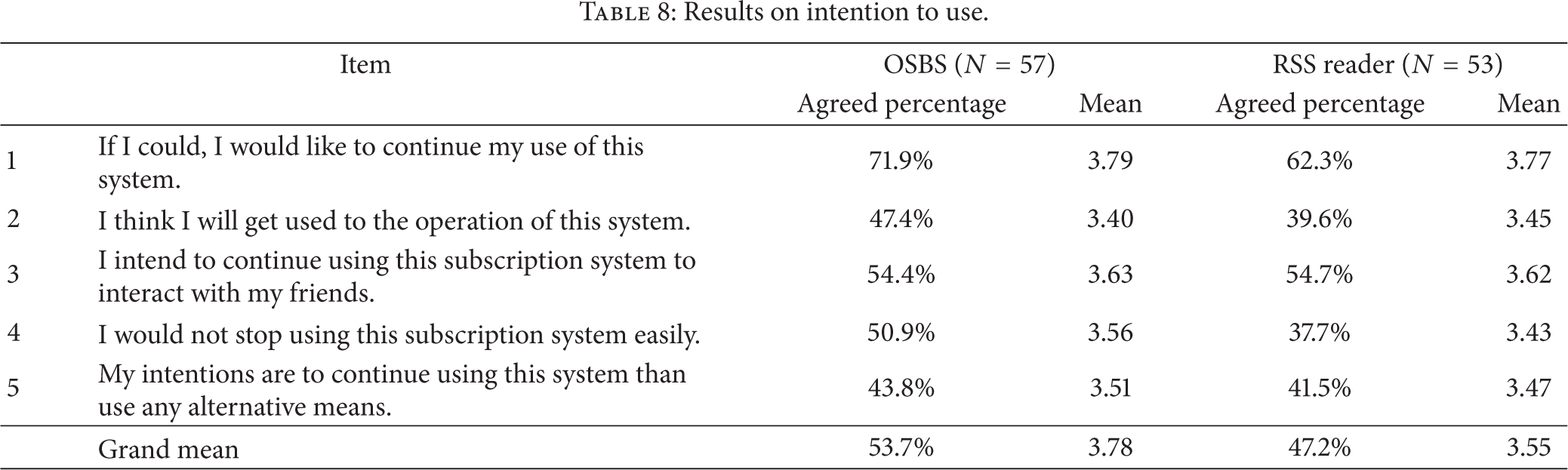
Table 8 shows the experimental results on intention to use. In general, the agreed percentages and means of intention to use in OSBS group are greater than RSS reader group.
Results on intention to use.
This study uses partial least squares (PLS), which is an approach in the structural equation modeling (SEM) family. The SmartPLS statistical software [27] is used in this study. The assumptions of homogeneity of variance and covariance of dependent variable across groups are not necessary in SEM [28, 29]. The PLS method was chosen over covariance-based methods in this study because PLS supports both exploratory and confirmatory research and PLS can be applied to relatively small samples [29, 30]. The recommended minimum sample size in using the PLS method should be the larger of 10 times the number of items for the most complex construct or 10 times the largest number of independent variables [29, 31]. In this study, the most complex construct has six items and the largest number of independent variables is three. The sample size of 110 for this study is more than the recommended minimum sample size.
Bootstrapping was performed to test the statistical significance of each path coefficient using t-tests assessment. The subsamples are 5000 which is suggested by Hair et al. [32]. The result depicted in Figure 7 is explained as follows. Perceived ease of use: subscription system functionality in high-level OSBS and low-level RSS reader does not significantly have influences on perceived ease of use. In other words, there is no significant difference in perceived ease of use between OSBS and RSS reader groups. Perceived privacy benefits: subscription system functionality in high-level OSBS and low-level RSS reader is significant and has positive impact on perceived privacy benefits ( Information overload alleviation: subscription system functionality in high-level OSBS and low-level RSS reader does not significantly have influences on perceived information overload alleviation. Perceived ease of use has positive and significant impacts on perceived information overload alleviation ( Intention to use: perceived ease of use has positive and significant impacts on intention to use (
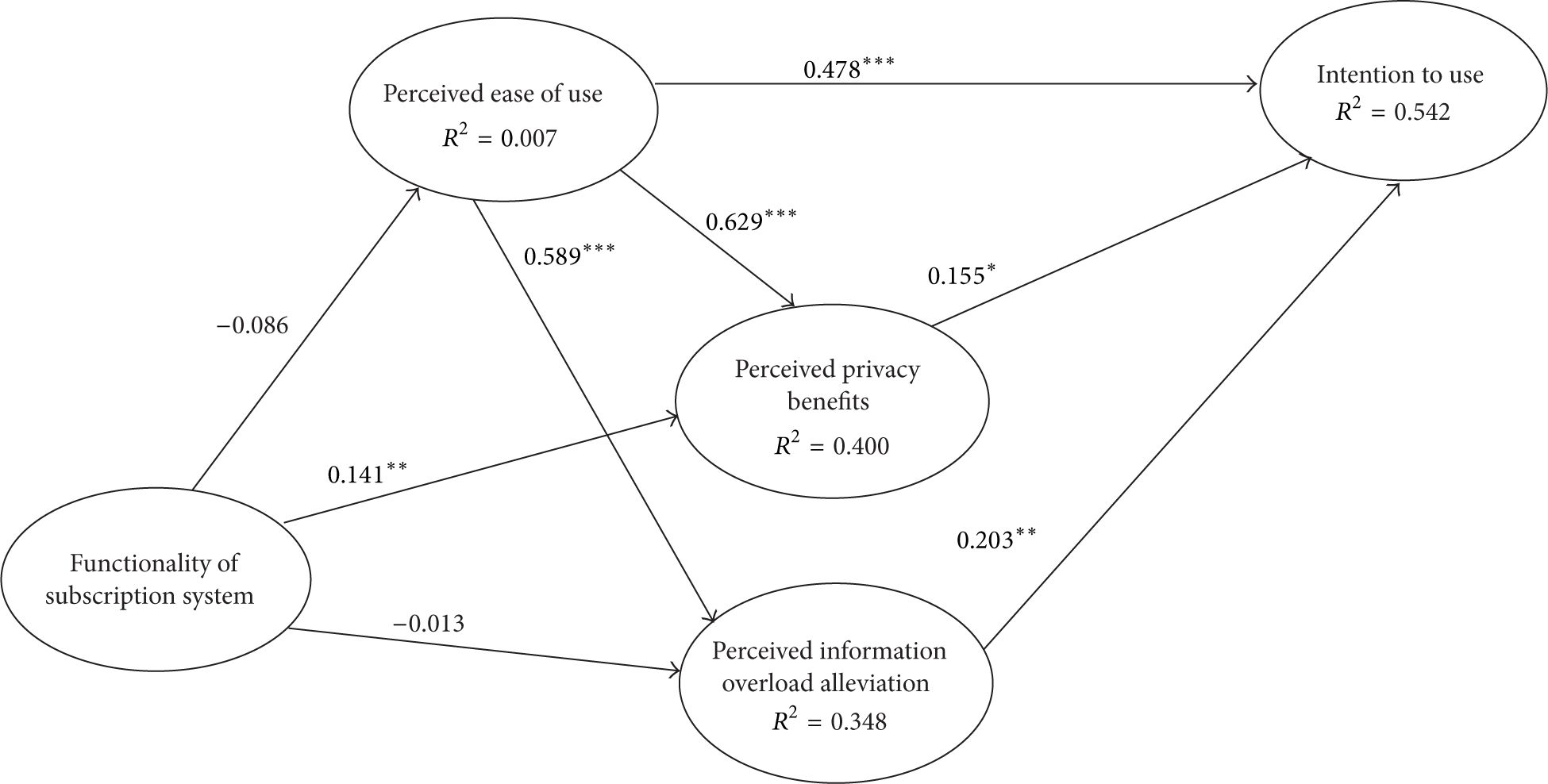
PLS structural model. Note: values above the arrows refer to path coefficients;
The
5. Conclusion
This work develops the novel OSBS mechanism based on ontologies. The experiment compares the novel OSBS and the existing RSS reader from ease of use, privacy benefits, and information overload alleviation perspectives. The empirical evidences show that the perceived privacy benefits on OSBS are better than the perceived privacy benefits on RSS reader. Both OSBS and RSS reader users perceive similar high levels of ease of use and information overload alleviation. Intention to use subscription systems is significantly influenced by perceived ease of use, perceived privacy benefits, and perceived information overload alleviation.
The research contributions of this paper are twofold. First of all, this work develops a prototype to demonstrate a novel ontological mechanism for posts subscription and blocking. Secondly, the experiment shows that the novel mechanism is better than the existing RSS mechanism from the perceived privacy benefits perspective.
It is interesting that users perceived information overload alleviation on the sophisticated OSBS is similar to the simple RSS reader. OSBS subscribes blog posts according to several content characteristics comprising social relations, collaboration verbs, and tags. RSS reader subscribes blog posts according to subscribed blog websites list. It implies that users are usually interested in specific-author's posts in their personal life.
Although the OSBS mechanism is demonstrated in the personal life context, the OSBS mechanism can also be used in organizations. The OSBS mechanism may facilitate knowledge sharing and storage in the organizational context. Exploring how collaboration verbs and tags of subscription systems influence perceived information alleviation in organizational collaboration context is an interesting topic in the future research direction.
Footnotes
Conflict of Interests
The authors declare that there is no conflict of interests regarding the publication of this paper.