




Abstract
Due to the imbalanced energy consumption among nodes in wireless sensor networks, some nodes die prematurely, which decreases the network lifetime. To solve this problem, existing clustering protocols usually construct unequal clusters by exploiting uneven competition radius. Taking their imperfection on designing the uneven competition radius and intercluster communication into consideration, this paper proposes an improved distributed unequal clustering protocol (IDUC) for wireless sensor networks, where nodes are energy heterogeneous and scattered unevenly. The cores of IDUC are the formation of unequal cluster topology and the construction of intercluster communication routing tree. Compared with previous protocols, IDUC is suitable for various network scenarios, and it can balance the energy consumption more efficiently and extend the lifetime of networks significantly.
1. Introduction
A wireless sensor network (WSN) consists of plentiful low-power sensor nodes capable of sensing, processing, and communicating. These sensor nodes observe the environment phenomenon at different points in the field, collaborate with each other, and send the monitored data to the base station (BS). As sensor networks have limited and nonrechargeable energy resources, energy efficiency is a very important issue in designing the network topology, which affects the lifetime of WSNs greatly. Thus, how to minimize energy consumption and maximize network lifetime are the central concerns when designing protocols for WSNs.
In recent years, clustering has been proved to be an important way to decrease the energy consumption and extend lifetime of WSNs. In clustering scheme, sensor nodes are grouped into clusters, in each cluster, a node is selected as the leader named as the cluster head (CH) and the other nodes are called cluster members (CMs). Each CM measures physical variables related to its environment and then sends them to their CHs. When the data from all CMs arrive, CHs aggregate data and send it to the BS. Since CHs are responsible for receiving and aggregating data from their CMs and then transmitting the aggregated data to the specified destination, the energy consumption of which is much higher than that of CMs. To solve this problem, most clustering algorithms divide the operation into rounds and periodically rotate the roles of CHs in the network to balance the unequal energy consumption among nodes. However, there exists another problem; that is, energy consumption among CHs is also imbalanced due to the distance to the BS. In single-hop networks, CHs farther away from the BS need to transmit data to a long distance. Thus, the energy consumption of these CHs is larger than that of CHs closer to the BS. In multihop networks, CHs closer to the BS undertake the task of forwarding data, which means that the energy consumption of CHs closer to the BS is larger. The imbalanced energy consumption of nodes leads to a certain number of nodes dying prematurely, causing network partitions. To solve this problem, researchers design unequal clustering algorithms to balance the energy consumption among CHs.
In this paper, aiming at energy heterogeneous networks where nodes are deployed unevenly, a more practical network case, we propose an improved distributed unequal clustering protocol (IDUC), in which a new competition radius and a new intercluster communication routing tree are designed to balance the energy consumption among CHs and extend the network lifetime.
The rest of the paper is organized as follows. Section 2 introduces the related works in this field. Section 3 gives the network model and related problem description. Section 4 presents the improved distributed unequal clustering protocol in details. Section 5 analyzes several properties of our algorithm. In Section 6, we conclude the paper. In the Appendix, exhibit and analyze simulation results.
2. Related Works
Since the energy consumption of CHs is much larger than that of CMs, in order to balance the energy among nodes, most clustering protocols adopt a rotation mechanism of CHs. The rotation methods used by the existing clustering algorithms can be divided into time-driven rotation and energy-driven rotation. In time-driven clustering algorithms [1–5], the role of the CH is rotated in the entire network periodically according to a predetermined time threshold. As each rotation is carried out in the entire network, the large overhead of recluster causes a lot of unnecessary energy waste. In energy-driven clustering algorithms [6–11], the role of CH is rotated when the residual energy of CH is less than a threshold. Recluster process only happens in local area; thus the large cost of global topology reconstruction can be avoided.
However, aside from the imbalance energy consumption among CHs and CMs, there also exists another imbalance consumption phenomenon among CHs that can impact the network lifetime significantly. To solve this problem, many unequal clustering algorithms have been proposed. The unequal clustering algorithms proposed in [12–14] all divide the network field into cirques. In [12], clusters in the same cirque have the same size, whereas clusters in different cirques have different sizes. Some high-energy nodes are deployed to take on the CH role to control network operation, which ensures that the energy dissipation of nodes is balanced. In [13], a cirque-based static clustering algorithm for multihop WSNs is proposed. Clusters closer to the BS have smaller sizes. Utilizing virtual points in a corona-based WSN, static clusters with dynamic structures are formed in ERP-SCDS [14].
The communication way of CHs in the distributed clustering protocol EECS [15] is single-hop, and the protocol adopts a weighted faction to control the numbers of CMs to construct unequal clusters. That is, the cluster size is smaller if it is farther away from the BS, vice versa.
EEUC [16] is also a distributed unequal clustering algorithm with intercluster multihop communication, which elects CHs based on the residual energy of nodes. Each node becomes a tentative CH with a probability T. However, the competition radius used by EEUC is not ideal for heterogeneous WSNs, and since the quality of the generated CHs is affected by T, there also exists “isolate points” in EEUC in some cases. LUCA [17] is similar to EEUC but presents more accurate theoretical analysis of optimal cluster size based on the distance between the CH and the BS.
In [18], we proposed EADUC to overcome the defects of EEUC. When designing the competition radius, besides the distance between nodes and the BS, the residual energy of nodes is also taken into account. That is, CHs closer to the BS and possessing lower residual energy have smaller cluster sizes to preserve some energy for the intercluster data forwarding; thus the cluster size is more reasonable and more suitable for heterogeneous WSNs. Simultaneously, EADUC overcomes the “isolate points” problem.
In [19], we proposed ECDC, in this algorithm, different coverage importance metrics are designed for different practical applications. We select cluster heads based on the relative residual energy and the coverage importance metrics of nodes. The intercluster communication adopts multihop forwarding mechanism. This algorithm can construct a better clustering topology with lower energy dissipation and better coverage performance through less control information.
These protocols described above, such as EEUC, only consider the distance between nodes and the BS, which is not suitable for heterogeneous networks; thus EADUC and ECDC also take residual energy of nodes into account besides the distance factor. However, they all overlook the distribution of nodes in WSNs, and it is not always effective to apply these algorithms into networks where nodes are scattered unevenly.
Aiming at this problem, what we need to do is design a protocol, which is suitable for various network scenarios, an improved distributed unequal clustering protocol (IDUC) is proposed in this paper. IDUC is effective in both heterogeneous and homogeneous network scenarios. In addition, it is suitable for WSNs where nodes are scattered evenly or unevenly. Our main contribution in the paper is as follows.
A new cluster head competition radius is proposed; it considers the distance among nodes and the BS, the residual energy of nodes, and the number of neighbor nodes within the nodes’ communication range. To meet the gap between the number of nodes within the communication ranges and finally cluster ranges, when designing the intercluster routing tree, CHs will choose CH nodes that possessing higher energy and fewer CMs as their next hops.
3. Network Model and Problem Description
3.1. Network Model
To simplify the network model, we adopt a few reasonable assumptions as follows.
There are N sensor nodes that are distributed in an The BS and all nodes are stationary after deployment. All nodes can be heterogeneous. All nodes are location-unaware. All nodes can use power control to adjust the transmit power. The BS is out of the sensor field. It has enough energy, and its location is known by each node. Each node has a unique identity
To transmit an l-bit data to a distance d, the radio expends energy is


3.2. Problem Description
As described above, some clustering protocols construct unequal clustering topology by uneven cluster head competition radius. However, these protocols, such as EEUC, only consider the distance between nodes and the BS, which is not suitable for heterogeneous networks; thus EADUC also takes residual energy of nodes into account besides the distance factor. Nonetheless, if we applied these algorithms into networks where nodes are scattered unevenly, such case is very likely to appear as shown in Figure 1, if the distance between

Imbalance energy consumption between
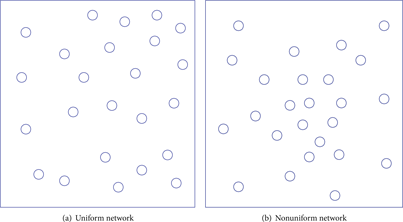
Meanwhile, in most practical applications, the deployment of nodes in networks is not always uniform, as shown in Figure 2. Figures 2(a) and 2(b) show the uniform and nonuniform distribution of nodes, respectively. Most clustering algorithms are inclined to be designed based on networks as Figure 2(a), an ideal network model, whereas these networks, as shown in Figure 2(b), are often neglected; since nodes are unevenly scattered, the nodes density is different in different area of the network. In such scenario, case appearing in Figure 1 easily happens when we applied existing clustering protocol. Thus, we need to control the number of CMs of each cluster; that is, if nodes have more communication neighbor nodes, their cluster competition radii should be smaller, vice versa. In fact, it is easy to obtain a method to solve this problem, as shown in Figure 1, that is, to reduce the competition radius of
Nodes distribution.
However, we have to admit that the number of neighbor nodes within the node initial communication range is very likely to be not equal with the number of CMs within its final cluster range. Thus, to further balance the consumption among CHs, when we construct the intercluster multihop routing tree, each CH needs to count the number of its CMs, and then it chooses the neighbor CH with fewer CMs and higher residual energy as its next hop.
4. IDUC Details
The whole operation is divided into rounds, where each round consists of a cluster setup phase and a data transmission phase. In the cluster setup phase, a clustering topology is formed, and, in the data transmission phase, a new routing tree is constructed to forward data. To save energy, the data transmission phase should be longer than the cluster setup phase. The descriptions of node states and several control messages are shown in Table 1, respectively.
Description of control messages.

4.1. Cluster Setup Phase
In the network deployment phase, the BS broadcasts a signal, and each node can compute its approximate distance to the BS based on the received signal strength; this step is necessary when designing an unequal distributed clustering algorithm. The following is the cluster setup phase. The first subphase of this phase is information collection phase, whose duration is set as 
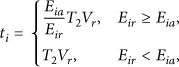
After 
In heterogeneous networks, nodes have heterogeneous initial energy. In the case that each node has the same energy consumption, nodes with low initial energy will die prematurely, reducing the network lifetime. In order to take full advantage of high-energy nodes, these high-energy nodes should take more tasks. Therefore, considering both the distance from nodes to the BS and the residual energy of nodes, we gave an improved formula of 
However, the cluster competition radius
Meanwhile, another remarkable problem generated in EADUC is that there is no restriction on the relation of α and β; thus, in such case where both If the network is energy homogeneous, we can set If the distribution of nodes in the network is uniform, we can set If nodes in the network is energy homogeneous and the distribution is nonuniform, we can set 
According to practical network applications, we can adjust α, β and γ, and to be the optimal value to extend the network lifetime.
When
Broadcast the Receive Update neighborhood table NT[ ] NT Continue Broadcast the Send Receive Broadcast the
Algorithm 1
4.2. Data Transmission Phase
In the data transmission phase, each CM collects local data from the environment periodically and then sends the data to the CH within its time slot according to the TDMA scheduling list to avoid the collisions among the members in the same cluster. When data from all the member nodes has arrived, the CH aggregates the data and sends it to the BS. Thus, this section is divided into two subphases,
In
Several nodes need to be selected as child nodes of the BS from all CHs and communicate with the BS directly. Therefore, each CH determines whether to be selected as the child node of the BS depending on its distance to the BS according to a threshold Euclidean distance
The concrete process is as follows. We set the duration as 
To visually demonstrate the construction of

Intercluster communication routing tree.
Algorithm 2 give the details of this phase.
Broadcast the Receive Router_Msgs Compute the cost Update && Update
Algorithm 2
5. Protocol Analysis
Theorem 1.
There is at most one
Proof.
As we state previously, formula (4) ensures that different nodes have different waiting time. Assume that node
From Theorem 1 and the proof, we can see that nodes with relatively higher energy are elected as CHs, and there is one and only one CH within the competition radius
Theorem 2.
The cluster head set generated by the IDUC algorithm is a dominating set, which can cover all the network nodes.
Proof.
According to Theorem 1, there is no more than one CH within a cluster, so the cluster head set must be an independent set. After the execution of the IDUC algorithm, each node in the network either is the CH, or the member node of one cluster, any plain node adding to the cluster head set will destroy its independence. Hence, the cluster head set is a maximal independent set. Since a maximal independent set is also a dominating set, the cluster head set generated by the IDUC algorithm is a dominating set.
Therefore, we conclude that the waiting time of any node is smaller than
Theorem 3.
The message complexity of control message in the network is
Proof.
At the beginning of each round, each node broadcasts a
IUDC adopts a distributed clustering strategy. Thus, the time complexity of the entire network is equal to that of a single node
Taking a comprehension analysis of IDUC, we can summarize the advantages of IDUC as follows.
Nodes with relatively higher energy are elected as CHs; thus the frequency of recluster will be lower, which is helpful to reduce the energy consumed in reclustering. There are no “isolate points” in the clustering topology generated by IDUC, which is proved in Theorem 3. The design of competition radius From Theorems 1 and 3, there is one and only one CH within the competition radius The construction of the new routing tree takes the distance from CHs to the BS, the residual energy of CHs, and the number of CMs covered by CHs into account, which makes the IDUC more suitable for heterogeneous and nonuniform networks.
6. Simulations
The simulation is performed in
Scenario 1.
100 nodes are uniformly deployed over a
Scenario 2.
100 nodes are nonuniformly deployed over a
Figure 4 shows the initial topology of two scenarios.

Simulation scenarios.
The parameters of the simulations are listed in Table 2.
Parameters of the simulation.

6.1. Clustering Topology
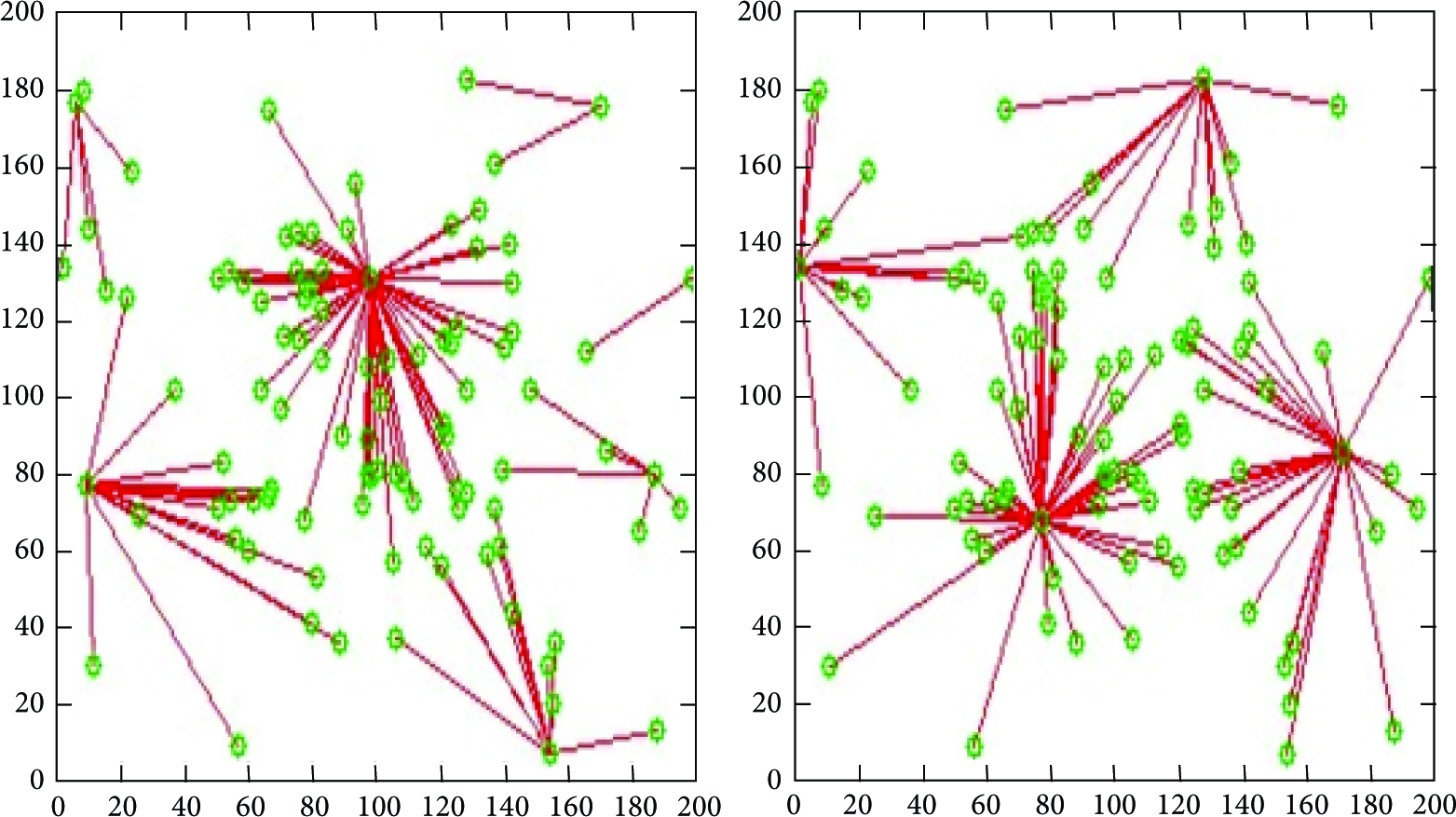
To show that IDUC is suitable for network scenario where nodes are scattered unevenly, we first divide experiments into two groups, that is, parameters are firstly set as (
Clustering topology.
6.2. Cluster Head Distribution
By analyzing formula (7), we can draw the conclusion that α, β, γ and
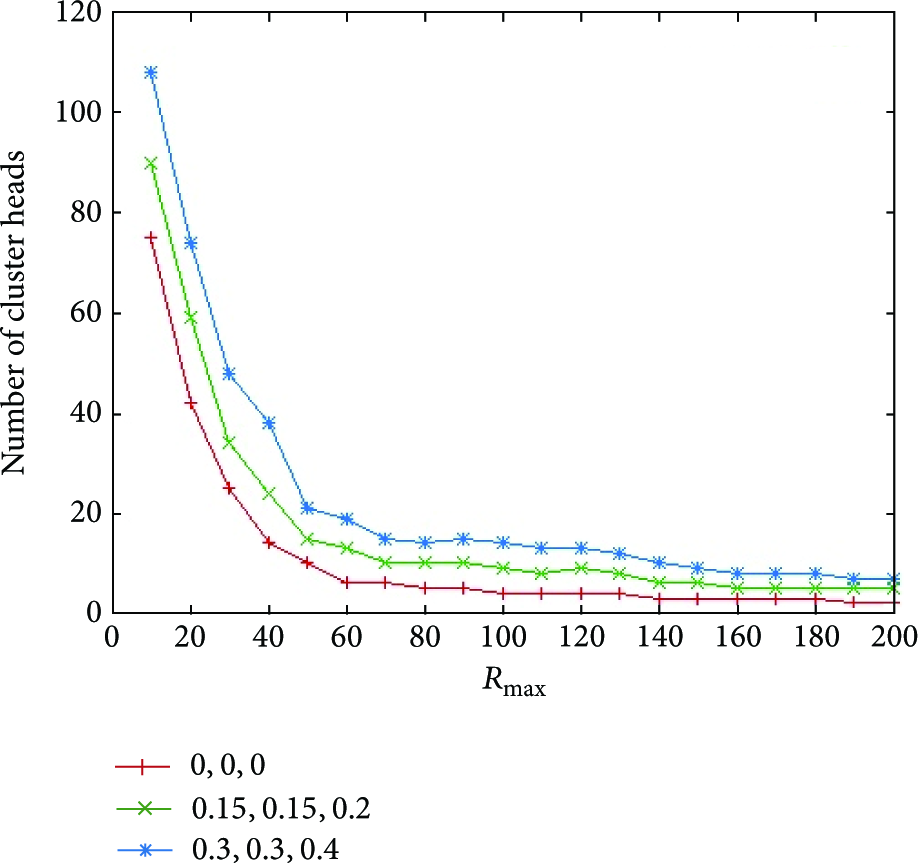
Number of cluster heads and
To prove the validity of our intercluster routing tree, in Scenario 2, we set
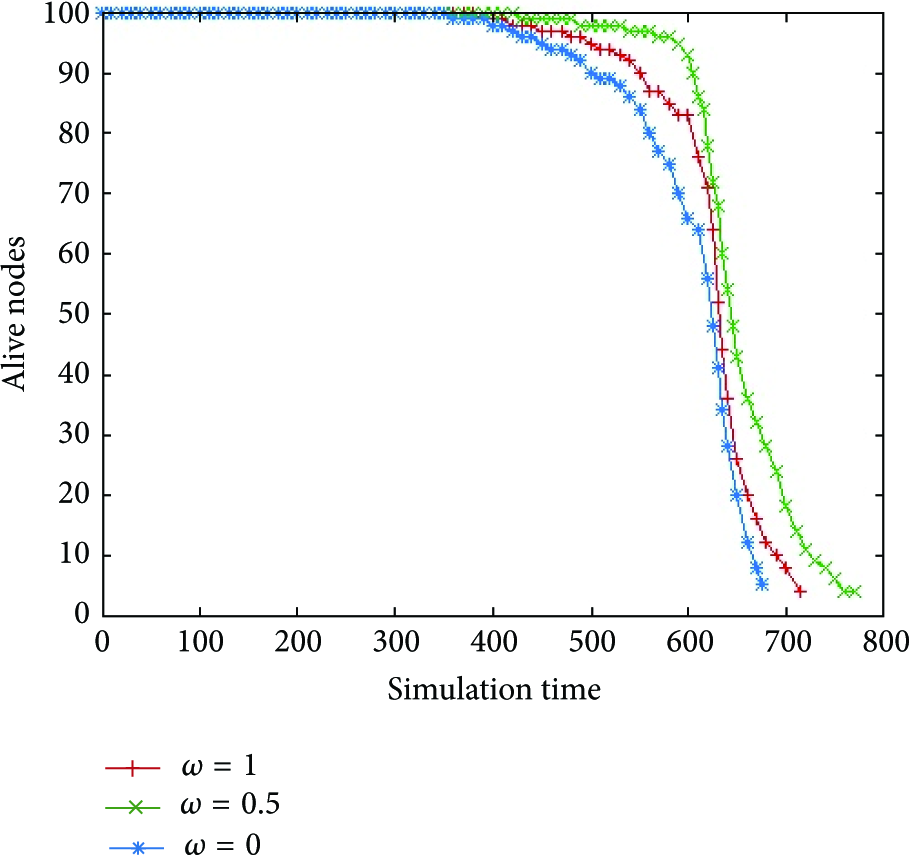
Network lifetime under different ω.
The following is the stability analysis of IDUC. We run LEACH, HEED, EADC, ECDC, and IDUC in two scenarios. Figure 8 shows the distribution of CHs numbers in different scenarios, we can see that IDUC and ECDC can achieve more stable performance than other algorithms. Compare IDUC with ECDC, we found that the stability of ECDC is better than that of IDUC in Scenario 1. However; when considering Scenario 2, the stability of IDUC is better than that of ECDC.

Distribution of the number of CHs.
6.3. Network Lifetime
In EADUC, we proved that the network lifetime in heterogeneous scenarios is longer than that in homogeneous scenarios if the residual energy of nodes is taken into account when designing the competition radius of CHs. Since we also consider the residual energy of nodes, in our simulation, we only need to test the performance of IDUC in different scenarios where nodes are distributed uniformly and nonuniformly, respectively. Thus, we set

Network lifetime in different scenarios.
To further test the performance of IDUC, in heterogeneous network Scenario 2 where nodes are scattered unevenly, we run LEACH, EEUC, EADUC, ECDC, and IDUC. Results in the Figure 10 show that ECDC and IDUC perform far better than LEACH, EEUC, and EADUC in prolonging the network lifetime.

Network lifetime in different scenarios.
7. Conclusion
In this paper, an improved distributed unequal clustering protocol IDUC is proposed, we design a new cluster competition radius considering the distance between nodes and the BS, the residual energy of nodes, and the numbers of neighbor nodes within the node communication range. Furthermore, to bridge the gap between the numbers of nodes within the initial communication radius and final cluster radius, we design a new intercluster communication routing tree. Theoretical analysis and simulation show that, the protocol is suitable for various network scenarios. In these scenarios, the nodes energy can be efficiently balanced and the network lifetime can be extended significantly.
Footnotes
Conflict of Interests
The authors declare that there is no conflict of interests regarding the publication of this paper.
Acknowledgments
This work was partially supported by the NNSF of China for Contract 61373027, the Macau Science and Technology Development Fund for Contract 013/2014/A1 and NSF of Shandong Province for Contract ZR2012FM023.