We investigate the joint effects of feedback delay and channel estimation errors (CEE) over Nakagami-m fading channels for two-hop amplify-and-forward (AF) relaying systems with transmit beamforming (TB) and relay selection (RS). We derive new closed-form expressions for the system outage performance including the exact analysis and informative high SNR asymptotic approximations, which indicate that TB feedback delay reduces the achievable diversity order to one, regardless of Nakagami-m fading parameters. Whereas RS delay reduces the diversity order to a case without relay selection and CEE merely result in coding gain loss, numerical results verify the theoretical analysis and illustrate that the outage performance is more sensitive to the TB feedback delay.
1. Introduction
Transmit beamforming (TB) and relay selection (RS) are regarded as two promising techniques for multiple-antenna multiple-relay assisted networks to achieve full spatial diversity and have been investigated intensively [1]. Generally, to achieve coherent beamforming for a maximal ratio transmission or select one or a set of relays for signal forwarding, perfect knowledge of channel state information (CSI) is required at the transmitter, which is probably unavailable because of practical limitations such as feedback delay and channel estimation errors (CEE).
The performance of transmit beamforming systems under imperfect CSI has been widely investigated in the literature. The effects of feedback delay on the performance of a two-hop TB and amplify-and-forward (AF) relay network with and without interference over Rayleigh-fading channels are investigated in [2, 3], respectively. The undesirable effect of CEE with beamforming is quantified in [4]. When relay selection is considered, feedback delays or estimation errors can create critical challenges. The impact of outdated CSI on the performance of AF relays with the kth worst partial relay selection scheme is presented in [5]. Then, the analysis of the effect of delay on relay selection has been extended to different relay selection schemes or channel environments (see [6, 7] and the references therein). Apart from feedback delay, the effects of CEE on the outage probability of selection cooperation are studied in [8].
However, most existing related works limited their analysis to either single-relay or single-antenna systems and do not yet consider TB and RS simultaneously or investigate the joint effect of outdated and imprecise CSI. Furthermore, to the best of our knowledge, prior works have been confined to Rayleigh-fading channels, and analytical results for TB-RS systems with delay and CEE over Nakagami-m fading channels have not yet been reported. In this paper, we consider a two-hop TB-RS system and a general imperfect CSI model taking feedback delay and CEE together into account is assumed over Nakagami-m fading channels. New closed-form expressions for the system outage performance including the exact analysis and informative high SNR asymptotic approximations are derived. Numerical results verify the theoretical analysis and illustrate the decremental effects of feedback delay and CEE on the system performance.
2. System and Signal Model
2.1. System Description
Consider a cooperative wireless communications system where a source, S, equipped with antennas communicates with a destination, D, assisted by a set of relays , . The direct communication link is assumed to be unavailable due to heavy shadowing between the source and the destination. We assume that each of the and channels experience independent and identically distributed Nakagami-m fading with parameters and , denoted by and , respectively. The noises at all receivers are mutually independent zero-mean Gaussian random variables with equal variance . In addition, we consider a total data transmit power constraint in which , where and denote the transmit power at the source and relay, respectively.
To exploit the multiantenna and multirelay diversity, transmit beamforming at the source-relay link and AF relay selection at the relay-destination link are employed. It should be noted that both the TB and RS processes are based on outdated and imperfect estimated CSI. Let and represent the actual (used for data transmission) and the outdated (used for relay selection and beamforming vector calculation) channel estimates with a time delay . According to the minimum mean-squared error (MMSE) channel estimation model [9, 10] and the time-correlated outdated CSI model [11, 12], we may have a modified joint delay and error model as follows (it should be noted that although the traditional bivariate distributed expression is more popular (see [11] and the references therein), this error model is in line with [9] and can be regarded as a good approximation):
where are approximated as Gaussian-distributed error with variance of , and
where and denote the estimation and delay correlation coefficients, respectively. Besides, denotes the variance of the actual channel , is the variance of the channel estimates, is the data transmission SNR, is the zero-order Bessel function of the first kind, is the Doppler frequency, and is determined by the cost of obtaining CSI in terms of the training pilots’ power consumption and reflects the quality of channel estimation [10]. It should be noted that corresponds to the case in which the estimated CSI is not outdated.
2.2. TB and RS with Delay and CEE
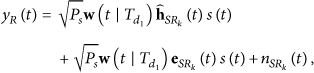
The data transmission process is divided into two phases. During the first phase, S beamforms its signal to a certain selected relay which achieves the largest receive SNR of the relay-destination link, and the received signal at can be written as
where and are the estimated channel and errors from S to , and is the AWGN at the relay. The beamforming vector is calculated from the outdated channel [9], where is the time delay between the beamforming vector feedback and data transmission. Then we define the received SNR of the first hop as
where , , and is the joint delay and estimation error from (1).
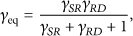
During the second phase, the received signal is multiplied by a variable-gain and retransmitted to the destination. After some mathematical manipulations, the end-to-end SNR at D can be written as [13]
where denotes the received SNR of the second hop with the average value . As mentioned above, before data transmission, a partial relay selection process is performed based on the highest instantaneous SNR of the second hop in which and is the delay between the relay selection and data transmission.
3. Outage Analysis
3.1. Exact Analysis
The outage probability is defined as the probability in which drops below an acceptable SNR threshold . We have
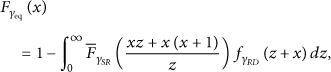
The CDF of can be written as a single-integral expression as [4]
where denote the complementary CDF.
Lemma 1.
The exact PDF and complementary CDF of are given in the following:
Proof.
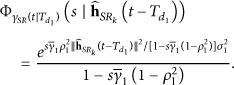
Conditioned on , can be approximated as complex Gaussian quadratic form , whose MGF can be derived as [14]
Reminding the assumption of Nakagami-m fading with identical parameter, the MGF of is , using which we can obtain the MGF of as
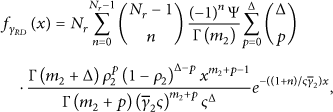
Obviously, has zeros at and poles at . Using (11) and the residue theorem, we have a closed-form PDF and the corresponding CDF results in (8) and (9).
The PDF and complementary CDF of the with outdated relay selection are given in (12) and (14) as [3]
where , , and
with and .
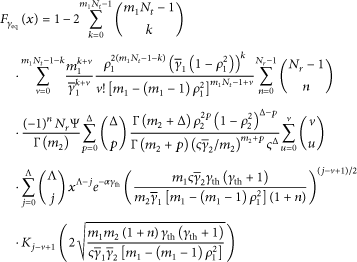
To this end, substituting (9) and (12) into (7) and using [15, Eq. (3.471.9)], the integral in (7) can be solved to yield a closed-form expression for as in
with and .
It should be noted that the outage result in (15) can be regarded as a generalized form where lots of previous works could be included, such as the TB without RS over Rayleigh-fading case in [2] by setting and and RS without TB case in [5, 6] by setting and .
3.2. Asymptotic Analysis
To gain further insights, we now look into the high SNR regime and derive the asymptotic expression for the outage probability, which enables the characterization of the joint effect of TB feedback delay, RS delay, channel estimation quality order, Nakagami-m fading parameters, the number of antennas and relays on the achievable diversity order, and array gain of the system. Assuming that , , and when , by substituting the related parameters we have
Obviously, according to the definition of δ that the training symbol power is scale to the data transmit power, we have in high SNR region. Thus, CEE have no effect on the system diversity gain and only lead to coding gain loss.
We now mainly focus on the feedback delay on the asymptotic outage analysis and present a separate treatment for the following three cases.
Lemma 2.
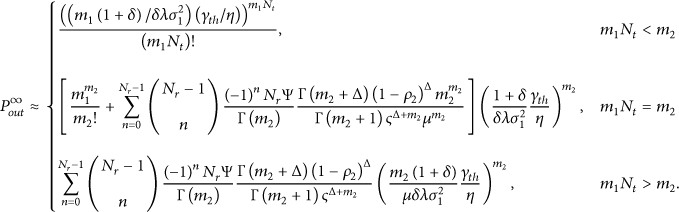
Case 1. It represents TB and RS feedback delay; that is, and ; the asymptotical approximation of the outage probability is given by
Case 2. It represents RS feedback delay only; that is, and ; we have
Case 3. It represents no feedback delay; that is, and ; we have
Proof.
For the three different cases, based on the PDF results in (8) and (12), we can expand the exponential function using Maclaurin series and choose the smallest order terms of x to obtain a high SNR approximation. Then using a lower bound in which we may obtain the asymptotic outage results. The details of the proof are omitted here due to the lack of space.
Lemma 2 shows that TB feedback delay plays the dominate role in reducing the achievable diversity order of the system to one (details in Case 1), regardless of Nakagami-m fading parameters and the number of antennas and relays. TB is so sensitive to CSI delay that we may obtain no diversity gain but only loss even compared with single-antenna communication link as . This is a new finding that differs from the intuitionistic result that RS delay will reduce the diversity order to a case without relay selection as (details in Case 2). When and approach one, the system achieves the full diversity order of the two-hop TB-RS system, as .
4. Numerical Results
This section presents the numerical and Monte Carlo simulation results of the detrimental effect of delay and CEE on the system performance over Nakagami-m fading channels. Without loss of generality we set , , , , , and .
Figure 1 illustrates the outage probability versus transmit SNR for various delays and channel estimation qualities. It can be clearly seen from the figure that analytical and simulated outage probability curves match excellently, which confirm the accuracy of our mathematical analysis and the tightness of the asymptotic analysis as well as the lower bound (in the proof of Lemma 2) in high SNR regime. As expected, the outage performance of the system is aggravated significantly, and we can draw same conclusions as described in Lemma 2.
Outage probability versus the transmit SNR.
Figure 2 plots the outage probability versus feedback delay (including TB feedback delay and RS delay) under perfect channel estimation. On the whole, we see that as increases, the outage probability at first degrades significantly but then approaches a limit and will fluctuate as delays increase, where the nonmonotonic change fits the behavior of . Besides, it can be observed that, for the same assumptions on the two hops, the outage performance is more sensitive to the TB vector feedback delay compared with the RS delay.
Outage probability versus feedback delay with .
5. Conclusions
We investigate the joint effect of outdated and imprecise CSI on the performance of the two-hop TB-RS system over Nakagami-m fading. Both analytical and simulated results indicate that TB feedback delay reduces the achievable diversity order to one, while RS delay reduces the diversity order to a case without relay selection. CEE will merely cause coding gain loss. These results will be helpful to predict practical relaying system performance with CEE and feedback delays.
Footnotes
Conflict of Interests
The authors declare that there is no conflict of interests regarding the publication of this paper.
Acknowledgments
This work was supported by the National Natural Science Foundation of China (nos. 61371122 and 61301162), the China Postdoctoral Science Foundation under a Special Financial Grant no. 2013T60912, and the China Equipment Development Foundation Grant no. 9140A05020114JB91064.
References
1.
FanY.ThompsonJ.MIMO configurations for relay channels: theory and practiceIEEE Transactions on Wireless Communications2007651774178610.1109/twc.2007.3603792-s2.0-34249297637
2.
SuraweeraH. A.TsiftsisT. A.KaragiannidisG. K.NallanathanA.Effect of feedback delay on amplify-and-forward relay networks with beamformingIEEE Transactions on Vehicular Technology20116031265127110.1109/tvt.2011.21127862-s2.0-79952846691
3.
HuangY.Al-QahtaniF.ZhongC.WuQ.WangJ.AlnuweiriH.Performance analysis of multiuser multiple antenna relaying networks with co-channel interference and feedback delayIEEE Transactions on Communications2014621597310.1109/tcomm.2013.112213.1303902-s2.0-84893767617
4.
AmarasuriyaG.TellamburaC.ArdakaniM.Performance analysis of hop-by-hop beamforming for dual-hop MIMO AF relay networksIEEE Transactions on Communications20126071823183710.1109//TCOMM.2012.051012.1005942-s2.0-84864119891
5.
SuraweeraH. A.SoysaM.TellamburaC.GargH. K.Performance analysis of partial relay selection with feedback delayIEEE Signal Processing Letters201017653153410.1109/lsp.2010.20455442-s2.0-77957893936
6.
SoysaM.SuraweeraH. A.TellamburaC.GargH. K.Partial and opportunistic relay selection with outdated channel estimatesIEEE Transactions on Communications201260384085010.1109/TCOMM.2012.12.1006712-s2.0-84858334631
7.
HwangK.-S.JuM. C.AlouiniM.-S.On the outage performance of two-way amplify-and-forward relaying with outdated CSI over multiple relay networkProceedings of the IEEE 24th Annual International Symposium on Personal, Indoor, and Mobile Radio Communications (PIMRC ′13)September 2013IEEE1185118910.1109/pimrc.2013.66663182-s2.0-84893247275
8.
JiaY.VosoughiA.Outage probability and power allocation of two-way amplify-and-forward relaying with channel estimation errorsIEEE Transactions on Wireless Communications20121161985199010.1109/twc.2012.040412.1106932-s2.0-84862835948
9.
MaY.JinJ.Effect of channel estimation errors on M-QAM With MRC and EGC in Nakagami fading channelsIEEE Transactions on Vehicular Technology20075631239125010.1109/tvt.2007.8954912-s2.0-34249730517
10.
NarasimhanR.Effect of channel estimation errors on diversity-multiplexing tradeoff in multiple access channelsProceedings of the IEEE Global Telecommunications Conference (GLOBECOM ′06)March 2006Cancún, Mexico16581663
11.
JinH.ChoC.SongN.-O.SungD. K.Optimal rate selection for persistent scheduling with HARQ in time-correlated Nakagami-m fading channelsIEEE Transactions on Wireless Communications201110263764710.1109/twc.2011.120810.1006342-s2.0-79951674896
12.
YangN.ElkashlanM.YeohP. L.YuanJ.Multiuser MIMO relay networks in Nakagami-m fading channelsIEEE Transactions on Communications201260113298331010.1109/tcomm.2012.081412.1104632-s2.0-84870503788
13.
WangL.CaiY.YangW.YangW.Performance analysis of transmit beamforming and relay selection with feedback delay and channel estimation errorsProceedings of the International Conference on Wireless Communications and Signal Processing (WCSP ′13)October 20131610.1109/wcsp.2013.66770312-s2.0-84898992054
14.
MaY.ZhangD.LeithA.WangZ.Error performance of transmit beamforming with delayed and limited feedbackIEEE Transactions on Wireless Communications2009831164117010.1109/TWC.2008.0805702-s2.0-62949208925
15.
GradshteynI. S.RyzhikI. M.Table of Integrals, Series and Products20006thSan Diego, Calif, USAAcademic PressMR1773820