




Abstract
Recently, applications of Internet of Things create enormous volumes of data, which are available for classification and prediction. Classification of big data needs an effective and efficient metaheuristic search algorithm to find the optimal feature subset. Cat swarm optimization (CSO) is a novel metaheuristic for evolutionary optimization algorithms based on swarm intelligence. CSO imitates the behavior of cats through two submodes: seeking and tracing. Previous studies have indicated that CSO algorithms outperform other well-known metaheuristics, such as genetic algorithms and particle swarm optimization. This study presents a modified version of cat swarm optimization (MCSO), capable of improving search efficiency within the problem space. The basic CSO algorithm was integrated with a local search procedure as well as the feature selection and parameter optimization of support vector machines (SVMs). Experiment results demonstrate the superiority of MCSO in classification accuracy using subsets with fewer features for given UCI datasets, compared to the original CSO algorithm. Moreover, experiment results show the fittest CSO parameters and MCSO take less training time to obtain results of higher accuracy than original CSO. Therefore, MCSO is suitable for real-world applications.
1. Introduction
Recently, applications of Internet of Things create enormous volumes of data, which are available for classification and prediction. Classification of big data needs an effective and efficient metaheuristic search algorithm to find the optimal feature subset. A wide range of metaheuristic algorithms such as genetic algorithms (GA) [1], particle swarm optimization (PSO) [2], artificial fish swarm algorithm (AFSA) [3], and artificial immune algorithm (AIA) [4] have been developed to solve optimization problems in numerous domains including project scheduling [5], intrusion detection [6, 7], botnet detection [8], and affective computing [9]. Cat swarm optimization (CSO) [10] is a recent development based on the behavior of cats, comprising two search modes: seeking and tracing. Seeking mode is modeled on a cat's ability to remain alert to its surroundings, even while at rest; tracing mode emulates the way that cats trace and catch their targets. Experimental results have demonstrated that CSO outperforms PSO in functional optimization problems.
Optimization problems can be divided into functional and combinatorial problems. Most functional optimization problems, such as the determination of extreme values, can be solved through calculus; however, combinatorial optimization cannot be dealt with so efficiently. Feature selection is particularly important in domains such as bioinformatics [11] and pattern recognition [12] for its ability to reduce computing time and enhance classification accuracy.
Classification is a supervised learning technology, in which input data comprises features classified by support vector machines (SVMs) [13], neural networks [14], or decision trees [15]. The classifier is trained by the input data to build a classification model applicable to unknown class data. However, input data often contains redundant or irrelevant features, which increase computing time and may even jeopardize classification accuracy. Selecting features prior to classification is an effective means of enhancing the efficiency and classification accuracy of a classifier.
Two feature selection models are commonly used: filter and wrapper models [16]. Filter models are used to evaluate feature subsets by calculating a number of defined criteria, while the latter evaluates feature subsets through the assembly of classification models followed by accuracy testing. Filter models are faster but provide lower classification accuracy, while wrapper models tend to be slower but provide high classification accuracy. Advancements in computing speed, however, have largely overcome the disadvantages of wrapper models, which has led to its widespread adoption for feature selection.
In 2006, Tu et al. proposed PSO-SVM [17], which obtains good results through the integration of feature subset optimization and parameter optimization by PSO. Researchers have demonstrated the superior performance of CSO-SVM over PSO-SVM [18]; however, its searching ability remains weak. In [19], the authors propose a modified CSO, called MCSO, capable of enhancing the searching ability of CSO through the integration of feature subset optimization and parameter optimization for SVMs. However, in [20], the authors do not consider the fittest value of CSO parameters. And for the real-world big-data applications, the training time of classifiers is the critical factor to be considered. Hence, in this study, we advancely improve the experiments to discuss the CSO parameters and verify that MCSO takes less training time to obtain results of higher accuracy than original CSO.
2. Related Work
2.1. Support Vector Machine (SVM)
Vapnik [21] first proposed the SVM method based on structural risk minimization theory in 1995. Since that time, SVMs have been widely applied in the solving of problems related to classification and regression. The underlying principle of SVM theory involves establishing an optimal hyperplane with which to separate data obtained from different classes. Although more than one hyperplane may exist, just one hyperplane maximizes the distance between two classes. Figure 1 presents an optimal hyperplane for the separation of two classes of data.

Optimal hyperplane.
In many cases, data is not linearly separable. Thus, a kernel function is applied to map data into a Vapnik-Chervonekis dimensional space, within which a hyperplane is identified for the separation of classes. Common kernel functions include radial basis functions (RBFs), polynomials, and sigmoid kernels, as shown in (1), (2), and (3), respectively.
RBF kernel is

Polynomial kernel is

Sigmoid kernel is

This study employed LIBSVM [22] as a classifier and an RBF as its kernel function, due to the ability of RBFs to handle nonlinear cases using fewer hyperparameters than that required for the polynomial kernel [23]. The SVM is regarded as a black box that receives input data and thereby builds up a classifier.
2.2. Cat Swarm Optimization (CSO)
CSO is a newly developed algorithm based on the behavior of cats, comprising two search modes: seeking and tracing. Seeking mode is modeled on a cat's ability to remain alert to its surroundings, even while at rest; tracing mode emulates the way that cats trace and catch their targets. These modes are used to solve optimization problems.
In CSO, every cat in a given population is given a position, velocity, and fitness value. Position represents a point corresponding to a possible solution set. Velocities are a variance of distance in a D-dimensional space. Fitness values refer to the quality of the solution set.
In every generation, CSO randomly distributes cats into either seeking mode or tracing mode, by which the position of each cat is then altered. Finally, the best solution set is indicated by the position of the cat with the highest fitness value.
2.2.1. CSO Process
The mixture ratio (MR) represents the percentage of cats distributed to tracing mode (e.g., if the total number of cats is 50 and value of MR is 0.2, the number of cats assigned to tracing mode will be 10). Because the cats spend most of the time resting, the value of MR is small. The process is outlined as follows.
Randomly initialize N cats with position and velocities within a D-dimensional space. Distribute cats to tracing or seeking mode; the number of cats in the two modes determines MR. Measure the fitness value of each cat. Search for each cat according to its mode in each iteration. The processes involved in these two modes are described in the following subsection. Stop the algorithm if terminal criteria are satisfied; otherwise return to (2) for the following iteration.
Pseudocode 1 presents the pseudocode used in the main processes of CSO.
Random initialize cats. WHILE (is terminal condition reached) Distribute cats to seeking/tracing mode. FOR ( Measure fitness for cat IF (cat Search by seeking mode process. ELSE Search by tracing mode process. END End FOR End WHILE Output optimal solution.
2.2.2. Seeking Mode
Seeking mode has four operators: seeking memory pool (SMP), self-position consideration (SPC), seeking range of the selected dimension (SRD), and counts of dimension to change (CDC). SMP defines the pool size of seeking memory. For example, an SMP value of 5 indicates that each cat is capable of storing 5 solution sets as candidates. SPC is a Boolean value, such that if SPC is true, one position within the memory will retain the current solution set and not be changed. SRD defines the maximum and minimum values of the seeking range, and CDC represents the number of dimensions to be changed in the seeking process. The process of seeking is outlined as follows.
Generate SMP copies of the position of the current cat. If SPC is true, one of the copies retains the position of the current cat and immediately becomes a candidate. The other cats must be changed before becoming candidates. Otherwise, all SMP copies will perform searching resulting in changes in their positions. Each copy to be changed randomly changes position by altering the CDC percent of dimensions. First, select the CDC percent of dimensions. Every selected dimension will randomly change to increase or decrease the current value of the SRD percent. After being changed, the copies become candidates. Calculate the fitness value of each candidate via the fitness function. Calculate the probability of each candidate being selected. If all candidate fitness values are the same, then the selected probability ( Randomly select one candidate according to the selected probability (

2.2.3. Tracing Mode
Tracing mode represents cats tracing a target, as follows.


3. Proposed MCSO-SVM
Neither seeking nor tracing mode is capable of retaining the best cats; however, performing a local search near the best solution sets can help in the selection of better solution sets. This paper proposes a modified cat swarm optimization method (MCSO) to improve searching ability in the vicinity of the best cats. Before examining the process of the algorithm, we must examine a number of relevant issues.
3.1. Classifiers
Classifiers are algorithms used to train data for the construction of models used to assign unknown data to the categories in which they belong. This paper adopted an SVM as a classifier. SVM theory is derived from statistical learning theory, based on structural risk minimization. SVMs are used to find a hyperplane for the separation of two groups of data. This paper regards the SVM as a black box that receives training data for the classification model.
3.1.1. Solution Set Design
Figure 2 presents a solution set containing data in two parts: SVM parameters (C and γ) and feature subset. Parameter C is the penalty coefficient that means tolerance for error. And, parameter γ is a kernel parameter of RBF, which means radius of RBF. The continuous value of these two parameters will be converted into binary coding. Another is feature subset variables (

Representation of a solution set.
3.1.2. Mutation Operation
Mutation operators are used to locate new solution sets in the vicinity of other solution sets. When a solution set mutates, every feature has a chance to change. Figure 3 presents an example of mutation. Before the process of mutation, the first, second, and fourth features of the solution set were assigned for mutation; therefore, these features will be converted from selected 0.8(1) to unselected (0), unselected 0.3(0) to selected (1), and selected 0.9(1) to unselected (0). This operation is used only for the best solution sets; therefore, it is not necessary to maintain the actual position—recording the selected features is sufficient.
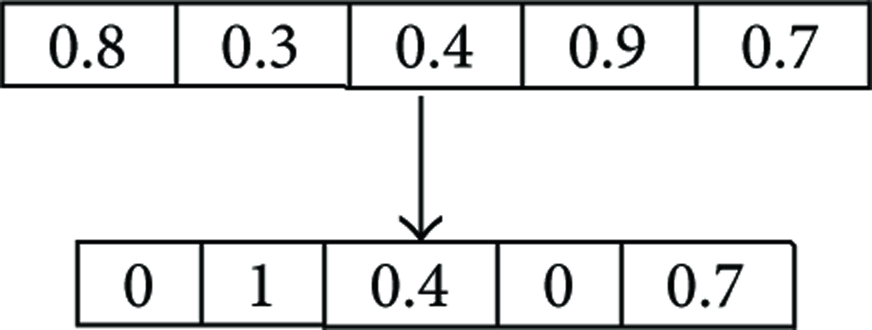
An example of mutation.
In addition, C and γ must be changed to binary, so they can select a mutation operation for the following search.
3.1.3. Evaluating Fitness
This study employed k-fold cross-validation [24] to test the search ability of the algorithms. k was set to 5, indicating that 80% of the original data was randomly selected as training data and the remainder was used as testing data. And then retain features up to a solution set that we want to evaluate for training data and testing data. This training data is input into an SVM to build a classification model used for the prediction of testing data. The prediction accuracy of this model represents its fitness.
In order to compare solution sets with the same fitness, we considered the number of selected features. If prediction accuracy were the same, the solution set with fewer selected features would be considered superior.
3.1.4. Proposed MCSO Approach
The steps of the proposed MCSO-SVM are presented as follows.
Randomly generate N solution sets and velocities with D-dimensional space, represented as cats. Define the following parameters: seeking memory pool (SMP), seeking range of the selected dimension (SRD), counts of dimension to change (CDC), mixture ratio (MR), number of best solution sets (NBS), mutation rate for best solution sets (MR_Best), and number of trying mutation (NTM). Evaluate the fitness of every solution set using SVM. Copy the NBS best cats into best solution set (BSS). Assign cats to seeking mode or tracing mode based on MR. Perform search operations corresponding to the mode (seeking/tracing) assigned to each cat. Update the BSS. For every cat after the searching process, if it is better than the worst solution set in BSS, then replace the worst solution set with the better solution set. For each solution set in BSS, search by mutation operation for NTM times. If it is better than the worst solution set in BBS, then replace the worse solution set with the better solution set. If terminal criteria are satisfied, output the best subset; otherwise, return to (4).
Figure 4 presents a flow chart of MCSO. The bold area indicates the processes added for the modification of CSO, while the other processes run as CSO. After searching in accordance with seeking and tracing modes, the cats with higher fitness can be updated to the best solution set (BSS). A mutation operation is then applied to BSS to search other solution sets. If a solution set following mutation shows improvement, it replaces the original solution set in the BSS.
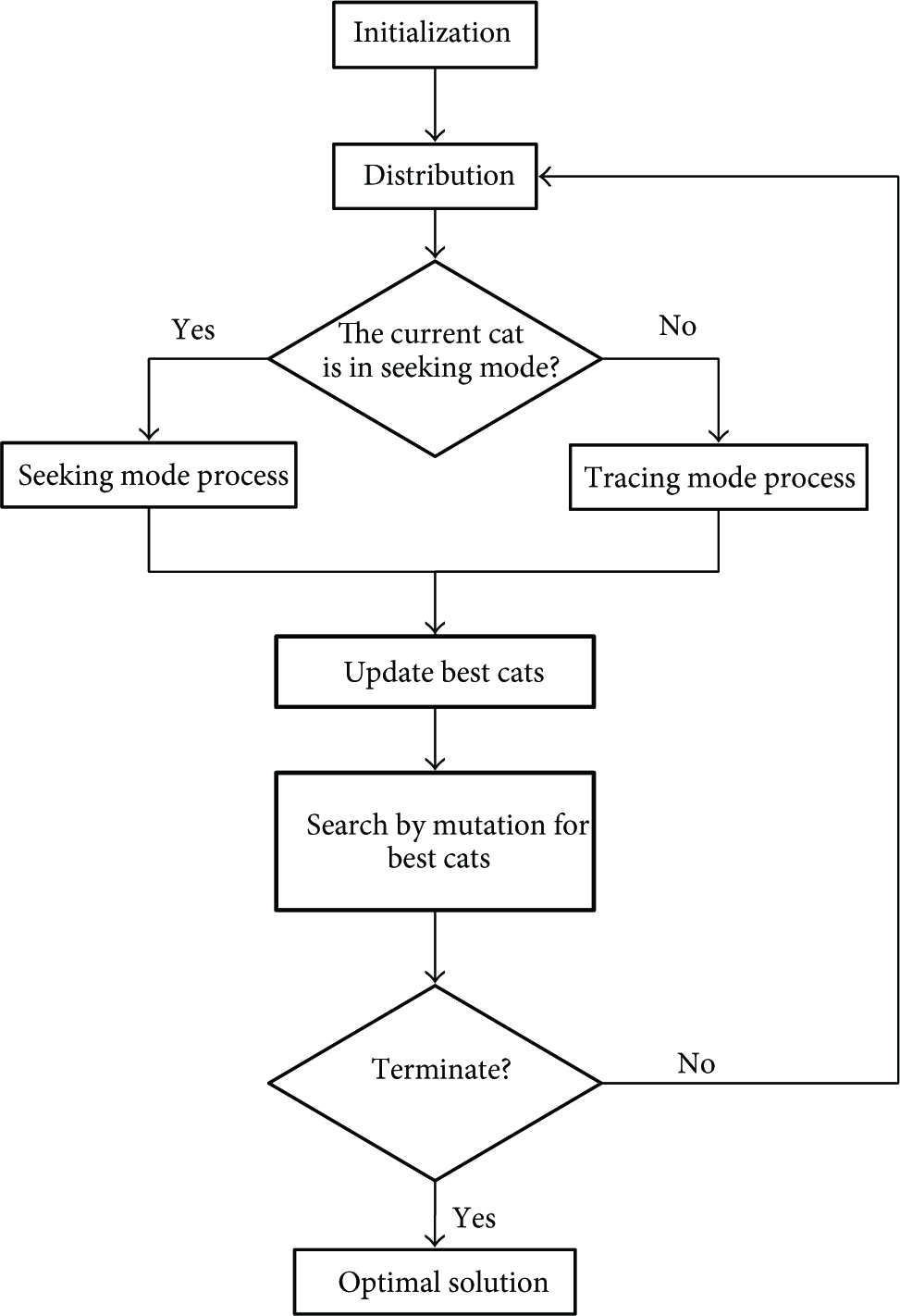
Flow chart of MCSO.
4. Experimental Results
This study followed the convention of adopting UCI datasets [20] to measure the classification accuracy of the proposed MCSO-SVM method. Table 1 displays the datasets employed.
Datasets from UCI repository.

The experimental environment was as follows: desktop computer running Windows 7 on an Intel Core i5-2400 CPU (3.10 GHz) with 4 GB RAM. Dev C++ 4.9.9.2 was used in conjunction with LIBSVM for development and a radial basis function (RBF) as the SVM kernel function.
Table 2 lists the parameter values used in the experiment. The terminal condition was determined as the inability to identify a solution set with higher classification accuracy, despite continuous iteration. We employed 5-fold cross-validation; that is, all values were verified five times to ensure the reliability of the experiment. The dataset was randomly separated into 5 segments. In each iteration, one segment was selected as test data (nonrepetitively) and the others were used as training data. The five tests were averaged to obtain a value of classification accuracy.
Parameters of MCSO.

4.1. Experiment Parameters
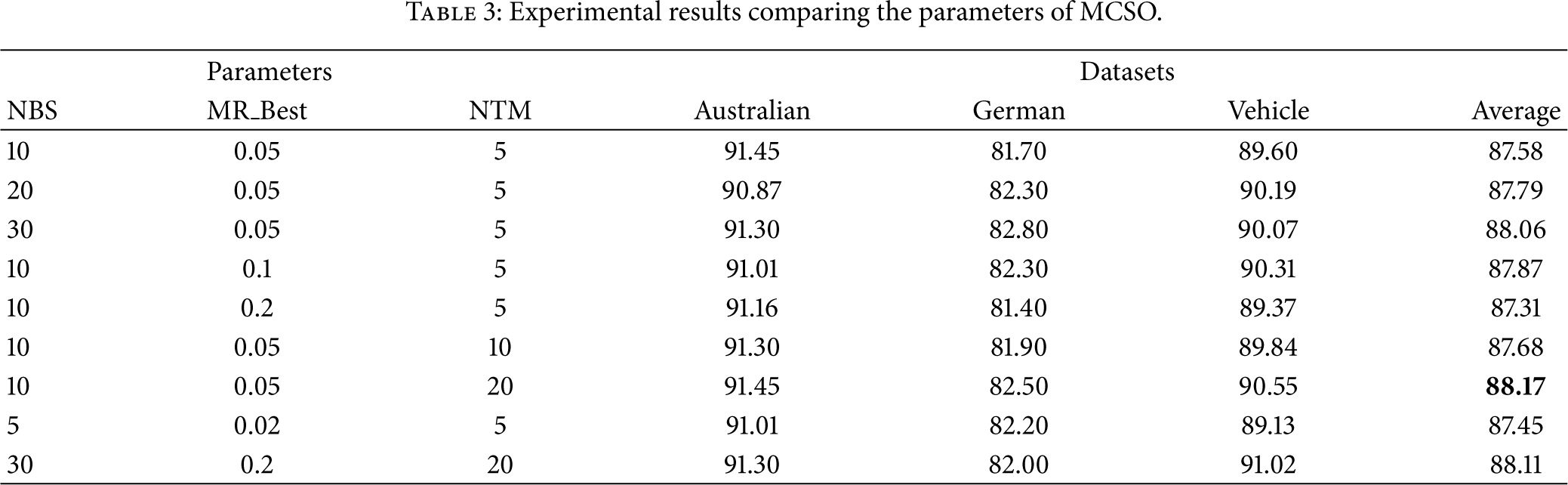
Various experiments were employed to test the parameters of the MCSO-SVM, including NBS, MR_Best, and NTM in nine groups. Table 3 lists the experimental results comparing the nine groups of parameters. The highest average classification accuracy for the three datasets was obtained using the following parameters:
Experimental results comparing the parameters of MCSO.
4.2. Comparison with CSO-SVM
The best combination of nine parameters was applied in the comparison of CSO and MCSO. The results are presented in Table 4.
Comparison results for CSO-SVM and MCSO-SVM.

**Higher accuracy.
***Higher accuracy and fewer features are selected.
Table 4 compares MCSO-SVM and CSO-SVM with regard to classification accuracy and the number of selected features. For Glass and Pima datasets, the MCSO-SVM had higher classification accuracy and fewer selected features than CSO-SVM. In Australian, Bupa, German, Ionosphere, and Vehicle datasets, MCSO-SVM had higher classification accuracy. Due to the advantages afforded by searching in the vicinity of the best solution sets, MCSO-SVM clearly outperformed CSO-SVM.
Training time is a crucial issue in many situations, such that the best solution set is sacrificed for one that is good enough. The above experiment was used to illustrate the relationship between time and classification accuracy in CSO and MCSO, using the nine datasets described in Table 1, as shown in Figures 5 and 6. The horizontal axis represents the execution of processes (in seconds) while the vertical axis presents classification accuracy. MCSO appears in the upper-left corner of Figures 5 and 6, indicating that it takes less time to obtain results of higher accuracy. So, the MCSO is suitable for the real-world big data applications.

Relationship between time and classification accuracy using CSO and MCSO (Australia, Bupa, German, Glass, Ionosphere, and Pima).
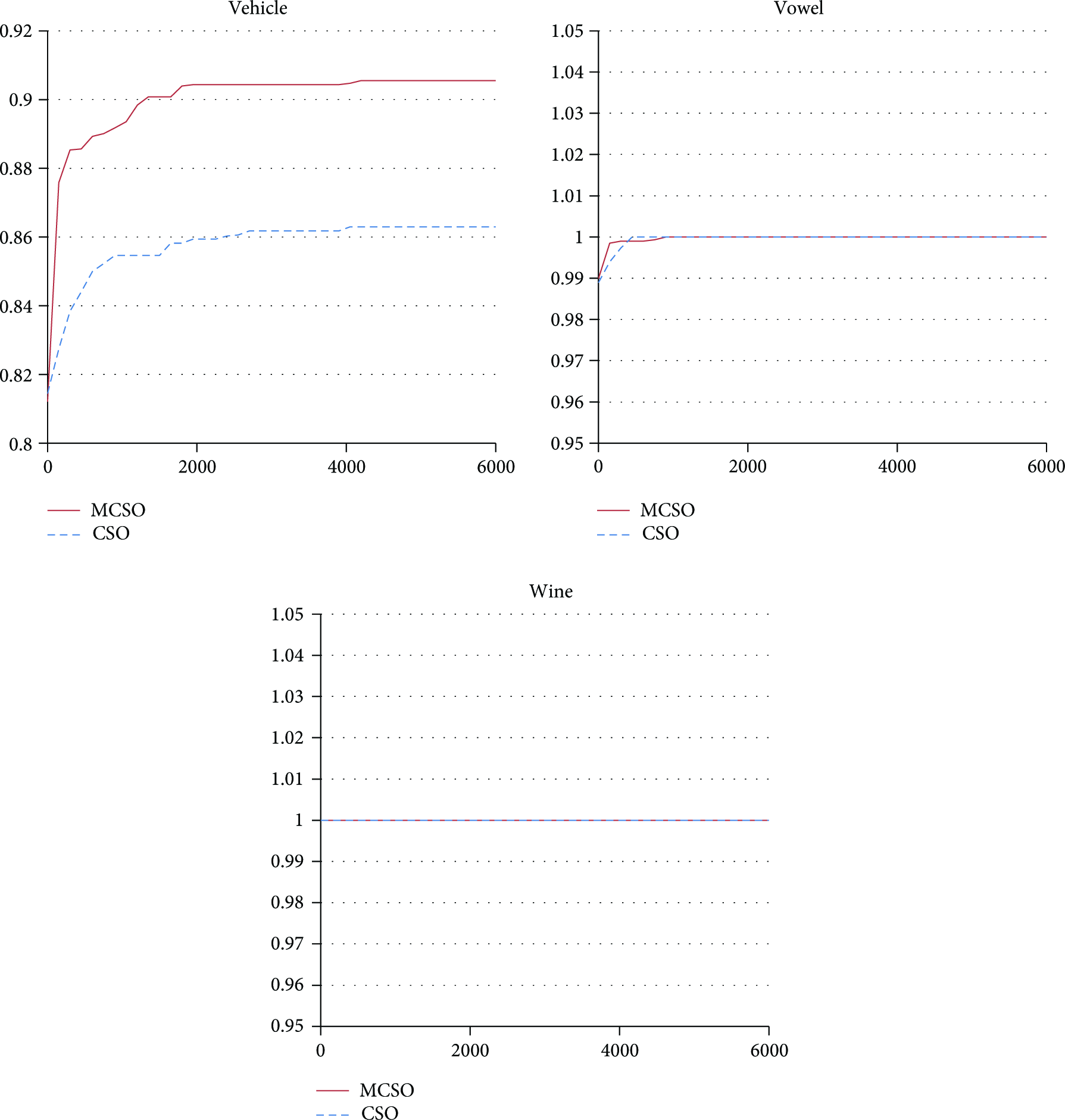
Relationship between time and classification accuracy using CSO and MCSO (Vehicle, Vowel, and Wine).
5. Conclusions
This study developed a modified version of CSO (MCSO) to improve searching ability by concentrating searches in the vicinity of the best solution sets. We then combined this with an SVM to produce the MCSO-SVM method of feature selection and SVM parameter optimization to improve classification accuracy. Evaluation using UCI datasets demonstrated that the MCSO-SVM method requires less time than CSO-SVM to obtain classification results of superior accuracy.
Footnotes
Conflict of Interests
The authors declare that there is no conflict of interests regarding the publication of this paper.