




Abstract
This paper tackles the coverage problem in homogenous and heterogeneous wireless sensor networks. The homogenous sensor network consists of sensor nodes and relays; however, the heterogeneous sensor network consists of sensor nodes, super nodes, and satellite nodes. In the latter network, super nodes and satellite nodes are utilized to demonstrate different scenarios. Super nodes consume huge amount of energy, compared to sensor nodes. To address this problem, the aim of this paper is to find the baseline when super nodes are used efficiently, despite the inherited high power consumption. Wolfram Mathematica is used to compare random independent deployment circular analytical model against a much simpler square analytical model. The achieved results showed that the simple square model is very close to circular model when K-coverage is ≤2.
1. Introduction
Deploying wireless sensors in a region to cover the entire area of interest is one of the main research issues in wireless sensor networks (WSN) [1–3]. Coverage of an area is determined by the quality of the sensing capabilities of the sensors; however, coverage definition is dependent on applications [4]. Different solutions are affected and constrained by sensors' sizes, weights, and costs. More important is the impact of network connectivity due to energy constraint. Currently, replacing batteries is not feasible so most applications are designed to be energy aware. Normally, energy conservation is implemented in both hardware and software. As a result, many algorithms and protocols are designed and implemented to minimize power consumption [5–8]. Moreover, major improvement can be done to reduce the energy consumption of super nodes (SNs). The lifetime of a sensor network on average is one year [5]. A wireless sensor network (WSN) is considered alive for that period which can collect data from sensors to the gateway. Moreover, many of the wireless sensor networks exhibit deterministic node deployment. This makes it one of the main objectives, which is minimizing the number of sensors [6, 9]. If every point in the area of the network is monitored by no less than k distinct sensors, the WSN is considered to be K-covered [7, 10, 11]. To prolong the lifetime and minimize energy consumption, sleep-scheduling approaches are used [5, 12–15]. The topology of the network also affects the power consumption of the sensors and consequently the lifetime of the network. In this paper, a cluster-based network is used to compare homogenous and heterogeneous networks. Two WSN scenarios are demonstrated, one scenario is with gateways and, in the other scenario, the WSN is mixed with SNs. In the first scenario, cluster heads are selected in such a way to minimize the energy consumption of the WSN all in all. A mechanism to optimize the sensing coverage is proposed [16]. In this proposal the authors discussed the hybrid problem; however, the WSN is not fully covered all the time. An energy-efficient heuristic to maximize total network lifetime is proposed in [17]. In an experimental setup, the authors compared the performance of two protocols, greedy [18] and High-Energy-First (HEF) [19], against the maximum coverage heuristic (MCH). The authors did not handle K-coverage problem and also did not describe whether the network is alive.
In this paper, the focus is on network connectivity with different levels of coverage, which means each active sensor can communicate with base station/super node and other active sensor nodes. We also simplify the traditional circular model with a square model, which makes the analysis of the coverage problem much easier. Moreover, we integrate the SNs that have the ability to communicate directly with satellite nodes to improve the quality of coverage. We run different scenarios to test the performance of the system and finally we compare the two-tier system with the regular wireless sensor network in terms of K-coverage and energy consumption.
In Section 2, we discuss randomized independent scheduling model, describe the random uniform distribution of the system, and compare the circular model against the square model. In Section 3, we describe the triggering mechanism of the network to collect information and show the distribution and the coverage of the sensors. In Section 4, we show detailed power calculations for each step in the system.
2. Randomized Independent Scheduling Model
In this section, we compare the square model with Kumar's random analytical deployment [5]. To calculate the coverage, circles are replaced by squares to calculate the sensing range of sensors. This model is much easier than the traditional circular model. We would like to find the limitations of the square model and set a baseline where it can be used. Moreover, Wolfram Mathematica package is utilized to implement Kumar's circular model and compare the outcomes against Kumar's original results. We start by defining the parameters to be used in the square model:
n is the number of nodes in the field. p is the likelihood that a sensor is active. r is sensing range. Growth function: a function Let Let the coverage function For each point
The investigation starts by showing that if a definite (limited) set of objects in the unit square is K-covered by a WSN with a definite sensing coverage then subsequently the full space is K-covered by an equivalent network with a larger sensing range. All utilized nodes are referred to by L which are the points in

A virtual unit square area grid overlaid with 169 objects.
2.1. Random Uniform Distribution
We discuss the random distribution of (in)active sensor. In this distribution, sensors are placed systematically over the virtual grid as shown in Figure 2. This figure provides an example of 300 nodes that are randomly distributed with probability of 0.1. Please note that, at any point in the grid, sensors have an equivalent probability distribution.
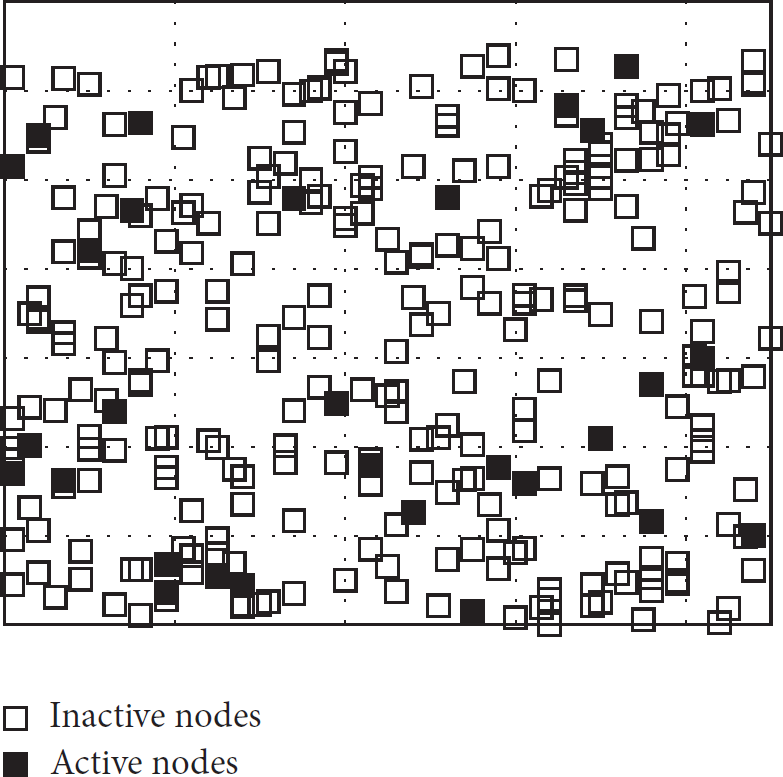
Random distribution of 400 nodes with probability = 0.1.
We calculate the coverage function by number of sensors with a certain probability of being active.
2.1.1. Statement
Let a number of sensors, n, be distributed uniformly in virtual square grid. If the function is monotonically increasing and approaches infinity as the number of nodes is large and p and r are satisfied, then coverage function

2.1.2. The Proposed Square Model
We swap the circular model with a square model (Figure 3). The circular model is similar to the square model, however the coverage function of the square model is:

Area of a square against a circle.
For a detailed proof of this formula, please refer to our previous work in [20].
3. Simulation Model
To demonstrate the experimental results on different scenarios, a custom made simulator is developed using Java to simulate K-coverage with random deployment. The amount of sensors required for each coverage level is calculated and the results are compared against the analytical model utilizing the same parameters.
Kumar et al. [5] simulated the random deployment. At the beginning, the aim is to make sure that the achieved results are similar to those achieved by Kumar's model and then the proposed square model is investigated. During these experiments, scheduling the WSN via SN is studied and we compare the performance of power consumption, K-coverage, and delay with random deployment. We name satellite with WSN as Satellite Wireless Sensor Network (SWSN).
In this simulation, sensors are randomly distributed in a 100 × 100 unit grid. Sensors are active with probability p and are switched off otherwise. The sensing range
In the simulation experiments, we take average of 100 runs and check the live sensors in each round.
The coverage of the two types of sensors is shown in Figure 4. Each sensor node covers five cells and each SN covers 13 cells.
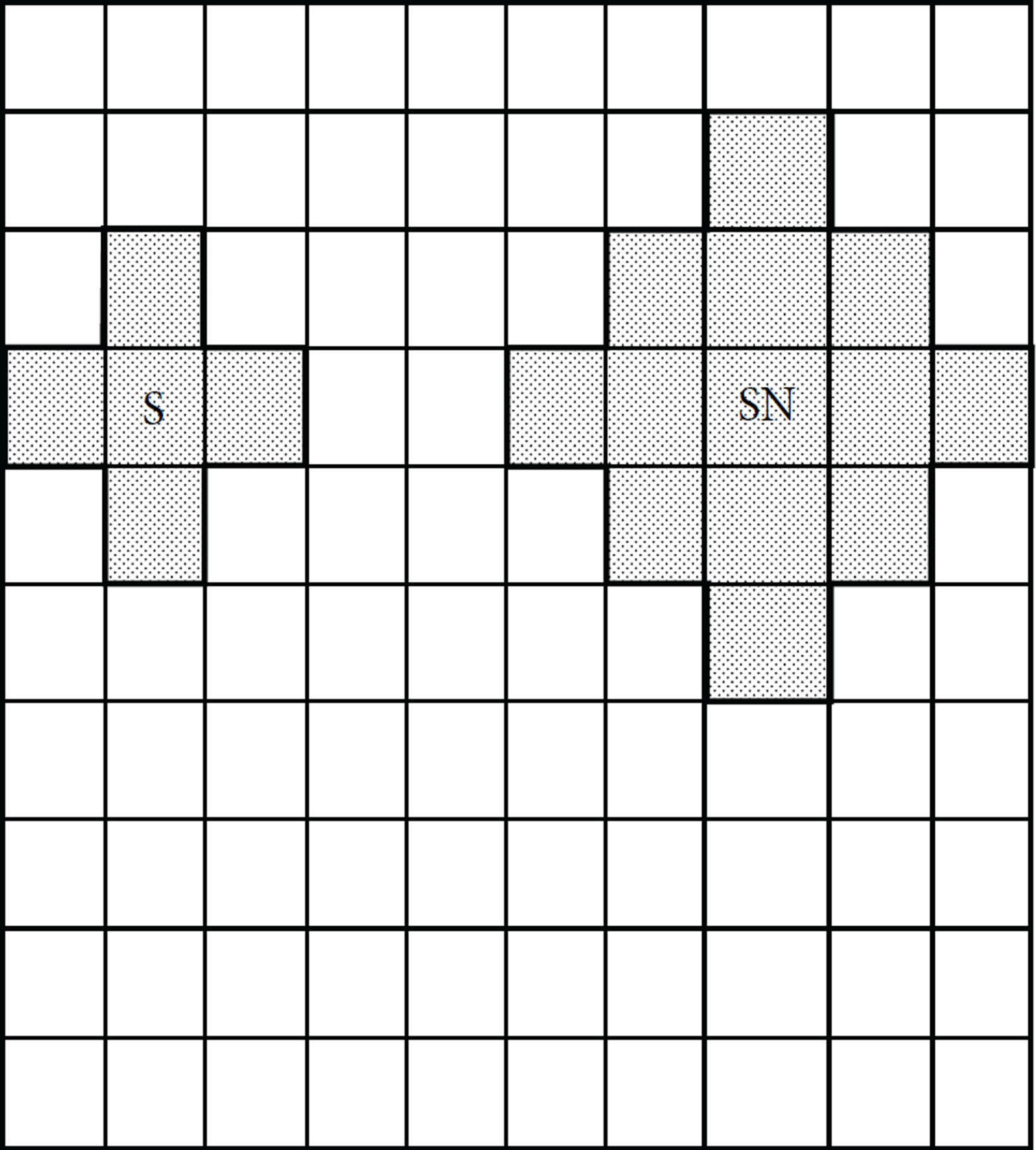
Sensing coverage of S and SN.
The parameters in Figure 5 are as follows: N is the number of sensors to be deployed, C is counter, and t is time.

Deployment process mechanism.
Different scenarios of network communication are performed for which the basis for calculating energy consumption of the network is derived. The trigger mechanisms and all phases of the procedure are depicted conceptually in Figures 6 and 7. Figure 6 depicts data collection scenario inquired by satellite. In Figure 6(a), the network is in the listening mode. The satellite triggers SN process of data collection by communicating a message to the SNs (Figure 6(b)). The SNs initiate messages to the sensor nodes to collect the required data (Figure 6(c)). In Figure 6(d), sensor nodes collect the required data. After that, sensor nodes communicate the data to SN (Figure 6(e)). Finally, SN sends the data to the satellite as shown in Figure 6(f).
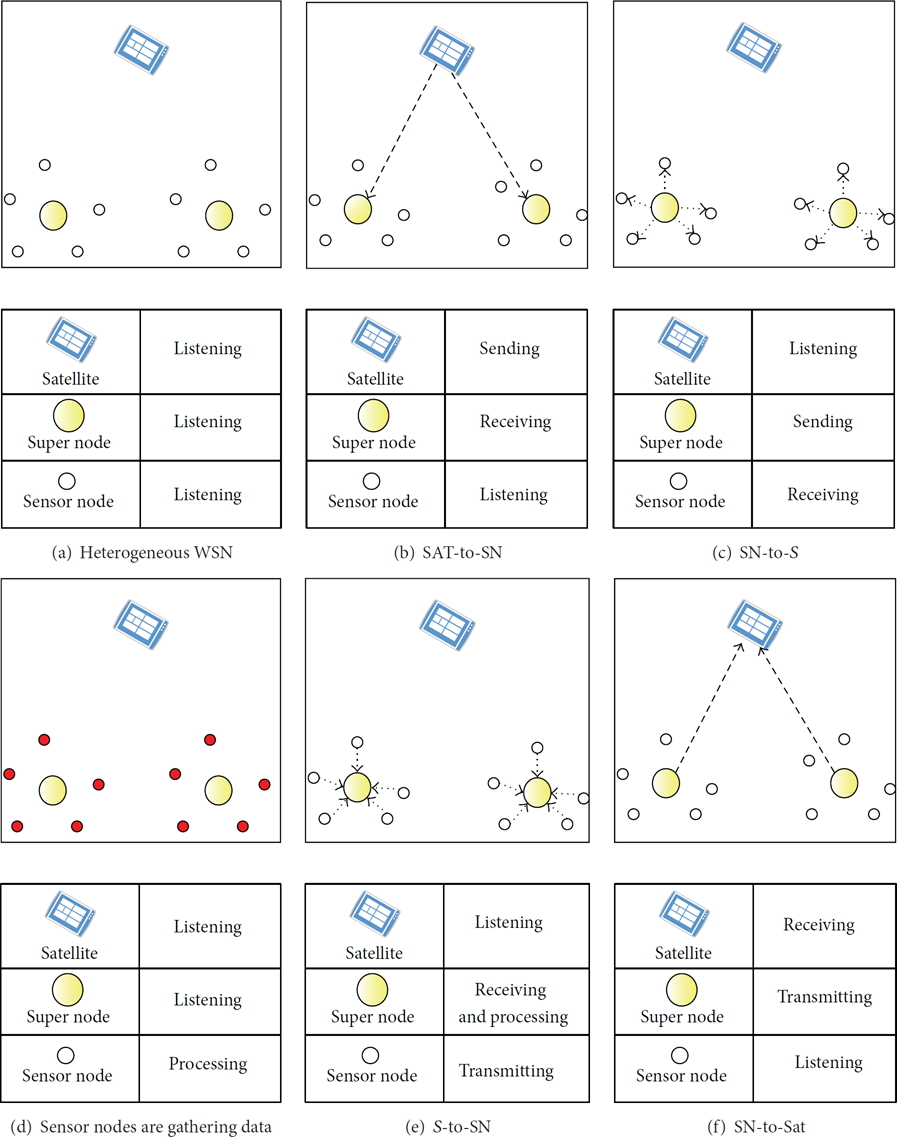
Satellite initiation query.
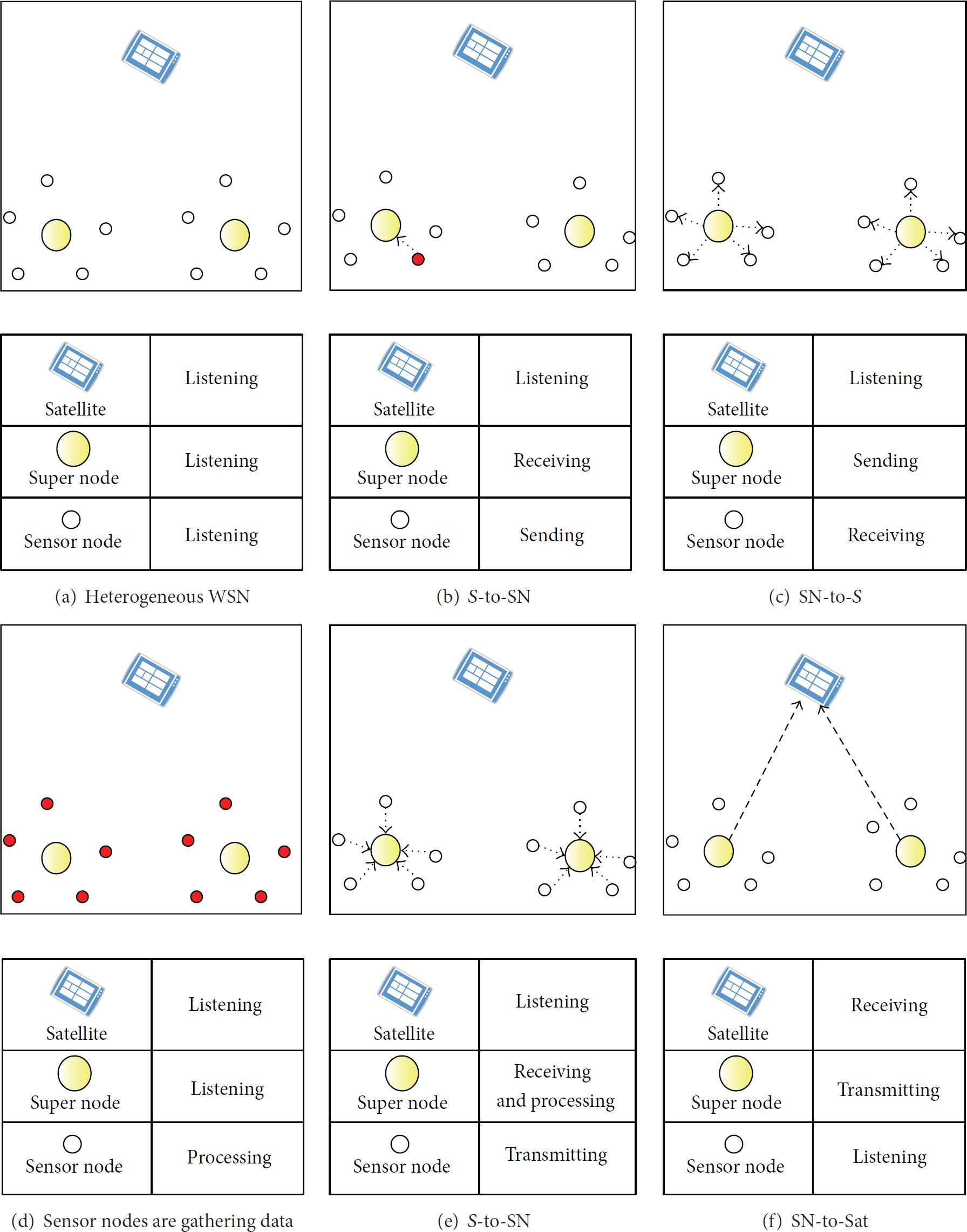
Periodic or event driven, initiated by sensors.
Figure 7 depicts data collection scenario for event-driven data scenario. In Figure 7(a), the network is in the listening mode. When a certain threshold is reached at one of the sensors, it triggers the process of data collection by communicating a message to the SN (Figure 7(b)). The SN sends message to the sensor nodes to inquire about the status of other sensor nodes (Figure 7(c)). In Figure 7(d), sensor nodes collect the required data. After the data is collected, sensor nodes communicate the data to SN (Figure 7(e)). Finally, that super node processes the data; if most/all the sensor nodes have reached the threshold, the data is sent to the satellite by SN (Figure 7(f)); otherwise no action is taken.
We demonstrate an example of the coverage concept for WSN and SN in Figure 8. In Figures 8(a) and 8(b), we show the location of randomly distributed sensors and super nodes, respectively, with
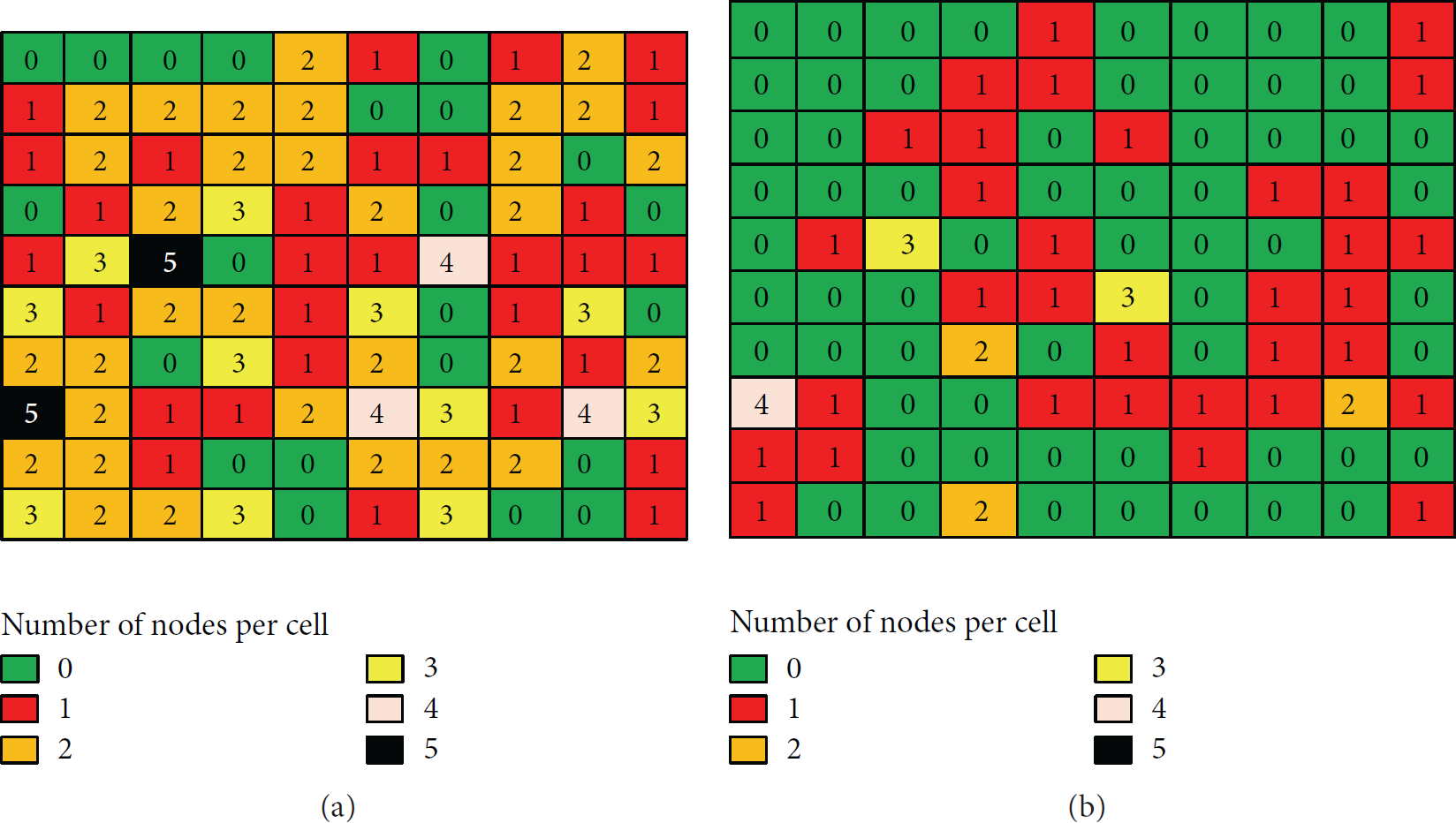
Location of active sensor and super nodes.
Figure 9 depicts a clearer distribution of the number of nodes per cell. We show the number of active sensors/SNs versus the number of cells. The WSN has a better distribution than that of SN due to the number of deployed nodes.
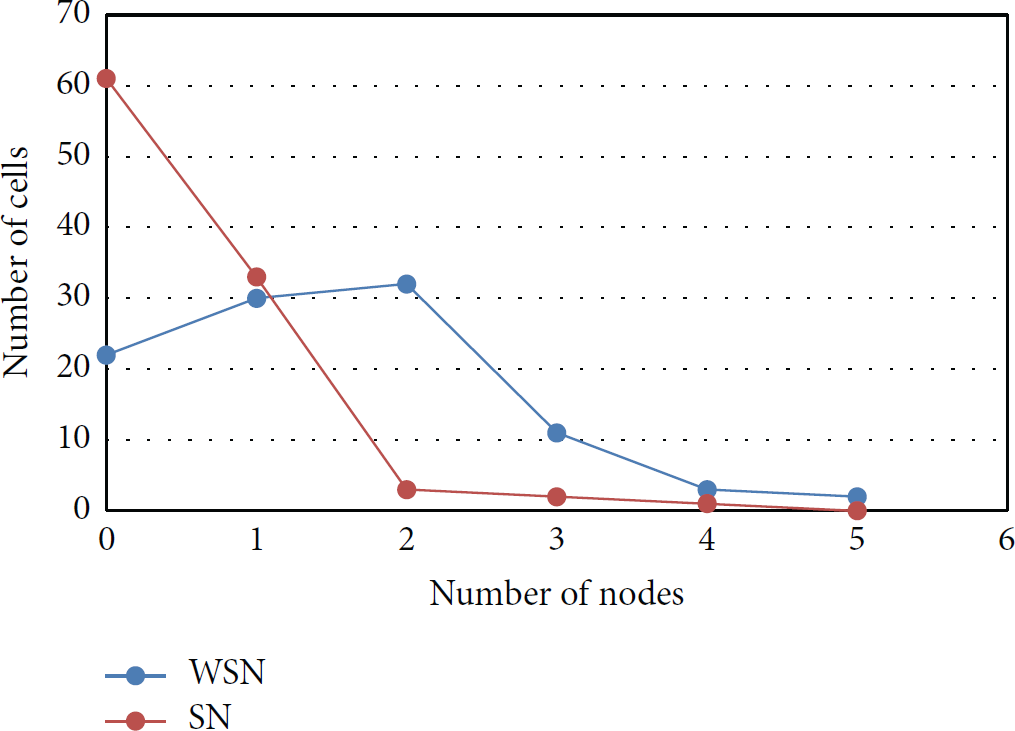
Nodes distribution per cell.
K-coverage for each cell is depicted in Figure 10. We start by K-coverage = 1 up to K-coverage = 13 and calculate the percentage of K-coverage for each case. The WSN has a better K-coverage than that of SN as a result of the better distribution.

K-coverage level in each cell.
In Figures 11 and 12, we find different levels of coverage, starting from

Coverage using simulation model without using SN.

Coverage using simulation model using SN.
The results of the analytical models are compared against the simulation model in Figure 13. We notice that the square analytical model is close to the simulation results when

K-coverage of simulation and analytical model comparing.
Out of the simulation results, we observe that more than 50 sensors in active mode cover some cells at the same time. This causes loss of energy and interference. Organizing the deployment of the wireless sensors solves this problem. Alternative approaches to solve this problem are to use a sleep-scheduling mechanism such as Probing Environment and Adaptive Sensing [21, 22] or Maximization of Sensor Network Life (MSNL) [23].
4. Power Calculation
The triggering process starts by the satellite node. It triggers the network requesting data from the field. The comparison is made between the following two configurations: one with only normal sensors in the network and another with SN. The Global Positioning System (GPS) is a great technological success story [24, 25]. A comprehensive treatment of the system, signals, performance, and applications are in [26]. The SN utilizes the GPS technologies to communicate with satellites.
The number of deployed sensors is the same and they are adequate for 1-coverage. However, the number of active sensors is different each time because of the random distribution.
For the SN, the energy consumed in the transmission part is much higher than that between the sensors. For instance, the satellite networks in the Low Earth Orbit (LEO) that are in the range between 1414 and 3500 Km (Globalstar) consume approximately one watt of power and work with a low data rate [26]. It should be noted that, using one watt of power, a mobile phone could work for 120 hours in normal mode or about 4 hours of continuous voice use. In this simulation, the power consumed in communication with satellite is between 0.6 and 1 watt per transmission; however, communication between sensor nodes consumes 50 μW on average. In other words, each transmission to the satellite consumes as much power as 12,000–20,000 transmissions between nodes. We compare the power consumptions to find the threshold at which adding SN improves the network.
To calculate the power consumption in SWSN, the following formulas are utilized [13]:
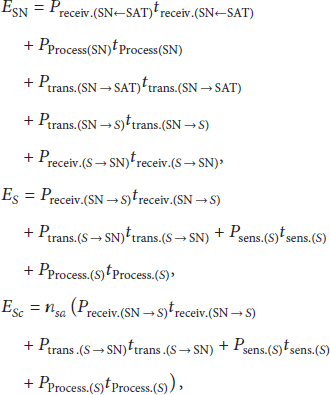
In the proposed model, we have the following assumptions:
The energy consumed by satellite is not counted. The required amount of energy per hop is equal to one energy unit.
On average, the energy consumption of SWSN is 50 times more than that of WSN. This is shown in Table 1.
Average power consumption for 1-coverage.

Figure 14 shows the relationship between the energy consumption and number of communications between satellite and SNs. An acceptable threshold for making an SN viable is found for the

Finding the acceptable threshold for SWSN.
5. Comparison between the Two Systems
We conduct a performance comparison with the same working area,
If the data is sent to SNs or gateway in the corners of the grid, then the best case is one hop, while the worst case is 50 hops. Thus, the average is 25 hops. Assuming all sensors have data to send, the total hops for sending are equal to 50000 (
For a system with SNs, all of the sensors are one hop from the SN. In addition, each cell is covered by one sensor. Therefore,
The cost of sending data from SNs to satellite is added. This is the number of SNs multiplied by 16,000 (the average of 12,000–20,000.)
From the above calculations, it is clear that the normal sensors in SWSN in the worst case scenario have longer lifetime by a factor of 25 times.
To clarify the idea, we provide another example with smaller grid.
Assuming
This clearly shows that the power needed without SN is 5.5 times greater than that of SWSN provided that the communication to the satellite is ignored.
We find the effect of the increase in the size of covered area versus the energy consumed in both WSN and SWSN, as depicted in Figure 15.

Consumed energy of WSN versus SWSN.
From Figure 15, it is clear that the use of SN is not practical due to the huge amount of energy needed for sending data to satellite. However, if we use a continuous power source for SN, which is feasible in some applications, it may become an acceptable model.
In Figure 16, we ignore the energy consumed by the SN for communication with satellite. As a result, the energy consumed by WSN is increased exponentially. To take advantage of both SWSN and WSN, we suggest using the satellite to trigger the SNs. After that, the SNs trigger the sensors and the data is returned by the multihop WSN to the sink of the network.

Consumed energy of WSN versus SWSN versus new system.
This suggestion reduces the energy used in communication by 50 percent, which is an excellent improvement considering the only addition required is the SN.
6. Conclusion
In this paper, we compare one-tier versus two-tier wireless sensor networks coverage problem with different scenarios. We used the random independent deployment analytical model by Kumar and applied it in Mathematica program. We used a custom-made Java simulator to compare the results obtained against the ones by Mathematica. We introduced the square model for its simplicity and compared it against the conventional circular mode. The square analytical model is close to the simulation results when
Footnotes
Conflict of Interests
The author declares that there is no conflict of interests regarding the publication of this paper.
Acknowledgment
The author would like to acknowledge the support of King Fahd University of Petroleum and Minerals (KFUPM) for this work.