




Abstract
Hybrid wireless sensor network made up of wireless body area networks (WBANs) and cellular network provides support for telemedicine. In order to facilitate early diagnosis and treatment, WBANs collect and transmit crucial biomedical data to provide a continuous health monitoring by using various biomedical wireless sensors attached on or implanted in the human body. And then, collected signals are sent to a remote data center via cellular network. One of the features of WBAN is that its power consumption and sampling rate should be restricted to a minimum. Compressed sensing (CS) is an emerging signal acquisition/compression methodology which offers a prominent alternative to traditional signal acquisition. It has been proved that the successful recovery rate of multiple measurement vectors (MMV) model is higher than the single measurement vector (SMV) case. In this paper, we propose a simple algorithm of transforming the SMV model into MMV model based on the correlation of electrocardiogram (ECG), such that the MMV model can be used for general ECG signals rather than only several special signals. Experimental results show that its recovery quality is better than some existing CS-based ECG compression algorithms and sufficient for practical use.
1. Introduction
Remote medical monitoring system helps doctors to remotely monitor the patient's medical data and feedback in time. The whole system of hybrid wireless sensor network model composed of a WBAN [1] and cellular network is shown in Figure 1. For providing real-time health monitoring, devices must integrate seamlessly into the patient's life and do not interfere with daily activities. In order to offer continuously sensing, processing, and early detection, an ECG sensor is used to collect and compress ECG signals. And then real-time ECG data are sent to a personal terminal (e.g., smartphone or iPad). Wi-Fi, CDMA, 3G, or other cellular networks can be utilized for transmitting the ECG data to a remote data center. In the terminal, the original ECG signals are recovered by computers for further diagnosis. By utilizing continuous remote heart monitoring, it can enhance ability of prevention and early diagnosis, elevate the personalized service quality, and improve patient autonomy, mobility, and security.

The whole system of hybrid wireless sensor network model.
Most of the power in an ECG sensor is consumed when the RF power amplifier transmits data to the personal terminal. A large amount of real-time ECG data is collected, stored, and transmitted. Thus, it is desirable to decrease the amount of data to be transmitted to reduce energy consumption. The WBAN-enabled ECG monitors have three important design constraints [2]. The most important one is energy constrain [3]. As far as possible, it should reduce the energy consumption because of the limited battery life. Due to the low communication capacity of ultralow power short-haul radio devices, another constraint is that transmitted ECG data should be compressed to a large extent. The third constraint is hardware costs. Low hardware costs are easier to make a wireless remote medical monitoring system economically viable and accepted by individual customers. This means that data compression (on sensors) should have low complexity.
Although conventional data compression methodologies [4, 5] are effective in data compression, one still needs to acquire a large amount of data at the Nyquist rate that is compressed later. It consumes significant energy and cannot reduce device cost. As an emerging data acquisition/compression methodology, compressed sensing is a promising program to meet these constraints. Some scholars have applied CS algorithm to ECG compression and have achieved good effect [6–9]. The application of CS before the transmission of typical ECG signals achieves compression of the data with a proportionate saving in energy. In [6], Mamaghanian et al. proposed a novel approach based on the CS framework to deal with the challenge of ultralow power embedded compression of ECG signals. In [7], several design considerations of CS acquisition systems for ECG and EMG biosignals are presented by Dixon et al. In [8], a dynamic compression (DC) scheme is proposed to tackle the challenge of ultralow power and real-time wireless ECG application. And, in [9], Ravelomanantsoa et al. proposed a simple and efficient CS encoder device used to measure signals within sensor nodes of a WBAN. Nevertheless, a discrete-time ECG signal exhibits a high degree of correlation between its successive samples. Such a signal can be better recovered by using an algorithm that encourages temporal correlation. Recently, so called block sparse Bayesian learning bound-optimization (BSBL-BO) algorithm has been effectively applied for the reconstruction of ECG signals [10]. Inspired by these applications in ECG processing, this paper proposes a novel CS algorithm based on the temporal correlation of ECG, which can transform the SMV model into MMV model for enhancing the quality of the reconstructed signal.
Higher quality of reconstructed ECG signals can better help the doctor to understand the patient's heart function. An ECG signal shows a high degree of correlation between its continuous samples. In this paper, ECG signal is firstly divided into several segments by the presented segmentation algorithm. And then, one-dimension discrete wavelet transform (DWT) is employed to decompose the segmental ECG signals into sparse data. Secondly, the sparse signals are integrated into the solution matrix. In this way, the SMV case is transformed into MMV model. It has been proved that the successful recovery rate of MMV model is higher than the SMV case. The proposed transforming method is relatively simple and of low complexity in encoder (sensor nodes) and consistent with low power consumption of actual system requirements.
The rest of this paper is organized as follows. First, Section 2 introduces the CS theory. And Section 3 describes the characteristics of ECG signals and presents the segmentation algorithm. The framework of transforming SMV model into MMV model is shown in Section 4. Analytical and simulation results based on the MIT-BIH arrhythmia database are shown in Section 5. Finally, Section 6 concludes the paper.
2. Compressed Sensing Background
Compressed sensing [11–13] solves the reconstruction of a sparse signal which contains a few nonzero elements, from its linear measurements, less than the number of unknowns. Many of algorithms have been developed to resolve this underdetermined inverse problem with sparsity prior on the solution. Suppose

Estimating the sparsest solution vector in accordance with the SMV model (1) is generally an NP-hard problem [14]. For resolving the problem of sparse signal recovery with SMV, a number of efficient algorithms have been proposed. Typical algorithms include basis pursuit (BP) or
In some special applications, such as magnetoencephalography (MEG)/electroencephalography (EEG) source location [23, 24], multivariate regression [25], and direction-of-arrival (DOA) estimation [26], where a sequence of measurement vectors has an identical sparsity pattern, the SMV model (1) has been extended to the multiple measurement vector (MMV) model in [27], given by

3. The Correlation Characteristics of ECG Signals and Segmentation Algorithm
In this section, we illustrate the correlation characteristics of ECG signals and give the segmentation algorithm. Wavelet transform as the sparse decomposition has been widely used in CS theory. In this paper, the one-dimension DWT is chosen as the sparsifying basis.
3.1. The Correlation of ECG
The correlation of ECG signal is mainly manifested in the sampling spots and cardiac cycle.
3.1.1. The Correlation between Sampling Points
ECG signal is generated by myocardial continuous motion; thus it has a strong correlation between sample points. As shown in Figure 2(a), we select ECG of record 100 in MIH-BIH arrhythmia database as an example and calculate its unbiased estimate of autocorrelation function:

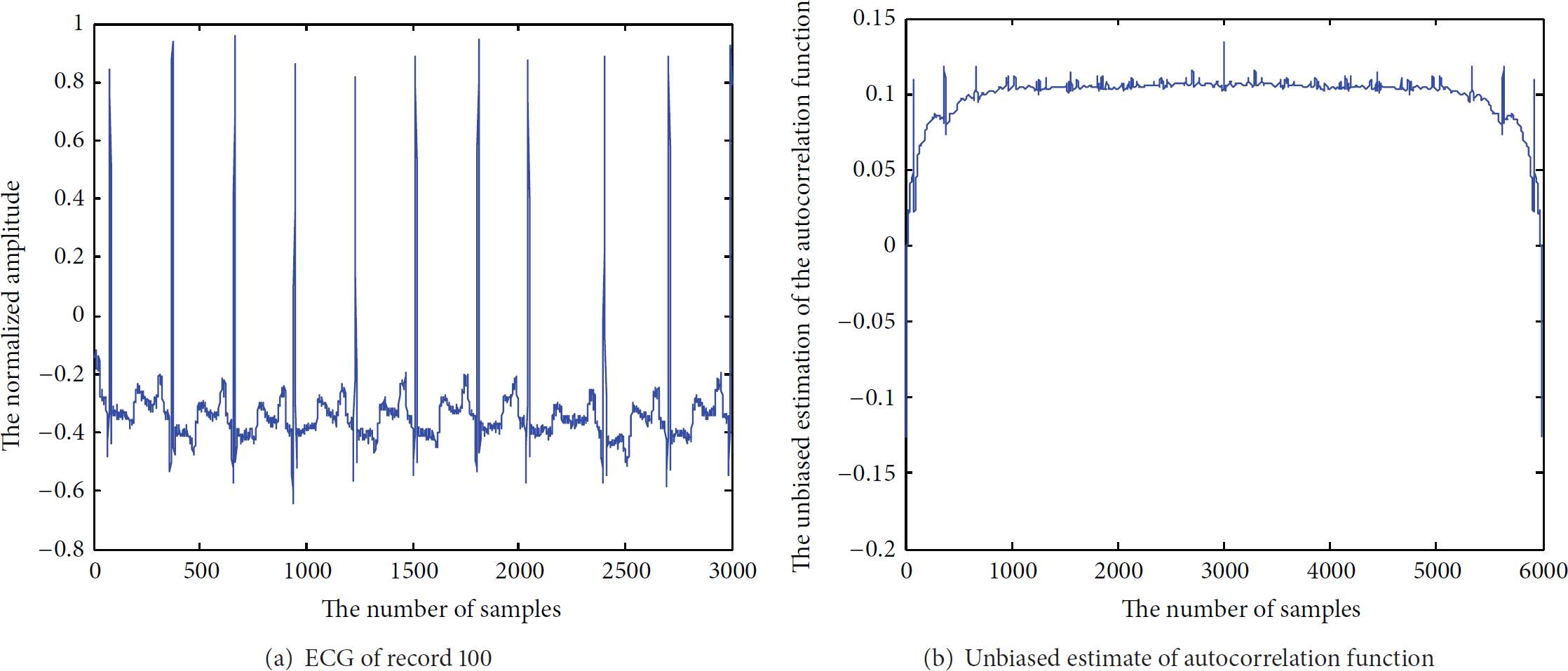
ECG of record 100 in MIH-BIH arrhythmia database and its unbiased estimate of autocorrelation function.
3.1.2. The Correlation between the Cardiac Cycles
Typically, long-term monitoring of ECG signals can present more obvious periodicity after pretreatment, such as removal of baseline drift, power frequency interference, and high frequency noise. It can be seen from Figure 2(a) that the shape, location, and duration of P wave, QRS complex wave, and T wave are similar within the cardiac cycle.
3.2. Segmentation Algorithm
Since the ECG is a one-dimensional signal, it is firstly transformed into two-dimensional data form in order to implement multiple measurements. The most notable feature of a cardiac cycle is the QRS complex. So we detect the entire QRS complex firstly and then segment the ECG signal on the premise of alignment QRS complex to make each section represent a cardiac cycle. It is important to note that each cardiac cycle length is not strictly equal; therefore, we find out the longest heartbeat cycle firstly, and other sections are complemented by average value according to longest length. The segmentation algorithm divides the ECG signal into beats (complexes). The specific process is shown in Figure 3.

The specific segmentation process of ECG signal.
We select ECG of record 100 as a test example. The number of samples

The wavelet coefficients
4. The Proposed Framework of Transforming SMV Model into MMV Model
In this section, we give the approach of transforming SMV model into MMV model. The proposed framework is shown in Figure 5. Our modeling instructions are summarized as follows.

The proposed framework of transforming SMV model into MMV model.
(i) ECG Segmentations. The ECG signal
(ii) DWT. The segmentation
(iii) Transform SMV Model into MMV Model. The wavelet coefficients

(iv) Measurement. The random Gaussian matrix
(v) Recovery. The decoder firstly recovers the solution matrix
5. Simulations and Analyses
The performance of the proposed transforming algorithm has been evaluated by simulations. We employ two most widely used performance metrics that are compression ratio (CR) and percentage root-mean-square difference (PRD) [37]. CR is defined as


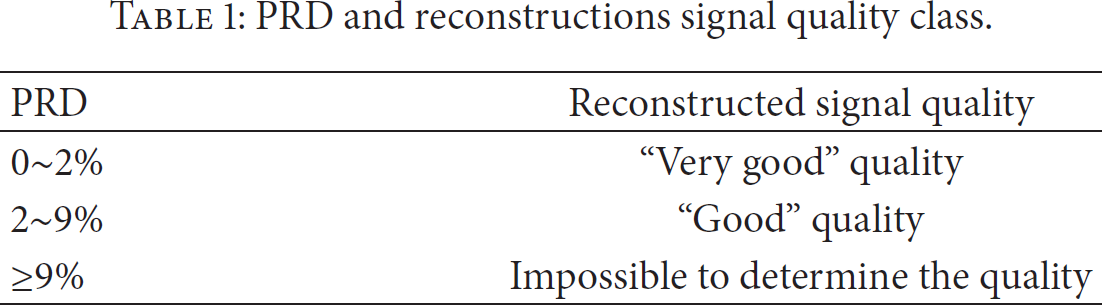
A relationship between PRD and the diagnostic distortion is established in [39]. Table 1 lists the resulting classes of very good quality, good quality, uncertain quality, and the corresponding PRDs.
PRD and reconstructions signal quality class.
In this paper, the MIT-BIH arrhythmia database [40] is used to validate the compression performance of the proposed scheme. MIT-BIH arrhythmia database is most commonly used for study of ECG signal compression algorithms, and it consists of two-lead ambulatory ECG recordings from 47 people. Because lead II is most commonly used in ambulatory ECG application, all results in this paper are based on the ECG signals of lead II.
5.1. Performance Analysis of Proposed MMV Model
Two types of heartbeats of 6 s (

Results of visual inspection of (a) record 100, (b) record 103, (c) record 114, (d) record 207, (e) record 214, and (f) record 234.
5.2. Performance Comparison with Other Methods
This paper numerically simulated the ECG compression with the CSBP [6], BSBL-BO [10], and DC [8] schemes for comparison of performance with the proposed approach. We choose the first 512 points of MIT-BIH arrhythmia database record 100 as the test signal. The resulting relationships of the signal distortion and compression efficiency are shown in Figure 7. The recovered quality of proposed algorithm achieves lower PRD and higher SNR than compared algorithms at the same CR. What is more, with the increase of CR, the increased rate of PRD is much lower than the compared methods. It indicates that the proposed method has more stable performance for bigger CR conditions.

Comparison of the output (a) PRD and (b) SNR versus CR of the MATLAB.
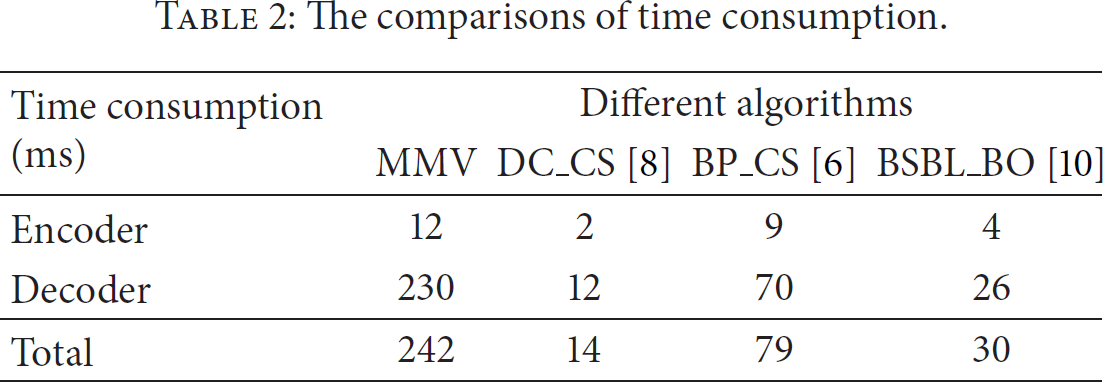
Meanwhile, the comparisons of time consumption are shown in Table 2. Unfortunately, the time consumption of proposed algorithm is higher than the compared algorithms. However, the time consumption of encoder (on sensors) is not great. This is precisely in accordance with the requirements of sensor networks.
The comparisons of time consumption.
6. Conclusion
In this paper, we addressed a simple algorithm of transforming the SMV model into the MMV model by exploiting the correlation of ECG signal, such that the MMV model can be used for general ECG signals instead of only several special signals. Based on this framework, the proposed algorithm leads to higher reconstructed quality compared with some existing CS algorithms. Although the time consumption of proposed algorithm is higher, the time consumption of encoder is not great. Extensive experiments have shown that the proposed algorithms have superior performance for general ECG signals.
Footnotes
Conflict of Interests
The authors declare that there is no conflict of interests regarding the publication of this paper.
Acknowledgment
This work was supported by National Natural Science Foundation of China (61171176).