




Abstract
Heterogeneous networks with dense deployment of small cells can employ cognitive features to efficiently utilize the available spectrum resources. Spectrum sensing is the key enabler for cognitive radio to detect the unoccupied channels for data transmission. In order to deal with shadowing and multipath fading in sensing channels, cooperative spectrum sensing is designed to increase the accuracy of the sensed signal. In this paper, an optimized local decision rule is implemented for the case that the received data from primary users are possibly correlated due to the sensing channel impairments. Since the prior information is unavailable in the real systems, Neyman-Pearson criterion is used as the cost function. Then, a discrete iterative algorithm based on Gauss-Seidel process is applied to optimize the local cognitive user decision rules under a fixed fusion rule. This method with low complexity can minimize the cost using the golden section search method in a finite number of iterations. ROC curves are depicted using the achieved probability of detection and false alarm by numerical examples to illustrate the efficiency of the proposed algorithm. Simulation results also confirm the superiority of the proposed method compared to the conventional topologies and decision rules.
1. Introduction
Heterogeneous networks are the next generation of cellular networks with densely deployed low power small cells that may reuse spectrum resources across the space. Since heterogeneous networks may experience spectral crowding, the main challenge is to coexist efficiently with other licensed users. According to the Federal Communication Commissions (FCC) frequency allocation chart, the spectrum bands dedicated to the licensed or primary user (PU) are highly underutilized [1]. Cognitive radio features may equip heterogeneous networks with spectrum sensing within the small cells to acquire available channels and enhance their operations [2]. Cognitive radio can provide opportunistic spectrum access for unlicensed or secondary users and optimize the spectral efficiency [3, 4]. The most critical requirement of cognitive radio is the sensing mechanism to exploit the spectrum holes while suppressing the mutual interference with PUs [4–6].
An optimal spectrum sensing mechanism is necessary for cognitive radios to maximize detection probability of the PUs’ signal subject to the constraint of the limited probability of false alarm. Among various signal detection schemes, energy detection has been recognized with low computational complexity to be used for spectrum sensing. This method is based on measuring and comparing the received signal strength from the PUs with a threshold, within the channels and a certain sensing time [7]. However, the performance of energy detector is degraded with sensing channel impairments which leads to attenuation and variations of the sensed signal. Multipath fading, path loss, shadowing, and hidden node problem inevitably compromise the sensing reliability. An effective approach to overcoming these uncertainty problems and improving the performance is cooperative sensing [8–11].
Cooperative sensing can be used to acquire information of an intelligent wireless network with various applications including radar and sensor networks [12, 13]. The design of cooperative sensing can increase the reliability, flexibility, speed, and coverage area of the sensing network. In a cognitive radio with large number of sensing nodes, cooperative spectrum sensing can increase the detection probability of primary users and the channel utilization. Cooperative spectrum sensing can enhance the sensing performance by exploiting the spatial diversity in the observations of spatially located secondary users which transmit their sensing information to a fusion center for final decision. It has been shown that increasing the number of cooperative users can decrease the required detector sensitivity and sensing time. Moreover, a cooperative approach needs lower communication bandwidth and is more robust to channel fading [14–16].
The drawback of the feedback overhead of spectrum sensing is overcome in [14] by using a fixed number of common feedback channels so that each node compares the sensing result with a threshold and selects the appropriate data to be sent to the fusion center. In [15], a sensor selection strategy is proposed to minimize the energy consumption for cooperative spectrum sensing under satisfactory primary user detection performance. A decentralized spectrum sensing approach is proposed in [16] to reduce the overall overhead and power consumption of the network by eliminating the need for fusion center node. In this scheme, each secondary user communicates only with its adjacent nodes via one-hop transmissions within several rounds to reach global convergence. The performance of cooperative spectrum sensing over Rayleigh fading channel is improved in [17] using an adaptive linear combiner with weights to secondary user decisions.
In this paper, a cooperative spectrum sensing is deployed for cognitive heterogeneous network with a parallel approach instead of centralized topology that needs wideband channels. With correlated local sensing observations, a numerical algorithm is proposed to optimize the local decisions of local cognitive users (LCUs) and send the information to a common cognitive user (CCU) as fusion center. The design of parallel topology increases the reliability, flexibility, speed, and coverage area of the sensing network. Based on Bayesian optimality criteria with independent observations, the optimized rule for decision making of each LCU is likelihood ratio test (LRT) [18–20]. Since the prior probabilities of hypotheses and accurate illustration of cost coefficients are not available in real systems, common Bayesian method for maximizing LRT is not practical. Therefore, Neyman-Pearson criterion is adopted for optimum local decision rule (OLDR) so that the probability of false alarm is limited to a desired value while the probability of missed detection is minimized [21].
The rest of this paper is organized as follows. Section 2 describes cooperative sensing schemes and Section 3 illustrates the system model. The proposed iterative algorithm for decision making at LCUs is described in Section 4. Then, this method is simulated and the results are analyzed in Section 5. The paper is concluded in Section 6 and the open issues for future researches are addressed.
2. Cooperative Sensing Schemes
Various cooperative sensing schemes by LCUs depending on the decision making methods of the fusion center can be used to carry out PU detection. In a centralized network approach, local sensors send the raw sensing information to a fusion center which decides on the presence or absence of the PU. However, the transmission of these unprocessed observations does not efficiently utilize the bandwidth. Cooperative sensing methods perform some preliminary data processing at each sensor to condense the information [21]. The major cooperative configurations include parallel, serial, and tree topologies as shown in Figure 1.

Major topologies of cooperative sensing networks.
In a parallel sensing model, each LCU can decide independently based on its sensed information and pass the quantized local decision to a CCU whose role as a fusion center is to make a final decision on PU existence according to the spatially collected results. Even though extensive investigations have been done for cooperative sensing schemes to increase the sensing accuracy, most of the research assumed that the sensed information is independent and identically distributed within the local sensors [22]. This assumption is practically unrealistic as shadowing is highly correlated when several cognitive users are geographically proximate with similar shadowing effects. Spatially correlated shadowing which exponentially depends on the distance can bound the achievable gain of cooperative sensing [23].
For optimal PU detection, Bayesian criterion with maximizing LRT is the most common method in signal detection theory. For a given set of observations,
In the case of Bayesian criterion for centralized network, as shown in Figure 1(a), there are N sensors that send their observations directly to one fusion center before processing and the final decision

The region of final decision based on
In parallel topology with distributed local observations as shown in Figure 1(b), Bayesian criterion leads to LRT for local decision rule. For a network with N receivers and OR fusion rule, it can be written that


The region of decision making for parallel sensing approach under cognitive radio channels is discussed in the next section. The local decision rules of local cognitive users and fusion rule are formulated to design an optimal algorithm with Neyman-Pearson criterion.
3. System Model
In this work, a cellular network scenario so called as heterogeneous network is considered for densely populated areas such that macrocells are mixed with low power cells. The small cells of heterogeneous networks can increase the signal coverage for the areas that are not accessible by macrobase stations to optimize the reliability and data rate. However, in this network, the coverage areas of small cells and primary systems can be overlapped. This mutual interference occurs when they are using the same time-frequency resources while spatially located in a certain distance apart from each other as shown in Figure 2. The frequency reusing of adjacent macrocell user equipment (M-UE) or other primary systems by small cells can create interferences to heterogeneous user equipment (H-UE). Hence, H-UE which operates as secondary users needs to transmit under a certain power level, which is acceptable by the licensed users, PUs, and at the same time mitigates the interference from the primary system.

A heterogeneous network overlapping with primary network.
The decision making on the presence or absence of PU signals is a critical part of spectrum sensing procedure at cognitive H-UE. In practice, each cognitive piece of H-UE plays a role same as distributed LCUs that is equipped with spectrum sensing by energy detection to locally measure the PU signal transmission power and frequencies. The local decisions are the output of certain local rules, at these distributed pieces of H-UEs that will be sent to H-eNB with the capability of a CCU to process the received information and produce the final decision based on the embedded fusion rule. Then, in the presence of PU signals, pieces of H-UE adapt their configurations to avoid mutual interferences with primary network. Since the channel impairments affect the input observations of each energy detector at H-UE, the assumption of independency is not correct any more and a cooperative decision making is required as the solution. Cognitive features enable the secondary users to analyze interference using the spectrum sensing mechanism that is mainly performed in LCUs, whereas the decision is made for the cooperative network. Let us consider N distributed LCUs as shown in Figure 3. In this figure, the ith LCU is shown as


Parallel cooperative spectrum sensing.
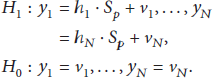
Given that

The CCU follows a fusion rule as

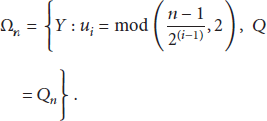
In the next section, the optimization problem for parallel local decision rules is reduced to solve a set of fixed point integral equations that minimizes the Neyman-Pearson cost function. The decision rules are digitized for simplicity, and Gauss-Seidel algorithm [24] and Golden Section search [25] are applied to find the final solutions.
4. OLDR Algorithm with Gauss-Seidel Process
Each distributed H-UE/


Therefore, the problem of optimum cooperative sensing is essentially reduced to optimizing a set of


To reduce the computation complexity, the discrete variables

Hence, the discrete local decision rules are defined as:

Accordingly, the cost function F is approximated as
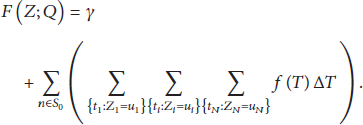
Therefore,

For the simplicity of computations, discrete local decision rules

The proposed optimization algorithm (OLDR).
5. Simulation and Discussion
For the performance evaluation of the proposed OLDR algorithm and compared to the other methods, the receiver operating characteristic (ROC) curve is depicted as a graph of
When normal pdf is assumed for the sensed signals, the conditional pdf's under both hypotheses
In the first case, a cooperative spectrum sensing with two local cognitive users is considered. Given that the received observations from PU are random Gaussian signal
Figure 5 compares the performance of OLDR and LRT with centralized network. As illustrated in this figure, OLDR with AND fusion rule outperforms the other techniques since it is closer to the CN curve. Meanwhile, OLDR performs better than LRT with the same fusion rules; for example, at

ROC comparison for Gaussian received signal in independent Gaussian noise with two LCUs.
In the second case, parallel spectrum sensing with two local cognitive users are considered with correlated received signals as

ROC comparison for deterministic received signal in correlated Gaussian noises with two LCUs.
The performance of the same network for various values of correlation coefficient (ρ) is shown in Figure 7. According to these results, the performance is enhanced by the reduction of the correlation coefficient (ρ).

ROC comparison for deterministic received signal in correlated Gaussian noise with different correlation coefficients (ρ).
Now a network of three local cognitive users with Gaussian signal observations is considered with mean
Figures 8 and 9 show that increasing the number of local cognitive users enhances the performance of the network. For Gaussian received signals with independent Gaussian noise at

ROC comparison for Gaussian received signal in independent Gaussian noises with different numbers of LCUs.

ROC comparison for deterministic signal in correlated Gaussian noises with different numbers of LCUs.
From these results, it is concluded that, for a fixed fusion rule, OLDR algorithm shows a superior performance of local decision rules to detect primary users compared to LRT method. Apparently, the probability of primary user detection is increased with the number of cooperative local cognitive users equipped with spectrum sensing. When the sensing channels are correlated, results show performance degradation in higher correlation coefficients.
OLDR method is a low complexity solution for the problem of (11) which is reduced to optimizing a set of local decision rules,

Time complexity comparison of local decision rules.
6. Conclusion
In this paper, the cooperative spectrum sensing for cognitive heterogeneous network has been designed with a parallel configuration. An optimum algorithm for local decision rule based on Neyman-Pearson criterion with correlated observations from PUs has been proposed. This scheme, based on a discrete Gauss-Seidel iterative algorithm, leads to a low complexity method of finding an optimum solution for LCU's decision rules. The performance evaluation shows the efficiency of this algorithm with fixed fusion rules in which AND rule outperforms the OR fusion rule. Furthermore, with lower correlation coefficients, a better performance is achieved. The experimental measurements and implementation of OLDR algorithm for a distributed heterogeneous cognitive network are a challenging open area for the future work. Meanwhile, optimizing the fusion rule simultaneously with the local decision rules, study of different topologies of cooperative cognitive networks, the performance analysis of multilevel decision rules, and shadowing in reporting channels are among the other suggestions for the future exploration.
Footnotes
Conflict of Interests
The authors declare that there is no conflict of interests regarding the publication of this paper.