




Abstract
Internet of Things (IoT) technologies have a great potential to improve the safety and quality of agricultural products. By providing near continuous monitoring from planting through harvesting and to our homes, IoT technologies are able to provide farm to fork visibility with all of the resulting benefits that accrue from that visibility. Unique identification provides the foundation of these benefits with a name service enabling efficient storage and retrieval of the data associated with each identifier. In this work, we present iotNS, a simple, efficient enterprise-oriented name service designed for agricultural products. The iotNS provides five times faster response than the standard GS1 ONS system. The iotNS has been deployed across five cities to enable the efficient storage and retrieval of information about agricultural products as they are tracked from the farm to the market. The deployment has shown that the visibility provided by iotNS is a mechanism that fosters cooperation and supply chain improvements among the enterprises using the iotNS.
1. Introduction
Food safety is a critical issue that has received global attention due to incidents affecting the global supply chain of agricultural and food products. Agricultural products have incurred the highest rate of incidents which, in turn, has heightened consumer awareness of food safety issues. Even though significant commercial and academic work has been performed to mitigate the food safety risks, no solution has received significant adoption, and incidents continue to occur, particularly in China and other large agricultural countries. The most promising food safety technologies are based on Internet of Things (IoT) technologies that make the food supply chains more transparent by uniquely identifying items throughout their life, from farm to fork, and using that visibility to enhance the safety and freshness of the consumed foods.
The IoT was first proposed in 1999 [1, 2] as a way to merge the physical world with the cyber world. Through the use of automated identification technologies, such as radio frequency identification (RFID) systems and barcodes, items can be uniquely identified and located within an IoT enabled environment. Strategically placed readers automatically identify items as they pass by with the reader acting as a network gateway through which the IoT enabled items can communicate. A name service may be used to locate the data and information stores for each uniquely identified item. The limit of the IoT tagging device functionality is determined solely by the size and cost constraints of the applications. High value items may utilize IoT devices that are effectively small computers. While, most agricultural and food products are more suited to utilizing low-cost passive RFID devices.
The IoT is recognized as one of the most promising networking paradigms that bridges the gap between the cyber and physical worlds [3]. The on-item tagging devices are only one portion of the IoT providing item connectivity to the Internet. IoT specific services, such as name services and location services, support the IoT, making the IoT an application which can be executed on top of the Internet just like the World Wide Web. The complete IoT can be used to manage both static and dynamic data and information for a range of items, including agricultural products, quickly and conveniently.
The visibility provided by the IoT helps to solve the food safety problem. Visibility of the items, their environments, and their movements enable agile and efficient product management which is necessary for perishable agricultural products. By integrating the IoT, particularly unique item identification and a naming service, into their supply chains, food and agriculture manufacturers, suppliers, and retailers can conveniently track and trace the items throughout their supply chains. The importance of unique identification for traceability and within the IoT was investigated by SchroederandTonsor [4]. SchroederandTonsor analyze the tracing systems of major world-wide beef exporters. They concluded that a widely adopted animal identification and IoT-based tracing system is necessary for a safe beef supply chain. Unique identifiers enable an item's history to be uniquely captured. When that history is stored in multiple data stores, a name service is necessary to locate all history data and to make that data available to all users. By integrating the IoT, including unique identifiers and a name service, within the food and agricultural product supply chains, histories will become transparent for all users, including the consumers, and food safety may be enhanced [5, 6].
In this paper, we present the iotNS, an Internet of Things Name Service that enables the distributed storage and retrieval of IoT data, thereby, providing for a scalable, distributed, and commercially viable approach to IoT enhanced food safety. The iotNS is based upon the GS1 EPCglobal ONS 2.0 specification [7] and targeted for seasonal and perishable supply chains such as the agricultural chain. The iotNS utilizes GS1 identification schemes, such as the Global Trade Item Number (GTIN), as the basis of its services. This allows for native batch and lot level traceability services that are necessary for agricultural products while maintaining compatibility with the currently used identification schemes for food and agricultural products. Furthermore, by being based upon ONS 2.0, iotNS supports highly distributed data stores.
The remainder of this paper is organized as follows. Section 2 presents related work. We review the IoT food safety system requirements in Section 3. Section 4 presents the iotNS architecture and implementation. Section 5 presents an evaluation and analysis of the advantages of iotNS and an evaluation of the costs and return of investment of an iotNS-based system. A real-world agricultural supply chain management deployment and evaluation of iotNS is presented in Section 6. Finally, we draw the relevant conclusions and discuss future work in Section 7.
2. Related Work
In this section, we review related work on using the IoT for food safety, and we review related work on name services.
2.1. The IoT and Food Safety
A number of researchers have investigated the use of IoT technologies to address the food and agriculture visibility and safety problems. Several basic approaches have been proposed. Liu et al. [8] use isotope analysis of cattle hair combined with a smart phone app to determine the geographical origin of beef, information that may be provided to consumers and other supply chain participants. However, the characteristic they found for cattle identification does not work in other agricultural products. Feng et al. [9] designed an RFID-based cattle/beef traceability system that can realize real-time traceability; however, the system is not generally applicable to open supply chains with distributed data stores. Most basic approaches such as these utilize a centralized IoT architecture that is not generally applicable to the open food and agricultural products supply chains.
A number of more advanced IoT-based systems have been proposed for traceability and food safety to support a hazard analysis and critical control points (HACCPs) approach to food safety through product traceability. One such system is the supply-chain pedigree interactive dynamic explore (SPIDER) [10] system. SPIDER was developed to verify, inspect, and investigate the pedigree of food products throughout the supply chain using RFID technologies for traceability and specific rule-based reasoning and fuzzy logic to support HACCP. Similarly, Zhang et al. [11] present a statistical heuristic approach to trace contamination sources by using large IoT systems and centralized stores for complicated food supply chains within a smart city context. With a similar design to Zhang et al., Ko et al. [12] propose a centralized system to trace and monitor agricultural products yields and the distribution channel by using wireless sensor network technologies. In a limited aquaculture domain, Qi et al. [13] present a Zigbee wireless sensor network-based traceability approach to automate tasks such as water quality monitoring and daily business flow for aquaculture. Even GS1, a trade organization that develops supply chain standards, has defined a standard for source tracing of perishable foods and vegetables utilizing a centralized data store [14, 15]. These works have shown that applying IoT technologies to the management system of agricultural products makes it more convenient for supervisors, consumers, and food providers to trace the changes of and environmental impacts on agricultural products [16]. However, the limiting factor of these designs is the need for a centralized data store upon which the food safety algorithms operate. Centralized data stores are not always feasible in the world-wide food and agricultural supply chains that exist today.
The iotNS supports highly distributed data stores, allowing each entity in the supply chain to maintain and manage the item level information that they capture. These distributed data stores allow for both a scalable and a practical name service.
2.2. Name Service
There are three main standards for name services worldwide: the ONS (object name service) defined by GS1 EPCglobal [17], the ucode-based ucode resolution protocol (ucodeRP) name service defined by Japan's Ubiquitous ID Center [18, 19], and the object identifier (OID) oriented object identifier resolution system (ORS) defined by ITU and ISO. These name service systems are all based on, or similar to, the DNS (domain name system) technology used on the Internet to map machine names to IP addresses. Non-DNS-based name services, such as the Handle System [20–22], have been standardized, but have received limited adoption in practice.
The ONS standard developed by GS1 EPCglobal is the most popular item identifier name service standard. The ONS 1.0 standard was first standardized in 2005 to resolve the EPC (Electronic Product Code) numbers on the RFID tags to the EPCIS server containing information about that EPC [23]. The current version, ONS 2.0.1 [7], was standardized in 2013. ONS is based on DNS, inheriting much of its strengths and weaknesses. Consequently, ONS can be used for supply chain management across the entire supply chain, including the production, storage, transport, and sales of agricultural products. Using GS1 Identification Keys, such as GTIN, with the name service enables easy integration for the supply chain enterprises, especially the super markets.
Numerous non-DNS-based ONS systems have been proposed; however, these variants have not been widely adopted in practice [24]. Fabian and Günther proposed an ONS architecture based on the DHT architecture [25] and realized an ONS system with point to point (P2P) architecture in 2009 in order to address the privacy issues inherent in ONS 1.0 [26]. Evdokimov et al. [27] proposed a multipolar architecture, MONS, in order to solve the access problem of a single Root of ONS 1.0. Balakrichenan et al. [28] proposed the F-ONS architecture in 2011 to address the security concerns when ONS is applied in multiple countries and districts. Secure ONS systems have been proposed based upon DNSSEC and basic PKI (public key infrastructure) models [29, 30].
ONS 1.0 was designed to be used for the name service of EPC identifiers, and it cannot be used directly for the name service of Identification Keys (e.g., GTIN) in agricultural products identification. In 2013, the GS1 published the ONS 2.0 standard that enables the use of GS1 Identification Keys. At the same time, ONS 2.0 introduces the Federated Model to solve the cooperating name service problem [7]. The enterprise-oriented name service in this work, iotNS, makes improvement to ONS 2.0 according to the supply chain attributes of agricultural products.
A comparison between iotNS and ONS and ONS-based name services is shown in Table 1.
Comparison between iotNS and other name services.

3. System Requirements
A name service operating for agricultural products should support the following attributes [31]:
Short Production-Consumption Circle. Due to the seasonality and limited shelf life of agricultural products, sensors are used to monitor the products from cradle to grave. Therefore, the name service must be optimized to support the storage and processing of sensor data and object events for continuously changing product types and product identifiers. Nonstandardization. Agricultural products do not follow a single standardized production process, or identification scheme, across all producers. Different identification levels, such as batch, product, and item level, are assigned and used in different portions of the supply chain. This requires name service support for identifiers used at multiple levels of product aggregation with different identifiers used in different portions of the supply chain. Audit for Quality Control. Quality inspections are performed through statistical sampling to limit the otherwise prohibitive cost of inspecting every agricultural product. The name service must support the association of related product information, such as statistical sampling and other agricultural events to enable quality control audits for each agricultural item. Complexity in Production Chain. The limited physical controls, nonstandardized facilities, and possible long supply chains, even for fresh products, create a complex supply chain that has many owners and operators. The name service must support data capture throughout these potentially long, complex supply chains and across the multiple owners and operators of the various supply chain segments.
The iotNS system presented in this work supports all four of these attributes while using an identification scheme appropriate for the agricultural supply chain.
Item identification schemes, data carriers and name service functionality are critical to the successful application of IoT technologies to the information management of agricultural products; therefore, the identification schemes and name service functionality are typically selected early in the system design process. Identification schemes based on the GS1 standards are the most popular schemes in use today. Currently, most IoT systems for agricultural products adopt the identification scheme established by GS1 EPCglobal ([9, 32, 33]) which uses low-cost passive RFID tags as the data carriers. However, the prices of agricultural products, especially raw agricultural products such as vegetables and fruits, are too low to support even low-cost past RFID tags. The enterprises cannot afford RFID tags and RFID readers. Barcodes, an even lower cost data carrier, are compatible with the infrastructure in the supply chain enterprises such as supermarkets and provide for IoT connectivity at all packaging levels.
The identification scheme applied to agricultural products in this work is a combination of multiple GS1 Identification Keys [17]. The item identifier consists of the Global Trade Item Number (GTIN) and a batch or lot number. The global location number (GLN) is adopted as the location identifier, and the serial shipping container code (SSCC) is adopted as the package identifier. The advantage of this combination method is that it is compatible with the existing bar code infrastructure and can manage identity at both the batch level and the item level.
The identification scheme must work in concert with the name service in order to be able to efficiently locate the correct data stores for an item. In this work, we consider EPCIS (electronic product code information services) servers as the data stores within the system. EPCIS was designed to work with ONS, which in turn was designed to work with the primarily shelf stable products within the retail supply chain. ONS realizes the translation from Identification Keys to fully qualified domain name (FQDN) by utilizing the AUS (application unique string) and DNS. The address data, in the form of uniform resource locators (URLs), are stored as a NAPTR (naming authority pointer) type in the resource records (RR) in the DNS server. The address data are provided to the ONS client by the item owner in order to accomplish the resolution to the corresponding EPCIS. The scheme based on ONS is actually conducting the object name service at the object class (OC) level via the DNS technology.
There are many issues concerning the use of ONS in the agricultural products supply chains. These include the following.
It is not practical for many agricultural production enterprises to register and maintain the name service data of each kind of agricultural product produced, particularly at the multiple levels of identification that are used in practice and the multiple EPCIS servers that are needed throughout the supply chain. Due to the seasonality and expiration date of agricultural products, the name service data at the OC level leave a large amount of useless name service recordings in the ONS. A constant “cleaning” of the ONS records is required to minimize the overhead of this out of data. The NAPTR RR impairs the performance of the DNS server because the name service data at the OC level increases the cache overhead.
A novel name service architecture, iotNS, is presented in this work. The iotNS name service architecture is based on the DNS technology. However, it only reserves the name service data of the enterprises in the supply chain through the DNS system. By converting the name service from an object-oriented name service to an enterprise-oriented name service, the iotNS architecture is more light-weight than the original ONS and overcomes the issues of ONS in the agricultural supply chain.
4. System Architecture & Implementation
The architecture and name resolution flow of the iotNS based IoT are shown in Figure 1.
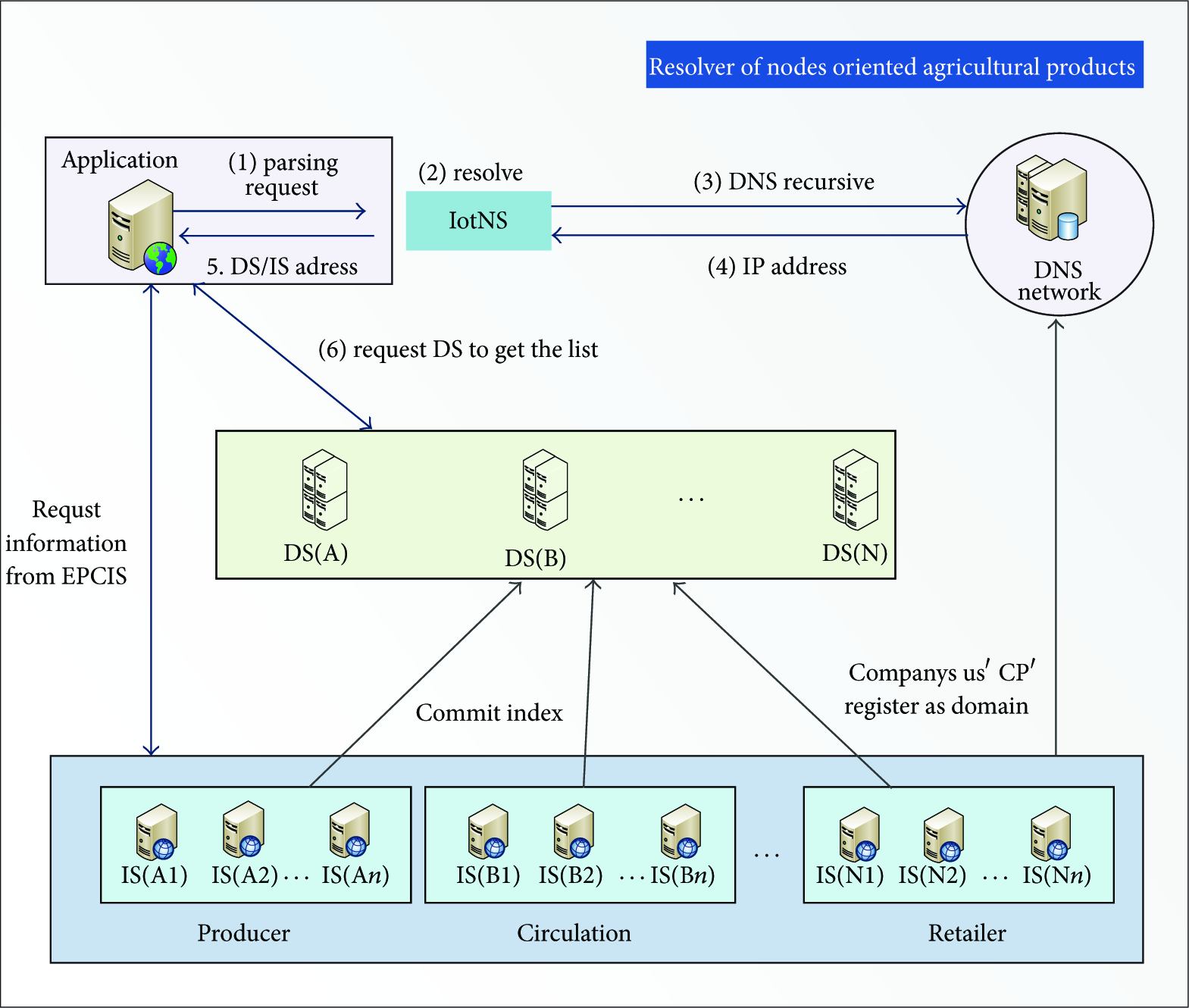
Architecture of the IoT system for agricultural products using iotNS.
The iotNS based IoT architecture has the following features.
The iotNS is used to convert the identifier to IP address information for the EPCIS information servers (ISs) that contain information for that identifier. The iotNS can be called by the applications that need to conduct the name service of agricultural products. The standard DNS protocol is recursively called to obtain the correct address resolution for the directory service and the IS. A directory service (DS) is deployed to offer the index access to the EPCIS URI (universal resource identifier) of each enterprise that the agricultural products travel through. Each supply chain enterprise deploys its own EPCIS and submits event indexes automatically to their representative DS server. The supply chain enterprises register and maintain their enterprise domain names through the domain name registrar (DNR).
The structure of the agricultural item identifier used with iotNS is as follows.
01 GTIN 10 LOT 91 R. This structure has three primary components, each preceded by a GS1 AI (application identifier). The AI (01) indicates that the following value is a GTIN. GTIN is a 14-digit number uniquely identifying the enterprise, for example, the manufacturer, and the product. The AI (10) indicates that the following value is the batch or lot number. LOT is a variable length alphanumeric string containing up to 20 characters. The LOT number may be, for example, a production lot number, a machine number, or a time. For agricultural products, we recommend the LOT value be the concatenation of [year], [month], [day], and [batch number on the day of the agricultural products harvested], which is also human readable. The AI (91) indicates that the following value, R, is a 1-digit number representing the length of the enterprise identifier in the GTIN.
For example, the identifier of Chinese cabbage harvested on April 24, 2013 in batch 0 at an agricultural products enterprise is the following.
(01) 02320206010107 (10) 201304240 (91) 9. The work flow of the name service procedure is shown in Figure 2.

Work flow of the name service procedure.
We illustrate this name service procedure for our example Chinese cabbage identifier.
The application program calls the iotNS service and initiates the name service request based on DS service for the identifier (01)02320206010107(10)201304240(91)9. The iotNS converts the identifier to FQDN (the domain name of TNSROOT.CN is provided by the China network information center (CNIC)). The procedure of the conversion is shown in Figure 3. When the GTIN-14 is disintegrated, the first digit representing the package identifier and the last check digit (CD) are removed. Then the first R digits are taken as CP, and the remaining digits are taken as IR. After the conversion, the identifier is transformed into the following format: 201304240.010.DS.GLSR.232020601. TNSROOT.CN The iotNS conducts the recursive DNS on the FQDN: DS.GLSR.232020601.TNSROOT.CN. The iotNS acquires the IP address of the DS server that can offer the inquiring service to the identifier. In our example, the IP address is 218.90.181.232. The iotNS combines the IP address and the URL acquired from the DS server. Then the iotNS returns the assembled service interface to the application program as an http formatted string: http://218.90.181.232:8071/getObjectRecord. aspx?GLSR= The application program visits the service interface acquired in Step 5 and gets the EPCIS server list of the object identifiers by visiting the following address: http://218.90.181.232:8071/getObjectRecord.aspx? GLSR=010232020601010710201304240919

Conversion of the identifier to FQDN.
The result is returned as
[“issrv_addr”:“ http://218.90.181.232:8072/ getObjectNameFull.aspx? GLSR=”,“issrv_name”:“is_YJK”,“evt_count”:“16”, “warning_count”:“0”,“first_evt_time”:“2013-4-24 08:00:30”,“last_gln”:“4142320206010015919”, “last_evt_time”:“2013-4-24 09:40:08”]
The result indicates that the information of the agricultural products is stored in one server. The access interface is 218.90.181.232:8072. The server name is is_YJK. The application program can request the event information for the Chinese cabbage product after receiving the EPCIS IP address from DNS.
5. Evaluation and Discussion
5.1. Advantages of the iotNS
The iotNS system and the presented architecture have numerous advantages over existing systems. These advantages include reduced configuration information, reduced configuration complexity, and reduced name service accesses.
5.1.1. Reduced Configuration Information
The name service data corresponds with the enterprise company prefix (CP) of the GS1 standard. The enterprises need not to configure or maintain the products information repeatedly. Since the quality of agricultural products is not easy to evaluate, more supply chain enterprises are required to take part in the application of the IoT on agricultural products to supply more complete event information. The reduction of the configuration information can improve the performance of actual applications for the supply chain enterprises and reduce the coupling of the enterprises’ systems and the DNS system. The iotNS name service can also reduce the amount of redundant data caused by the limited-time consumption and nonstandardization of agricultural products in the DNS server.
For comparison, we assume that the number of the producing enterprises that take part in the application of the IoT on agricultural products is X, and we assume that the number of types of agricultural products of each enterprise is Y. Each enterprise has its respective authoritative DNS server. We simulated a supermarket configured to accept agricultural products from the enterprises and analyze the procedure of the ONS and iotNS name servers. The GS1 ONS and our iotNS are both simulated to be adopted to realize the name service procedure. The comparison on the amount of records and number of requests is shown in Table 2. The iotNS has a factor of
Comparison on the amount of records and requests.

5.1.2. Decreased Configuration Complexity
The IP name service from the enterprise node to the EPCIS or DS is realized by adopting the A (IPv4)/AAAA (IPv6) record. Then, the data access at the application level is accomplished through the JSON interface provided by the DS server. Although defining the IP address based on the A record has lower flexibility than defining the URI based on NAPTR, it is more convenient for enterprises because only simple configuration on the IP address is needed in the iotNS solution.
5.1.3. Reduced Name Service Accesses
Because the length of the company prefix (CP) in GTIN, GLN, and SSCC is variable, the GS1 ONS system stipulates that the length of CP can be obtained by interpreting the identifier. Actually, for a particular kind of agricultural product, the length of CP is constant. So the company internal information (CII) can be configured to indicate the length of the CP in the GTIN, GLN, and SSCC when the identifier is designed. In this way, the number of accesses to the iotNS and DNS can be reduced.
5.2. ROI Analysis
The iotNS system is designed to be a practical system that can be deployed in a cost effective manner for all participants in the agricultural supply chain. In this section, we provide an analysis of return on investment (ROI) for the presented iotNS system. It is assumed that a national operator conducts the initial construction of the network with iotNS, adds new nodes, and assists the agriculture enterprises to both establish EPCIS systems and support the operation of the IoT system. An IoT-based system in an agriculture enterprise and an iotNS operator is shown in Figure 4.

IoT-based system in agriculture with enterprise and iotNS operator.
In this enterprise-oriented IoT framework, the cost of the system consists of four parts: cost of identifiers and data carriers (tags), constructing agriculture enterprise EPCIS systems, constructing the iotNS and DS systems, and the daily operation and maintenance costs.
The cost of identifiers and data carriers is paid by the food processing companies, or original product providers such as the farmers or breeders. An identifier will be attached to a single item if it is worthy; otherwise, the identifier is attached to the carrier for a lot or batch. For livestock, it is required that all animals should be tracked with unique identification since birth; therefore, little additional investment is spent on this portion of the system for livestock.
For our cost calculations, we assume that there is already an information system in an agriculture enterprise, and we only need to adjust it to the requirements of the iotNS based IoT system. This cost can be shared by the operator and enterprises. We model this sharing with parameter R (note that this is not the same R used in the identifier). We assume that the cost of constructing EPCIS for one enterprise is 
The operator will cover the rest, which is one part of its nonrecurring cost as follows:

The operator leads the construction of the iotNS and DS systems and pays for all the cost, 
The operation and maintenance cost is assumed as
For the information accessing, an enterprise should pay an annual fee P to the operator. The yearly fees are assumed to constitute the primary income of the operator.
The ROI for the enterprises comes from the promotion in reputation due to the increased food safety which leads to an increase of sales revenue and an improvement of storage and transportation efficiency which reduces supply chain management costs including shrinkage. The increase of revenue and reduction of costs directly attributable to the IoT are difficult to be counted directly, because revenue is impacted by multiple factors in a complicated process. In our model, the increase of enterprise revenue and the reduction of enterprise costs are referred to as
In evaluating the balance and return of investment, we assume the system will keep running for y years, and the interest rate is not considered.
The total profit of one enterprise after y years will be E as calculated in

The enterprise will benefit from the project after E is larger than 0. The parameters may vary from different enterprises.
For large enterprises, it is true that
For the operator, the total profit O is calculated according to

In (5), n indicates the number of enterprises joining the project, and
When 
In the best case for the operator, R is set to 1 and P simply needs to be large enough. Consider

Solving for y, we can see that the length of time for the ROI to become positive is dependent on the fixed cost per enterprise and the annual fee P paid by each enterprise.
In the worst case, 
In the conduction of the project, P should be set to a reasonable level that most agriculture enterprises will be able to pay, and R can be negotiated for each enterprise.
From the result, it can be indicated that the operator needs to set a large P to make more profits. However, the strategy of lower annual fee will attract more enterprises to join it and the network can really work in large scale. It is recommended that the annual fee should be low enough that no enterprise will hesitate to join the iotNS system for the reason of annual fee. In China, DNS service fee for one domain name is yearly paid and accepted by every enterprise. Based on that, if the annual fee is set at the same level, common enterprises will accept it, and the operator will achieve enough profits as more enterprises join the iotNS based IoT system.
6. Experiment and Deployment
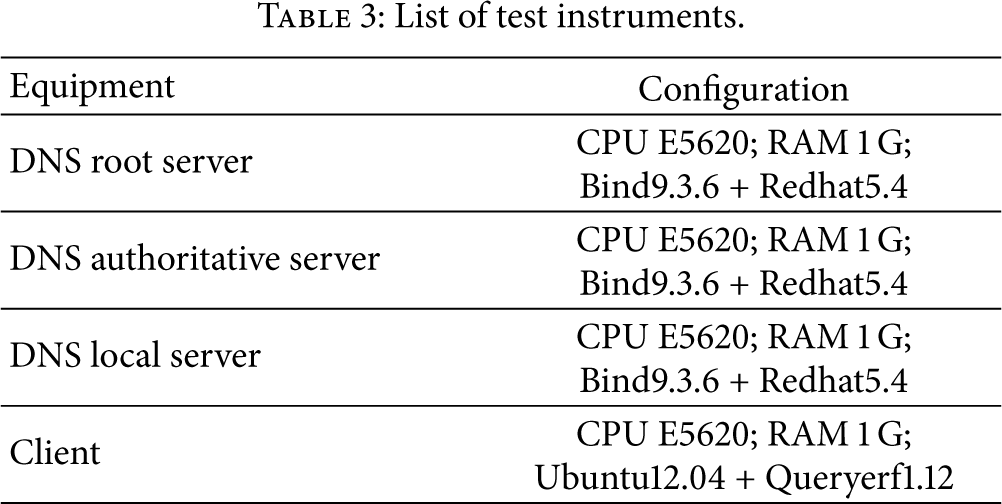
Different from the name service of the ONS on the OC level, the iotNS name service employed on agricultural products identification is an enterprise-oriented solution based on the company prefix. We performed a set of experiments to compare the performance of the iotNS name services with the ONS related work. A set of DNS servers is adopted and the OPS of DNS are calculated by the client using Queryperf. The list of test instruments is shown in Table 3.
List of test instruments.
Experiment 1.
The number of data samples to be resolved by DNS is 100,000. The number of enterprises is 1,000 and each enterprise has 100 different agricultural products. In the test procedure, the data samples of the first enterprise are visited in order, and all the other data samples of other enterprises are visited in the same way. After testing for 10 times, the calculated QPS value is shown in Figure 5.
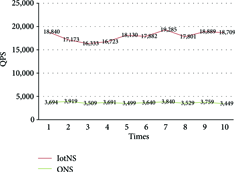
Test results of Experiment 1.
Experiment 2.
Experiment 2 is based on Experiment 1, the number of data samples of each enterprise varies from the options of 100, 200, 300, 400, and 500. The average response time of 10 tests is shown in Figure 6.

Test results of Experiment 2.
In Experiment 1, a larger QPS value indicates higher performance response to the service. In Experiment 2, a shorter responding time indicates higher performance to response to the service. The test results show that the iotNS scheme is more efficient in employing the DNS compared with the GS1 ONS scheme.
Because the iotNS interprets the identifier to the enterprise with A records, the number of requests to the local recursive server is smaller than the normal GS1 ONS 2.0 scheme.
For the URL data returned by ONS scheme (for example http://www.gsl.org/ons/epcis), another DNS name service is needed before the data access. So the actual response time of ONS should be longer and the workload to the DNS network is heavier.
The name service system based on the architecture above is put into practice in 5 cities of China.
At the same time, the application of the IoT on agricultural products based on the name service system is established. The main contribution of the application is resolving the source tracing problem of agricultural products. Figure 7 shows pictures of actual application scenarios of the iotNS system within the agricultural supply chain.

Application scenarios.
The work flow in the actual application scenario is as follows.
Farmers provide the information of production, packaging and shipping of the products to the EPCIS owned by agriculture enterprises. During the transportation, the parameters of the transporting environment are collected by different sensors and sent to the EPCIS owned by logistics companies automatically. Retailer uses either handheld terminals or stationary equipment for the receiving process, inventory process, and selling process, and all this information is uploaded to the EPCIS owned by the retailer automatically. Consumers scan the 2D barcode of agricultural products using a mobile phone or the stationary machine at the retailer. The result is that the consumer receives the life cycle information of the products as the iotNS will interpret the serial number of the agricultural product to all of the EPCIS.
The iotNS platform provides public APIs for further development. Thus, it is possible for the software developers or solution providers to develop applications using the iotNS system. Examples of the types of applications that can be developed include a Mobile Traceability app, a My Farm app, and a Recall Assistant app. The Mobile Traceability application is a mobile App designed for ordinary consumers. The software allows ordinary consumers to use their mobile devices to sense the traceability code attached to an agricultural item and acquire the traceability data about that item in order to obtain the status of the food safety, electronic pedigree, and even expiration date. This App is designed for use when ordinary consumers choose and buy foods at the store or cook them at home. The My Farm application is a mobile APP designed for producers. The software allows producers to obtain the current status and history trends of the sensors which are leveraged in the field managed by the producers. In addition, the software allows producers to subscribe to the exception information of sensors in order to better handle unexpected events during production. The Recalling Assistant application is a mobile APP designed for supervisors. The software allows supervisors to quickly obtain the distribution information of the agricultural items of the same batch. This is particularly important for recalls or when a food safety incident has been identified.
7. Conclusions
An enterprise-oriented name service for the Internet of Things, iotNS, is presented in this paper. The iotNS is designed to be an efficient tool used to retrieve and store information associated with IoT devices and tagged products. The iotNS is based upon the GS1 ONS v2.0 standard, but iotNS is designed to address the specific requirements that arise in the supply chain management of agricultural products including product seasonality and limited shelf life of agricultural products. The iotNS is five to six times faster than the standard ONS, and it is simpler to configure and maintain than standard ONS.
The large-scale trial of iotNS demonstrated the benefits to all enterprises within the agriculture supply chain from the use of IoT with the name service. The visibility enabled by iotNS provides significant value to all enterprises participating in the supply chain. Furthermore, the cost to each enterprise utilizing iotNS can be on the order of their standard DNS network costs which is less than the value derived from system. This makes it feasible for all supply chain enterprises to participate with the iotNS and for the iotNS to be operated as a trusted third party public service enterprise for agriculture supply chain management.
We are continuing to develop and improve the iotNS. Our ongoing and future work includes further improving the ease of maintenance, efficiency, and security functionality of the iotNS. Although the adoption of the A record simplifies the configuration of iotNS, this decreases flexibility. We are investigating the use of a URI based system to increase flexibility while maintaining ease of maintenance. We are also investigating the optimization of the iotNS buffering structure in order to further increase performance by taking advantage of the specific characteristics of the agriculture supply chain such as product seasonality. Secure functionality is a requirement for all Internet accessible services, and we are researching the use of DNSSEC as the basis of a secure iotNS implementation.
Footnotes
Conflict of Interests
The authors declare that there is no conflict of interests regarding the publication of this paper.
Acknowledgments
This work was sponsored by the National Science & Technology Pillar Program of China (2015BAK36B01), the National Natural Science Funds of China (61211140046), and the Shanghai Pujiang Program.