




Abstract
Wireless body area networks (WBANs) have become a leading solution in mobile health (mHealth). Typically, a WBAN consists of in-body or around-body sensor nodes for collecting data of physiological feature. For a WBAN to provide high throughput and low delay in an energy-efficient way, designing an efficient medium access control (MAC) protocol is of paramount importance because the MAC layer coordinates nodes' access to the shared wireless medium. To show the difference of MAC protocols between Energy-Harvesting wireless body area networks (EH-WBANs) and battery powered WBANs (BT-WBANs), this paper surveys the latest progresses in energy harvesting techniques and WBAN MAC protocol designs. Furthermore, a novel energy utility architecture is designed to enable sensor node lifetime operation in an EH-WBAN.
1. Introduction
Future healthcare systems should provide a long-term monitoring service for early detection and prevention of diseases. Recent advances in wireless body area networks (WBANs) and mobile communications provide an opportunity to this new requirement, which is known as mobile health (mHealth) providing early detection of abnormal conditions with online health monitor service. They can be used to monitor physiological signal in daily life of out-hospital patient as well as in-hospital clinics [1–3]. As a multidisciplinary and intersectional technology, WBANs are composed of several smart miniaturized devices which are either worn on or implanted within the patient body for continuous ambulatory monitoring of vital physiological signals. The wearable and implanted biosensors with integrated wireless communication capability can monitor the physiological status of human body and are converted into an electrophysiology signal. And that can communicate with the sink in a single hop environment. The sink collects and analyzes the sensory data from biosensors locally or further transmits it to data processing center in hospital or cloud through internet for clinical decision-making support. Therefore, WBANs can provide 24/7 health monitoring service and can also free patient from ward to improve the quality of medical treatment and user experience [4]. Figure 1 shows a health monitoring system based on WBANs.

The general architecture of WBANs (the WBANs are composed of in-body or around-body sensor nodes, including a coordinator on human body. The sensor node and the coordinator exchange information directly in the one-hop manner and form a star topology. A variety of information in regard to biosignals can be collected by sensor nodes and then transmitted to the coordinator. The coordinator can analyze the sensory data locally or forward the aggregated data to the remote data processing center through wireless or bandwidth networks).
Generally, there is no requirement for large scale networks in above-stated scenario; thereby small scale networks (single-hop communications with star) are the most popular networks in WBAN [5]. In this context, network lifetime and network latency are two important design constraints along with the miniature size of the biosensors. Considering the bad effect of user experience and healthcare quality by battery replacement, the nodes that are implanted inside the body require lifetime operation, that is, ultra-low power technologies and protocols, need to be used to realize the lifetime operation of the sensor nodes and network [6]. Since the monitoring data is extremely sensitive for patient, that is, the physiological data is delivered to the sink and further to data processing center, making a difference on patient's life or death, consequently, low latency intensely needs to be realized by using novel protocols.
In a typical WBAN platform, most of the energy consumption is attributable to the radio transceiver, and the duty cycle of transceiver is controlled by the medium access control (MAC) layer; therefore, it is desirable to design an energy-efficient MAC protocol suitable for WBAN. In this context, adaptive duty cycle protocols such as adaptive time division multiple access- (TDMA-) based MAC protocols can adapt to different nodes for their various energy harvesting rates.
How to power these biosensor nodes in a WBAN is closely related to whether the goal of sustained online healthcare services can be realized or not. In typical WBAN, the power-limited battery is served as the energy supply. However, the power-limited battery has limited lifetime and difficulties-in-maintaining and replacing in implanted sensor nodes; it is desired to obtain an infinite powering solution for extending the WBAN into practical applications. For this purpose, energy harvesting techniques are globally studied in the field of WSN [7, 8]; some of them are already deployed into WBANs [9, 10], known as Energy-Harvesting WBANs (EH-WBANs).
Although some literatures analyzed and summarized the energy consumption [11], power efficient MAC protocols [12, 13], and power-efficient communication [14] of WBAN, the access mechanism, sleep scheduling, and energy harvesting of WBANs are rarely mentioned. And there are little references that make a comparison between WBAN with power-limited battery and energy harvesting and pay close attention to the scientific analysis and summary of the channel utilization in EH-WBAN. To this end, a survey on recent MAC protocols for WBANs and compared features of the various power sources is to be done first.
MAC protocol development encounter many problems; from recent studies, we can see that the energy harvesting rate is one of them. It is obvious that the energy harvesting rate varies typically with time in a stochastic manner and among various sensor nodes, which is related to available source and application environment, as shown in Figure 2. Thus, there exists a significant difference on energy utility mode between EH-WBAN and battery powered WBAN. Therefore, it is necessary to design a novel power usage solution to ensure the realization of lifetime operation of EH-WBAN.

The profile of an energy harvesting system (in (a), the energy harvesting system is divided into two parts, an energy harvester and a rechargeable storage device. As shown in (b) and (c), the energy harvesting rate varies with time for one sensor node and among various sensor nodes at the same time. In order to realize lifetime operation in an EH-WBAN, the variation of energy harvesting rates needs to be considered).
To tackle the above-stated challenges, this paper proposes a novel energy utility architecture to enable lifetime operation in EH-WBANs, which make the EH-WBAN more practical. An example is that it can avoid a surgery operation for changing implanted battery involved in an in-body medical application. The goal of the proposal is to enable lifetime operation on EH-WBAN. Rather than using a fixed slot scheduling for node transmissions, the sink can dynamically allocate slot assignments according to various energy harvesting rates for different kinds of biosensor nodes. The proposal can ensure the power consumption is less than the harvested energy in every node by means of adaptive duty cycle.
As a research hotspot, MAC protocol is directly related to network lifetime and QoS of WBAN. This work makes a survey on MAC protocol in WBAN. By contrast with other works, we propose an energy utility architecture based on the survey of MAC protocol both in BT-WBAN and in EH-WBAN.
To this end, the main contributions of this paper are summarized as follows.
(1) A survey on recent MAC protocols for WBANs and a comparison between BT-WBAN and EH-WBAN is first introduced.
(2) The character of energy harvesting rate is first taken into consideration for the energy utility architecture to enable lifetime operation in an EH-WBAN.
The rest of this paper is organized as follows. In Section 2, we first summarize the studies on energy harvesting techniques. In Section 3, a survey on MAC protocol in WBAN is proposed. In Section 4, a novel energy utility architecture design will be given. We present the performance evaluation in Section 5. Finally, a conclusion is drawn and a future research consideration is presented.
2. Energy Harvesting Techniques
WBANs powered by limited battery have a limited lifetime because of the size limitation of sensor nodes. And it is generally undesirable to maintain lifetime operation; the replacement is inconvenient in implanted node. In order to make the WBANs more practical, WBANs powered by ambient energy harvesting (WBAN-HEAP) has been studied worldwide.
In this section, we review the state-of-the-art and technology trends. We can move away from finite energy sources by harvesting from the ambient. There are a variety of such potential sources, and all have been investigated to some degree for applications. The main categories are motion and vibration, sound, temperature differences, light, and radio frequency (RF) radiation. The drawback of light energy is that the sensor must be in a well-lit location, free from obstructions. This generates severe limitations for a WBAN application. Gathering radio frequency energy suffers much less from these geometric limitations unless a relatively large antenna can be used. Harvesting thermal energy depends on the presence of temperature differences. Practical implementations of thermoelectric generators in WBAN applications have generally reported much lower power levels. The use of sound energy is strongly restricted because of low harvested power. Harvesting power from vibration or body motion is perhaps the most promising approach, for the advantage of this approach is that devices based on motion harvesting can function both on and in the body.
Table 1 summarizes the state-of-the-art progress and character of various energy sources [15]. Up to now, there is no reliable energy harvesting solutions depending on a single energy source simply. To obtain energy as much as possible, it is desirable to design a hybrid energy harvesting system to collect various kinds of energy around the body.
Characteristics of various energy sources available.

3. A Survey on MAC Protocol in WBAN
3.1. MAC Protocols for BT-WBANs
In this section, we summarize the recent developments in energy-efficient MAC protocols. MAC protocols for WBAN have been widely studied, which can be grouped into two types: contention-based protocols and contention-free protocols. In [32], sleep and wakeup schedules are applied to reduce energy usage and prolong network lifetime at the cost of smaller throughput and longer delays. Since these schemes assume the use of batteries in their scenarios, that is, WBAN with power-limited battery, energy conservation, therefore, is a key consideration. In contention-based protocols, sensors have to compete for the media access for data transmission. Contention-based protocols such as [16–19] have no need to establish fixed structure and have shown good scalability. However, contention among nodes may incur packet collisions and result in energy-inefficient utilization in WBAN. Contention-free protocols, such as time division multiple access (TDMA), divide the channel into time slots and explicitly assign slots to nodes. Each sensor node sends its data to the sink over its allocated time slots and remains asleep in other slots. Consequently, collisions are avoided and energy wastage is reduced in TDMA-based collisions-free MAC protocols. The WBANs have relatively constant network topology and fixed sensor functions. Therefore, a lot of recently proposed MAC protocols are TDMA-based [20–24]. In these networks the synchronization procedure can be simplified due to their hierarchical structure. Master nodes that have more power act as coordinators and this removes the need of idle listening for other nodes. In these proposals, sensor node powered by limited battery and the typical power management design goals are to minimize the energy consumption or to maximize the network lifetime while meeting required performance constraints.
3.2. MAC Protocols for EH-WBANs
BP-WBANs are typically designed to minimize the energy consumption in order to prolong the network lifetime as much as possible. Instead, EH-WBANs are being designed on a different principle. It focuses on maximizing the network performance while working at a state that is called “energy neutral operation.” The authors in [33] firstly proposed power management in energy harvesting sensor networks. In this mode, two design considerations are apparently different from BP-WBAN: (1) energy neutral operation, that is, maintaining the amount of power consumption less than harvested energy for a sensor node; (2) maximum performance, that is, maximizing performance level while ensuring energy neutral operation. As a distributed application, maximum performance can be achieved using different workload allocations at multiple nodes. Consequently, it is important to make sure of matching with the workload allocation and the energy availability at the harvesting nodes.
A large amount of studies on MAC protocol for EH-WBANs was proposed in recent years [25–28]. The authors of [29] proposed ODMAC, an on-demand MAC protocol for EH-WBANs based on the idea behind [33], in which every node can operate as close to energy neutral operation and maximum performance (ENO-Max) as possible. ODMAC has the following key features. First, it supports individual duty cycles for various nodes with different energy profiles; therefore, each node is able to ensure that the energy consumed is at the same level to the energy harvested. Second, the communication process is on demand, in the sense that the sensor transmits a frame when the receiver asks for it. Hence, the sink node can dynamically adjust the period of these requests in order to reach an ENO-Max operating state. Third, the protocol provides the network administrator (patient or medical stuff) with a tool to adjust energy consumption according to the application requirements. Furthermore, an opportunistic forwarding scheme was adopted to significantly decrease the end-to-end delay.
The authors in [30] developed four different MAC protocols based on CSMA and polling techniques for WBANs which are powered by ambient energy harvesting. This scheme is developed for single-hop communication to maximize throughput and minimize delays. First, the study assumes a linear charging process for describing the ambient energy harvesting process. In the slotted CSMA protocol, a sensor node could be divided into three states: charging, carrier sensing, and transmit states; a cycle begins with the charging state and ends with the transmit state. Figure 3 shows the transmission timing of this protocol.

Transmission timings in slotted CSMA (each slot is composed of the time to transmit one data packet denoted by
Considering that the protocols in [30] were designed for sensor nodes with unstable energy source and the unfairness among energy harvesting nodes is ignored, authors in [31] proposed a MAC protocol for WBANs based on radio frequency (RF) energy transfer. The scheme, called energy adaptive MAC (EA-MAC), adaptively adjusts the duty cycle of harvesting nodes in accordance with the amount of harvested energy and the contention period of sensor nodes considering fairness among them as well. For the EH-WBANs, a star topology was proposed. In this topology, the master node is responsible for gathering data, and slave nodes are responsible for sensing data and transmitting data to the master node. The master node operates with no-ending power and emits RF energy for powering slave nodes. Simultaneously, the slave nodes harvest energy transferred by the master node. A sleep scheduling strategy was adopted to manage duty cycle adaptively. The state transition diagram for EA-MAC is shown in Figure 4. In addition, an energy adaptive contention algorithm based on the unslotted CSMA/CA algorithm was proposed. This algorithm aligns the back-off time of each sensor node with its energy harvesting rates.

State transition diagram for EA-MAC (in the active state, a slave node contends for the channel and transmits its data, if it acquires the channel. In the sleep state, a slave node completely turns off its radio and processor to save energy except for an interrupt routine to wake up).
3.3. Comparisons between MAC Protocols
A comparison is made in Table 2 to display various features of MAC protocol with different power sources.
Comparisons between existing works.

3.4. Design Challenges for WBANs MAC Protocols
3.4.1. Network Lifetime
One of the most critical challenges for WBAN is network lifetime. Despite the limited battery power, devices are required to work unobtrusively for months or even years. To extend network lifetime, energy wastages, primarily resulting from idle listening, collision, packet overhead, and overhearing, should be mitigated. Energy saving by putting nodes into low-power sleep mode periodically is a fundamental mechanism in WBAN MAC protocols. Synchronous protocol can synchronize a cluster of nodes for contention-free medium access. Therefore, a node can obtain dedicated time slots for data transmission and go into low-power sleep mode in other periods, which can avoid the aforementioned problem. EH-WBAN can further provide potential infinite network lifetime. However, characteristic of energy harvesting rates among various sources is unstable, which form a new challenge.
3.4.2. Channel Utilization
To further boost channel utilization, multichannel MAC protocols became a hot topic. One challenge for future research is the design of dynamic channel allocation algorithms that adapt to the dynamic traffic of sensor networks. It is desirable to allocate network resources flexibility according to the traffic but it is also challenging to design such a dynamic channel allocation algorithm with low overhead.
4. An Energy Utility Architecture to Enable Lifetime Operation in an EH-WBAN
EH-WBAN is composed of various energy harvesting sensor nodes and one sink in a single-hop environment. A sensor node is not typically powered by a battery, and the energy supply of sensor node is harvested from the ambient powering sources. In this architecture, the sensor nodes transmit the data to the sink in a TDMA manner (where the sink is less constrained and equipped with large batteries).
There are two features for the purpose of lifetime operation as follows. Firstly, in the node level, an adaptive duty cycle can be designed to control the energy condition while considering the harvesting rates (namely, to keep the harvested energy amount greater than the energy consumption for each sensory node). Secondly, in the network layer, the sink can be equipped with an algorithm, which dynamically allocates the adequate number of time slots for each sensor node within its duty cycle. Our proposal is illustrated in Figure 5.

Organization chart of the proposal (this architecture incorporates a sleep scheduling scheme and a Harvesting-Rate Oriented Self-Adaptive Algorithm based on adaptive duty cycle that is in accordance with energy harvesting rate).
In an EH-WBAN, it is important to ensure the workload allocations to keep pace with the energy availability at each harvesting node. One of typical methods is to use an intermediate energy buffer by modifying the load consumption to align the load requirements with a variable energy supply. In this study, we discuss an adaptive duty cycle management solution, which can guarantee the energy consumption amount to be less than the energy harvested from ambient powering sources.
The duty cycling technology is employed to realize the energy condition
After the setup phase, all the sensor nodes have been clustered into a WBAN. In the control period, the sink has knowledge of the harvested energy
i: index of current sensor node, (1) (2) Time slots allocation ( ) (3) (4) (5) (6) (7) (8) (9) (10) (11) (12) (13) (14) (15) (16) (17)
5. Performance Evaluation
To analyze and evaluate the performance of proposal, it is necessary to configure a demo for tests, using a MATLAB simulator. And then, we carry out the simulation experiments for performance tests.
5.1. Simulation Demo Setting
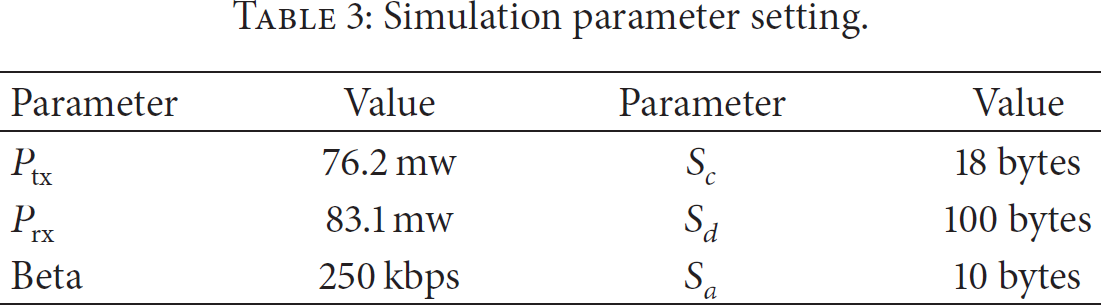
A single-hop network consisting of one sink node, connected to power mains, and n energy harvesting sensor nodes are simulated. In each simulation trial, the sensor nodes are deployed at uniformly random locations over a 5 m by 5 m area, in the center of which sits the sink node. As listed in Table 3, we set data packet size to 100 bytes, denoted by
Simulation parameter setting.
5.2. Results Analysis
We consider that transmission period should be larger than the sum of control period and announcement period to accumulate enough energy for data transmission. Figure 6(a) shows the simulation results of channel utilization using different frame structures. In Figure 6(a), we fixed n at 20 and energy harvesting rate (K) at 5 mW and vary the value of time slot denoted by N from 0 to 100. The number of time slots in the transmission period affects the performance of EH-WBANs. When

Simulation results of the proposal. (a) Channel utilization changes with number of time slots. (b) Channel utilization changes with energy harvesting rates.
As shown in Figure 6(b), the x-axis denotes the average energy harvesting rate of each sensor node, and the y-axis denotes the channel utilization of frame with fixed length. K is not fixed in real scenarios because of environmental factors. To ensure the accuracy of our model for different average harvesting rates, we fixed n at 20 and N at 100, varying K from 0 to 10 mW. In Figure 6(b), it is shown that the channel utilization is increasing with the increasing of the energy harvesting rates when the value of average energy harvesting rate
6. Conclusion and Future Work
In this study, we conduct a survey on MAC protocol for WBAN, in which the MAC protocols are divided into two categories according to power source. In addition, a novel energy utility architecture is designed for lifetime operation in EH-WBAN, which is significant to online healthcare services. In future research, we will implement our algorithm and have it verified in this architecture and take energy awareness and traffic awareness into consideration to design a MAC protocol.
Footnotes
Conflict of Interests
The authors declare that there is no conflict of interests regarding the publication of this paper.
Acknowledgments
This work is supported by NSFC (61572262, 61100213, 61170276, 61201160, 61201222, and 61401107); SFDPH (20113223120007); NSF of Jiangsu Province (BK20141427); NUPT (NY214097 and XJKY14011); Open research fund of Key Laboratory of Broadband Wireless Communication and Sensor Network Technology (Nanjing University of Posts and Telecommunications); and Ministry of Education (NYKL201507).