




Abstract
An interference avoidance mechanism for Chinese Wireless Body Area Network (WBAN) is proposed in this paper. This mechanism firstly classifies the channels by priority based on the distribution characteristics of potential interference on the China medical band, commits energy detection on all channels in the network initialization phase, and compares to energy threshold to form available channel set. Then differentiated channel maintenance strategy is utilized to avoid interference as far as possible in network running phase. The scheme proposed in this thesis is proved to be superior by simulation from either the interference probability or packet loss rate. Apart from that, the interference detection threshold that can satisfy the least communication demand is calculated for every Type B, C channel by simulation and convenient for referring to.
1. Introduction
Hybrid wireless sensor networks [1, 2] consist of wireless networks and wireless sensor networks; such network is important to overcome the limitations of conventional sensor network where transmission range and data rate are quite limited. Wireless sensor networks without support from the fixed infrastructure is known as ad hoc sensor networks [3]. Due to the lack of infrastructure, the data is forwarded to the destination via a multihop fashion. In hybrid wireless sensor networks, the nodes exchange information over a common wireless channel. Under different traffic scenarios and different constraints, for example, bandwidth and power, the amount of data exchanged among these nodes may vary. Under such challenges, new theory and design should be studied for hybrid wireless sensor networks with different channel conditions. In this paper, we study a special hybrid wireless sensor network, Chinese Wireless Body Area Network (WBAN), and propose an interference avoidance mechanism.
As population aging speed accelerates, the world has entered the aging society. It has become a serious limitation on the economic and social development, especially in China, because of the huge population and shortage of medical resources. Hence, WBAN emerges as the times require. It has become a research hot spot with wide application prospect [4, 5] and huge market potential.
At present, the released international standards of WBAN are IEEE 802.15.6 [6] and IEEE 802.15.4j [7]; the former has been officially released in March 2012: it uses the industrial, scientific, and medical (ISM) band and other bands authorized by supervision bureau. The latter has been launched in February 2013 which was based on American newly promulgated 2360 2400 MHz band. Institute of Electrical and Electronics Engineers (IEEE) established the IEEE 802.15.4n [8] working group based on Chinese medical bands in 2012, researching on new standard in order to suit to the difference of frequency division and medical and health habits.
Wireless Body Area Network is responsible for the transmission of vital signs data, so how to ensure continuous and reliable network service becomes a critical problem especially for China. This is because there exist not only huge population and jammed situations, but also many kinds of interference signals on the China medical band. Therefore, researches on interference suppression and avoidance for WBAN are crucial. But currently, most researches in the industry are centering on how to suppress interference between WBAN [9–11], while researches are seldom which are on the avoidance of interference from other kinds of devices to WBAN devices in the same frequency band. Reference [12] studies the anti-interference performance of IEEE 802.15.6 with ultrawideband (UWB) impulse radio physical layer utilizing DPSK modulation, but no solution is presented to suppress interference. In order to improve the anti-interference performance of IEEE 802.15.4n, [13] proposed twice-delay correlation frame detection algorithm on China medical bands, but the improvement is limited. References [14–16] proposed different kinds of interference suppression technologies for other wireless networks, but these technologies have high complexity and often need to consume large amounts of resources to obtain performance improvement. So they are not suitable for WBAN which request low power consumption. Furthermore, these methods are all designed aiming at narrowband interference and not suitable for Gaussian-like broadband interference, such as China Mobile Multimedia Broadcasting (CMMB) interference on the China medical band. Besides, the covering range of WBAN is only 2-3 meters; the interference is changing more drastically when users are moving. So it is necessary to design a more perfect interference avoidance policy.
This paper firstly analyzes the distribution characteristics of interference on the China medical band and then proposes an interference avoidance algorithm for Chinese WBAN based on abundant frequency resources. According to this method, once interference is detected, the network will switch channel to avoid interference by differentiated channel maintenance strategy. The rest of the paper is organized as follows: Section 2 presents system model and types of interference. Section 3 designs interference avoidance scheme and Section 4 discusses the simulation results. Finally, conclusions are drawn in Section 5.
2. Cause of Interference
WBAN is a communication network centering on a person, composed of personal terminals, and sensors on body surface, clothes or even inside the body [22]. A network with star topology is shown in Figure 1, of which C is coordinator and N means sensor nodes. The human body signs data is collected and transmitted to coordinator through wireless network by these nodes and then uploaded to remote data centers by the coordinator. The WBAN standard is aiming at providing a technical specification for communication among the nodes and coordinator in Figure 1. Besides WBAN equipments, there are often devices with other uses working on the medical bands at the same time, which will bring interference to communication among the nodes and coordinator. The paper will focus on the effects of other interfering devices to IEEE 802.15.4n devices and present a solution.

Application scenario of WBAN.
2.1. China Medical Band
The Ministry of Industry and Information Technology of the People's Republic of China has approved the 174–216 MHz, 402–405 MHz, 407–425 MHz, and 608–630 MHz bands for medical information transmission [23]. But there have not been any related communication standards based on these bands; this situation severely restricts the development of WBAN market in China. IEEE 802.15.4n is established based on these bands until 2012, which are divided into 41 channels with 2 MHz bandwidth. The channelization method is

2.2. Interferences in IEEE 802.15.4n Frequency Band
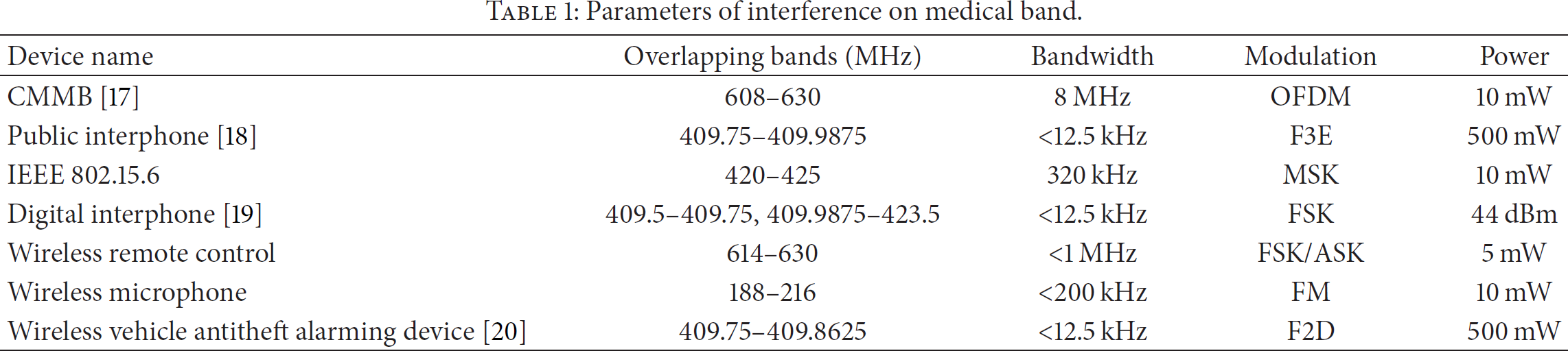
According to the relevant provisions of China radio management [24], there are seven kinds of interferences, such as China Mobile Multimedia Broadcasting (CMMB), walkie-talkie, wireless microphone, remote control devices, and IEEE 802.15.6 device. Their relevant information and the parameters are shown in Table 1.
Parameters of interference on medical band.
CMMB is a broadcasting system used for mobile terminal which adopts China's indigenous standard. According to the CMMB industry standard, there are two kinds of bandwidth, which are 2 MHz and 8 MHz. Currently in real application, the bandwidth is 8 MHz. The frequency range of CMMB standard is 30 MHz–3000 MHz, but in fact only CMMB channels numbered as 25, 26, and 27 overlap with IEEE 802.15.4n channels, as shown in Table 2 and Figure 2. Besides, only one channel of them is occupied in each city. Thus this kind of situation may occur only in certain cities. For instance, interference caused by CMMB signals on channel 26 to IEEE 802.15.4n devices will only occur in Shiyan city and Fuzhou city.
Overlapping channels of CMMB and medical band [21].


The distribution of interference signal.
If a city occupies a frequency band to broadcast, there will always be broadcast signal in this band, which means that there will always be interference in this band to WBAN equipment. Taking Linyi city as example, whenever WBAN devices are used in this city, they will always be interfered by CMMB signal in 606–614 MHz band. The other 6 kinds of interference can be considered as burst interference with mobility and uncertainty both in moment and duration of communication.
In this paper, interferences with bandwidth larger than that of IEEE 802.15.4n are classified as broadband interference, while interferences with bandwidth smaller than that of IEEE 802.15.4n are classified as narrowband interference. Because the bandwidth of IEEE 802.15.4n is 2 MHz, only CMMB signal is broadband interference. The distribution of 7 kinds of interference signal is shown in Figure 2, in which numbers 1–41 are the numbers of IEEE 802.15.4n channels.
3. Interference Avoidance Algorithm
The main idea of algorithm is channel classification and maintenance. The detailed steps are shown as below.
3.1. Channel Classification
At first, IEEE 802.15.4n channels are classified by priorities. Based on both the number of narrow band interference types and the relationship between channel energy level Energy(i) and interference threshold TH1, the channels can be classified into Types A, B, and C. The channels with few interference are classified as channel with highest priority, Type A. The channels with most interference are classified as channel with lowest priority, Type C. The others are classified as Type B. The following can be seen from Figure 2.
(1) The characteristic of frequency bands 174–188 MHz and 407–409 MHz is that no interference of the 7 kinds exists in these bands, so the two bands are classified as Type A.
(2) The characteristic of frequency bands 188–216 MHz and 411–419 MHz is that only one of the 6 kinds of narrowband interference exits in these bands, so the two bands are classified as Type B. Because of the burstiness of narrowband interference, these devices may not just be working during the energy detection in initialization of an IEEE 802.15.4n coordinator. So these kinds of interference may not be detected in this stage.
(3) The characteristic of frequency bands 409–411 MHz and 420–425 MHz is that there are 2 or more kinds of narrowband interference.
In 409–411 MHz band, there are 20 public interphone channels, 10 wireless vehicle antitheft alarming device channels, and 101 digital interphone channels (12.5 kHz bandwidth). So both kinds of interference and quantity of interference channels are quite large in this band, whose use should be avoided.
In 420–425 MHz, there exists interference from IEEE 802.15.6 devices and digital interphones. Because IEEE 802.15.6 is a kind of Wireless Body Area Network (WBAN) standard and most devices currently working in China medical bands are designed according to IEEE 802.15.6, IEEE 802.15.4n should try to avoid using this band.
To sum up, IEEE 802.15.4n channels in 409–411 MHz, 420–425 MHz frequency bands should be classified as Type C.
(4) The characteristic of frequency band 608–614 MHz is that there only exists CMMB interference. Each city only uses one CMMB channel, and only broadcast channels used in some specific cities overlap with IEEE 802.15.4n bands, as shown in Table 2. Therefore, when 802.15.4n channel number i satisfies
(5) In 614–630 MHz bands, there exist not only wireless remote control signal as narrow interference, but also CMMB signal as broadband interference. When
Taken together, 8 channels with no above-mentioned interference are classified as Type A, 18 channels perhaps with one kind of narrowband interference are classified as Type B, and channels with CMMB interference are added to blacklist. The classifying result is shown in Table 3, in which A (to be determined) and B (to be determined) are bands overlapped by CMMB signal bands, which should be further judged based on energy detection result.
Channel classification result.
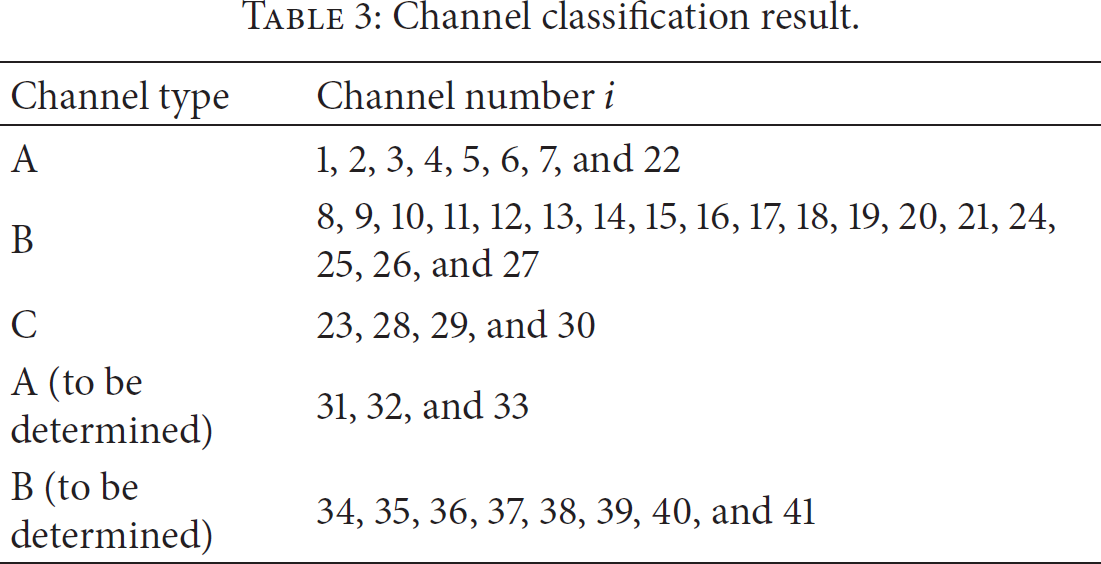
In a specific city, the 3 undetermined Type A channels will either be classified as Type A or added to blacklist; the 8 undetermined Type B channels will either be classified as Type B or added to blacklist. For example, in such cities like Haikou, Sanya, Qionghai, Danzhou, Suzhou, and Linyi, apart from Type B channels listed in Table 3, 8 channels numbered from 34 to 41 will be added to Type B channels. In any other city, apart from Type A channels listed in Table 3, 3 channels numbered from 31 to 33 will be added to Type A channels. Thus, in general, the quantity of Type A and Type B channels is quite big and that is to say there are many high quality channels. Therefore, even though antenna in 174–188 MHz bands is too big that the bands may not be used, there are still plenty of high quality channels, which makes the scheme proposed in this paper still feasible.
3.2. Generation of Available Channel Set
IEEE 802.15.4 selects the channel with the lowest channel level as working channel [25]. This policy can provide best channel for communication only within a short period and cannot guarantee the network performance during whole operation. Besides, the covering range of WBAN is only 2-3 meters and the interference is changing more drastically when users are moving. So a more perfect channel maintenance scheme is proposed for Chinese WBAN in this paper.
In this scheme, coordinator scans all the 41 channels in the order of channel number in Figure 2, records energy level Energy(i) (
When generating available channel set by above steps, the selected channels of each type are stored according to their own number from small to large order. Here the storage order of each kind of channels in the available channel set needs to be randomized. The reason is that the interfering devices usually work on continuous bands, and when IEEE 802.15.4n device is interfered in a certain channel, the channels around are more likely to be interfered. By using randomization method, the possibility of IEEE 802.15.4n device to be still interfered by the same kind of device after switching channel is lowered effectively.
The first is to randomize, respectively, the storage order of channels of each type in the available channel set. For example, in the available channel set formed in the above step, the numbers of Type A channels are
3.3. Selection and Maintenance of Working Channel and Alternate Channel
Coordinator preferentially selects Type A channel as working channel; the next channel in the available channel is set as the alternate channel. Then it transmits the information to all devices in the network by broadcasting the beacon frame. When Type A channels are all unavailable, Type B channels are second choice, and Type C channels are the last consideration. All the channels are numbered and used in the order of storage in the available channel set, which has already been randomized. Assuming that working channel number in the available channel set is Channel(N), the alternate channel number is Channel
(1) When working channel and alternate channel are all Type A, or when working channel is Type A and alternate channel is Type B, coordinator does not take interference detection. This is because Type A channels usually have better communication environment. The channel quality often remains in a good level unless there are special situation such as being attacked or with illegal wireless device around. Only when the average value of link quality indicator (LQI) provided by PHY layer data service is lower than some threshold, it is indicated that the link quality becomes worse and the channel needs to be switched. Coordinator will broadcast beacon frame in the SF
(2) When working channel and alternate channel are all Type B, or when working channel is Type B and alternate channel is Type C, coordinator needs to launch energy detection of working channel and alternate channel at the inactive period of the Energy(working channel) < TH1 and Energy(alternate channel) > TH1, working channel remains; Channel Energy(working channel) > TH1 and Energy(alternate channel) < TH1, the working channel and alternate channel are switched in the method described in (1) and execute Energy(working channel) > TH1 and Energy(alternate channel) > TH1, coordinator broadcasts beacon frame at the SF
As can be seen from above, in the situation when channel maintenance is not too frequent, this mechanism guarantees to the best extent possible the WBAN device working on channel without any interference.
(3) When working channel and alternate channel are all Type C, within the inactive period of the current superframe, coordinator detects energy on the working channel and a Type A channel (in the order of Type A channels of available channel set) and sets the detection cycle
The channels in the original available channel set are scanned in the channel storage order which is already randomized. Then channels outside the available channel set are scanned which may not be next to each other. Finally the new available channel set is generated. After many times of process like this, the storage order of channels, either inside the original available channel set or not, is already different to the channel order in Figure 2. That is why there is no need to randomize channel storage order again when generating new available channel set.
If interference in the working channel is detected during the process of generating new available channel set, then switch channel in the order of the Type C channel in the original available channel set. Because it needs only 41 superframe periods to generate a new available channel set, which is relatively short, the situation that all the Type C channels are interfered during these periods is out of consideration. This differentiated channel maintenance strategy is shown in Figure 3, and the channel type number is shown in Table 4, where
Channel type number.


Differentiated channel maintenance strategy flow chart.
3.4. Network Running Mechanism
In the network initialization phase, coordinator scans all the channels to generate available channel set and then selects working channel and alternate channel in the A-B-C priority order and starts running.
In the running process, when coordinator detects interference in the inactive period of SF
3.5. Selection of the Key Parameters
3.5.1. Selecting of Interference Detection Cycle L
The selecting of L depends on specific scenario. A too small L may bring too frequent interference detection and unnecessary energy loss, while a too big L cannot detect interference timely. The value of L can be calculated using superframe period and the length of interference signal, which means L = shortest length of interference signal/superframe period. If user is indoor and external ambient is quite stable, L should be a bigger value, while external ambient is quite changeful, L value can be reduced accordingly.
3.5.2. Selecting of Interference Threshold TH1
A too high threshold may lead to severe interference, while a too low threshold may make the coordinator switch working channel too frequently, which affects the network stability. This paper proposes three methods to select the threshold.
Reference [10] gives detailed analysis of interference and proposes a modified frame detection algorithm based on twice-delay correlation to promote the anti-interference performance of the system. By utilizing the simulation method of the reference, this paper firstly gets the respective SIR curves in existence of different interference when different frame detection algorithm is used in the two kinds of rate modes 250 kbps and 500 kbps. Then with signal power value and the SIR that can satisfy the lowest communication performance demand (PER = 1%), the interference power value is obtained (as shown in (2)) and set to be the threshold of interference detection:

The simulation counts PER of 3000 data package with 2040 bit length of each package. When IEEE 802.15.4n signal power is set as −85 dBm (sensitivity in 250 kbps rate mode) +10 dB and −82 dBm (sensitivity in 500 kbps rate mode) +10 dB, the simulation result is shown in Figure 4. The curves indicate the interference detecting thresholds of Type B, C channels. In the figure, frame detection algorithm 1 uses delay correlation algorithm, which utilizes noncorrelation of noise and periodicity of preamble to detect the starting position of data frame. Frame detection algorithm 2 uses twice-delay correlation frame detection algorithm, which can eliminate the influence of narrowband interference to promote frame detection accuracy. As can be known from the figure, spread spectrum factor, frame detection algorithm, and interference type can all affect interference detection threshold TH1. TH1 can either be a fixed value for all interference or dynamically change as interference changes.
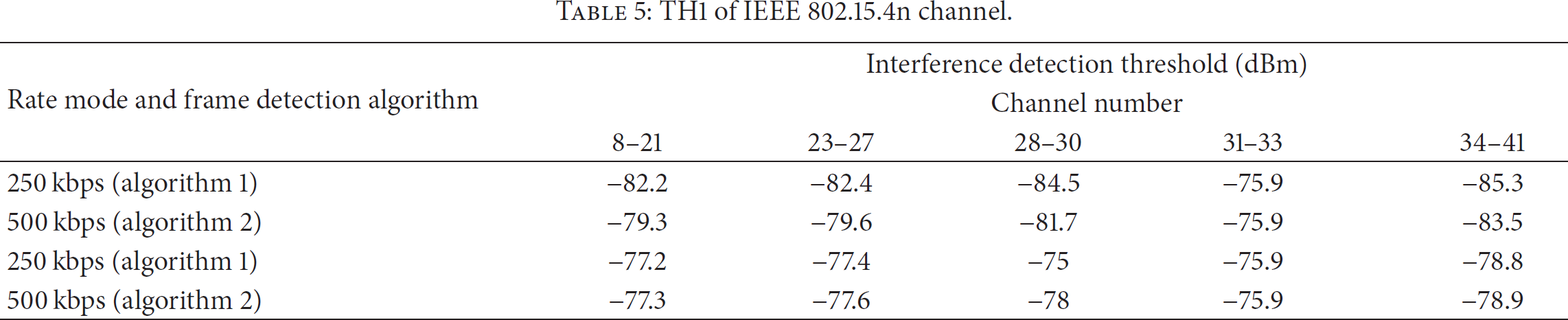
Method 1: if TH1 is fixed, select the smallest threshold of every curves as TH1 in Figure 4. If frame detection algorithm 1 is utilized, select −85.3 dBm as TH1 in 250 kbps mode and −83.5 dBm as TH1 in 500 kbps mode. If frame detection algorithm 2 is utilized, select −78.5 dBm as TH1 in 250 kbps mode and −78.8 dBm as TH1 in 500 kbps mode. Method 2: if TH1 is dynamic, TH1 needs to be sectionally determined according to Figure 4 based on current working channel number, frame detection algorithm, and rate mode. They are sorted in Table 5 to be more intuitive and convenient for referring to. For 250 kbps mode using frame detection algorithm 1, the thresholds of channels 8–21 and channels 23–27 are basically the same. So on channel 8–27, the same TH1 value of −82.4 dBm can be selected and −84.5, −75.9, −85.3 dBm subsequently.
TH1 of IEEE 802.15.4n channel.

Interference detection threshold TH1 for IEEE 802.15.4n channel.
Furthermore, there is another simple way to select TH1 as shown below:
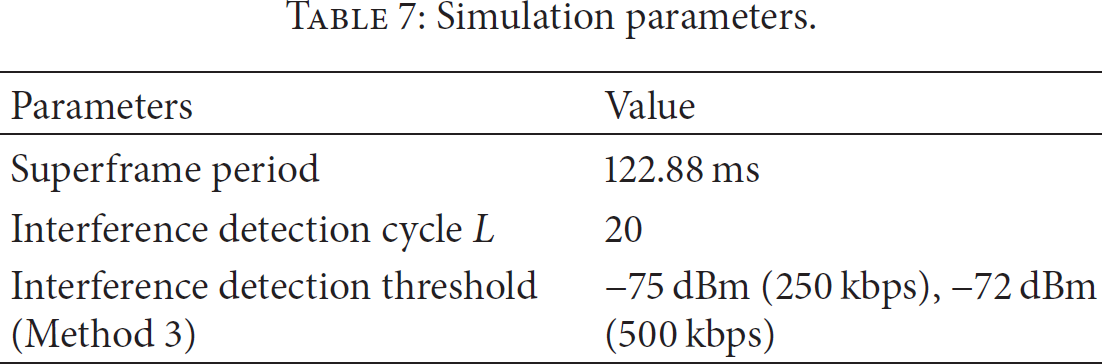
Method 3: in IEEE 802.15.4, the energy detection threshold of CCA < receiver sensitivity (−85 dBm) +10 dB. Thus, the interference threshold here can be similar to the threshold of CCA, which means using −75 dBm in 250 bps mode and −72 dBm in 500 kbps mode.
4. Simulation
4.1. Signal Model
At the receiver, the received signal can be described by

4.1.1. Public Interphone and Wireless Microphone
The signal is modulated in F3E mode, in which F means frequency modulation, 3 represents analog modulation, and E means voice. The transmitted signal can be illustrated by


In the simulation,
4.1.2. IEEE 802.15.6
The signal is modulated in GMSK, and the baseband signal can be illustrated by

4.1.3. Digital Interphone and Wireless Vehicle Antitheft Alarming Device
The signal is modulated in F2D mode, in which F means frequency modulation, 2 represents digital modulation, and D means data, telemetering, and remote instruction. The transmitted signal can be illustrated by

4.1.4. Wireless Remote Control
There is no mandatory rules for modulation of this type of product and the signal is usually modulated in FSK/ASK. In the simulation, ASK is chosen and the signal can be illustrated by

4.1.5. CMMB
Among all the potential interferences, CMMB signal is the only broadband signal with a much bigger bandwidth and a much stronger receiving power than that of 802.15.4n signal. Considering that, we use Gaussian noise to describe it in the simulation.
4.2. Simulation Configurations
The simulation is conducted in Linyi city, Shandong province. The scenario is family use, disregarding hospital environment. According to State Radio Regulatory Commission (SRRC), wireless microphone is forbidden to be used in hospitals. So in this simulation the interference of wireless microphone should be taken into consideration. As can be seen from Table 2, CMMB interference in Linyi city only exits in 608–614 MHz. So there are 8 Type A channels and 26 Type B channels, which are a great number of high quality channels.
The quantity of narrowband interfering devices subjects to normal distribution whose mean value is num-i and variance is σ, of which the specific parameters are listed in Table 6. The quantity of interfering devices is no bigger than the total channel number on the frequency band it is allowed to use. For example, public interphone has 20 channels in 409–411 MHz frequency band, so the max number of interfering public interphones is no more than 20. The frequency point of interfering distributes randomly.
Parameters of narrowband interfering.

At the same time, the simulation assumes that IEEE 802.15.4n devices are not interfered by other IEEE 802.15.4n devices on the 41 channels within medical frequency band. The specific parameters are listed in Table 7. The simulation analyzes the probability of IEEE 802.15.4n being interfered and packet loss rate as the number of IEEE 802.15.4n networks changes. In the simulation, superframe period is set as the smallest time unit, and the simulation duration is 10000 superframe periods. The final result is the mean value of 1000 times simulation results. The simulation is conducted using MATLAB.
Simulation parameters.
In the simulation, scheme 1 is the method proposed in this paper. As the contrast method, scheme 2 is the method used in IEEE 802.15.4, whose strategies of channel selection, interference detection, and channel switching are as follows.
(1) Channel Selection of IEEE 802.15.4. Coordinator detects channels energy in the random order and selects the channel of lowest energy level as working channel.
(2) Interference Detection of IEEE 802.15.4. By statistic analysis of the mean value of data frame LQI within a period of time, judge whether the channel is interfered. LQI is a service provided by PHY layer, generated, and appended after each PHY data frame. However, because fluctuation of each LQI is quite severe, statistical average value of LQI within a period of time is usually used. The LQI in the simulation is the average LQI value of the link between coordinator and all the nodes in the WBAN within a superframe period. After a superframe period ends, if LQI is higher than threshold, the working channel quality is considered good; otherwise it is quite poor and needs to be switched.
(3) Channel Switch Strategy of IEEE 802.15.4. When channel quality gets worse, detect all the channels again, select channel with the lowest energy level as the new working channel, transmit channel switch command on the original channel, and then switch to work on the new channel.
4.3. Performance Validation
4.3.1. Interference Probability
In Figure 5, the horizontal axis shows the quantity of IEEE 802.15.4n and IEEE 802.15.4 networks, and the vertical axis shows the probability of network being interfered. The probability of network being interfered both rises as the quantity of networks rises when using the two schemes, but it rises quite slowly with barely no deteriorated performance when using the scheme proposed in this paper.

Interference probability of the two schemes.
4.3.2. Package Loss Rate (PLR)
The simulation only counts the package loss caused by interference, without considering package loss caused by collision inside the same IEEE 802.15.4n network. As can be seen from Figure 6, compared to PLR of IEEE 802.15.4 protocol, the PLR of proposed scheme always stays at lower levels and does not surge as network quantity grows.

PLR of the two schemes.
Thus it can be seen from either the interference probability or PLR that the scheme proposed in this paper is superior for two reasons. First, the scheme classifies channel by quality, uses high quality channel in preference, and randomizes the storage order of channel in available channel set. So when quantity of IEEE 802.15.4n networks in Linyi city is no more than 8, the effect of interference can be avoided completely. Second, the scheme utilizes different channel maintenance strategies on channels with different priority and switches channel when interference is detected. This differentiated strategy utilizes different interference detection methods and periods on channels of different types and sets interference detection period of Type B channel to be dynamic, which means a long detection period when channel state is good and a short detection period otherwise. Therefore, there is barely no rise of the interference probability and PLR as network quantity rises and available channels quantity reduces gradually.
5. Conclusions
Chinese medical frequency band has abundant frequency resources and 802.15.4n channel quantity is large. Based on this feature, an interference detection and avoidance method is proposed. First it classifies channels by priority based on potential interference situation, commits energy detection on all channels in the network initialization phase, and compares to energy threshold to form available channel set. Then differentiated channel maintenance strategy is utilized on channels with different priority. The strategy can not only make channel maintenance less frequently and energy consumption reducing, but also make sure to switch channel in time when interference is detected. Finally, apart from guaranteeing the quality of working channel in real time, it also maintains alternate channel in real time, so switching channel time when interfered is shortened. This method has a lower protocol overhead and reduces probability of interference. The simulation results show that the method has better performance of interference avoidance.
In Linyi city, the promoted performance is already quite obvious with relatively small quantity of Type A channels. Thus the effect of the proposed scheme will be better in other cities with more Type A channels. Furthermore, only fixed TH1 is utilized in Section 4. If dynamic TH1 is utilized, the performance will be more remarkable.
Footnotes
Conflict of Interests
The authors declare that there is no conflict of interests regarding the publication of this paper.
Acknowledgment
This work was supported by the 863 Program of China under grant no. 2015AA01A703, the Fundamental Research Funds for the Central Universities under grant no. 2014ZD03-02, fund of SKL of MMW (no. K201501), NSFC (no. 61171104).