




Abstract
Many time-sensitive applications impose high requirement on real-time response. There exist many algorithms and routing protocols for efficient data packet delivery. However, previous works set the same retransmission threshold for all the relay nodes along a delivery path. The method decreases the probability of a packet being transmitted through the delivery path within given deadline. In this paper, we focus on finding the optimal retransmission thresholds for the relay nodes, such that the summation of the probability of a packet being transmitted to the next relay node or destination node within the specified deadline is maximized. A distributed greedy algorithm that can be run on sensor node is proposed, which enables the sensor node to adaptively set the optimal retransmission threshold. To avoid dropping the packet forwarded to the destination within given deadline with high probability, we develop a packet dropped protocol based on probabilistic delay bound. Experimental results show that the proposed protocols have better performance.
1. Introduction
Cyber-physical systems (CPS) integrate the computation and physical processes to monitor and control the continuous dynamics of physical world and engineered systems, which revolutionize the approaches for observing the physical world and the process of information access. As extremely critical component in CPS, wireless sensor networks (WSNs) have been envisioned to observe and cognize the complicated physical world at low cost [1, 2]. Deployments of large-scale WSNs have potential to shed light on a variety of monitoring purposes, such as environment monitoring, pollution levels monitoring, and progress of climate change. The discovery of useful knowledge from the massive sensed data is helpful for deeper scientific understanding of human-physical world interaction, which motivates researchers to explore complex and evolving relationships among the data. Plentiful research works have begun focusing on extracting useful knowledge from the Big Data perspective by using the large-scale sensed data.
Large-scale WSNs have been considered as one of the promising, high-value applications for CPS, whose enormous societal impact and economic benefit will be created by the discovery of useful knowledge from the sensed data. Many time-sensitive applications, such as intruder tracking, environment control, and structural health diagnosis impose high requirement on real-time response for decision making and future actions [3–6]. In these applications, deadline misses in data communication may bring about irreparable financial and environmental impacts. Therefore, achieving fast data delivery and response for the massive data generated in WSNs poses new research challenges.
Data delivery delay has been extensively studied in forwarding quality measurement [7–9], sensor network routing, and scheduling [10–13]. Most of the works focus on investigating the metrics to characterize the forwarding quality or minimizing average path delay. Moreover, existing works set the same retransmission threshold for all the sensor nodes along a delivery path. The method is short of taking the link quality and delay requirement into account, which decreases the probability of a packet being successfully transmitted through its delivery path within given deadline. In many cases, the retransmission threshold imposes a significant effect on the probability. To understand the impact of retransmission threshold on the probability of packet delivery before its deadline, we give an example, which is illustrated in Figure 1.

The impact of retransmission threshold on success probability of packet delivery.
The number at each link is the probability of a packet being successfully delivered to the next node through the link, denoted by
To improve the reliability of packets delivery, the method of packets being transmitted along multiple paths is widely applied. Therefore, in this paper we focus on computing the optimal retransmission thresholds for the relay nodes along a delivery path, such that the summation of the probability of a packet being successfully delivered to the next relay node or destination node within the specified deadline is maximized. To find the optimal retransmission threshold, a distributed greedy algorithm that can be run on sensor node is proposed, which enables the sensor node to adaptively set the optimal retransmission threshold based on the link quality and the remaining time to deadline. Stringent retransmission threshold may make the packet forwarded to the destination within deadline with high probability be dropped. To overcome the shortcoming, we develop an The problem of finding optimal retransmission thresholds for the relay nodes along a delivery path is proposed. A formal description of the problem is given, and it can be formalized as an integer optimization problem. A distributed greedy algorithm for computing optimal retransmission threshold is proposed and the correctness of this algorithm is proved. The time complexity of the algorithm is To avoid dropping the packet forwarded to the destination within the given deadline with high probability, an Simulation experiments are conducted to evaluate the proposed algorithm and protocol. Experimental results show that our algorithms have better performance in terms of deadline success ratio and real-time ratio.
The rest of this paper is organized as follows. The related works on real-time data delivery are surveyed in Section 2. In Section 3, the optimization problem is described first, and a greedy algorithm for computing optimal retransmission threshold is provided. Based on Chebyshev inequality, an
2. Related Works
Data delivery delay is extensively considered in routing metric. The metric of expected transmission count (ETX) was proposed in [14]. ETX measures the expected number of transmissions for successfully delivering a packet over the link, which works well in a homogeneous sigle-radio environment. Effective number of transmissions (ENT) [15] was proposed to enhance ETX by taking the variable link reliability into account. Expected transmission time (ETT) [16] and the path metric of weighted cumulative ETT were proposed for multichannel mesh networks. ETT can be considered as enhanced ETX by counting the hererogeneous channel rate and intraflow interference.
Data delivery delay has also attracted much attention in designing efficient routing protocol. There are three categories of routing protocols that favor the end-to-end delay performance guarantee in WSNs [17]: (I) tree-based routing; (II) optimal routing based on the knowledge of network topology; (III) geographic routing by the information of node position. To shorten the worst-case delay, [18] proposed tree-based routing protocol, which looks up the neighbor table for routing decisions. Tree-based protocol may lead to high energy consumption of the nodes near root of the tree. Generally, geographic routing protocols are not optimal, because they are merely based on one-hop decision [17]. SPEED protocol was proposed in [12], which estimates the forwarding delay. In SPEED protocol, the node of higher relay velocity is selected with higher probability. However, for high efficient energy utilization it is significant to integrate the information effectively.
Motivated by the tradeoff between the energy consumption and real-time routing performance, [19–21] investigated the optimal construction of virtual backbone and node placement. Aiming at enabling routing with probabilistic delay bounds in wireless sensing and control networks, multitimescale adaptation routing protocol was proposed in [22], which addresses the challenges of dynamic, uncertain link/path delays in real-time routing. To minimize the cost of packet delivery, [23, 24] developed approximation algorithms for the capacitated multicast routing problem.
There are plentiful research works that focus on the analysis of the end-to-end delay in wireless networks. In literature [25], the open queueing network theory was applied to model the WSNs and the analysis for the paths delay based on the model was provided. By mapping the scheduling of real-time periodic data flows in a wirelessHART network to real-time multiprocessor scheduling, the analysis of end-to-end delay was given in [26].
However, all the previous works set the same retransmission threshold for the sensor nodes in advance. The method of setting the same retransmission threshold for the sensor nodes along a delivery path is short of taking the link quality and delay requirement into account, which decreases the probability of a packet being successfully transmitted through its delivery path within given deadline. To the best of our knowledge, this paper first investigates the problem of finding optimal retransmission thresholds.
3. Greedy Algorithm for Computing Optimal Retransmission Threshold
The method of setting the same retransmission threshold for all sensor nodes has poor performance in real-time data delivery. In this section, we develop a greedy algorithm for computing the optimal retransmission thresholds for the relay nodes along a delivery path, such that the summation of the probability of a packet being successfully transmitted to the next relay node or destination node within the specified deadline is maximized.
3.1. Problem Description
Suppose that the end-to-end path is
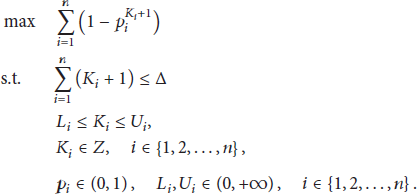
Obviously, the value of objective function

Then the problem of finding the optimal retransmission thresholds for each relay node along a delivery path can be defined as follows.
Input.
Output. Optimal retransmission thresholds
Based on the above analysis, the key point is to design an efficient algorithm for finding the optimal solutions to integer optimization problem (2). In the following section, we prove that the optimization problem can be solved by a greedy algorithm. And the correctness of the algorithm is proved.
3.2. Correctness of Greedy Algorithm
Lemma 1.
For any

Proof.
Let
Thus
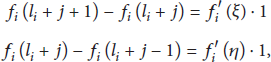
For any

According to Lemma 1, for any

Lemma 2.
Let

Proof.
Based on the definition of

It can be easily known that
Lemma 3.
Let

Proof.
The proof is by induction on Λ. According to Lemma 2,
Suppose that

It is easily verified that the solution
Theorem 4.
If

Proof.
Based on Lemma 3, it can be verified that the solution
Suppose that
Theorem 5.
Let

Proof.
The proof is by induction on Λ. According to Lemma 2,
Suppose that

Let

Let
3.3. Greedy Algorithm for Computing Optimal Retransmission Threshold
From Theorems 4 and 5, we know that integer optimization problem (9) exhibits the optimal substructure and greedy-choice properties, which are two key ingredients of the greedy approach. In this section, a greedy algorithm for computing the optimal retransmission threshold is proposed.
Suppose that the end-to-end path is
Input: Output: optimal retransmission threshold of node i (1) (2) (3) (4) (5) (6) (7) (8) (9) (10) (11) (12) (13)
For a given delay requirement Δ and a delivery path consisting of n sensor nodes, the cost for computing the optimal retransmission threshold is
4.
-Probabilistic Delay Bound Based Packet Dropped Protocol
In previous section, we investigate the problem of finding the optimal retransmission thresholds for the relay nodes along a given end-to-end delivery path. Due to the uncertainty of wireless link, stringent retransmission threshold may make the packet forwarded to the destination within deadline with high probability be dropped. Since computing the probabilistic distribution of path delays is NP-hard [27], then we develop an
The main idea of the proposed protocol is as follows. When a packet fails to be transmitted after a predefined number of retransmissions, if the upper bound of the probability of the delivery delay within the deadline is smaller than α, then the packet is dropped; if the upper bound of the probability of the delivery delay exceeding the deadline is smaller than β, then the packet is transmitted once again. In the following section, the probabilistic path delay bounds are derived.
4.1. Probabilistic Path Delay Bound
Given a path
Property 1.
Suppose that Δ is the delay requirement, let


Proof.
According to one-sided Chebyshev inequality, the following inequality holds, if


4.2.
-Probabilistic Delay Bound Based Packet Dropped Protocol
Suppose that relay node
Firstly, node
Secondly, the node decides whether the packet will be dropped as follows.
Case 1 (
).
If
Case 2 (
).
If
The detail of the protocol is described in Algorithm 2.
Input: Output: node (1) (2) (3) (4) (5) (6) (7) (8) The packet is dropped; (9) (10) The packet is transmitted once again; (11) (12) (13) The packet is transmitted once again; (14) (15) The packet is dropped;
5. Performance Evaluation
In this section, a series of experiments have been conducted to evaluate the performance of the retransmission threshold setting protocol based on greedy algorithm for computing optimal retransmission threshold (GAORT) and probabilistic delay bound based packet dropped (PDBPD) protocol. The simulations are carried out by MATLAB.
The first group of experiments is to investigate the deadline success ratio (DSR) of the GAORT based protocol. In this paper, deadline success ratio is the percentage of the packets delivered to the destination before given deadlines among all the packets. And DSR can be calculated as follows:


Deadline success ratio of GAORT based protocol.
The second group of experiments is to investigate the real-time ratio (RTR) of the GAORT based protocol. Real-time ratio is the percentage of the packets delivered to the destination before given deadlines among the packets successfully delivered to the destination. And RTR can be calculated as follows:

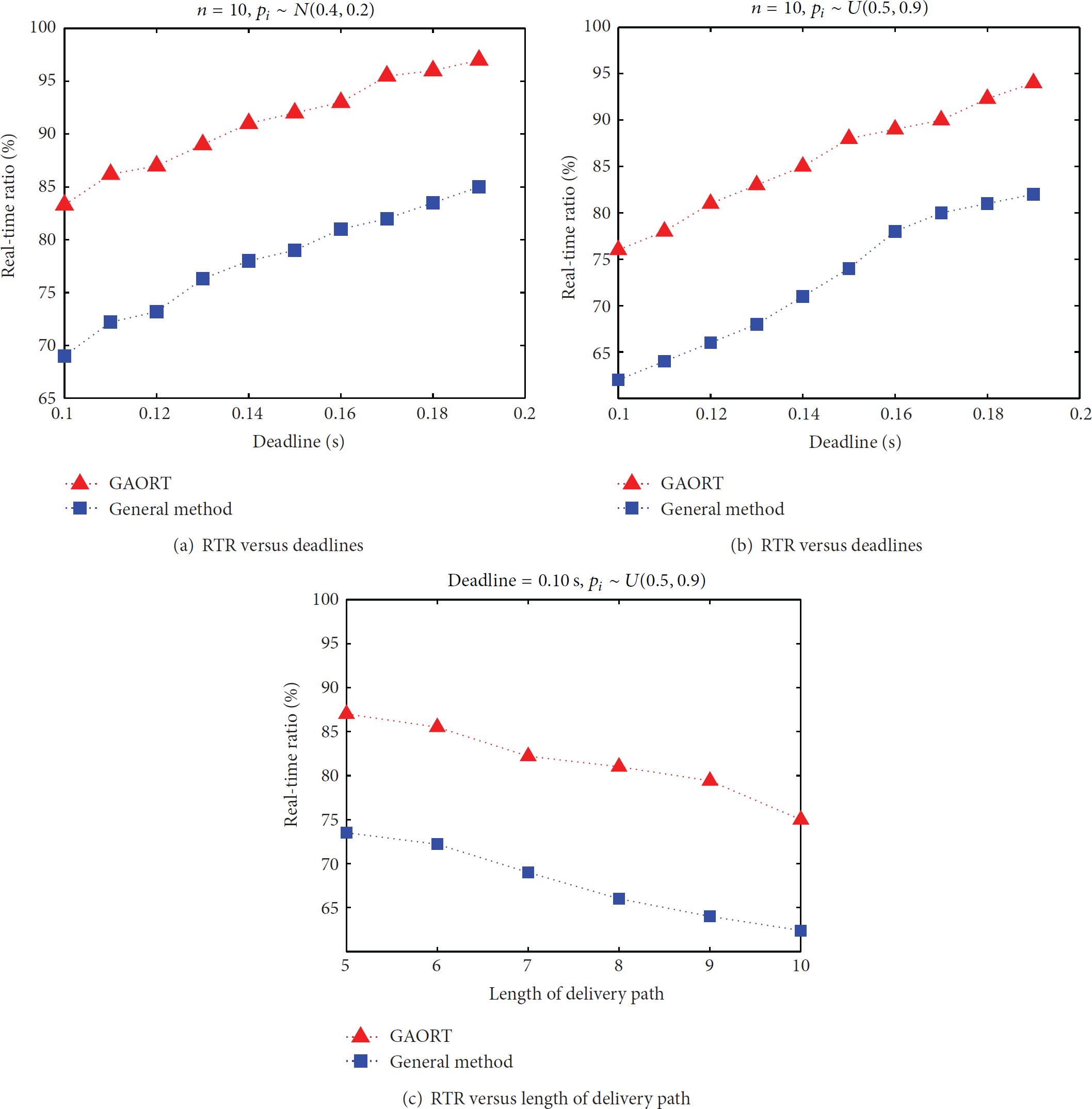
Real-time ratio of GAORT based protocol.
The third group of experiments is to investigate the performance of PDBPD protocol. The comparisons between Normal Method and PDBPD protocol are carried out. The main idea of Normal Method is that a data packet is dropped after a predefined number of retransmissions, where the retransmission threshold is the result by implementing GAORT. As shown in Figures 4(a) and 4(b), PDBPD protocol achieves higher deadline success ratio than that of Normal Method, when the probability of transmission failure,

Performance of
6. Conclusion
As one of the promising, high-value applications for CPS, deployments of large-scale WSNs have potential to shed light on a variety of monitoring purposes. Many time-sensitive applications impose high requirement on real-time response. There exist many algorithms and routing protocols for efficient data packet delivery. However, previous works set the same retransmission threshold for all the relay nodes along a delivery path. The method decreases the probability of a packet being transmitted through the delivery path within given deadline. In this paper, we focus on finding the optimal retransmission thresholds for the relay nodes, such that the summation of the probability of a packet being transmitted to the next relay node or destination node within the specified deadline is maximized. A distributed greedy algorithm that can be run on sensor node is proposed, which enables the sensor node to adaptively set the optimal retransmission threshold. To avoid dropping the packet forwarded to the destination within given deadline with high probability, we develop an
Footnotes
Conflict of Interests
The authors declare that there is no conflict of interests regarding the publication of this paper.
Acknowledgments
This work is supported in part by the National Grand Fundamental Research 973 Program of China under Grant 2012CB316200, the Key Program of the National Natural Science Foundation of China under Grants 61033015 and 60933001, and the Major Program of National Natural Science Foundation of China under Grant 61190115.