




Abstract
With the rapid growth of various data, it is becoming increasingly important to extract useful information from big data. While the analysis tools of big data visualization is very rare, in this paper, we propose a new big data visualization algorithm analysis integrated model. The model integrates the processing of big data and the visualization of data as a whole. It is a good analysis tool of timely big data visualization. We use hadoop_1.X as the data storage and use R as the compiler environment in the model. If you are skilled in R, it is easy to design kinds of paralleling algorithms, and analyze and process the kinds of big data. Secondly we design and implement a paralleled collaborative filtering algorithm with the model. Finally we analyze the various performance indicators with kinds of experiments. The indicators show that the model has good scalability and easy operability, and contains all the advantages of Map Reduce. In conclusion, the big data visualization algorithm analysis integrated model has high performance to process and visualize the big data.
1. Introduction
1.1. Motivation and Problem Statement
With data generated rapidly by the Internet and bioinformatics and sensors and so on, the data visualization and the big data with distributed processing have become a more popular topic today. At the same time, the analysis of big data, particularly mining valuable information from big data, and the data visualization with a very good tool are the research trend in the big data and visualization field. However, the kind of product, which is combined by the big data processing framework and visualization tools, is rare. In the information age, all kinds of data are just like natural resources, and the demand for the product becomes more imminent.
As is well known, the concept of precision marketing [1–3], which recommends the interested product to the users and improves the user experience when people buy something in the Online Shopping Mall [1, 2, 4], especially the personalized recommendation [5–7], is more and more important in the electronic commerce and the information system domain. Because the accurate personalized recommendation can bring huge economic benefits for E-business at the same time [7]. But the electronic commerce data is so big, while the algorithm's design of the recommendation systems is facing more and more challenges with the ZB or PB data in the electronic commerce business [8].
In this paper, we aim to design a big data visualization algorithm analysis model based on RHadoop. The model includes two parts, the first part is used as big data storage and processing, the second part is used as algorithm's design and analysis. The details are shown in the III part. On the other hand, we design and implement a new collaborative filtering algorithm using the model. Afterwards through a large number of experiments, this new thought, in which we design the big data visualization algorithm analysis integrated model, solves properly the poor scalability bottleneck problem of the collaborative filtering algorithm and adds to the divine one pen for the big data analysis and visualization.
1.2. Limitation of Prior Art
There are two major limitations of the big data analysis and visualization. Big data processing tools can process ZB and PB data quite naturally but it cannot analyze and visualize the ZB and PB data. On the contrary, the data visualization tools can analyze and visualize all kinds of data but it cannot process ZB and PB data. At present, big data processing tools include Hadoop, High Performance Computing and Communications, Storm, Apache Drill, RapidMiner, and Pentaho BI [9–11]. And data visualization tools include NodeBox, R, Weka, Gephi, Google Chart API, Flot, Raphaël, D3, and Visual.ly, [9, 12].
1.3. Our Approach
In this paper, we propose a big data visualization algorithm analysis integrated model. The integrated model can process ZB and PB data naturally, and then it can analyze the data, and finally it can show the valuable result with visualization picture. The integrated model is suitable for the design of parallel algorithm with ZB and PB data. Particularly, it is very convenient for data analysis of scientists, who use R skillfully. Because we use Hadoop to store the big data, use MapReduce to process the big data, use R as the analysis and visualization the data in the integrated model. Moreover, we design and implement a new collaborative filtering algorithm using the model.
1.4. Summary of Experimental Results
We use nine machines as the hardware server, and install operator system with the Red Hat Enterprise Linux Server6.4 in those servers. Similarly, we deploy the distributed cluster with the Hadoop_1.2.1 and R3.0.2 as the compiler environment and configure a serial of file with kinds of component. We use a large real world data set from the Group Lens Research Project, through horizontal dimension and vertical dimension to show our results. At horizontal dimension, we use the standalone mode and cluster mode to test the new collaborative filtering algorithm based our integrated model. The experimental data are shown in the Table 1. The experimental results are shown in Figure 10. From Figure 10, as the growth of the data, it is shown that the speed of the cluster mode is faster than the standalone mode. At vertical dimension, we use the cluster mode, with different data nodes, and test the new collaborative filtering algorithm. The result shows that with the data nodes increasing, the time consumed linearly. The indicators show that the model has good scalability and easy operability and contains all the advantages of Map Reduce.
Experimental data information table.

1.5. Key Contributions
We make three key contributions in this paper as follows.
We propose a big data visualization algorithm analysis integrated model. We design a paralleled collaborative filtering algorithm with the big data visualization algorithm analysis integrated model. We implement the paralleled collaborative filtering algorithm with the big data visualization algorithm analysis integrated model.
2. Related Work
2.1. The Development of Hadoop and R
Hadoop is a distributed system framework [9, 11, 13]; the initial design idea is mainly used to deploy on the cheap hardware. The framework implements a distributed file system, referred to as “HDFS,” which has high fault tolerance and high speed and scalability to store large amounts of data and implements a computation model of parallel processing large data sets; this model is of high speed computing in big data processing field. In addition to these advantages, the distributed system framework is open source software. With the advent of big data, it is becoming a good technical solution, which can process and store big data, for IT company. While currently it has become a big data processing framework in the field of the big data domain, at the same time, Hadoop ecosystem, with continuous improvement and optimization, is becoming more and more large and perfect. In the Hadoop ecosystem, Hive data warehouse software facilitates querying and managing large datasets residing in distributed storage. Pig is a platform for analyzing large data sets that consists of a high-level language for expressing data analysis programs, coupled with infrastructure for evaluating these programs. HBase is the Hadoop database, a distributed, scalable, big data store. Sqoop is a tool designed for efficiently transferring bulk data between Apache Hadoop and structured data stores such as relational databases. ZooKeeper is an effort to develop and maintain an open-source server which enables highly reliable distributed coordination. Mahout project's goal is to build a scalable machine learning library. Avro is a data serialization system. Ambari project is aimed at making Hadoop management simpler by developing software for provisioning, managing, and monitoring Apache Hadoop clusters. Chukwa is an open source data collection system for monitoring large distributed systems. However in order to improve the performance of the distributed system framework, many companies and supporters provide their first-class good components and high performance code for Hadoop, such as YARN, Hcatalog, Oozie, and Cassandra [9], which make the performance of Hadoop become more and more strong, and the application field of Hadoop is becoming more and more wide.
R language [12], as a data analysis and visualization tool, is widely used for statistical analysis, drawing, data mining, machine learning, and visualization analysis. Particularly, R tool has been built in a variety of statistical and digital analysis functions and drawing functions; furthermore R language is an open source software, and massive third-party packages which are written by the users around the world can be downloaded freely. Therefore, its application field is wide, such as being used for statistical analysis, applied mathematics, econometrics, financial analysis, financial analysis, human science, data mining, artificial intelligence, bioinformatics, biomedical, global geographical science, and data visualization.
2.2. Parallel Computing Theory of Big Data Processing
Since the birth of the computer, it is an immortal topic to improve the computing performance and the processing speed of the computer for big data [14, 15]. Because of the limitation of physical devices, parallel computing is more and more famous and has become a comprehensive computer science. The discipline includes the hardware concurrent design technology and software concurrent design technology [15]. According to the hardware concurrent design from computer, hardware architecture can be divided into (1) single instruction stream and data stream (SISD); (2) single instruction multiple data (SIMD) flows; (3) multiple instruction stream data flow (MISD); (4) the instruction stream and data stream (MIMD). However the software concurrent design mainly includes the algorithm of concurrent design, high-speed internet clustering framework, and high-efficiency concurrent calculation model. Hardware concurrent design is skilled in numerical analysis and the floating point precision but will face a technical bottleneck in large-scale data, especially, in the unstructured data, while the software concurrent design, which includes parallel computing model and cluster system design, will be very good to make up for the defects above.
For example, cluster system is constituted with the workstation or PC, which is linked by high-speed network with a certain optimizing structure, with unified dispatching visual human-computer interface, and efficient parallel processing system. Those cluster systems have the good expansibility, the good programming model, and the system development cycle is little short [7, 8, 11]. While with the rapid development of efficient communication mechanism, the cluster system is becoming more and more popular, now the kind of cluster system is a good solution to process the unstructured big data. Hadoop is one of the most popular cluster systems, which includes the high-performance calculation model Map Reduce and Spark.
3. System Model and Problem Statement
3.1. System Model
We integrate the advantage of Hadoop and R, respectively, and design the big data visualization algorithm analysis model. Processing and analysis of big data makes the original impossible possible with the big data visualization algorithm analysis model. In the system Model, people can easily implement parallel algorithms using R and can use ZB and PB data to analyze and visualize. In this way, the statistician must first conduct the sample extraction, hypothesis testing and various regression calculations, when analyzing and processing the large data. But now statistician can complete mathematical analysis with the total big data based on the system Model. Figure 1 shows the whole process of the system integrated model.

The big data visualization algorithm analysis integrated model.
In this system Model, we use Hadoop Distributed File Systems to store big data, use MapReduce calculation model to implement distributed computation, and use R to control the algorithm and data streaming. While people, who are skilled in using R, can easily use the system Model to implement kinds of parallel algorithms with R, the system model has three divisions; the first part is the client; people can use the Client to control and monitor the data streaming. The second part is the design of parallel algorithms, in which people can use R to program their own thought and idea. The third part is the storage of big data with the Distributed File Systems. Through this new perspective, it is of great practical significance, with large-scale data storage and data processing and data analysis as and data visualization a whole, to process the big data and analysis.
3.2. Algorithm Model
Algorithm model is the most flexible portion in our big data visualization algorithm analysis integrated model. People can program kinds of parallel algorithms with their thoughts based our system model, the only requirement that the parties understand the theory of MapReduce, While they do not need to care about the data processing details. Figure 2 shows the finer details. The algorithm model includes three key parts; the top part is the application layer; people can program kinds of algorithms. The middle and bottom parts are the processing and analysis layers; people can control the data streaming with the application layer through kinds of algorithms. In the next sections, we design a paralleled collaborative filtering algorithm with the algorithm model. The experimental results can show the algorithm model's advantages. The sixth part of Experimental Results explains the details.

The architecture of kinds of algorithms.
3.3. Design Analysis
In this paper, the main characteristic of the big data visualization algorithm analysis integrated model can implement parallel algorithms easily. This is also the focus of this paper. As we all know, many algorithms are only calculated on a single computer basically. When the quantities of data reach a certain level, the performance of algorithm restricts. In other words, the performance bottleneck appears. Using the big data visualization algorithm analysis integrated model can solve the performance bottleneck, because we use the Distributed File Systems, and the divide-and-conquer logical thought, to process the problem. As shown in Figure 3. In the image on the left you can see the traditional stand-alone processing data model, while on the right you can see the extended parallel processing model. The paper is also using the extended parallel processing model to process and analyze the big data.

The traditional stand-alone processing data model (left) and the extended parallel processing model (right).
4. Algorithm Design and Implementations
4.1. Algorithm Design
In this section, we design and implement the collaborative filtering algorithm based on our design's model. The primal collaborative filtering algorithm can only calculate in a single computer basically [5–7]. In addition to this characteristic, the primal collaborative filtering algorithm also has defectiveness in the high dimensional sparse matrix and the poor scalability, while, through our design, it can be calculated paralleling on the cluster.
This paper proposes the big data visualization algorithm analysis integrated model to solve the above problems. The design of the parallel collaborative filtering algorithm framework is shown in Figure 4. There are three parts in the algorithm design. The first part is the Directed Acyclic Graph, short for DAG, including kinds of matrix computation, for example, the kinds of computations which have cooccurrence matrix and rating matrix. We design them as a Directed Acyclic Graph, because they have same correlation in kinds of computation. Only in this way can the parallel collaborative filtering algorithm run correctly. After we format the cooccurrence matrix and rating matrix, we can compute the combination of cooccurrence matrix and score matrix. Finally, we can obtain the results of recommendation using the algorithm model.

The whole framework of paralleling collaborative filtering algorithm.
4.2. Algorithm Implementations
At first, we upload the data to the distributed file system. Then through the data pretreatment model, convert data into key-value pairs, while we group all users by these formatted key-value pairs; then we use the output data computing the cooccurrence matrix. The design thought shows Algorithm 1. We use a simple example to explain Algorithm 1. For example, there exist
(1) Input: HDFS (2) Output: <key, value> (3) Map: (4) keyval(k,v$item) (6) Reduce: (7) m<-merge(v,v) (8) keyval(m$x,m$y) (1) Input: <key, value> (2) Output: <key, value> (3) Map: (4) d<-data.frame(k,v) (5) d2<-ddply(d,.(k,v),count) (6) key<-d2$k (7) val<-d2 (8) keyval(key, val)
The previous part of the algorithm design shows that the Directed Acyclic Graph includes the cooccurrence matrix and the rating matrix. The design's algorithm can run in the distributed file system correctly, because the DAG can control the data's streaming. The detail of rating matrix algorithm shows Algorithm 2. In order to explain the algorithm in a detailed way, we use a sample to elaborate. We continue using the formatted key-value pairs from the distributed file system. For example, firstly we use C grade for each item on 1001, 1002, 1004 to 3.0, 2.0, and 5.0; then we use the standard format
(1) Input: HDFS (2) Output: <key, value> (3) Map: (4) df<-v # the parameter of v is from the key-value pairs in HDFS (5) key<-df$item (6) val<-data.frame(item=df$item, user=df$user, pref=df$pref) (7) keyval(key, val) # achieve the key value pair from the above information
Merging cooccurrence matrix and scoring matrix is a key operation and is also a special step in the entire algorithm, mainly because the output data of score matrix and item cooccurrence matrix are two heterogeneous data sources in the above processing. We use the equijoin function of rmr2 package to process the two heterogeneous data sources matrix. Algorithm 3 shows the finer details. In other words, with the mathematical formula, through the score matrix
(1) Input: <key, value> (2) Output: <key, value> (3) Equijoin: # the merged operation of the two matrix (4) left.input=step2.mr, (5) right.input=train2.mr, (6) Map.left # achieve the key value pair from the left side (7) keyval(k,v) (8) Map.right # achieve the key value pair from the right side (9) keyval(k,v)
Through the above design, the last step, we will compute the items' recommended results.
The design formula is as follows:

(1) Input: <key, value> (2) Output: <item1,item2,user, value> (3) Map: (4) val<-v # the parameter of v is from the key-value pairs in HDFS (5) na<-is.na(v$user.r) (6) if(length(which(na))>0) (7) val<-v[-which(is.na(v$user.r)),] (8) keyval(val$k.l,val) # through the value of v$user.r to achieve the key-value (9) Reduce: (10) val<-ddply(v,.(k.l,v.l,user.r),summarize,v=freq.l*pref.r) (11) keyval(val$k.l,val) # through an algorithm to calculate the recommendation list (1) Input: <item1,item2,user, value> (2) Output: <user, item, value>. (3) Map: (4) input=cal.mr, # the parameter of cal.mr is the input key-value pairs (5) keyval(v$user.r,v) # achieve the key-value pairs through the new combinations (6) Reduce: (7) val<-ddply(v,.(user.r,v.l),summarize,v=sum(v)) (8) val2<-val[order (val$v,decreasing=TRUE),] (9) names(val2)<-c(“user”, “item”, “pref”) (10) keyval(val2$user, val2) # achieve the key-value pairs from the above information
5. Analysis
In this section, we analyze the complexity and performance of the paralleling collaborative filtering algorithm. The complexity analysis focuses on the time consumed and the proportion of time for processing data on different nodes. The performance analysis focuses on the speedup ratios in kinds of conditions. For the descriptions of experimental data, please refer to the next section of experiment results.
5.1. Complexity Analysis
Evaluation of parallel algorithm mainly includes the following aspects, for example, the parallel part of the whole algorithm and the speedup ratios with the incremental machines. In this paragraph, we use the Amdahl law to analyze the collaborative filtering algorithm, and then in the next paragraph, we analyze the speedup ratios by experiment. Through the experimental records, we obtained the experimental data with the pie chart by the original collaborative filtering algorithm. The pie chart is shown in Figure 5.
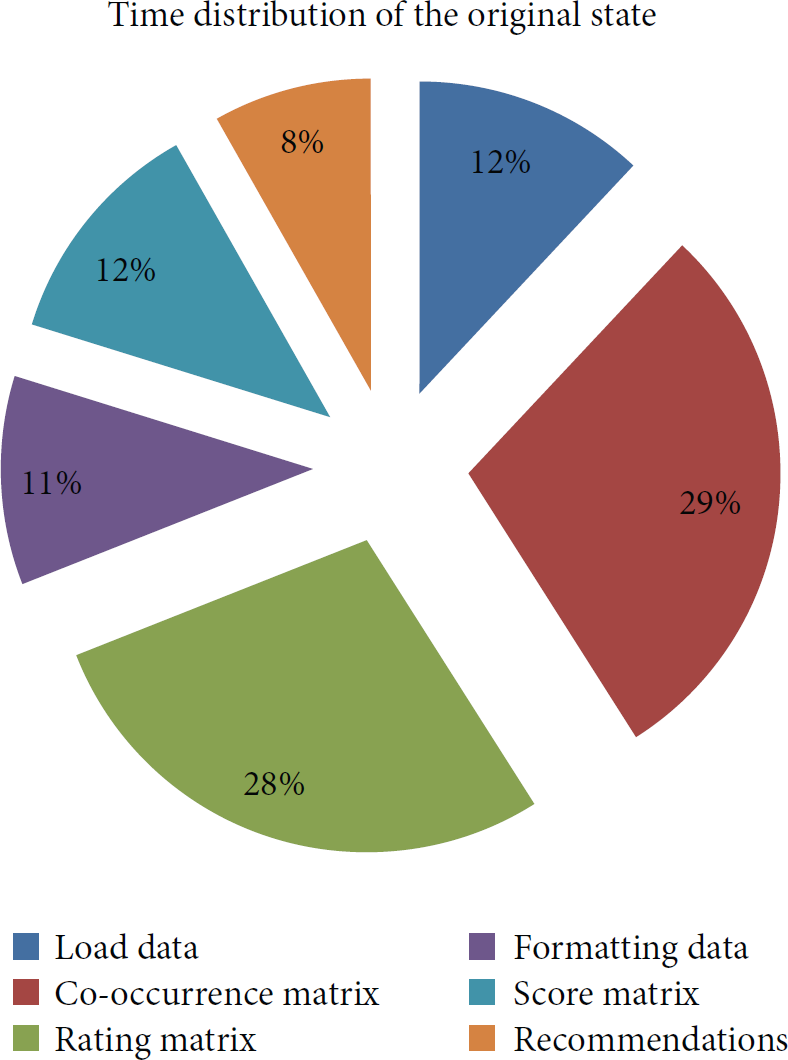
Time distribution of the original state.
Then using the improved algorithm, the design of the paralleling collaborative filtering algorithm is shown in Figure 4; we obtained the experimental data with the pie chart by the improved algorithm. The pie chart is shown in Figure 6. The design of the paralleling collaborative filtering algorithm is more significant by the big data visualization algorithm analysis integrated model.

Time distribution of the optimized condition.
5.2. Performance Analysis
In this paragraph, we show superiority of the paralleling collaborative filtering algorithm by speedup ratio. In the part of the Complexity Analysis, we refer to Amdahl's law. In order to analyze the performance, we explain Amdahl's law in some detail. The law of Amdahl is important in computer science; it defines the upper limit ratio through the acceleration calculation formula and the theoretical with parallel system from serial system.
The defined Ratio is

Amdahl's law gives a formula; the formula shows the relationship between the quantity of processor system and the parallelism of system. There are

The parameter of F indicates the proportion of serial procedures, the parameter of N indicates the number of processors. From the pie chart shown in Figures 5 and 6, we can know that the collaborative filtering algorithm has 80%+ coding which can be concurrent execution. Therefore the speedup is 4+.
We analyze the speedup ratio with three groups of experimental data. For the detailed description of experimental data, please refer to the next section of experiment results. The experimental results are shown in Figures 7, 8, and 9. Now we give a detailed description of the experimental results. The blue line represents the nodes number, while the red line represents the speedup ratio. So we can know that the speedup ratio is higher with the incremental node number.
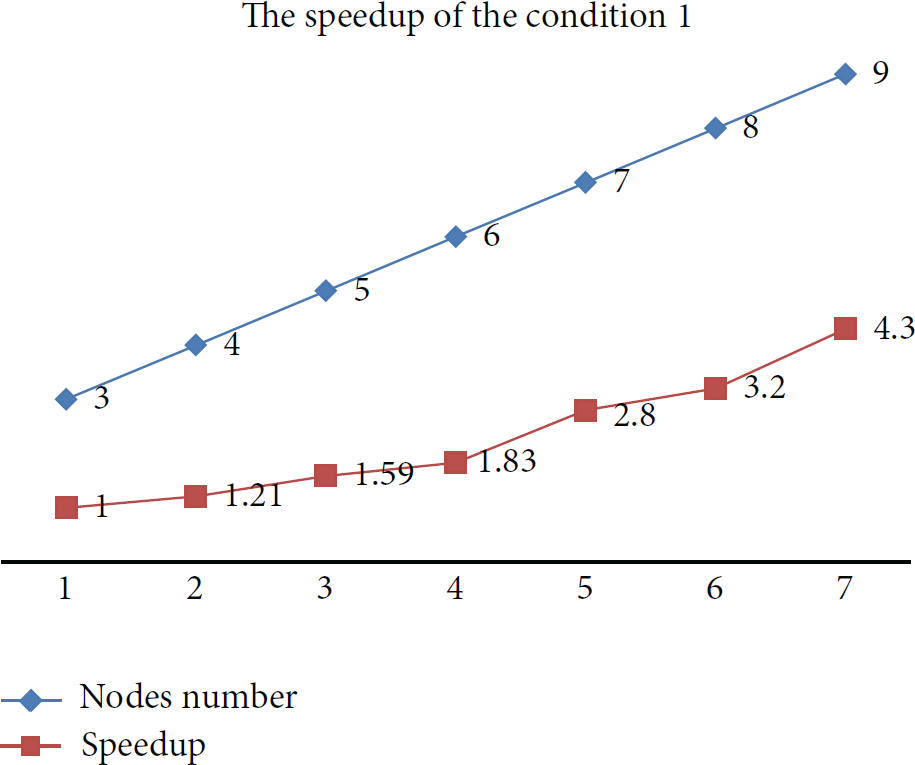
The speedup of condition 1.

The speedup of condition 2.

The speedup of condition 3.
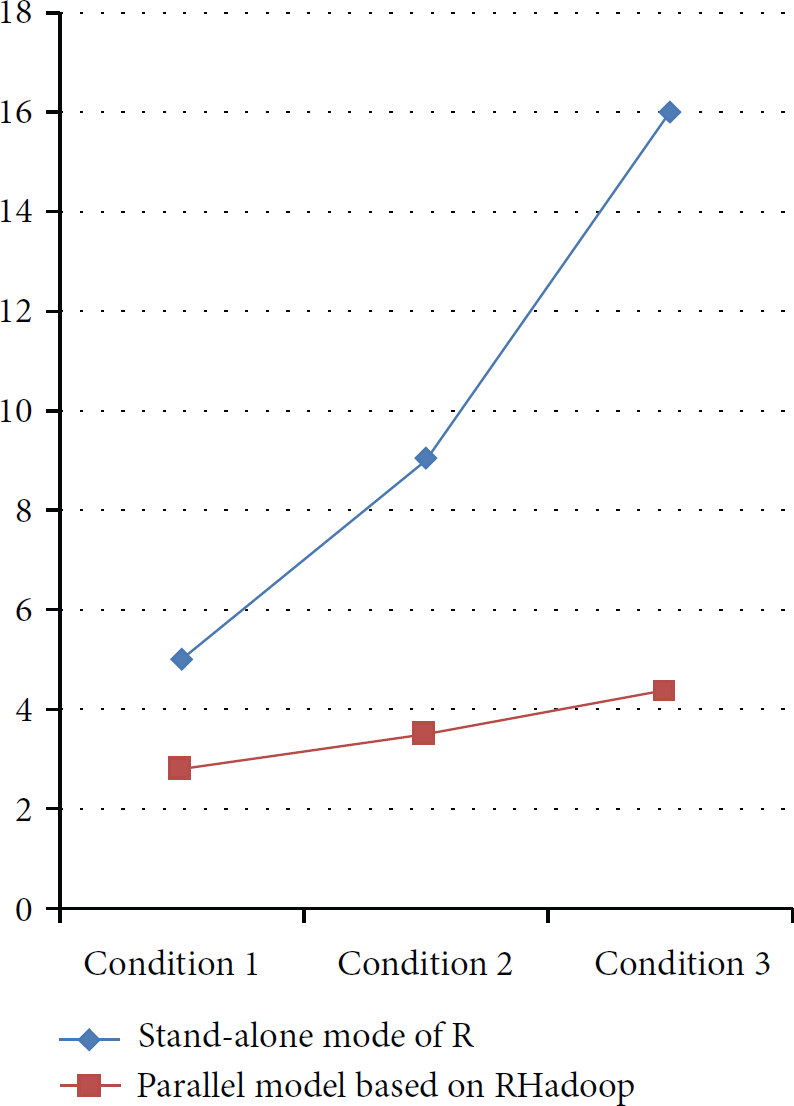
Time comparison of the Stand-alone mode and our design model.
6. Experimental Results
There are nine machines as the hardware server in our experiments. In this hardware server, the operating system platform is used with The Red Hat Enterprise Linux Server6, while Hadoop1.2.1 is our framework version as data stored [10], and the R3.0.2 is taken as the compiler environment. The data source comes from the Group Lens Research Project (http://grouplens.org/datasets/movielens/). Movie Lens data set is divided into three parts. According to the number of users, the first data files include 943 user numbers, the second data files include 6040 user numbers, and the third data files include 71567 user numbers. The experimental data information is shown in Table 1, including the user number and the film's number and the size of the file.
We analyze the complexity and performance in above section, while in this section we analyze experimental result by two aspects. Firstly, we compare the performance of using the R stand-alone mode and the advanced parallel algorithm by our big data visualization algorithm analysis integrated model mode. Secondly, we compare the performance by changing the clusters' node numbers with our big data visualization algorithm analysis integrated model mode.
Firstly, from the comparison with the performance of using the R stand-alone mode and the advanced parallel algorithm by our big data visualization algorithm analysis integrated model mode, it is shown that the big data visualization algorithm design model mode has better high ratio than R stand-alone mode. The result is shown in Figure 10. As shown in Figure 10, we use the R stand-alone mode and the advanced parallel algorithm by our big data visualization algorithm analysis integrated model mode with five data nodes to run the three kinds of experimental data. Figure 10 shows that our big data visualization algorithm analysis integrated model is far superior to the R stand-alone mode. Particularly, when the amounts of data are very large, our big data visualization algorithm analysis integrated model shows the absolute advantage.
Besides, we compare the performance by changing the clusters' node numbers with our big data visualization algorithm analysis integrated model mode. The experimental results are shown in Figure 11. As seen from Figure 10, the R stand-alone mode responses take longer time than our design model with five data nodes, because the processing speed of multinode in cluster is quicker than a single node. In Figure 10, we know that, with the increasing amount of data, the consumption of time grows exponentially with the R stand-alone mode, while the data quantity is very large and up to the TB, ZB data; the R stand-alone mode will appear bottleneck when processing these data, while using the advanced parallel algorithm by our big data visualization algorithm analysis integrated model mode with five data nodes is almost linear growth.

Time comparison of variable nodes by our algorithm model.
In order to prove this view better, this paper also alone takes the cluster data nodes as the reference to run the experimental data and record operation time. The experimental results are shown in Figure 11. In addition, we find that, with 3 data nodes processing data, the consumption of time is a bit higher. The reasons are attributed to the underlying data partitioning mechanism of Hadoop_1.2.1. In other words, a data block appears in different machines, the scheduling of this data spends some time. In a word, from Figure 11 it is shown that the cluster increased number and cluster data processing time are nearly linear function. It shows that our big data visualization algorithm analysis integrated model to process big data is of good scalability and good superiority.
7. Conclusions
This paper designs a big data visualization algorithm analysis integrated model based on RHadoop. At first, we analyze the superiority based on the software design of parallel computing model from the computer parallel theory to demonstrate the epidemic and practicability of Hadoop. Secondly we analyze the advantage of the ecological system of Hadoop and the disadvantage of R and propose the superiority of the big data visualization algorithm analysis integrated model based on RHadoop. Finally, we design and implement the paralleling collaborative filtering algorithm based on the big data visualization algorithm analysis integrated model. Because the original collaborative filtering algorithms have some shortcomings, for example, the sparse matrix and the poor scalability, while our big data visualization algorithm analysis integrated model can solve the problem well, through a lot of experiments, we verify that our big data visualization algorithm analysis integrated model is a good design. Particularly, it is good at the practical problems of the combination with big data and visualization. Certainly given the limitations of the Map Reduce calculation model, in the next step we will add up the Spark calculation model to the big data visualization algorithm analysis integrated model and conduct further research and analysis.
Footnotes
Conflict of Interests
The authors declare that there is no conflict of interests regarding the publication of this paper.
Acknowledgments
This work is supported by the national science and technology support program of China (Grant no. 2012BAH09B02) and key science and technology project of Hunan Province (Grant no. K1204006-11-1).