




Abstract
The key to realizing the crowd sensing network is to overcome the resource restrictions of energy, bandwidth, computing, and so on. First of all, due to the number of users and sensor availability will be dynamic change over time, crowd sensing system is difficult to accurately predict and allocate resource to accomplish a specific task. Secondly, there is a need to consider how to choose an effective subset from a large number of users with different sensing ability, so as to allocate the sensing devices in communication resources under the constraint conditions. This paper proposes a profit maximization algorithm for resource allocation component in crowd sensing environment. The proposed algorithm not only considers the current profit of crowd sensing service request but also considers the long-term expected profits, so as to ensure long-term maximum profit. The objective function is no longer to minimize the completion time but rather to achieve the target profit maximization. The experimental results show that the new algorithm is feasible and superior to the traditional algorithms.
1. Introduction
Crowd sensing is using all kinds of equipment and location technology to statistic and depth analysis the group positions and behavior patterns and then obtain the behavior patterns, organization structure, and dynamical evolution process. It provides support for all kinds of intelligence sensing service in mobile, dynamic, and heterogeneous environments.
The Internet of Things has entered the stage of development; the demand for physical environment thorough sensing becomes more and more strong. In the meanwhile, with the progress of wireless communication and sensor technology, mobile terminal such as smartphones, tablets, wearable devices, and automotive sensing devices integrates more and more sensors and has more and more powerful computing, sensing, storage, and communication ability. With the explosive popularity of the wireless mobile terminal equipment, the Internet of Things will be using the universal mobile devices to provide a larger, more complex, thorough, and comprehensive sensing service. Thus it has already entered a new era of development [1].
In crowd sensing environment, how to effectively allocate the crowd sensing resources is an issue for determining the performance and efficiency of the whole system because the geographical location of the resources is widely distributed, belonging to different autonomous systems and often heterogeneous, dynamic resources. Thus, with the growing popularity of crowd sensing technology, effective resource allocation models and algorithms will be the key to efficient use of these resources. Since crowd sensing technology is moving from theory to practice, so allocation model of economic utility is more meaningful [2].
Crowd sensing resource allocation algorithm inherits the spirit from grid computing, which began in 1960s, that is, multiprocessor parallel unit allocation research. Its mathematical model is an integer programming problem, taking the shortest task makespan as allocation goal, using heuristic algorithm to solve the suboptimal solution. With the popularization of grid computing and crowd sensing, resource allocation algorithm is increasingly considering the economic profit, adding economic metrics, such as price of the unit and the latest completion time in the model. However, whether or not the parameters of economic profit are contained, the solution of allocation model is the 0-1 variable matrix: if the job J is allocated to the unit p,
The resources allocated to crowd sensing users are not exclusive to one or more physical unit because of virtualization technology widely used in crowd sensing environment. With the Amazon EC2 platform as an example, the user can pay to buy “one” computing server for several hours to use. In fact, users are not always exclusively using a real physical unit, and there may be one or multiple physical units to provide a virtual unit resource services. The virtualization technology is an important driving force to promote the development of crowd sensing. A single physical machine can be instantiated multiple virtual machines, while the remaining computing resources of multiple physical machines can also be turned into a virtual machine. With the continuous development of virtualization technology, it can be expected that computing resources virtualization consumption will be reduced. From convenient management and safety point of view, the virtual unit will be widely used by crowd sensing service provider.
Thus, crowd sensing resource allocation may not use integer programming model but allocate the computing resources according to the proportion to realize the optimization, and provide these optimized resources to users through virtual technology to provide these resources to the crowd sensing users. This paper presents a crowd sensing resource allocation profit maximization algorithm, describes the resource optimization problem of crowd censing, and analyses the theoretical significance of the model from the point of view of economics. Finally the authors present the experiment data and analyse the algorithm performance.
2. Related Works
The essence mathematical model of basic allocation research on multiprocessor and parallel units is integer programming problems: allocation objective is the task completion time as short as possible and the objective function is the minimum makespan. This kind of integer programming model almost uses heuristic algorithm to find suboptimal solutions: such as Min-Min, Max-Min, sufferage, and xsufferage classic algorithms [2]. With the rapid development of modern optimization algorithms, such as Tabu search, simulated annealing, genetic algorithm/evolutionary algorithm, ant colony optimization algorithm, artificial neural networks algorithm and so on, are also used by advanced distributed computing platform, but it is necessary to improve those algorithms to overcome the existing deficiencies.
Subsequently, there are also some economic profit models added to the economic parameters, such as unit price, operation budget, deadline, and other parameters [3]. This kind of model adds more constraints on the basis of parallel unit allocation model and puts forward higher requirements for the solution algorithm. The solution is still using mostly genetic algorithm and its derivative algorithm.
The above model studied is off-line scheduling problem, which is aware of all job information in advance, and the processing time for certain jobs on certain units needs to be estimated. The method is as follows: to estimate the number of unit instructions that are included in the job [4], according to different computing nodes performance dealing with million instructions per second to estimate the processing time of the work required in the node. Before all jobs entering the sorting system, they need a preprocessing step to estimate the processing time. Another useful research can be seen in [5, 6], and it uses rough set theory to estimate the application execution time, especially suitable for crowd sensing environment.
However, this kind of scheduling models has the following problems: first, the target solution is defined as 0-1 variable, and its essence is the linear integer programming problem. From the theory perspective, linear integer programming problem can be transformed into a linear programming problem, but from computational perspective to achieve the transformation is quite difficult. Secondly, the model almost uses the heuristic algorithm to search the local optimal solution. According to the different input conditions, the convergence rate of the algorithm may be different. It is difficult to guarantee the allocation efficiency.
With the increasing popularity of crowd sensing especially the development of virtualization technology, computing resource allocation is no longer limited to whether one job assigned to a single physical unit. From the profit maximization perspective, crowd sensing environment allocates the overall computational resource. Some computing resources allocated to a job may be surplus resources coming from multiple physical units. Although the physical unit parallel processing will produce more additional overhead, it makes the computing resources management more effective.
In summary, resource allocation problem is equivalent to the virtual unit placement; how to allocate the virtual unit to physical nodes becomes the key factor influencing crowd sensing performance [2, 7–9].
A few applications based on profit maximization can be seen in [10]. The paper [11] presents a method to help content provider distribute the service, but it does not belong to the resource allocation problems. The paper [12] proposed a resource management method whose goal is to make the profit maximization in the model, but eventually the problem is still NP hard. This paper proposes a profit maximization algorithm for crowd censing resource allocation. Compared with the traditional algorithm, the objective function is no longer to minimize completion time but rather to achieve the target profit maximization.
3. Architecture for Resource Allocation Based on Profit Maximization
Based on Xen virtualization technology, this paper constructs crowd sensing resource management platform which can provide virtual unit resources on demand. The platform takes into account two elements: one is virtual unit cost and the other is resource reconfiguration transformation operation cost. Figure 1 shows the architecture, including web application performance model, web application performance attenuation model, and virtual unit price model and resource adjustment engine. Web application performance model establishes the mapping relationship between web application load and response time. It is the foundation for determining whether web application of QoS constraints is satisfied or not. Web application performance attenuation model establishes the mapping relationship between the resource reconfiguration operation under some load and web application performance changes. It is one of the key elements of computing resource reconfiguration operation of transformation costs. Virtual unit price model describes the mapping relationship between rent price and configuration of the virtual unit. It is the basis for calculating resource cost of virtual unit to be supplied. Resource adjustment engine is the key module to realize profit maximization for resource allocation on demand.

Architecture for crowd sensing resource allocation.
3.1. Web Application Performance Modeling Based on Queuing Theory
Web application performance modeling uses the method [13] based on session description. A session is a collection of multiple transactions; for example, TPC-W contains 14 basic transaction types [14].
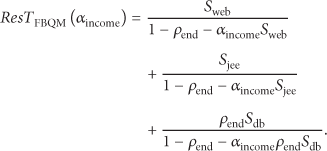
Some literature works present the queuing network performance models based on simple feedback circuits; this paper called FBQM model, in which Web application transaction request arrival rate

According to Ritter's law, system resource utilization is

3.2. Off-Line Test Based Web Application Performance Attenuation Model
This paper constructs web applications performance degradation table by off-line test method. This method consists of web application component Component, virtual unit resource type Type, and classic workload Workload, respectively, executing resource reconfiguration operations Operation, where
During the experiment, we performed the following operations: increasing VM resource capacity, reducing VM resource capacity, increasing new VM instance, removing the VM instance and VM live migration, recording the response time
Live migration operation performance degradation.

In the process of actual operation, we take the combination conditions of web application component Component, virtual unit resources Type, the current workload Workload, and resource reconfiguration operation Operation as input and calculate the response time of resource reconfiguration operation Operation of current web application according to the record values which searched the most similar workload value 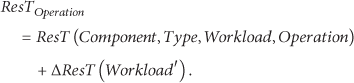
4. Algorithm Based on Profit Maximization
As shown in Figure 1, resource allocation engine consists of 4 components: load monitoring, load forecasting, planning adjustment, and resource capacity adjustment. The load monitoring component selects the tool with the properties of crossing platform, high performance, and scalability. The load prediction component selects the open source software based on statistical methods. Capacity planning component is the core of resource adjustment engine and the decision maker of resource reallocation. Resource adjustment component is the specific performer for resources reconfiguration.
By the above analysis, the best option for resource reconfiguration is when the benefit/cost maximization constraint is satisfied. Because the cost is related to resource reconfiguration of transformation period and stable period and the profit is related to resource reconfiguration of stable period, this section first presents calculation method for resource reconfiguration whole period, transformation period, and stable period, then describes the construction method for profit function and cost function, and finally presents the nonlinear algorithm for maximization the profit/cost.
4.1. Calculation for Resource Reconfiguration Total Period, Transformation Period, and Stable Period
4.1.1. Prediction for Resource Reconfiguration Total Period
Resource reconfiguration of the whole period refers to the web application WebApp being detected in the load
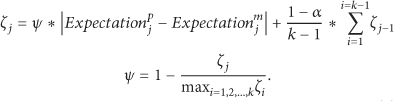
Web applications with 
4.1.2. Calculation for Transformation Period
According to the [17] and the above analysis on VM reconfiguration, we present the calculation formula for transformation period as follows:
4.1.3. Calculation for Stable Period
Based on the relationship of resource reconfiguration total period, transformation period, and stable period, the calculation for stable period of web application will be represented as follows:
4.2. Profit Function
Profit function is used to describe the satisfaction degree with QoS constraints under new configuration in the stable period, so as to effectively prevent application from frequent violating QoS constraint in mutation load. This paper describes the profit as
In [12], the user's satisfaction is proportional to the load. The greater the load is, the higher the user satisfaction for the current web application performance is guaranteed. This paper takes the mathematics expectation for resource reconfiguration of total period as a target to construct piecewise satisfaction function: b represents the satisfaction degree factor constant, m represents the change trend of satisfaction degree,
4.3. Cost Function
According to the above analysis, resource reconfiguration cost
4.3.1. Transformation Period Cost
The transformation period is the operation completion time of resource reconfiguration. The guarantee for the process of the web application of QoS is uncertain, and the transformation cost of resource reconfiguration operation is the main cause of uncertainty. Therefore, K is specified by users and is used to describe the change trend for penalty factor. This paper sets C represents penalty factor constant. As an extreme case of resource reconfiguration allocation, 
4.3.2. Stable Period Cost
Stable period refers to the virtual unit resource for web application service and the period for satisfaction of the QoS constraints. So the
4.4. Planning Algorithm
The programming process is to select the optimal combination of QoS guarantee and resource to satisfy the goal of cost minimization of the virtual unit configuration and resource reconfiguration operation. According to the principle of reduction, the optimal combination is established when formula
We propose the programming algorithm based on profit maximization as shown in Algorithm 1, where stable period expectation function minimal price function represents the minimal resource cost and maximum price function represents the maximum resource cost; minimal cost function represents the transformation cost and maximum cost function represents the maximum transformation cost.
Input: Operation Set; VM Configuration Set; QoS; VM Configuration Price; wrokload; Expectation (Time). Output: Operation: Operation ∈ Operation Set; VM: VM ∈ VM Configuration Set. (1) Estimation workload (2) IF Workload > Workload + b //estimation whole cycle is bigger than Expectation (Time) (3) IF (4) Virtual Unit = Minimal Price (Virtual Unit Configuration Set); (5) Operation = Minimal Cost (Virtual Unit, Operation Set); (6) ENDIF (7) ELSE //Estimation whole cycle is shorter than Expectation (Time) (8) Maximum = 0; (9) FOR (10) If (Revenue − Cost)/Cost > Maximum (11) Virtual Unit = Choose (Virtual Unit); (12) Operation = Choose (Operation); Maximum = (Profit − Cost)/Cost; (13) ENDIF (14) ENDFOR (15) ENDIF (16) ENDIF (17) ELSE IF Workload < Workload − b //Estimation whole cycle is bigger than Expectation (Time) (18) IF (19) Virtual Unit = Maximum Price (Virtual Unit Configuration Set); (20) Operation = Maximum Cost (Virtual Unit, Operation Set); (21) ENDIF (22) ELSE //Estimation whole cycle is less than Expectation (Time) (23) Operation = Minimum Cost (Operation Set); (24) Virtual Unit = Maximum Price (Operation, Virtual Unit Configuration Set); (25) ENDIF (26) ENDIF (27) ELSE (28) Waiting for whole cycle timeout and go to Line (2); (29) ENDELSE
The profit function value is the maximum when the predicted stable period
When the predicted stable period is less than the mathematics expectation value of users resource reconfiguration, the process of resource reconfiguration is shown as line 7–15 in Algorithm 1. For example, the current stable period is
5. Evaluation for Algorithm Performance
In this section, we use the MATLAB programming event simulator to simulate and evaluate the proposed resource allocation algorithm for crowd sensing based on profit maximization. In this experiment, we divided 3 quality of service (QoS) levels, respectively, corresponding to the number of VM crowd sensing resources allocated, namely,
In order to further validate the proposed resource allocation algorithm for crowd sensing based on profit maximization, we compared the profit rate and blocking rate of the proposed algorithm with greedy algorithm. As long as there are enough crowd sensing resources, resource allocation algorithm based on greedy algorithm is always set to allocate the biggest crowd sensing resources to its request so as to obtain higher efficiency gains of the system.
Figure 2 compares the difference between profit rate maximization algorithm and greedy algorithm. From the figure we may see that, along with the increase of crowd sensing service request arrival rate, the system effectiveness income also increases along with it, and the algorithm we proposed is superior to the performance of the greedy algorithm. This is because of the fact that, when a crowd sensing service requests the crowd sensing resource, the greedy algorithm is always set to allocate the biggest resource to the request. Therefore, there exists such risk: when a crowd sensing service requests crowd sensing resource, because of crowd sensing resources shortage, greedy allocation algorithm can only refuse the next crowd sensing service request. The proposed algorithm in this paper, for a new request, takes into account not only the current benefit by the current request but also the long-term whole system of expected profit.

System profit.
As shown in Figure 3, with the increase of crowd sensing service request arrival rate, blocking rate of greedy allocation algorithm for crowd sensing service request is also increased rapidly. At the same time, the blocking rate of benefit maximization algorithm increases relatively slow. Therefore, the result of experiments shows that the performance of profit maximization algorithm for crowd sensing resource algorithm is far better than greedy allocation algorithm.

Blocking probability for request rate.
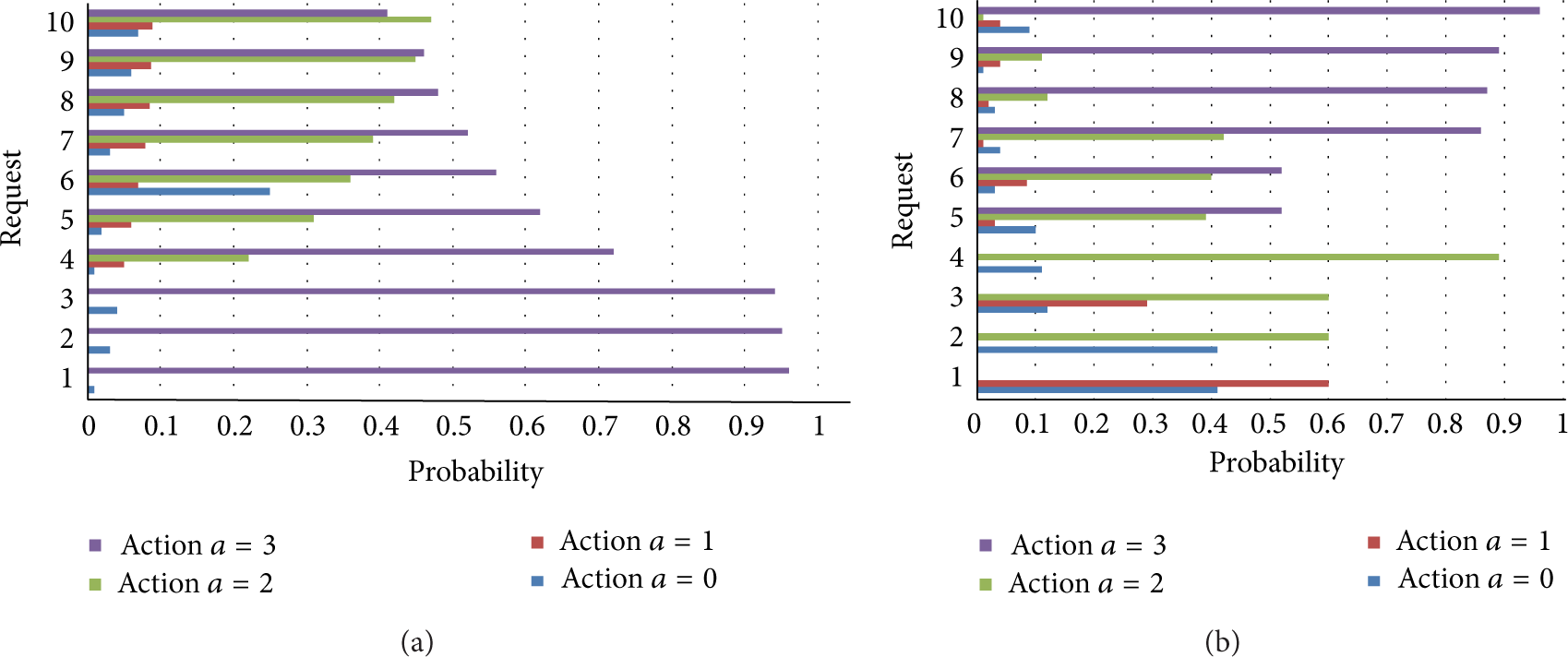
When a crowd sensing service request arrival rate is low, there are more available crowd sensing resources that can be reserved. In this case, the probability of the crowd sensing service domain receiving a new crowd sensing service request will be higher. For example, when a crowd sensing service request arrival rate is 3, the probability of allocating
Since the benefit maximization algorithm proposed in this paper needs to consider the long-term profit of the whole system, the new crowd sensing service requesting crowd sensing resources will be more cautious. As shown in Figure 4(a), with the increasing of crowd sensing service request, the probability of the new crowd sensing service requests being adopted (decision
The probability of crowd sensing request that has been adopted.
6. Conclusions
The crowd sensing resource allocation algorithm based on profit maximization is proposed in this paper. Different from the traditional method, this paper uses the thinking of network profit maximization and realizes physical crowd sensing resource allocation in the higher lever: the algorithm takes the maximum profit as the allocation objective. One or more physical resources are allocated to one or more crowd sensing jobs. Our solution not only considers the current profit of crowd sensing service request but also considers the long-term expected profits, so as to ensure long-term maximum profit. We conduct experiments to validate our hypotheses; experimental results show that this algorithm performance is better than other traditional methods.
The future works will explore the impact of different utility functions on the virtual unit resource allocation efficiency. The crowd sensing resources from the simple measurement is extended to multiple resources common constraints; that is, the description for crowd sensing resource will be developed from one-dimensional to multidimensional description.
Footnotes
Conflict of Interests
The authors declare that there is no conflict of interests regarding the publication of this paper.
Acknowledgments
This work was supported (in part) by Shanghai Science and Technology Development Funds (13dz2260200, 13511504300), Projects in Science and Technique of Ningbo Municipal (2012B82003), and Key Research Center of Philosophy and Social Science of Zhejiang Province-Modern Port Service Industry and Creative Culture Research Center.