




Abstract
Data aggregation is an important method of improving transmitting efficiency of WSNs, but existing researches have some disadvantages as follows: several periods delay will be generated when filtering messages; the reduplicated messages filtering ratio is low; complex calculations need to be executed; and extra hardware should be added to obtain high performance. To resolve these problems, this paper proposes a real time and high efficient data aggregation scheme (dynamical message list based data aggregation, DMLDA) based on clustering routing algorithm. DMLDA includes three procedures: activating nodes, clustering nodes, and filtering messages. In filtering procedure, a special data structure named dynamic list will be established in every filtering node; it is designed to store messages transmitted by filtering node, and, comparing current message with list's items, the message's redundancy can be judged without any delay. To improve the filtering efficiency, the message list can be adjusted dynamically. The three procedures of data aggregation are all introduced, and the filtering method is designed in detail in this paper. At last, a series of experiments are simulated to prove our scheme's performance, and the advantages are analyzed in theory.
1. Introduction
WSNs (wireless sensor networks) are a new technology used to collect information from harsh environment; it is developing very rapidly and now it is one of the most important fields of information science. In WSNs, there are one or several sink nodes and a lot of sensor nodes. Sink node has limitless energy and powerful calculation capability, while sensor node has limited energy and poor calculation capability [1–5]. For the hardware restrict of sensor node, how to use limited resource to transmit more useful messages is the most important specification [6]. But, as the distributed and self-organized structure of WSNs, the transmitting efficiency is much lower than classical networks. Therefore many methods have been proposed to improve the transmitting efficiency of WSNs. Among these methods, data aggregation is one of the most important ones by reducing invalid message transmitting. There exist many data aggregation algorithms, but these algorithms have many disadvantages: real time is poor; the efficiency of filtering is not high; the burden of extra hardware is too large, and so forth. In this paper, a new high efficient and real time data aggregation scheme is proposed to resolve existing problems, and this scheme includes three main steps: activating all sensor nodes by ladder diffusion, which is proposed in our previous research in [7]; clustering all nodes based on semistatic HAC method, which is proposed in our previous research in [8]; and filtering reduplicated messages using dynamical list, which is the key of this paper. The rest of this paper is organized as follows: in Section 2, we analyze the performance standards and introduce some of the main existing research works; in Section 3, we introduce the design of three steps of DMLDA in detail; in Section 4, we prove and analyze the performance of DMLDA in theory and by simulated experiments; in Section 5, the innovations and advantages of this paper are concluded.
2. Related Works
2.1. The Key Problems of Designing Data Aggregation Schemes for WSNs
Nowadays, WSNs have been widely used in battlefield surveillance, industrial production detection, and environmental monitoring, and, in these applications, information has strong timeliness, so the transmission delay should be as little as possible. In WSNs, delay occurs mainly in data aggregation when messages are waiting to be judged their repetitiveness and whether to be filtered, so how to reduce delay in data aggregation is one of the most important problems in designing scheme, and real time filtering procedure is the key performance of data aggregation.
Meanwhile, according to the structure of WSNs, when designing data aggregation scheme, the extra burden both in hardware and in software should also be taken into account for sensor nodes’ limited memory and poor capability of computing. Therefore the scheme should be operated by as less calculation as possible and should not need much storage space without causing degradation in performance of filtering.
In data aggregation, the distribution of filtering nodes is also an important problem, and it will very much affect the performance of data aggregation. In WSNs, the filtering nodes must be held by sensor nodes; however all sensor nodes are randomly deployed in sensing area and each sensor node cannot obtain global information of WSNs. Therefore, how to optimally distribute filtering nodes without global information is a basic problem to be resolved in designing data aggregation scheme.
Besides, on the demands of real time transmission, little extra burden, and distributed structure, some quantitative standards should be considered when designing data aggregation scheme. The key function of data aggregation is to filter reduplicated messages to reduce the invalid transmitting, so one of the most important standards of judging the performance of data aggregation is the efficiency of filtering, which includes two parameters as the accuracy of filtering and omission rate of reduplicated messages:

The accuracy of filtering is defined in (1), as the ratio of the number of real reduplicated messages (

The omission rate is defined in (2), as the ratio of the number of messages which should be filtered but is wrongly transmitted (
2.2. Existing Researches
For the broad application prospect of WSNs, many researchers have focused on data aggregation, and a lot of schemes have been proposed. These researches can be divided into two types: one is operated in data link layer and based on MAC protocol; the other is operated in network layer and based on routing protocol. The schemes based on routing protocol have these advantages: it can be dynamically adjusted according to routing states; it is easy to be deployed than the one based on MAC protocol [6]; it is fit for more application situations and has less restriction for WSNs structure. Most of new proposed researches are based on routing protocol, and these schemes will be, respectively, introduced according to their routing methods and policy of filtering messages in this section.
The efficiency of data aggregation schemes operated in network layer is much influenced by their routing method. The routing method can be divided into three types: data-centric, tree-based, and clustering-based. In data-centric routing, messages are transmitted by flooding mode, and the reduplicated messages are filtered by some special nodes that will be chosen to act as filtering by sink node according to WSNs global distribution [9, 10]. Although this scheme is simple to be designed and has high self-organization ability and robustness, it has two serious defects: too many reduplicated messages will be generated in WSNs which will influence the efficiency of routing; and the distribution of filtering nodes violates the principle of distributed characteristic of WSNs. In tree-based routing, a spanning tree will be generated from source nodes to sink node, and the message will be transmitted toward this tree from leaf nodes to root node. In the spanning tree, some special nodes will be chosen as filtering nodes. The key of this scheme is to efficiently establish the spanning tree [11, 12]. Typical researches like Steiner minimum tree (SMT) that sensor nodes’ residual energy will be considered and the nodes with more energy will have larger probability to be chosen as filtering nodes and in PEDAP that the filtering nodes are all set on parent nodes of spanning tree [13], which is easy to be applied but needs more filtering nodes than necessary. In general, the filtering efficiency of tree-based routing can be improved by optimizing the distribution of filtering nodes, but this type of method has the defects those the procedure of routing is not flexible for the single transmitting direct through the spanning tree, and the calculation of establishing spanning tree is too complicated for WSNs.
Clustering-based routing is one of the most popular methods in WSNs. In this routing, all sensor nodes will be divided to a certain number of clusters by special rule, and in every cluster one node will be elected to act as cluster head. The cluster head is responsible for collecting messages from other nodes in its cluster and forwarding these messages to sink node. After several rounds transmitting, cluster head will be rotated to other nodes. The advantages of this kind of routing are that the task distribution among different sensor nodes is more balanced, and the method has strong robustness. But this routing is relatively complex in that it is hard to design, and its efficiency is influenced by clustering method. Now there are some researches focusing on combining filtering function with clustering routing procedure such as LEACH [14], LEACH-C [15], and HEED [16]. In these schemes, cluster heads are always chosen to act as filtering nodes, so how to select cluster head and rotate it is the key factor of affecting filtering efficiency. But, in existing schemes, the picking and rotation of cluster head are all designed based on simple probability, which leads that the distribution of filtering nodes is not optimal and cannot be adjusted according to transmission of WSNs.
Besides the restrictions mentioned above, existing schemes have defect in the work mode of filtering messages. These schemes adopt the method of transmission delaying: when filtering nodes receive a new message, it will delay several periods to find whether subsequent messages are reduplicated with current one and then to judge to transmit this message or abandon it. To improve the filtering ratio and reduce the hardware burden, the delaying policies are developed from simple static delaying periods to dynamical delaying periods which are adjusted according to WSNs transmission [17–19]. The advantages of transmission delaying include that it takes a little hardware burden; the calculation of filtering is simple; and the filtering ratio is relatively high based on long delay. But this method has two defects that the real time performance of data aggregation is decreasing and that the dynamical adjustment of delaying period is hardly obtained optimal result for the distributed structure of WSNs.
Based on analysis of existing researches, although many data aggregation schemes have be proposed, the demands of real time transmission, little extra burden, distributed structure, and high filtering efficiency are not well satisfied. How to improve real time, reduce the computational complexity of distributed structure, and make it more efficient is the emphasis of designing data aggregation scheme.
3. Detail of Design
According to the former analysis, we will propose a new clustering-based and real time data aggregation scheme named DMLDA in detail in this section. In this scheme, a special data structure named dynamical list is deployed in every filtering node to store history messages before transmission, and we use the message list replacing the periods delaying method to filter reduplicated messages which highly improves real time performance. The length of this list will be initially set according to the hops from filtering node to sink node, and, with transmission running, it will be adjusted by filtering state. In this scheme, there are three parts functions being implemented: first is to activate all sensor nodes; second is to cluster all sensor nodes including of choosing cluster heads and rotating them; third is to design the method of filtering reduplicated messages. To achieve these functions, the process of DMLDA is divided to three steps: in the first step a ladder diffusion method is designed to activate all nodes and at the same time the adjacent relationship of every node will be established; in the second step a semistatic hierarchical routing algorithm based on HAC is designed to organize the routing of WSNs, and the energy consumption in all nodes can be balanced by this routing algorithm; in the third step filtering node will be deployed in every cluster head, and the content and length of message list in filtering node will be dynamically adjusted. We will introduce the detail design in the following section.
3.1. The Activation of All Sensor Nodes
After WSNs deployment, all sensor nodes should be activated to obtain the location of sink node and discover its neighbor nodes, and, in DMLDA, this step should also achieve the function of computing the hops number from every node to sink node to help establish message list. To obtain these targets, a special packet head is designed as Table 1, and the activating packet will be transmitted by the method of ladder direct diffusion. At the same time, a list storing all neighbor nodes will be created in every node when it receives activating packet, and the list's structure is designed as Table 2. The content activating packet's head and neighbor nodes’ list will be updated when transmission is running.
The definition of packet head.

The structure of neighbor node list.

The first step is that the sink node creates and broadcasts some activated packets and sets these packets’ grade value to 1. If a node receives the packet, it will set its grade value to 1 and add sink node to its neighbor node list. Then the current node will update the activated packet with its location and energy information, set the grade value of itself as 1, and update the packet's value as 2. The procedure is shown as Figure 1.

First step to activating WSNs.
In the second step, activated nodes will broadcast the new packet along the reverse direct of source node. When a node receives an activating packet, it will extract the grade value from packet head and compare the value with itself. If the packet value is larger, it will be abandoned; otherwise, the node's grade value will be updated by packet value. While comparing the grade value, the neighbor nodes list will also be updated: the list will be browsed to judge the source node whether it is in the list. If the node is not in list, the source node will be added to list and create a confirming packet with current node's information and send it to source node; otherwise, no operation will be executed.
When a node is receiving a confirming packet, it will browse its neighbor node list and judge how to deal with this packet. If the source node has been in list, no operation will be executed and the packet will be abandoned; otherwise the source node will be added to the list and create a confirming packet with current node's information and return it to source node.
While updating the nodes’ information, a new activating packet will be generated with current node's information. And then this packet will be sent to next hop nodes. This operation will be executed until all nodes in WSNs have been activated, and the hops to sink node are all stored in each node, and all neighbor nodes have been found too. The procedure of this step is shown in Figures 2 and 3.

The second step of activating WSNs.

The last step of activating WSNs.
3.2. The Clustering of All Sensor Nodes
Based on the result of step 1, all sensor nodes are clustered by a semistatic HAC method according to their location and residual energy. Besides basic efficient routing function, there are four main targets that should be achieved in this step: nodes should be efficiently clustered; the cluster head should be reasonably elected; all cluster heads should be dynamically rotated; and the distribution of clusters should be adjusted according to nodes’ state. In this step, a special data structure named LNC (list of nodes in cluster) has been defined in Table 3, and LNC is created and maintained by cluster head and it stores the information of member nodes.
The structure of LNC.
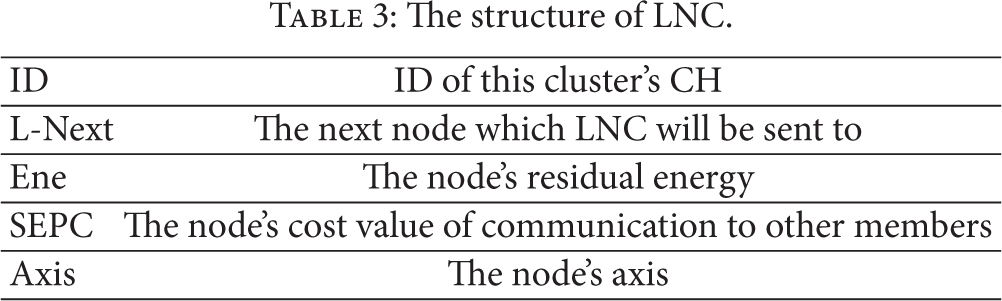
In this clustering step, the distance of each pair of nodes can be calculated by (3) and the SEPC (the summary of every pair of nodes in cluster) of node i is calculated by (4). And, in HAC, smaller clusters will be merged to be a larger one, and the standard of merging is the distance of each pair of clusters which could be calculated by


In (3), E is the initial energy of sensor nodes and
Based on these formulas and data structures, all sensor nodes can be clustered according to nodes’ residual energy, and cluster head will be dynamically rotated. The detail of clustering and cluster head rotation procedure is proposed in our previous researches, and the illustration of clustering is shown in Figures 4–6, in which nodes’ residual energy has little difference.

The first step of clustering.

The result of one round of merging.

The final result of clustering.
To better illustrate the procedure of clustering-based routing algorithm, a simple WSNs model is defined with 9 sensor nodes randomly distributed in sensing area. In the first step of clustering, each node forms a cluster, acting as the cluster head. A LNC will be created in every node. The result is shown in Figure 4.
In Figure 5, the clusters with least distance will be merged according to the distance calculated by (5), and LNC of each smaller cluster will be combined, and the nodes’ order in LNC will be sequenced by the value of SEPC which is computed by (4). Repeat this operation until all distance of clusters has been larger than the threshold defined according to WSNs scale.
In Figure 6, the first round of clustering procedure is finished and WSNs will come into sensing and transmitting phase. After several rounds transmitting, the energy consumption of cluster head will be much larger than their member nodes, and then the rotating procedure will execute with the order in LNC. After some rounds of rotating, the difference of nodes’ residual energy is larger and just rotating cluster head cannot balance this difference, so a reclustering operation will be executed, and the result is shown in Figure 7. Comparing the result of Figure 6 with Figure 7, it can be concluded that the clusters’ distribution can be dynamically adjusted according to nodes’ residual energy, so the routing algorithm can improve the energy efficiency of WSNs.
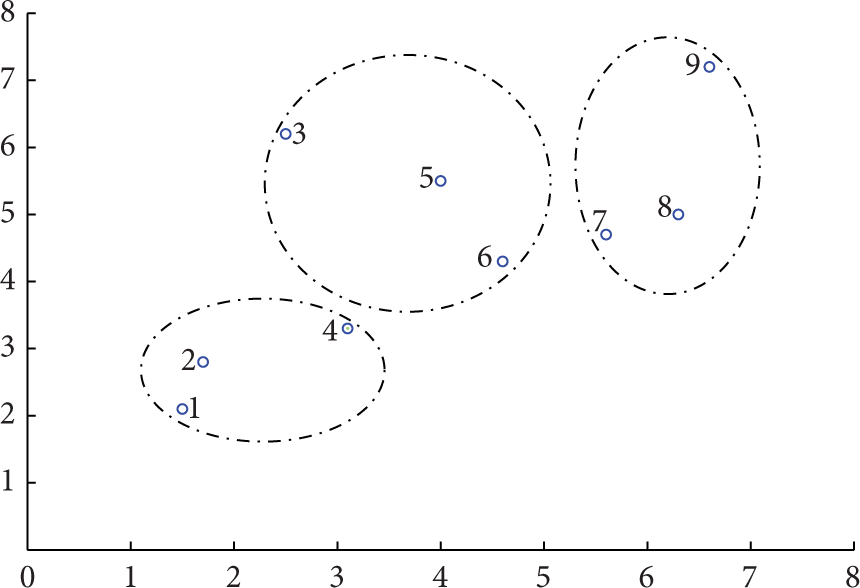
The result of clustering with different nodes’ energy.
3.3. The Design of Filtering Method
After last two steps, all nodes have been activated with the information of location and hops from itself to sink node, and clustering-based routing structure has been established. In this step, filtering method will be designed in detail. To improve real time performance of filtering, a message list is designed as Table 4 which is created and maintained by each filtering node, and the content and length of this list will be dynamically updated according to transmitting state of filtering node.
The structure of list.

The first operation in this step is to choose filtering node and create message list in every filtering node. In clustering-based routing, cluster heads will collect messages from their member nodes and sometimes they will also relay other clusters’ messages, so cluster heads have obvious advantage to act as filtering nodes. Because cluster heads are randomly distributed in sensing area, and transmitting burden of different cluster heads will be much different, the nodes nearer to sink node should not only collect the messages from their member, but also undertake more tasks of relaying messages from outer nodes. In DMLDA, the hops number from each node to sink node has been obtained in activating phase that we set as the parameter grade value, and the length of message list could be set according to this value: the list length is shorter when hops number is larger, which means the nodes faraway from sink node should store less messages than nodes near sink node. The process of this operation is as follows: firstly, the largest grade value of all nodes
(1) HLevel = 0; //the current maximum level is set as 0. (2) Browse All Clusters to; (3) (4) If (5) (6) end browse (7) Browse All CHs again; (8) (9) //calculation of current head node's level (10) end browse; //all head nodes’ level has been initialed. (11) Browse All Clusters; //Begin to establish the dynamic list (12) new (13) //the list's initial length is set according to its current level (14) for (15) //set the current list item as null; (16) (17) (18) //Set the current item's threshold of updated as 0; (19) //Establish the list’ link; (20) end for (21) end browse //All filtering nodes’ lists have been initialized; (22) if CH is being rotated (23) new //The current cluster's head has been changed to (24) (25) release (26) end if (27) if Clusters are being re-calculated (28) Filter nodes’ configuration (29) Setup List; (30) end if //When all nodes have been re-clustered, the List will be re-initialized; (31) End
In this procedure,
The second operation is filtering and transmitting message. When all filtering nodes have been set and all message lists have been initialized, WSNs will come into the sensing and transmitting phase. When a filtering node receives a message
(1) a filter node (2) browse (3) (4) if (5) Throw up this message (6) //Prolong this message's storing time; (7) end if (8) (9) if not exist any (10) For all item of (11) flag = flag − lifetime; //Reduce the threshold to help update list; (12) all content lifetime + 1; (13) change //Relay this message (14) browse (15) find the info with minimum flag (16) //Update list corresponding item (17) (18) (19) end if in line (9) (20) end
In this procedure, if current item of
The third operation in this step is to dynamically update the length of message list. To achieve this function, two thresholds are defined: one is judging whether to reduce the length of list, and the other is judging whether to prolong the length of list, and the detail operation is shown in Procedure 3.
(1) a filter node (2) browse (3) for every item in list (4) if //Means this item should been deleted; (5) length = length − 1; (6) (7) else if all //Means all items’ content was often updated; (8) length = length + 1; (9) new list (10) (11) (12) (13) (14) end browse (15) end
In this procedure, the
4. The Result of Experiments
In order to prove the performance of DMLDA, a series of experiments are designed and analyzed in this section, and these experiments are simulated by NS2. Some parameters of WSNs are listed in Table 5, and the sensing area is 1000∗1000 m2. Messages are generated in the sensor nodes, which are distributed at random locations in the sensing area. In our experiments, we compare the proposed algorithm, that is, DMLDA, with a typical data scheme using delay transmitting mode based on LEACH routing. Moreover, theoretical analysis of the performance is provided.
Summary of parameters.

4.1. Simulations
The standards of measuring data aggregation have been introduced in Section 2.1. Every new message should be compared with history messages in both of DMLDA and LEACH, so a new message cannot be mistaken as a reduplicated one. The experiments in this section are mainly used to measure the filtering ratio, which is defined as the percentage of filtered messages in all reduplicated ones by considering the additional burden and real time performance decline for WSNs. The additional burden it takes to WSNs can be compared according to the length of the list in DMLDA, and real time performance decline for WSNs can be quantified by computing the delaying cycle in LEACH. In order to demonstrate the performance of DMLDA comprehensively, three simulations are designed in our experiment: first, the change trend of filtering ratio with the increase of the proportion of the reduplicated messages is presented in Figure 8; then, Figure 9 shows the change trend of filtering ratio with the increase of sensor nodes; finally, we present the change of list's length with the increase of reduplicated messages’ proportion, and the result is shown in Figure 10.

The result of filtering ratio changing with redundant messages’ proportion.
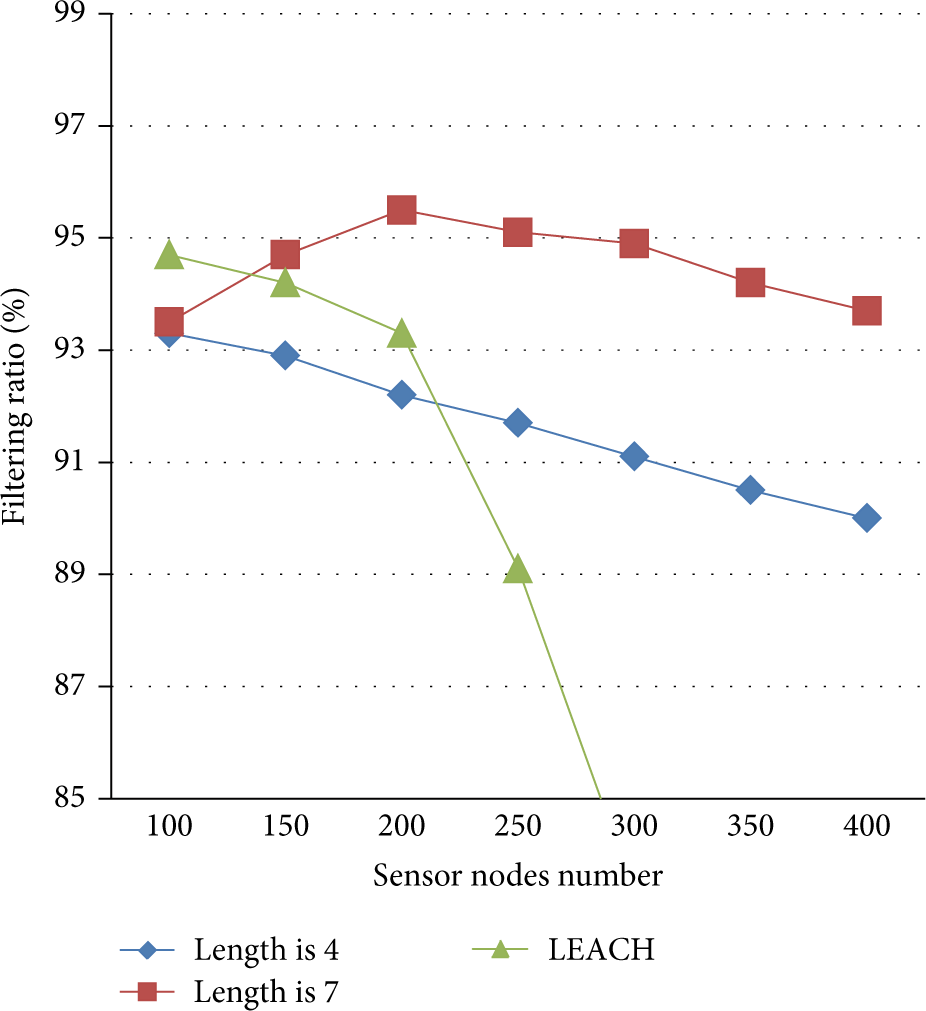
The result of filtering ratio changing with sensor nodes number.

The changing of list's length with reduplicated messages’ proportion.
200 sensor nodes are deployed in the target area, and the change of filtering ratio is illustrated by three curves in Figure 8. The red and blue curves present the changing state with the message lists’ longest length is 4 and 7, respectively. The green curve shows the changing state of LEACH with the delaying cycle being 7 in every filtering node; that is, every message would be delayed 7 periods before being transmitted by the filtering nodes. The curve with the longest length of the message is 4 and shows that the filtering ratio increases when the reduplicated messages’ proportion increases from 10% to 30%, and it is lower than 90%; when the reduplicated messages’ proportion is larger than 50%, the filtering ratio is changed a little and the values are stabilized around 92%. When the length of the list is 7, it can be seen that the filtering ratio is almost stable and the lowest value is 93.7% when the proportion is 30%, and the highest value is 95.2 when the proportion is 50% and 60%. The result of LEACH shows that, with the proportion of the reduplicated messages being less than 30%, the filtering ratio is larger than that of DMLDA with the length of 4; however, it is lower than the filtering ratio of DMLDA with the length of 7. Moreover, the filtering ratio is declining very quickly with the growth of reduplicated proportion, and when the reduplicated proportion is larger than 70%, more than 20% reduplicated messages would be omitted by LEACH. Through this experiment, it can be concluded that the length of the message list affects the filtering ratio obviously, and when the list is longer, the influence of reduplicated messages’ proportion is weaker. In this experiment, the time cost of LEACH is no less than the memory cost of DMLDA. In particular, DMLDA outperforms LEACH obviously under high reduplicated proportion situation.
Figure 9 shows the changes of the filtering ratio with different sensor nodes numbers. In our experiment, the proportion of the reduplicated messages is fixed at 50%, and the filtering ratio is tested under three situations: the longest length of the list is 4 in DMLDA, the longest length of the list is 7 in DMLDA, and the delaying cycle is 7 in LEACH. When the list length is set as 4, the slope of the filtering ratio is relatively stable. The filtering ratio is declined steadily with the increase of nodes number, and when there are 100 nodes in WSNs, the filtering ratio has the highest value of 93.3%. If the list length is 7, the change trend of filtering ratio is more complex: the filtering ratio rises from 93.5% to 95.5% when the node number is changed from 100 to 200; however, the filtering ratio remains around 95% when the nodes number is changed from 200 to 300, and when the node number is larger than 300, the filtering ratio begins to decline in a little slope. In LEACH, when nodes number is less than 200, the filtering ratio can be maintained above 90% and a little higher than that of DMLDA with the list length of 4; after nodes number increases to 250, the filtering ratio falls sharply and much lower than that of DMLDA. This experiment shows that the number of the clusters decreases with the reduction of the nodes in WSNs, which leads to fewer filtering nodes to be used. In DMLDA longer message list means fewer filtering nodes along the transmitting route, and hence the filtering ratio does not show obvious advantage comparing with shorter list. In addition, the filtering nodes in LEACH have big time cost to filter messages, so it has advantage in small WSNs. If the number of the nodes in WSNs increases, the number of the clusters and filtering nodes will increase. In DMLDA longer message list means higher capability of filtering and similar number of filtering nodes along transmitting route. However, in LEACH, more nodes mean more clusters, but it cannot dynamically adjust the cluster distribution according to transmission, which leads to the filtering ratio fall sharply. According to the results, it can be concluded that DMLDA is more efficient in larger scale WSNs, especially for the WSNs with longer message list.
Figure 10 shows the relationship between the reduplicated messages proportion and the list length. In our simulation, the number of the sensor nodes in sensing area is fixed to 200. Three situations, that is, DMLDA with a filtering ratio of 95%, DMLDA with a filtering ratio of 90%, and LEACH with a filtering ratio of 90%, are simulated. If the filtering ratio maintains in 90%, the longest list length of DMLDA will be relatively short, and the largest value is 4 when reduplicated message proportion is 10% and 20%. In the other case, the list length changes as 2 or 3. If the filtering ratio is fixed in 95%, the list length of DMLDA changes around 5 in most cases, and the largest value is 6 when reduplicated message proportion is set as 60%. In LEACH, when the proportion is no larger than 20%, it needs 5 delaying periods to achieve the target, and the time cost is equal to the memory cost of DMLDA with 95% proportion. But if the proportion increases to more than 30%, the delaying periods would be increased rapidly, and the time cost is much larger than the memory cost of DMLDA. When the proportion is larger than 60%, LEACH cannot maintain the filtering ratio in 90%. It can be observed that the list length cannot be a quite large value for sensor node. Conclusively, DMLDA would not bring much extra hardware burden to WSNs with high reduplicated message filtering ratio, but LEACH would bring much time cost to achieve the same results.
4.2. Analysis
According to the simulated results introduced in Section 4.1, DMLDA can maintain high filtering ratio with relatively low extra hardware cost, and the filtering mode based on message list ensures its real time performance. Furthermore, it has obvious advantage in large scale WSNs. The innovation of DMLDA is that a dynamic list is deployed in every cluster head, which can be used to store the history messages to judge whether current message is reduplicated or not. In any filtering node, supposing the message list length is l, the omission ratio can be calculated as (6), in which p is the probability of a message being reduplicated. According to (6), assuming a message m is reduplicated, only under the condition that there are 
The omission ratio in single node can be calculated by (6). In DMLDA, one message would be filtered by several rounds of filtering nodes for clustering-based structure, and its omission ratio would be much less than the result of (6). So when there are more nodes in WSNs, there would be more levels and longer list in filtering nodes, and DMLDA can obtain better effect.
5. Conclusion
In this paper, a new data aggregation scheme named DMLDA is proposed based on clustering routing algorithm, and the whole procedure of DMLDA is described in detail. The main innovations of this paper are summarized as follows: firstly, a special list structure is defined to store history messages, which is used to judge the message redundancy instead of period delay, and this can improve the real time performance of transmitting significantly; secondly, the distribution and initialization of dynamical list have been optimized based on our previous research on clustering-based routing; finally, the content of every list item and list length would be adjusted dynamically with transmission according to filtering state, which ensures high filtering efficiency with little extra hardware burdens for the sensor nodes. Based on these innovations, DMLDA has obvious advantages in large distributed WSNs with many reduplicated messages applications. In the end of this paper, a series of experiments are designed and simulated to prove the performance of DMLDA.
Footnotes
Conflict of Interests
The authors declare that there is no conflict of interests regarding the publication of this paper.