




Abstract
Mesh clients in hybrid wireless mesh networks can participate in networking and routing. When the backbone transmission network is broken, the mesh client can route and forward the data, which will eliminate the absolute dependence on the backbone network of traditional infrastructure wireless mesh networks in mine emergency rescue. However, the energy of mesh clients is limited. Based on the comprehensive consideration of the efficiency and balance of energy consumption of mesh clients for data transmission, a new energy cost criterion is designed. Energy optimized and fault recovered routing algorithm is proposed on account of different network states. At last, the simulation analysis on the performance of routing algorithm is conducted and compared with typical routing algorithms. Simulation results show that the algorithm has effectively extended the network lifetime and achieved optimized combination of energy efficiency and energy balance. When mesh routers in the backbone network are failed, this algorithm can rapidly rebuild the route and shows strong capacity of routing recovery.
1. Introduction
China is a major coal producer. Coal accounts for about 70% in disposable energy consumption in China currently, and it will play an important role in economic and social development of China as a kind of important strategic resource in a long period of time. Normal radio systems can provide at best a very limited and ineffectual communication capability in confined spaces. As a result, the problem of providing communications capability in hostile underground environments such as tunnels in coal mine, both for exploitation and emergency situations, has been an important issue in recent decades, especially after a series of unfortunate underground disasters and accident [1].
As coal mining and tunnel excavation, coal face and tunnel face are constantly moving, with the harsh environment and complex conditions. So, the wired communication networks could not reach these special areas and there are some blind spots existing in the wired communication and monitoring systems in the underground mine [2]. At the same time, rescue members need to transmit video, voice, and environmental monitoring to the commanders on the ground and the rescue staff underground through the wireless emergency rescue communication system. The coal mine needs wireless monitoring and wireless communications. Recently, wireless mesh networks have been considered as an alternative solution.
As a promising wireless access network, wireless mesh networks (WMNs) are multihop wireless networks which consist of three types of nodes, mesh routers, mesh clients, and gateway nodes, with self-healing and self-configuring [3–5]. They have the features of high transmission rate, wide coverage, rapid deployment, flexible networking, and scalability [6, 7], which can effectively solve some problems that the wired network and traditional wireless networks could not solve. The architecture of WMNs can be classified into three main groups on the functionality of the nodes [8, 9].
Client WMNs. In this type of architecture, client nodes constitute the actual network to perform routing and configuration functionalities as well as providing end-user applications to customers. Hence, a mesh router is not required for these types of networks. Infrastructure/backbone WMNs are as follows. WMNs include mesh routers forming an infrastructure for clients that connect to them. Client nodes in this type do not have the routing function and could not communicate with each other directly. It needs to connect to mesh routers to achieve wireless broadband access. Infrastructure/backbone WMNs are the most commonly used type. Hybrid WMNs are as follows. This architecture is the combination of infrastructure and client WMNs. Mesh clients can access the network through mesh routers as well as directly meshing with other mesh clients, which will enhance the connectivity of the network and expand the coverage. So, the hybrid architecture will be the most applicable case.
The current WMNs in coal mine are infrastructure/backbone WMNs. Adapting to the long and narrow underground tunnel, the topology of the backbone routing layer is single-chain or strip (double-chain), with low connectivity and poor robustness. The failure of mesh routers could easily break the backbone transmission network, causing that the corresponding clients could not communicate with the gateway and forming blind monitoring spots. So, the infrastructure/backbone WMNs in coal mine are difficult to provide reliable communication support for special underground region monitoring and emergency rescue.
Based on the features of networking and routing of mesh clients in hybrid WMNs, the architecture of hybrid WMNs used for underground mine was proposed in this paper. We use mesh clients to participate in networking to improve the connectivity and reliability of WMNs, which will provide a new method for constructing the mine broadband wireless networks. But the client nodes have limited energy. So, in this paper, comprehensively considering the efficiency and balance of energy consumption of mesh clients for data transmission, a new energy cost criterion for mesh clients is designed. Energy optimized routing algorithm for hybrid wireless mesh networks (EOR-HWMN) in coal mine is proposed on account of different network states, which will effectively extend the network lifetime and rapidly rebuild the route when mesh routers in the backbone network are failed.
The rest of this paper is organized as follows. In Section 2, we present related works. Section 3 provides a brief review of the network architecture of the hybrid wireless mesh networks for mine emergency rescue and describes the network state. Section 4 proposes the energy optimized routing algorithm that could be used for hybrid WMNs in underground mine. In Section 5, we show how the algorithm has been implemented. The simulation model and the comparative performance evaluation of the proposed routing algorithm are presented in Section 6. Finally, Section 7 concludes this paper.
2. Related Works
The study of WMNs used in coal mine mainly focuses on the application of emergency rescue communications. The research covers multihop transmission performance, network planning and coverage, routing protocol, channel allocation, and resource management, which can be divided into two categories: single-chain and strip (double-chain), in accordance with the topology of the backbone routing layer.
2.1. Single-Chain Topology
In [10], an emergency communication system based on WMNs is proposed and the deployment strategy of the gateway nodes is analyzed. But achieving full coverage with WMNs in underground mine is not necessary and realistic. In [11], the emergency communication system is constructed based on WMNs as [10]. Simulation results show that the bandwidth of the WMNs will decrease and the latency will increase after multiple hops. But this paper does not provide the solution. The multihop performance of WMNs in underground mine is studied in [12, 13]. In [12], the optimization strategies on multihop performance of WMNs are given and analyzed. The multihop transmission performance is tested on the experimental platform, which is based on the 2nd WMNs technology. In [13], the multiradio structure of multihop mesh backbone network is proposed based on 802.11n, which improves the basis bandwidth of backbone network and decreases the bandwidth attenuation per hop. The design for multiradio mesh node in this paper plays an important role in the research of the resource management and network capacity of WMNs in coal mine.
2.2. Strip Topology
In [14], the structure of the coal mine emergency rescue wireless communication system based on WMNs is proposed with the strip topology. The theories and key technologies are extracted according to the actual requirements in underground mine and the characteristics of spatial structure and radio transmissions, which would provide theoretical support for the following research of WMNs in coal mine. In [15], link expected traffic with different routing schemes and distributions of bottleneck collision domain with different radio interfaces are analyzed in the application of emergency rescue WMNs with strip topology in underground mine, and the nominal capacity model is proposed, which can provide the theoretical basis for strip WMNs in coal mine. To meet the unbalanced bandwidth requirements of links in the strip WMNs, a modified and classified channel allocation strategy is proposed to improve the performance of the network, using distributed and static channel allocation pattern in [16]. In [17], according to the application features of WMNs in underground mine, node deployment and resource allocation schemes are proposed based on the integration of the backbone routing layer, gateway layer, and mesh client layer.
The above studies are based on infrastructure/backbone WMNs and the problems of backbone routing layer with strip topology are solved in a certain extent. However, the WMNs with single-chain or strip topology in underground mine have low connectivity and the failure of mesh routers in backbone routing layer could easily lead to the disconnection of backbone transmission network. Mesh clients in hybrid WMNs are provided with the functions of data forwarding and routing, which will achieve rapid recovery from failure when mesh routers are broken down. But these will consume additional energy and deteriorate the network lifetime of WMNs, because of the limited energy supply of mesh clients. Since the radio transceiver typically consumes more energy than any other hardware components onboard a mesh client, designing energy optimized routing algorithm is of great importance to prolong network lifetime [18].
In [19], the energy efficient channel assignment and routing problem is defined and two mixed-integer linear programs are proposed to optimally solve the problem. But these algorithms have the central control architecture, which will produce heavy communication overhead. In [20], this paper presents that power-aware routing plays an essential role to prolong emergency service in an accident area network, when preexisting communication infrastructure and power resources have been destroyed. A power and node-type-aware routing algorithm is proposed, which selects optimized routes based on joint consideration of the nodes' types and power levels along the path.
Recently, there is a growing interest in the use of renewable energy sources to power wireless networks in order to mitigate the detrimental effects of conventional energy production or to enable deployment in off-grid locations [21–23]. In [21], an energy-efficient survivable routing protocol is proposed based on solar energy and wind mixed for power supply in green WMNs. A new routing metric is defined, which converts the remaining energy of the nodes into hop penalty factor and achieves the combination of hops with remaining energy. In [22], according to the dynamics of energy supply of renewable energy sources, adaptive resource management and admission control schemes are proposed to maximize the energy sustainability of the network. In [23], it formulates the problem of network-wide energy consumption minimization under the network throughput constraint as a mixed-integer nonlinear programming problem by jointly optimizing routing, rate control, and power allocation. But the formulated mathematical programming problem has high computational complexity, which is hard to be realized on the platform of WMNs. Although providing renewable energy sources to WMNs is unavailable in underground mine, the energy optimized strategies in these papers are worth to be referenced for related research in underground mine.
3. Hybrid Wireless Mesh Networks for Mine Emergency Rescue
3.1. Network Architecture
WMNs deployed along the tunnel in underground mine with single-chain topology based on the backbone architecture are shown in Figure 1. The mesh clients in this network do not have the capability of networking and routing and can only access the wireless backbone transmission network through mesh routers. Any mesh router's failure will cause some mesh clients interrupting the communication with the gateway, and the security monitoring system will lose some monitoring sites, which will threaten the life of emergency rescue members.

Infrastructure/backbone WMNs in underground mine.
Mesh clients in WMNs with hybrid network architecture in underground mine could participate in networking based on its routing function, which is shown in Figure 2. When mesh routers are broken down, the mesh clients could establish new communication with the gateway through other mesh clients, avoiding monitoring blind spot and enhancing network reliability. However, the performance of mesh clients (e.g., CPU and storage space) is lower than mesh routers, especially its limited energy supply. Therefore, in the process of routing, a joint optimization combining backbone routing layer and mesh client layer should be employed depending on the network states.

Hybrid WMNs in underground mine.
3.2. Network State
According to the relationship between mesh clients with backbone routing layer and the status of mesh routers, the network state can be divided into three types: AP covering, network edge, and backbone-recovery.
3.2.1. AP Covering
If a mesh client is within the coverage of a mesh router which has a routing path to the gateway, it is the AP covering network state. The mesh client can access the backbone transmission network directly through mesh routers to communicate with the gateway, without the process of route discovery, and reduce the energy consumption of mesh clients for broadcasting RREQ messages.
3.2.2. Network Edge
If a mesh client is not under the coverage of any mesh router, it could not access the backbone transmission network directly. It needs to start the request-reply route discovery mechanism and form a multihop ad hoc network through adjacent mesh clients. Then, it will access the backbone transmission network via a mesh client which has already established a wireless connection to the mesh router.
3.2.3. Backbone Recovery
If one or several mesh routers are broken down, the backbone transmission network will be interrupted and the mesh clients covered by the faulted mesh routers cannot achieve communicating with the gateway. In this status, the mesh clients can repair the interruption of the backbone transmission network using its function of networking and routing. The mesh routers and related mesh clients will start the request-reply route repairing mechanism and rebuild the route to the gateway.
Based on the above description of different network states, we can find that the mesh clients participating in routing or not depend on the network state. Designing the energy optimized routing algorithm should comprehensively consider different network states and achieve the optimized combination of energy efficiency and energy balance for mesh clients.
4. Energy Optimized Routing Algorithm
4.1. Definitions and Notations
Wireless mesh networks studied in this paper are mainly used in the application of mine emergency rescue communication. The network contains a number of mesh routers, mesh clients, and a gateway node. In order to simplify the system model, we use similar network mode as in [20], which is shown as follows:
Nodes can dynamically adjust its transmitting power. Nodes can read the power information from the physical interface and pass up to its network layer. Nodes use the whole antennas and have equal transmission radius, which means that the radio channel is bidirectional and symmetrical. The energy of mesh routers and the gateway node is unrestricted, but the power of mesh client is limited.
For the purpose of describing the routing algorithm more clearly, we define the mine hybrid wireless mesh networks and neighbors.
Mine Hybrid Wireless Mesh Networks. The mine hybrid wireless mesh network can be expressed by an undirected graph
Consider
Consider
Neighbor. The neighbor set of node i is defined as
4.2. Energy Consumption Model
The energy consumption of the mesh clients includes three components: sensing energy, communication energy, and data processing energy. Sensing and data processing require much less energy than communication, so we only consider communication energy consumption. We use the same energy consumption model as is used in [24] for wireless communicating hardware. In this model, the transmitter dissipates energy to run the radio electronics and the power amplifier, and the receiver consumes energy to run the radio electronics, which is consistent with the real situation better on energy consumption for wireless communication module.
If the mesh client transmits an l-bit packet over distance d, the radio expends

When the mesh client receives an l-bit packet, the energy consumed is

4.3. Energy Optimization for Mesh Client
In some scenarios of mine hybrid wireless mesh networks, for example, network-edge state and backbone-recovery state, the mesh clients will consume extra energy to receive, process, and transmit relayed packets. But the mesh client is energy-constrained, so it is important to design energy optimized routing algorithm to optimize the energy consumption of mesh clients.
4.3.1. Energy Cost
To achieve the effectiveness of the energy consumption of the mesh client, it is required that the data transmission for the mesh client to the gateway node consumes less energy. However, most energy-efficient routing algorithms tend to route data via nodes on energy-efficient paths and thereby drain their energy quickly. To achieve energy balance of the mesh clients, the nodes with more residual energy should be used to forward data, which will often lead to data relaying among many nodes, long routing paths, large data transmission delay, and the waste of energy. So, to prolong the lifetime of wireless mesh networks, the routing algorithm must be designed to achieve both energy efficiency and energy balance together. It should not only reduce the energy consumption for data transmission to extend the lifetime of a single mesh client, but also balance the energy consumption for the whole network. Based on the above requirements, we have designed a new energy cost function.
If mesh client i transmits data to mesh client j, the definition of energy cost is

4.3.2. Path Cost
The basic idea of the routing algorithm based on the energy cost is to build a path with the minimum energy cost from data source node to the gateway node. The total energy cost achieving data transmission, in which node j was selected as the relay node, is the sum of the energy cost from node i to j and from node j to k (one of the neighbors of node j) it is shown as

Based on the definition of the total energy cost, the mesh client will not only consider the energy consumption for data transmission from itself to the candidate node, but also consider the energy consumption for the subsequent data transmission, which will measure the energy efficiency of the candidate node selected as the next hop accurately.
During the process of route discovery, the mesh client will broadcast the route request (RREQ) messages. When RREQ passes through each hop, the node will calculate the path energy cost and the hop count according to (4). The mesh router receives the RREQ messages from multiple paths and calculates path cost according to (5). The route reply (RREP) message will be routed back along the reverse path to the source node and the path with the least path cost will be selected:

4.4. Avoiding Strategy for Low-Energy Nodes
The above energy optimization strategy can significantly balance the energy consumption of the mesh clients. If most of nodes in a route have much residual energy, but only a few nodes have little remaining energy, in this way the path cost is not very high and this path may be chosen. However, when this route is used to transmit data, the nodes with little residual energy will deplete its energy, which will interrupt the processing of the traffic and decrease the network lifetime.
In order to solve this problem and further optimize the energy consumption among nodes, we propose the avoiding strategy for low-energy nodes. This strategy will delay the low-energy nodes of which the residual energy is less than a certain threshold for a period of time to broadcast RREQ messages. So, this strategy can indirectly control the arrival time of RREP messages. The arrival time of RREP message with the route including low-energy nodes is much later than other routes; therefore the source node can select other routes avoiding low-energy nodes. Since the delay is only for low-energy nodes, this strategy can avoid long delay during routing discovery process.
When the intermediate node forwards RREQ messages, it should examine its residual energy firstly. By comparing the residual energy with the threshold, this strategy will determine when to broadcast RREQ messages after a period of time, which is defined as follows:

5. Algorithm Implementation
5.1. Network Initialization
In the network initialization phase, the mesh routers establish the path to the gateway using proactive routing protocol. Hello messages are used to establish, maintain, and update neighbor set. Nodes broadcast initialization messages with the preset transmission power based on the neighbor distance, which include the identification number and residual energy of nodes. If the broadcasting node is the mesh router, the hello message contains its hop count to the gateway in addition. Every node receiving this setup message will determine its distance to the transmitting node by the received signal strength and extract the information from the message to establish its neighbor set. The mesh clients join the mesh router with the least hop count to the gateway from its neighbor set and record the hop count of the router.
5.2. Route Discovery
The route discovery is initiated whenever a source node needs to communicate with the gateway and has no routing information in its routing table. In the energy optimized routing algorithm proposed in this paper, the route discovery and recovery mechanism is designed based on the network state. When a source node
If
If
If
When a node receives the RREQ message, it will perform the following actions, shown in Figure 3.

Flow chart of route discovery.
Firstly, it will check the network state of RREQ message. If it is network-edge state, it indicates that the upstream mesh client is at the edge of the wireless mesh network. So, the node which received the RREQ message may be only mesh client. This mesh client will check its own state. If it is in AP covering state, it will perform action 1. Otherwise, if it is network-edge state or backbone-recovery state, it will perform action 2.
If it is backbone-recovery state, it shows that the mesh router connected to the transmitting node is broken down. The node which received the RREQ message may be the mesh client or the mesh router. If it is the mesh client, it will perform action 1 or action 2 according to its own state, AP covering state, or network-edge state, respectively. If it is the mesh router, it will perform action 3.
Action 1. The receiving node automatically sets up the reverse route to
Action 2. The node automatically sets up the reverse route to
Action 3. The mesh router compares its hop count with
5.3. An Example
This section provides an example to clarify the mechanism of the energy optimized routing algorithm. In Figure 4, mesh client a has data to be sent to the gateway. But it has no route, so it will start the request-reply route discovery mechanism and broadcast RREQ messages. When RREQ passes through a hop, the node will accumulate the energy cost and hop count. When RREQ has arrived at the mesh router r from different paths, which has the route to the gateway, it will calculate the path cost. RREQ containing path cost will be routed back along the reverse path to mesh client a, and the route with the least path cost will be selected.

An example of EOR-HWMN.
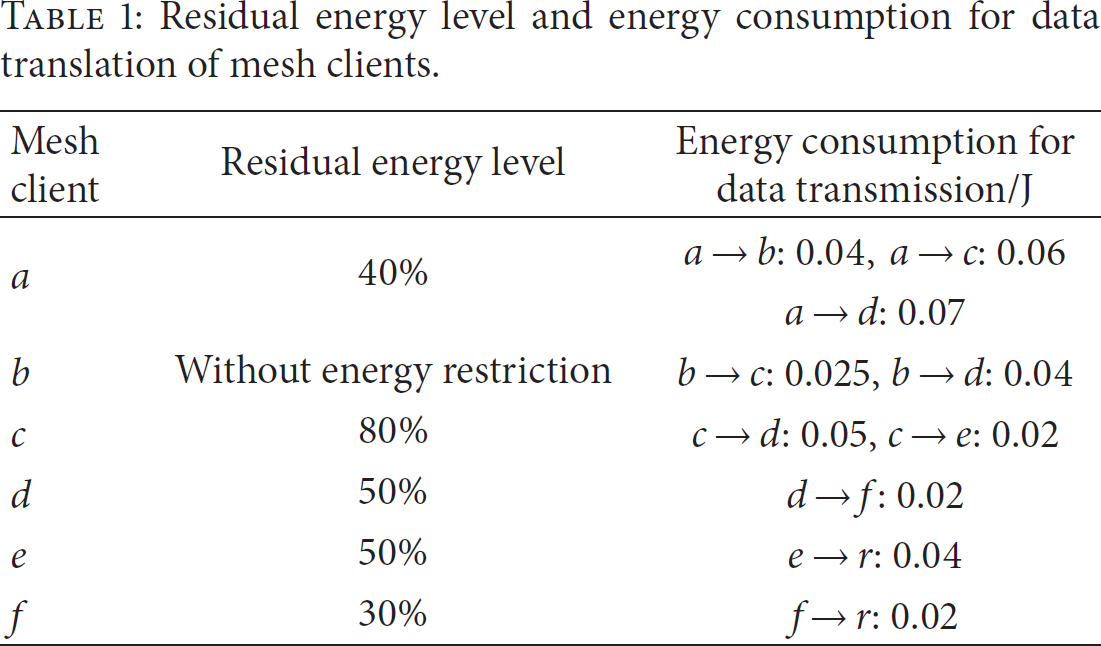
For each alternative route, the energy consumption for data transmission of each route can be obtained from accumulating the energy consumption of wireless link along the path (the third column of Table 1), which is shown in the second column of Table 2. Based on the residual energy level of transmitting node (the second column of Table 1) and the energy consumption of wireless link, each node on the path calculates the energy cost of each link, accumulating the energy cost of each path (the fourth column of Table 2) at router r. The path cost (the fifth column of Table 2) is calculated based on the energy cost and hop count of the path according to (5), and the route 2 with the least path cost will be selected. Although the energy consumption for data transmission of route 2 is the same with route 5, the energy cost of route 2 is less than route 5, because the node b on route 2 is mesh router, which has no energy limitation. Route 1 has the least energy consumption for data transmission along the path, but the node f has less residual energy (30%), so the path cost is more than route 2.
Residual energy level and energy consumption for data translation of mesh clients.
Route, energy consumption for data transmission, hop count, energy cost, and path cost.

6. Simulation Results and Performance Analysis
We have implemented the proposed EOR-HWMN algorithm on the platform of QualNet Developer 5.0 to study a hybrid wireless mesh network used in underground mine for the communication in special underground region monitoring and emergency rescue. In the simulation, the network consists of 25 mesh routers, 30 mesh clients, and a gateway, which are randomly distributed in a rectangular region of 2000 × 6 square meters abstracted as a tunnel in underground mine. The maximum transmission range of nodes is 200 meters, and the simulation time is 400 seconds. The initial energy of mesh clients is 10J and the energy consumption model used in the simulation is the model in [24] for wireless communication hardware. The traffic model is CBR and the size of data packet for sending is 512 bytes. Considering the hybrid WMNs in actual mine emergency rescue, the data collected by mesh clients is mainly sent through the gateway to the commander center or outside network, so the destination of data stream generated by mesh clients is set as the gateway in the simulation. The duration of traffic is set as 60 s and the transmission interval of data packet is 1 s. The application of CBR randomly starts and continues for a fixed duration, which makes the simulation close to reality of underground mine and focuses on the analysis of the energy consumption.
We compare the performance of EOR-HWMN algorithm with power- and node-type-aware routing algorithm (PNTARA) [20] and ad-hoc on-demand distance vector routing (AODV) [25] on energy efficiency and energy balance, such as average residual energy of mesh clients, unbalanced degree of residual energy of mesh clients and the number of nodes with energy depletion, and quality of service (QoS) metrics including packet delivery ration and average end-to-end delay.
6.1. Energy Efficiency and Energy Balance
6.1.1. Average Residual Energy of Mesh Clients
In Figure 5, it shows that the average residual energy of mesh clients decreases slowly with the increase of the number of mesh routers, when the first mesh client exhausts its energy. The average residual energy of mesh clients in AODV is higher than that of PNTARA and EOR-HWMN. In AODV, the hop count is used as criterion of route decision and the algorithm does not consider the characteristics of energy supply of nodes with different types, which will lead to heavy load, fast energy consumption, and prematurely energy depletion of mesh clients in the shortest path. EOR-HWMN has designed a new energy cost criterion for mesh clients, which combines the energy consumption for data transmission and residual energy of mesh clients into path cost calculation. The less energy consumption for data transmission and more residual energy of data sending node will lead to less energy cost, which has achieved the optimized combination of energy efficiency and energy balance. At the same time, EOR-HWMN reduces the probability of the low-energy node relaying the data through the avoiding strategy for low-energy nodes, which will further balance the energy consumption of mesh clients.
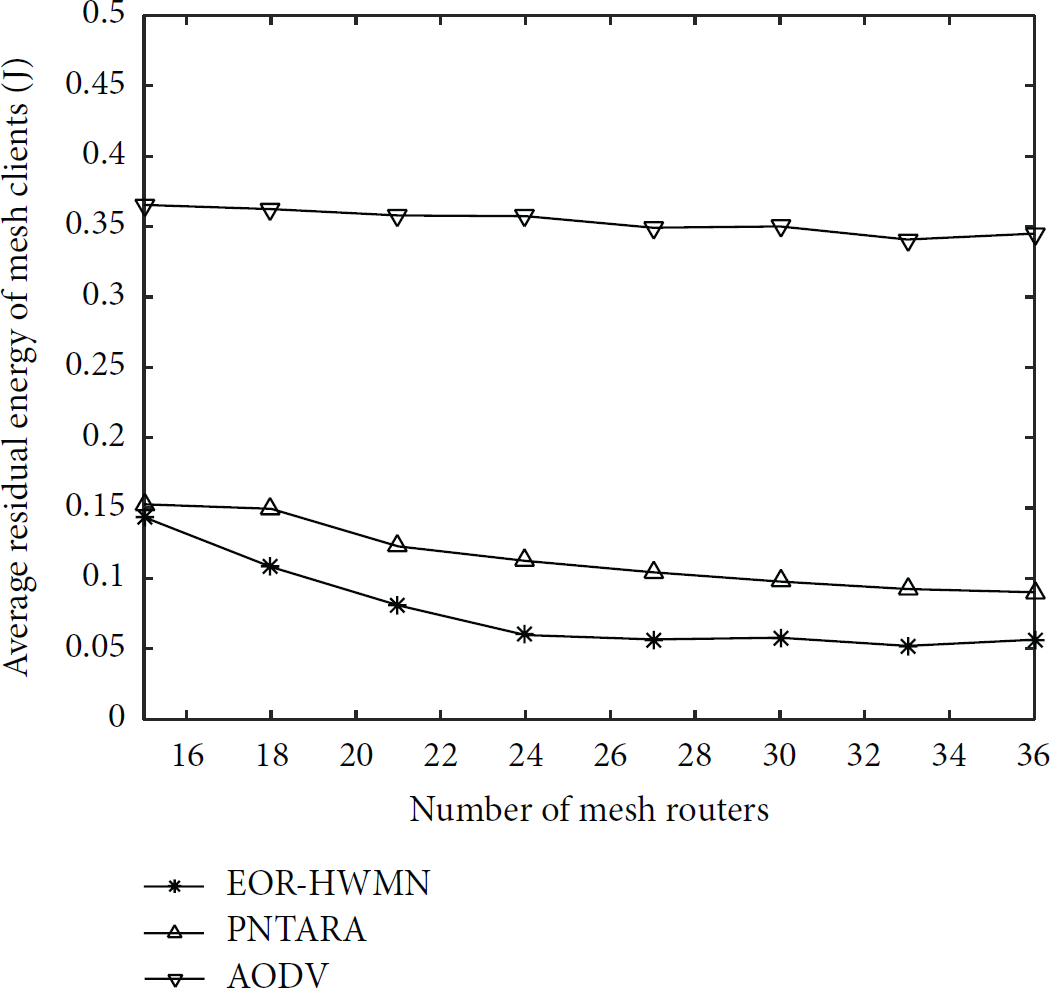
Average residual energy of mesh clients.
6.1.2. Unbalanced Degree of Residual Energy of Mesh Clients
In this paper, we use the standard deviation of the residual energy in all mesh clients to measure the unbalanced degree of residual energy. The energy consumption of mesh clients is not balanced and the energy of nodes is easily depleted when the value of unbalanced degree of remaining energy of nodes becomes large. In Figure 6, the standard deviation of the residual energy of mesh clients in EOR-HWMN is lower than that of PNTARA and AODV, which means that EOR-HWMN has better performance on energy balance thanks to the new designed energy cost criterion and avoiding strategy for low-energy nodes. At the beginning of the simulation, the residual energy of mesh clients is the same and the standard deviation of residual energy is zero. Along with the data transmission, different mesh clients have different energy consumption, and unbalanced degree of residual energy of mesh clients increases. But the growth of EOR-HWMN is slower than PNTRAR and AODV, and the value of the standard deviation is always lower than PNTARA and AODV, which shows significant effects on energy balance. In PNTARA, the residual energy of mesh clients is used to calculate the path cost, which is divided into three levels by setting the upper and lower threshold. But the residual energy in the same level may have many differences, which will affect the result of energy balance. Since the traffic of CBR randomly starts from 0 to 340 s and lasts 60 seconds, the traffic and the energy consumption of mesh clients decrease from 350 s, and the unbalanced degree of residual energy tends to be stable.

Unbalanced degree of residual energy of mesh clients.
6.1.3. The Number of Mesh Clients with Energy Depletion
From Figure 7, we can see that the mesh client with energy exhaustion first appears in AODV and the number of energy depleted nodes rapidly increases over the simulation time, because routing decision does not include the energy factor of mesh client. The nodes on the shortest path have heavy data forwarding task and the energy of mesh clients is consumed rapidly. The mesh client runs out of energy at 300 s in PNTARA and at 320 s in EOR-HWMN. The time in which the mesh client exhausted energy and the number of mesh clients with energy depletion in EOR-HWMN are later or less than in PNTARA and AODV, which means that EOR-HWMN has consumed energy more balanced, prevented the mesh clients exhausted energy prematurely, and achieved the efficient and balanced energy consumption among mesh clients. In WMNs used in the underground mine, if there are nodes with energy exhausted, there will be lost monitoring on some sites. If this node is used as intermediate node for routing, it would rebuild the route and cause packet loss and more data transmission delay. Therefore, EOR-HWMN is more suitable for safety monitoring and emergency rescue in underground mine, which requires higher reliability.
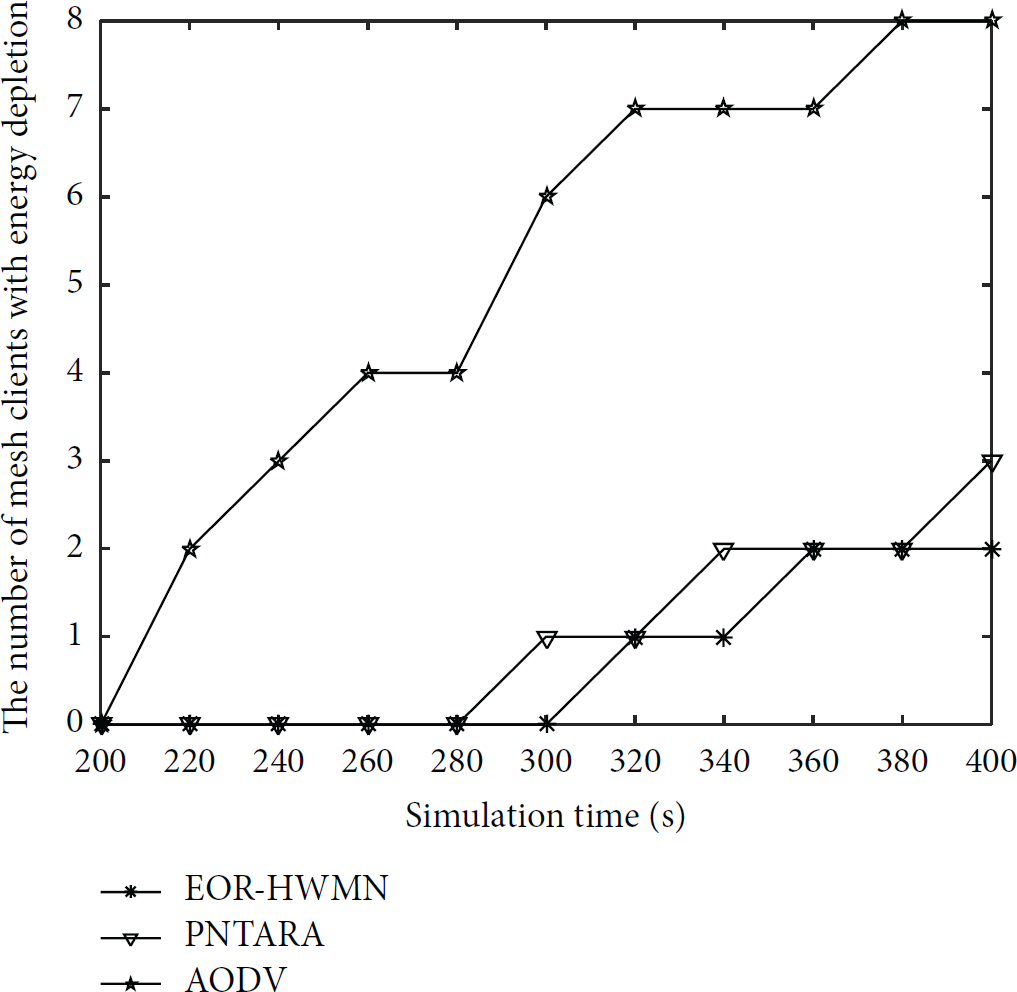
The number of mesh clients with energy depletion.
6.2. Quality of Service (QoS)
6.2.1. Packet Delivery Ratio
In Figure 8, the mesh clients with energy depletion appear from 220 s in AODV, and the number of energy exhausted nodes increases over the simulation time, so the packet delivery ratio (PDR) has declined. EOR-HWMN and PNTARA have employed the energy optimization strategy, delayed the time in which nodes with energy exhaustion emerged, and decreased the number of nodes running out of energy. But the hop count of the route in EOR-HWMN and PNTARA is more than that in AODV, which will increase the packet loss probability. So the PDR in these three algorithms is basically the same in the beginning period of the simulation. To verify the routing recovery capacity of EOR-HWMN, we set arbitrary two mesh routers' failure at 260 s in the simulation. From Figure 8, we can see that EOR-HWMN has conducted the route discovery and maintenance mechanism based on network states when the mesh routers are broken down. Although the value of PDR in EOR-HWMN has slightly decreased, it has quickly recovered stability, which shows better routing recovery capacity than PNTARA and AODV.
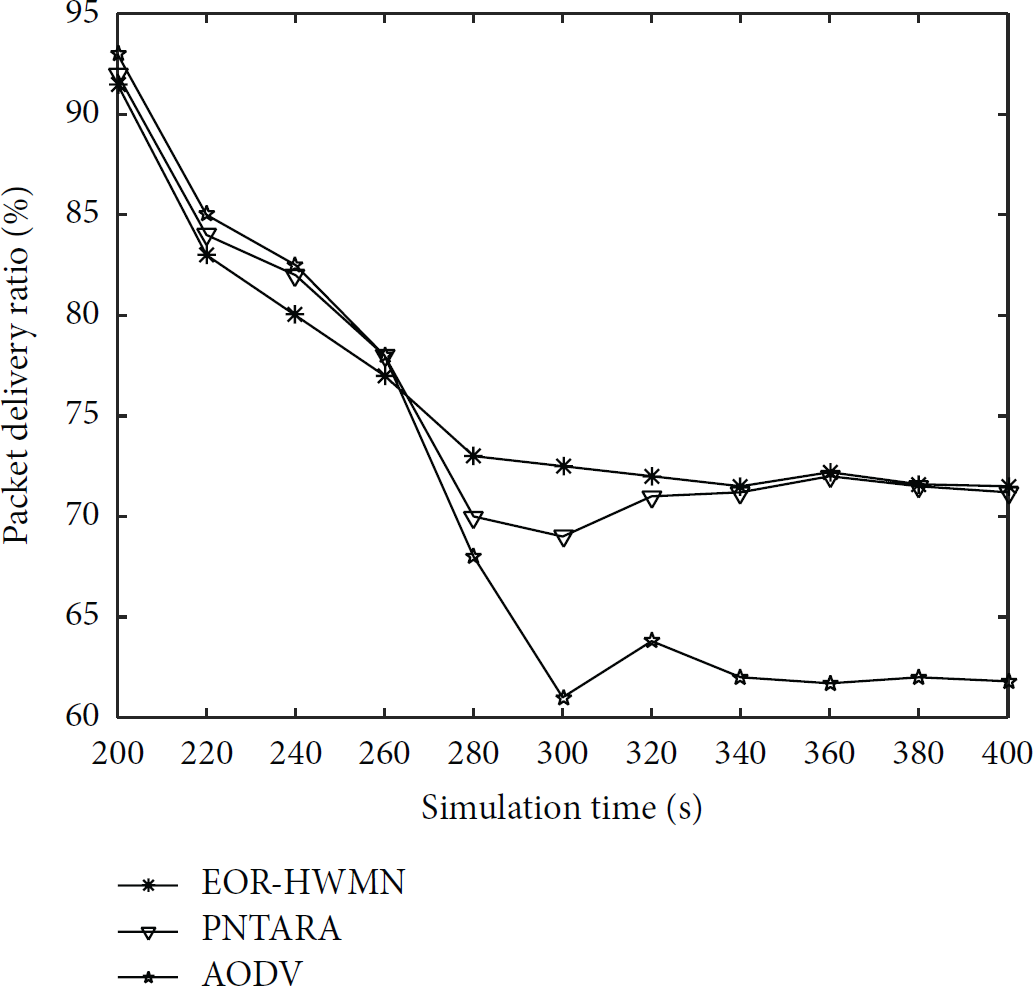
Packet delivery ratio.
6.2.2. Average End-to-End Delay
In Figure 9, the average end-to-end delay in EOR-HWMN starts to increase after 220 s. With the increase of the energy consumption of mesh clients, EOR-HWMN needs to generate routes with more hops to avoid low-energy nodes, which will increase the average end-to-end delay. From 350 s in the simulation, the traffic and the energy consumption of nodes decrease, so the average end-to-end delay tends to stability. In AODV, the route with the least hop count is selected to transmit data, which causes the average end-to-end delay to be lower than EOR-HWMN and AODV.
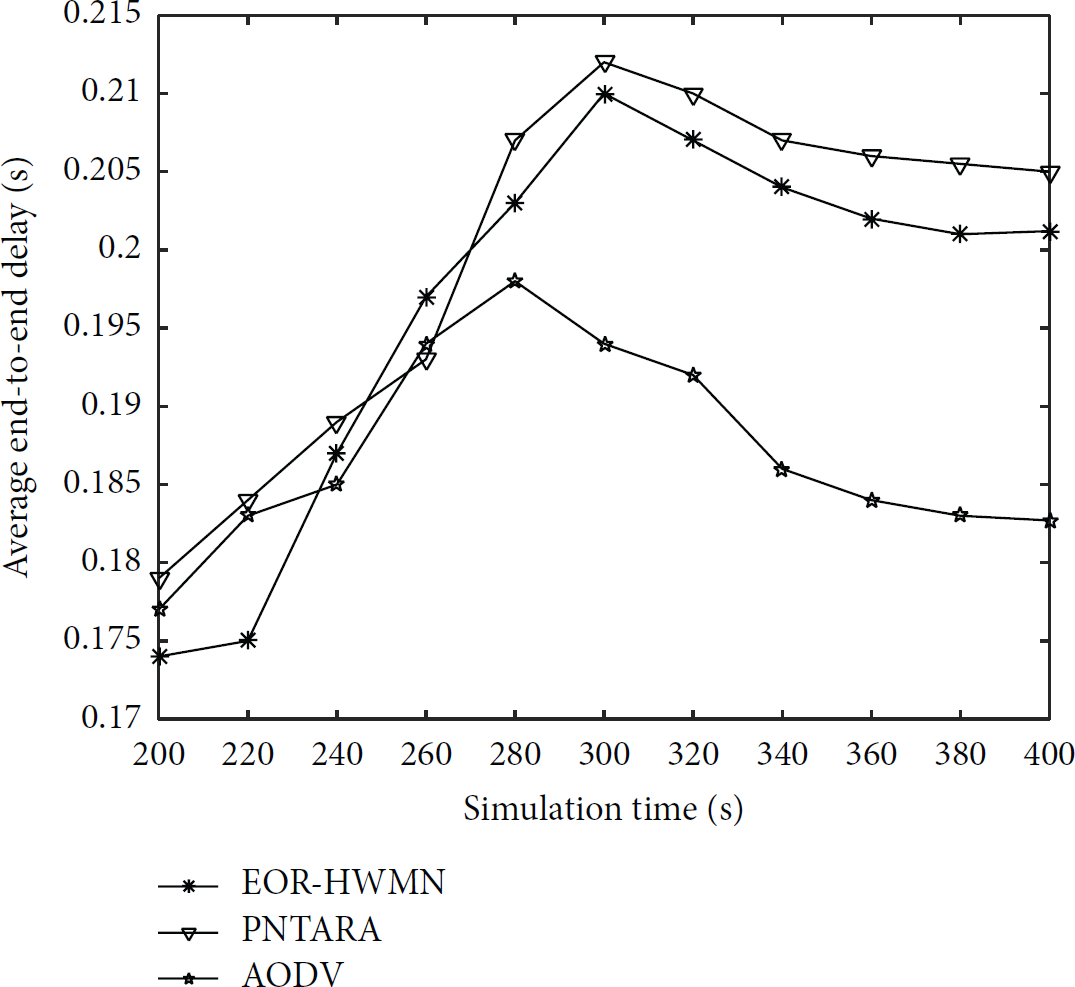
Average end-to-end delay.
7. Conclusions
In WMNs with infrastructure/backbone architecture used in underground mine, the breakdown of mesh routers could damage the backbone transmission network, causing corresponding clients out of contact with the gateway and forming blind monitoring spots. Mesh clients in hybrid WMNs can participate in networking and routing, which will improve the connectivity and reliability of WMNs. Hybrid WMNs are more suitable to provide communication for safety monitoring and emergency rescue in underground mine. Energy is one of the most critical resources for mesh client in hybrid WMNs. The energy of mesh clients should be consumed optimally.
In this paper, we have designed a new energy cost criterion for mesh clients considering the energy consumption for data transmission and residual energy of data sending nodes, which has achieved the optimized combination of energy efficiency and energy balance. Energy optimized routing algorithm for hybrid WMNs in underground mine is proposed on account of different network states. The route with the least path cost will be selected to transmit data. In order to further balance the energy consumption, we have proposed the avoiding strategy for low-energy nodes to decrease the probability of these nodes to relay data.
The designed algorithm EOR-HWMN demonstrates its superiority to power- and node-type-aware routing (PNTARA) and ad-hoc on-demand distance vector routing (AODV) on energy efficiency, energy balance, and quality of service metrics. Simulation results show that EOR-HWMN has balanced the energy consumption among mesh clients, extended the network lifetime, and rapidly rebuilt the route when mesh routers are failed.
Though the performance of EOR-HWMN has been demonstrated by simulation study, the understanding of this approach can be deepened by building theoretical foundations. Two theoretical works are being considered. One is the building of the analytical models of the combination of energy efficiency and energy balance, and another is the perfect weight (ω) in the path cost obtained through theoretical analysis. In the future, we plan to build a real hybrid wireless mesh network in underground mine, through deploying mesh clients, mesh routers, and the gateway in the tunnel. EOR-HWMN will be tested on the real network.
Footnotes
Conflict of Interests
The authors declare that there is no conflict of interests regarding the publication of this paper.
Acknowledgments
Financial support for this work provided by the Fundamental Research Funds for the Central Universities (no. 2014QNB22) and Natural Science Foundation of Jiangsu Province (no. BK20140202) are gratefully acknowledged.