




Abstract
This paper considers the performance problem of VoIP over 802.11e WLANs caused by the unfairness between uplink and downlink as well as the inefficient EDCA. A novel medium access control scheme named BEDCA (Balanced EDCA) is presented, which provides service differentiation between the access point (AP) and the mobile stations (STAs) to enhance VoIP capacity. In BEDCA, the expression of AP's contention window is obtained which is a relative constant value independent of the participating STAs. The minimum contention window of the STAs is traffic-aware based on the proposed algorithm. The performance improvement of BEDCA is verified through intensive simulations and the results show the capacity improvement of 82.1% compared to EDCA.
1. Introduction
In recent years, the wireless LAN (WLAN) has become the dominant Internet access method because of its attractive features, including low cost, high bandwidth, ease of deployment, and mobility support. Besides, the rapid growth of the mobile devices, coincidental with the proliferation of the emerging voice applications, has made the VoIP over WLAN become popular [1].
Distributed coordination function (DCF) is the fundamental 802.11 media access control (MAC) technique. While popularly being adopted in the current WLAN, the best-effort-based mechanism cannot meet the QoS requirements of the VoIP applications. As the VoIP applications are characterized by their real-time nature, they impose upper limits on delay and jitter in addition to usual requirements on packet loss and throughput, which are properly supported only in overprovisioned scenarios with DCF. To overcome this limitation, IEEE 802.11e [2], also known as the enhanced distributed channel access (EDCA), has been introduced to differentiate the channel access priorities of the different QoS requirements [3]. EDCA defines four traffic access categories (ACs), namely, voice, video, best-effort, and background. The MAC parameters can be set according to the expected access category of the incoming traffic. As a result, a high-priority data packet has a large chance to win the media contention for being transmitted than a low-priority one.
The EDCA service differentiation becomes less effective, however, when the VoIP streams dominate the traffic: a majority of STAs are sending/receiving VoIP packets. The problem is caused by the fact that there is no media access priority differentiation between the AP and STAs. As more STAs compete for the channel access for uplink traffic, the AP gets less opportunity to win the channel contention and thus its transmission attempts (downlinks) are suppressed. As VoIP applications generally require a balanced uplink/downlink throughput, the deficiency of the AP-STA access coordination in EDCA significantly throttles the VoIP capacity over WLAN. In addition, the fixed EDCA parameters perform poorly in matching the dynamical network conditions, in terms of the number of STAs and their corresponding traffic loads. In particular, when the WLAN is heavily loaded, the performance of the delay sensitive VoIP streams will be severely degraded.
The above VoIP over WLAN performance issues have inspired a number of research studies both at the TCP layer [4–8] and the MAC layer. In the paper, we focus on the latter. A natural idea is giving AP a channel access priority [9–11] to strike a balance between the downlinks and the uplinks. Studies also suggest that network collision reduction, either by adjusting the contention window size [12–15] or tuning the transmission opportunity coordination [16–20], can enhance the capacity of the VoIP traffic.
More recently, WiFox [15] and BDCF [21] are proposed. WiFox solves the problem of traffic asymmetry by adaptively prioritizing APs channel access over competing STAs. To achieve a fine balance between uplink and downlink traffic in order to optimize network throughput, WiFox works with the scheme wherein the percentage of downlink traffic being given priority is proportionately controlled based on the queue length at the AP. One issue in WiFox is that only increasing the chances for AP to contend for the channel may aggregate the collision rate in heavy load WLAN environment. As validated in Section 4, the obtained throughput of WiFox degrades when the network traffic load is heavy.
BDCF aims to achieve both the traffic balancing and the throughput enhancement by giving the AP's minimum contention window size (
In this paper, we aim to address the above VoIP over WLAN performance issues and enhance the VoIP traffic capacity in a densely deployed 802.11 wireless network with one AP and n active mobile STAs. We propose a balanced EDCA scheme, BEDCA, based on IEEE 802.11e. BEDCA modifies the access category of voice (AC_VO) only. As for other categories, we use the recommended configurations. Our scheme can be implemented solely at the AP side without the burden modifying the STAs. BEDCA differentiates the service between the AP and STAs by allocating a higher priority AC for the AP that benefits from n times greater channel access probability compared to a STA. Our rigorous analysis reveals that AP's minimum contention window size,
The rest of the paper is organized as follows. Section 2 illustrates our system model. The algorithm of BEDCA is described in Section 3 and is verified by simulation results provided in Section 4. Finally, we conclude the paper in Section 5.
2. System Model
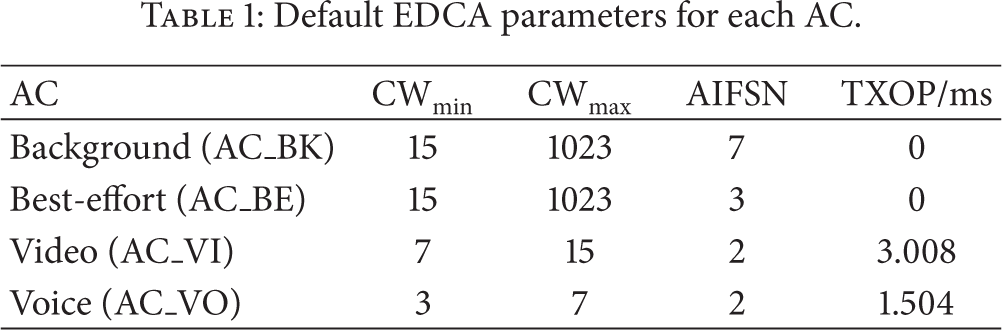
EDCA defines four ACs for different kinds of traffic to provide service differentiation. Each AC is assigned with its own MAC parameters and operates independently. The default EDCA parameters for each AC defined by the standard are listed in Table 1, where
Default EDCA parameters for each AC.
We consider a wireless LAN with one AP and n STAs. Each STA is associated with the AP and shares the channel with other STAs by means of the modified EDCA access method with adaptive
Let
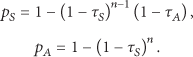
As derived in [22], the initial contention window size, symbolized as

where m is the maximum backoff stage which is a constant value.
Let us consider a scenario when a node, either the AP or one of the STAs, attempts to transmit a packet. A successful transmission happens if and only if no other nodes transmit. Thus, the probability of a successful transmission is

Similarly, the probability of an idle slot

The collision probability

The system throughput can be estimated by the fraction of time the channel is used for successful packet transmissions [22]. Let

where δ is the duration of the idle slot,
3. BEDCA Scheme
In this section, we provide the theoretical analysis that backs the intuition of the proposed BEDCA scheme. Our study suggests that the optimal
3.1. Theoretical Analysis
We start the discussion by explaining how to obtain the optimal

In practice,

where

To balance the uplink and the downlink traffic, we differentiate the services between the AP and STAs where AP is allocated n times access probability compared to a STA expressed as
By plugging

By setting the first derivative of (10) to zero and utilizing the quadratic formula of the quadratic function, we can obtain that
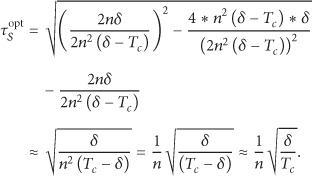
Thus,

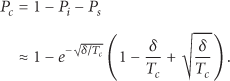
Based on the above result, we can derive the collision probability
Let us take 802.11b parameters as an example. The default parameter values are reported in Table 2.
Relevant network parameters of 802.11b.

For a certain codec, for example, G.711 codec, which has its data length of 160 bytes, the optimal attempt access probability of the AP is 0.3276. Similarly, the collision probability

By substituting the obtained values of
The above results reveal that the AP's optimal contention window size of AC_VO is independent of the number of STAs, once the 802.11 CSMA parameters and the VoIP codec are determined. Note that the optimal value can be easily computed by combining (12), (14), and (2). As we have shown above, to boost the VoIP capacity, we only need to adjust the STAs’ contention window size.
3.2. The Process of the Algorithm
Enlightened by the above conclusion, we develop an AP oriented node access scheme in a way that the
(1) Input: jth iteration, (2) Output: (3) (4) (5) (6) (7) (8) (9) (10) compute STA's
We assume the time domain is divided into a number of equal time periods, for example, the 802.11 beacon period of

where
Then the derived network collision probability is compared with the target value. If the collision probability is larger, indicating a saturated network condition, the attempt probability
Given
4. Evaluation
In this section, we validate our proposed BEDCA scheme by comparing its performance with the default EDCA of 802.11e, WiFox algorithm [15], and the BDCF [21] scheme. Our experiments are conducted on the ns-2 (version 2.28) with the EDCA extension from the TU Berlin.
4.1. Simulation Testbed
Our network testbed, illustrated in Figure 1, consists of one AP and 70 STAs. The AP is attached to a gateway node through the Ethernet with 125 Mbps, ensuring that it is not the bottleneck of the testbed. The network is located in a 500-meter by 500-meter square area, where the AP is located at the center and the STAs are uniformly distributed. To provide a stable and evenly distributed workload to each STA, we deploy the same number of workstations around the AP (connected through Ethernet), each of which serves as a peer station for the corresponding STA. During the simulation, each STA sends/receives its data packets over the uplink/downlink TCP/UDP flow to/from its peer station.
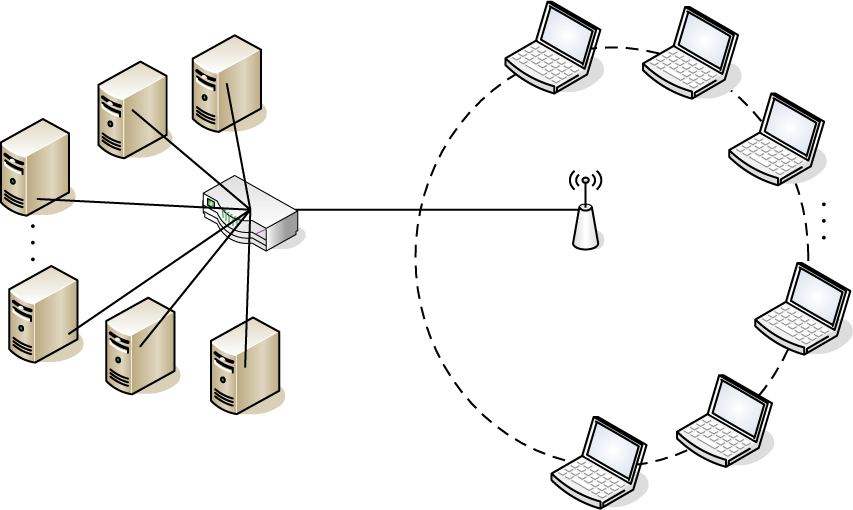
Simulation topology.
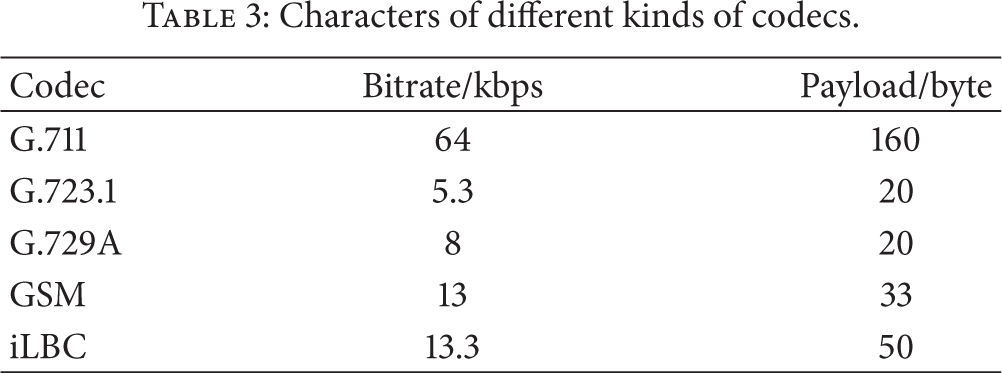
To select a proper VoIP codec for our experiments, we list five common ones as illustrated in Table 3. We finally pick G.711 encoder in the experiment as it is one of the most often used codecs in prior work [16, 23, 24].
Characters of different kinds of codecs.
All of the tests are performed using the 802.11b physical maximal transmission rate of 11 Mbit/sec with basic access except for the evaluation of the VoIP capacity which is conducted with both 802.11b and 802.11g (54 Mbit/sec). In the experiments, the parameters are set as shown in Table 4. The maximum backoff stage, m, as validated in [22], does not practically affect the system throughput as long as m is greater than four or five. Thus, in our experiments, we give m the value of 7. The parameter of α, when chosen in the range of [0.75, 0.9], can achieve good performance in terms of the goodput and delay as evaluated in the previous work [25]. So in the following simulation scenarios we set α to 0.875. β and ϵ are given with the empirical values of
Parameters of BEDCA algorithm.

We use the following three metrics in our evaluation.
Gain of goodput: the average throughput of the successful transmissions for a certain duration.
Downlink/uplink throughput ratio: the throughput ratio between the downlink traffic and the uplink traffic.
VoIP capacity: the VoIP quality is evaluated on the basis of R-score defined in ITU E-model, which is a popularly used QoS metric for VoIP calls [9]. R-score takes into account one-way delay, loss rate, and the type of the encoder. The one-way packet delay is measured as the time from the source sending a packet to the destination receiving it while the packet loss rate is the average proportion of packets lost during the measurement period [26]. For the G.711 encoder, the R-score is expressed as [27]

where d is the one-way delay (in milliseconds), e depicts the packet loss probability, and

The values of the R-score are typically categorized as shown in Table 5. In general, the acceptable limit of R-score is 60 in WLANs [27, 28]. Thus, the VoIP capacity is the maximum number of calls whose R-score is above 60 simultaneously for a certain channel bit rate.
R-score categorization.

4.2. Experimental Results
We first present the throughput improvement of BEDCA as shown in Figures 2 and 3. Figure 2 plots the throughput performance of four different schemes as the number of STAs changes from 1 to 25. We select the 64 kbps G.711 codec as the workload. Combining the uplinks and downlinks, each STA at the 64 kbps G.711 codec should produce 128 kbps throughput.
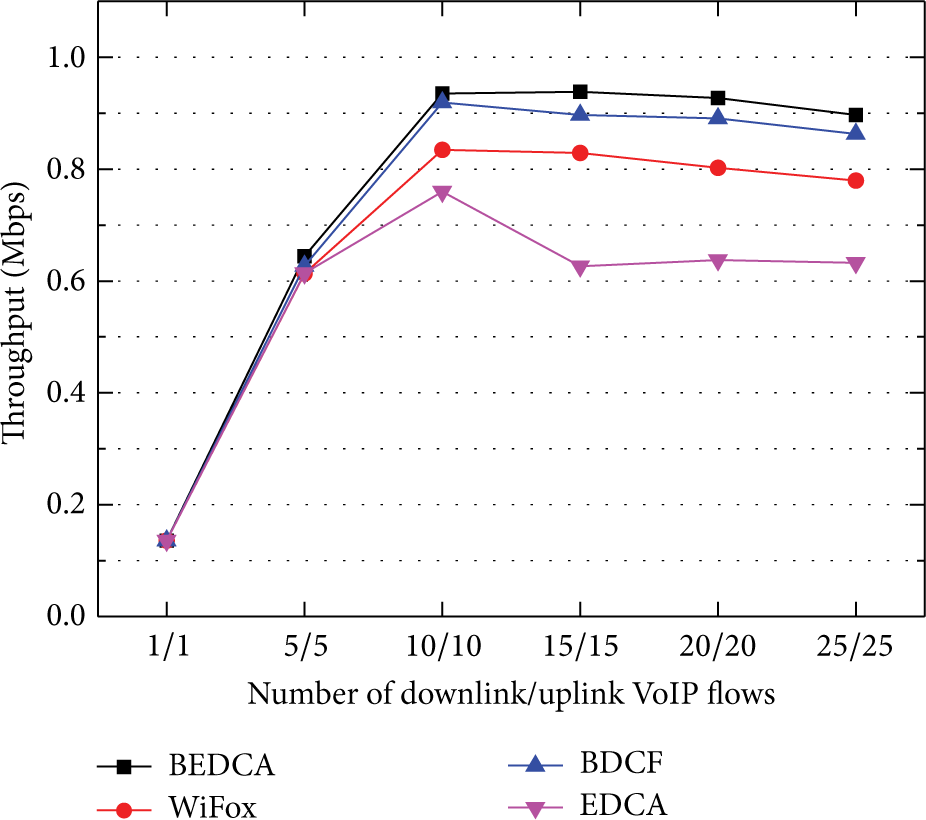
Obtained throughput with varying STAs.

Obtained throughput under different codecs.
As we can see in Figure 2, when the numbers of STAs are one and five, all four schemes have the throughput around 0.128 Mbps and 0.64 Mbps, respectively. When the number of STAs is getting larger, however, the throughput of the EDCA scheme suffers the performance degradation because of the growing number of the message collisions caused by the larger traffic volume from the STAs. A similar phenomenon can also be identified in Figure 3, which shows the average throughput when different codec schemes are used. It is obvious that the performance difference between EDCA and other three schemes is the largest for the G.711 workload and getting smaller when the coded scheme becomes GSM and G.7321. The reason is that both GSM and G.7321 have much less traffic volume than that of G.711 and therefore incur much less message collisions.
Besides, the figures also show that WiFox performs worse compared with BDCF and BEDCA in terms of network throughput. As mentioned before, the reason lies in the fact that WiFox alleviates the traffic asymmetry problem only by dynamically controlling the priority of AP over associated stations. This will aggravate the network collisions, leading to degraded network throughput in heavy load network environment, for example, when the VoIP conversations are above 10 with G.711 codec.
As discussed previously, the balance between the uplink and the downlink streams is a key factor that determines the quality of the VoIP services. When the balance is reached, the throughput ratio of the uplink to the downlink should be equal to one. Figure 4 plots the throughput ratio comparison among the four different schemes. To simplify the illustration, our ratios are always computed by comparing a smaller value to a larger value. As a result, the ratios are always less or equal to one. Our simulation is performed with 10 pairs of VoIP flows.
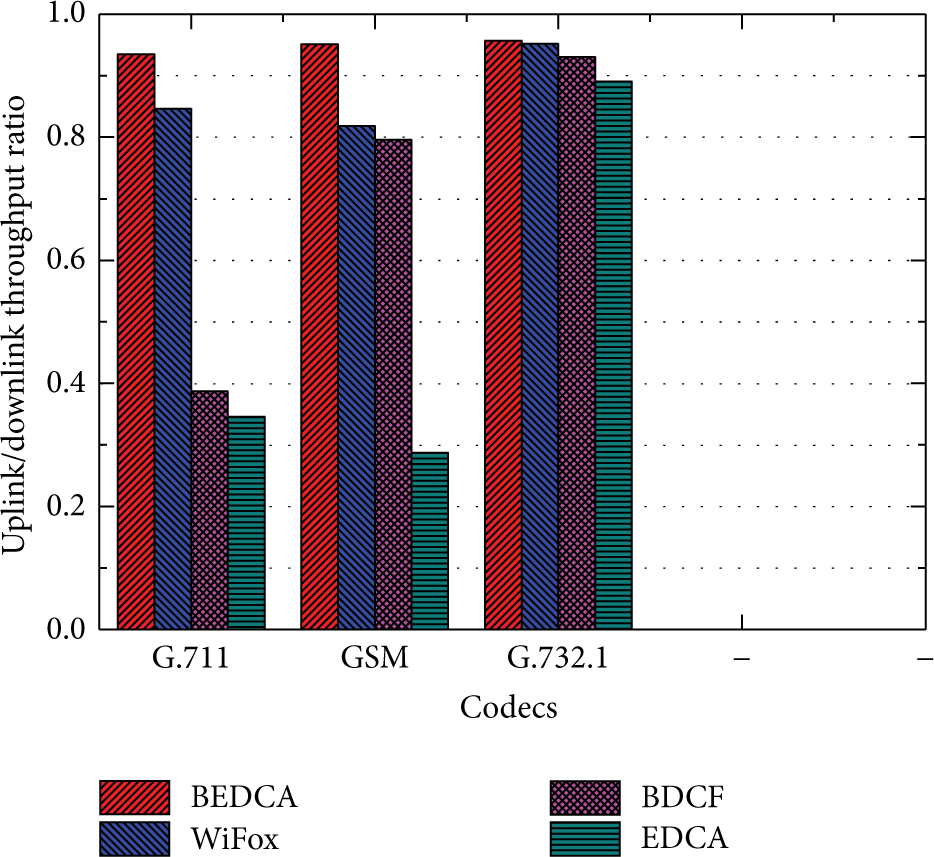
Throughput ratio between uplinks and downlinks under different codecs.
As shown in Figure 4, the ratios of BEDCA are closest to one for all codecs and indicate the better uplink/downlink balance compared to the other three schemes. In comparison, EDCA has the poorest performance with the ratios being around 0.3 for G.711 and GSM codes. The reason is that there is no service differentiation between the AP and the STAs. When the network load is heavy, the STAs are most probably to win the channel content and thus the downlinks (sent by the AP) are suppressed, eventually causing the buffer overflow at the AP, as observed in Figure 6. Since BDCF as well as WiFox favors the AP channel access, the AP can easily win the channel contention. As a result, they achieve better ratio comparison with EDCA. In addition, WiFox outperforms BDCF. The reason lies in that WiFox prioritizes APs channel access over competing STAs according to the dynamic traffic load at the AP in terms of the queue length. BDCF gives AP the priority by assigning the STAs’ contention window size n times larger than that of the AP's, which is a relative constant value with neglecting the network traffic load. When the traffic becomes much heavier, for example, G.711 codec is used, however, the STAs with BDCF start to have trouble to acquire the channel accesses (this phenomenon is also observed in Figure 7) and thus its ratio performance degrades to a lower value.
Next, we are curious to compare the VoIP capacity of the four schemes. Our capacity measuring methodology is described as follows. For each scheme, first we start with one pair of VoIP flows. We record the average packet delay by measuring the difference between the packet transmission and reception time and estimate the packet loss rate by dividing the number of received packets by the total number sent. Based on the average packet delay and the loss rate, we determine the R-score defined in (16). We make sure that the R-score is no less than 60, which is above the low quality of the VoIP service as shown in Table 5. Second, we add one more pair of VoIP flows and measure the R-scores for all VoIP pairs. We make sure that none of the pairs has the R-score below 60, which implies that the system can service the all VoIP flows with the guaranteed quality. We repeat the above procedure until we find that at least one of the flows has the R-score lower than 60. We record the previous number of pairs (when the system does not have any flow's R-score under 60) as the VoIP capacity.
It is worth noting that BEDCA, which works at the MAC layer, is based on 802.11e. Its performance is only determined by the operation mechanism of the EDCA access method, regardless of the amendments for the PHY layer as well as the MAC layer of other 802.11 standards (802.11a/b/g/n). Thus, in the paper, we take the PHY parameters of 802.11b and 802.11g as an example to perform the experiment.
Figure 5 clearly shows that BEDCA always outperforms the other three schemes. Particularly, with 802.11g scheme, the VoIP capacity of BEDCA is 51 while that of EDCA is 28. In other words, BEDCA can accommodate as much as 82.1% more VoIP flows (in 802.11g) than EDCA. It can be explained that the higher channel access priority assigned to the AP effectively avoids the downlink data collision and therefore reduces the downlink data loss caused by the AP buffer overflow. Figure 6 plots the CDF of the packet loss rate with 50 pairs of 802.11g VoIP flows. As shown in the figure, the loss rate of nearly 50% of packets, belonging to the downlink flows, is distributed in the range of
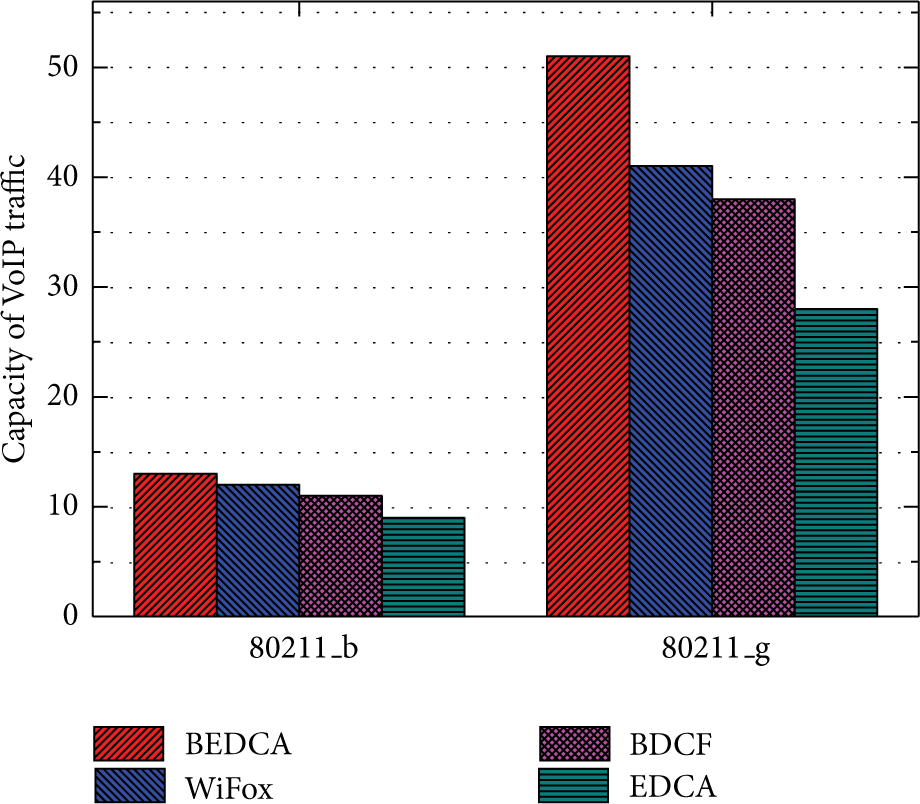
Capacity for VoIP traffic under different algorithms.
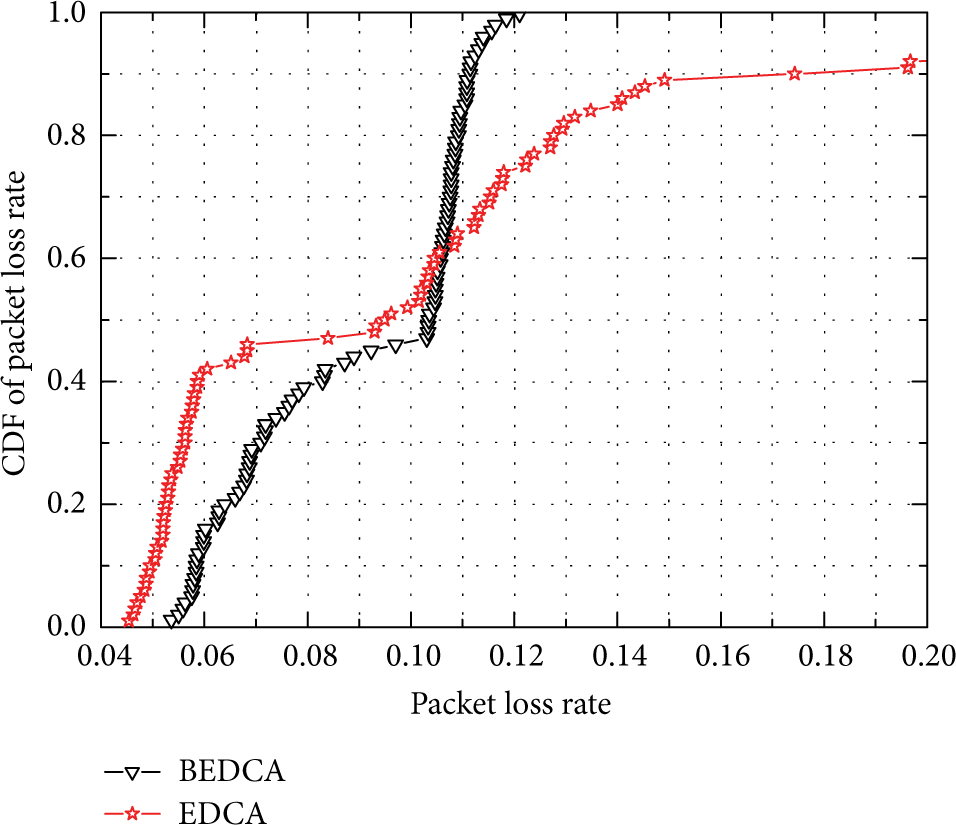
CDF of packet loss rate.

CDF of one-way packet delay.
Besides, as shown in Figure 5, both BDCF and WiFox perform worse than BEDCA but better than EDCA. The reason can be easily concluded from the above experimental results. On the one hand, they adjust the MAC parameters to enhance the network throughput. On the other hand, the two algorithms give the AP a priority to avoid the high packet loss rate of the downlink flows. However, WiFox only prioritizes AP's channel access, leaving the STAs’ MAC parameters unchanged. This may aggregate the collision in heavy load WLAN environment, causing degraded throughput as shown in Figures 2 and 3, consequently poor VoIP capacity compared to BEDCA. Meanwhile, in BDCF, the contention window of STAs depends on the number of the participating STAs, which is n times that of AP. This gives AP too high priority when n is large, for example, 50, which causes high one-way packet delay of the uplink VoIP flows. As shown in Figure 7, the one-way packet delay of 50% packets belonging to the downlink flows in BDCF is smaller than that of BEDCA. However, the other 50% packets belonging to the uplink flows have such a high one-way packet delay, which is up to 300 ms, making an unacceptable VoIP quality.
Furthermore, we can also see that WiFox outperforms BDCF from Figure 5. Again, it is because that WiFox adjusts the MAC parameters more dynamically according to the network traffic load, which can balance the uplink and downlink traffic more efficiently as shown in Figure 4.
In wireless networks, packet losses may be caused by collisions as well as other reasons like degraded signal quality and handoffs. However, they are not quite easy to distinguish at AP side. For simplicity, when calculating the network collision rate, we omit the retransmissions due to the transmission errors. To study the effects of the wireless channel errors on the quality of VoIP, we conduct experiments with the Gilbert-Elliott (GE) model. The GE model is one of the well-known channel models used to measure the burst error pattern [29]. It is based on a Markov chain with two states G (for good or gap) and B (for bad or burst). In the good state (G), losses occur with low probability
Packet error rate of GE model with varying

The experimental results are shown in Figure 8. As expected, the VoIP capacity of all the four algorithms degrades gradually with the increasing packet error rate. The reason is obvious that the packet losses caused by link error increase the retransmissions both at the AP and at the STAs, causing degraded throughput and increased packet delay. Besides, BEDCA still outperforms the other three schemes in this condition. BEDCA assumes that all the retransmissions are caused by collisions. Thus, the increasing packet error rate will lead to a higher estimation of the network collision rate. As depicted in Algorithm 1, BEDCA will give the STAs a larger contention window size correspondingly. However, we find that although BEDCA can achieve a better balance between the uplink and downlink traffic as shown in Figure 4, the uplink flows are still the dominant in the previous experiments. Thus, the larger
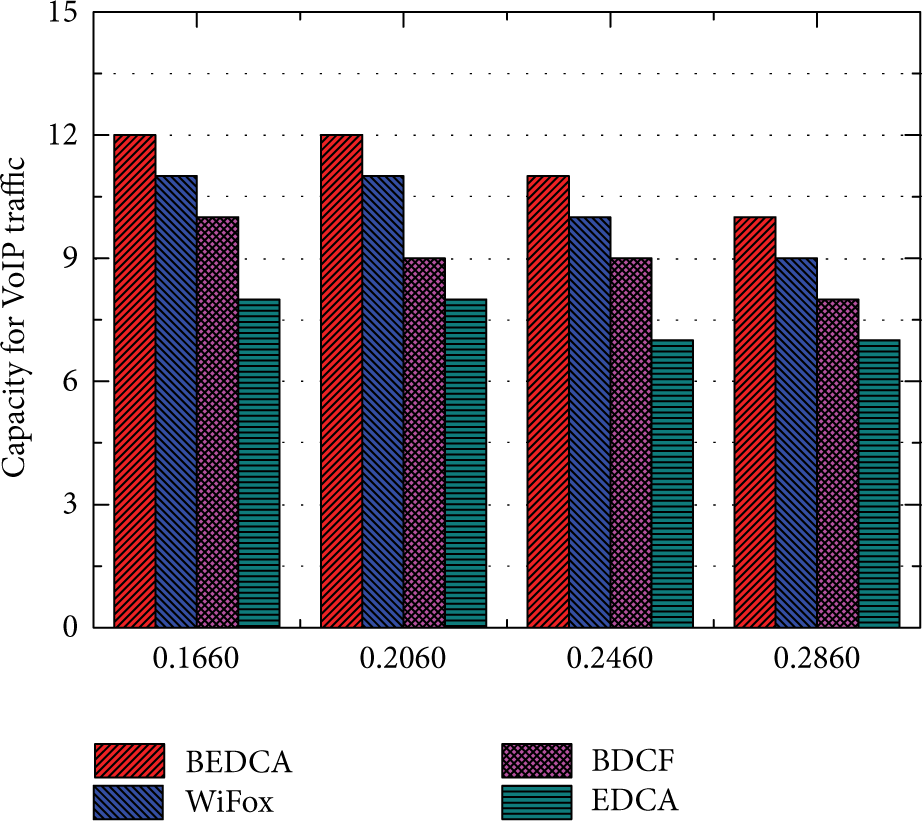
Capacity for VoIP traffic under different packet error rate.
Furthermore, we conduct experiments when hidden nodes exist with 802.11b physical parameters. In the wireless network infrastructure, the hidden node problem occurs when the STAs are visible from AP, but not from other STAs communicating with the AP. To construct this scenario, in this experiment, the 72 STAs (
The experimental results are shown in Figure 9. According to the figure, the VoIP performance degrades when there are hidden nodes. It is because the fact that hidden STAs cannot hear each other, the carrier sensing mechanism may fail to prevent packet collisions. When a collision occurs, the binary exponential backoff (BEB) algorithm in EDCA will compute a new random backoff time to retransmit the frame. Since the BEB algorithm assigns a larger backoff counter to the failed STA, the corresponding STA cannot compete with the channel immediately even when the channel is idle. This causes performance degradation over wireless networks. Besides, BEDCA performs best, followed by WiFox and BDCF. EDCA performs worst. Again, the larger

VoIP capacity when hidden nodes exist.
Finally, we conduct experiments on how the proposed scheme would deal with mixed flows, where both VoIP flows and data flows exist. In the experiments, the data flows act as best-effort traffic. The rate of the data flow is 1 Mbps and the packet size is 1000 bytes. The experiments consider the legacy 802.11e MAC and the BEDCA. In the experiments, we take the 802.11b parameters and the G.711 codec as an example. Here we evaluate the maximum number of VoIP conversations and the obtained data throughput.
Figure 10 depicts the data throughput achieved by the data flow for an increased number of voice conversations when there are only one uplink data flow and one downlink data flow. Figure 11 describes the obtained throughput of data flows when there are 5 pairs of VoIP flows. From the figures we can see that the throughput of data decreases linearly with the number of voice flows. Besides, the data throughput, for a given number of VoIP conversations, is higher when using BEDCA as compared to EDCA. The reason lies in that the STA's contention window of the AC_VO is fixed at
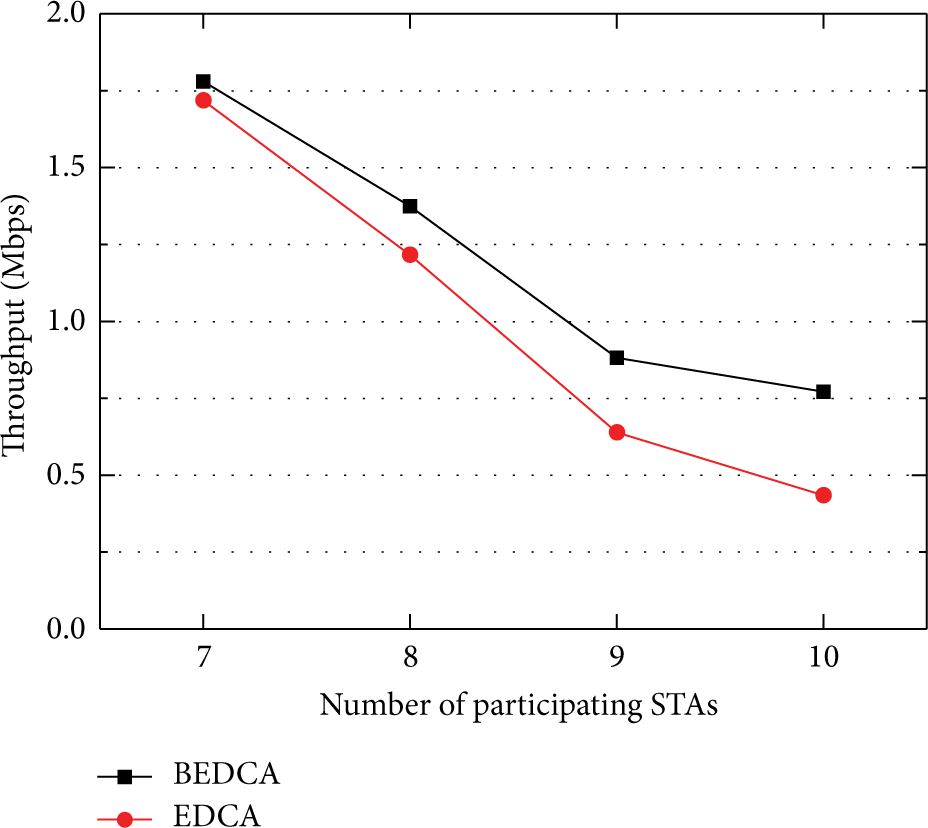
Obtained throughput of data flows with varying pairs of VoIP flows.

Obtained throughput of data flows when there are 5 pairs of VoIP flows.
Figure 12 shows the VoIP capacity; we find that it reduces slowly with increasing number of date flows. As shown in the figure, when there are 20 data flows (10 uplink data flows and 10 downlink data flows), BEDCA can still support 11 voice flows while the maximum number of conversations with EDCA is 7 (in 802.11b).
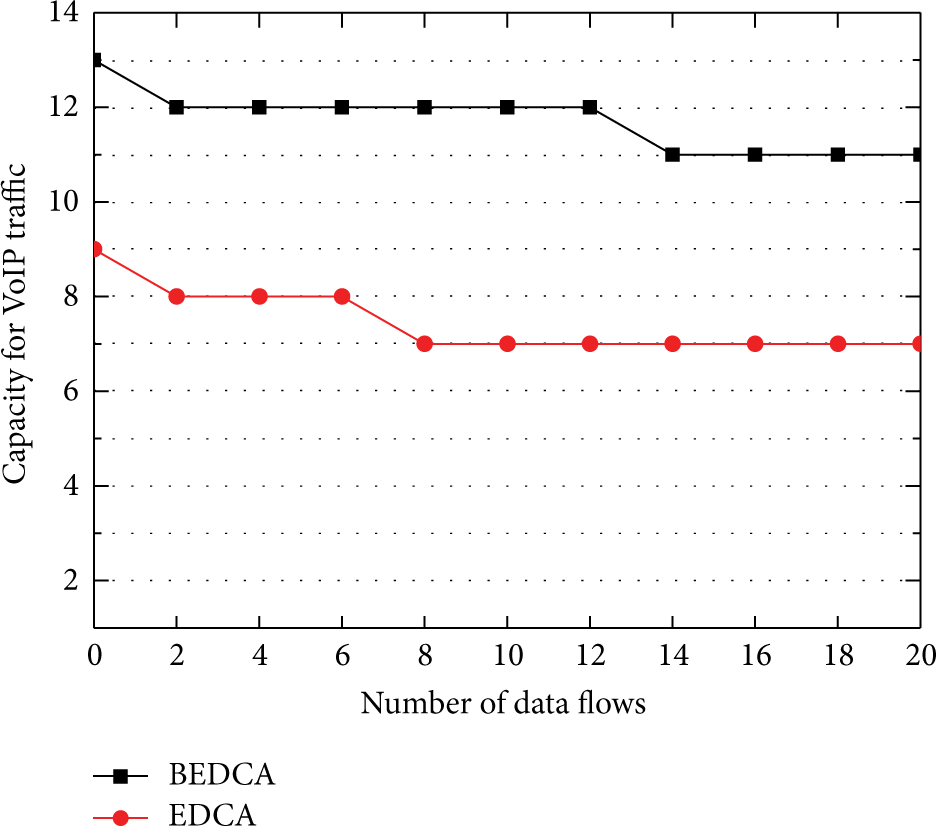
VoIP capacity with varying data flows.
Figures 13 and 14 illustrate the average packet delay and the packet drop rate of voice flows when the voice conversations are 7, 8, and 9, where one uplink data flow and one downlink data flow exist. As shown in the figures, BEDCA performs similarly as that in pure VoIP environment. Specifically, giving AP high priority guarantees the channel access probability of the downlink flows while the dynamic nature of BEDCA ensures low collision overhead. Thus BEDCA gives lower average packet delay and packet drop rate compared with EDCA, and thus BEDCA shows a higher VoIP capacity. Above all, the adaptive nature of BEDCA not only leaves more resources for data flows, but also increases the voice capacity of the WLAN as the appropriate MAC parameters alleviate the network collision as well as fully utilizing the resource.

Average one-way packet delay of VoIP flows with mixed traffic.

Average packet drop rate of VoIP flows with mixed traffic.
5. Conclusion
In the paper, we propose a novel access scheme for 802.11e WLANs with the goal to improve the QoS of VoIP over WLAN by differentiating the service between the AP and STAs. We first present the theoretical analysis that reveals the relation between the throughput and the access probability. Then we derive the expression of the optimal access probability that maximizes the throughput where we find that the optimal access probability of AP is a relative constant value independent of the number of the STAs. Finally, a practical scheme is developed that enables the STAs to achieve the optimal access probabilities by adjusting their
Footnotes
Conflict of Interests
The authors declare that there is no conflict of interests regarding the publication of this paper.
Acknowledgments
This work was supported by the National Natural Science Foundation of China (Grant nos. 61173169, 61103204, and 61402542) and the open funding of Science and Technology on Information Transmission and Dissemination in Communication Networks Laboratory (Grant no. ITDU14010/KX142600017).