




Abstract
This paper considers the problem of source localization using quantized observations in wireless sensor networks where, due to bandwidth constraint, each sensor's observation is usually quantized into one bit of information. First, a channel-aware adaptive quantization scheme for target location estimation is proposed and local sensor nodes dynamically adjust their quantization thresholds according to the position-based information sequence. The novelty of the proposed approach comes from the fact that the scheme not only adopts the distributed adaptive quantization instead of the conventional fixed quantization, but also incorporates the statistics of imperfect wireless channels between sensors and the fusion center (binary symmetric channels). Furthermore, the appropriate maximum likelihood estimator (MLE), the performance metric Cramér-Rao lower bound (CRLB), and a sufficient condition for the Fisher information matrix being positive definite are derived, respectively. Simulation results are presented to show that the appropriated CRLB is less than the fixed quantization channel-aware CRLB and the proposed MLE will approach their CRLB when the number of sensors is large enough.
1. Introduction
Wireless sensor networks (WSNs) is an emerging technology that can provide an inexpensive solution for lots of applications, including surveillance and urban monitoring [1], smart power monitoring [2], and target localization or tracking [3–8]. Locating a target or object in an area of interest using a wireless sensor network (WSN) is a typical application. The WSN usually employs low-cost densely deployed sensors that have very limited energy and communication bandwidth resources. Its local sensors detect specific events and then forward their sensed observation information to a fusion center (FC). Finally, the FC implements the task of target location estimation [9].
A multitude of studies have researched source localization since it has found lots of applications in radar, sonar, and microphone arrays [10, 11]. The localization problem is to estimate the coordinates of a source. Based on measurement models, the localization methods usually use the received signal time of arrival (TOA), the distance measurement, the received signal strength (RSS), the angle of arrival (AOA), the signal energy, and their combinations. It is worthwhile to mention that distance information is not directly available and should be estimated based on other measurement models. On the other hand, techniques based on TOA and time-delay of arrival (TDOA) estimation usually require complicated timing or synchronization.
Compared with TOA, TDOA, distance measurement, and RSS, the localization problem based on acoustic energy has practically attracted much attention over the past few years, due to its lower cost, lower complexity, and easier implementation. In this paper, the source localization problem with the use of the energy measurement model in WSNs is considered. These energy-based methods of source localization are classified into two major groups: analog measurement models [12–18] and quantized measurement models [19–24]. Due to bandwidth constraints in WSNs, it is naturally desirable that local sensors only transmit their quantized observations to complete the estimation task. For example, consider a uniform quantizer with certain quantization levels: (1) At each sensor, it observes a received signal power following a power decay model, quantizes the signal using the uniform quantizer, and then communicates to the FC the quantized level; (2) At the FC, it reconstruct the “quantized” observations and estimates the coordinates of a source.
For these quantized measurement models, the maximum likelihood target estimator and two heuristic design methods for optimizing quantization threshold have been proposed [20]. Within them, two heuristic design methods are proven to be very robust under various situations. Additionally, the localization problem under nonideal channels between sensors and the FC has been investigated in [21]. For robust localization problems, compared against the classical maximum likelihood estimators (MLEs), the proposed fault tolerant maximum likelihood (FTML) estimator and the subtract on negative add on positive (SNAP) have been shown to be more fault tolerant in [22] and [23], respectively. Recently, Byzantine attacks for localization estimation in WSNs under binary quantized data have been considered in [24] and a novel scheme in conjunction with the identification scheme has been proposed to make the Byzantines ineffective. However, these quantized schemes only consider fixed thresholds in designing local sensors' quantization schemes, such as the cases with the single threshold and a set of different thresholds.
In other words, it is worth noting that the estimation performance for the above quantized localization problems depends on the strategies of selecting sensors' quantization thresholds, that is, fixed quantization in local sensors. For example, the single threshold or a fixed set of different thresholds have been studied in [19–21]. However, most of the works only considered the fixed quantization schemes in localization problems. Motivated by the observation that adaptive quantization design schemes in distributed estimation problems [25, 26] can outperform fixed quantization schemes [27], we propose novel kinds of quantization schemes that can adjust local sensor nodes' quantization thresholds adaptively according to sensor nodes' positions in a region of interest, that is, adaptive quantization schemes for source localization problems are adopted here.
As one of the early related works in the distributed estimation problem, a common threshold τ is applied at all the sensors [27, 28], which is called the fixed quantization approach. It is of great challenge for the approach to make a good choice of the common threshold. To be close to the unknown parameter, a further improvement is to apply a set of thresholds with equal or unequal frequencies and hopes that one of thresholds can be enough close [27, 28]. However, the multithresholding is required to have the knowledge of the prior distribution of the parameter. Recently, being the most related work, a data-dependent distributed adaptive quantization approach is considered and sensors' thresholds are adjusted dynamically to converge to the unknown parameter [25, 26].
As the early related work in the source localization problem, some prior knowledge about the region of interest is assumed and two kinds of intuitive quantization methods are designed to obtain optimal quantization thresholds [20]. Although the heuristic design methods require minimum prior information about the system, identical thresholds are simply employed at all the sensors and their performances are constrained by the fixed common thresholds. In the latest work [29], a dynamic nonidentical threshold design is proposed for making the Byzantines ineffective, where each threshold is calculated based on each sensor's signal amplitude from the source. In other words, the proposed quantization methods [20, 29] all require some prior distribution knowledge about the source’ unknown parameters.
The main contributions of this paper are as follows:
A novel adaptive and channel-aware quantization scheme for target location estimation using one-bit data is proposed. Within it, local sensors' quantization thresholds are adaptively adjusted according to sensors' location coordinates and their received binary information. The appropriate maximum likelihood estimator (MLE) is derived to seek the estimate of the location of the target, and the metric Cramér-Rao lower bound (CRLB) is derived theoretically to benchmark the performance of locating. Some additional simulations show that the proposed channel-aware quantization scheme has better performance than the existing fixed schemes under several cases.
The rest of the paper is organized as follows. Section 2 introduces our system model. In Section 3, the position-based adaptive quantization scheme is proposed. Their corresponding channel-aware MLE and the channel-aware CRLB both are derived in Section 4. Compared against the classical MLE with the fixed quantization scheme [21], the proposed MLE is evaluated in simulation in Section 5. Finally, conclusions in Section 6 are presented.
2. Problem Formulation
Consider a wireless sensor network with a fusion center, where N locally distributed sensors are densely deployed in a region of interest (ROI) [20]. As shown in Figure 1, the ROI is a two-dimensional square region. Local sensors are assumed to share the communication channel on a time-sharing basis [25]. Additionally, we assume that each sensor and the FC have the prior knowledge of locations of all the sensors. Without loss of generality, each sensor is deployed in a grid for simplicity. The sensors are indexed as

The square ROI of target localization in WSN. The signal power contours of a target are denoted by red solid circles.
The target emits an acoustic attenuation signal, which is a function of the Euclidean distance between the target and local sensors [21]:

The observation model for local sensors is considered as given below:

In this paper, (1) is shown to be a widely adopted model for the acoustic attenuation signal which is propagating in free space and (2) also is a reasonable model [20]. Without loss of generality, the same model in [20] is simply adopted here. Meanwhile, at each sensor, due to severe bandwidth limitations in WSNs, its received signal amplitude


3. Channel-Aware Position-Based Adaptive Quantization
Generally, the thresholds
It is noted that
The key principle of the position-based information sequence is that the close neighbors of the ith sensor are assigned almost the same threshold. That is, if the ith sensor transmits a binary data
The position-based and adaptive quantization scheme consists of two stages: (1) Define the indexes of all local sensors according to their distance information; (2) Update thresholds in order of indexes. For the first stage, it is noted that local sensors are indexed as

Flow chart of the first stage of the proposed adaptive quantization scheme.
For the second stage, the position-based sequence of transmission can be shown in Figure 3. It assumes that the communication channel on a time-sharing basis has a preset number of slots according to the sensors' indexed order and each sensor has received an acoustic attenuation signal. Let


Flow chart of the second stage of the proposed adaptive quantization scheme.
Note the signal power
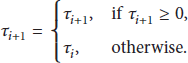
Under the setting above, a set of binary observations

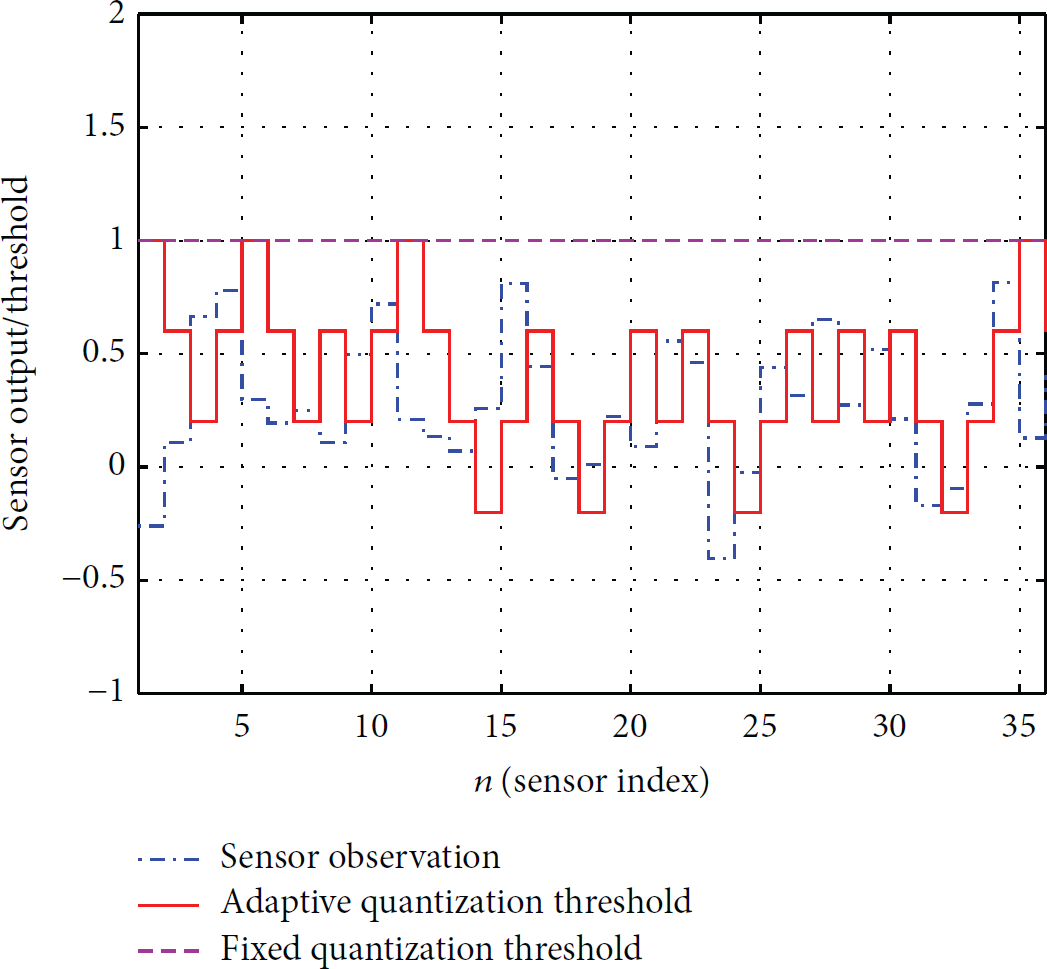
Dynamic evolution of the quantization threshold versus sensor index.
4. Analysis of MLE and CRLB
4.1. MLE
Using the model of BSCs (5), the probability of a received binary observation



In general, according to formula (11), we have


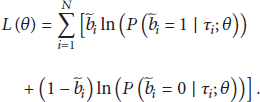
Thus, the likelihood function of the parameter θ at the FC based on the received binary sequence



Then its log-likelihood function is expressed as
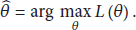
4.2. CRLB
The aforementioned section has presented the channel-aware adaptive quantization scheme. In this section, its CRLB associated with the proposed scheme is derived to determine the lower bound on the variance of any unbiased estimator and provide the best performance benchmark.
According to the CRLB for vector parameter [32], the CRLB for the channel-aware adaptive quantization scheme can be given as follows:


Thus,


To obtain


Then, for the


For example, if


Example of a state diagram.
Theorem 1.
For any unbiased estimator


Proof.
First, we derive the element

We have

According to formula (8), we have

The theory above introduces
Lemma 2.
If matrix A is positive definite, then matrixes
Theorem 3.
Let the multiplicity of the positive definite matrix A be
Proof.
By hypothesis, A is positive definite and therefore there exists an orthogonal matrix T such that
Meanwhile, we have

By Lemma 2, we have that matrixes
It is obvious that


Similarly, we have


It therefore follows from (36) and (38) that
Hence

Since A is positive definite,

Remarks. The proposed position-based adaptive quantization scheme in Section 3 is easy to apply. According to (20), the MLE is found through a systematic grid search and the lower bound on this time complexity is
Nevertheless, Theorem 3 introduces the basic principle for designing indexes of all local sensors of stage
5. Performance Evaluation
In this section, some simulations are given to assess the performance of the proposed MLE in Section 4.1. Its CRLB provides a benchmark (lower bound) for comparison. Our MLE is also compared with the fixed quantization MLE described in [21]. In order to find the global optimal value in the proposed MLE, a systematic grid search, such as the sequential quadratic programming (SQP), is employed to find an approximate maximum point. Additionally, it is assumed that the WSNs are uniformly deployed as shown in Figure 1.
Here, we consider five simulation scenarios. Scenario 1 considers the performance of different quantization methods versus the number of sensors N. Scenario 2 considers CRLBs of different quantization methods versus different crossover probabilities
Scenario 1.
The performances of fixed and adaptive channel-aware CRLBs are compared for different numbers of sensors. As shown in Figure 6, it is noted that the proposed channel-aware adaptive quantization scheme has a lower CRLB than the classical fixed quantization scheme [21]. As N increases, both P-CRLB and F-CRLB become lower. Further, the proposed MLE will approach its appropriate CRLB when the number of sensors is large enough, as shown in Figures 6 and 7.

CRLB versus the number of sensors N.

RMS versus the number of sensors N.
Scenario 2.
The performances of fixed and adaptive channel-aware CRLBs are compared for different crossover probabilities, as shown in Figure 8. It is noted that the proposed channel-aware adaptive quantization scheme has a lower CRLB than the classical fixed quantization scheme [21] for different crossover probabilities

CRLB versus different crossover probabilities.
Scenario 3.
The performances of the adaptive channel-aware CRLB are examined for different sensor densities. The sensor density of ROI in Figure 9 is

The higher sensor-density square ROI of target localization in WSN.

CRLB versus the sensor density.
To further examine the effect of the initial position of the target, we uniformly choose the initial position of the target as

CRLB versus different locations of the target.
Scenario 4.
The performances of fixed and adaptive channel-aware CRLBs are compared for different step-size parameters Δ, as shown in Figure 12. Firstly, the fixed channel-aware CRLB is constant under different step-size parameters. Then, a larger Δ gets a better performance because the proposed position-based scheme with a larger Δ can track
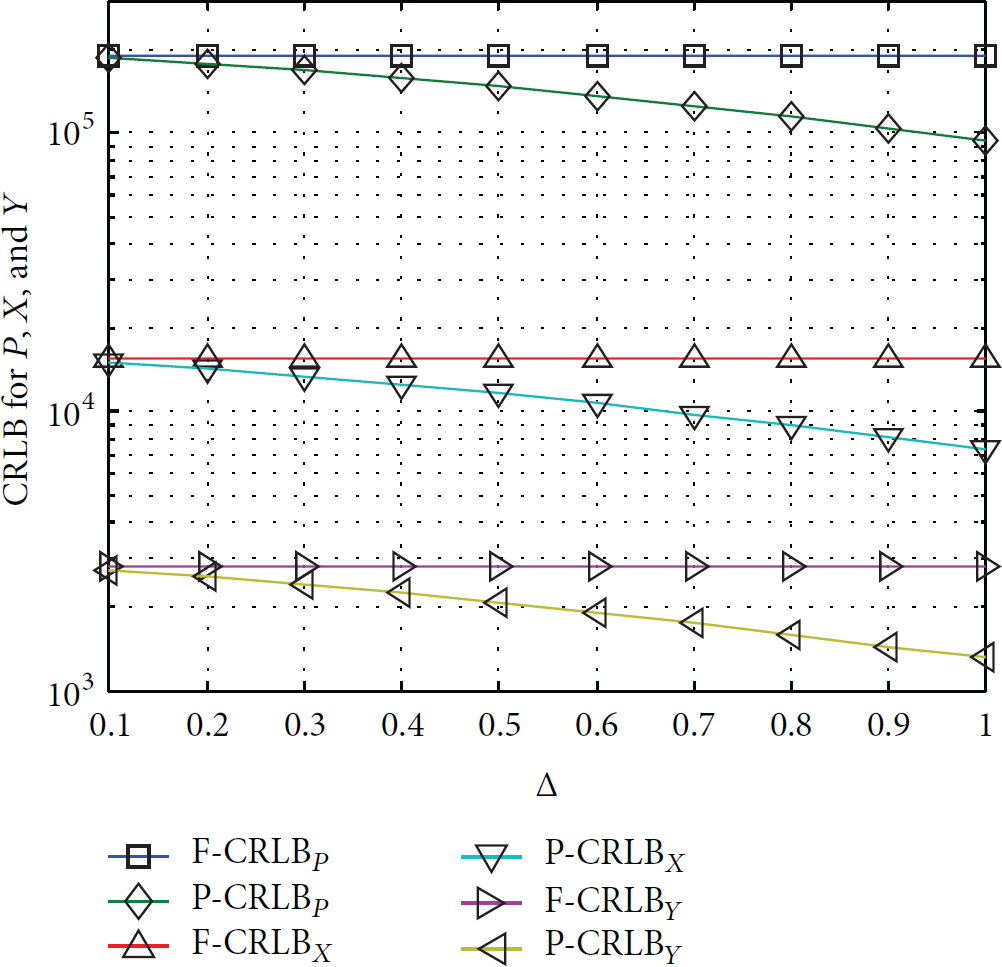
CRLB versus the step-size parameter Δ.
Scenario 5.
As claimed in Theorem 1, the adaptive channel-aware CRLB is a function of

CRLB as a function of

The maximum and minimum of
6. Conclusion
In this paper, the quantization scheme in source localization problems under imperfect communication channels was investigated. A novel adaptive quantization scheme using one-bit data was developed and the appropriate channel-aware MLE which incorporates channel statistics information at the FC was also proposed. Additionally, the CRLBs for the adaptive quantization scheme was derived to benchmark the estimation performance and then a sufficient condition for the corresponding Fisher information matrix being positive definite was introduced. Finally, simulation results show that the MLE is effective and the crossover probability of BSCs greatly influences the performance of the CRLB.
Footnotes
Conflict of Interests
The authors declare that there is no conflict of interests regarding the publication of this paper.
Acknowledgments
This work was supported by National Natural Science Foundation, China (61403089, 61162008, 61573153, 51205072, and 51575115), Program for Guangzhou Municipal Colleges and Universities (1201431034), Natural Science Foundation of Guangdong Province, China (2014A030310418), Foundation for Distinguished Young Talents in Higher Education of Guangdong, China (2013LYM_0068), Project of DEGP (2014A010105053), and Guangzhou Science and Technology Foundation (nos. 2014J4100142, 2014J410023).