




Abstract
Wireless Body Area Networks (WBANs) supporting healthcare applications are in early development stage but offer valuable contributions at monitoring, diagnostic, or therapeutic levels. They cover real-time medical information gathering obtained from different sensors with secure data communication and low power consumption. As a consequence of the increasing interest in the application of this type of networks, several articles dealing with different aspects of such systems have been published recently. In this paper, we compile and compare technologies and protocols published in the most recent researches, seeking WBAN issues for medical monitoring purposes to select the most useful solutions for this area of networking. The most important features under consideration in our analysis include wireless communication protocols, frequency bands, data bandwidth, transmission distance, encryption, authentication methods, power consumption, and mobility. Our study demonstrates that some characteristics of surveyed protocols are very useful to medical appliances and patients in a WBAN domain.
1. Introduction
With ageing of the population, existing medical resources cannot satisfy future healthcare demands of seniors and patients. Resources are limited and it is impossible for most patients to afford long-term hospital stays due to economic restrictions, work, and other reasons, even though their health status must be monitored in a real-time [1] or short periodic time mode. As a result, wireless monitoring medical systems will become part of mobile healthcare centers with real-time monitoring in the future.
In this context, WBAN supporting healthcare applications can offer valuable contributions to improve patient healthcare, including diagnosis and/or therapeutics monitoring. In a short time, WBAN technology has taken its first steps in the medical rehabilitation and monitoring of patients. However, underlying technology is still in an early development stage and typically based on very specific wireless communications technologies. Patients may be comfortably monitored at home while carrying out their daily activities, and medical staff have to monitor many patients simultaneously. The balance between these generally conflicting features means that research in this arena is not finished. In this area, data reliability, power consumption, and small size are very important characteristics to consider when choosing appropriate WBAN sensor nodes. Many studies have been focused on WBANs for medical purposes. However, few works have been concerned with a global solution for tens or hundreds of patients, each of whom is fitted with multiple sensor nodes, and confined to a relatively small environment like an infirmary or a living or dining room of a hospital. Until now, some of the research and studies carried out for hospital environments have obtained results for different nodes in several experimental subjects.
Given the present situation, the aim of this work is to identify and select existing technologies and protocols that satisfy the main requisites of WBANs for the application of healthcare with regard to patient mobility, secured and reliable data, power consumption, and the requirements needed for large amounts of sensor nodes to coexist in a relative small space. To understand the special needs in a medical network, both the protocol stack and understanding of each protocol layer are essential. This paper presents an overview of the state of the art in WBAN. It is mainly focused on architectures and communication protocols for healthcare networks based on WBANs. We analyze the most recent implementation solutions for this type of network, as well as the protocols used at each protocol layer. Each implementation has its own characteristics, advantages, and disadvantages, which are comprehensively described and analyzed in several comparative tables. Moreover, we also provide a comparative study of emerging and existing radio technologies and protocols for nonproprietary WBANs on unlicensed radio frequency bands.
While in this section we have introduced the main motivation of the work, the rest of the paper is structured as follows. Section 2 describes the characteristics of WBANs for medical applications, medical sensors, and security issues. Section 3 presents a survey of existing WBAN projects in medical domain. Sections 4 to 8 analyze existing works at the application layer, transport layer, network layer, medium access sublayer, and physical layer, respectively. Section 9 summarizes relevant outcomes resulting from the study carried out. Finally, Section 10 concludes the paper and identifies future research work.
2. Main Characteristics of Wireless Body Area Networks for Medical Purposes
WBANs for healthcare applications are mainly used in patient monitoring tasks. In this type of network, the sensors are distributed on the human body measuring different physiological parameters, which represent the most widely used solution within this domain [2]. Sensors nodes around the body with wireless capabilities are of special interest to this kind of WBAN, since they provide a comfortable and user-friendly way to monitor a patient's health status over extended periods of time, avoiding the use of cables wired around the patient. Generally, the composition of the human body tissue has different amounts of water. Because of this, the propagation of electromagnetic signals through the human body is variable and subject to absorption and reflections within the body. Consequently, the propagating wave diffracts around the human body rather than passing through it. The transmission power for on-body transmission for a wireless link depends on the physical distance of the link and its instantaneous channel condition. The inherent characteristics of RF attenuation in and around the human body can have a direct impact on channel conditions. Additionally, patient mobility and posture can have a significant effect on efficient packet delivery. The characteristics of the WBAN radio propagation are dynamic due to the motions of the human body. Daily activities such as running and walking and physiological activities such as the heartbeat and breathing affect the wireless propagation dramatically [3].
A typical WBAN architecture includes (i) a small network around the body (about 1-2 meters), (ii) a gateway (sink) bridging to another network types that can be another node with some routing and data aggregate features, (iii) a wide network that can be an Internet or intranet network, and (iv) applications with GUI for medical or other healthcare personnel. Figure 1 shows this typical WBAN architecture.
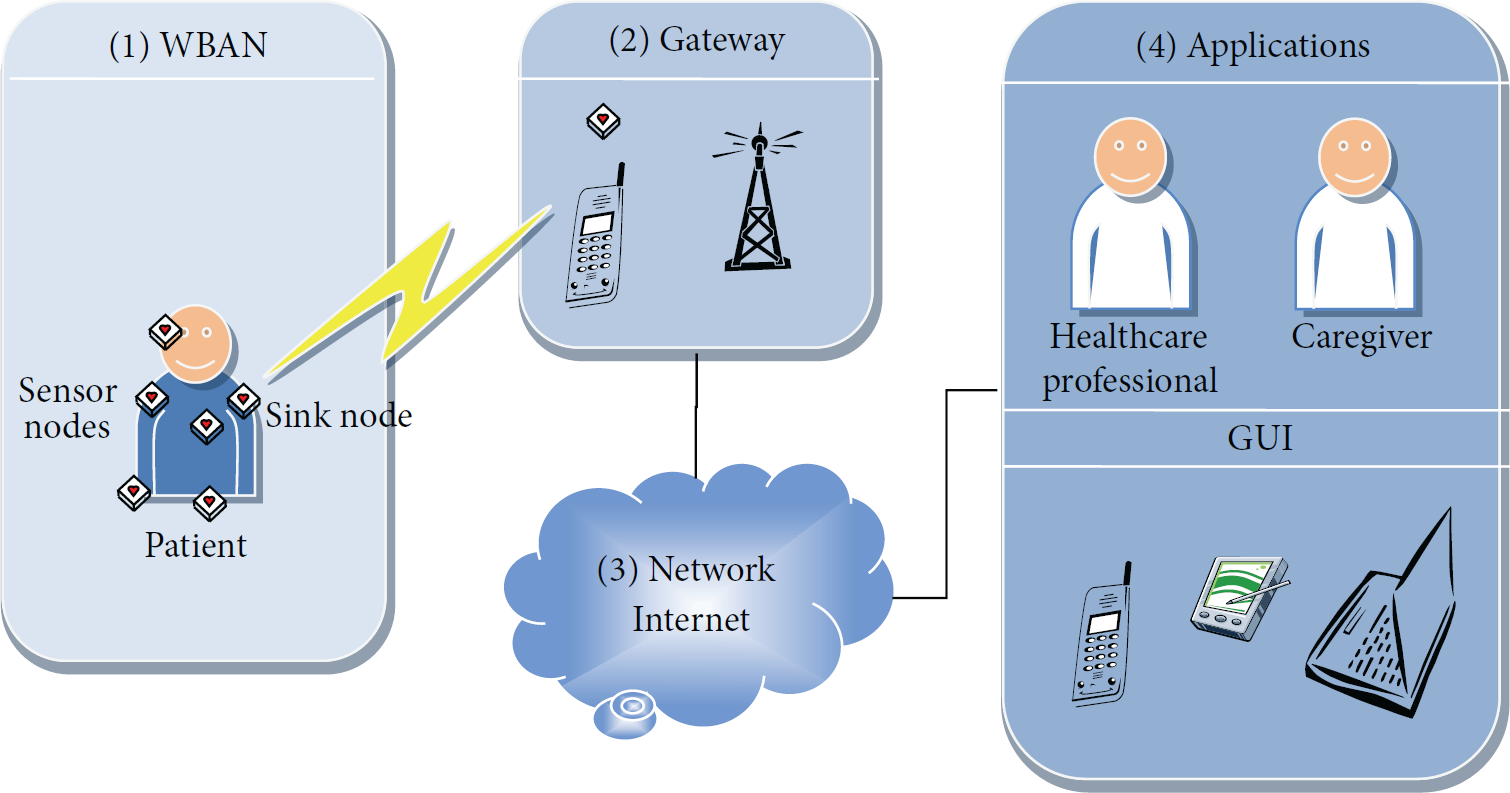
Typical WBAN architecture.
Recently, some authors have identified the main characteristics of this type of network [4]. Their studies identify some requirements of WBANs:
minimal weight, miniature form-factor, low power operation, simplified integration into a WBAN, standards-based interface protocols, and patient-specific calibration, tuning, and customization, medical data transfers requiring encryption of all sensitive information related to personal health, fault tolerance: in case a sensor node stops working, a back-up node in the immediate neighborhood can take on the role of that node, so that critical measurements are not missed, network quality of service (QoS): it is essential for medical data to be transmitted and received without error and in a usefully time, the potential of WBANs that can only be fully explored if they can interoperate securely and seamlessly. Interoperability should take place at the neighborhood level among the WBANs of a given patient and surrounding environmental sensors.
According to [5], the WBAN design phase must consider several significant requirements influencing performance: energy-management policy, energy-efficient design, link reliability, robustness, scalability support, interoperability, self-organization, point-to-point reliability, security, and mobility support.
Additionally, other features of this type of WBAN can be identified.
Easy access and comfort [6]: WBAN nodes are strategically placed on the human body or are hidden under clothing. Noninvasive sensors are mainly used. Small size and low cost are mandatory. Real-time processing [1]: WBANs are employed to register a human's physiological activities and actions, which may occur in real time [6, 7] or in periodic timing [8]. This requirement is dictated by the applications and may be traded for improved reliability and energy consumption. Mobility requests [6]: WBAN users may move around. Therefore, their nodes share the same mobility pattern with respect to an external gateway. The signals that body sensors provide can be effectively processed to a central point.
Other applications (e.g., motion estimation) can be implemented without additional resources on WBAN. Received Signal Strength Indicator (RSSI) measurements are unique in the sense that they can be included in all WBANs and as such, they do not require additional resources. In [9], authors demonstrate the potential of using RSSI measurements on kinematic human.
Moreover, some WBAN architectures have been successfully tested, specifically in fitness applications. In these architectures, the BAN gateway is a mobile phone or a personal digital assistant (PDA) transported by person. In such a situation, the PDA is the sink node; that is, it is part of the WBAN and can connect to the healthcare center via Internet using GSM, GPRS, UMTS, Mobile WiMAX, or other technologies. This mode of operation increases mobility of WBAN. Figure 2 introduces the new approach of mobility-free WBAN architecture.
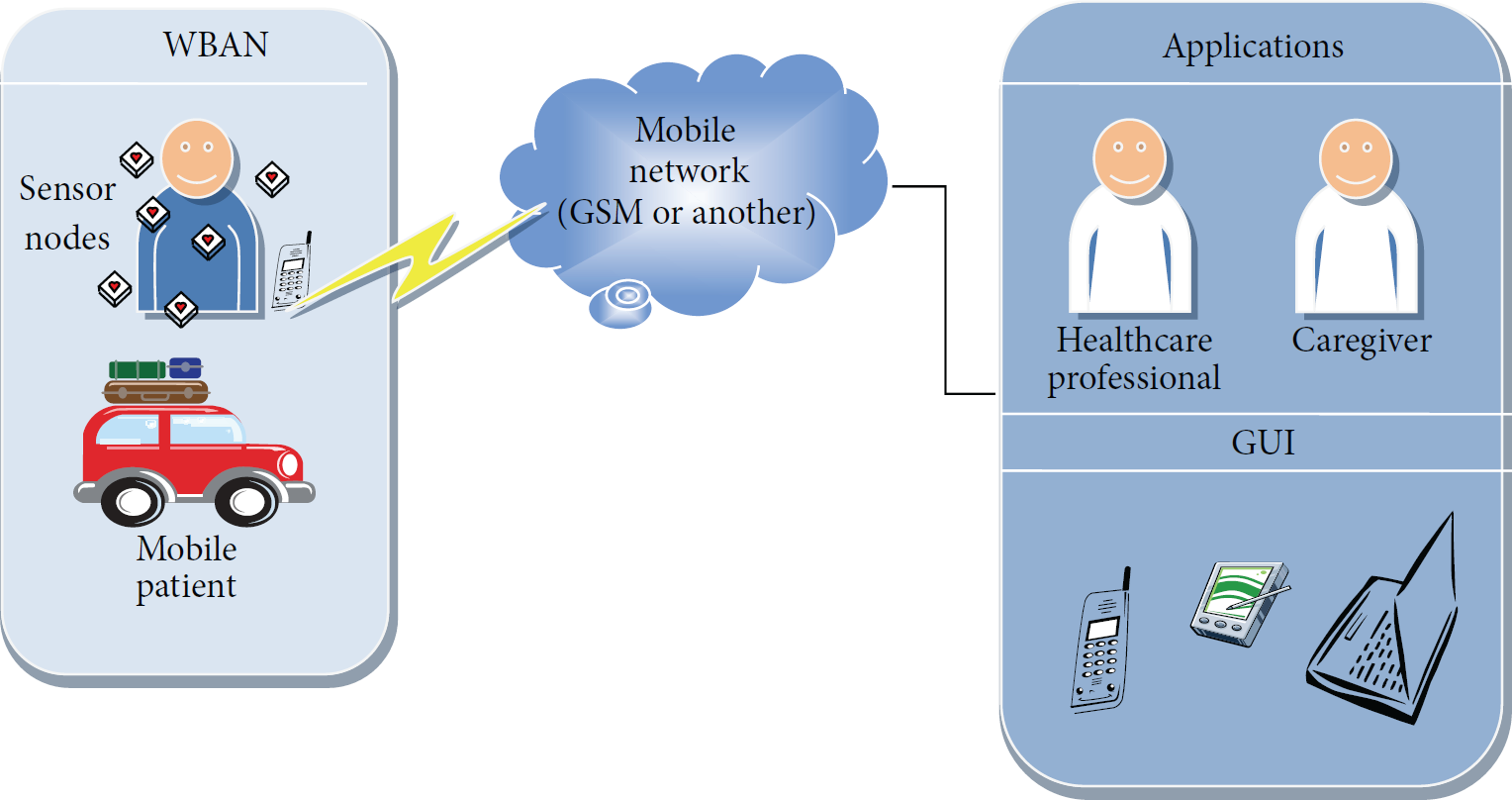
New (mobility-free) WBAN architecture approach.
With regard to the actual hardware, body sensors must be small, thin, noninvasive, and wireless-enabled and must be able to operate at a low power level [8]. Therefore, because the batteries can be easily changed by users or medical assistance, the operation of body sensors at low power levels is not so critical when compared to other types of wireless sensors. A sensor system in medical appliances should be comfortable to wear and not intrusive, and it should require no skillful preparation to apply to patients, nor accurate positioning. While conductive materials with organic textiles (e-textiles), noninvasive and wireless-enabled, are emerging technologies, they are not the focus of this paper. In most medical applications, sensor data rates are critical and the network needs to correctly handle this situation. Each medical application has an ideal data rate [10], so the network and related protocols must have enough bandwidth for supporting all applications.
Internally, a sensor node is made up of four basic components: a sensing unit, a processing unit, a transceiver unit, and a power unit [11]. Typically, the most power consuming component is the transceiver. Each node must operate autonomously in order to reduce power consumption. Multipath or multihop methods of wireless communication increase the interdependency of the nodes, also augmenting power consumption [12].
From another perspective, WBANs must incorporate adequate levels of security and privacy to protect sensitive personal and medical data. WBAN nodes are used to collect sensitive (life-critical) information and may operate in hostile environments that require strict security mechanisms to prevent malicious interaction with the system. Attacks, where the information is intercepted or modified by malicious users, or attacks to attempt to exhaust the energy resource of the sensors are possible. Saleem et al. [12] and Kumar and Lee [13] highlight that major attacks that can be harmful to wireless healthcare networks at physical, Medium Access Control (MAC), network, and transport layers, as well as possible security defenses. All these attacks affect the transmission of information in different ways: occupying the available bandwidth of the network, consuming the energy of nodes, and violating the integrity and confidentiality of patient data. To protect the network from these attacks, network protocols must be secure, providing services such as encryption and authentication [4].
Taking all the previous reported topics into consideration, WBANs for healthcare applications require an approximate 1-2 meter range, present small wireless sensors nodes around the body, require real-time processing [6, 7], and need to be comfortable and easy to use. If the batteries are easy to replace, the power consumption is not so critical. Protocols of WBANs must support mobility, data encryption, and reliability.
3. Survey of Existing Body Area Networks Used in Healthcare Applications
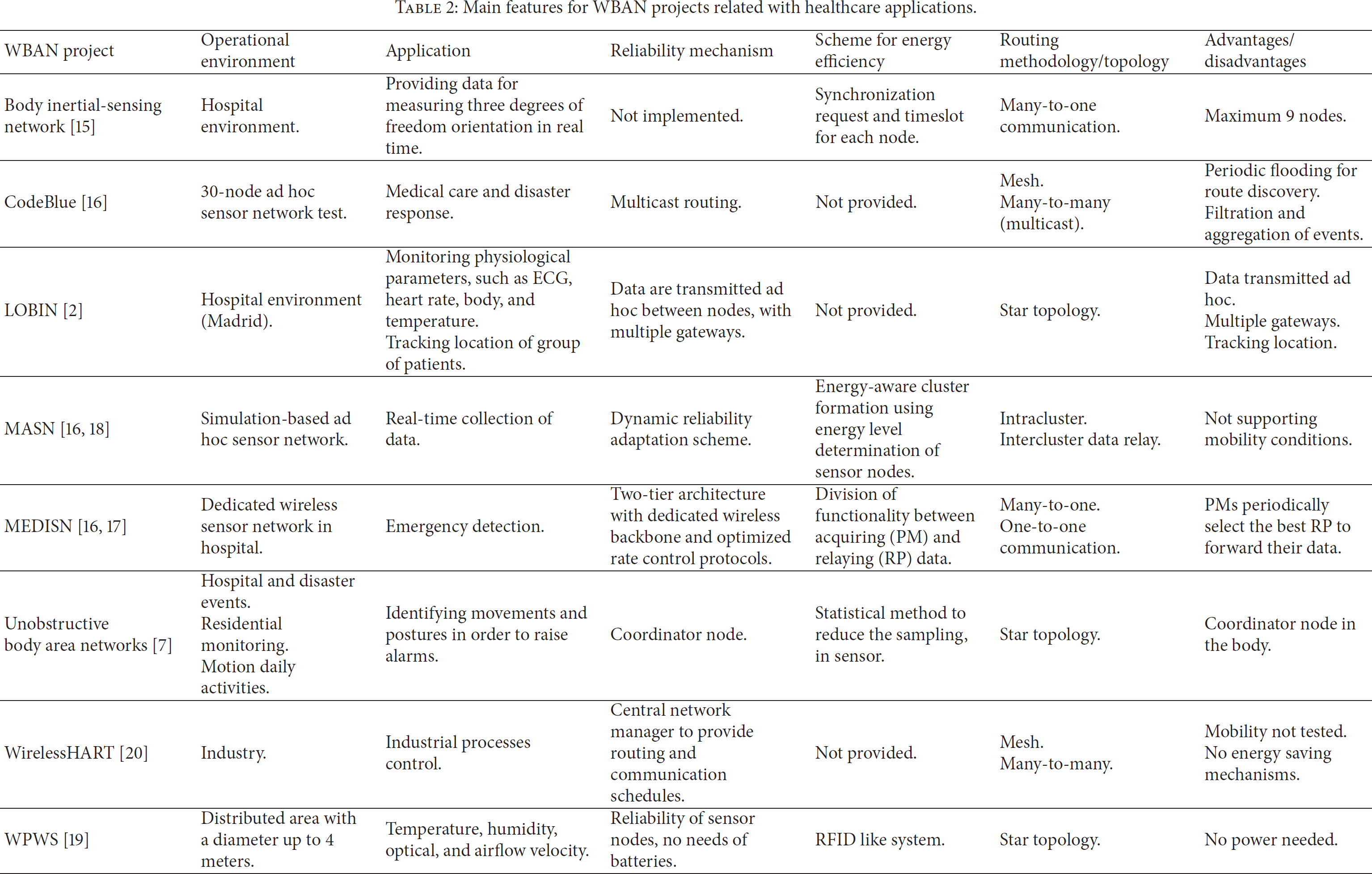
Various WBAN architectures and protocols related to the studied domain have been proposed in recent works. This section provides a literature review of existing approaches. Our goal is to analyze the type of protocol used in each network stack layer, operational environment, applications, reliability mechanisms, scheme for energy efficiency, routing methodology, used topology, and advantages and disadvantages. At the end of the section, Tables 1 and 2 summarize the information collected.
Protocol stack distribution of WBAN used in healthcare applications.

Main features for WBAN projects related with healthcare applications.
WBANs are application-dependent, being generally classified into two different types: event detection and periodic event. In the first, the nodes send data only when an event occurs (e.g., when a patient falls), while in the second the nodes send data at periodic intervals (e.g., sending blood pressure, body temperature, or heart beat). In each case of the network topology, both node resources and the data sent are different. One of the most important things in designing standards for WBANs is the balance of QoS requisites with the low power constraints of nodes. Some standards have been adapted for healthcare applications like Bluetooth (IEEE 802.15.1) or ZigBee (IEEE 802.15.4) protocols. These wireless standards are well documented and tested but are not efficient because they target networks that are more flexible and are used for longer transmission ranges. This makes them less energy efficient than protocols that are specifically designed for a WBAN (e.g., 802.15.6) [14].
Chen et al. classify the BAN communication architecture into three main tiers [8]: (i) intra-BAN communications, (ii) inter-BAN communications, and (iii) beyond-BAN communications. In this tiered architecture, a WBAN (Tier 1) is limited to the sensors and local gateway in patient, Tier 2 connects some patients or sensors (by type for localization, e.g.,), and Tier 3 represents the existing network (e.g., Internet or intranet). This approach maintains each network segment well defined and correctly separates their respective functions.
Body inertial-sensing network [15] is a project that uses a new method of gestures of body segments to estimate the knee joint angle and identify gait cycles. It was designed to provide data for real-time measuring of three degrees of freedom orientation. It contains four sensing components: a three-axis accelerometer, a three-axis magnetometer, a three-axis gyroscope, and the temperature sensor. Each node, part of a star topology, transmits data to the central base station (CBS), which is connected to a computer via wireless. For energy savings reasons, wireless transmission is not always active. Every node in the network sends a synchronization request packet to the CBS when it wants to send data. After this request, the connection between the CBS and the node is established.
The LOBIN project [2] is an e-textile and Wireless Sensor Network (WSN) based healthcare platform that aims to both monitor several physiological parameters (e.g., ECG, HR, inclination, activity index, and body temperature) and track the location of a group of patients within hospital facilities. The system shows and stores the data associated with patients in real time and has multiple gateways for better mobility and reliability.
Unobstructive Body Area Networks [7] are a system that collects and transmits data from sensor nodes to a control center capable of analyzing and processing the information. The system creates movement profiles based on the data sent by the nodes and detects any abnormal movement in real time, allowing for monitored rehabilitation of the user.
CodeBlue [16] is referred to as a prototype healthcare Wireless Sensor Network that defines the architecture for hardware and a framework for software. The framework provides protocols for device discovery, subscribing a routing layer and a simple query interface that allows for requesting data from groups of nodes. It provides protocols and services for node naming, discovery, any-to-any ad hoc routing, authentication, and encryption.
The MEDiSN architecture [17] includes a number of Physiological Monitors (PMs) to collect patient's physiological data. Relay Points (RP) aggregate and forward data from PMs. A gateway collects all the data from RPs using management command handling. PMs only send data and are not involved with data forwarding. RPs self-organize into a routing tree and use hop-by-hop bidirectional data traffic retransmissions, which are prone to packet collision and corruption. The backend server host stores patient data and supports multiple gateways. The connection between the backend server host and the gateways is made through existing network (i.e., intranet or Internet).
Low power Medical Ad hoc Sensor Networks (MASN) [18] consist of low-cost ECG sensors that are attached to the patients' bodies. They involve a cluster based, energy-aware ECG collection scheme whereby the ECG data are reliably relayed to the sink node in the form of aggregated data packets.
A Wireless Sensor Enabled by Wireless Power (WPWS) [19] presents an RFID system architecture. The nodes have no batteries and have two antennas: a power antenna that works at 915 MHz and induces energy to sensors on each node and a data communication antenna that works in a 433 MHz band. The power antenna was designed to gather power from a standard reader. A special physical data link layer was designed for this purpose. WPMS requires the definition of only three layers: the physical (PHY) layer, the media access control (MAC) layer, and the application (APP) layer.
WirelessHART [20] is the first open wireless communication standard specifically designed for process measurement and control applications. WirelessHART was officially released in September 2007 and implements a secure and Time Division Multiple Access (TDMA) based wireless mesh networking technology operating in the 2.4 GHz Industrial, Scientific and Medical (ISM) radio band. To support the mesh communication technology, each node is required to be able to forward packets on behalf of other devices. Both the MAC and network layer provide security services.
Most of previous reported systems are experimental and their goal is to demonstrate some parts belonging to the layer protocol stack. The transport layer is frequently absolved by the application layer. In fact, questions about congestion control, flow control, allocation of bandwidth, packet-loss recovery, and energy efficiency are commonly treated at the application layer, depending on the functionality.
Table 1 summarizes the protocols developed in the previous commented projects for each network layer.
As shown in Table 1, the physical and data link of 802.15.4 standard (ZigBee) is the most used approach in all the projects, although it is not energetically optimized. There are also many other previous works and studies with this standard. As it was designed specifically for wireless sensing industry, it is well tested and uses low-cost hardware. Other technologies like IEEE 802.11 (Wi-Fi) or IEEE 802.15.1 (Bluetooth) were developed for nonmobile applications, using other types of equipment without the processing and energy limitations that exist in WBANs. Table 2 shows the main features identified for each project.
In the survey carried out, each project has some special characteristics to promote it. Each one has advantages and disadvantages. Star and many-to-one communication are the topologies most frequently used by these projects to solve routing or aggregate data problems. For solving power problems, RFID-like systems seem to be a good solution but in WBANs applied to patient monitoring this issue are not so critical. Multiple gateways and dedicated wireless backbone are used for reliable, mobility, and routing issues in WBANs.
4. Application Layer
At the application level, the network architectures should be implemented according to the corresponding applications [8]. In addition, an application layer management protocol makes the hardware and software of the lower layers transparent to the sensor network management applications. Mamun [21] identifies different application protocols such as protocols for data gathering/collection, target tracking, routing, data aggregation, data dissemination, and so forth.
Akyildiz et al. [11] mention three possible application layer protocols: the Sensor Management Protocol (SMP), Task Assignment and Data Advertisement Protocol (TADAP), and Sensor Query and Data Dissemination Protocol (SQDDP). The system administrators interact with sensor networks by using SMP. A management protocol provides the software operations needed to perform administrative tasks such as introducing the rules related to data aggregation, time synchronization of the sensor nodes, moving sensor nodes, turning sensor nodes on and off, querying the sensor network configuration and the status of nodes and reconfiguring the sensor network, authentication, key distribution, and security in data communications.
TADAP permits users to send their interest to a sensor node, a subset of the nodes, or whole network. This interest may be about a certain attribute of the phenomenon or a triggering event.
SQDDP provides user applications with interfaces to issue queries, respond to queries, and collect incoming replies. These queries are generally not issued to particular nodes, but to part or the entire network. Any query simultaneously sent to multiple nodes (or part of the network) allows for energy saving and processing, which in WBANs is important because this type of network usually presents limited resources.
ZigBee standard Application Layer (APL) defines three sublayers: The Application Support Sublayer (APS), the ZigBee Device Object (ZDO), and the Application Objects (AO).
The AO are manufacturer-defined applications, based on requirements defined by the end users. Up to 240 application instances may be supported on a single ZigBee node. Each application instance communicates via an endpoint, where endpoints are numbered between 1 and 240. The APS layer is responsible for communicating with the relevant application, maintaining binding tables and sending messages between nodes, and providing communication with the trust center. This sublayer has an associated database, APS Information Base (AIB), that relates to system security. APS also provides discovery capability to neighbor devices. The ZDO defines functions provided by the device for network operation. The role of devices such as a network coordinator or a router is defined through the ZDO.
The advantage of using ZigBee on WBANs is that the entire protocol stack is already defined and implemented, allowing the applications to use the network stack without modifications. This makes it possible to test and use WBAN applications without requiring knowledge of networking.
Figure 3 shows ZigBee and IEEE protocol stack.

IEEE and ZigBee protocol stack.
In the WirelessHART project [20], communication between the devices and gateway is based on commands and responses. The application layer is responsible for parsing the message content, extracting the command number, executing the specified command, and generating responses.
Protocols like Incremental Join Algorithm (IJA) [22] gather data from sensors by modeling it as a distributed database that uses queries to collect and process sensor readings. Using simple queries such as SELECT and AGGREGATE commands, the nodes send and aggregate the data transferred in network.
At WBANs level, data aggregation allows data to be sent at one time, therefore preforming less transmission. Besides saving energy on aggregator nodes (sink), this characteristic also causes less congestion in the electromagnetic spectrum.
The IEEE 1451 [23] standard defines an Application Program Interface (API) for applications that provide communications between smart sensor node and actuators. The goal of this standard is to provide an interface schema that allows for connections between different devices and heterogeneous networks. The IEEE 1451.0 standard defines a set of functionalities for the IEEE 1451 and is independent of physical communication media.
A scheme that allows for connections between different devices may be useful in WBANs because each sensor has different characteristics (e.g., a temperature sensor is necessarily different from a heartbeat sensor). The type, frequency, and amount of data are also different. A protocol able to deal with these heterogeneous systems may be important.
Health Level 7 (HL7) [23], which was approved by ANSI, is the most popular standard for the exchange of medical information in Local Area Networks (LAN) and can also be used in WBANs. The goal of the HL7 standard is to exchange information based on text messages. The most important concepts of HL7 are triggers, trigger events, and messages. Triggers are used to listen for trigger events. The trigger event is detected as a trigger and directs the application to prepare specific documents. HL7 documents and messages are text-based information and use the XML file structure to store information. The HL7 messages are easy to encode and provide satisfactory reliability in the application layer, because the information is text based and has mature technology for encryption.
Table 3 summarizes the application protocols and their main functionalities.
Application layer protocols and their respective main functionalities for WBANs.

The application layer includes a variety of protocols that perform various sensor network applications, such as query dissemination, node localization, time synchronization, and network security. Once the application layer connects from the client to each sensor, we can consider that all the protocols described in this layer can be classified under categories Tier 1, Tier 2, and Tier 3. Application protocols like IJA or HL7 with queries or XML messages are more flexible and versatile for any data communication between each node or group of nodes and user API.
The bandwidth requirements in the network are defined by the amount of information to be carried out. Thus, the application layer plays a very important role in the required bandwidth to the network. Protocols, such as IJA (that provides commands for data aggregation) and TADAP and SQDDP (in which queries are performed only to part of the network or to some relevant nodes), allow for a reduction of the bandwidth used and the consequent minimization of the energy consumed by the nodes.
5. Transport Layer
Transport layer protocols have gained fundamental importance in WBANs (like in WSNs) as they establish end-to-end connections over the network, while offering services such as congestion control, flow control, fair allocation of bandwidth, reliability, packet-loss recovery, energy efficiency, and heterogeneous application support [24]. This layer is especially useful when there are plans for the system to be accessed through Internet or other external networks.
Unlike protocols such UDP or TCP, some of the end-to-end communication schemes in WBANs are not based on global addresses. These schemes must consider the fact that attribute-based naming is used to indicate the destinations of the data packets. Factors, such as power consumption and scalability, and characteristics, such as data routing, require sensor networks to be processed differently in the transport layer. New types of transport protocol layers are needed.
One of the major limitations in TCP, as applied to WBANs, is that it involves an end-to-end reliability model and enables an expensive retransmission mechanism at every hop of the path between the source and the sink node if the packet is lost [24]. There are two common approaches to improving end-to-end reliability in WBANs. One approach explores the use of reliable transport protocols, while the other explores the use of redundant transmissions and coding techniques to allow data to be reconstructed at the receiver [16].
TCP connections can be used between sink nodes and end user terminals, while the UDP or a special transport layer protocol can handle the communications between the sink node and sensor nodes. For that reason, we can consider that the protocols described at WBANs transport layer can be classified under categories Tier 1 and Tier 2. For Tier 3 (beyond-BAN) the connection between sink nodes (or access points) and end user terminals can use TCP. The communication between the sink and sensor nodes may be purely because of the UDP type protocols, because each sensor node has limited memory and energy [11].
In [24], authors evaluated technical and experimental attributes of the 22 transport protocols developed between 2002 and 2010 for WSN and established a benchmark for experimental settings, recommending special attention to reliability and congestion control. At this level, these two attributes also apply to WBANs.
In most of these protocols, congestion control mechanisms monitor the channels and dynamically regulate the data transmission rate only when congestion is detected. However, it is important to monitor the channel intelligently to control and, if possible, anticipate congestion. TRCCIT and RT2 [24] make this feature. Very few transport protocols such as RT2, PCCP, and PHTCCP [24] enhance performance using cross layer interaction. Because of this feature and the intelligent monitoring of the channel to control and anticipate congestion, RT2 is a good protocol to use in WBANs, namely, at Tier 1 and Tier 2 levels.
In Asymmetric and Reliable Transport Mechanism (ART) research [25], there are essential and nonessential classification nodes. The essential nodes are the nodes in the main path between the end node and the sink node. Only essential nodes participate in the route path, but it can change because the essential nodes and the path are defined by remaining energy in each node. Each node loses energy in each bit sent and received. The nonessential nodes are neighbor nodes of the essential nodes, and the roles can change when the energy levels change. At WBANs, this feature can be useful to collect data if some nodes in the route path fail or have power loss.
Pump Slowly Fetch Quickly (PSFQ) [26] provides reliable transport from sink to node and relies on the slow pump operation to limit congestion, although congestion occurs as the node numbers increase.
In the ZigBee standard [27], the APS is a sublayer of application layer but has characteristics of the transport layer. The APS provides discovery capability to devices so that the neighbors and the functionalities provided by these neighbors can be stored. APS has capabilities of binding, group address, reliable transport, duplicate rejection, and fragmentation. These characteristics are good for WBANs partly because some of the medical data can be critical and reliable, and fragmentation helps to guarantee the delivery of all the data sent. Group nodes and reject duplicates help energy saving of the nodes.
Congestion Detection and Avoidance (CODA) [28] is an energy-efficient congestion control scheme for sensor networks, which comprises three mechanisms: receiver-based congestion detection, open-loop hop-by-hop backpressure, and closed-loop multisource regulation.
Table 4 summarizes the main features of the most recent and most used transport layer protocols.
Main utility for WBANs transport layer protocols with reliability and congestion control.
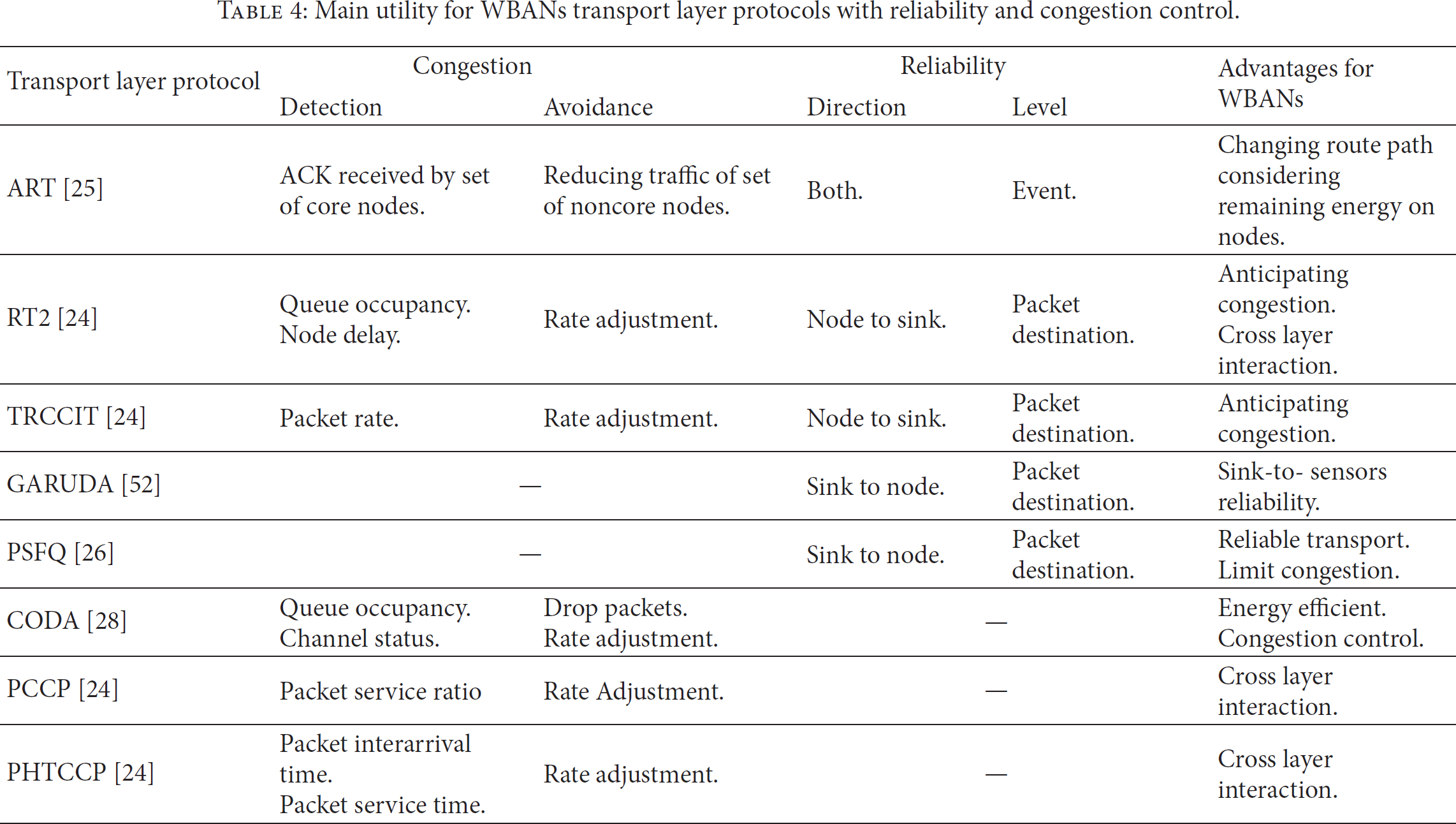
Protocols with congestion control detect congestion by packet time or queue occupancy. They deal with congestion, adjusting the transmission rate. Only the ART protocol controls ACK packets received on core nodes and reduces traffic on noncore nodes, in an effort to deal with congestion. The ART method does not guarantee the reduction of congestion and may reduce important traffic on noncore nodes. With regard to controlling reliability, most protocols discussed analyze the packet received on destination. Some protocols are reliable only from node to sink, while others, like GARUDA and PSFQ, are reliable only from sink to node. The ART protocol is reliable in both directions. In order to control reliability, a critical events report message is received by the sink node.
The RT2 is the protocol selected to use in WBANs (at both Tier 1 and Tier 2 levels) because of its cross layer interaction to enhance performance and the intelligent monitoring of the channel to control and anticipate congestion. At Tier 3 level, communication is between end user and one or more access points. The equipment has more resources and energy than sensor nodes, and protocols can require and use more processor, memory, and energy. With end user static or not, the existing TCP protocol can be used.
6. Network Layer
Over the last decade, a large number of routing protocols have been designed for achieving energy efficiency while collecting data within wireless sensor networks. Among them, the tree-based routing protocols have garnered attention in this research field. There is a variety of reasons for using trees as a routing topology, in WBANs: routing is very simple since the path between any two nodes is unique, and data aggregation can be employed to reduce the volume of data by combining highly correlated data [29].
Additionally, at WBANs the human body is distinctive compared to other environments since it has a complex shape consisting of different tissues, carries out activities such as walking and running, and executes physiological activities such as the heartbeat and breathing; all of these might affect the wireless propagation channels dramatically [3]. In addition, in WBANs we can consider that the batteries can be easily changed on nodes, because they are very accessible. Nevertheless, we must not overlook the fact that the nodes need to be energetically efficient and self-sufficient for a reasonable period of time.
For solving routing and energy problems, some authors focus on minimizing the maximum energy consumption (Emax) of any single node in the network, while others aim at minimizing the average energy consumption (Ebar) over all nodes [30]. In a WBAN tree routing topology, sink nodes are the critical ones, because they require more processing to aggregate data and can more easily lose energy, compromising all the communication.
Akyildiz et al. [11] state that the networking layer of sensor networks is usually designed according to power efficiency, data-centric approach, data aggregation, and attribute-based addressing.
To select an energy-efficient route, Akyildiz et al. [11] refer to various processes.
Maximum total available power (PA) route is preferred. The total PA is calculated by summing the PAs of each node along the route. Minimum energy (ME) route: the route that consumes ME to transmit the data packets between the sink and the sensor node is preferred. Minimum hop (MH) route: the route that makes the MH reach the sink is preferred. Maximum minimum PA node route: the route along which the minimum PA is larger than the minimum PAs of the other routes is preferred.
Another important issue analyzed in the work of Akyildiz et al. [11] is that routing in networking layers may be data centric. In data-centric routing, the interest dissemination is performed to assign the sensing tasks to the sensor nodes.
In addition, another function of the network layer is to provide internetworking with external networks such as other sensor networks, command and control systems, and the Internet. To do this, the sink node can be used as a gateway to other networks. The sink node is a node that collects data from all other nodes. Physically, sink nodes can be located in the center of WBAN or peripherally; their position can be static or relatively mobile, in relation with the nodes.
Khan et al. [30] have provided a simulation-based analysis of the energy efficiency of WSNs with static and mobile sinks. They concluded that, for small values of the duty cycle (sleep and active-time period), a static sink is optimal in terms of both maximum and average energy consumption; for larger values of the duty cycle, a mobile sink has advantages over a static sink, especially in terms of maximum energy consumption. This is one reason why we use WBAN tree routing topology with a static or relatively mobile sink.
Low Energy Adaptive Clustering Hierarchy (LEACH) [31] is considered a state of the art and is used as reference for testing other routing protocols. It introduces data fusion into the routing protocol to reduce the amount of information that is transmitted to the sink node to deliver significant improvements when compared to conventional routing protocols. It also introduces randomized rotation of local cluster base stations (cluster-heads) to evenly distribute the energy load among the sensors in the network. Data fusion or data aggregation can be used in WBANs (also at network layer) to reduce energy consumption, mainly on the sink node.
Most studies that have been carried out are based on the Ad hoc on-demand Distance Vector (AODV) [32], which was originally proposed in RFC 3965. AODV is a standard reference that can be considered a benchmark solution for routing protocols. The popularity of AODV is due to the fact they have a well-defined structure and low complexity. In AODV, on-demand routes can be discovered by using pairs of route request and route reply messages, which decrease overhead. However, the route selection process is only carried out based on the minimal number of hops, which is not suitable for ensuring energy efficiency and reliable data transmission. Given the well-defined structure and the low complexity of AODV it is suitable to be used by WBANs, where processing and memory resources are reduced.
Among the protocols for WSNs that evaluate other metrics in addition to the number of hops, LABILE [32] proposes a routing algorithm based on a metric provided by the physical layer (LQI) of the IEEE 802.15.4 standard. Using this metric, LABILE is able to evaluate the link quality. The LABILE proposal evaluates end-to-end link quality, by classifying the possible values of LQI into good or bad. The purpose of LABILE is to select routes with good link qualities. However, it does not consider energy efficiency, and this behavior implies that routes have an exhaustive use and lead to the premature death of these nodes.
The Routing protocol based on Energy and Link quality (REL) [32] is similar to LABILE. REL selects routes based on a proposed end-to-end link quality, residual energy, and hop count. The end-to-end link quality is a metric provided by the physical layer. On the IEEE 802.15.4 standard, this metric ranges from 0 (worst) to 255 (best) and is calculated on the basis of RSSI, SNR (Signal-Noise-Ratio), or a combination of both metrics. Additionally, the number of hops and energy of each one are part of the evaluation to define the route. On WBANs, where link quality and noise can compromise the communication, one protocol with these characteristics is a good choice.
At the network layer, 802.15.4 defines the ZigBee Network Layer (NWK) [27]. It handles network addressing and routing by invoking actions in the MAC layer. It provides services for starting the network, assigning network addresses, adding devices to and removing them from the network, routing messages, applying security to outgoing messages, and implementing route discovery and storing routing table information. The NWK layer has an associated database, called the NWK Information Base.
Another protocol, the Minimum Wiener index Spanning Tree (MWST) [29], proposes a routing topology for WSNs where multiple base nodes are expected to have mobility. Results showed that the MWST provides high efficiency in terms of a packet transmission distance, hop counts, and energy consumption. These characteristics of MWST could be used if WBANs have needs of great mobility.
Cluster Based Energy-Efficient Location Routing Protocol (CELRP) [33] is for a new routing adopted hierarchical structure method, multihop, and location-based node. This routing method involves the clustering of nodes and the selection of a Cluster Head (CH) node. The CH is the messenger that sends all the information to the Cluster Head Leader (CHL). This CHL will then finally send the aggregated data to the Base Station (BS). The CH is dynamically selected according to the node with maximum residual energy and minimum distance to the CHL, which is dynamically selected according to the node with maximum residual energy and minimum distance to the base station. In this research, the authors have only tested the power optimization of the nodes. The concept of hierarchical cluster fits and can be used in WBANs, when classified in Tier layers 1, 2, and 3.
In the Energy-aware Coverage preserving Hierarchical Routing network protocol (ECHR) [34] the authors implement an algorithm to extend network lifetime without the risk of data loss. In the stage of root node selection, both of the energy-balancing and coverage-preservation mechanisms are taken into account. Moreover, the algorithm can be adopted without knowing the exact location of the sensor nodes. The link quality indication (LQI) and the received signal strength indication (RSSI) can be used to estimate the distance between nodes.
Lundén and Dunkels are the creators of Politecast [35], a new communication primitive for periodic traffic. Typically, periodic traffic to more than one node is handled using broadcast. In their approach, they identify some problems when using broadcast. The use of broadcast for this type of traffic results in at least three problems: redundant receptions, which have energy costs; increased congestion, which reduces application performance; and unbalanced effort, which causes infrastructure strain. These cause problems with regard to the stability and functionality of network. With Politecast, only some nodes receive the periodic transmissions. To receive them, Politecast receivers must explicitly listen for them. This policy is not dictated by the Politecast primitive but is application specific. In this approach, the application decides which nodes receive the transmissions. Different applications may choose different listen strategies. Applied to WBANs, this strategy allows applications to define their routes according to the application-desired functionality, without compromising and using the remaining nodes and resources of the network.
Collection Tree Protocol (CTP) [17] is a tree routing protocol. The authors highlight the high-quality end-to-end paths compared to other tree routing protocols because they have been widely tested and because they are part of TinyOS 2.x. TinyOS is an open source operating system and platform for WSNs. It is an embedded operating system written in nesC programming language as a set of cooperating tasks and processes. It is intended to be incorporated into smart sensors. TinyOS was developed by University of California, Berkeley, in cooperation with Intel Research and Crossbow Technology. Given the fact that CTP is a good routing tree protocol with high-quality end-to-end paths (when compared to other tree routing protocols), it could be a good network layer protocol for being used in WBANs.
The basic approach of the Dynamic Source Routing (DSR) [2] protocol during the route construction phase is to establish a route by flooding route request packets in the network. The destination nodes, upon receiving a route request packet, respond by sending a route reply packet back to the source, which carries the route traversed by the route request packet received. While it is similar to AODV, it uses source routing instead of the routing table at each intermediate device to construct the route table. Moreover, in the source node, the first received response is stored as the default route; the following responses are stored as back-up routes. In addition, nodes periodically exchange status information with their neighbors.
Reliable MASN Communication Protocol (RMCP) [18] is part of the MASN platform and it groups wireless sensor nodes into clusters to detect signals for the goal of prolonging the MASN lifetime, load balancing, and scalability. The authors state that RMCP differs from other cluster based protocols, because it takes into consideration the energy level, determination of sensor nodes, event triggered and energy-aware cluster formation, and dynamic adaptation of reliability based on the cluster member density.
RPL [36] is a Distance Vector IPv6 routing protocol for low power and Loss Networks, proposed as standard in RFC6553 [37]. Its goal is to build a graph using a combination of metrics and constraints to compute the “best” path. The graph built by RPL is a logical routing topology built over a physical network to meet specific criteria. The network administrator may decide to have multiple routing topologies active at the same time, which are used to carry traffic with a different set of requirements. A node in the network can mark the traffic according to the graph characteristics to support QoS and constraint based routing. In WBANs, multiple routing topologies active at the same time are a good approach to have redundant paths ensuring data delivery. The counterpart is the power consumption, memory, and processing resources required, because some WBANs sensors may not support these requisites.
The developers of CodeBlue use the TinyADMR [16] as a routing protocol to meet their defined requirements of delivering data reliably and efficiently to multiple receivers. In the route discovery phase of TinyADMR, each node builds a table that contains an entry for the publisher, previous hop node, and the estimated cost for the best path from the publisher to the subscriber. To keep updated entries in the node table, each publisher periodically floods a broadcast ADMR message that is propagated along all intermediate nodes. Each intermediate node that receives the ADMR message first consults its node table. If the estimated path cost from the publisher to the current node is lower than the node table entry, the new previous hop and path cost fields are updated accordingly. This entire process has high processing and high power requirements on nodes.
Table 5 summarizes these network layer protocols and, respectively, main functionalities. In this table we highlight the DSR protocol that implements different backup routes on standby, initially defined to increase energy economy and facilitate the routing process, the MWST to prevent mobility problems of nodes with multiple base nodes to collect data. With CTP, delay is minimized using dynamic adjustment of retransmissions and computing optimal interpacket arrival time. Politecast implements a new primitive for periodic traffic. It seems to be a good solution for Tiers 1 and 2 comprising WBANs for healthcare applications, because most patient monitoring networks have periodic traffic, and Politecast presents low latency, good robustness to mobility, and good energy efficiency. Tier 3 connects end user to the access point and has more resources and energy. Even if end user is not static, like a personal digital assistant (PDA), smartphone, or laptop computer, the existing protocols, namely, Internet Protocols (IP), can be used at network layer.
Network layer protocols and, respectively, main functionalities.

7. Medium Access Sublayer
The Medium Access sublayer (MAC) provides an interface between upper layers and the physical layer. It handles channel access, link management, frame validation, security, and node synchronization [38]. It is responsible for the multiplexing of data streams, data frame detection, medium access, and error control [11], addressing, and packet encoding. As such, it must achieve maximum energy efficiency and data throughput by the efficient management.
Traditional MAC protocols mainly focus on improving bandwidth utilization, throughput, and latency. However, they lack energy conserving mechanisms, which is one of the most important constraints of WBANs. The main sources of energy waste are collisions, idle listening, overhearing, and control packet overhead [14]. For that reason, the most important attribute of a good MAC protocol for a WBAN is energy efficiency [39]. MAC protocols play a significant role in determining the energy consumption in wireless communication [14].
From the perspective of WBAN communications, it is imperative to design appropriate MAC protocols to ensure higher network capacity, energy efficiency, and adequate quality of service (QoS) [8]. These protocols can be divided into single-hop and multihop protocols [40]. In a wireless multihop self-organizing sensor network, these protocols serve two goals: the creation of the network infrastructure and the fairly and efficient sharing of communication resources between sensor nodes [11]. A new concept of Wake-Up Receiver (WUR) was used by some WBAN protocols. A Traffic-adaptive MAC protocol (TaMAC) for WBAN that supports dual wakeup mechanisms for normal, emergency, and on-demand traffic and improves energy efficiency by exploiting traffic patterns of the nodes is mentioned in [41].
Medium access mechanisms can be grouped into three groups: schedule-based, predominantly TDMA but also CDMA; contention-based, usually CSMA/CA; and hybrid schemes, combining contention and scheduled methods. Many methods have been used with some success in WBAN, to access the spectrum and efficiently transmit data and efficiently use the power of the nodes; however, CSMA and Time TDMA are the most popular medium access techniques used in WBAN. Ullah et al. [39] conducted a study of performance of some parameters between CSMA/CA and TDMA in WBANs. They highlight that TDMA has maximum bandwidth utilization and lower power consumption compared to CSMD/CA; this has a lower effect on packet failure and good scalability compared to TDMA.
In Code Division Multiple Access/Collision Avoidance (CSMA/CA) based protocols, the node will first listen to the medium. If no activity is noticed, the node will start its transmission. Otherwise, it will start a back-off procedure where it will probabilistically wait for a given time. If another node is heard during transmission, it will wait for a period of time for the node to stop transmitting before listening again. With high traffic levels and low bandwidth, unslotted CSMA/CA has high levels of collision resulting in high energy use and high levels of latency, which is not good for WBANs energy saving.
A special medium access method is used in 802.15.4 [12]. Slotted CSMA/CA can operate in beacon-enabled mode with the use of superframe. The use of superframe offers an alternative approach whereby communications need to guarantee delivery. All nodes are synchronized with a periodic superframe, which is received from the coordinator node and transmitted according to its timeslot.
Time Division Multiple Access (TDMA) is a medium access method that divides time into little segments (or slots). Nodes wishing access to the medium are assigned one or more of these slots. While TDMA avoids collisions, the cost of this is the periodic node synchronization requirement to ensure all node clocks are synchronized.
The guarantee of delivery using timeslot to each node can be a good technique for WBANs. Both Slotted CSMA/CA and TDMA could do this.
In the CDMA method, some nodes can send information simultaneously over a single communication channel. To permit this without interference between the transmissions, CDMA employs spread spectrum technology and a special coding scheme, where each transmitter is assigned a code.
Frequency Division Multiple Access (FDMA) method divides frequency band into slots, and nodes that wish access to the medium are assigned to one frequency. Dividing frequency band in slots is a good technique when the network has much nodes to transmit simultaneously and/or with great amount of data. In WBANs there are some nodes around the body, and each one sends little information (blood pressure value, temperature, etc.). Therefore, this technique can be considered to guarantee availability of the transmission medium in WBANs.
Other access methods have been especially developed for WSNs. A slotted ALOHA [42] is also a timeslot method. In the slotted ALOHA protocol, the nodes access the channel using predefined user priorities. These priorities are used to classify the high and low priority traffic. In WBANs, we could use this approach to prioritize some critical nodes around the body (e.g., heart beat monitor or others).
As part of the WirelessHART implementation [20], the WirelessHART MAC layer stack was developed. One distinct feature of this access method is the time-synchronized data link layer. It defines a strict 10 ms timeslot and uses the TDMA method to provide collision-free and deterministic communications. The concept of superframe is introduced to group a sequence of consecutive timeslots. Both the MAC layer and network layer of WirelessHART provide security services. The MAC layer provides hop-to-hop data integrity, using AES-128 cypher keys.
Recently, cognitive techniques have been used in wireless networks to work around the limitations imposed by conventional wireless networks [43]. Cognitive radio (CR) is an intelligent radio that can be programmed and configured dynamically. CR has the ability to know the unutilized spectrum in a licensed and unlicensed spectrum band and utilize the unused spectrum opportunistically. Its transceiver automatically detects available channels in a wireless spectrum and then makes changes to its transmission or reception parameters to allow for better wireless communications in a given spectrum band. CR technology has been proposed as a viable solution to allow for such opportunistic access to the limited spectrum resources. The purpose of Cognitive Radio Medium Access Control (CRN MAC) [44] is to improve the spectrum utilization of the frequencies through opportunistic spectrum access. It uses a novel channel assignment mechanism that attempts to maximize the packet success probability of each transmission, hence avoiding the significant overhead and latency of channel switching. These techniques imply more complex hardware and antennas, being not compatible with the small sensors used in WBANs.
CSMA/CA-based MAC protocol for CRNs (MAX-PS-MAC) [44] is based on the CSMA/CA access method. It is a CRN MAC method to enhance network throughput. By exchanging control messages, MAX-PS-MAC enables a pair of CR radios to select the idle channel with the highest probability of packet success, which significantly reduces the overhead and delay of consistent communication.
Wireless Healthcare Environments MAC method (WhMAC) [14] is a TDMA-based access method with very low power consumption to work with Wake-Up Receiver (WUR) nodes. WUR nodes are novel ultra-low power Wake-Up Receiver technology. The node is always in sleep mode and wakes only when it receives a wireless signal with data. WUR technology and WhMAC MAC method are optimal for WSNs wherein the energy requirement needs to be extended to the maximum. If we consider that in WBANs the batteries can be changed easily, this feature does not represent a great requirement.
The Heartbeat MAC method (H-MAC) [39] is a TDMA-based access method originally proposed for a star topology WBAN. The nodes do not need to receive periodic information to perform synchronization. Heartbeat rhythm is used to synchronize the nodes, improving the energy efficiency. The MAC method was designed especially for WBANs, and the use of TDMA access method (guaranteeing the delivery) is a good approach. However, if the heartbeat sensor node fails, the entire WBAN network can fail.
A Reservation-based Dynamic TDMA method (DTDMA) [39] was originally proposed for WBAN traffic where slots are allocated to the nodes, which have buffered packets and are released to other nodes when the data transmission is completed. It has been shown that, for periodic traffic, the DTDMA method provides more dependability in terms of low packet dropping rate and low energy consumption when compared with IEEE 802.15.4. However, it does not support emergency and on-demand traffic, which may be necessary for some sensor nodes of WBANs.
Self-Organizing Medium Access Control for Sensornets (SMACS) [11] is a medium access control protocol to enable the formation of random network topologies without the need to establish global synchronization among all the network nodes. A communication link consists of a pair of timeslots operating at a randomly chosen, but fixed frequency (or frequency hopping sequence). This is a feasible option in WBANs, since the available bandwidth can be expected to be much higher than the maximum data rate for sensor nodes. Such a scheme avoids the need for network-wide synchronization, although communicating neighbors in a subnet need to be time-synchronized. Power conservation is achieved by using a random wake-up schedule during the connection phase and by turning the radio off during idle timeslots.
Eavesdrop-And-Register (EAR) [11] attempts to offer continuous service to the mobile nodes under both mobile and stationary conditions. With EAR, the mobile nodes assume full control of the connection process and decide when to drop connections, thereby minimizing messaging overhead. The EAR is generally used in conjunction with SMACS. Once SMACS creates links between adjacent nodes, SAR works with the SMACS to establish end-to-end connections.
In a pure Additive Link On-Line Hawaii System (ALOHA), a node simply transmits whenever it has a packet to send. In the event of a collision, the collided packet is discarded. The sender just waits for a random period of time and then transmits the packet again. In slotted ALOHA [42], time is divided into discrete timeslots. Each node is allocated a timeslot. A node is not allowed to transmit until the beginning of the next timeslot. In the slotted ALOHA, the nodes access the channel using predefined user priorities. These priorities are used to classify the high and low priority traffic. These two types of connections can be useful to WBANs when there is a need for a sensor node to overlap other nodes, because of the urgency or importance of the information provided, but in ALOHA could have collisions and consequently being energy inefficient.
Body Area Network (IEEE 802.15.6): in December 2011, the IEEE 802.15.6 task group approved a draft for a Body Area Network (BAN) technology standard. The final version of the standard was published in February 2012. The IEEE 802.15.6 has the focus on a low power and short-range wireless standard to be optimized for devices and operation on, in, or around the human body and serves a variety of applications including medical, consumer electronics, and personal entertainment. The IEEE 802.15.6 standard defines a Medium Access Control (MAC) layer that supports several physical (PHY) layers and supports three security levels: unsecured communication level, authentication level, and authentication and encryption with a 256-bit preshared key [42]. The IEEE 802.15.6 also supports high priority traffic. At MAC level, it uses slotted ALOHA or CSMA/CA protocol, depending on the physical layer, and divides the channel into beacon periods. The nodes are organized into one- or two-hop star. A single coordinator or hub controls the entire operation of each WBAN.
The polling MAC protocol with Human Energy Harvesting capabilities (HEH-BMAC) [45] (designed for WBANs) uses methods of capturing human energy from heart contractions, chest movement from breathing, motion of walking, the body temperature difference, and so forth. It is not well known how this energy is withdrawal, but the protocol provides the operation with different energy levels. This protocol provides for the adjustment of its operation using methods of probabilistic polling and contention random access as energy levels that each node has. The algorithm energy awareness performs time allocations in a dynamic way and offers different levels of node priorities (i.e., high and normal). Tests were carried out for comparing HEH-BMAC against IEEE 802.15.6, and HEH-BMAC achieved higher energy efficiency when the number of nodes increases. However, there are still under-study algorithms to exploit conditions to enhance quality of service.
The Low Power Listening-based (LPL) [46] MAC protocol for WBANs explores the transmission of a burst of short packets to synchronize the transmitter and the receiver. The main feature of this protocol is that when data is exchanged, the receiver can immediately go back to sleep, since the data packet received carries the indication about pending packets. In consequence, the devices are able to spend most of the time in sleeping mode, saving their energy.
Table 6 summarizes characteristics of medium access methods above. All these MAC protocols can be classified under categories Tier 1, Tier 2, and Tier 3, but they were developed specially for Tier 1 (intra-BAN) and Tier 2 (inter-BAN).
Medium access methods and, respectively, main functionalities.

In Table 6 we highlight the DTDMA protocol. It has good energy efficiency, low latency, and robustness to mobility. Timeslots reused by other nodes optimize the use of radio spectrum and exceptionally permit some nodes to transmit more data than what it usually needs. The best standard to be used in WBANs at Tier 1 and Tier 2 is IEEE 802.11.6, supporting authentication, encryption, high priority traffic, low power, and slotted channels and being developed specially for this type of networks.
8. Physical Layer
The physical layer is responsible for frequency selection, carrier frequency generation, signal detection, modulation, and signal encryption [5]. It receives a bit sequence from the data link layer and is responsible for its correct transmission and reception, including the bit synchronization. The physical layer creates a basis for upper layers and its behavior significantly influences upper layer implementation. It is present as the base in all distributed system standards, including sensor networks.
In WBANs, one of the most important specifications of this layer is the frequency band to use. The radio spectrum includes many frequency bands, but most of them are already occupied. The international Table of Frequency Allocations, defined by ITU-R in Article 5 of the Radio Regulations (Volume 1) (RR nos. 5.138 and 5.150), specifies some frequency bands that may be made available for Industrial, Scientific and Medical (ISM) applications [47]. Table 7 shows frequency bands available for ISM applications, defined by ITU-R.
Frequency bands available for ISM applications, as defined by ITU-R.
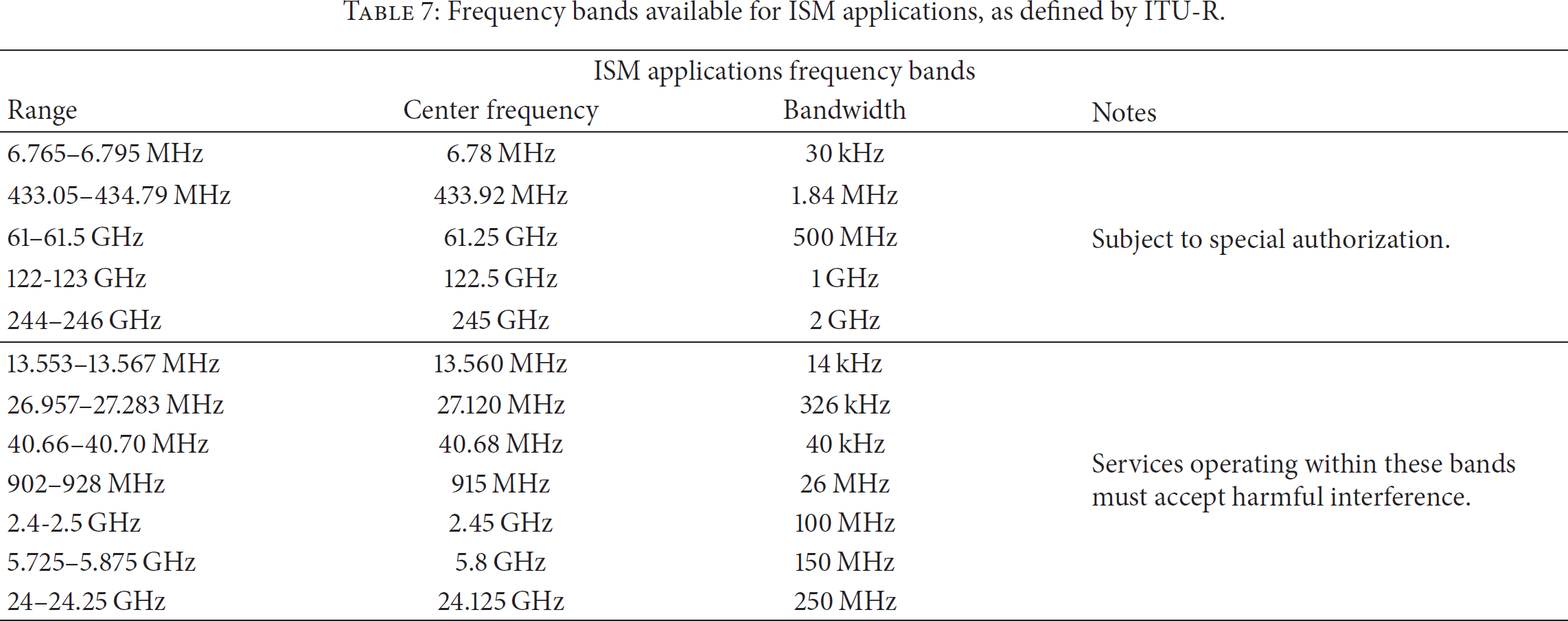
Initial research in WBAN studied the Ultra-wideband (UWB) for the physical Layer. Similar to spread spectrum, UWB communications transmit in a manner, which does not interfere with the conventional narrowband and carrier wave used in the same frequency band. UWB is a technology for transmitting information spread over a large bandwidth (>500 MHz); it should, in theory and under the right circumstances, be able to share spectrum with other technologies. UWB has low energy consumption and a range large enough to support the entire body. Nevertheless, UWB does not progress well at very high speeds, and other researchers propose the Small Industrial, Scientific and Medical (ISM) bands of the IEEE 802.15.4 and IEEE 802.15.6. Currently most working WBAN research is based on ISM bands [10].
In the WBAN, radio propagations from devices that are close to or inside the human body are complex and distinctive compared to other environments since the human body has a complex shape consisting of different tissues. Daily activities such as walking and running and physiological activities such as the heartbeat and breathing might affect the wireless propagation channels dramatically [3]. The propagation wave will diffract around the human body rather than pass through it. The path loss is very high especially when receive antenna is placed on the side opposite the transmit antenna [2].
Studies have shown that three factors have contributed to the characteristics of the channel models of WBANs [8]: environment, the location of WBAN (e.g., indoors, outdoors), whether the user is mobile, and how severe the interference is from other users in proximity; LinkClass, where the sensor node is located (e.g., in-body, on-body, and off-body); the user's current activity (e.g., walking, running, and jumping), as well as how long the activity lasts.
The main characteristics of existing standard wireless communication protocols that could be used for WBANs are described below.
WI-FI (IEEE 802.11N): this standard provides secure, reliable, and fast connectivity and can be used to connect electronic devices to each other, to the Internet, and to wired networks that use Ethernet technology. It is indicated for applications such as wireless local area network connectivity, broadband Internet access, and healthcare and is currently the most widely used protocol in private networks. Wi-Fi can operate in the 2.4 and 5 GHz radio bands and is able to deliver data rates of up to 540 Mbps [4]. Due to (i) the relative high level of energy consumption and (ii) the possible interference with other types of functional equipment in the same frequency range, it is not advisable for use in small WBANs sensors around the human body. However, it can be used on networks like Tier 3, backbone access to end users.
Bluetooth (IEEE 802.15.1) operates at 2.4 GHz, using a DSSS as the spread spectrum method, full-duplex signal at a nominal frequency hopping of 1600 hops/s. This frequency hopping adds protection against eavesdropping. The key features of the protocol are robustness, relatively high bandwidth, low latency, low cost, short range (10 m), data rate of up to 1 Mbps, and support for many mobile platforms. This technology is currently in widespread use in hospitals, medical offices, assisted-living facilities, and homes. However, Bluetooth has been designed for high data rate networks and large battery capacity, which does not match the WBAN requirements [16]. Its high power consumption, its limitation of only up to eight devices in a body area network, its inefficient idle modes, and the long start-up times make Bluetooth an unattractive option for wearable long-term health monitoring applications [4].
Bluetooth Low Energy (BLE), the Bluetooth version 4.0 or Bluetooth Low Energy (BLE) technology, provides ultra-low power consumption, a data rate of up to 1 Mbps, a range of 10 m, and a fast start-up time (few milliseconds compared to Bluetooth's seconds). It consumes only 10% of the power consumed by Bluetooth, extending its battery life by sleeping and waking up when it needs to send data. Time needed for connection setup and data transfer is less than 3 ms (classic Bluetooth needs 100 ms), and it supports star and bus topology. These features make it particularly suitable for latency critical WBAN applications. Although a promising technology, it is not yet supported by many devices [4].
ZigBee (IEEE 802.15.4) [27, 48, 49] is not new but is a reference in WSN. This standard builds on the established IEEE 802.15.4 standard for packet-based wireless transport. It was developed to provide low power, wireless connectivity for a wide range of network applications concerned with monitoring and control. It is an open standard controlled by the ZigBee Alliance. The IEEE 802.15.4 specification is the most widely adopted point-to-point communication standard for low-rate wireless personal area networks [5]. The standard defines robust radio physical and Medium Access Control (MAC) layers. The protocol operates at 2.4 GHz, 950 MHz, 915 MHz, 868 MHz, 780 MHz, 500 MHz, and 3.1–10.6 GHz frequency bands. The capacity is 250 Kbps at 2.4 GHz, 40 Kbps at 915 MHz, and 20 Kbps at 868 MHz. Some modern devices have an indoor communication range of 50 m and an outdoor range of more than 500 m. When measurements obtained by multiple sensors must be accurately synchronized, we can use the IEEE 802.15.4 beacon-enabled mode. In this mode, the coordinator node of the network broadcasts beacons periodically to synchronize devices and specify the structure of the superframe. When a device receives a beacon, it synchronizes with the superframe structure and transmits its data [4]. It is already a known fact that IEEE 802.15.4 outperforms IEEE 802.11 in terms of routing overhead and power consumption [38]. This study shows that 802.15.4 is an energy-efficient standard especially favoring low data rate and low power consumption applications. A number of researchers have considered IEEE 802.15.4 for a WBAN since it supports low data rate applications, but it is not enough to support the high data rate of some applications [39]. Moreover, according to Ragesh and Baskaran [40], the performance of this protocol in a multihop environment is very poor. Table 8 shows IEEE 802.14.5 standard frequency bands main characteristics.
IEEE 802.15.4 frequency bands, data rates, and modulation methods.

ZigBee PRO [49] is an enhancement of the original ZigBee protocol, providing a number of extra features that are particularly useful for very large networks. In the PRO version, a peer-to-peer link encryption layer is added to the standard. It can work in 2.4 GHz, 915 MHz, and 868 MHz radio bands, but the nodes will move to another channel if the current one has interference or noise.
Body Area Network (IEEE 802.15.6) focuses on a low power and short-range wireless standard to be optimized for devices and operation on, in, or around the human body and serves a variety of applications including medical, consumer electronics, and personal entertainment. The IEEE 802.15.6 standard defines a Medium Access Control (MAC) layer that supports several physical (PHY) layers, such as Narrowband (NB), Ultra-wideband (UWB), and Human Body Communications (HBC) layers. The main characteristic of this standard is the very low power consumption (~10 mW), in addition to the very low data range (1.2 m). Exceeding this range, communication with other systems can be compromised. Figure 4 shows the IEEE 802.15.6 standard MAC and physical layer model.

IEEE 802.15.6 MAC and physical layer model.
Given (i) its very low power consumption, (ii) the capacity to support several communication bands, and (iii) considering WBAN a short network around the body (Tier 1), this stands as a good standard for this type of networks.
Kim et al. [50] evaluate the performance of a wireless transmission system in the 433 MHz ISM band for biomedical applications, which they have called Integrated Posture and Activity NEtwork by Medit Aachen (IPANEMA). Multiple test scenarios were evaluated to analyze different factors that might influence channel quality, antenna orientation, number of nodes, and body environment. The IPANEMA packet-loss rates are comparable to the packet-loss rate of ZigBee systems in the proximity of Bluetooth and Wi-Fi systems. They concluded that the design of a wireless sensor node requires careful placement of components on the circuit board (antenna, external components, battery, etc.) with respect to finished setup including the housing. The antenna should also be radiating homogenously to allow free placement around the body. The sensibility with placement of components and antenna is not recommended for critical medical applications in WBANs. The network management has to be able to handle multiple sensor data streams, and because of that, the authors propose a TDMA scheme.
Another interesting research study is “A Wireless Sensor Enabled by Wireless Power” (WPWS) [19], where sensors do not have a power supply problem. In their work, the authors implemented a passive RFID system with sensor capabilities, working in a network with 4 m range. The sensor uses a dual-antenna system, working with RFID system architecture. A power-harvesting antenna was designed to gather power from a standard reader working in the 915 MHz band, and the other antenna was designed to transmit data. Currently, commercial RFID systems deployed to human or animal bodies can only send data over distances up to 10 cm [51]. Despite this, the technology will be considered in the future, since it at larger distances allows only one external access point to provide unlimited power on time for all sensors of one or several patients.
There are other proprietary projects such as ANT, Sensium, Zarlink, Insteon, and Z-Wave [8] or projects using licensed radio frequency bands, such as Rubee or RFID [8]. However, they are not analyzed in this study because proprietary projects or licensed radio frequency bands are not the target of this paper.
In Table 9 we highlight WBANs for healthcare applications using the IEEE 802.15.6 standard. This standard supports secured communication, relative high speed (10 Mpbs), short-range network indicated for human body, and very low power consumption (0.1 μW) and was specifically designed for WBANs. The downside is that there is still no hardware supporting this standard. Other standards have good characteristics for WBANs that are used for healthcare applications. The Bluetooth Low Energy (with 10 mW of power consumption, 1 Mbps of data rate, and secured and full duplex communication) and IEEE 802.15.4 ZigBee or IEEE 802.11N are for higher range networks, with ranges of 50 meters indoor to 500 meters outdoor. Table 9 shows the main physical layer protocols and their main features.
Physical layer protocols and their main functionalities.

9. Learned Lessons
After the analysis of the most recent implementations of WBANs for healthcare applications, we have noted that much of the research focuses on the main difficulties with regard to the power efficiency of nodes, routing methods, data reliability, and medium control access. Most works are experimental, with few initiatives where results are actually applied to patients in clinical conditions. Despite that, some research has produced good contributions for this type of networks.
Our study draws important conclusions for the special application of WBAN for medical purposes. In patient monitoring networks, data security is mandatory because WBAN nodes are used to collect critical information of a patient's life. Network protocols must be safe, providing services such as encryption and authentication.
WBANs are dependent application, and protocols such as IJA or HL7 with queries or XML messages are more flexible and versatile for any data communication between each node, or between nodes and end user applications.
At the transport layer, the TCP end-to-end reliability model presents many limitations in WBANs, because each sensor node has limited memory and energy. The TCP data reliability model has an expensive retransmission mechanism. UPD protocols have more efficiency, but data reliability mechanisms should be implemented at the transport level or at the application level as with other implementations.
Assuming that WBANs for healthcare applications have sensor node batteries that can be easily changed, the power consumption is not a critical problem. Therefore, routing methods with multipath or multihop can be used to improve data reliability at the network layer. If multihop is used, trees such as a routing topology are preferred; in these cases, routing is very simple because the path between any two nodes is unique and data aggregation can be employed to reduce the volume of data. In this layer, the DSR protocol implements different backup routes on standby. This can be useful for the quick use of an alternative route in case of packet loss or excess traffic. The Politecast protocol implements a good primitive for periodic traffic with low latency, good robustness to mobility, and good energy efficiency.
At the data link sublayer, the DTDMA protocol has good energy efficiency, avoids collisions with low cost, and has low latency and robustness to mobility. Furthermore, the reuse of timeslots by other nodes optimizes the utilization of radio spectrum. However, it needs further development to support priority and on-demand traffic.
Bluetooth 4.0 (BLE) technology provides secure and full duplex communication at the physical layer, data rates up to 1 Mbps, a range of 10 meters, and ultra-low power consumption. BLE can be an alternative to the recent development of IEEE 802.15.6, which has very low power consumption and was especially designed for WBANs for medical purposes, but there is still no hardware to support it.
Gathering these improvements on a WBAN protocol stack may implement an optimal wireless network for medical purposes.
Table 10 summarizes the protocols identified as most suitable for each of these tasks.
Most suitable protocols and their utility.
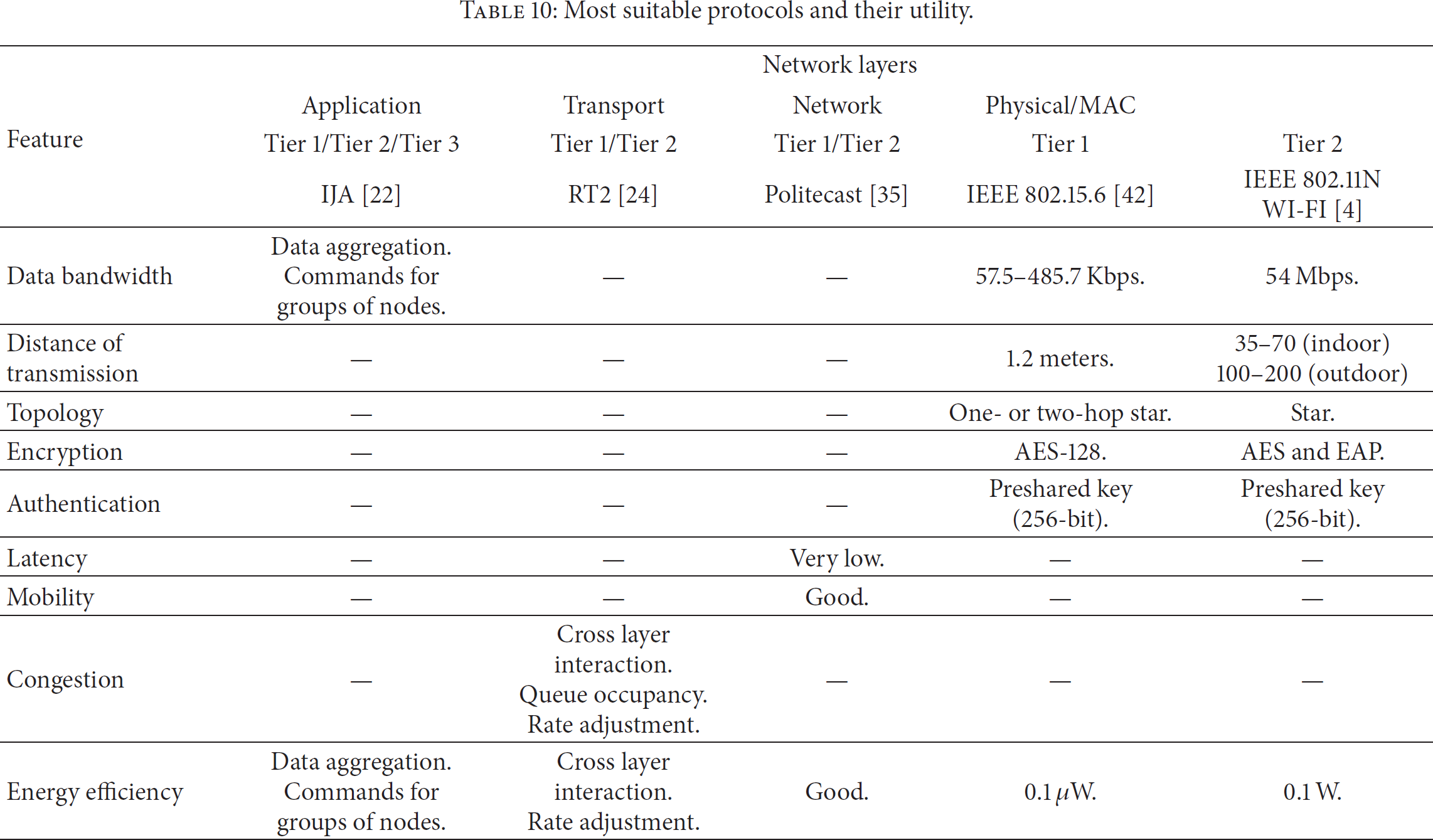
In Tier 1 (intra-BAN) are small networks of nodes and sink around the body, the batteries can be changed easily, and energy efficiency is not a critical requirement. The distance of transmission can be short because it is “around the body network.” On the other hand, at Tier 2 the sink (or access point) connects mobile Tier 1 networks (patients). In that case, the distance of transmission can be greater and needs more bandwidth, because it aggregates all of the Tier 1 network data.
In the application layer, the protocol is transversal to all network types, directly connecting sender and receiver. It can be the same in all tiers.
Finally, Tier 3 is not mentioned at transport, network, and physical layers in Table 10 because in Tier 3 (beyond-BAN) the network connects the fixed sinks or access points. Tier 3 can use actual technology of IEEE 802.11x or Ethernet at physical layer, TCP at transport layer, and Internet Protocol (IP) at network layer because this equipment has more resources like memory, energy, and processor capacity. It is not mentioned in Table 10 because these LAN protocols are out of the scope of this work.
10. Conclusions
This paper presents the latest work and research in WBANs for healthcare applications, as well as some standards used with better results for this type of network. The purpose of our study was to identify and select existing technologies and protocols that satisfy the main requisites of WBANs for medical purposes such as patient mobility, secured and reliable data, economy of power consumption, and the need for a large number of sensor nodes to coexist in a relatively small space.
A protocol stack overview and the latest research for each protocol layer were also analyzed. Some characteristics distinguish the WBANs from typical WSNs. While all nodes are static among themselves, the WBAN moves in relation to other networks. WBAN can have a few sensor nodes, while the WSN can have hundreds. Because of that, each sensor in a WSN needs data aggregation functions, including routing the data of all neighbor sensors to a central point, because they may be physically distant. In WBAN this feature is not a requirement. All nodes are usually at relatively short distance and accessible to the central point. In WBAN the batteries can be easily changed on nodes, whereas in typical WSN nodes are inaccessible and battery replacement is not possible, although we must not overlook the fact that the nodes need to be energetically self-sufficient for a reasonable period of time.
Future work in WBAN for healthcare applications includes gathering all the features previously identified into a single protocol stack, thus allowing for significant improvement of this type of network for use in real environments.
Footnotes
Conflict of Interests
The authors declare that there is no conflict of interests regarding the publication of this paper.
Acknowledgments
This work has been partially funded by (i) the Innovation Network of the Central Region, Portugal (RICE) Project, cofunded by Portuguese Program MaisCentro (SAICT); Computer-Assisted Recovery (CAR), project funded by INOV INESC INOVAÇÃO, Institute for New Technologies, (ii) the Agrupamento INBIOMED [2012/273] from DXPCTSUG-FEDER unha maneira de facer Europa, and (iii) the [14VI05] Contract-Programme from the University of Vigo.