




Abstract
In heterogeneous vehicular networks, the communications among moving vehicles (MV) and between vehicles and the roadside infrastructures have posed a challenge for providing continuous mobility services. FMIPv6 looking toward the support of a timely and precise link layer (L2) trigger provides a fundamental mobility management approach. The time stamp of L2 trigger hence is crucial for guaranteeing the handover performance but is difficult to be obtained in the practical application scenarios. The unsatisfactory handover trigger includes the late L2 trigger and the premature L2 trigger. The former would cause a missed detection deteriorating the perceived quality of service, and the latter would cause a false alarm with serious performance loss and resources waste. To address this issue, we propose a solution to optimize the unsatisfactory handover trigger (O-UHT), including promptly determining the unsatisfactory handover trigger and elaborately developing the specific measures to reduce the performance loss caused by the above two cases. The simulations conducted on NS-2 platform have verified the efficiency.
1. Introduction
In vehicular networks with a variety of access technologies (e.g., WiFi, WiMAX, GPRS, and UMTS), the moving vehicles (MV) communicate not only with the other vehicles, but also with the deployed roadside infrastructures, even if with the remote terminals to share the traffic report or obtain the real-time applications, such as Voice over Internet Phone (VoIP) and multimedia stream. Roaming in such heterogeneous networks hence poses a challenge for providing continuity services, seamless IP mobility, and ubiquitous connections [1]. Currently, an extensive body of research has been conducted. Kim et al. [2] introduced enhanced information server (EIS), at which wireless channel conditions are estimated by exploiting spatial and temporal locality to skip the channel scanning time and accelerate vertical handover procedures in IEEE 802.21 media independent handover (MIH) networks. Mussabbir et al. [3] introduced information element container to store static and dynamic L2 and network layer (L3) information obtained by MIH services and make intelligent handover decisions. Chiu et al. [4] utilized oncoming side vehicles to accumulate physical and media access control (MAC) layers information of passing through public transportation vehicles and broadcast the information to temporarily disconnected vehicles. The disconnected vehicles can perform a rapid handover when they enter into the transmission range of one approaching public transportation vehicle.
Anyway, IPv6 is being chosen as an underlying convergence protocol for vehicular networks, while fast handovers for mobile IPv6 (FMIPv6) [5], as a representative achievement proposed by the Internet Engineering Task Force (IETF), provides a cross-layer solution to support better mobile services. The FMIPv6 handover procedures can be divided into proactive mode and reactive mode in terms of whether the message named fast binding acknowledgement (FBAck) is received before terminating the current access link or not. A common feature among researchers is requiring the underlying L2 to anticipate link changes and facilitate upper layer mobility management protocols. Different research approaches vary from forewarning the link connectivity failure by statistical analysis of a single L2 parameter [6], that is, received signal strength (RSS) [7–10], up to exchanging the neighboring network conditions [3, 11]. However, owing to shadowing effects, imperfect receivers, and signal interferences, the anticipated timely L2 trigger is not easy to be achieved in the practical application scenarios, and the simple prediction relying on a single L2 parameter may cause the late L2 trigger (missed detection).
Firing the L2 trigger however is not always preferable in some special application scenarios. As far as we know, the mobile terminals often take the Random Walk model in which the trajectory follows no certain rules, or the mobility profiles are often motivated by the wants and goals put forward by the end-users [12]. In such a case where the mobile terminal moves towards the new adjacent access network, if the fired L2 trigger does not correspond to a deterministic handover, the system still must have an entire handover implementation in terms of the FMIPv6 specifications. The premature L2 trigger (false alarm) will initiate unnecessary handover operations and cause serious handover overhead, performance loss, and network resources waste. This problem is thoroughly verified in the well-designed experiments and the detailed analysis conducted in [13]. The works in [14, 15] present the issue of false L2 trigger as well but do not conduct further research or put forward any reasonable solutions to fire intelligent and reliable L2 trigger, or reduce the caused performance loss.
Therefore, developing an effective scheme to promptly determine the unsatisfactory handover trigger and reduce the caused performance loss is necessary. To address this issue, the IP prefix included in the router acknowledgement (RA) messages received by the MV within a defined time-frame is firstly analyzed to promptly determine the unsatisfactory handover trigger, and then a set of specific measures for reducing the caused performance loss are, respectively, developed. Finally, the efficiency in the form of TCP flow and the communication interrupt delay is verified by the simulations conducted on the NS-2 platform.
The remainder of this paper is organized as follows. The measures of promptly determining the unsatisfactory handover trigger and reducing the caused performance loss are thoroughly depicted in Section 2. Section 3 addresses the simulation and analysis results. We devote the final section to some key concluding remarks.
2. Optimizing Unsatisfactory Handover Trigger
The main contributions in the proposed O-UHT include, first of all, timely determining the unsatisfactory handover trigger and then immediately initiating the process of accessing the new roadside unit (NRSU) to reduce the communication interrupt delay and the packets loss for the missed detection, or immediately initiating the process of reaccessing the previous roadside unit (PRSU) to accelerate the reaccessing process for the false alarm. The employed specific operations for optimizing the missed detection and the false alarm in O-UHT are shown in Figure 1 and will be described in detail below. The abbreviations throughout the paper and the corresponding explanations are given in Table 1 as well.
The involved abbreviations and the corresponding explanations.

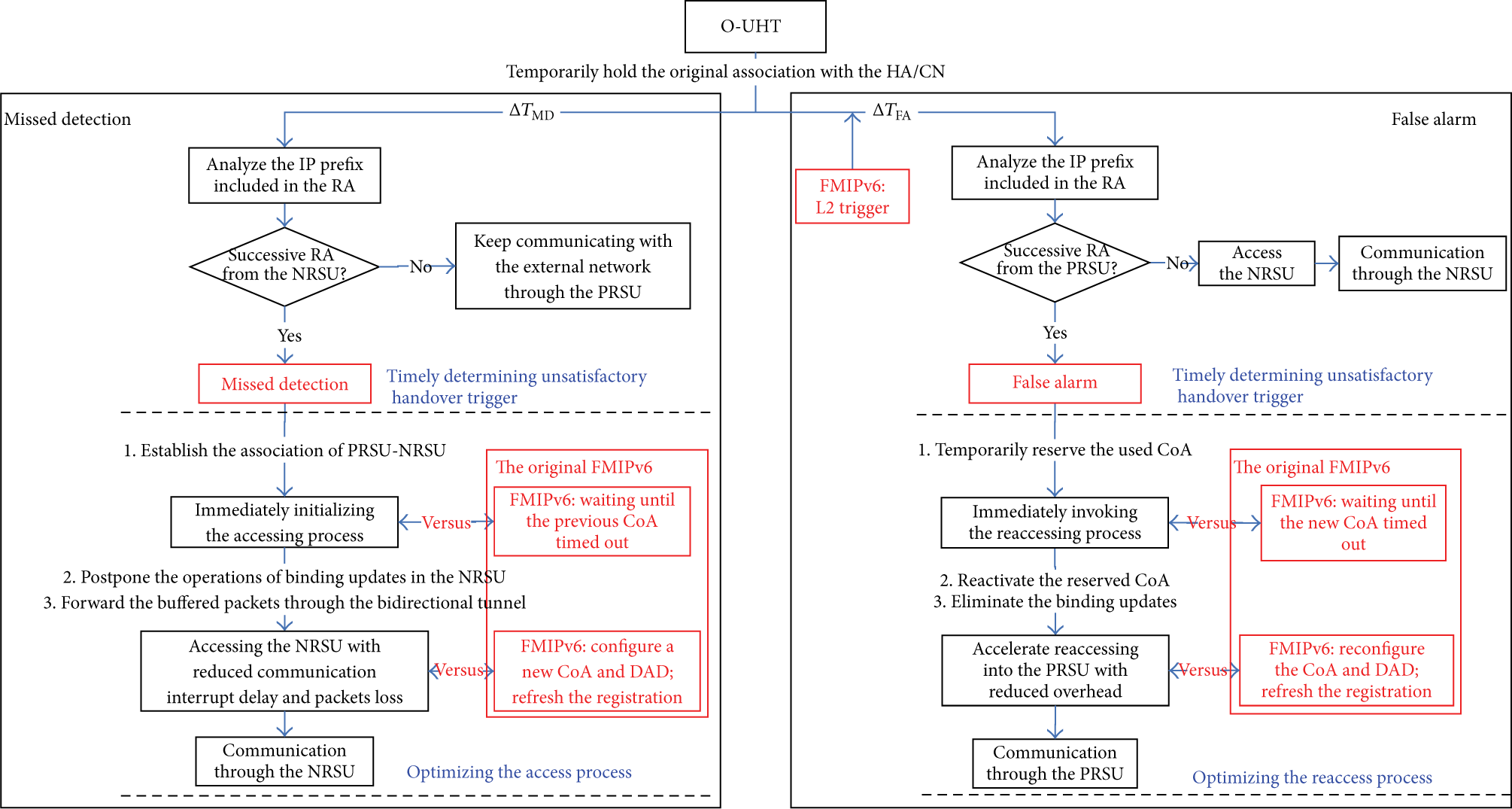
The employed operations for optimizing the unsatisfactory handover trigger in O-UHT.
2.1. Missed Detection: The Late L2 Trigger
2.1.1. Determining the Missed Detection
Owing to the deployed roadside unit (RSU) periodically sending RA messages to the MV in the local link to announce its reachability and configurations, the IP prefix in the RA received within a defined time-frame after the consecutive packets loss can be analyzed to determine the missed detection. By analyzing the FMIPv6 handover process, the handover procedures after the L2 handover (terminating the current wireless link) mainly include sending the fast-neighbor advertisement (FNA) message to the target RSU to announce the attachment and binding update with the home agent (HA) and the corresponding node (CN), so the time-frame can be defined as 
Just as shown in Figure 1, in the decision of not firing the L2 trigger in FMIPv6, if the packets loss is consecutive and the MV can receive the successive RA messages from the NRSU within
2.1.2. Optimizing the Accessing Process
To address the issue of further shortening the delay of accessing the NRSU and reducing the packets loss, a set of performance compensation measures is developed. Refer to the flow chart in Figure 1; the signaling interactions among the involved protocol entities are shown in Figure 2.

The signaling sequence for the optimized missed detection.
First of all, the original associations in the HA/CN are temporarily held, so the packets with the destination of the previous CoA still can be sent to the PRSU and buffered. When the process of accessing the NRSU is initiated, the NRSU sends a fast binding update (FBU) message to the PRSU. The CoA field included in the FBU is the new configured CoA used in the NRSU. By using the exchanged FBU/FBAck messages, the association between the NRSU and the PRSU can be established and so is the bidirectional tunnel between them. The packets buffered at the PRSU now can be encapsulated by using the new CoA as the destination and redirected to the NRSU through the tunnel. However, before the MV accomplishes the binding updates with the HA and the CN in the NRSU, the packets all should be forwarded through the tunnel, which introduces the routing problems for packets transmission. We here pay more attention to reducing the packets loss; the raised routing problem is not the focus in this paper, but we will conduct further discussion about the problem in the future work.
In addition, since the MV still can keep the communications with the external network by the established PRSU-NRSU association, we can postpone the operations of binding updates and further reduce the communication interrupt delay by eliminating the signaling interaction overhead imposed by the binding updates. According to the specifications in FMIPv6, when the MV roams in the foreign network, the MV should exchange the BU and BAck signals with the HA for refreshing the registration. Most pointedly, the MV should execute a return route process (RRP) before executing the binding update with the CNs to guarantee the security of the communication. The basic idea is to verify the registration by encrypting the signaling interactions. The two couples of messages, Home Test Init (HoTI) & Home Test (HoT), Care-of Test Init (CoTI) & Care-of Test (CoT), are, respectively, used to test whether the packets destined to the home address (HoA) and CoA can be forwarded to the served MV and finally determine whether to accept the binding update. The MV firstly exchanges the HoTI & HoT messages through the HA and exchanges the CoTI & CoT messages in the direct link to the CN. If the RRP test is successful, the MV sends BU to the CN, and then the CN replies with BAck for acknowledgement. That is, updating the binding cache of the CN totally needs to exchange six messages. The binding updates with the HA and the CN therefore have great contributions to the communication interrupt delay. Accordingly, the processing delay of establishing the PRSU-NRSU association directly related to the distance of the PRSU and NRSU is introduced, but it is usually much less than the processing delay of banding updates. When the MV completely accesses the NRSU after accomplishing the binding updates, the PRSU-NRSU association can be released, and the packets that arrived now can be directly sent to the MV through the established access link in the NRSU.
2.2. False Alarm: The Premature L2 Trigger
2.2.1. Determining the False Alarm
After the L2 trigger, the IP prefix in the RA received within a defined time-frame also can be analyzed to determine the false alarm. In terms of the conducted experiments analysis in [13] and the further analysis of the FMIPv6 handover process, when the MV moves towards the NRSU and the L2 trigger is fired, if the MV turns back before executing the L2 handover, or turns back within the time from completing the L2 handover to fully accessing the NRSU, the fired L2 trigger can be identified as a premature one. Hence, the time-frame can be defined as 
Just as shown in Figure 1, in the decision of firing the L2 trigger, the specified handover procedures in the proactive mode are executed. If the successive received RA messages are from the NRSU, the practical motion shows the L2 trigger is necessary, and the MV would use the new CoA to resume the communication after accessing the NRSU. If the MV still receives successive RA messages from the PRSU within
2.2.2. Optimizing the Reaccessing Process
The false alarm of L2 trigger leads to the unnecessary handover operations with serious performance loss and resources waste. To address this issue of further shortening the delay of reaccessing the PRSU and reducing the performance loss, a set of performance compensation measures is developed as well. Refer to the flow chart in Figure 1; the signaling interactions among the involved protocol entities are shown in Figure 3.

The signaling sequence for the optimized false alarm.
In FMIPv6, the CoA used in the PRSU should be reconfigured and the DAD process also should be performed to verify the validity of the new CoA. The two operations impose great contributions on the reaccessing delay, while in the O-UHT, if the L2 trigger is fired, the old CoA used in the PRSU should not be dropped; instead, it should be temporarily reserved by introducing a CoA-cache at the MV, whose definition is just “int coa_cache
In the proactive handover mode that the L2 trigger does correspond to a handover, the packets that arrived in the time period of executing handover are firstly buffered at the PRSU and then forwarded to the NRSU. However, these packets may be dropped since the MV may never really access the NRSU in the false alarm of L2 trigger. We still use the buffer at the PRSU and take the following approaches to achieve better performance on the packets loss. The timers of binding caches at the HA and the CN are temporarily prolonged to hold the original associations, so the arriving packets during the period of terminating the previous access link still can be buffered at the PRSU. When the premature handover trigger is timely determined, the PRSU keeps buffering but stops forwarding the packets to the NRSU. If there are some packets forwarded to the NRSU before, the NRSU should reforward the buffered packets to the MV through the PRSU after the MV reaccesses the PRSU. In this manner, the number of dropped packets is reduced as much as possible, but the problems of out-of-order packets and additional storage overhead for the RSU are caused. It is not the focus in this paper and we will also conduct further discussion about the problem in the future work.
In addition, owing to temporarily prolonging the original associations with the HA/CN, when the MV reaccesses the PRSU, the operations of binding updates executed in the original FMIPv6 may not be needed again, and the caused time overhead will not be imposed on the reaccessing delay. If the MV indeed accesses the NRSU, the temporary associations can be released when the timer of binding cache expires. Obviously, in the case of premature handover trigger, the communication interrupt delay in the O-UHT is significantly decreased along with the accelerated reaccessing process.
3. Simulation and Analysis
3.1. Experiments Setup
NS-2 platform with the expansion modules supporting FMIPv6 is used to model the realistic simulation conditions, and the detailed information of the used network topology is shown in Figure 4. In this implementation, we use statically configured mapping information and assume that the MV already knows which AR it should attach to. Each node is marked by its name and the assigned domain address, and the typical parameters of network links, such as bandwidth (Megabits/s), delay (milliseconds), and queue type, have been marked as well. The whole experiment will last for 100 seconds, a pair of simulated application-FTP source and sink agents is attached to the CN and the moving vehicles to generate traffic flow from the 5th second on. The size of packet and the size of control message are, respectively, set to be 512 Bytes and 25 Bytes, and the size of congestion window is set to be 32.

The simulation network topology.
To evaluate the efficiency of the proposed O-UHT, an experiment scenario corresponding to a deterministic handover is elaborately designed for the missed detection, and FMIPv6 with timely L2 trigger and missed detection are used for comparative study. Additionally, two scenarios are elaborately designed for the false alarm, and the original FMIPv6 and the IMP-AHT [13] are used for comparative study. The first scenario corresponds to the case that the MV turns back after the L2 trigger but before the L2 handover; the second scenario corresponds to the case that the MV turns back within the time period from executing the L2 handover to fully accessing the NRSU. All the schemes participating in comparison employ the same experimental settings to achieve a fair comparison, and random waypoint mobility model [17] is used to gain the mobility profiles of the MV but should undergo some modifications to meet the designed experimental requirements.
3.2. Analysis and Comparison
3.2.1. Missed Detection
In the scenario corresponding to a deterministic handover, if the L2 trigger is timely fired in FMIPv6 by using some specific manner, the proactive handover mode is performed and the upper layer mobility management procedures can be completed prior to a subnet change. It significantly reduces the service disruption. Although only a few packets are dropped owing to the signal interferences during the simulation, the performance is the most preferable in the three compared mechanisms. If the missed detection of L2 trigger occurred, the handover preparation is not promptly triggered. The handover process is degenerated into the reactive mode and the L3 handover for accessing into the NRSU would not be executed until the previously used CoA timed out. The simulation results shown in Figure 5 show that the packets loss and the communication interrupt delay are serious within this period. In Figure 5(a), the vertical axis is labeled as the segmental sequence number of TCP packets that the MV receives in the whole simulation, and the horizontal axis is labeled as the segmental simulation time. In Figure 5(b), the vertical axis is labeled as the communication interrupt delay, and the horizontal axis is labeled as the segmental simulation time as well. Figures 6 and 7 have the same labels.

The simulation results for evaluating the efficiency of optimizing the missed detection: (a) the TCP performance, (b) the communication interrupt delay.

The simulation results for evaluating the efficiency of optimizing the false alarm in the first scenario: (a) the TCP performance, (b) the communication interrupt delay.

The simulation results for evaluating the efficiency of optimizing the false alarm in the second scenario: (a) the TCP performance, (b) the communication interrupt delay.
Due to introducing some effective measures to prevent the performance loss for the missed detection, the performance is enhanced much more than that in FMIPv6. In the proposed O-UHT, if the consecutive packets loss caused by the terminated wireless link emerges, the missed detection of L2 trigger can be timely determined by analyzing the IP prefix included in the RA messages received by the MV in the well-defined time-frame, and the process of accessing the NRSU then can be immediately initiated without waiting until the previously used CoA timed out. In addition, by temporarily holding the original associations with the HA and the CN, the arriving packets still can be sent to the PRSU and buffered. And then, by establishing the PRSU-NRSU association and using the bidirectional tunnel, the packets buffered at the PRSU can be encapsulated by using the new configured CoA used in the NRSU as the destination and redirected to the NRSU. It effectively prevents the packets loss. Meanwhile, by using the PRSU-NRSU association to keep the communications, the binding updates with the HA and CN can be postponed to be executed until the MV completely resolves its movement. It effectively further reduces the communication interrupt delay by eliminating the influence of signaling interaction overhead imposed by the binding updates with the HA and CN.
3.2.2. False Alarm
In the first scenario designed for the false alarm, the MV turns back after the L2 trigger, while the time stamp of turning back is prior to the actual L2 handover. If the L2 trigger is fired in FMIPv6, the specified handover procedures must be taken for an entire implementation and the process of reaccessing into the PRSU would not be executed until the new configured CoA used in the NRSU timed out. The time of waiting for the new CoA time-out is quite a while and is a principal influencing factor of the communication interrupt delay. In addition, the MV should reconfigure the link information used in the PRSU and refresh the registration with the HA and the CN again. The simulation results in Figure 6 show that the communication interrupt delay and the packets loss are serious within this period.
Due to introducing some effective measures to compensate the performance loss for the premature handover trigger in the IMP-AHT and the O-UHT, the network performance reflected by the TCP performance and the communication interrupt delay is enhanced much more than that in original FMIPv6 in the case of premature L2 trigger. For example, the premature handover trigger can be timely determined by analyzing the IP prefix included in the RA messages received in the well-defined time-frame after the L2 trigger, and the process of reaccessing the PRSU then can be immediately initiated without waiting until the new configured CoA timed out. By introducing the CoA-cache at the MV to reserve the CoA used in the PRSU, the reaccessing delay is further reduced as well by reactivating the buffered CoA without reconfiguring a new one. Compared with the IMP-AHT, by temporarily prolonging the original associations with the HA and the CN rather than refreshing the registration again, the O-UHT further reduces the reaccessing delay and the communication interrupt delay. In addition, the packets buffer and the bidirectional tunnel between the PRSU and the NRSU also effectively prevent the packets loss.
In the second scenario designed for the false alarm, the MV turns back after the L2 handover, but before fully accessing the NRSU. For the same sake of firing the L2 trigger in original FMIPv6 and because the L2 handover is executed in advance, the communication interrupt delay and the packets loss are more serious, as shown in Figure 7. Just as stated above, with the timely determination of premature handover trigger and the performance compensation measures in the IMP-AHT and the O-UHT, the network performance is enhanced much more than that in FMIPv6. In addition, determining the premature handover trigger timely can prevent the initiated unnecessary handover procedures, and the performance compensation measures can reduce the singling interactive overhead caused in the reaccessing process as well, so the waste of network resources, such as the processing capacities of the involved entities and the occupied bandwidth, is reduced significantly.
4. Conclusions
For the vehicles with time-varying positions, timely and precise handover trigger is critical for guaranteeing the handover performance, but firing the handover trigger in a satisfactory manner is not easily achieved. The missed detection of handover trigger significantly deteriorates the handover performance, while, in terms of the analysis of the mobility profiles, the prematurely fired handover trigger may be a false alarm, which causes unnecessary handover operations with serious performance loss and resources waste. In this paper, to optimize the performance in the case of unsatisfactory handover trigger, an approach of promptly determining the unsatisfactory handover trigger is developed by analyzing the IP prefix embedded in the RA messages received within a well-defined time-frame, and then the customized measures for reducing the performance loss are, respectively, developed. The simulation conducted on the NS-2 platform has shown that the proposed O-UHT effectively reduces the performance loss caused by the unsatisfactory handover trigger.
Footnotes
Conflict of Interests
The authors declare that there is no conflict of interests regarding the publication of this paper.
Acknowledgments
This study is supported by the National Natural Science Fund, China (Grant no. 61300198), Guangdong Province Natural Science Foundation (no. S2013040016582), Guangdong Higher School Scientific Innovation Project (no. 2013KJCX0177 and no. 2013KJCX0018), Fundamental Research Funds for the Central Universities (SCUT 2014ZB0029), and China Postdoctoral Science Foundation (no. 2014M552199).