




Abstract
Cloud computing is promising avenue for supporting high-performance and interactive streaming service. Making use of the clouds to flexibly increase the scale of video service system and provide fast search are key determinants for scalable mobile video streaming in order to ensure smooth playback experience. In this paper, we propose a novel Cloud-assisted Scalable Video Delivery Solution over mobile ad hoc networks (CSVD). CSVD makes use of the clouds to share responsibility for the load of resource management of media server, which supports fast resource searching and enhances system scalability. CSVD designs a new estimation model of resource maintenance scale in terms of quality of service- (QoS-) oriented dynamic balance between supply and demand, in order to economically use the clouds. A novel supplier scheduling algorithm that assigns resource suppliers for fast responding user request in terms of their load and serving capacity is proposed. Extensive tests show how CSVD achieves much better performance results in comparison with other state-of-the-art solutions.
1. Introduction
The mobile ad hoc networks (MANETs) are the significant network technologies for the next generation Internet, which have extensive application areas [1–3]. The new wireless communication protocol such as IEEE 802.11 can meet high bandwidth requirement of multimedia services to enable provision of rich visual content for the mobile users in MANETs [4]. Video streaming is a significant one of the multimedia services, which provides rich content in multiple network environment such as MANETs, VANETs, and wireless sensor networks (WSN) [5–10]. P2P technologies are well known for supporting large-scale video streaming system deployment [11–15]. However, provision of P2P-based high-quality video streaming service with efficient content sharing over MANETs is a challenging issue. Due to limited capacities of energy and storage, the mobile nodes only cache relatively short video clip, so as to frequently replace the data in the playback buffer for watching desired content. Searching requested video content from fragmentary distributed resources in P2P networks leads to long start delay and high-cost network bandwidth, which cannot ensure smooth playback and meet the demand of green communication. On the other hand, the pursuit of popular video content results in high load of system due to process request and schedule resources, reducing system scalability. Therefore, a light-duty solution which efficiently maintains and schedules resources carried by the mobile nodes and supports fast search for video content should be considered for video streaming service in MANETs.
Numerous researchers have shown great interest in high-efficiency resource sharing for video streaming system in wireless networks. For instance, QUVoD in [16], a Chord-based video sharing solution over VANETs, groups peers into a chained Chord structure in 4G networks in terms of the similarity of stored video chunks, which can achieve reliable supply and fast location of video resources. SURFNet in [17] is a tree-based video sharing solution in which the peers with long online times are grouped into an AVL tree and connect with an attached holder-chain whose items have similar video content. However, with increasing number of nodes, the high maintenance cost for structured topology (Chord/tree) limits the scalability of these solutions. For uncertain blowout of user access for video resources, enlarging the scale of server cluster increases the cost of system deployment. SPOON in [18] is a community-based file sharing solution over MANETs. SPOON groups the peers into multiple communities in terms of the interest similarity, which can achieve high efficiency of content sharing. However, the stability of community structure relies on the capacities of community coordinator and determines system performance and maintenance cost of communities. Making use of the server to compensate insufficient bandwidth further limits the system scale.
Recently, cloud computing has become the most popular computing paradigm [19]. Providing on-demand server resources to users relies on the shared pool of servers in datacenters [20]. With rapid growth of mobile devices usage, mobile cloud streaming becomes a promising avenue for supporting high-performance and interactive streaming service [21, 22]. The most of cloud-based multimedia systems use the clouds to compensate insufficient capacities of upload bandwidth, computing and storage in the systems. However, the random request behavior of users for the video content leads to the increase in the complexity of cloud usage and the cost of interactivity between server and clouds. Moreover, making use of the clouds to meet the requirement of bandwidth brings expensive monetary cost.
In this paper, we propose a novel Cloud-assisted Scalable Video Delivery solution over mobile ad hoc networks (CSVD). As Figure 1 shows, the clouds assist the media server to manage the hotspot resources to address the large-scale intensive request when the server cannot meet the demand of users for video resources. A novel estimation model of resource maintenance scale based on QoS-oriented dynamic balance between supply and demand is proposed, reducing monetary cost from rental resources in the clouds. A novel supplier scheduling mechanism that schedules suppliers in terms of their load and estimated processing capacity is proposed, reducing the lookup delay and balancing the load of suppliers. Simulation results show how CSVD achieves much better performance results in comparison with other state-of-the-art solutions.

CSVD architecture.
2. Related Work
There have been numerous studies on P2P-based management and lookup optimization of resources for video streaming services in recent years.
The solutions based on structured content distribution topology are well known for resource lookup efficiency. For instance, QUVoD in [16] employs a group-based Chord structure to uniformly distribute the video content, where the peers which store similar content in the Chord overlay form a group. By using this structure, the request for sequential video chunks can be addressed in a group, reducing chunk seeking traffic and balancing peer load. However, the increase in the number of nodes leads to high system load for maintaining the Chord overlay and limits QUVoD's scalability. SURFNet in [17] groups stable peers which have long online time and store superchunk-level video content into an AVL tree. A holder-chain which is composed of peers with similar video content is attached to a peer in the AVL tree in terms of the similarity of stored content. SURFNet makes use of the tree-based overlay topology to obtain nearly constant and logarithmic lookup time for seeking in a video stream or between different videos. The maintenance cost of peers relies on the stability of the AVL tree. However, the long online time cannot ensure the state stability of nodes in the tree. Therefore, with the increase in the number of peers, the maintenance of the tree structure also increases very much so that the system scalability and lookup efficiency are highly restricted. The structured overlay such as QUVoD and SURFNet can achieve fast lookup of resources and make full use of peers’ upload bandwidth, but the high maintenance cost limits the system's scale and wastes network bandwidth.
The proposed mesh-based solutions with an unstructured topology have high system scalability. For instance, the authors of [23] proposed a mesh-based P2P streaming solution. Each peer selects the nodes as its neighbors according to different predefined policies. Because mutual contact between these nodes form a random graph, the system can perceive dynamic distribution process of video chunk and utilize created cluster of large-bandwidth peers to address intensive request of hotspot resources. Chang and Huang [24] proposed a mesh-based interleaved video frame distribution scheme to support user interactivity. However, the resource search in the mesh-based solutions employs gossip scheme which does not support fast resource lookup. The low performance of resource lookup does not ensure smooth playback. Moreover, the dissemination of gossip messages consumes mass network bandwidth.
Recently, some P2P file sharing solutions based on virtual communities have been proposed. For instance, SPOON [18] groups mobile nodes into a community in terms of common interest and frequent interaction between users. SPOON designs a role assignment for the community members to handle the file lookup both intracommunity and intercommunity and an file searching scheme for high-efficiency resource search in terms of user interest. However, SPOON makes use of files stored to estimate the interest similarity between nodes, which does not obtain high accuracy of interest similarity. The fragile community structure results in increasing maintenance cost of community members and a negative influence on file search efficiency. The mobility of nodes is not mentioned in SPOON so that the dynamic geographical distance between community members brings negative influence for content delivery. C5 [25] groups the peers which request the same content and are near to each other into a community and collaboratively fetches content. The community members use a WLAN to deliver local resources with other members. Making use of WLAN interfaces to communicate with internal members can improve the delivery efficiency. However, the deployment environment of C5 relies on the premise that a number of mobile nodes have close location with each other during a long period and subscribe the same content, so C5 is difficult to be implemented in mobile networks. The increase in the community scale introduces the high maintenance cost for community members, so the capacities of community coordinator become the bottleneck of system scalability.
Inspired by community-based file sharing solutions, the community-based video streaming systems have attracted increasing research interests from various researchers. For instance, AMCV in [26] proposed a mini-community-based video sharing scheme in wireless mobile networks. AMCV groups the peers into a community in terms of the similarity of requested video chunks and uses an ant colony optimization-based community communication strategy that dynamically bridges communities to support fast search for resources. The interest-based peer groups can ensure high accuracy for predicting the resource demand of users to reduce the start delay, however, because the broker nodes in the communities need to maintain information of community members and handle the request messages from internal or external members. With increasing number of peers, AMCV's scale relies on the capacities of broker nodes; namely, the broker nodes in the communities cannot bear high load for the management of community members so as to limit system's scalability. PMCV in [27] proposed a novel performance-aware mobile community-based video delivery system over vehicular ad hoc networks. PMCV employs a mobile community detection scheme to group peers into a mobile community in terms of the similarity of playback and movement behavior between users. This scheme can obtain high stability of community structure and efficient video delivery. Moreover, PMCV makes use of a community member management mechanism to achieve high efficiency of resource lookup and low maintenance cost.
3. CSVD Detailed Design
3.1. Media Server
The media server stores several video resources to provide original video data for all mobile nodes in MANETs; namely, a video files set is
With increasing number of maintained members and request messages, the server cannot shoulder the load of maintaining node state and processing messages. The server requires the clouds to maintain the state of members which have the video content of high-frequency access. When the system members or mobile nodes request a popular video file, their request messages are redirected to the clouds which are responsible for assigning the appropriate supplier for the requesters.
3.2. Maintenance Scale
Renting cloud resources to maintain and schedule the video resources stored by the nodes in P2P networks brings monetary cost. In order to economically use clouds, the scale of maintained members should be kept within appropriate level in terms of the balance between supply and demand. Due to the variation of cached video content, the maintenance scale is dynamically regulated in terms of the resource requirements change. Let





The stay delay of request message in the message queue of supplier is defined as
Rule 1.
If the decreased number of items in
As we know, once the request nodes receive the video data from the suppliers, they cache the video content and are considered as CSs. When the clouds need to enlarge the scale of
3.3. Supplier Scheduling Mechanism
As Figure 2 shows, the supplier scheduling mechanism architecture relies on the serving capacity of CSs and the similarity of moving behavior between CSs and requester to select appropriate supplier. (1) Serving capacity of CSs: each CS makes use of the length of handling queue to calculate the expectation time of handling a request message and delivering video data. This expectation time is considered as the serving capacity of CS; namely, the low time of handling and delivery denotes strong serving capacity. (2) Similarity of moving behavior between CSs and requester: the CSs report the information of serving time and moving trace. The clouds/server use(s) the similarity of moving trace of CSs and requester as weight value of serving capacity of CSs. The measurement of weighted serving capacity can ensure high efficiency of handling request message and delivering video data.
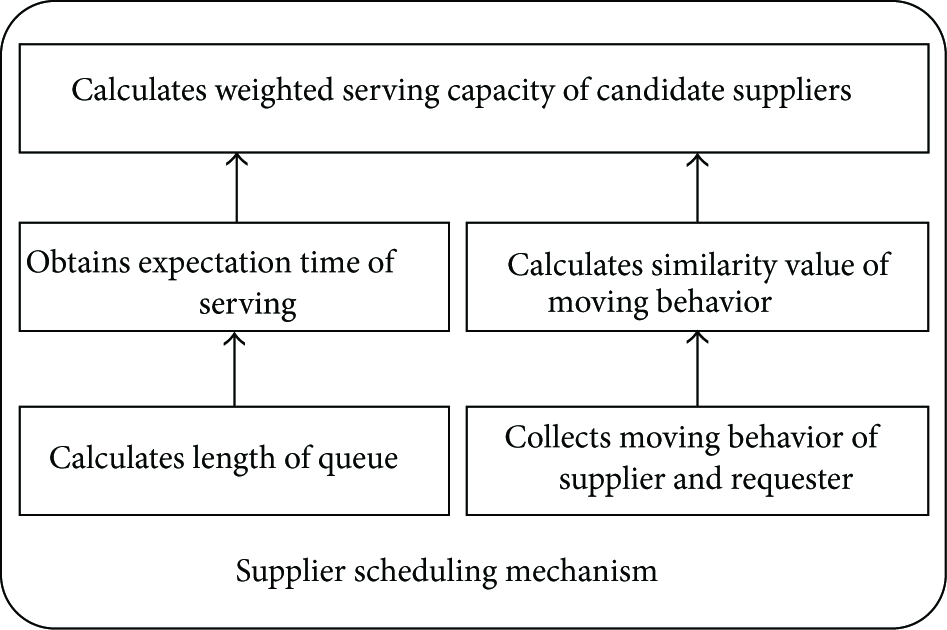
Supplier scheduling mechanism architecture.
When the clouds/server receive(s) the request messages of members, it selects the appropriate CSs from


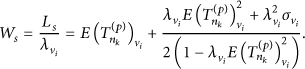
Further, the expectation time of serving a requester is obtained according to


If
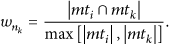
The new system members which request a video content have not served other nodes; namely,
3.4. Model Implementation
In the process of scheduling the request, the clouds/server need(s) to balance the load of CSs. The clouds/server remove(s) the CSs whase surplus bandwidth cannot meet the playback rate or request processing rate (RPR) is lower than the request arrival rate from
(1) receives request message of requester (2) (3) (4) calculates serving expectation time of (5) calculates moving similarity of (6) obtains measurement value (7) adds (8) (9) (10) forwards message to supplier (11) (12)
4. Testing and Test Results Analysis
We investigate the performance of the proposed CSVD in comparison with SPOON [18], a state-of-the-art P2P-based file sharing solution. The number of video files is 100 and the length of each file is 60 s. CSVD was modeled and implemented in NS-2, as described in the previous sections.
4.1. Testing Topology and Scenarios
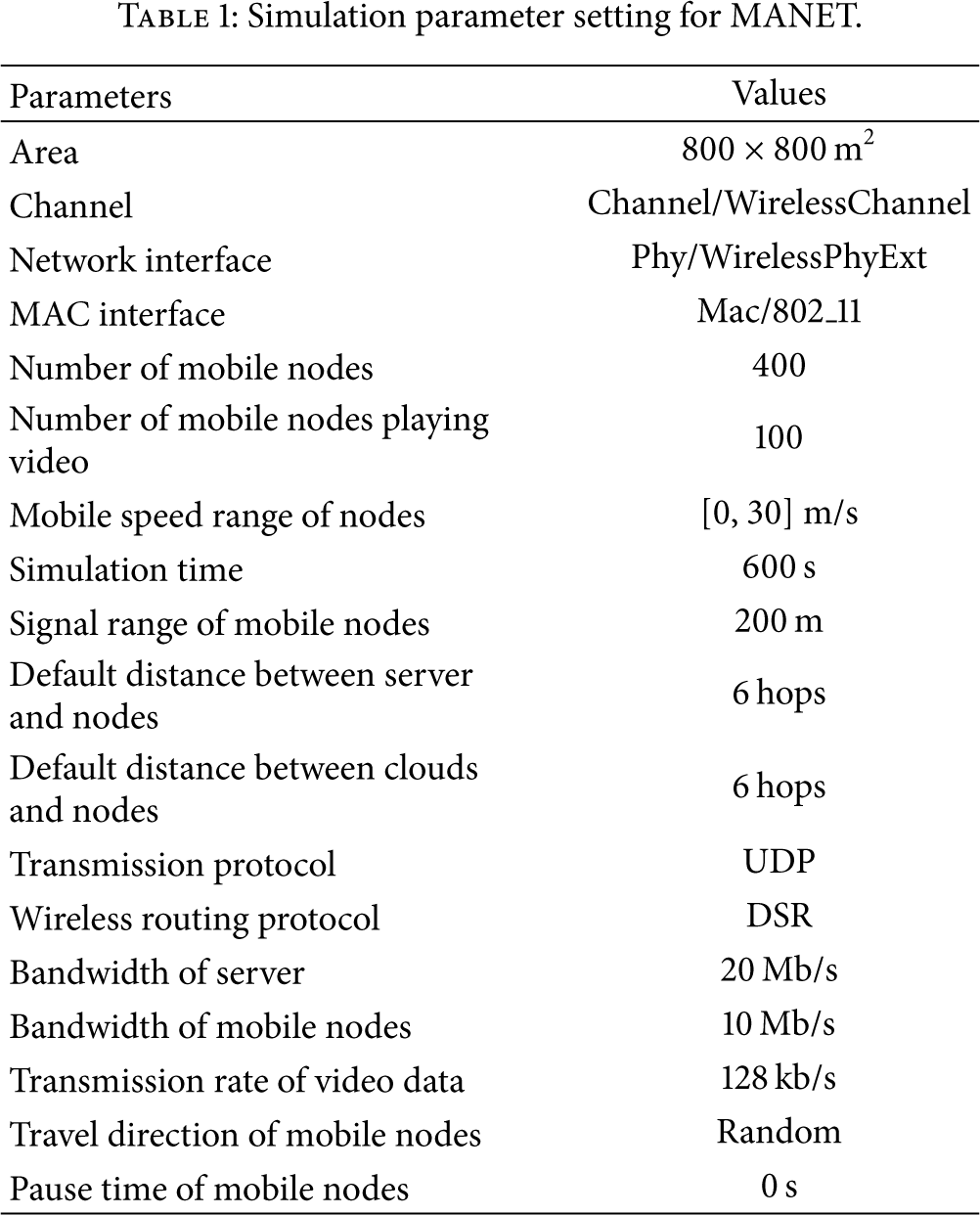
Table 1 lists some NS-2 simulation parameters of the MANET for the two solutions. We created 100 user viewing logs; namely, each user randomly accesses 20 video files and the viewing period time is set to random value. Moreover, when the users have watched a video in terms of the random playback period time, they continue to request new video file. 100 mobile nodes play video file following 100 logs and uniformly join the system following the Poisson distribution from 0 s to 360 s. After the nodes arrive at the target location, they continue to move to new target location in new assigned speed. In SPOON, 100 nodes randomly store 20 files with different keywords before they join system and the number of intersection of their local files is 100. The requested files corresponding to 100 logs are not included in their local files. We define some parameter value for SPOON:
Simulation parameter setting for MANET.
4.2. Performance Evaluation
The performance of CSVD is compared with that of SPOON in terms of average file seek delay (AFSD), packet loss rate (PLR), throughput, video quality, and overlay maintenance cost, respectively.
(1) AFSD. The difference value between the time when a node requests a video file and the time when the node receives first video data is considered as the file seek delay. The mean value of the cumulative sum of delay values during a time interval denotes AFSD.
As Figure 3 shows, SPOON's AFSD curve experiences slow increase from

AFSD against simulation time.
Figure 4 presents the AFSD variation with increasing number of nodes which have joined the system. The blue curve corresponding to the SPOON's results has both higher values and larger fluctuation with the increase in the number of nodes (the values are between 2.6 s and 4.6 s). The CSVD results, illustrated with red curve, have values between 1.5 s and 2.3 s, with lower variations than SPOON's results.

AFSD against number of nodes.
Initially, the number of members in communities is relatively less, so SPOON only uses the interest-oriented routing algorithm (IRA) to search the video files from foreign communities. The request messages are continually forwarded between the mobile nodes, which leads to the high AFSD. With the increase in the number of nodes, the community members require the community coordinators to search desired files. If the requested files are in the intracommunity, the intracommunity search speeds up the process of resource location, so SPOON's AFSD values can fast decrease and keep the relatively low level. However, when the members do not fetch the requested files from the intracommunity, they rely on the community ambassadors to search the resources from foreign communities. Therefore, SPOON's AFSD values show fast rise with increasing number of search messages. Moreover, SPOON does not consider the mobility of nodes, so that the dynamic change of geographical location between the requesters and the suppliers brings negative influence for the delay of data delivery. In CSVD, the server and clouds are responsible for handling the request messages and scheduling the available resources for the requesters, so the fast response at the server and clouds side reduces the delay of video file seeking. Moreover, CSVD investigates the similarity of moving trace between requesters and suppliers. The stable mobility between requesters and suppliers enhances the efficiency of video data delivery. On average CSVD's results are better than those of SPOON.
Packet Loss Rate (PLR). The ratio between the number of packets lost in the process of video data transmission and the total number of packets of video data sent is defined as PLR.
As Figure 5 shows, the curves corresponding to CSVD and SPOON show a rise trend with increasing number of nodes. The results of CSVD and SPOON maintain low levels when the number of nodes increases to 60 and represent fast rise from 70 to 100. However CSVD's PLR is roughly 20% better than the values associated with SPOON.
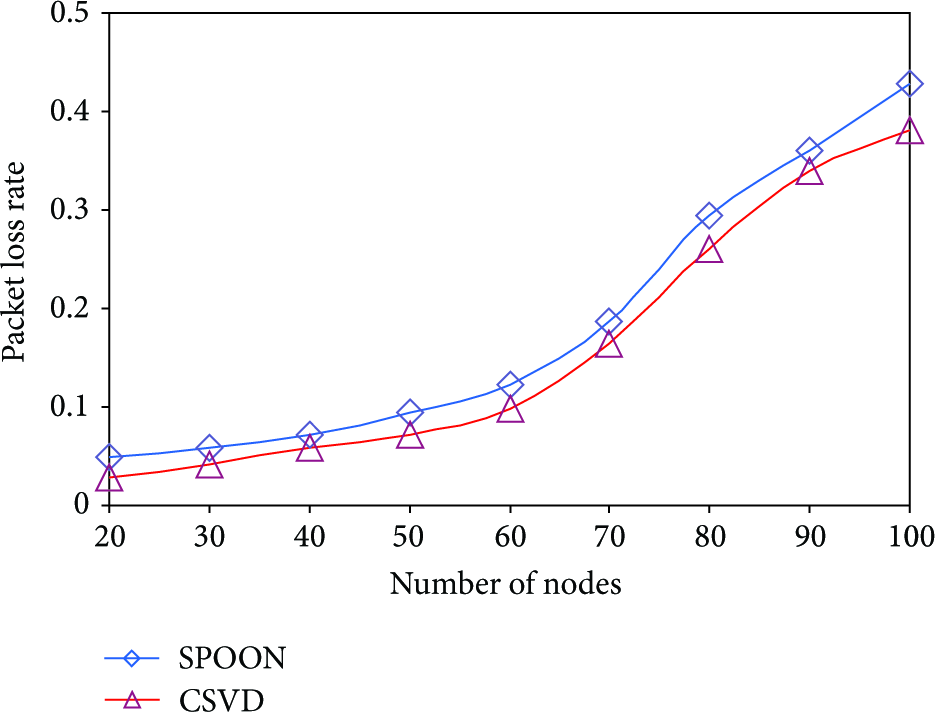
PLR against number of nodes.
Figure 6 shows the variation of PLR values with the increase in mobility speed of mobile nodes in MANETs. The CSVD results have both low values and slight increase from

PLR against range variation in the mobility speed of mobile nodes.
Small scale system members only consume the small number of network bandwidth, so the PLR curves of two systems keep slight rise. With increasing number of system members, the members require more network bandwidth so that the network congestion results in high PLR. On the other hand, the low mobility of mobile nodes brings slight variation in the PLR due to the slow change in the geographical distance. With the increase in the mobility of mobile nodes, the fast variation of geographical distance between requesters and suppliers leads to high probability of packet loss. The community coordinators and ambassadors in SPOON do not consider the mobility of nodes in the process of the assignment of suppliers for the requesters. The efficiency of data delivery in SPOON is influenced by the increase in the geographical distance between requesters and suppliers; namely, the communication with long distance increases the probabilities of wireless link break and packet loss. In CSVD, the server and clouds match the similarity between requesters and suppliers and assign the suppliers which have the most similar moving behavior with requesters to provide requested video streaming. The stable geographical distance between them ensures high transmission performance such as low delay and reduced PLR. Therefore, CSVD PLR is kept at low level.
Average Throughput. The total number of packets received in the overlay during a certain time period divided by the length of this time period is defined as the average throughput.
Figure 7 shows the variation of average throughput of SPOON and CSVD with increasing simulation time. The curves corresponding to two systems show similar rise trajectory; namely, they experience a fast rise from

Throughput against simulation time.
The mobile nodes request the video content following a Poisson distribution from
Video Quality. The peak signal-to-noise ratio (PSNR) [29] is used to denote the video quality, measured in decibels (dB), and is estimated according to (13):

Figure 8 shows the average video quality of single video streaming corresponding to each node with increasing number of the nodes. The results of SPOON and CSVD show the fall trend. The red bars corresponding to CSVD's results have the range

PSNR against number of nodes.
PSNR reflects the video quality perceived by users. The delivery of video content relies on the retransmission of mobile nodes in MANETs. The small number of system members do not consume too many bandwidths of the forwarding nodes, so that the PLR and delay maintain low level (PSNR also keeps high level). With increasing number of nodes, the requirement of high bandwidth for the video streaming consumes the network bandwidth and triggers the network congestion. At the moment, the high PLR and low throughput bring low PSNR of single video streaming corresponding to each node. SPOON neglects the mobility of requesters and suppliers, so that the transmission performance of video data is subjected to serious influence from network congestion. In CSVD, the requesters and suppliers have similar moving behavior by the assignment of the server and clouds. The high-efficiency delivery of video data can obtain, respectively, low PLR. The PSNR values of CSVD are better than those of SPOON.
Maintenance Overhead. The average bandwidth which is used by the sent messages for maintaining the overlay topology is considered as the maintenance overhead.
As Figure 9 shows, the overlay maintenance overhead values of two systems have similar changing trend with increasing number of mobile nodes. SPOON's results fast increase from
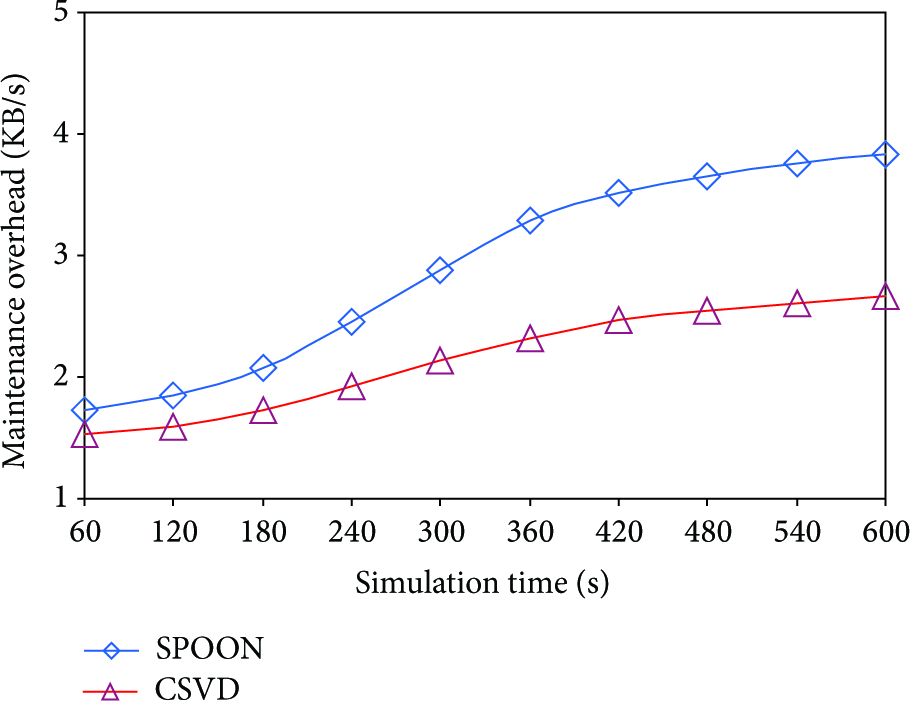
Maintenance overhead against simulation time.
The nodes in SPOON are grouped into multiple communities in terms of the interest. The community coordinators are responsible for maintaining the state and stored resources of members and handling the request messages of files. Although SPOON employs a periodical state maintenance mechanism, the increasing scale of maintained nodes leads to high load for the coordinators. Mass messages of state maintenance and files request consume a lot of energy and bandwidth of coordinators, so the capacities of coordinators become the bottleneck of system scalability. Moreover, the frequent exchange of members’ state messages and broadcast messages of coordinators’ replacement increase the maintenance cost of communities. SPOON's maintenance overhead values fast increase with increasing number of nodes. Unlike SPOON (all nodes are maintained by the coordinators), the server and clouds in CSVD only maintain the playback state of nodes, reducing the number of exchanging messages. The clouds also dynamically regulate the number of maintained nodes in terms of the balance between supply and demand. Therefore, CSVD's maintenance overhead for the overlay topology keeps lower level than that of SPOON.
5. Conclusion
In this paper, we propose a novel Cloud-assisted Scalable Video Delivery solution over mobile ad hoc networks (CSVD). CSVD improves the scalability of light-duty video streaming system with the help of the clouds by maintaining the peers which carry hotspot resources in P2P networks to ensure smooth playback experience of users. The estimation model of resource maintenance scale can regulate the utilization of cloud resources in terms of dynamic balance between supply and demand. The supplier scheduling mechanism can assign resource suppliers in terms of their load and serving capacity. The results show how CSVD ensures lower average file seek delay, lower packet loss rate, higher throughput, higher video quality, and lower overlay maintenance cost than SPOON.
Footnotes
Conflict of Interests
The authors declare that there is no conflict of interests regarding the publication of this paper.
Acknowledgments
This work was supported in part by the National Natural Science Foundation of China (NSFC) under Grant nos. 61402303 and 61303053, in part by the Project of Beijing Municipal Commission of Education under Grant KM201510028016, and in part by the Beijing Natural Science Foundation under Grant 4142037.