




Abstract
Cognitive radio has been proposed as a promising way to effectively utilize the scarce spectrum resources. A cognitive radio sensor network (CRSN) is a wireless sensor network that is equipped with cognitive radio capability. Clustering is a popular technique that can be applied to wireless sensor networks, although it has been proven to be a challenge to implement it in CRSNs. Moreover, few proposals have successfully applied energy-efficient clustering techniques in CRSNs. Therefore, with the aim of increasing energy efficiency, network lifetime, network stability, and optimal cluster-head selection process, this paper proposes a novel energy-efficient clustering based on cooperative spectrum sensing (ECS) for CRSNs. The proposed ECS scheme utilizes the concept of pairing among sensor nodes and switches between Awake and Sleep modes for energy efficiency. A comprehensive simulation in MATLAB was carried out to validate the proposed method. The simulation results show that, compared with conventional methods, the proposed method is more energy efficient and that the overall CRSN's lifetime is prolonged.
1. Introduction
A wireless sensor network is a network of densely deployed distributed sensors that monitor physical or environmental conditions such as temperature, sound, and pressure, in order to cooperatively transfer data through the network to a sink node or base station [1]. Wireless sensor networks are composed of multiple limited-power sensor nodes delpoyed randomly in a region of interest. Clustering is a popular technique applied in such networks, where nearby nodes form a group, known as “cluster” [2].
Because of the explosive growth in wireless device over the past few years, spectral congestion and inefficient spectrum usage have been a pressing concern. In a survey conducted by the Federal Communication Commission (FCC) on spectrum utilization revealed that the actual licensed spectrum is largely underutilized, given its vast geographical dimensions [3]. Cognitive radio provides opportunistic access to unused licensed bands. With cognitive radio, unlicensed secondary users can use licensed frequencies when the primary user is inactive [4, 5]. In practical applications, the received signal at each cognitive user may suffer from the so-called hidden primary-terminal problem and uncertainty due to fading and shadowing. Thus, cooperative spectrum sensing has become a popular technique to address such issues, rendering the spectrum usage more efficient and providing a high level of protection to the primary user [6–8].
Cognitive radio sensor networks (CRSNs) are a smart combination of wireless sensor network and a cognitive radio, these have recently attracted increased attention [9]. Clustering algorithms for wireless sensor networks have been reasonably successful at improving the performance of networks. Clustering refers to the task of grouping a set of sensing nodes in such a way that the nodes form a group (called a “cluster”). The nodes in a cluster are more similar (in some sense or another) to each other than to those in other clusters. Each cluster consists of one cluster head. The cluster's members sense the attributes of the target environment and send this sensor data to the fusion center or base station. In a CRSN, a cluster head is mainly responsible for all spectrum-management tasks, such as acquiring the sensor data from the nodes in the cluster and forwarding it to the fusion center in order to reduce the overall energy consumed. However, clustering in a CRSN cannot be applied directly, as it can in a wireless sensor network. Clustering in a CSRN is particularly delicate. For instance, in order to make clustering possible in a CSRN, all of the sensor nodes in the cluster must be located within the transmission range of the others, and they must share a common communication channel among them.
Furthermore, clustering schemes for wireless sensor networks are designed with the aim of accumulating target information with minimized energy consumption [10]. However, they cannot deal with the spectrum-aware sensing and communication in the context of cognitive radio. Clustering methods for CRSNs are relevant insofar as they directly affect the energy consumption and the lifetime of the network. Clustering algorithms, such as the low-energy adaptive clustering hierarchy (LEACH) method and the distributed energy-efficient clustering (DEEC) method, have achieved a reasonable degree of success at optimizing the performance of a network. In [11], an energy-efficient LEACH protocol is proposed, whereby cluster heads are selected with predetermined probability and energy drain, and then other nodes join their nearest cluster heads. With a DEEC protocol, nodes are independently elected as cluster heads based on the initial energy and residual energy [12]. The nodes with high initial and residual energy are more likely to be cluster heads than nodes with low energy, under a DEEC protocol. Reference [13] proposed a stable election protocol (SEP) protocol to prolong the time interval before the death of the first node in a heterogenous network. With their proposal, advanced and normal nodes are distinguished when electing the cluster head. Another protocol, called the hybrid energy-efficient distributed (HEED) protocol, is proposed in [14]. This proposal involves choosing a node with more residual energy and more neighboring nodes as the cluster head through coordinated election. However, all of these clustering schemes assume a fixed-channel allocation and cannot handle dynamic spectrum access. Therefore, these schemes are not suitable for CRSNs.
A learning-inspired and dynamic channel decision and access technique for cognitive-radio-based wireless sensor networks (CRWSNs) is proposed in [15]. With their proposed method, the CRWSN agent decides and accesses any available channel, based on previous information regarding the energy-consumption rate and the energy efficiency achievable by the CRWSN. Reference [16] investigated dynamic-spectrum access issues for multichannel CRSNs. Here, the primary user's behavior is modeled as a two-state Markov chain, and its transition probabilities are estimated using a maximum-likelihood estimation. They also employed varying packet size adaptation techniques to adapt the transmission over the state-varying channel, and this, in turn, more efficiently utilizes the battery life of the sensors. A novel quality-of-service-aware spectrum-access algorithm is proposed in [17], with power allocation for both noncooperative and cooperative users to maximize spectrum utilization and minimize power consumption. An efficient medium-access control (MAC) protocol with selective grouping and cooperative sensing in cognitive-radio networks called group-based cooperative MAC (GC-MAC) is proposed in [18]. The GC-MAC scheme can quickly discover the spectrum opportunities without degrading the accuracy of the sensors. They also proposed an algorithm for selecting the secondary user, specifically choosing cooperative secondary users based on channel dynamics and usage patterns, in order to reduce the sensor overhead in both time-invariant and time-varying channels. Reference [19] proposes a cluster-based cooperative spectrum-sensing strategy for obtaining a suitable spectrum-assignment policy for cognitive-radio networks, in which all the cluster members are cooperative in sensing the same channels. The cooperative spectrum-sensing problem in a cluster was further formulated as a maximum weight one-sided biclique problem, and a greedy heuristic algorithm was used to find the appropriate spectrum-assignment policy.
A distributed spectrum-aware clustering (DSAC) is proposed in [20, 21]. This scheme uses constrained clustering [22, 23] to cluster CRSN nodes under spectrum-aware constraint. The aim is to merge two nearby nodes or clusters that share the same available channel, or where at least one channel is common between the two nodes or clusters for communication. Whether two nodes or clusters are merged depends on the local minimum distance obtained from the information exchanged between two nearby nodes or clusters. The cluster-formation process is repeated until an optimal number of clusters is reached.
Extending the idea of spectrum-aware constrained clustering as proposed in [20, 21], we propose a novel energy-efficient clustering scheme based on cooperative spectrum sensing (ECS) for CRSNs. In our proposed method, a pair of nodes that are grouped together can switch between Awake and Sleep modes such that the sensing process is more energy efficient. Moreover, the proposed method operates in a self-organized manner, extending the network's lifetime, and with more stability and an optimal cluster-head selection process.
The principal contributions of this paper are outlined as follows. We developed a clustering method suitable for CRSN with low energy consumption, increasing the lifetime and stability of a CRSN network. Moreover, we develop a novel approach to clustering by introducing spectrum-aware node-grouping suitable for CRSNs, such that the pair of nodes in a group can alternate between Sleep and Awake modes during the sensing process to increase the energy efficiency of a CRSN network. We develop an algorithm to configure the Awake and Sleep modes for coupled CRSN nodes.
The rest of the paper is organized as follows. Section 2 describes our proposed method along with its distinct features. A performance evaluation of the proposed method is discussed in Section 3. Finally, conclusions are drawn in Section 4.
2. Energy-Efficient Clustering-Based Cooperative Spectrum Sensing (ECS) Scheme
In this section, we present our energy-efficient clustering-based spectrum-sensing scheme (hereafter, the “ECS scheme”). Below, a “node” refers to a CRSN node. In the proposed ECS scheme, and the following assumptions and objectives are used. Each node is equipped with cognitive-radio capabilities, such as spectrum sensing, dynamic spectrum access, and transmission-parameter configurability. Moreover, each node is aware of the radio environment. The deployment of nodes is random, dense, and redundant. Nodes that belong to the same cluster should have at least one common available channel that is not currently occupied by a neighboring primary user. Each node is randomly deployed in a region, and its location is determined with a global positioning system (GPS) that transmits its location, along with the application type and the node-identification number, to the fusion center or base station. The MAC protocol is based on a time-division multiple-access (TDMA) method. Efficient application-oriented source sensing. There is a cluster head for every cluster in the CRSN. The source information sensed by different cooperating nodes in a cluster should first be aggregated in the cluster head and then relayed to the fusion center.
2.1. Spectrum-Aware Pairwise Coupling
In the proposed ECS scheme, spectrum-aware pairwise coupling is somewhat similar to distributed spectrum-aware clustering (DSAC) scheme proposed in [20]. With DSAC, the local minimum distance between a pair of nodes is exchanged through neighborhood-information interchange, merging the closest local pair. Moreover, with the DSAC scheme, both nodes in a pair are active for sensing the target, and they communicate with the cluster head, adding to the energy consumed. Our main goal is to minimize the energy used by the CSRN to enhance the stability and the lifetime of the network.
As shown in Figure 1, Nodes A and B can be paired together, provided that they have at least one channel in common. The numbers marked beside Nodes A and B represent the available channels. As seen in the middle of Figure 1, Nodes A and B can be coupled together, because they have Channel 1 in common. However, on the right side of Figure 1, Nodes A and B do not have a channel in common. Hence, they cannot be coupled together.

Spectrum-aware pairwise coupling.
For our ECS scheme, we assume that the fusion center or base station has received the location information, application type, and node-identification numbers for all of the nodes deployed in the region of interest. This information is used by the fusion center to compute the mutual distance between nodes. CRSN nodes of the same application type that have at least one channel in common and are at a minimum distance from each other within their intracluster transmission range are coupled together, as directed by the fusion center. This process is known as spectrum-aware pairwise coupling. The fusion center broadcasts the coupling information to all CRSN nodes in the network. Each node is thus aware of its pairing. Moreover, during the pairwise-coupling process, some nodes remain unpaired, because they do not fall within the intracluster transmission range of any other node. Figure 2 shows an example of spectrum-aware pairwise coupling with different CRSN nodes. The fusion center does the work of spectrum-aware pairwise coupling for CRSN nodes. The cluster-head selection process and the process by which nodes are clustered are explained in Section 2.2, below.

Example of spectrum-aware pairwise coupling of different CRSN nodes.
The coupled nodes in the proposed ECS scheme can switch between Sleep and Awake modes during a single communication interval for energy efficiency. Initially, a node in a coupled node which has already been paired by fusion center switches into “Awake” mode, if its distance from the fusion center is less than the coupled node. The active node in Awake mode senses the channel status and relays this information to the cluster heads. The other node in the pair switches to Sleep mode and neither senses the channel status nor communicates with the cluster head. During the next communication interval, the Awake node switches to Sleep mode and the other node becomes active (i.e., it switches to Awake mode), sensing the channel and communicating with the cluster head. The reason for alternating between modes in our proposed ECS scheme is to minimize the energy consumption. Nodes in Sleep mode do not require energy to sense the channel status and communicate with the cluster heads. Rather, they delegate these tasks to the other node. The cluster-head selection process and the Awake-Sleep modes of each node-pair are, respectively, detailed in Sections 2.2 and 2.3, below. The unpaired nodes remain in Awake mode continuously, until their energy resources are depleted.
2.2. Clustering and Cluster-Head Selection
LEACH is a hierarchical protocol according to which most nodes transmit information to the cluster heads, and the cluster heads aggregate and compress this data before forwarding it to the base station. Each node uses a stochastic algorithm at each round to determine whether it will become a cluster head during this round. Nodes that have already been cluster heads cannot become cluster heads again for P rounds, where P is the desired percentage of cluster heads. Thereafter, each node has a
In our ECS scheme, the cluster heads selected after the first round are determined based on the remaining energy of each node. Furthermore, only nodes in Awake mode engage in the cluster-head selection process. This reduces the communication costs. In the first round, when all nodes have an initial energy level

If the random number picked by a CRSN node in Awake mode is less than the threshold
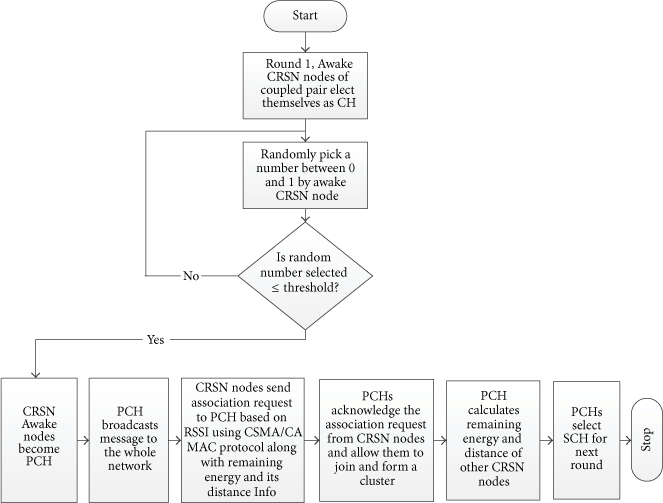
Procedural flow of cluster formation and cluster-head selection.
2.3. Awake-Sleep Mode Configuration for Coupled CRSN Nodes
After spectrum-aware pairwise coupling, clustering, and cluster-head selection, each node configures its respective Awake and Sleep modes for the next round. Both nodes in a spectrum-aware coupled pair take turns switching between Awake mode and Sleep mode after each round. Nodes that are selected as the SCH by the PCH (i.e., to be the cluster head for the next round) must be in Awake mode during the current round. This situation gives rise to a conflict with the node to which it is paired in terms of alternating between Awake and Sleep modes. To resolve this issue, we develop an algorithm for configuring Awake and Sleep modes for coupled nodes in our ECS scheme.
In Algorithm 1, the node first checks whether spectrum-aware coupling has been done. If the node is coupled, then one of the nodes in the pair will check whether it is in awake mode and whether it is flagged as the SCH for the next round. If the SCH next-round flag is “ON,” then the same node will be in Awake mode during the next round and the other node will remain inactive. If the node is in Awake mode and its SCH next-round flag is “OFF,” then the current node will go into Sleep mode and other node will take its turn in Awake mode node for the next round. This procedure is repeated for all other Sleep-mode nodes.
( ( Current CRSN Node Mode = Awake /∗ Keep Current CRSN Node in Awake Mode for Next Round ∗/ ( Current CRSN Node Mode = Sleep /∗ Keep Current CRSN Node in Sleep Mode for Next Round and Activate Other Coupled Sleep-mode Node to Awake Mode ∗/ ( CRSN Node Mode = Awake ( ( ( Mode During the Next Round
2.4. Data Transmission and Reporting in a CRSN
After spectrum-aware pairwise coupling, clustering, and PCH and SCH selection, all active nodes send their sensor data to their respective cluster heads during their individual TDMA slots. It should be noted that nodes in Sleep mode do not take part in data transmission under our proposed ECS scheme The cluster heads aggregate the data from different nodes and send it to the fusion center for the decision-making process. The various decision-making and data-fusion techniques fall outside the scope of this paper. In terms of data transmission, then, we are interested in successfully gathering data for the cluster heads and transmitting it to the fusion center. Data aggregation is a key technique for compressing the amount of data and decreasing the energy consumption of the network.
If there are N total nodes and K is the optimal number of cluster heads, then the average number of nodes in each cluster will be

The energy consumed during data transmission and reporting under our ECS scheme can be divided as follows: data transmission by the node to the cluster head, data received by the cluster head from the node, aggregate data by the cluster head, aggregated data transmission to the fusion center.
During the data transmission of

If

If

If

From the above equations, the total energy

3. Performance Evaluation of the Proposed ECS Scheme
In this section, we analyze the performance of the proposed ECS scheme in terms of its stability period, network lifetime, instability period, the number of cluster heads selected, and the number of packets sent to the fusion center. The metrics used to evaluate the ECS scheme are defined as follows: stability period: duration of the CRSN's performance from its initialization until the first node dies out, network lifetime: duration of the CRSN's performance from its initialization until the last node is alive, instability period: duration of the CRSN's performance from when the first node dies until the last node dies, the number of cluster heads: the number of cluster heads generated each round, packet to fusion center (FC): the rate of successful data delivery to fusion center from cluster heads.
We used MATLAB to simulate the performance of the proposed scheme. In all simulations, we randomly deployed 100 CRSN nodes in a
Simulation parameters.

We compared our ECS scheme with the DEEC protocol proposed in [12]. Figure 4 provides a graph of the number of dead CSRN nodes against the number of rounds. Figure 4 shows that the ECS scheme has a longer stability period than the DEEC protocol. Under the ECS scheme, the first node died near Round 1,600, whereas the first node died near Round 1,300 under the DEEC protocol. Furthermore, the nodes started dying more rapidly under the DEEC protocol after Round 1,500, and this did not occur with our ECS scheme. This indicates that the ECS scheme provides a longer network lifetime than the DEEC. This is because the ECS scheme deactivates CRSN nodes in Sleep mode.

The number of dead CRSN nodes.
Figure 5 shows the number of alive CRSN nodes against number of rounds. Initially all nodes are alive. In Figure 5, we can see that, out of 100 alive nodes, the first node in the ECS scheme died around 1,600 and that subsequent nodes died at a constant rate. Under the DEEC protocol, on the other hand, there was a sudden increase in dead nodes after round 1,500. This shows that, with our proposed ECS scheme, unstable regions appear later than they do with the DEEC protocol.

The number of alive CRSN nodes.
Figure 6 shows the number of cluster heads selected each round. The DEEC protocol resulted in more uncertainty in selecting cluster heads. A random number of cluster heads are selected every round under the DEEC protocol. However, with our ECS scheme, cluster-head selection is energy efficient, resulting in less uncertainty in cluster-head selection. Moreover, with the DEEC protocol, there were more cluster heads selected, leading to increased communication costs. With the proposed ECS scheme, only the Awake nodes take part in cluster-head selection. Thus, the optimal number of cluster heads is selected for every round in a controlled fashion to prolong the networks lifetime.

The number of cluster heads selected each round.
Figure 7 shows the data transmission to the fusion center against the number of rounds. Owing to the Sleep and Awake modes with our ECS scheme, there was less data transmitted to the fusion center compared to the DEEC protocol. Under the DEEC protocol, all nodes take part in data transmission. Hence, with the DEEC protocol, there is significantly more data transmitted. Under the ECS scheme, only Awake nodes take part in data transmission to the cluster heads, and the cluster heads aggregate the data from associated Awake-mode CRSN nodes exclusively, transmitting only this data to the fusion center. Thus, there is considerably less data transmitted under the ECS scheme. This tradeoff can be justified by the increased network lifetime and stability of the proposed ECS scheme.
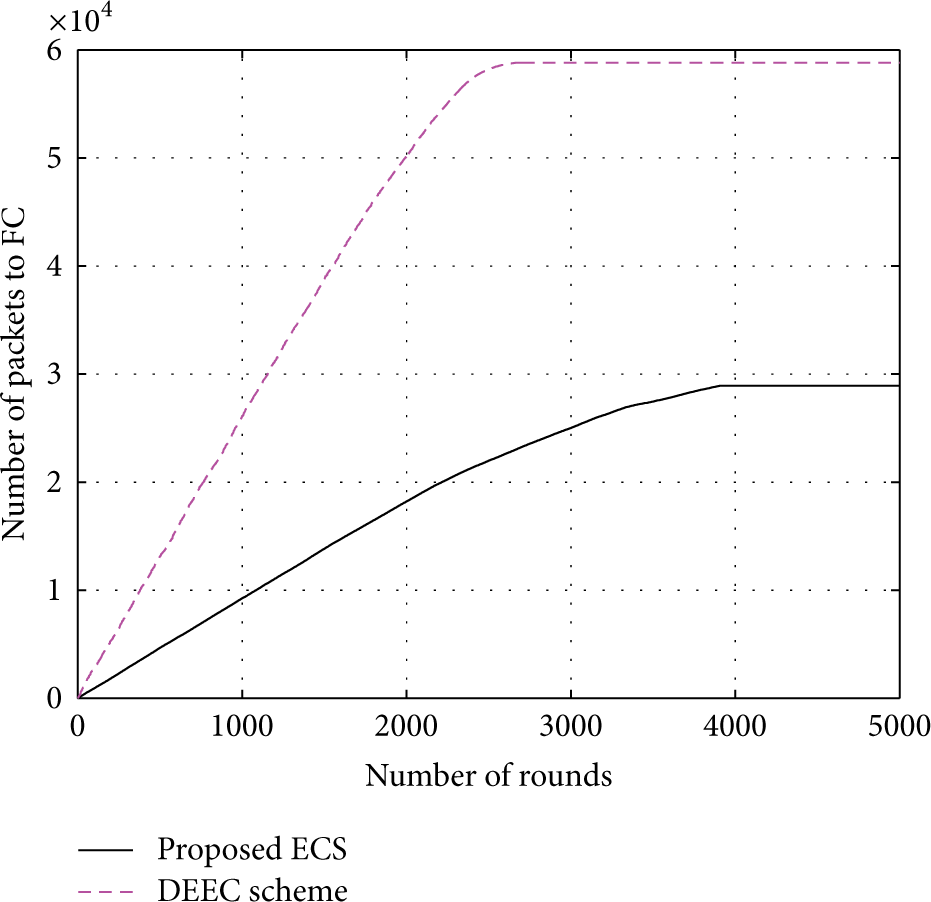
Data transmitted to the fusion center.
4. Conclusion
In this paper, we proposed a novel energy-efficient clustering based cooperative spectrum sensing (what we call the “ECS” scheme) for cognitive radio sensor networks. Our main goal was to enhance the energy efficiency of a cognitive radio sensor network, in order to increase the networks lifetime and stability. Further, we developed techniques for energy-efficient cluster-head selection and clustering. With our proposed ECS scheme, we used spectrum-aware pairwise coupling for the sensor nodes. The coupled nodes alternate between Awake and Sleep modes in order to minimize the energy consumed by the network and to increase the lifetime of the network. Through extensive simulations, we demonstrated a significant improvement in the stability and lifetime of a cognitive radio sensor network.
In future work, we will consider the involvement of primary users, and we will provide network-coverage analysis and discuss data and decision-fusion and convergence rates for our proposed ECS scheme.
Footnotes
Conflict of Interests
The authors declare that there is no conflict of interests regarding the publication of this paper.
Acknowledgment
This research was supported by the MSIP (Ministry of Science, ICT and Future Planning), Korea, under the Global IT Talent Support Program (NIPA-2014-H0904-14-1005).