




Abstract
In a cognitive radio network (CRN), secondary users (SUs) utilize primary users (PUs) licensed spectrum in an opportunistic manner. Spectrum sensing is of the utmost importance in CRN to find and use the available spectrum without harmful interference to the PUs. Conventionally, to implement spectrum utilization, SUs are required to sense the primary spectrum first and then transmit data on the available spectrum. In this paper, we propose a dedicated wireless spectrum sensing network (WSSN), eliminating sensing overhead from SUs with the aim of improving achievable throughput. With WSSN assistance, we eliminate sensing time from the SUs frame, hence increasing the transmission time, which maximizes the achievable throughput. Additionally, the sensing duration is increased by deploying a dedicated WSSN, decreasing the probability of false alarm and achieving a targeted high probability of detection. A low probability of false alarm increases the spectrum utilization, improving the achievable throughput, while a high detection probability ensures PUs protection. Moreover, the proposed technique also addresses hidden and exposed terminal problems along with smooth spectrum mobility. Finally, we provide simulation results to demonstrate the proposed techniques, effectiveness. In the results, we have compared the achievable throughput of the proposed scheme with that of conventional CRN.
1. Introduction
The electromagnetic spectrum is one of the precious natural resources used for radio communication. The regulatory body, that is, the Federal Communication Commission (FCC), allocates this spectrum to the licensed users of certain geographical locations, while some portion is kept license-free. The significant underutilization of the licensed spectrum accompanied by the substantial overutilization of the unlicensed spectrum has demanded the need for dynamic spectrum access. Such a paradigm improves the spectrum's utilization by exploiting the code, temporal, and spatial variations of different spectrum bands. Cognitive radios based on dynamic spectrum access have been a topic of interest for researchers in recent years. The cognitive radio network (CRN) is composed of unlicensed users, also known as secondary users (SUs), capable of cognition and reconfiguration properties. In particular, the cognition cycle includes radio environment sensing, spectral hole identification, information analysis, and spectrum decisions that are used for temporary data transmission. Spectral holes are the bands legally assigned to licensed users, also known as primary users (PUs), but are not used by primary transmitters at specific times and specific locations. In addition, reconfiguration takes into account the organization of transceiver parameters according to the sensed radio environment. However, being a different scheme from traditional communication networks, dynamic spectrum access is technically challenged by several factors. For instance, in dynamic spectrum access, to identify the spectral hole from a wide range of frequencies, SUs require wide band transceiver implementation along with a quick decision algorithm. Second, dynamic spectrum access entails SUs ability not to disturb PUs transmission. Hence, SUs must return the spectrum back, as PUs start transmission. Further, SUs should coordinate among themselves to share the available spectral hole in a friendly manner. Moreover, in current CRN technology, SUs are unable to measure the interference at a PUs receiver. Such inaccurate sensing, poor response time, hardware limitations, and PU restrictions remain challenges for researchers.
In the literature, spectrum sensing and access techniques have been extensively investigated with the general objective of maximizing the CRN throughput without violating the interference limits of the licensed network. Such schemes are mainly categorized into two classes: centralized spectrum access (CSA) and distributed spectrum access (DSA). In CSA, a single central entity gathers the spectrum measurements and makes spectrum access decisions solely on its own information. For example, the authors of [1] used a graph-theoretic approach, where a spectrum server is deployed to find the optimal schedules in order to maximize the average sum rate given the minimum average rate constraint. Meanwhile, in [2], based on the IEEE 802.22 WRAN standard, infrastructure-based network model is utilized where base stations are responsible for spectrum access and management. On the other hand, DSA techniques rely on the individual or cooperative decision of the cognitive users in a decentralized manner. Several DSA techniques have been proposed in the literature for the CRN. For instance, the authors of [3] adopt a game theoretic scheme to propose a price-based spectrum model for cognitive radios. In their work, CRN is modeled as a noncooperative game that uses price-based iterative water-filling algorithm to reach Nash equilibrium. Moreover, [4] used a randomized sensing combined with a probabilistic and nongreedy transmission policy to counter the unavoidable inaccuracies in spectrum measurements. In their novel RAP-MAC protocol, they allow SUs to better explore the spectral holes randomly, regardless of spectrum sensing inaccuracy, enabling multiple secondary flows to share the available spectrum in a distributed manner. Meanwhile, [5] presents a novel game-theoretic channel sharing scheme that allows SUs to freely optimize the channel utilization to transmit PUs data along with their own data.
The frame structure of DSA cognitive radios is comprised of sensing time and data transmission time, as shown in Figure 1 [6]. According to the frame structure, first, the cognitive user senses the spectrum for a specific time duration. Then, the user starts data transmission if a PU is not available. According to [7], a longer sensing time results in precise spectrum sensing, ultimately avoiding interference with the licensed network. However, on the other hand, an increase in sensing time results in a decrease in transmission time, leading to low throughput. Hence, there is always a trade-off between perfect sensing and throughput. This contrast has been discussed in [7], where the authors have tried to find the optimal sensing time, aiming at maximizing throughput along with ensuring no harmful interference with PUs. In the aforementioned spectrum access schemes, CSA is totally governed by an infrastructure-based system providing spectrum access to SUs. Taking into account an unlicensed user, the sensing time is approximately negligible in centralized spectrum access as the SU is not directly involved in spectrum sensing. The SU requests the spectrum to the centralized entity, which allocates the available spectral hole to the SU based on its own measurements. Thus the sensing time can be neglected in CSA, increasing the throughput of the CRN, as shown in Figure 2(a). However, CSA requires expensive infrastructure that is not economically recommendable. Alternatively, in the DSA technique, as shown in Figure 2(b), the cognitive user accesses the spectrum itself, which wastes a significant amount of time in sensing, resulting in decreased throughput. Thus, a scheme is needed that can increase the throughput of the cognitive network with low-cost infrastructure. This is the main motivation for this work. This paper proposes a dedicated wireless spectrum sensing network (WSSN) for the CRN that overwhelms the sensing time versus throughput tradeoff. In the proposed scheme, the throughput has been maximized by separating the sensing portion from the SU architecture; instead of infrastructure based sensing network a cost effective dedicated ad hoc WSSN is deployed, giving the idea of hybrid spectrum access. Whenever SUs need spectrum access, they send channel requests to the dedicated WSSN on a separate control channel. The proposed system model and SU/WSSN network handshake algorithm are explained in more detail in the next section. Furthermore, the proposed scheme also addresses the hidden terminal problem and missed opportunity due to an exposed primary transmitter [4]. The major contributions of this work are maximizing the CRN throughput, lowering the SU architecture complexity by removing the sensing portion, improving the ease of spectrum mobility, and minimizing the sensing time with the aid of a dedicated WSSN network.

Frame structure of the conventional CRN [6].
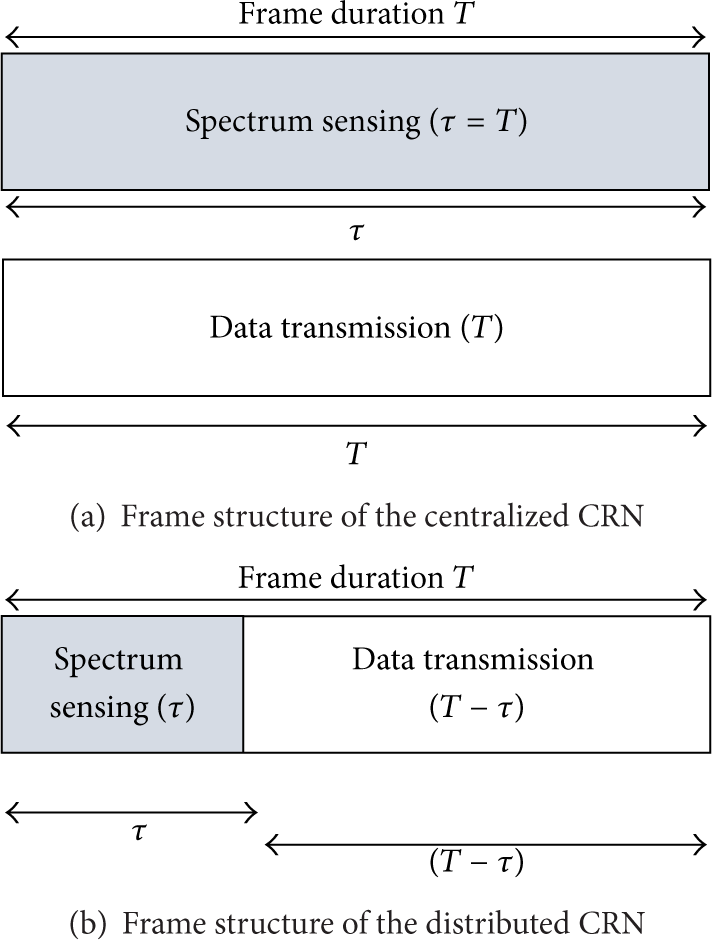
Frame structures.
The rest of this paper is organized as follows. The proposed scheme is described in detail in Section 2. In Section 3, the throughput analysis of the proposed scheme is discussed. Finally, the simulation results are presented and discussed in Section 4, whereas Section 5 concludes the paper.
2. Proposed System Model
In this section, first, we present a general network overview and then we explain the hybrid nature of the proposed system. Later, a spectrum allocation algorithm and a modified cognition cycle are described. Finally, the proposed scheme presents a smooth spectrum transition along with the solution to hidden and exposed terminal problems.
2.1. Sensing Network Overview
Here we present an inclusive overview of the scenario. As shown in Figure 3, a number of sensor nodes are deployed around a PU transmitter to cover a specific geographical area. The SU transmitter and receiver are located in the PU network range.

Network overview of the proposed CRN.
In this work, we propose a dedicated WSSN to identify spectral holes for the CRN. The WSSN is an ad hoc network comprised of several sensor nodes with an enhanced spectrum sensing capability, that is, equipped with wide-band transceivers. Sensor nodes inside the WSSN can be installed in two different setups: (i) a single sensor per location, where only a single sensing node is deployed to sense spectral holes in its coverage area; (ii) multiple sensors per location, where multiple sensors can sense spectral holes for the same coverage area. Sensor nodes inside the WSSN network communicate on a common control channel of the assumed wireless sensor network technology. A coordinator of the WSSN serving as the fusion center (FC) is adopted to collect results from the sensing nodes, and it maintains the records in a table, termed the information table (IT) in this work. After obtaining data from all sensor nodes, the FC updates its IT and hence is up-to-date with all geographical locations at any instant. The FC is responsible for providing spectrum availability to the SU of the CRN. Moreover, the sensor nodes use the most popular energy detection [8] model for spectrum sensing because it is easy to implement and requires no prior knowledge about the primary signal

2.2. Frame Structure and Hybrid Nature
The proposed system combines good features of centralized and distributed spectrum access schemes and is therefore a hybrid system. Unlike the aforementioned CSA and the similar DSA, the proposed hybrid scheme is an infrastructure-less ad hoc wireless sensor network. The frame structure of the proposed hybrid system is similar to CSA, as shown in Figure 4, where sensing and transmission are performed in parallel for a complete frame duration T. The significance of this frame structure is that sensing and transmission times are simultaneously increased. The increased spectrum sensing time results in the following: an improved detection probability that ensures better protection of the PU from harmful interference; a reduced false alarm probability that increases spectrum utilization, improving the achievable throughput; the optimization of sensing time, and the sensing time-throughput trade-off problem is overwhelmed.

Frame structure of the proposed WSSN-assisted CRN.
On the other hand, unlike the DSA technique, the proposed WSSN scheme eliminates the sensing time slot from the conventional frame structure, which is the better half of CSA. The advantage of eliminating the sensing slot from the conventional frame structure is that now this slot is also used for data transmission, which maximizes the achievable throughput. Cognitive users only request the FC for the spectrum when it needs to transmit data.
2.3. SU-WSSN Handshake Algorithm
When an SU needs to transmit data, it will contact the FC directly. If the FC is not accessible to the SU, sensor nodes have the ability to route its request to the FC. Note that sensor nodes can only route the channel request and channel grant message but cannot grant the channel to the SU based on their own decision. We assume a separate control channel for the WSSN-SU communication. The channel allocation algorithm is carried out through the following steps. The SU broadcasts a channel request ch_req packet on a separate control channel and starts its timer. The FC receives the request from the SU directly; if the FC is not in the SUs range, the nearby sensor node redirects the ch_req packet to the FC. The described packet contains the SU transmitter location, the SU receiver location, the maximum transmit power, and the maximum amount of data to be sent over the primary channel. The FC discards multiple copies of one request. Upon receiving the ch_req packet, the FC examines the IT table measurements. Based on IT table measurements, two cases can occur.
If the spectrum is available, the FC sends the channel grant ch_grt packet to the SU. The described packet contains information about the available spectrum, its bandwidth, the maximum data-rate, and the maximum allowable transmission power. If the spectrum is not available, the FC sends the channel reject ch_rjt packet to the SU. Upon receiving the ch_grt packet, the SU acknowledges the FC by transmitting ack packet and starts data transmission on the allocated channel. In the second case, after time-out, the SU again requests the channel. When the PU starts transmission on the primary channel, the FC sends a channel stop ch_stp packet to the SU in order to ensure the QoS of the PU. It also updates the SU with the new available spectrum for smooth and quick channel mobility.
2.4. Modified Cognition Cycle
As shown in Figure 5, the architecture of the cognition cycle given in [9] is modified according to the proposed scheme. Compared to the traditional cognition cycle, the sensing part is moved outside of the traditional cognition cycle. Spectrum sensing is the responsibility of the dedicated WSSN network. The dedicated WSSN network will decide the spectrum band, the channel bandwidth, the maximum data rate, and the maximum allowable transmission power. Further, if the PU starts transmission on the specified spectrum, the FC can stop the SUs transmission. In other words, cognitive terminal complexity has been lowered by eliminating the sensing portion from the SUs architecture.
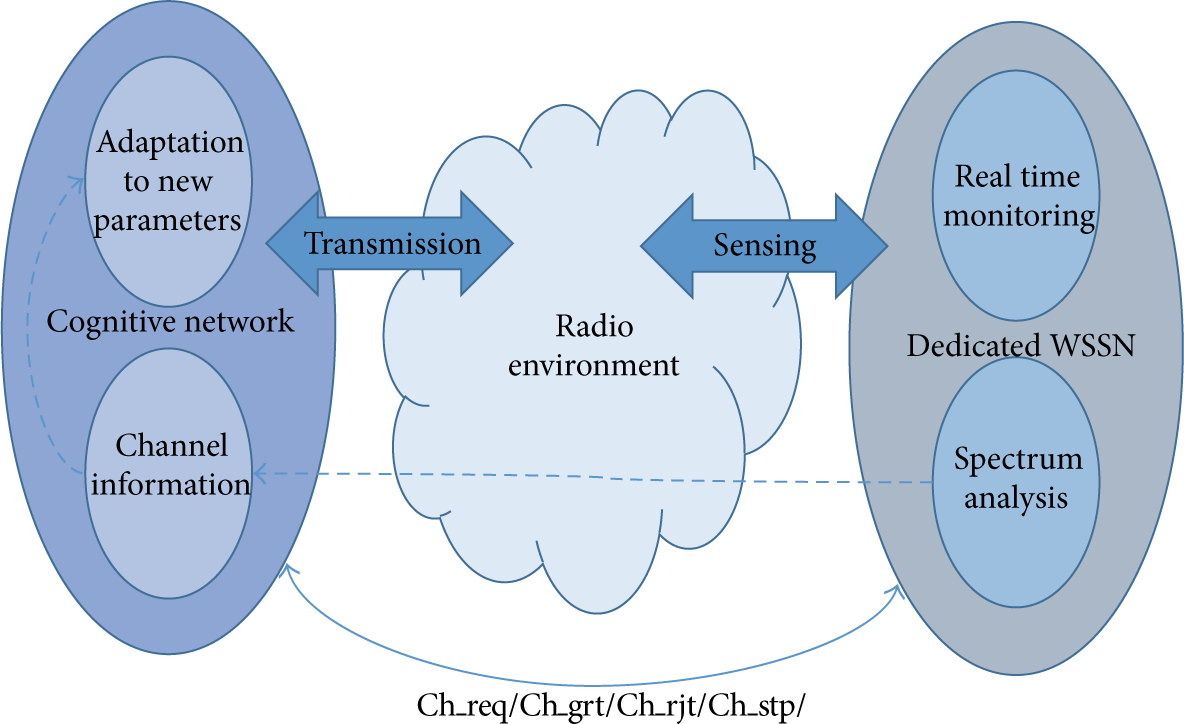
Modified cognition cycle. The spectrum is analyzed by WSSN. The FC provides spectrum information that is used by the CRN to adapt to new parameters shown by the dotted lines.
2.5. Spectrum Mobility
Spectrum mobility [10] refers to the spectrum change made by a cognitive user when a PU starts data transmission on its licensed band. The purpose of spectrum mobility is to guarantee smooth and fast channel changeover, resulting in minimum performance degradation. The important prerequisite of spectrum mobility is information regarding the available spectral holes and the time duration required for smooth channel transitions. The availability of the spectrum ensures in-time and fast transitions in spectrum mobility. Zhu et al. [11] show through Markov chain analysis that the channel reservation and spectrum handoff significantly increase the throughput of cognitive users. In a performance evaluation, they present that the channel reservation reduces the force termination probability with a small increase in the blocking probability. In the proposed WSSN-assisted CRN system, the FC provides SUs with the backup reserved spectrum information based on its IT measurements. Thus, having the spectrum information, ongoing communication can be well-preserved with minimum performance degradation and enhanced throughput. Moreover, Park et al. in [12] present a stochastic model for a cognitive radio sensor network. In their work, they claim that the probability of force termination and the probability of blocking are both considerably decreased while the throughput has been enhanced by the channel reservation and spectrum mobility. The optimum number of reserved channels and system modeling based on the Markov chain are beyond the scope of this work.
2.6. Hidden and Exposed Terminal Problems
The hidden terminal problem [13] refers to the scenario in which PU transmission is occurring and is mistakenly inferred as a spectral hole. Consider the case, as shown in Figure 6(a), in which the PU transmitter transmits data to the PU receiver. If the SU is equipped with sensing capability, it is still unable to detect the PU transmitter, due to the hidden terminal problem. In the proposed scheme, the SU will request the FC of the WSSN network for the spectrum. The sensing network consists of several nodes that continuously sense the spectrum and update the FC accordingly. If there is a PU transmitter, the FC is aware of its existence, even in the situation in which the SU cannot sense the PU, as shown in Figure 6(a). Hence, by deploying WSSN nodes, the hidden terminal problem is solved without any additional sensing arrangement.

Terminal problems.
On the other hand, the exposed terminal problem [4] is considered a missed opportunity and is defined as the situation in which the spectrum is available but is mistakenly sensed as being occupied by the PU. Consider the scenario, as shown in Figure 6(b), in which the PU transmitter is transmitting data to the PU receiver. Here, the PU transmitter is near to the SU transmitter, while PU receiver is far away from the SU transmitter. In addition, the SU receiver is at the other side relative to the PU transmitter and receiver, as shown in the figure. Hence, in this case, the SU transmitter can transmit to the SU receiver without interfering with the primary network. However, due to a position dilemma, the SU transmitter senses that the primary network is occupied, resulting in a missed opportunity. In the proposed scheme, the IT table of the FC possesses the location information. Hence, the missed opportunity due to the exposed terminal problem is solved by the dedicated WSSN network with no additional setup required.
3. Throughput Analysis
This section demonstrates the throughput analysis of the proposed WSSN-assisted hybrid CRN and compares it with the throughput of the traditional CRN that works on the conventional packet frame, as shown in Figure 1. Here, our main objective is to achieve a higher throughput than the conventional frame structure-based CRN network. A high detection probability is considered in order to protect PUs against harmful interference, maintaining the QoS of the licensed network.
3.1. Sensing Preliminaries
As aforementioned, the most popular spectrum sensing scheme, that is, energy detection [14], has been considered to determine the spectral hole for the proposed system. Our throughput analysis is based on the work specified in [7] that aims to find the optimal sensing time in the sensing-throughput trade-off. In our analysis, we have considered two cases for the proposed WSSN sensing scheme: (i) a single sensor per location; (ii) multiple sensors per location.
3.1.1. A Single Sensor per Location
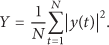
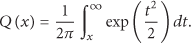
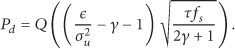
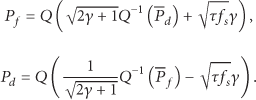
In this case, only one sensor is installed per unit geographical location to sense its spectral environment and report to the FC. Starting with (1), let τ be the sensing time and ϵ the detection threshold; Y as given in (2) is a random variable, which follows Chi-square distribution. For





3.1.2. Multiple Sensors per Location
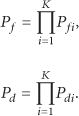
Here we are interested in the case in which multiple sensors are deployed per unit geographical location to sense the spectrum. Let K be the maximum number of sensors per unit location,

The probability of false alarms


3.2. Throughput Calculations
After deriving the relationship between the probability of false alarms and the probability of detection, now we are able to compute the throughput of the secondary network based on the derived equations. As mentioned before, the conventional frame consists of a sensing slot and a transmission slot, as shown in Figure 1. The sensing time is denoted by τ, while the total frame duration is T. Note that, in the proposed scheme, the sensing time is zero from the SUs viewpoint, as the SU is not involved in spectrum sensing. The spectrum sensing task is the responsibility of the dedicated WSSN network. Moreover, the value of τ varies from 0 to T as the proposed dedicated network senses the spectrum maximum to the frame duration.
In the proposed scheme,
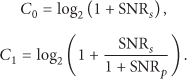
The throughput of the secondary network when it operates in the absence of a PU is denoted by
Case 1.
When the PU is inactive and no false alarm is produced, then the achievable throughput of the CRN is calculated as



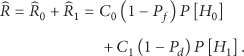
By comparing (18) and (20), it is validated that the throughput of the proposed WSSN-assisted CRN is greater than the traditional frame-based CRN network


Similarly, for a target detection probability

For maximum sensing time


4. Simulation Results
In this section, the simulation results are presented to demonstrate the surge in throughput of the proposed WSSN-assisted cognitive network. The PU is assumed to be a QPSK-modulated signal with a 6 MHz bandwidth. We choose the frame duration
First, we compare the probability of false alarms as a function of sensing time τ for single sensor per location and multiple sensors per location cases. Figure 7 shows that, for a given sensing time, increasing the number of sensors per unit location decreases the probability of false alarms, improving the performance of spectrum sensing and enhancing the achievable throughput of the cognitive network.

Probability of false alarm for single sensor and multiple sensors per location cases versus sensing time τ.
Next, we suppose that the SNR for cognitive user
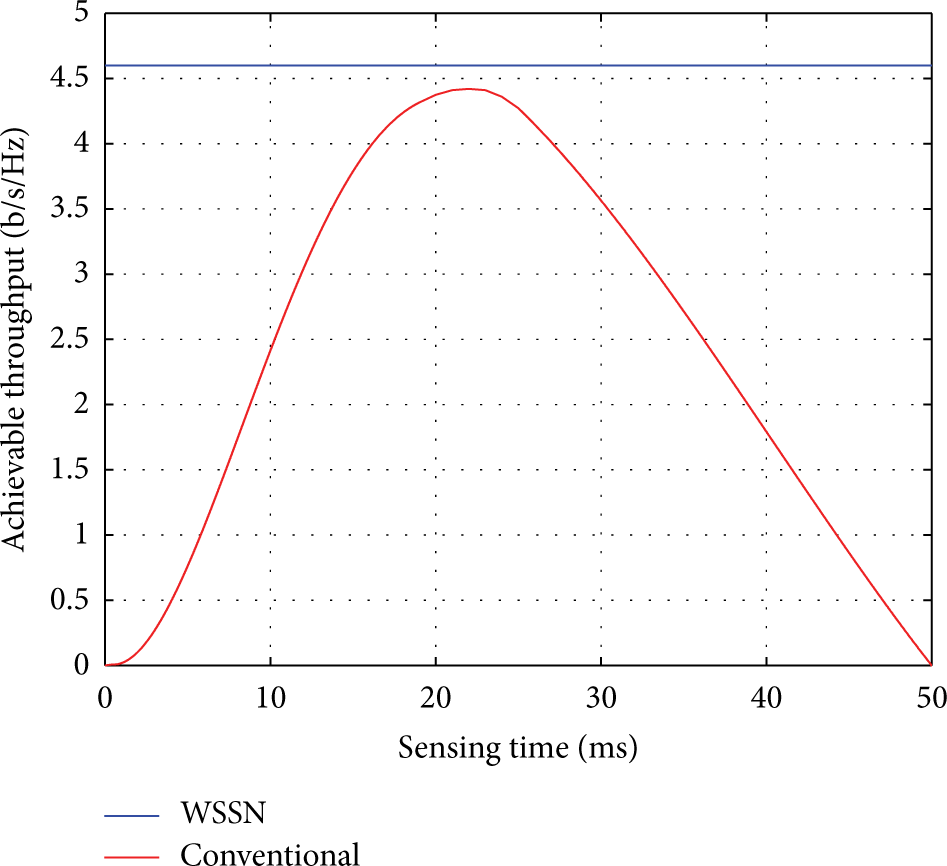
Achievble throughput of a proposed and conventional scheme versus sensing time τ.

Normalized throughput of a proposed and conventional scheme versus sensing time τ.
In Figure 10, we show the achievable throughput versus target detection probability for the proposed and conventional schemes where

Achievble throughput of a proposed and conventional scheme versus target detection probability

Achievble throughput of a proposed and conventional scheme versus primary SNR
5. Conclusion
In this paper, we have proposed a dedicated WSSN network that separates the sensing task from SUs of a CRN. The dedicated sensing network detects the spectral hole in the primary network and provides admission control for the secondary users. The proposed scheme significantly improves the achievable throughput by minimizing the sensing time to zero from secondary users perspective. Alternatively, the sensing time for spectrum detection has been increased by deploying a separate sensor network. Using an energy detection scheme in the sensing network, we have analyzed a high detection probability and a lower false alarm probability. The given analysis clearly indicates that a high probability of detection prevents secondary users harmful interference to the primary network, while a lower probability of false alarm ensures better utilization of the primary spectrum by secondary users. The simulation results reveal that the proposed technique significantly increases the achievable throughput compared to the conventional frame-based CRN. In addition, the proposed scheme solves the hidden and exposed terminal problem without extra setup and also gives an optimal solution to the spectrum mobility problem. Finally, the proposed schemes’ effectiveness is demonstrated through simulation results.
Footnotes
Conflict of Interests
The authors declare that there is no conflict of interests regarding the publication of this paper.
Acknowledgment
This work is supported by the GRRC program of Gyeonggi province (GRRC-Hanyang-2013), South Korea.