




Abstract
IPv6 developed as a next generation Internet protocol will provide us with safer and more efficient driving environments as well as convenient and infotainment features in cooperative intelligent transportation systems (ITS). In this paper, we introduce the use of pseudonyms in IPv6 ITS communications for preserving location privacy. We conduct qualitative study on the performance degradation due to the use of pseudonyms and quantitative analysis on the optimal pseudonym change interval. Numerical results demonstrate that an appropriate pseudonym change interval should be changed depending on the packet arrival rate, mobility rate, and security level.
1. Introduction
Cooperative intelligent transportation systems (ITS) aim at providing new advanced solutions to today's transport problems. Communications among ITS stations (e.g., cars and roadside infrastructures) are essential parts of the cooperative ITS for improving road safety, efficiency, and comfort during driving. As the communications between ITS stations are the heart of the cooperative ITS, it is important to correctly understand how the deployment of cooperative ITS will affect an individual's privacy during his/her driving.
Privacy is one of the fundamental rights of human being. In particular, location privacy is a specific type of privacy that can be defined as follows [1]: “the ability to prevent other parties from learning one's current or past location.” Imagine your car as a vehicle ITS station constantly communicating with other nearby ITS stations, for example, cars and roadside infrastructures. Your car emits its location (e.g., GPS position information), speed, heading direction, and even identity 10 times per second. Thus, anyone that has a wireless radio receiver system (e.g., wireless access point) within the wireless radio transmission range (probably in 500 meters or 1,000 meters) is able to capture all messages sent out from your car. Now imagine the ability to set up a set of wide-range wireless radio receiver systems in a city. It means that the activity of every single car in the city can be surveilled including yours. In other words, without sophisticated skills, communications among ITS stations, for example, vehicle, roadside, and personal ITS stations, are exposed to an observer in a wireless radio transmission range because of the nature of wireless communications. As the observer extracts identifiers from a message such as addresses in each protocol layer in transmissions, he/she could link messages and track a vehicle ITS station emitting the messages having the same identifiers.
To address location privacy in cooperative ITS, the use of pseudonyms has been chosen as a baseline approach for preserving location privacy. A pseudonym, which is an arbitrary bit string to generate a temporary identifier in each protocol layer, is used with an appropriate changing scheme [2]. For instance, a vehicle ITS station uses a pseudonym
In this paper, which is an extension of the paper published in [6], we focus on the use of pseudonyms in IPv6 ITS communications for preserving location privacy. In particular, we present an IPv6 address configuration with pseudonyms and then study a performance degradation issue due to frequent pseudonym changes at the IPv6 layer. We also investigate the optimal pseudonym change algorithm that makes a balance between communication overhead and location privacy at the IPv6 layer.
2. IPv6 Communications in Cooperative ITS
2.1. IPv6 Communications and Applications
The ISO/ETSI ITS station reference architecture specified in [7, 8] introduces various communication protocols designed to meet specific requirements for cooperative ITS. However, among communication protocols in the network layer, IPv6 is a major communication protocol as it provides Internet connectivity and communication capacity for various applications. The use of IPv6 especially satisfies the addressing needs of a growing number of vehicles and personal devices [9] and provides session continuity between heterogeneous networks, thanks to a mobility support extension, that is, NEtwork MObility (NEMO) [10].
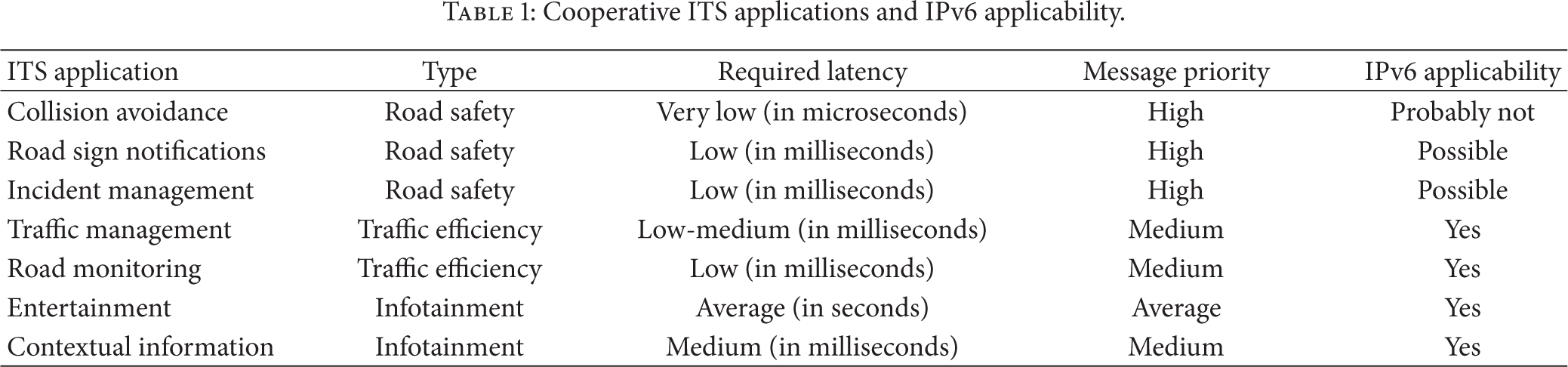
Various ITS applications have been investigated and studied with respect to their functionalities: safety, efficiency, and infotainment applications [11]. At the beginning of ITS research, most of studies focused on the road safety applications that are basic and essential applications as those applications aim at minimizing the risk of accidents. However, cooperative ITS does not only provide such limited functionalities. It also provides advanced applications such as traffic efficiency and infotainment applications. In particular, as shown in Table 1, IPv6 communications can be applied into the traffic efficiency and infotainment ITS applications that do not require strict message transmission and very low latency. Then, among the road safety applications, some applications like road sign notifications and incident management are possibly supported by IPv6 communications. For instance, messages of road sign notifications and incident management may be delivered to specific vehicles via roadside infrastructures that use IPv6 communications.
Cooperative ITS applications and IPv6 applicability.
2.2. IPv6 Related Standardization Efforts
As IPv6 has been originally developed for the Internet, its adaptation into cooperative ITS requires a set of standardizations that do not intend to define new protocols or message modification at the IPv6 layer but define how standard IPv6 protocols developed by the IETF are combined for cooperative ITS. The following are standardization efforts at the ISO and ETSI levels.
ISO 21217 [7] and ETSI EN 302 665 [8]: the ISO/ETSI ITS station reference architecture containing IPv6 communications at the network layer is specified. ISO 21210 [9]: IPv6 networking between two or more ITS stations has been specified. ETSI TS 102 636-6-1 [12]: IPv6 networking over GeoNetworking capabilities has been specified. ETSI TR 101 555 [13]: as of writing this paper, IPv6 networking analysis is being documented. ISO 16788 [14]: as of writing this paper, IPv6 network security is being documented. ISO 16789 [15]: as of writing this paper, IPv6 network optimization is being documented.
2.3. IPv6 Related European Projects
IPv6 communications have been widely tested and validated through successful ITS related projects. In the Cooperative Vehicle Infrastructure Systems (CVIS) European FP6 project (2006–2010), an implementation of the ISO CALM architecture has demonstrated capabilities offered by IPv6, for instance, session continuity support during handovers between M5 (IEEE 802.11p variant) and 3G access technologies. The GeoNet European FP7 project (2006–2010) was also launched to investigate a combination of IPv6 and GeoNetworking, that is, IPv6 networking over GeoNetworking capabilities. The recently launched European FP7 project, ITSSv6 (IPv6 ITS Station Stack for Cooperative ITS Field Operational Tests, 2011–2014), aims at developing an IPv6 ITS station communication stack complying related ISO, ETSI, and IETF standards. In particular, the IPv6 ITS station communication stack, which is being developed based on the existing open source software with additional software components, will be released as an open source software.
3. Use of Pseudonyms in IPv6 ITS Communications
3.1. IPv6 Address and Pseudonym
At the IPv6 layer, the IPv6 address is an identity that is globally unique when the address is a unicast address. In order to provide location privacy at the IPv6 layer, a pseudonym, an arbitrary bit string, is used to generate an arbitrary IPv6 address.
Figure 1 shows an example of a pseudonym use in the link and network layers for preserving location privacy. Note that pseudonyms can be used in all communication stacks against observers examining not only one communication layer. In this example, the pseudonym is assumed to be 48 bits long and it thus replaces the 48 bits of MAC address, while a new IPv6 address, which is 128 bits long, is generated based on the supplied pseudonym. More specifically, the rightmost 64 bits of IPv6 address, that is, interface identifier, are generated based on the pseudonym while the leftmost 64 bits of IPv6 address, that is, network prefix, are supplied from a router advertisement (RA) sent from an access router.

Example of a pseudonym use in the link and network layers.
As mentioned earlier, the pseudonym is synchronously changed across the entire communication stack in order to make sure that identity information at each layer is changed. For instance, as shown in Figure 1, when a current pseudonym
3.2. Pseudonym Change
An example of pseudonym changes at the IPv6 layer is introduced in detail. In particular, we illustrate two specific pseudonym changes similar to [3]: (1) pseudonym change due to a handover and (2) pseudonym change due to a pseudonym expiration.
Figure 2 shows a considered network topology wherein a vehicle ITS station implementing IPv6 mobility, that is, NEMO, changes its attachment point from an access router, AR-1, to a new access router, AR-2. The vehicle ITS station is thus assumed to be equipped with a mobile router (MR) functionality defined in [10]. Each access router provides the Internet connectivity to the vehicle in its access network. The home agent (HA) is located at the Internet.
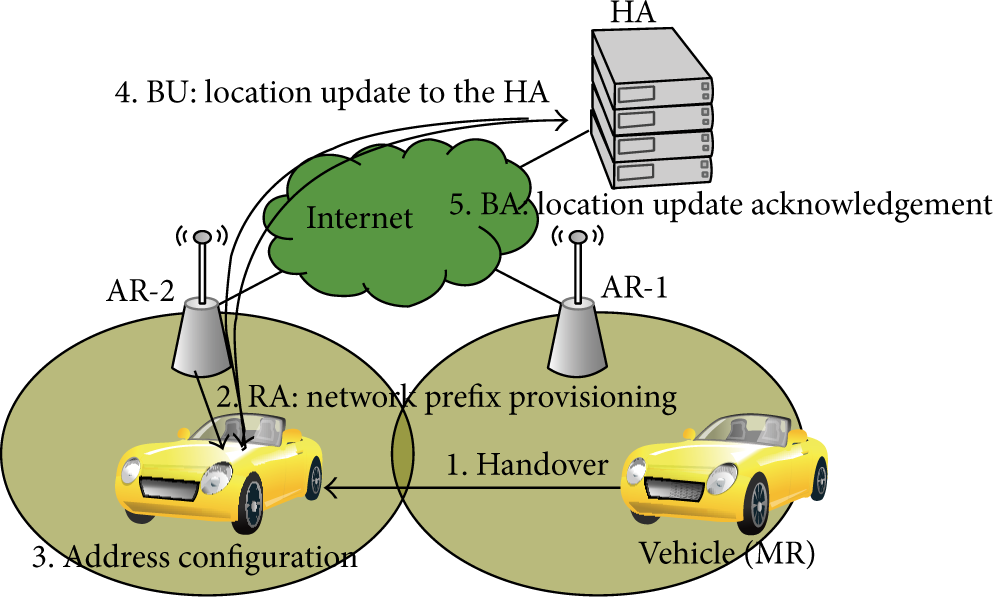
Movement of a vehicle.
Figure 3 shows pseudonym change procedures. The details of each step are as follows.
First, a pseudonym change due to handover is considered. Suppose that the vehicle ITS station V attaches to a new access network of AR-2. V receives an RA message from AR-2. The RA message includes the network prefix V is required to configure a new address called care-of address (CoA) with where Before the use of The HA replies with the BA message to V. A pseudonym change due to pseudonym expiration is now considered. Suppose that the current pseudonym's lifetime where V sends a new BU message containing Upon receiving the BU message, the HA updates its binding cache for V and replies with the BA message.


Example of pseudonym changes for handover and pseudonym expiration.
4. Qualitative Analysis
In this section, we examine performance degradation with the use of pseudonym at the IPv6 layer.
A pseudonym at the IPv6 layer is changed mostly due to the following:
the pseudonym change interval, that is, pseudonym expiration, the change of point-of-attachment, that is, network-level handover.
Figure 4 is the timing diagram showing which procedures are performed when the IPv6 address is changed due to the pseudonym change. At

Pseudonym change due to the pseudonym expiration.
As shown in Figure 4, during the time for the DAD procedure
Figure 5 shows the time diagram on the procedures that occurred when the IPv6 address changed due to the network-level handover [9, 10]. At
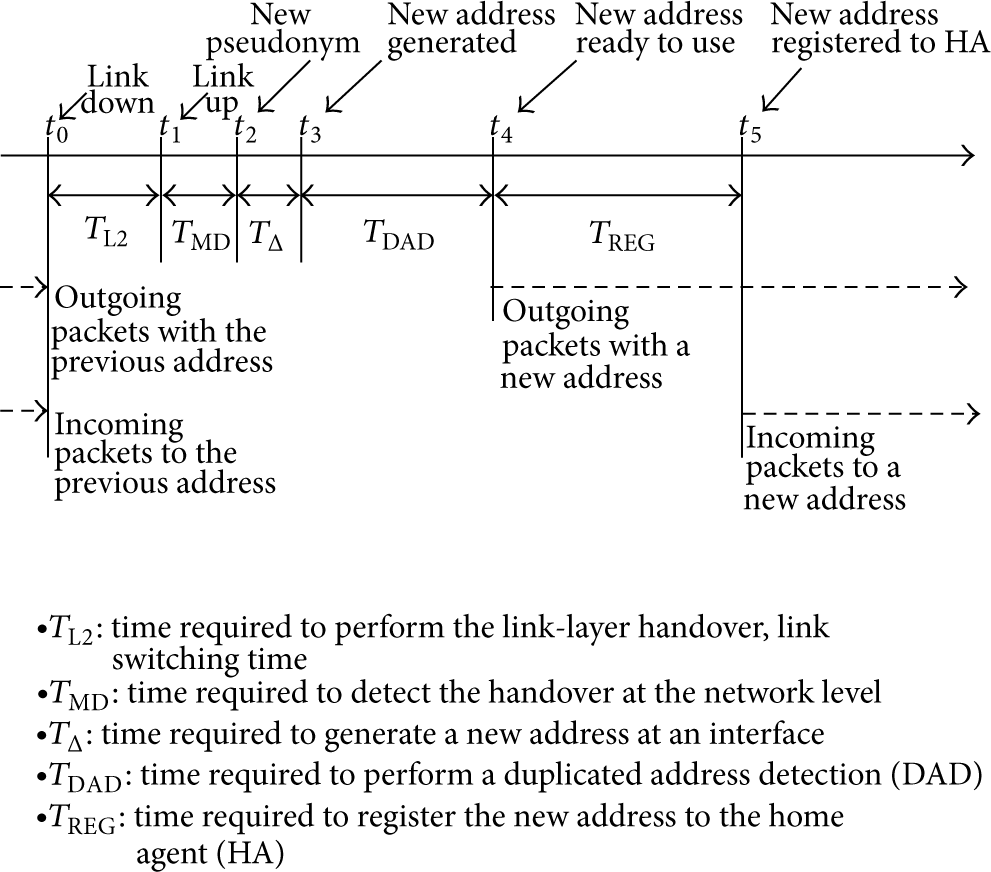
Pseudonym change due to the network-level handover.
5. Quantitative Analysis
A pseudonym change badly influences communication performance as it yields the IPv6 address change during IPv6 communications. If a pseudonym change interval is long, the privacy exposure time increases. On the other hand, if the pseudonym change interval is short, the overhead due to frequent pseudonym changes increases. Accordingly, an algorithm that finds an optimal pseudonym change interval for making a balance between communication overhead and location privacy is needed.
Figure 6 shows a timing diagram for modeling the privacy exposure time, which is defined as the time until a new pseudonym is set. The following are the used notations with explanations:

Diagram for the optimal pseudonym change interval.
With the timing diagram, we model the privacy exposure time and develop the optimal pseudonym change algorithm. After the observation starts at 

Now, we need to find proper distributions for 
On the other hand, if the subnet residence time 
Then, the PDF of z, 
From (7), the Laplace transform of
Suppose a vehicle generates packets with rate 
Intuitively, 
Figure 7 shows
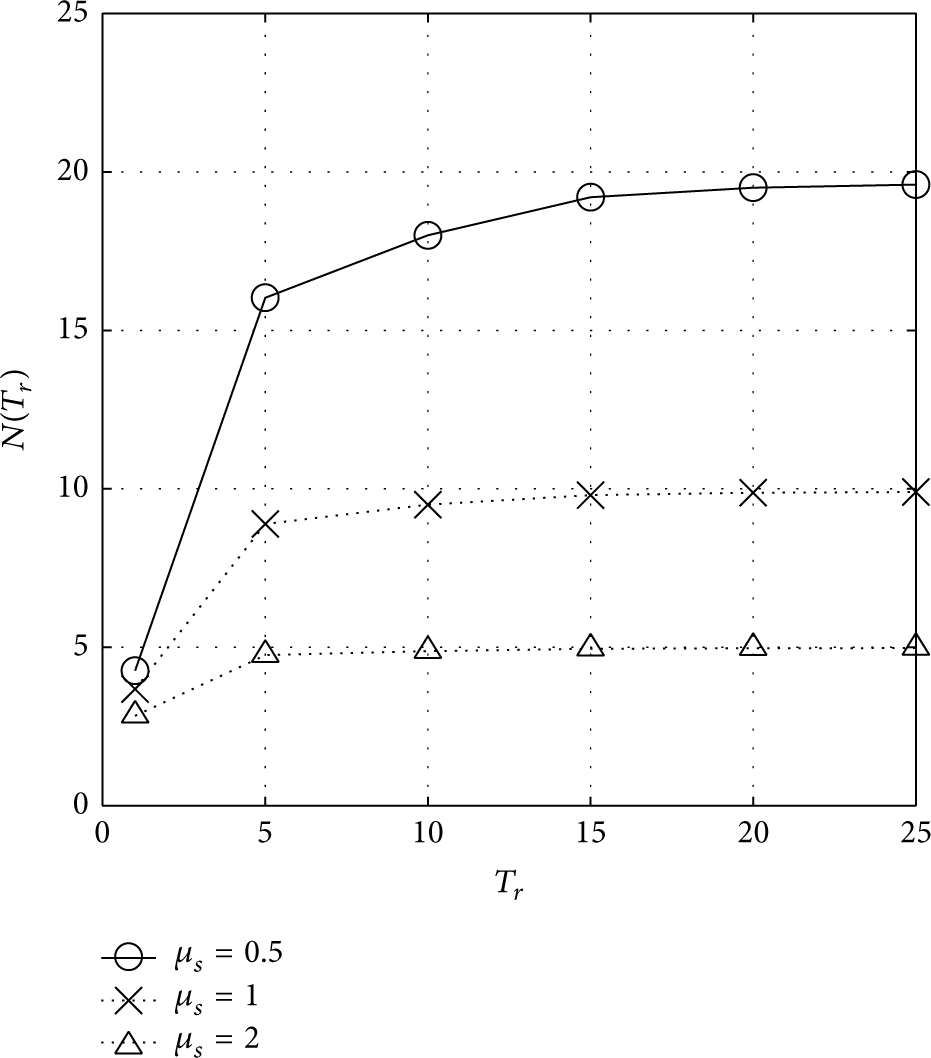
Effect of
Figure 8 shows the effect of

Effect of
6. Conclusions
As IPv6 is considered as a main communication protocol for accessing the Internet during driving, location privacy at the IPv6 layer is becoming an important issue in cooperative ITS. In this paper, we have presented an IPv6 address configuration with pseudonyms and then studied a performance degradation issue due to the pseudonym change at the IPv6 layer. We moreover proposed the optimal pseudonym change algorithm that adaptively finds an optimal pseudonym change interval with given parameters.
Footnotes
Disclosure

Conflict of Interests
The authors declare that there is no conflict of interests regarding the publication of this paper.
Acknowledgment
This work was supported by Basic Science Research Program through the National Research Foundation of Korea (NRF) funded by the Ministry of Science, ICT & Future Planning (NRF-2014R1A1A1006770 and NRF-2014K1A3A1A21001357).