




Abstract
A wireless system consisting of a finite number of heterogeneous users transmitting packets over a slotted ALOHA Rayleigh-fading channel is investigated in this paper. In this system, each user tries to minimize its number of transmission attempts while meeting the throughput demand. The user interaction in such an ALOHA network is modeled as a random access game. A novel technique to better exploit the channel state information (CSI) named adaptive CSI transmission method is proposed. Benchmarking with the no-CSI method and threshold-based CSI method, it is revealed that the proposed adaptive CSI method can yield up to 9.9% more throughput and 12.3% power reduction. Two simple yet effective guidelines on selecting among these CSI-related methods are formulated for systems with different SNRs and capture ratios. A distributed algorithm is proposed to find the optimal transmission probability. Both analytical and simulation results show that the algorithm exhibits fast convergence speed and is robustness against changes on the number of active nodes in the network.
1. Introduction
The ALOHA protocol has been attracting a lot of attentions from both academia and industry since its introduction. It has been used for various generations of mobile phone services such as GPRS and SMS [1]. In recent years, various derivatives of ALOHA protocol have been developed and considered promising for a wide spectrum of applications including wireless sensor networks [2], next generation Internet of Things (IoT) [3, 4], cognitive radio [5, 6], and smart grid [7].
The earlier works on ALOHA, for example, in [8, 9], were focused on the system-level performance, for example, the system throughput. With the evolution of telecommunication systems into distributed systems in recent years [10], the focus has been shifted from the system perspective to the user perspective. As the network might be of heterogeneous nature, a system-level approach might be insufficient to differentiate each user's goal and action. Moreover, many users in the wireless networks are power-constrained and they may prefer power conservation over throughput maximization. As such, new techniques and performance metrics should be developed to better design the network [11, 12].
In [13], MacKenzie and Wicker conducted the analysis of a slotted ALOHA from the perspective of a selfish user. It is shown that a game-theoretic approach [14] was able to provide insights into the equilibrium operating point [15, 16] and the network performance such as throughput from a decentralized perspective. Later works explore more realistic settings by incorporating the CSI into the ALOHA model to enable each node to make channel-aware decisions [10, 12, 17–19]. More sophisticated channel models were also investigated towards a more accurate characterization of the fading channel. A simple collision model had been widely assumed to model the network interaction in a random access network [10, 18, 20, 21]. It was subsequently generalized to power capture model [22] and SINR capture model [17] to better characterize the time-varying fading channels and the multipacket reception capacity [23].
Intuitively, the use of CSI should lead to power-efficient outcomes as a node can choose not to send a packet under bad channel conditions to avoid wasting energy. In [10, 12, 24], CSI is exploited to enhance the throughput performance in a collision channel. However, it was shown in [17, 25] that, for a channel model with capture effect, a threshold-based CSI method may experience Braess Paradox [26]; that is, adding extra information to the network reduces the overall performance. Consequently, the achievable throughput may be even worse than that without CSI.
This paradox does not occur all the time. In ideal cases when the signal-to-noise ratio (SNR) approaches to infinity, it will always occur and it is suggested in [17] not to use CSI in such cases. When the SNR is a finite number, the occurrence of Braess Paradox is quite intricate. Thus it is difficult to decide whether to use CSI.
In this work, this Braess Paradox has been further investigated and it has been shown that the occurrence of the paradox is purely determined by the radio capture ratio and the SNR. It has been further discovered that there exists an enhanced method on exploiting the CSI, namely, adaptive CSI method, which may result in better system-level performance. Inspired by the threshold-CSI and no-CSI methods in [17], the adaptive CSI method adopts a probabilistic rather than deterministic strategy on how to respond to the instantaneous CSI. With the adaptive CSI method, this paper presents three original contributions.
The throughput using the proposed adaptive CSI is derived. The adaptive CSI can achieve up to 9.9% more throughput than the threshold CSI and no-CSI methods for a wide variety of systems. Moreover, it can result in up to 12.3% power reduction than the other two methods. Two simple yet effective guidelines are generalized on selecting the aforementioned three CSI-related methods to achieve maximum throughput or power efficiency for different system parameters and thus to avoid the occurrence of Braess Paradox. A distributed algorithm is proposed to tune the transmission probability to the optimal point. It is shown that the algorithm can guarantee fast convergence and is robust against changes on the number of active nodes in the network.
The rest of the paper is organized as follows. Section 2 formulates the problem and states the assumptions on the system. The proposed adaptive CSI is presented in Section 3. Section 4 compares the adaptive CSI with the threshold-based CSI method and no-CSI method. Guideline on the selection scheme for different systems is also derived. Section 5 compares the power efficiency for the three methods. The convergence algorithm is presented in Section 6, together with an update interval analysis. Section 7 presents the simulation results, followed by a conclusion in Section 8.
2. Problem Formulation
In the following, a wireless network where there are n nodes transmitting packets at a predetermined power level to a base station over a shared channel is considered. It is assumed that the time is slotted and the amount of information contained in a data packet is fixed and is the same for all the nodes. A data packet, with the possible acknowledgement packet, occupies one time slot. Each node contends for the channel access using the slotted probabilistic ALOHA protocol. In each time slot k, each node i transmits with a transmission probability
2.1. Throughput
For the brevity of the analysis, the average throughput for node i is defined as the ratio of the number of packets that are successfully received by the base station to the total number of time slots. For example, if a node i transmits 100 packets to the base station during a 10000-slot period, of which 67 are successful, then the average throughput for node i is 0.0067.
2.2. Fading Channel and SINR Capture
Signal-to-interference-and-noise ratio (SINR) capture [17] is considered in this paper to model the fading channel. In the SINR model, node i's packet at time k will be successfully received by the base station if
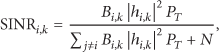
In the sequel, it is assumed that the channel is an i.i.d Rayleigh Fading channel and
2.3. Adaptive CSI-Based Transmission Method
In this paper, a novel method named adaptive CSI-based method is proposed. Instead of using a fixed threshold-based CSI strategy as in [17], the proposed method considers the fact that
Definition 1.
An adaptive CSI-based transmission strategy for node i in time slot k is defined as a mapping from
It can be concluded that

2.4. Acknowledgment Information
It is assumed in this study that an acknowledgement (ACK) packet issued from the base station is available upon each successful transmission. By recording all its ACK results for a certain period, each node can determine the average packet success rate
3. Equilibrium Analysis
3.1. Power Optimization Problem
According to the problem formulation, the local optimization problem for each node i using the adaptive CSI method can be modeled as
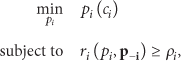
The system can be modeled as a constrained noncooperative game. Each node acts as a selfish entity, taking actions, that is, choosing the tuning factor
3.2. Nash Equilibria
It is assumed that each
Definition 2.
An action profile

Equivalently,


3.3. Existence of Nash Equilibrium
When there are


Theorem 3.
Under the SINR capture model with capture ratio b and i.i.d., Rayleigh fading channels between all nodes and the base station, the average throughput of node i when the transmission probability vector is

Proof.
The theorem can be proved by Binomial theorem and is similar to Lemma 1 in [17]. Thus the details are omitted here for brevity.
From (9), the following 2 corollaries can be given.
Corollary 4. The average packet success rate of node i is given as
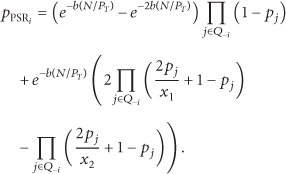

To determine the existence of Nash equilibrium, the derivative of r is derived as

When there are 2 equilibrium points, the one associated with smaller transmission probability is superior to the other in terms of minimizing power investment. This immediately follows from the fact that power investment is an increasing function of transmission probability.
Moreover, simulation results show that, for heterogeneous network, there exists at least one equilibrium point given that the throughout demand is feasible.
4. Maximum Throughput Analysis
In Section 3, the Nash equilibrium of (3) is analyzed. The relationship between throughput demand and transmission probability is derived for the adaptive CSI scheme. In this section, the maximum achievable throughput of the adaptive CSI scheme is compared with the 2 other schemes in [17], namely, threshold-based CSI method and no-CSI method.
For the no-CSI method, the throughput is given by [17] as follows:


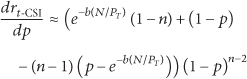
Moreover, (17) can be approximated as

Combining (18) and (19), it can be shown that
When


Theorem 6.
Given a capture ratio b and the network size n, when


Proof.
The proof can be completed by enforcing
It also follows that when
Using (14), (20), and (22), the maximum throughput of each method under different capture ratios b and network sizes n can be obtained. Figure 1 compares the maximum throughput of the three methods. It is shown that there exists a red region in terms of SNR and capture ratio where the proposed adaptive CSI results in the highest throughput among the three methods. This improvement in throughput can be up to 9.9% as compared with the highest throughput that can be achieved by the no-CSI and threshold-based CSI methods.
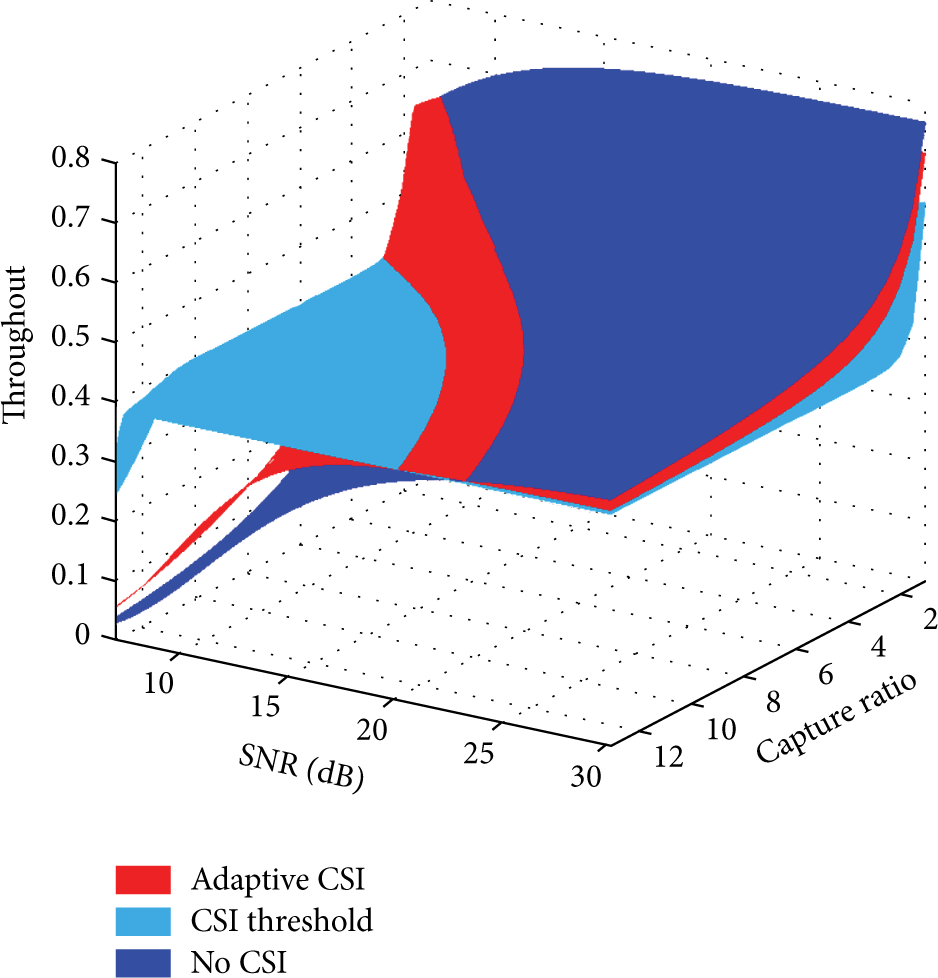
Maximum throughput with different SNRs (dB) and capture ratios.
5. Power Efficiency Analysis
Given the same transmission probability p (i.e., the same power investment) and using (11)–(13), the adaptive CSI method outperforms the no-CSI method when




Theorem 7.
Given a capture ratio b, the network size n, and a fixed power investment in terms of transmission probability p, the power investment of each node can be minimized using the adaptive CSI method when the SNR satisfies both (25) and (27). When
It should be noted that the intersection of (25) and (27) may be an empty SNR set for a given
As an illustrative example, Figure 2 shows the throughputs of the three methods for a given power investment (i.e., transmission probability)

Throughput comparison for a given transmission probability

Power reduction for different power investment schemes.
6. Convergence Analysis
6.1. ACK-Based Game Strategy
In Section 3, the Nash equilibrium is derived for the adaptive CSI method. In this section, an ACK-based algorithm is proposed for each node to find the power-efficient Nash equilibrium in a distributed manner.
Each node i in the network updates the transmission probability

In particular, the initial transmission probability
The following theorem shows each node will converge to the Nash equilibrium using the strategy in (29). It is assumed that the throughput demand profile
Theorem 8.
Using the ACK-based strategy in (29), the transmission probability of each node in the network asymptotically converges to the power-efficient Nash equilibrium point of the game (3).
Proof.
Case 1. First consider the case where the number of nodes in the network is fixed. For this scenario, the following should be satisfied.
The sequence of the transmission probability of any node Any two arbitrary entries The actual throughput of node i at any update interval t will not exceed its corresponding throughput demand.
Factor (i) must be satisfied because only when the sequence of the transmission probability increases, then it is possible that it converges to the equilibrium point. Factor (ii) must be met because, at the equilibrium point, according to (9) and Corollary 4,
While Factor (ii) immediately follows from the game strategy and Corollary 4, and it can be met starting from the second update, factor (i) can be proved by induction. It has been assumed that
Recall that
As for the proof of (iii), since
Combining (i) and (iii), the transmission probability
Case 2. Next consider the case when there are newly joined nodes during the network operation. In this case, a new equilibrium point must be sought and the new equilibrium probability is expected to be greater than the previous one as more packet transmissions are expected. This situation can be viewed as a special case of case 1. The convergence can be achieved as long as the new throughput demand is feasible.
Case 3. Finally the case where there are nodes dissociating from the network or stopping transmitting data during the network operation is examined. Contrary to case 2, the new equilibrium probability of each node should be smaller than the previous one as there is less traffic in the network. For this case, which is similar to case 1, the following guidelines must be met.
The sequence of the transmission probability of any node i deceases over time after the nodes leave the network. Any two arbitrary entries
The rationales and proofs are similar to case 1 and omitted for brevity. In this case,
This completes the proof of Theorem 8.
Remark 9.
This proposed ACK-based updating strategy can also apply to threshold-based CSI and no-CSI methods. The proofs are very similar and are omitted.
Remark 10.
Through simulations, it is observed that the condition that the initial transmission probability
6.2. Update Interval Analysis
For the proposed algorithm, the update interval I is a key parameter that can affect its performance. There exists a tradeoff: frequent updates allow each node to respond promptly to the traffic condition. However, a short update interval may result in a high randomness in calculating the
A statistical characterization of the packet transmission is given here in order to provide a guideline on choosing the update interval that allows timely update while reducing the randomness to a desired level.
Each packet transmission is considered i.i.d with success probability
Accordingly, the
The standard deviation of the sample mean, σ, can be used to characterize the significance of the randomness and show how “steady” is the
Given a standard deviation requirement, say T, the minimal sample size
It can be concluded that if the imposed standard deviation requirement is the same for every node, the node with the lowest throughput, say node i, will require the largest update interval. Assuming that all nodes update their transmission probabilities synchronously, the update interval will depend on node i, that is,


7. Simulation Results
In this section, various Monte Carlo simulation results are presented to validate the proposed distributed convergence algorithm. A scenario where there are n nodes transmitting fixed-length packets to a base station in a probabilistic manner is considered. Each transmission, with the possible acknowledgement, takes up one time slot. The update interval is determined using (31) with a standard deviation requirement of 0.04.
The applicability of the convergence algorithm for different CSI-based methods is first evaluated. In this case the capture ratio is
Figure 4 shows the actual throughput and transmission probability of both the simulation and the theoretical analysis. The simulation results match quite well with the theoretical ones for all the three methods, indicating that the proposed ACK-based convergence algorithm can achieve accurate results.
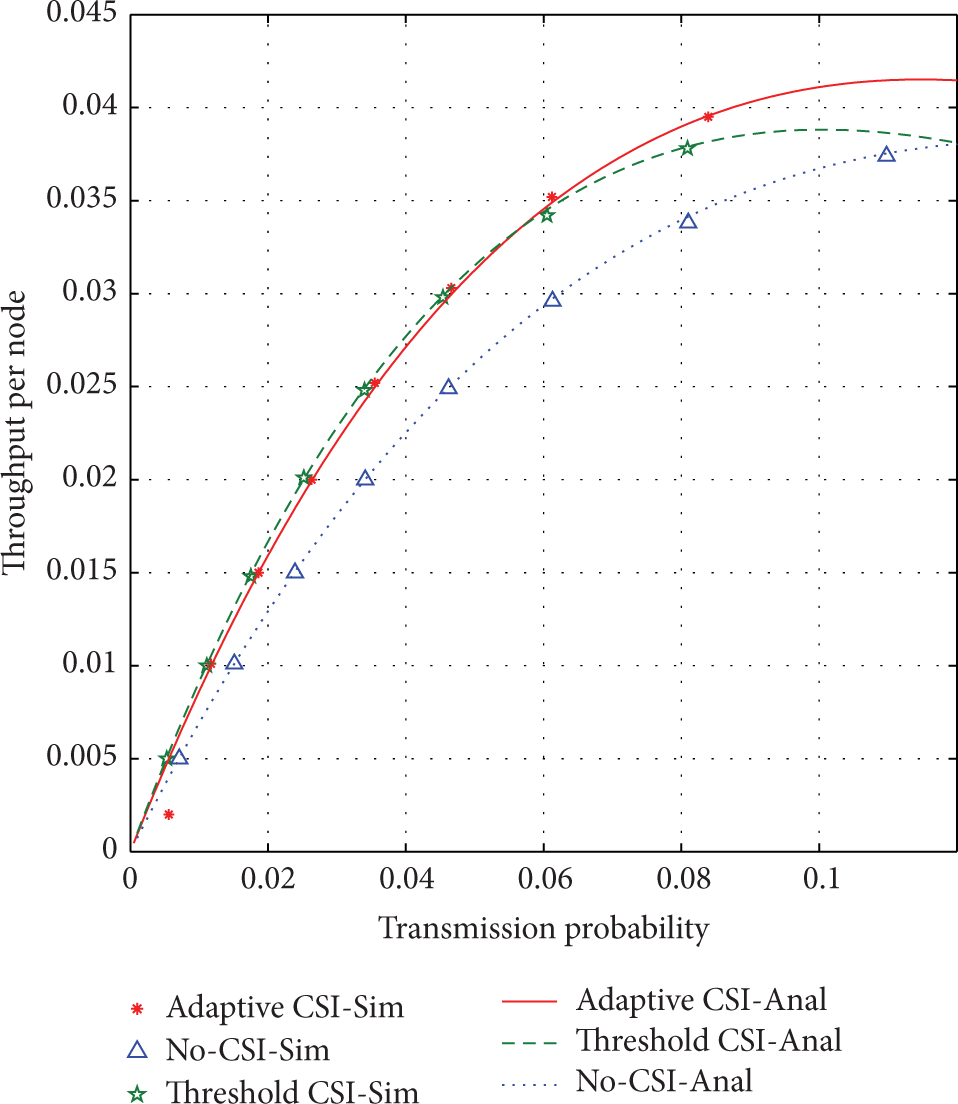
Comparisons between the simulation results and the theoretical analysis (Sim: simulations and Anal: analytical derivations).
Figure 5 examines the accuracy of the convergence algorithm for different heterogeneous networks in detail. Such a network consists of 5 classes of nodes, with a throughput demand of 0.002, 0.004, 0.006, 0.008, and 0.01, respectively. The capture ratio is

Throughput and transmission probability for heterogeneous networks (□: transmission probability; Δ: actual throughput; ∗: throughput demand).
As an illustrative example, Figure 6 presents the convergence speed for a heterogeneous network with 5 nodes and a capture ratio of 5 and a SNR of 50. The throughput demand is set to be 0.01, 0.02, 0.03, 0.04, and 0.05 for each node, respectively. It is observed that each node can reach the equilibrium point from the 3rd update instant and is stable subsequently with negligible deviations after 2 updates.
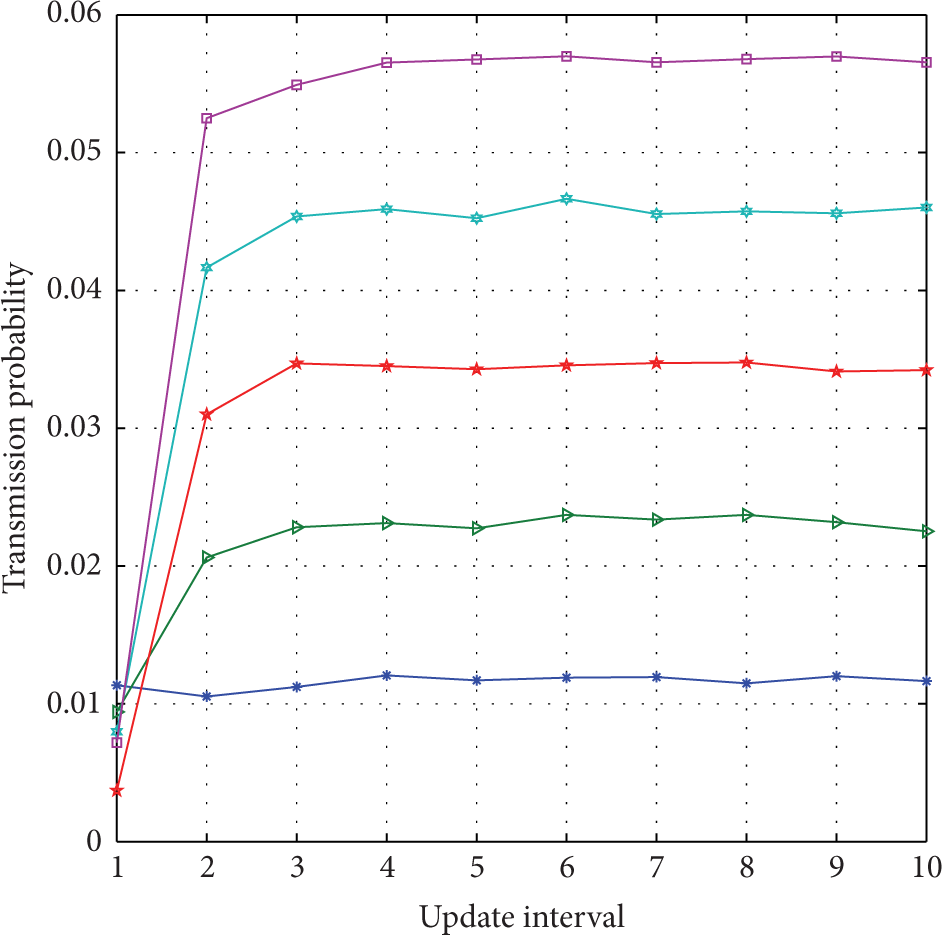
Performance of the convergence algorithm.
Lastly, the robustness of the algorithm against changes on the number of nodes in the network is examined. The capture ratio and the SNR are the same in the previous simulations. In the following study 10 nodes are evaluated, each with a throughput demand of
Figure 7 plots the transmission probability versus the update interval. It can be observed that both groups of node adapt well with the changes and the new equilibrium points can be reestablished in a distributed manner. Table 1 shows the actual throughput at the equilibrium. It is assumed that the equilibrium can be established one update interval later after each change on the number of nodes. The results show that each node matches well with its corresponding throughput demand, with an average relative error of 1.26%. Compared with the case that there is no change on the number of nodes (e.g., Figure 5, with average error of 1.1%), the error is still insignificant, indicating that the proposed algorithm works well with such changes.
Actual throughput with changes on the number of nodes.


Transmission probability with changes on the number of nodes.
8. Conclusion
A new method to exploit the channel state information (CSI), namely, adaptive CSI, has been presented. The throughput performance of the proposed adaptive CSI method has been analyzed and compared with the threshold-based CSI and the no-CSI method. It is shown that the proposed method is able to achieve up to 9.9% throughput improvement and 12.3% power reduction for a wide variety of systems as compared to the other two approaches. Two guidelines have been derived on selecting these three methods under different system scenarios. The proposed method can be readily implemented in a distributed manner with the use of the acknowledgement packets issued by the base station. Both the analytical and simulation results show that this distributed implementation is able to guarantee fast convergence and is robustness against changes on the number of nodes in the network.
Footnotes
Conflict of Interests
The authors declare that there is no conflict of interests regarding the publication of this paper.