




Abstract
The IEEE 802.15.4 standard is a rapidly growing technology for short-range communications and low rate Wireless personal area networking. The standard has been widely accepted as the de facto standard for wireless sensor network (WSN) because of its low cost deployment and remarkable applications. The mobility management in the existing WSN has highly suffered from different issues like high packet loss and delay because the current mobility management in IEEE 802.15.4 lacks the support of handover management for real-time streaming applications. In this paper, we propose a new fast handoff mechanism which eradicates the scanning delay. The proposed scheme uses the information of link quality (LQ) of the neighboring coordinators (COs), and on the basis of this information it selects an appropriate CO for handoff. The proposed scheme is evaluated through extensive simulations which show its strength and accuracy in the context of switching of high streaming data from one CO to another.
1. Introduction
A wireless sensor network (WSN) consists of tiny devices which can be adjusted anywhere and can be attached to anything. The devices used in WSN have the capabilities of independent computing, data communication and sensing, and long battery life. Due to these unique characteristics and low cost deployment, WSNs have rapidly developed in recent years. In traditional WSN, sensor nodes are static and hence very less amount of research work has been done in designing protocols for mobility management. The use of WSN is rapidly adopted by different technologies such as machine to machine and device to device communications, internet of things, cyber physical systems, and so fourth. Therefore, the researchers divert their focus to design sophisticated algorithms for mobility management in WSN.
The IEEE 802.15.4 standard for low rate wireless personal area network (LR-WPAN) has been broadly used as the de facto standard for WSN that focuses on short-range wireless communications [1]. The IEEE 802.15.4 technology is built for short coverage area communication, and hence it requires a large number of access points, called CO, to cover large areas called personal area network (PAN) [1, 2].
The most recent applications such as human body sensor networks (BSN) and under water WSN (UWSN) have demanded for the mobility operations in WSN. Similarly switching data from one PAN to another is a challenging job for the researchers in the last couple of years. Recently, researchers come up with enhanced ideas for switching data between different PANs and softly redirecting data with less packet loss and delay. These ideas still need improvement and standardization for future generation of networks. Various organizations, such as ACM and IEEE is working to design a generic handoff scheme which transfer a continuous data session from one PAN to another. In the last decade, a lot of research work has been carried out in enhancing the quality of service (QoS) of switching data from one PAN to another.
The switching of data from one PAN to another is divided into two categories on the basis of performance. One is called smooth handoff and another is seamless switching. Most of the traditional handoff techniques are based on the RSSI factor. But the RSSI is highly dependent on the environment factor and hence it leads to false or frequent handoff problems. Similarly, an MN needs to scan the entire subnet of a PAN and eventually it connects to the PAN with the highest RSSI. Performing full scanning quickly consumes the battery, and hence it shorter the life of a sensor node. Similarly, when a sensor node uses high bandwidth application like multimedia streaming and voice communication, then it requires much power to operate smoothly while moving across different PANs. Similarly, full scanning increases handoff delay during switching between different PANs. The delay sometimes reaches 90% of the total switching time which ultimately leads to high packet loss and breaking of connection. Recently, researchers developed different schemes to take care of the existing problems and challenges in handoff in WSNs [3, 4]. Most of the schemes use other parameters such as bandwidth and data rate for handoff. Similarly researchers designed different schemes such as partial and prescanning which require less energy compared to traditional schemes [5]. Prescanning scheme scans available networks at once and hence there is no need to scan the available networks again and again. Similarly, partial scanning schemes scan only those networks which are available near the MN and hence require less energy.
The IEEE 802.15.4 WSN is consisted of a combination of COs and MNs as shown in Figure 1 [6, 7]. There are 16 channels in the 2.4 GHz band, 10 in the 915 MHz band, and 1 in the 868 MHz band allocated for IEEE 802.15.4 [1]. Inside one particular PAN, all of the MNs communicate by a peer-to-peer wireless link and transfer messages with each other. It is also possible to send messages to the MNs which are not in direct communication through multihop links. From the data delivery point of view, it appears as if all MNs in a PAN are directly connected at the MAC layer, even if the MNs are not within the range of each other [2, 6].
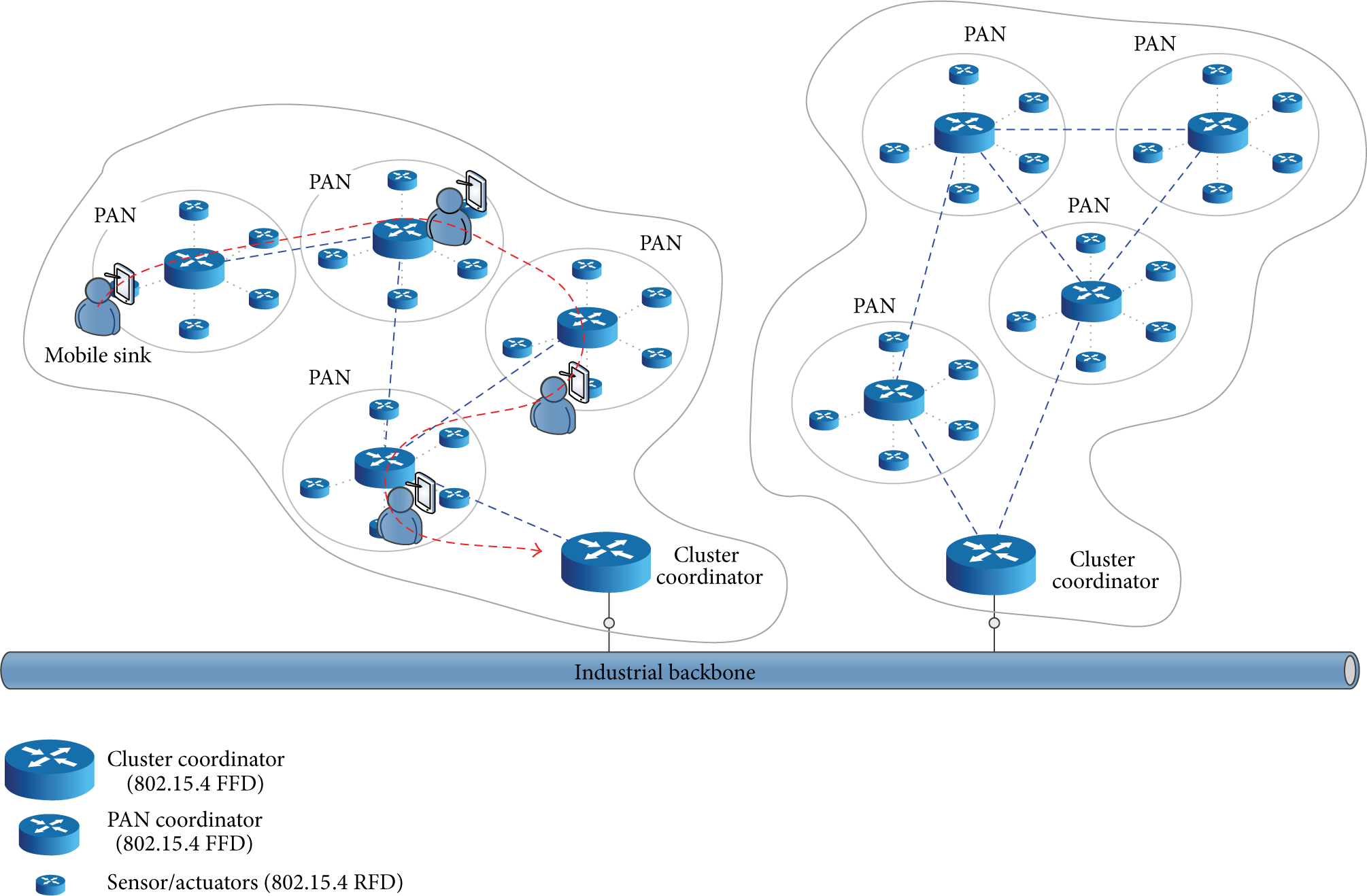
Network architecture of 802.15.4 WSN.
In a WSN environment, an MN is provided with the ability to move freely inside in a network of different PANs and it must be provided with the capacity of attaching to a new CO. Therefore, a handoff mechanism needs to provide WSNs to softly transfer the traffic from one CO to another. These types of WSNs require frequent and dynamic topology to maintain the connection between the individual sensor nodes [8, 9]. Healthcare wireless sensor networks are one such area where node mobility is prevailing and it must be provided under any circumstances [1]. In such application scenario, transferring of data without breaking of connection and less packet loss is very important [10–12].
Supporting mobility and seamlessly transfer of data in IEEE 802.15.4 brings lots of new challenges and issues. To maintain the sensor connectivity, a sensor node should regularly change its CO by performing smooth handoff from one network to another or within a subnet [1]. However, providing IP connectivity to mobile devices means that the devices should be provided with some sophisticated mechanisms like MIPv6 and HMIPv6 [7, 12]. Similarly, the simplicity of and ease of use of a new mobility protocol should be kept as one of the important factors while designing algorithms for seamless transfer of data [1].
In this paper, we propose a new fast handoff scheme for IEEE 802.15.4 networks. The rest of the paper is organized as follows. We have surveyed the existing research in Section 2. In Section 3, a detailed explanation of the proposed scheme is provided. Section 4 shows the simulation results. Finally, the conclusion is given in Section 5.
2. Background and Related Works
In WSN, a handover procedure is initiated when an MN is moving away from its current CO and getting near to another CO. In other words, when the connectivity of an MN with its current CO is dropped below a predefined threshold of signal strength then it initiates a handoff process. Therefore, most of the handover processes are based on the LQ measurement from the current CO. The LQ factor is also used for selecting a new CO for handover among other PANs. The MN is assumed to select an appropriate PAN on the basis of the LQ of the available PANs. When the signal condition from the current associated CO becomes poor to communicate, MNs should discover other CO to continue the communication by performing a MAC layer handover [1, 8, 10, 12]. The important consideration in this regard is to redirect the data from one PAN to another as quickly as possible, in order to avoid possible packet loss and connection breaking during handoff. The tradition schemes have mainly suffered from this problem. Therefore, researchers introduced optimal solution to avoid additional delay during transfer of data from one PAN to another.
The scanning procedure is normally triggered by an MN when its current LQ with a CO drops below a particular level of predefined threshold. While discovering an appropriate channel among available channels an MN performed scanning of available channels and makes a list of the available CO which provides suitable channels. The process normally requires higher time than the other process and it covers 90% of the entire handover process. Once the MN lists down all of the available appropriate channels, then the MN sends request for connection to the CO with the highest signal strength [6, 13]. The MN compares the signal strength of the selected CO with its current CO and if the new CO signal strength is greater than its current CO's signal strength, it initiates handoff; otherwise, it backs off for some time.
Higher throughput can be achieved if the MN has the information of the CO's capability status, and hence it will also help the MN to connect to a CO for long duration. The information of connected MNs to CO is provided by the IEEE 802.15.4, but it is not clear in the sense of how much of the bandwidth is consumed by the active MNs [7, 14]. Similarly, if an MN connects to CO with less number of MNs attached to it, this sometime leads to different problems like low bandwidth and poor channel connectivity.
A scheme based on the swift passive discovery and association has been proposed in [10]. The scheme is successful in discovering the nearest neighbor first on the basis of beacon interval of the coordinators that are close to mobile devices for prompt neighboring coordinator(s) discovery. Thus the time to discover a CO almost reduces to half of the total time to discover all available COs. Also, it avoids and gets rid of the response wait time during association based on early registration mechanism. The CO uses LQ for two purposes:
In beacon-enabled IEEE 802.15.4, two types of channel scanning operations are performed by end devices. During scan, nodes are deprived from data communication and must discard all data frames received. (i) Passive scan is performed by the node, which was just turned on or failed to find its coordinator through the orphan scan. As shown in Figure 2(a), during passive scan, a device search for beacon frame in each channel for a duration of

Channel scanning mechanism in beacon-enabled IEEE 802.15.4.
A mobility-aware medium access control protocol (MA-MAC) has been proposed in [8]. The aim of this protocol is to support seamless handover in multihop WSNs. The protocol also works on the LQ values of the acknowledgement packets and uses the information obtained from it for computing the deterioration level which helps in avoiding breaking of connection before an MN connects to a new CO. When the LQ of a CO is not enough to hold an ongoing connection, then it initiates a handover by switching transmission from a unicast to a broadcast mode and by embedding neighbour discovery requests in the broadcast data packets. The neighbor discovery is carried out through intermediates nodes but the data transmission is remained continue through the existing links. The MN first searches for appropriate intermediate node and once an intermediate node is found, the MN establishes a link with it and switches transmission back to unicast. The performance of the MA-MAC protocol is tested while changing the speed of mobility, handover threshold value, and the sending interval of data of different sizes.
A scheme based on dividing the working of a handover process in three different phases has been proposed in [1]. The first phase is used to develop a proactive algorithm in order to anticipate the future link breakage. In the second phase a new greedy scanning technique is proposed, which puts off nodes from scanning multiple channels. The third phase is mainly concerned with mobility management of the MN and it predicts the direction of the MN and selects appropriate CO for the MN on the basis of its direction of movement. The selection of the appropriate CO is based on the bandwidth of the available COs. The algorithm selects CO with the highest bandwidth. The proposed scheme efficiently reduces energy consumption during handoff and provides the CO which provides long time for connection.
In all of the exiting schemes used for handover, management in WSN is mostly concerned with shortening the link layer channel scanning delay and selecting CO with the best LQ. Therefore, keeping focus on this point, we propose a new fast handoff scheme for IEEE 802.15.4 networks to support streaming service with less packet loss and smooth transfer of data from one CO to another.
3. The Proposed Scheme
We propose a new fast handoff scheme using the information of the neighboring COs to eliminate scanning delay when the MN decides to make a handoff from one CO to another in WSNs. The working of the proposed scheme is divided into the following two phases: network initialization phase and handoff phase.
3.1. Network Initialization Phase
We further divide network initialization phase into three steps before the MN decides to perform a handoff process.
3.1.1. Gathering Information of Neighboring COs
The MN gathers information about the neighboring COs by listening to beacon from them during the initial scanning process. Then, the MN creates a table, called “CO table,” storing neighboring CO's information. This table contains the CO ID (MAC address), available channel number, and link quality (LQ) value as shown in Figure 3.

MN gathers information of neighboring COs.
3.1.2. Sharing CO Table
Each MN broadcasts a message containing its CO table in the designated time slot during the CFP (contention free period) as shown in Figure 4. Figure 5 shows delivery of message from

Broadcasting of AP table in CFP mode.

Sharing of CO table.
3.1.3. Monitoring LQ Variation
Each MN keeps updating the CO table by monitoring the LQ variation as shown in Figure 6. Variation of the LQ can be used to make a guess about the relative distance from MN to the neighboring COs. If the LQ on a channel becomes weaker, it means that the MN is leaving away from the CO. On the other hand, if the LQ on another channel becomes stronger, it means that the MN approaches closer to the CO.

Monitoring the LQ variation.
3.2. Handoff Phase
The chances of handoff are getting increased if the MN moves to the coverage area of another CO. When the LQ of the MN drops below a predefined handoff threshold, then MN triggers the reassociation directly rather than scanning the available COs. For example, in Figure 7, the MN is moving in the direction towards CO3. The MN determines the LQ value from CO table which is recently updated by

Example of handoff in our scheme.
4. Performance Evaluation
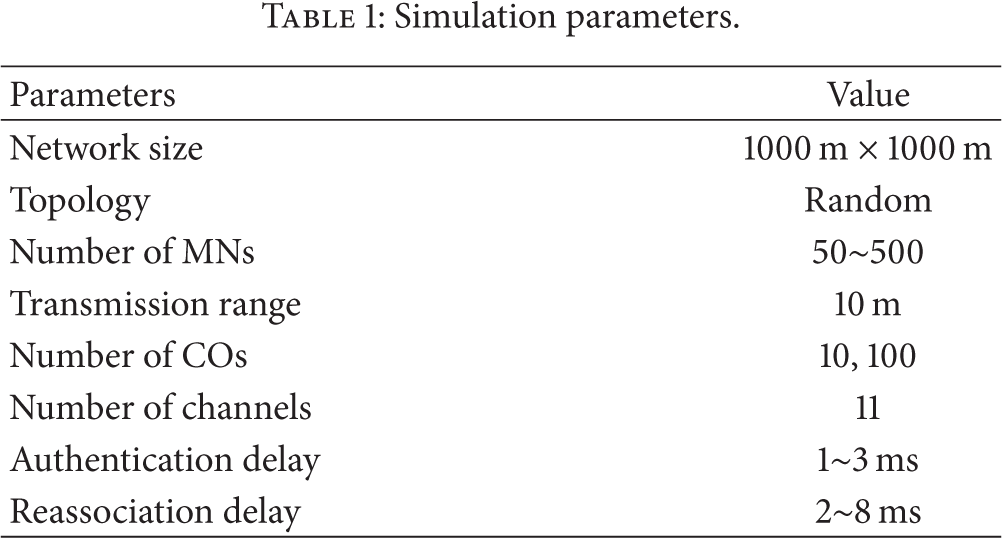
We compared the performance of the proposed scheme with the handoff mechanism of IEEE 802.15.4 standard. We set all transmission ranges of MN equal to 10 m, and we generate random topologies with different numbers of MNs in each experiment. The number of MNs in a network varies from 50 to 500 in an instance of simulation. All numerical results are obtained by taking average of around 500 different experimental values. Simulation parameters are shown in Table 1.
Simulation parameters.
We assume that there are N MNs and M COs uniformly distributed over a network field with an area of A. MNs and COs are assumed to have the same propagation range of r.
4.1. Handoff Failure Probability
As previously described, in our scheme, MN triggers the reassociation directly by using the information of CO table when its LQ drops below a predefined threshold. At that time, there is a possibility of handoff failure due to wrong information of CO table. Let us show two scenarios in which the CO table has wrong information.
4.1.1. Scenario 1
Consider that the MNs in zone
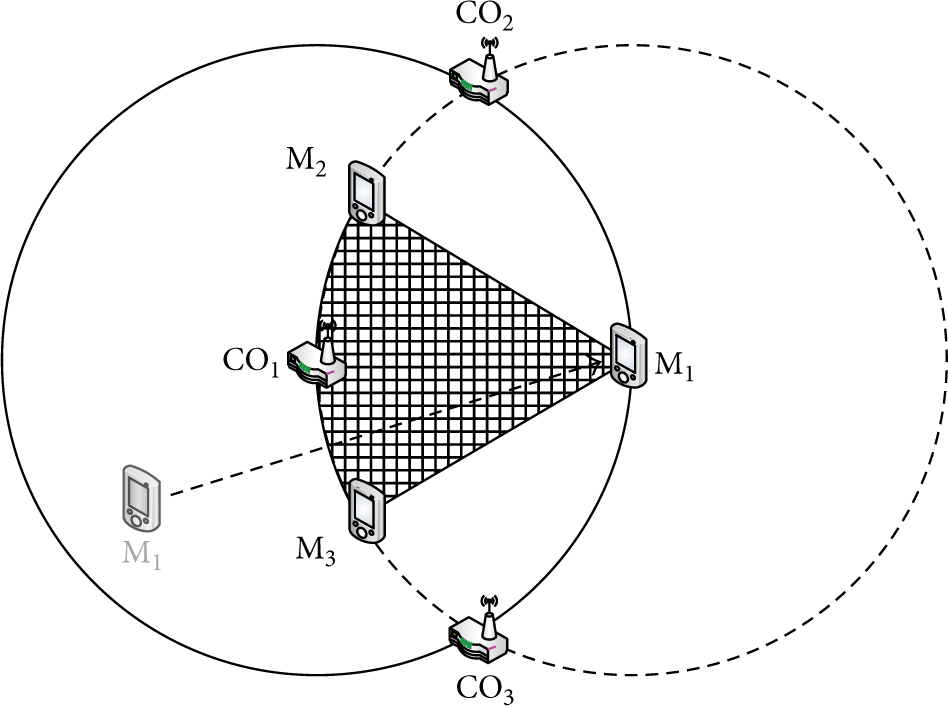
The set of MNs that can give wrong information for handoff to
This type of handoff failure is caused by MNs located in zone

where the area of
4.1.2. Scenario 2
This type of handoff failure is caused by COs located in zone
For example, if

where
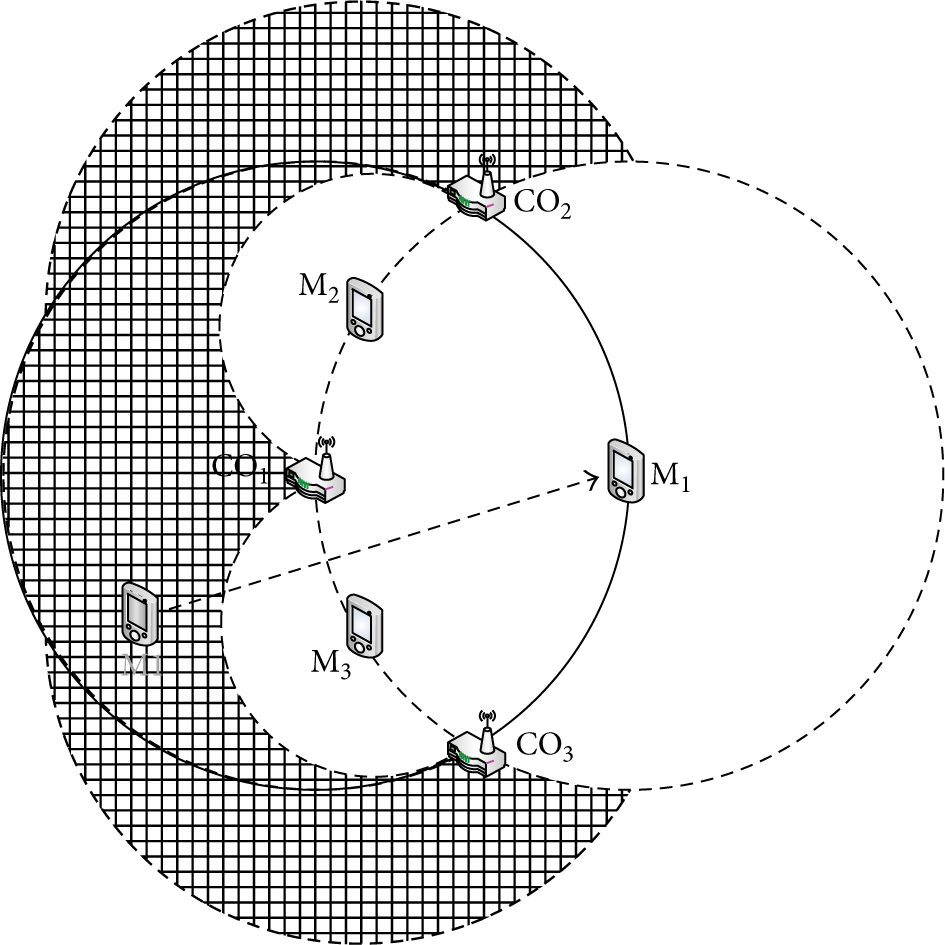
The set of COs that
So, the probability of this type of handoff failure is

From (1) and (2), we get the probability of handoff failure by

Figure 10 represents the handoff failure probability as the transmission range is increased. We can see that type 2 of handoff failure is more dominant and the total failure probability is proportional to the transmission range. This is because the area causing handoff failure becomes larger.

Handoff failure probability as the transmission range is increased.
4.2. Average Handoff Delay
There are two types of handoff delay: authentication delay and reassociation delay, denoted by
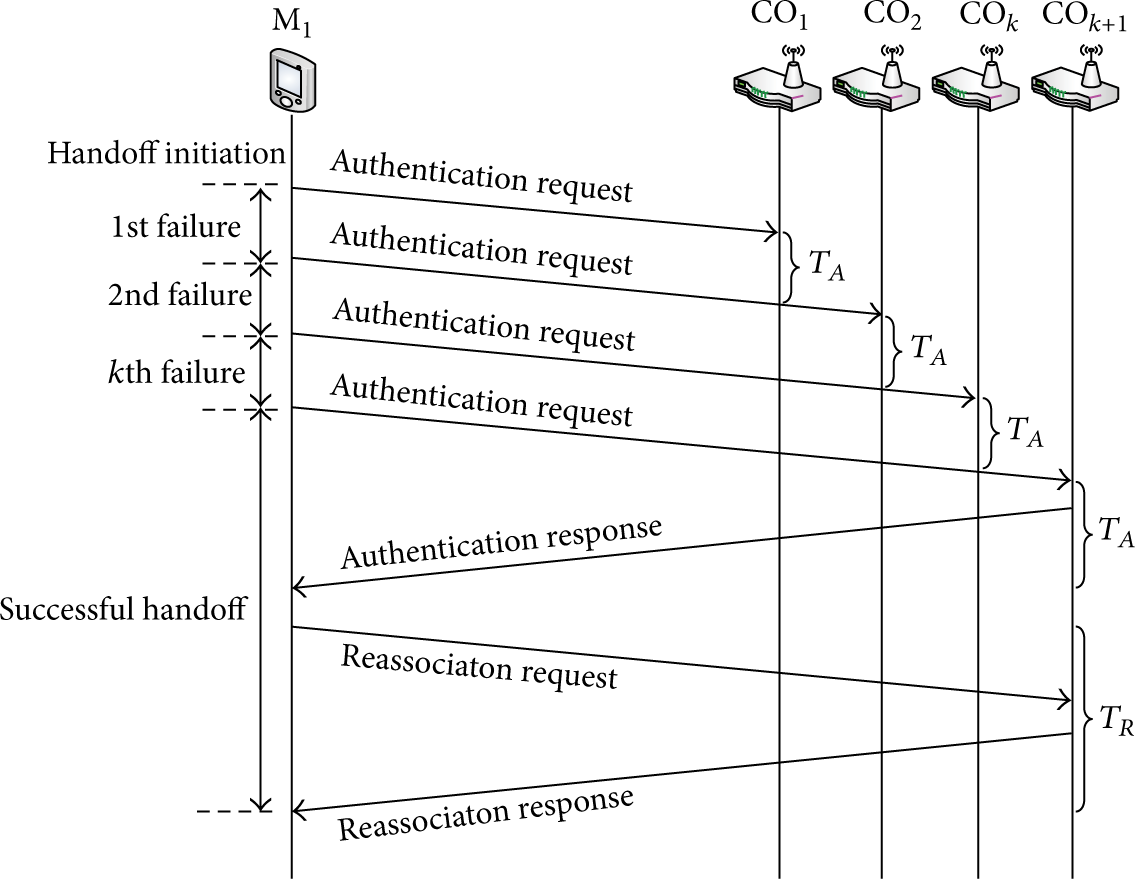
Handoff delay experienced in scenario of a successful handoff after k consecutive failures.
From Figure 11, we can get the average handoff delay (denoted by TD) by

Figure 12 indicates that the average handoff delay gradually increases as the transmission range becomes larger. We can see that our scheme can successfully provide streaming service seamlessly because the average handoff delay is below 50 ms in any case. Figure 13 shows the average handoff delay of the proposed scheme. It is shown that our scheme significantly reduces the handoff delay against the passive and active scanning techniques of IEEE 802.15.4 standard. Our scheme requires much less time to associate with the best CO among neighboring COs by taking advantage of the information available in the CO table.
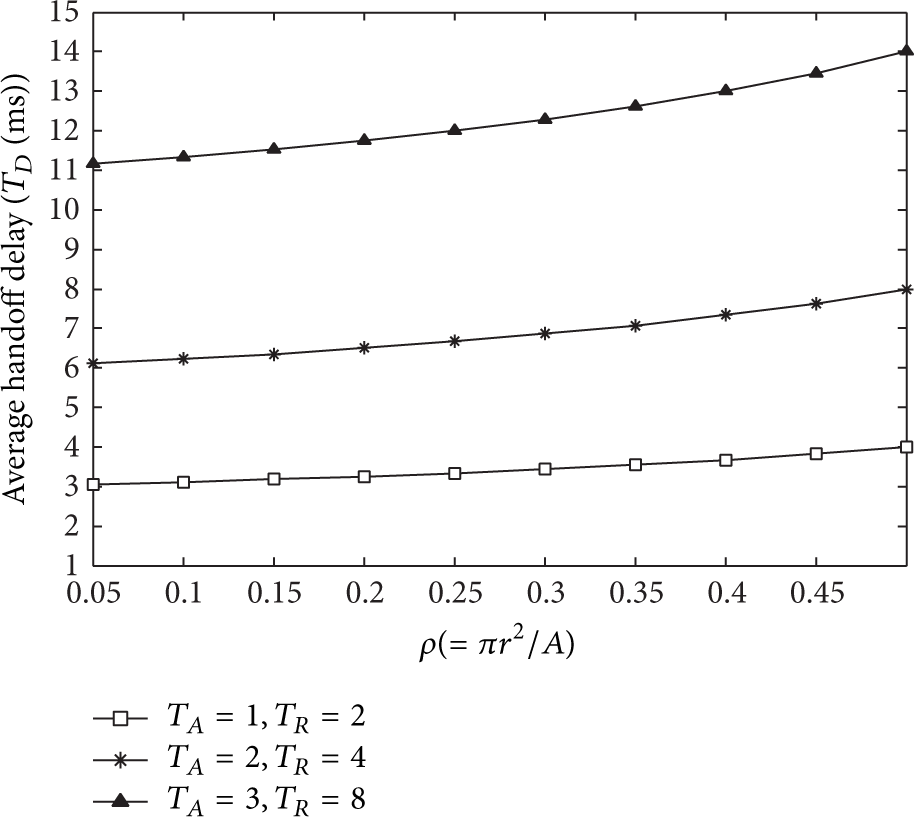
Average handoff delay as the handoff failure probability is increased.

Average handoff delay as time varies.
Figures 14(a) and 14(b) represent the handoff delay as the number of COs varies from 10 to 100. Our scheme produces a very short handoff delay regardless of the number of nodes. In contrast, the IEEE 802.15.4 standard yields a very long handoff delay, which can break the connection of streaming application. Our scheme yields a relatively long handoff delay when the number of nodes is small. This is because the information of CO table is not enough to perform better handoff process when the number of COs and MNs is small. But, even in this case, the handoff delay does not exceed 50 ms.
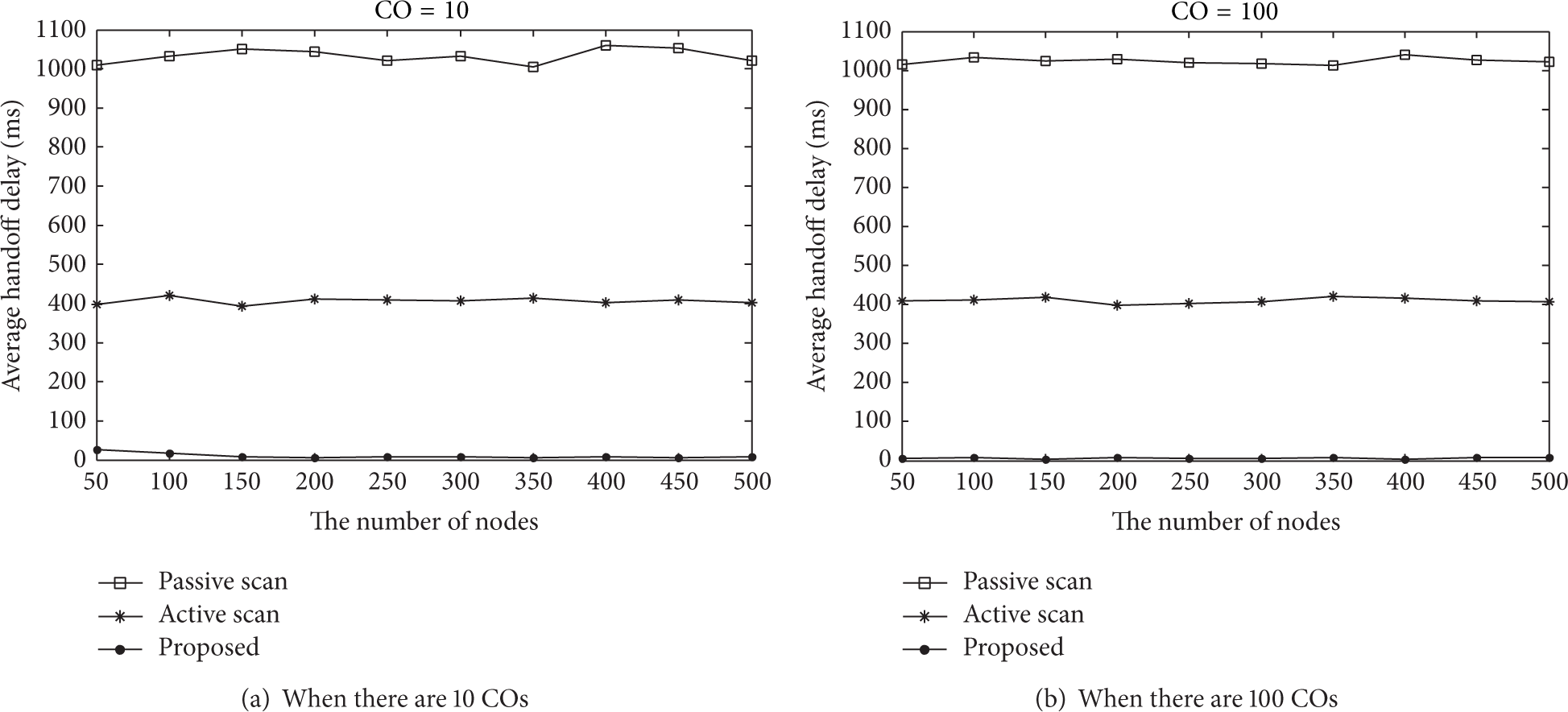
Average handoff delay when there are 10 or 100 COs.
4.3. Handoff Packet Loss
Figure 15 illustrates the number of packet losses as the number of nodes increases. Our scheme significantly reduces packets loss compared with the IEEE 802.15.4 standard. A large number of packet loss leads to the bad call quality or termination of a call session. Thus, our scheme works better than the standard to support seamless streaming service due to the elimination of scanning delay.

The number of packet losses.
5. Conclusion
The transfer of an ongoing session from one CO to another CO without loss of connection and data can only be possible through an optimal handoff procedure. Real time and multimedia streaming can bear a handoff delay of approximately 50 ms. The handoff procedure presented in the current literature offers high delay and packet loss; hence, it cannot be used as a generic handoff process for future mobile sensor networks.
In this paper, we propose a new fast handoff scheme which eliminates scanning delay when the MN decides to handoff. In our scheme, the MN exchanges CO table to be used for any future possible handoffs. We support our scheme through numerous extensive simulations study. Our scheme significantly reduces the handoff delay and packet loss during a handoff process. The proposed scheme provides the lowest possible handoff delay which can be easily adopted for real time streaming. The proposed scheme can be used with the existing technology without any modification in the architecture.
Footnotes
Conflict of Interests
The authors declare that there is no conflict of interests regarding the publication of this paper.
Acknowledgments
This work was supported by the IT R&D program of MSIP/IITP (10041145, Self-Organized Software platform (SoSp) for Welfare Devices). This study was supported by the BK21 Plus project (SW Human Resource Development Program for Supporting Smart Life) funded by the Ministry of Education, School of Computer Science and Engineering, Kyungpook National University, Korea (21A20131600005). This research was financially supported by the Ministry of Education (MOE) and National Research Foundation of Korea (NRF) through the Human Resource Training Project for Regional Innovation (no. 2014H1C1A1067126).