




Abstract
A new multiple antenna-aided cascaded energy and matched filter detector (MCEM) for cognitive radio networks is proposed. Our proposed scheme is equipped with multiple receive antennas employing energy efficient energy detector (ED) and reliable matched filter (MF) to mitigate the channel fading and increase the detection performance of the secondary users (SUs). Partial decisions are first made by using cascaded energy and matched filter detector (CEM) at each antenna and then the final collaborative decision is made based on those partial decisions. The probability of detection/false alarm of the proposed scheme is presented in terms of the complementary receiver operating characteristics (ROCs). The performance of MCEM scheme is explored via MATLAB simulations that implement the clear channel assessment (CCA) modules for IEEE 802.15.4. Simulation results showed that our proposed MCEM scheme improves the detection performance and is more energy efficient as compared to CEM scheme employing single antenna and other conventional schemes.
1. Introduction
The explosive growth of the wireless devices over the past few years has led to the spectral congestion and an apparent scarcity in radio spectrum is felt for quite some time. The densely spaced wireless devices have resulted in spectrum overcrowded, whilst licensed band occupied with primary user (PU) is often underutilized. A survey conducted by Federal Communication Commission (FCC) has revealed that hardly 25% of the spectrum gets utilized [1]. A scheme to exploit the underutilized spectrum opportunistically, better known as cognitive radio (CR) technology, uses clear channel assessment (CCA) to determine the spectrum holes [2, 3]. In wireless communication, CR has become a promising technique to solve the conflicts and enable spectrum sharing. In CR systems, the unlicensed or secondary users (SUs) can utilize the licensed frequencies while the PU is absent. The precise detection is a prerequisite so that PU does not face any excessive interference from the contending SU. This can only be achieved through accurate spectrum/channel sensing by the SU during CCA. Different algorithms for spectrum sensing such as energy detector (ED) [4], matched filter detector (MF) [5], and Cyclostationary Feature Detection (CFD) [6] in the context of CR have been extensively studied in the open literature.
The merits and demerits of each of the abovementioned algorithms have also been well researched and documented in the literature [7, 8]. Reliable spectrum sensing is not always guaranteed, due to multipath fading, shadowing, and hidden node terminal problem. Cooperative spectrum sensing (CSS), which involves the cooperating SUs to send their local spectrum sensing information to the fusion center (FC), where the final decision is taken considering all the results from the participating SUs, has been proposed to enhance the sensing performance [9–11]. The cooperation among several cooperating SUs comes at the cost of cooperation overhead and extra bandwidth for control channel. Also CSS is prone to several possible malicious user attacks such as spectrum sensing data falsification attack [12] and PU emulation attack [13].
Multiple antenna schemes have been proposed as another alternative to increase the sensing reliability. Reference [14] proposed multiantenna based spectrum sensing method for CR using generalized likelihood ratio test (GLRT) approach. The authors showed that, under the mild assumptions on the PU signal, their proposed approach can perform better than conventional energy detector. Reference [15] carried out the performance evaluation of cooperative spectrum sensing with multiple antennas at each CR. The authors demonstrated that it is possible to achieve significant improvement in utilization of the spectrum hole by using the total error rate minimization criterion. A channel assessment method called cascaded CCA based on ED and preamble detector (PD) was proposed in [7]. But the problem with the proposed scheme in [7] was that it cannot perform CCA in any part of the signal. If the preamble of the signal was missed then the post end PD failed to do correlation and arrive at a firm decision regarding the presence of signal. Further, an ED and MF as cascaded CCA in wireless network were suggested in [16] where ED is used as a front end CCA and MF as a post end CCA which can be able to perform CCA in any position of the signal.
The goal to obtain energy efficient method for CR network is inevitable. ED is mostly preferred because of its ease of implementation. Also ED consumes little amount of energy for its operation. However, ED poor performance under low SNR condition made it unreliable and its performance is highly degraded under such conditions [4]. MF is a reliable detector which performs correlation of signal that can be done anywhere within a packet. Beside its reliable detection, MF consumes enormous amount of power for its successful operation. Therefore, in this paper, by extending the idea proposed in [16] and taking the advantage of multiple antennas, we propose a novel spectrum/channel sensing scheme which combines the energy efficient ED and the reliable MF with multiple receive antennas to improve the sensing reliability. Since our proposed scheme is equipped with multiple receive antennas and do channel sensing task with ED and MF detector in cascaded manner, we named it as MCEM scheme. The idea is to use the mutual benefit of multiple antenna-aided ED and MF to mitigate the problems caused by noise power uncertainty of ED, mitigate the channel fading, and leverage the enormous power consumption of MF. We take the particular case of wireless sensor network using IEEE 802.15.4 as a representative example.
The principal contributions of this paper are outlined as follows:
We have proposed a novel spectrum/channel sensing method called MCEM scheme for CR networks. Our MCEM scheme takes the collaborative benefits of energy efficient ED, reliable MF detector, and multiple receive antennas to improve the detection performance of SUs and mitigate the multipath channel fading, shadowing, and hidden node problem and increase the energy efficiency of our proposed MCEM detector. We implemented our MCEM scheme in CCA modules and medium access control (MAC) protocol for low powered IEEE 802.15.4 to check the effective performance of our proposed detector at network level. We also derived the power consumption for ED and MF from measurement of time execution code by implementing it in LabVIEW for ED and MF, respectively, and testing with NI-USRP-2921.
It should be noted that our proposed method is applicable to any wireless networks.
The rest of the paper is organized as follows. Section 2 describes briefly the conventional approaches to spectrum sensing and the problems thereof. Section 3 explains the proposed MCEM sensing scheme. The operation of cascaded energy and matched filter (CEM) detector scheme on IEEE 802.15.4 upon sensing the channel is also briefly explained and power consumption of our proposed MCEM scheme in IEEE 802.15.4 is elaborated in this section. Performance analysis and simulation of MCEM scheme are carried out in Section 4. Finally the conclusion of our paper is drawn in Section 5.
2. Performance Analysis of Conventional Spectrum Sensing Schemes
2.1. Energy Detector (ED)
If the prior knowledge of the PU signal is unknown, the ED is optimal for detecting the radio frequency (RF) energy in the channel or the received signal strength indicator is measured to determine whether the channel is idle or not [17]. ED is a noncoherent detector that detects the presence of the signal by simply squaring its received energy and comparing it with certain threshold. If the threshold is exceeded, it is decided that PU signal is present; otherwise it is absent. However ED is prone to false detection due to the noise uncertainty condition or when the signal is heavily fluctuated, it becomes difficult to distinguish between the presence and absence of PU signal [4]. Also the threshold value used in ED depends on the noise variance and small noise power estimation errors can result in significant performance loss.
The ED consists of a quadrature receiver with

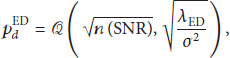
Within observed sensing period, test statistic ED can be approximated as

2.2. Matched Filter (MF)
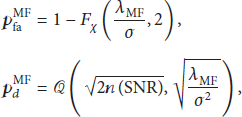
If there is a prior knowledge of the signal transmitted by the primary transmitter, the MF detector is the optimal detector to detect the presence or absence of the PU signals [5]. MF is a reliable detector but consumes high amount of power. A MF is obtained by correlating a known signal with an unknown signal. This is equivalent to convolving the unknown signal with a time-reversed version of the signal. In the case of IEEE 802.15.4, each symbol in packet data is transmitted using one of the known pseudorandom


3. Proposed Multiple Antenna-Aided Cascaded Energy and Matched Filter Detector Scheme
The state diagram of proposed MCEM scheme is presented in Figure 1. The ED block on ith antenna is always on, integrates the received RF signal over several symbol durations, and produces an output at symbol rate. If the integrated output exceeds the ED threshold
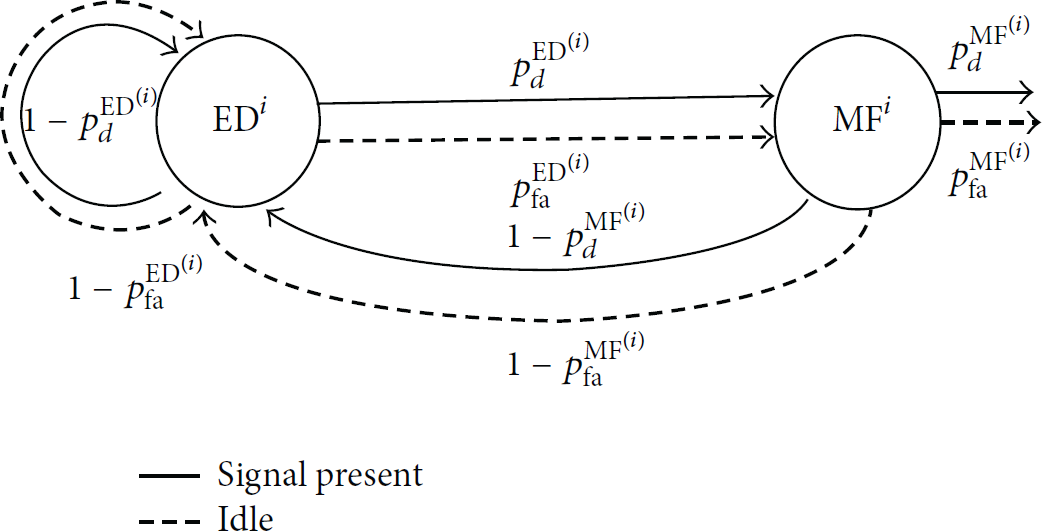
State diagram of proposed multiple antenna-aided cascaded energy and matched filter detector scheme.
The block diagram of proposed MCEM scheme is presented in Figure 2 which consists of two stages. In first stage, partial decisions are made by using CEM detector at each antenna. Then a collaborative decision whether the primary user is present (Hypothesis


Block diagram of proposed multiple antenna-aided cascaded energy and matched filter detector scheme.
There are two main probabilities associated with the spectrum sensing. When the channel is vacant (

The presence of the signal is detected when the output from detector is greater than the defined threshold λ. The probability of correctly deciding the presence of PU when the channel is used by PU (

As mentioned earlier, a final decision is made at second stage based on all the partial decisions of ith receiver antenna equipped with CEM detector. The two similar hypotheses are also defined at the second stage.
If

3.1. Operation of Cascaded Energy and Matched Filter (CEM) Detector in IEEE 802.15.4
The block diagram of operation of CEM scheme on IEEE 802.15.4 is shown in Figure 3. When a SU wakes up from idle or sleep state to perform CCA in the middle of packet transmission as shown in Figure 3(b), it will do some random back-off as it will sense the channel as busy. When the back-off

Block diagram of CEM detector operation in IEEE 802.15.4.
In our proposed MCEM scheme, the operation of ED interchanges with MF. Hence, the power consumed by the ED and MF has the factor of
3.2. Power Consumption of Multiple Antenna-Aided CEM in IEEE 802.15.4
It is very important to analyze the power consumption as IEEE 802.15.4 devices are meant to work for battery operated low powered devices. In our proposed multiple antenna-aided CEM scheme, the channel is first detected by ED on ith antenna and then MF on the same ith antenna is turned on when ED output is greater than
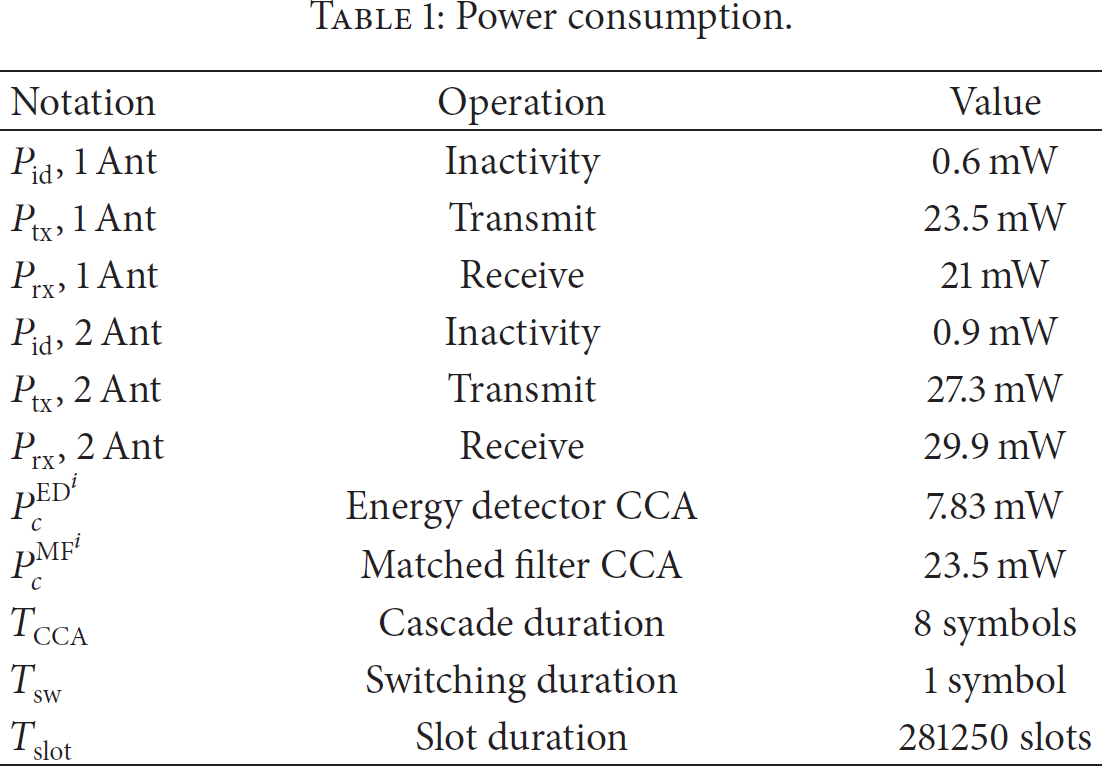
The parameters of the radio were obtained from [21], which has idle, transmit, and receive states. To the best of our knowledge, accurate models for power consumption of the multiple antenna modules of IEEE 802.15.4 are not available as of now. We therefore resort to certain heuristic arguments to arrive at reasonable numbers for the power consumption in IEEE 802.15.4 multiple antenna case as shown in [22]. It should be observed that receive power for multiple antenna case in IEEE 802.15.4 is greater than the transmit power. It is because of the fact that the low powered IEEE 802.15.4 should turn on the circuitry at the receiver side to enforce necessary signal processing techniques. The power consumption for ED and MF was derived from measurement of time execution code. The execution code was implemented in LabVIEW for ED and MF, respectively, and was tested in NI-USRP-2921. The power consumption for each state can be seen in Table 1.
Power consumption.
The power consumption for our MCEM detector consists of ED and MF part. Our MCEM detector must do CCA within
In IEEE 802.15.4 channel sensing, the energy consumption for ED, MF, and MCEM when
After successful CCA, 

4. Performance Evaluation
Our simulation was conducted in MATLAB to investigate the performance of our proposed multiple antenna-aided cascaded energy and matched filter detector scheme. AWGN channel is considered for our analysis. Generated signal
Figures 4 and 5 show the complementary ROC curve (

Complementary ROC of IEEE 802.15.4 for proposed multiple antenna-aided cascaded energy and matched filter detector scheme with
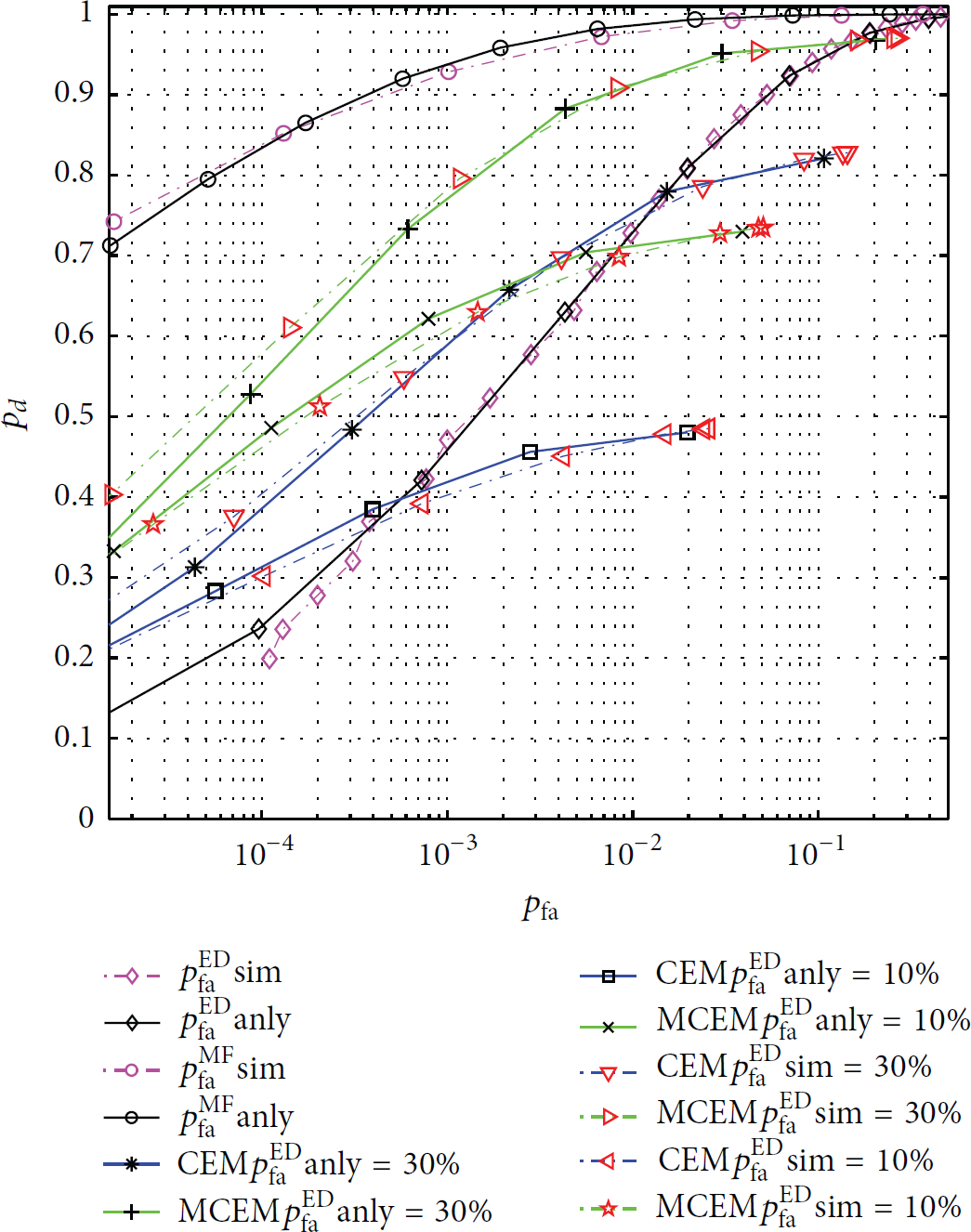
Complementary ROC of IEEE 802.15.4 for proposed multiple antenna-aided cascaded energy and matched filter detector scheme with
Figure 6 shows the ROC of IEEE 802.15.4 for proposed MCEM scheme with

ROC of IEEE 802.15.4 for proposed multiple antenna-aided cascaded energy and matched filter detector scheme when performed in the middle of transmission.
4.1. Network Throughput Analysis
The aggregate network throughput is considered as the fraction of time that the device spends in successful data transmission after successful CCA; that is, channel is free. Hence, it represents the normalized throughput and does not have any units. If α and β denote the probability that the channel is successfully detected as busy (i.e., 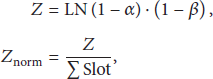
Figure 7 shows the simulation results for the network throughput analysis for proposed MCEM with

Network throughput analysis for proposed multiple antenna-aided cascaded energy and matched filter detector scheme in IEEE 802.15.4.
4.2. Network Power Consumption Analysis
The power consumption and parameters for our MCEM scheme are detailed in Section 3 of this paper. Figure 8 shows the simulation results for the network power consumption analysis for MCEM with

Network power consumption for proposed multiple antenna-aided cascaded energy and matched filter detector scheme in IEEE 802.15.4.
4.3. Energy Efficiency Analysis
Figure 9 shows the simulation results for the energy efficiency metric (kbyte/J) for proposed MCEM with

Energy efficiency for proposed multiple antenna-aided cascaded energy and matched filter detector scheme in IEEE 802.15.4.
5. Conclusion
In this paper, a new multiple antenna-aided cascaded energy and matched filter detector (MCEM) for CRN was proposed. Our proposed scheme blends the energy efficiency of an ED and reliability of MF detector. Multiple receive antennas are used to mitigate the channel fading and increase the detection performance of the SUs. Receiver operating characteristics of proposed MCEM scheme in IEEE 802.15.4 were analyzed mathematically and the analysis was validated via MATLAB simulation and compared with CEM scheme employing single antenna and other conventional ED and MF schemes. Our proposed MCEM scheme outperformed the single antenna CEM scheme and other conventional energy detection schemes in terms of detection performance. Although the power consumption of our proposed MCEM scheme is shown higher than ED and single antenna CEM scheme, the performance metric like throughput and energy efficiency of our MCEM scheme is higher than other schemes which makes it a more suitable choice for the channel sensing in the CRNs. It was shown that our proposed MCEM scheme achieved
Footnotes
Conflict of Interests
The authors declare that there is no conflict of interests regarding the publication of this paper.
Acknowledgment
This research was supported by the MSIP (Ministry of Science, ICT and Future Planning), Korea, under the C-ITRC (Convergence Information Technology Research Center) (IITP-2015-H8601-15-1011) supervised by the IITP (Institute for Information & Communications Technology Promotion).