




Abstract
This paper proposes a novel method for device-to-device (D2D) user clustering that allows wireless users in proximity to share common resources to save both system bandwidth and energy resources. The idea at the basis of our proposed cluster formation is to incorporate both social interactions and physical relationships among D2D terminals. Towards this goal, we propose two clustering approaches. The first one is based on the Chinese restaurant process (CRP), whereas the second one enhances the traditional CRP by defining a “distance-dependent Chinese restaurant process” (namely, DCRP). Numerical simulation results demonstrate superiority of our proposed clustering schemes in terms of system throughput, energy consumption, and energy efficiency over the existing schemes that rely only on physical distance.
1. Introduction
Given the explosive growth of online social networking activities, social interactions among mobile users and people's social behaviors can be significantly impacted by the advent of D2D communications. On the other hand, social interaction profiles of mobile users can also have strong impact on the efficacy and efficiency of D2D clustering communications. The concept of D2D communication is widely used for hot-spot services, whereas D2D user equipments (DUEs) in close proximity usually can form D2D clusters to collaboratively communicate and/or share resources. By letting multiple DUEs collaboratively form user clusters, it becomes possible to better utilize their collective resources, coordinate intracommunications, manage interferences, and improve their social interactions.
D2D communications can offer a number of advantages including better spectrum efficiency, higher energy efficiency, shorter latency, and improved social interactive experience. A number of existing works have studied various D2D perspectives, such as selecting a mode between cellular and D2D [1], spectrum resource allocation [2, 3], and interference management [4]. In terms of spectrum efficiency, D2D communications allow cellular user equipments (CUEs) to directly send and receive without having to go through the base stations (BSs) as relays, thereby improving spectrum utility. D2D underlay links [5, 6] can also share other cellular user equipment (CUE) channels through interference management to further improve network spectrum efficiency. With respect to energy efficiency [7], shorter distance D2D communications allow DUEs to expend significantly less transmission power than in cellular mode. Furthermore, D2D communications can substantially reduce latency in local content (file) sharing and social media interaction [8, 9]. D2D communications also facilitate the formation of self-organizing networks in time of disaster or emergency relief [10, 11].
In this work, we investigate novel approaches to form D2D clusters. D2D clustering exploits the proximity property of D2D communications. Because of wireless channel diversity, cluster members with good channel conditions can assist DUEs under poor channel conditions to avoid link failure through means such as content (file) sharing or relaying [12, 13]. There already exist a number of works on D2D clustering. For example, D2D clustering can improve multicast performance in cellular networks, as shown in [14, 15], by balancing multichannel diversity and multicast gain, and can improve the effectiveness of D2D cellular links with respect to noncellular short-range technologies [16]. Further, cluster heads (CH) can assist cluster members [17], by letting them retransmit the store information in the event of initial transmission failures. Finally, for supporting traffic safety applications, [18] proposes a cluster with a multihop relay chain of devices in order to maximize the dissemination distance and minimize the dissemination delay.
In this work, we take advantage of user behavioral information in terms of DUE social interaction to form more effective DUE clusters. Clearly, more and more people are actively involved in online social interactions with the explosive growth of online social media. Wireless networking can potentially benefit from exploiting such social interactions [19]. The work in [20] exploited such social ties to enhance cooperative D2D communications among devices by leveraging social trust and social reciprocity. The work in [21] presented a social-aware approach for the optimization of D2D communications by exploiting the social ties and influence among individuals. The work in [22] studied joint precoding strategy of D2D and cochannel cellular transmission in clustered D2D underlaying cellular network, whereas [14] introduced intracluster D2D retransmission scheme. Nevertheless, these works focus on D2D clusters formed by exploiting only information on distance among DUEs. Our work advances the state of the art on D2D cluster formation by adopting a novel approach that exploits social interactive information in addition to user proximity.
To the best of the authors’ knowledge, there exists no work on specific performance analysis of social-oriented D2D clustering based on CRP. With this aim, we propose new approaches to D2D clustering based on the Chinese restaurant process (CRP). Specifically, we integrate the social interaction of DUEs in the CRP-based clustering methods by considering both the basic CRP and a distance-dependent CRP (namely, DCRP). Both can integrate physical distances and social interaction metrics among DUEs in their clustering process. Through performance analysis, we shall show that CRP- and DCRP-based clustering can take advantage of both the physical and social distances directly to achieve better user experience including file sharing.
We discuss socially oriented clustering approaches based on CRP in two scenarios, that is, (i) underlay and (ii) overlay. For D2D underlay, we first extend the work in [9] by proposing an efficient D2D clustering admission policy designed to increase the system rate. By analyzing the interplay between D2D clusters and the arrival rate of DUEs intending to join a D2D cluster, we present two attraction functions describing the mutual suitability by considering (i) social interaction, (ii) energy balance, and (iii) location. Further, we formulate the probability of the arrival user joining a certain D2D cluster based on CRP and utilize a matching function to assign an optimal D2D cluster for each arrival user.
For D2D overlay, we propose a novel clustering scheme by incorporating both social and physical relationships among DUEs. We exploit the CRP to characterize the formation of our D2D-based clusters by taking into account both the physical distance and the social relationship among nodes. We present a performance analysis of our proposed scheme in comparison with clustering schemes in literature based on physical distance only.
The organization of this paper is as follows. Section 2 provides the preliminary concepts, notations, and problem formulations in this work. Section 3 briefly introduces the classic CRP and delineates the application of CRP in D2D clustering. Section 4 presents a distance-based CRP (DCRP) and also provides D2D clustering algorithms based on DCRP. Further, Section 5 elaborates in detail on social interaction oriented D2D clustering. Section 6 analyzes the performance of D2D clusters before the conclusions in Section 7.
2. Preliminaries and Problem Description
2.1. Preliminary and Scenario Description
D2D communications represent a novel transmission paradigm that enhances the traditional cellular communications by allowing user equipment (UE) to directly send to or receive data from another peer UE without having to route traffic through the basestations (BSs). As shown in Figure 1, D2D links can exploit the system resources in underlay (i.e., D2D and cellular links share the overall resources in the cell) or in overlay (i.e., D2D links are given their dedicated resources assigned by the BS) modes. In this paper, we propose novel clustering schemes that are suitable to both underlay and overlay modes.

D2D communication in cellular networks.
Clustering is the process of forming different DUE groups, where group members effectively collaborate to improve the perceived quality of services such as content (file) sharing, spectrum sharing [23], distributed transmission, and multihop connection. As shown in Figure 1, a D2D cluster should consist of DUEs typically in close proximity with twofold benefits: reduced transmission power for DUE cluster members and reduced interference to users external to the cluster. To take full advantage of user collaboration and file sharing, DUEs in a cluster should share as much common interest as possible. In addition, a number of DUE members in a cluster cannot be too large, since too many DUEs sharing the same bandwidth in a cluster will lead to excessive delays in intraclustering communications. It is worth noting that different D2D clusters can lead to different content and resource sharing performance that are important measures of D2D communications.
In addition to physical distance limitation, social interaction is really a critical factor for D2D communication. Thus, we will consider the impact of social interaction on users’ behaviors to form D2D clusters. In fact, for D2D cluster communications, whether a user is willing to share files owned or not with another user in the same cluster depends in part on their social relationship. Since the degree of trust and willingness among different users for content resource sharing is different, how to divide the users into D2D clusters to enhance the performance is very important. Thus, we present an efficient D2D clustering scheme by jointly considering the social interaction and physical distance factors.
Assume a number of D2D users with subscription to different types of shared resources in a given area and each D2D user is itself an initial D2D cluster. More users may arrive and join an existing D2D cluster. According to our proposed approach, when a new user arrives, the selection of the relevant cluster will be performed by taking into account information such as user locations, user preference, and also user social interaction (such as the number of users in clusters and the social tie of the user with other existing cluster users). These arriving users have opportunities either to join existing clusters with which they share common interest and are close in distance or to start their own clusters. Such decisions should not be deterministic. In particular, the Chinese restaurant process provides a very natural model for this clustering decision process.
2.2. CRP in D2D Clustering with Social Interaction
CRP studied in nonparametric modeling due to its flexibility and extensibility [24, 25] is a stochastic process through generating an exchangeable partition of data points. CRP has been extended to deal with distances and sequential data, such as the distance-dependent CRP (DCRP), which has been introduced in [26] to model random partitions of nonexchangeable data (which is a feature of many applications). In DCRP, each data point is more likely to be clustered with other data that are nearby.
Since CRP is an efficient tool to model data partitions, here we adopt the CRP to model the formation of D2D clusters. We will present our multiple objective oriented schemes in CRP-based clustering and analyze D2D clustering performance by evaluating the benefits from content sharing. Without unnecessary repetition, we shall focus on traditional CRP-based clustering scheme in D2D underlay in Section 3 and illustrate DCRP-based clustering approach in D2D overlay in Sections 4 and 5, though the proposed general principles of clustering apply to both cases of underlay and overlay.
2.3. Assumptions and Notations
We denote the channel response between nodes m and n by
We assume that the channels from BS to users follow a large-scale path loss model [27], and the D2D user channels are independent and identically distributed (i.i.d.) and are in flat fading. We assume channel noise to be additive white Gaussian (AWG) with zero mean and variance
3. Our Proposed CRP-Based Clustering
In this section, we describe an admission policy for D2D clustering that utilizes the CRP. The proposed admission policy is suitable for both D2D underlay and overlay. However, in order to avoid the overlapped explanation, we will take D2D underlay, for example, to elaborate the clustering policy.
3.1. System Model
As shown in Figure 1, we consider a single cell environment where the users can work in two modes, which are cellular mode (cellular user) and D2D mode (D2D user). Each user is equipped with a single omnidirectional antenna and any two users in D2D clusters communicate in pairs consisting of one transmitter and one receiver. We focus on the uplink period of the system where K orthogonal channels are occupied by K corresponding cellular users. At the beginning of the network, there are K D2D users owning K types of resources and each of them shares the channel with a certain cellular user. The K D2D users can be considered as K initial D2D clusters, and the set of D2D clusters is denoted by
As depicted in Figure 1, when the cellular UEs need to communicate with BS to access required service or data in D2D underlay, the BS suffers interference caused by the D2D transmitters sharing the cell resources. On the other hand, the D2D receivers are exposed to interference from the corresponding cellular user and the other D2D transmitters in the same cluster. Since D2D communications are aimed at improving the overall system capacity, in this paper, we utilize the system sum rate to evaluate the performance of our clustering scheme.
3.2. Description of CRP
Let us consider a Chinese restaurant with an infinite number of tables, and the customers will come in and choose to sit in one of the tables. The first customer sits down at a table. The nth customer sits at a table (which is previously chosen by some customers) with a probability proportional to the number of customers sitting at that table or the nth customer sits at a new table with a probability proportional to the scalar parameter α. Thus, for the nth customer, the distribution over customer assignments conditioned on

If we consider the adoption of CRP for D2D cluster formation, the clustering process is totally based on CRP without considering the factors that affect the optimal cluster of a new D2D user. For the nth D2D user, we can define a distribution over cluster assignments conditioned on

To make the clustering results more practical, we will take several factors into account, including users’ behavior, social interaction, social relationship, and their preference as well. Indeed, one related literature [30] proposed a dynamic multirelational CRP to study the interplay of world-wide, geographic, network, and user specific influences and their dynamics in generation of social media. In this paper, we propose two new different D2D clustering schemes based on CRP jointly considering the factors affecting the clustering process.
3.3. Generalized Cluster Formulation with Multiple Objectives
To evaluate the mutual suitability between the nth D2D user and D2D cluster
We can jointly consider multiple factors to formulate the attraction function
Based on the above description, we can formulate the attraction function
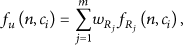

On the other hand, we can also formulate attraction function
Reliability describes the trust level of the nth D2D user for cluster
Therefore, considering a minimum distance threshold

3.4. Admission Policy Based D2D Clustering Scheme
Taking the attraction function
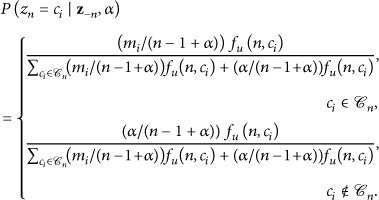
When the D2D cluster

We have assessed this CRP-based clustering approach by evaluating the system sum rate during the uplink period in D2D underlay in [31], where achieved results demonstrated the effectiveness of this approach.
4. DCRP and Social Interaction Oriented Clustering
Definitely, we can consider multiple factors to form cluster as mentioned before. However, to make the treatment simpler, we only consider the joint use of distance and social interaction in this section, and we will present the performance analysis of D2D clustering by evaluating the benefits from content sharing. Since we already discussed traditional CRP and its application in D2D clustering, next we will investigate DCRP based D2D clustering.
4.1. P-DCRP Clustering Scheme
Refer to the distance-dependent CRP proposed in [26]; we exploit a physical distance-dependent D2D clustering scheme utilizing CRP (P-DCRP), which considers the physical distance between D2D users. The P-DCRP clustering scheme is summarized in Algorithm 2. The probability of user n selecting user ℓ as its partner to form a D2D link can be calculated as
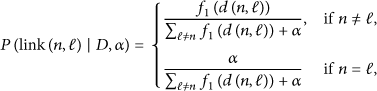
In addition, the physical distance-based function

The direct application of P-DCRP for clustering is straightforward. In particular, define the mutual physical distance between two DUEs as

4.2. Our Proposed S-DCRP Clustering Scheme
We present (see Algorithm 3) a novel social oriented and CRP-based D2D clustering scheme by considering social interaction and physical distance simultaneously, and we denote this by S-DCRP. Specifically, we formulate the social distance between two users to evaluate the effect of their social interaction on D2D clustering. Thus, we calculate the social distance based on the social trust [20] as

Notice that larger value of

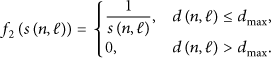
Similarly, based on the probabilities of user n selecting other users, user n selects one user as its partner and cluster randomly (otherwise, it remains alone):

4.3. Merits of S-DCRP Clustering Scheme
Different from the traditional CRP, P-DCRP and S-DCRP schemes generalize the ideas in [26] to model the users’ D2D clustering, which is nonexchangeable. By jointly considering social and physical distance to form clusters, our scheme can boost the benefits from both the social and physical information of the users.
In our proposed S-DCRP scheme, we take the social distance into account in addition to the physical distance. Under the maximum D2D communication distance constraint, for a certain user, our proposed S-DCRP scheme can effectively obtain a higher probability of selecting a partner who prefers to share its file with the considered user. Therefore, for our scheme, users belonging to the same D2D cluster can more efficiently share their files with each other rather than obtaining the files from BS, which can undoubtedly enhance system performance in terms of lower energy consumption and higher system throughput by involving D2D clustering.
5. Performance Analysis for S-DCRP Clustering
In this section, we will discuss the benefits of file sharing in D2D clusters in two separate modes, which are request mode and delivery mode. In request mode, D2D user will act as a request node to ask for resource file from BS or other neighbouring nodes who own the requested file. In delivery mode, we assume a D2D user already obtained a file from BS and can share it with other neighbouring users in the same cluster who acquire the same file.
5.1. Delivery Mode
In this subsection, we analyze the system performance by evaluating the benefits from file sharing in D2D clusters. Note that we assume that a user can request and get a desired file from BS first, with whom other members (DUEs) within the same cluster may ask for sharing the acquired file. Thus, we can assess the resulting system gain from file sharing in clusters, including throughput, energy consumption, and energy efficiency. We utilize the social trust between two users in the same cluster as the probability of their file sharing. The social trust between two users varies according to their relationship.
Let
If node


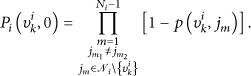
Let
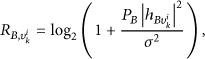

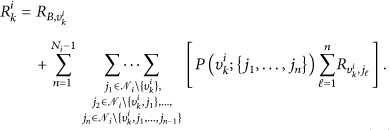
For all users in the ith D2D cluster, the throughput brought by the file transmission from BS to members in the cluster can be written as


We assume that data files from BS have the same length (L), and each D2D cluster is assigned the same bandwidth (W). Thus, for node

When n users in the cluster want to get this file through file sharing, the average transmission time and the energy consumption for node
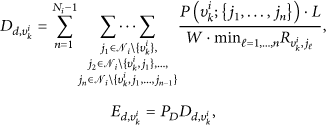
Thus, we can calculate the average cluster energy consumption corresponding to the cluster file sharing throughput as
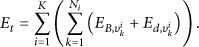
It is clear that file sharing in D2D clusters can lead to a higher throughput but also requires additional energy consumption in D2D communications. Therefore, we utilize its energy efficiency to evaluate the performance advantage of D2D clustering schemes, which is defined as


5.2. Request Mode
In this scenario, the users request files from BS or from neighbouring users who own the files in the same cluster. For a certain user, when there are cluster members who have a file and are willing to share such a file, it can obtain the file from file sharing. Otherwise, it needs to request the file from BS.
For node
For node


Similarly, by considering all users in all D2D clusters, the total throughput can be calculated as

We assume that the requested files have the same length (L), the total bandwidth is
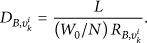


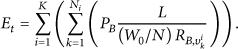
Similarly, the total energy consumption for the users in all D2D clusters can be written as

When D2D clustering is not utilized, that is, in the nonclustering case, the users obtain the files from BS with probability 1, and we calculate the total throughput for all users in (31) as

6. Numerical Results for DCRP Clustering
In this section, we present numerical results to demonstrate the performance of our proposed DCRP clustering scheme in D2D communications. The random clustering scheme and the nonclustering scheme are also used for comparison. In the simulation test, we consider a special case by taking three social trust levels into account for, respectively, friends, acquaintances, and strangers, denoted as
In our test scenario, the DUEs are uniformly distributed within a circular region of 100 m radius centered at (100 m, 0). We fix the BS at (300 m, 0). The large-scale path loss exponent between the BS and users is
6.1. Cluster Delivery Mode
In this simulation scenario, we let

Throughput versus N with different values of
It may be misleading to see that clusters formed by our scheme consume more energy because of more active participation in this cluster delivery mode. Indeed, extra energy consumption is used for more file sharing in socially well connected clusters. Therefore, to tell a more balanced story, Figure 3 plots the energy efficiency for all schemes, in which our scheme results in a higher energy efficiency than other schemes.

Energy efficiency versus N with different values of
Next, we consider different schemes for different social trust values of
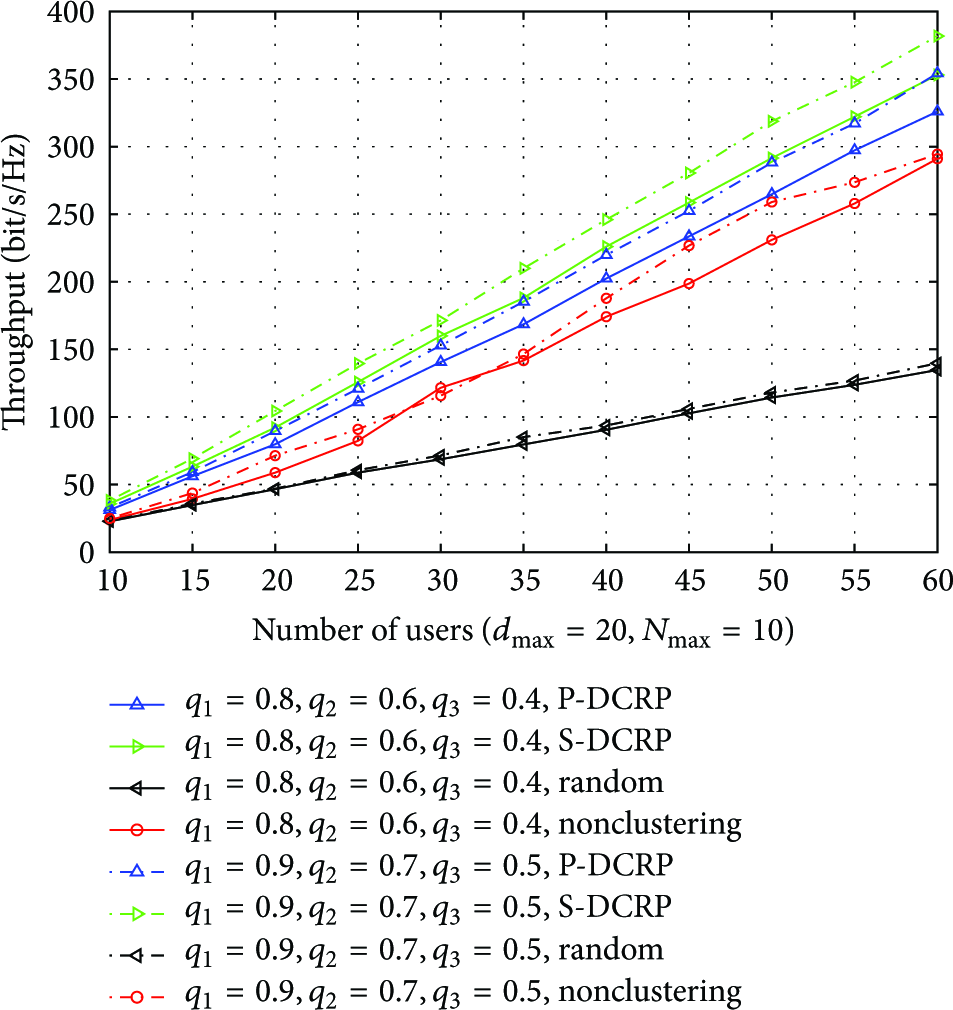
Throughput versus N with different values of
Comparing clusters formed by different methods, Figure 5 demonstrates energy efficiency from different solutions. We find that larger values for

Energy efficiency versus N with different values of
We also examine the performance of different schemes with different values of N. From Figure 6, we can see that more nodes lead to higher system throughput for all schemes. Among algorithms in comparison, for moderate value of

Throughput versus

Energy efficiency versus
6.2. Request Mode in Clusters
In this simulation scenario, we fix
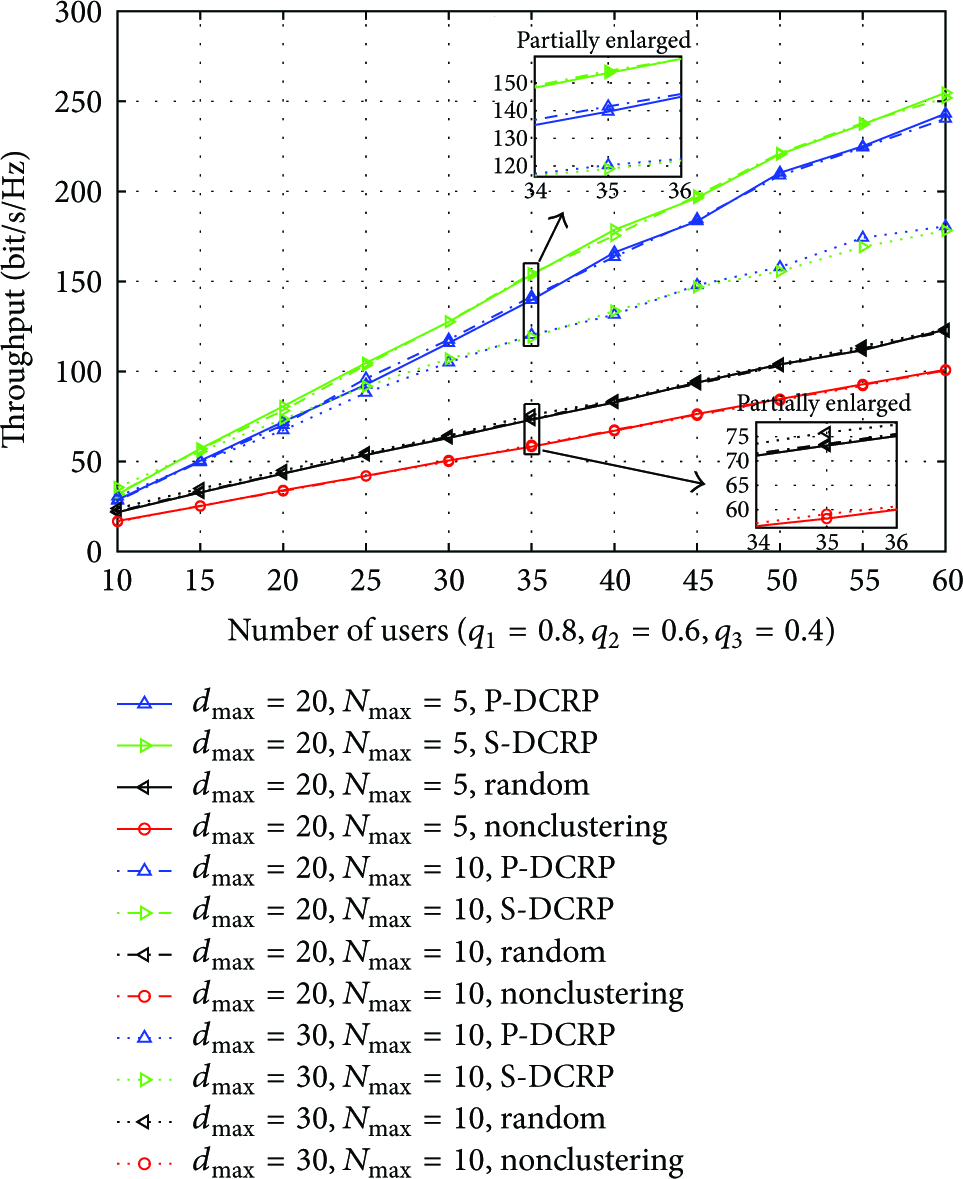
Throughput versus N with different values of

Energy consumption versus N with different values of

Energy efficiency versus N with different values of
We then illustrate the cluster performance from different clustering schemes for different

Throughput versus N with different values of

Energy efficiency versus N with different values of
Finally, we demonstrate the clustering performance of different schemes for different values of N. As shown in Figure 13, with moderate

Throughput versus

Energy efficiency versus
7. Conclusion
This paper studies D2D clustering based on CRP and DCRP. We propose a multiobjective clustering approach based on CRP that allows each new device to select a cluster for improving link rate for D2D underlay in cellular networks. For D2D overlay, we propose a novel clustering scheme by incorporating both social and physical relationships among D2D users. Furthermore, we present performance analysis of D2D clusters in different content sharing modes. Our results demonstrate the advantages of our proposed scheme in terms of system throughput and energy consumption, as well as energy efficiency.
Footnotes
Conflict of Interests
The authors declare that there is no conflict of interests regarding the publication of this paper.
Acknowledgments
This work was supported in part by the National Natural Science Foundation of China (Grant no. 61201150), the National High Technology Research and Development Program of China (Grant no. 2014AA01A701), and the Beijing Higher Education Young Elite Teacher Project (Grant no. YETP0442).