




Abstract
This work introduces an edutainment system specifically designed to help children with intellectual disability (ID) in order to allow them to have an enhanced and enjoyable learning process and addresses the need for integrating physical activity into their daily lives. The proposed system consists of a multimedia technology based games with a tangible user interface. The edutainment system was tested on 77 children with different intellectual disabilities (IDs). The mildly disabled groups achieved best results in terms of scores and coordination, but all the observed groups exhibited high motivation levels. The results proved that the system had very positive effects on the children, in terms of cognition and motivational levels, especially as the children became more physically active in the classrooms. Instructors also expressed willingness to incorporate the edutainment system into the classroom on a daily basis, as a complementary tool to conventional learning.
1. Introduction
The number of children and youths with disability is increasing dramatically in the whole world [1]. The World Health Organization (WHO) classifies general learning disabilities into mild, moderate, and severe. The definitions of the degrees of disability are usually expressed in terms of intellectual functioning or IQ, behavioral competence, and/or the need for special service [2].
Children with intellectual disability (ID) often have several characteristics, which hold back their development. They usually have underdeveloped physical growth, deformation and retarded movement, and balance. They have less than average IQ, difficulties with speech, poor memorization, attention, perception, and thinking skills. They often have difficulties with social adjustment, which causes them to be aloof and aggressive and have low esteem and emotional imbalance. All of these traits play a role in the impediment of their cognitive advance. Moreover, according to WHO [3] obesity rates by body mass index (BMI) of children with ID are approximately 38% higher than that of children without disabilities. Therefore, obesity might develop to various negative health issues such as difficulty participating in activities of daily living, social isolation, depression, and also serious illnesses such as heart disease and cancer [4–8]. In Arab countries, accurate statistics that can be relied on to show precise numbers of children with disabilities are not abundantly available. A study in the state of Qatar [9] indicates that there were 5,378 disabled children and youths in Qatar, accounting for about 0.4% of the total population. According to the Central Authority for Public Mobilization and Statistics [10], there are approximately two million people with disabilities in Egypt, which represents about 3.5% of the total population.
Assistive technology systems including computer-based tools and software have the potential to help the children with disability to learn, communicate, play, and be more independent in their lives. Hence, increasing attention has been drawn towards the design and development of accessible computer applications for individuals with cognitive impairments [11, 12]. Reference [13] has presented a novel learning resource called collaborative complex learning resources (CC-LR) which is based on live sessions and collaborative learning. In CC-LR, animated avatars discuss together a topic, and consequently learner can understand the communication between the avatars in a relative simple way. The evaluation of the research work showed a significant effect in the online learning processes and the importance of collaborative work sessions. Reference [14] illustrates a new system which assists children's early learning and development by using books, toys, and mobile digital media. These tools relied on embedded computer chip technology and connect children with the home television, computer, and the Internet. According to [15], lessons with physical activity in classrooms have been found to enhance the children's cognitive experiences and improve their overall performance by 6% on a standardized test. The Physical Activity across the Curriculum Project (PAAC) [15] also supported the role of physical activity in the classroom.
In this work we use an edutainment system with a multimedia-based learning model to help children with different types of intellectual disabilities overcome their cognitive challenges. The proposed learning model combines Mayer's cognitive multimedia learning approach [16] with Skinner's operant conditioning [17], and involves incorporating physical activity in the learning process. This is implemented with the use of edutainment lesson-games with a tangible user interface, which have been developed with the above pedagogical model in mind. Our system has been tested on a group of 77 children with different cognitive levels, ranging from mild to moderate to severe disabilities. The paper is organized as follows: Section 2 presents information on the use of multimedia models and applications for children with ID. Section 3 discusses the proposed pedagogical model. Section 4 illustrates the proposed system and the developed games. Section 5 shows the assessment results and Section 6 concludes the paper.
2. Related Work
Researchers in special education are to some extent aware about the potential of assistive technology tools in helping children and the youth with ID [18–20]. Reference [21] showed that the actual benefits of assistive technology may be reduced or not apparent depending on the quality of the software. This could be true since, first, the contents of many software are not age appropriate. Second, many educational software is unable to reach educational goals and is used as a tool for mere entertainment. Third, many programs do not promote independent learning.
There have been many efforts in developing edutainment systems with tangible user interface (TUI) aimed at promoting both learning and physical activities for children with ID [22, 23]. Such systems either interact with the computer as an input device or as both an input device and an output device. In this section, we illustrate different types of tools that were proposed to involve children into physical activity through games. The Magic Stick [24, 25] is an RFID-based TUI that aims to help children learn about new objects and entities by providing their names associated with different images. The RFID is used for object identification and is placed on the tip of the stick in order to detect the tags located on different objects. The system was highly appreciated by parents and teachers for its learning benefits; however, it did not really help encourage physical activity. ActiveCube [26] is a device that allows a user to interact with a 3D environment by using a set of rigid cubes with a bidirectional user interface to construct a structure that is recognized by the computer in real time. Children can use the system by retrieving 3D shape models. LearnPad [24] is a math-based exergam and edutainment system aiming to improve the mathematic skills of children while they are playing. The system consists of 4 square pads as a tangible user interface. They have integrated pressure sensors and work with an arithmetic video game running on a computer machine. The child simply jumps on two of the four pads alternatively N times to answer some basic arithmetic operations. Although the system creates an atmosphere of fun among the children and engages them in a physically active learning exercise, it can become repetitive with time due to the static shape of the interface [27, 28]. There are also many exergaming and educational tools for children that have been commercialized and become very popular. Examples are SmarPads [29], Smart Fit Park [30], Wii Balanced Board [31], and Equilibrator [32]. Arab children with ID cannot use these games [33], as their cognitive levels would not allow them to understand the flow or language of the games.
Our Arabic-based edutainment system allows for the replacement of traditional tools (i.e., mouse, keyboard, etc.) with tangible interface and provides children with ID an improved learning opportunity by involving their visual and auditory senses. It includes a mild implementation of operant conditioning by giving positive and negative feedback depending on how the children answer the questions of the exercises.
3. Background on Learning Models
3.1. Mayer's Cognitive Theory of Multimedia Learning
Mayer's cognitive theory of multimedia learning [16] allows children to use their auditory and visual channels in the learning process. It involves active use of their sensory, working, and long term memory to process multimedia elements into logical mental constructs. This theory assumes the following: There are two main channels for processing information: auditory and visual. Each channel has a finite capacity for cognitive load. Filtering, selecting, organizing, and integrating information are an active part of the learning process.
According to this theory, there are three important cognitive processes, which the multimedia learner engages in. The first one involves selecting verbal and visual information to yield a learning base, the second involves organizing verbal and visual information to form into coherent mental representations, and the third one includes integrating the resulting verbal and visual representations with one another. Figure 1 represents this cognitive process.
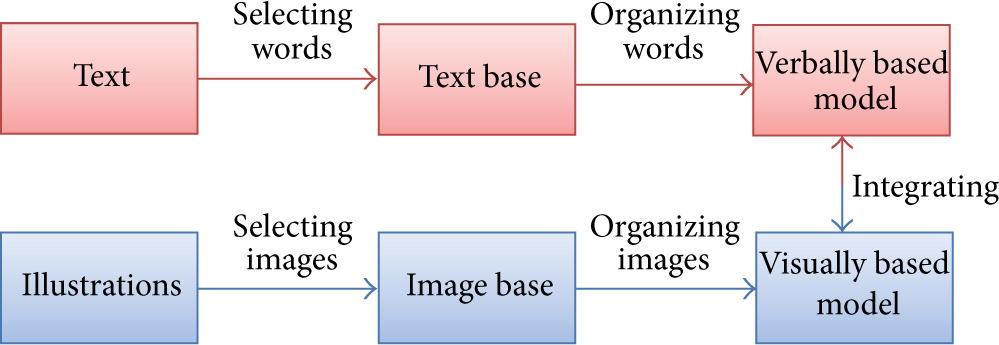
The cognitive process of multimedia content.
3.2. Skinner's Behaviorist Operant Conditioning Model
Skinner's behaviorist operant conditioning model [17] is a process that encourages behavior through positive or negative reinforcement. Reinforcement may come in the following forms: positive reinforcement: favorable event given to a child after an achievement (i.e., praise, reward, etc.), negative reinforcement: the removal of an undesired outcome after a positive achievement is made by the child, positive punishment: unfavorable event is given to the child in order to weaken the wrong response, negative punishment: favorable event is removed after undesired behavior is occurred.
According to Skinner's theory, there are three types of responses that can alter behavior: neutral operants, which are responses from the environment or other unaffecting factors which neither increase nor decrease the probability of a certain behavior happening, reinforcers, which are responses that increase the probability of a certain behavior being repeated. These reinforcers may be positive or negative, punishers, which are responses that decrease the likelihood of a certain behavior being repeated.
While Skinner's theory implies that human behavior is solely affected by external factors such as what the subject is being exposed to, we note that external factors merely play a role in the child psychology and learning process, and the ideology of behaviorism may be integrated with other techniques which do take into account internal factors such as thinking, emotions, and previous experience. For the purpose of this study, only the positive and negative reinforcement will be mildly used, and this is in order to promote positive encouragement of the child rather than negative.
3.3. Learning Model Combination with Physical Activity
Research works [22, 23, 30–32] have found repetitive results that conclude the inevitable positive outcomes of incorporating physical activity with lessons in the classroom. Physical activity has been found not only to reduce health risks on children but also to improve cognitive and concentration abilities. Children with ID are especially in need of this due to the fact that they are generally more prone to overweight and inactivity problems than average children.
We propose a combined view of Mayer's cognitive theory of multimedia and a mild representation of Skinner's operant conditioning coupled with physical activity at the implementation level. Instead of using conventional tools such as classroom board, notebooks, or computers, the tools used in this system are edutainment based, meant to get the children up and moving, while educating them with multimedia games aimed to enhance their memorization and learning process. The following section contains a more elaborate discussion of the implementation of the edutainment system.
4. Proposed System
The proposed system is a padding system that consists of a custom number of tiles that are used to interact with a number of games specially designed to suit the mental needs of children with ID. Three games that focus on enhancing the memory of the children and widening their knowledge have been developed so far. Unlike the traditional video games that are played with a mouse and a keyboard, the system uses a mat comprised of sixteen square-shaped tiles integrated with force resistive sensors that children with ID have to step on in order to interact with the games. As shown in Figure 2, each row contains four tiles and has a different color. The tiles are mapped on the computer screen in the same pattern they are on the physical mat on the floor.

The system physical mat.
The games have different difficulty levels that can be customized whenever needed to suit every child in the classroom. The first game targets the children who have difficulties to identify or recognize objects or numbers. The first game is called the “Twin Match,” where children have to identify a set of eight twin images displayed on the screen. The images are considered from the children's local environment. The second game is called “the Memory Game,” it requires children to remember the location of matching pairs of pictures among a set of images from different categories. The third game is the “Math Game,” and aims at enhancing the basic arithmetic skills of the children by asking questions that require them to add, subtract, or organize numbers while playing on the mat. The system's media content can also be customized to suit the children's learning needs and therefore aims to enhance their cognitive development.
These interactive games allow the children to involve their audio and visual senses in the learning process. The children can hence proceed with the three-step cognitive process of selection, organization, and integration of the audiovisual information they receive. In order to interact with the tangible user interface of the games, the children will be required to coordinate the tile locations between the virtual mat they see on the screen in front of them and the physical mat they see on the floor. They will be asked to step on a corresponding tile to answer a question or play a game. Every time they answer a question correctly, they are rewarded with a sound of applause and an encouraging message. If they answer a question incorrectly, they will hear a negative buzz implying that it was a wrong answer and will be given the chance to try and answer again. This is where the mild representation of Skinner's operant conditioning takes place. It is implemented mildly and mostly focused on positive conditioning and encouragement, such as the sound of applause and approving messages in order to motivate the child to keep trying and improving. The padding system hardware description along with the details about each game is explained thoroughly in the following sections.
5. System Design
Before we introduce the games, we tend to give a brief overview of the developed hardware. Figure 3 shows a high level block diagram of the system. The system consists of the physical mat containing 16 tiles. Each tile is integrated with pressure sensors. Each sensor is connected to a potential divider. The analog output voltage of each divider circuit is connected to the microcontroller input ports. The microcontroller detects the steps on the tiles by comparing the pressure sensor value with the already set threshold value.

A high level block system diagram.
When the player steps on a tile, the input voltage goes higher than the threshold value. Accordingly, the microcontroller sends the sensor number (i.e., the tile number) to the host PC serial port through the USB port. The host PC runs three games: the “Twin Match Game,” the “Memory Game,” and the “Math Game.” The host PC receives the tile number from the microcontroller and takes the required action depending on which game is being in use. The games have been implemented with C# programming language on a Visual Studio 2012 environment. We have used the Microsoft Speech Engine's API for the verbal spelling of texts and messages. We have also recorded some short audio files (.wmv) that include different types of sounds that were initiated during the games for motivation and fun, such as applause, special music or encouragement messages for correct answer, and so forth. The mat was designed with 16 square-shape force sensitive resistors that input their analog signals to an Arduino Mega where all the related signal processing takes place. The communication was achieved either by a RS232 cable or via a Bluetooth wireless connection through the use of a Bluesmirf Gold Bluetooth Chip. The following is the detailed description of each game design.
5.1. Twin Match Game
The Twin Match game aims at helping children who suffer from memory loss regarding concepts and entities they learn in the classroom. The game displays sixteen pictures of different contents at the start of the game. A database containing all the pictures that the children have learnt in previous lessons is used to fetch different sets of images at each run. Every child has his/her own set of images. The pictures are displayed on a graphic user interface of a mat which will be visible to the children while they are stepping on the physical mat. The children then have to associate the locations of the images on the screen with the associated locations on the physical mat. Among those pictures, eight are identical (i.e., four pairs) and the children have to step on the pair of tiles that correspond to a twin of pictures. Upon making a step on the mat, the children will hear an audio representation of the associated image, so their attention will be drawn to the name and shape of the object. This allows them to make quick associations with the object of the images and helps to enact the cognitive and memorization process. Each time a pair of pictures is correctly identified as twin matches, those pictures are highlighted by a dark color around their edges, followed by a sound of applause with an encouraging message. Afterwards, the twin pictures are eliminated from the game display and the child can proceed to identify the rest of the twin matching images. If the child tries to falsely identify a pair of images as identical, they will hear a wrong answer buzz and have the chance to try again. The game ends once all pictures have been properly identified. Each game consists of three levels of difficulty: Level 1: suitable for children with severe ID. Only four tiles will be displayed on the screen, to be associated with only four tiles on the physical mat. Children will be asked to identify only one pair of identical images. Level 2: suitable for children with moderate ID. Only eight tiles will be displayed on the screen, to be associated with only eight tiles on the physical mat. Children will be asked to identify only two pairs of identical images. Level 3: suitable for children with mild ID. All sixteen tiles will be displayed on the screen, to be associated with sixteen tiles on the physical mat. Children will be asked to identify four pairs of identical images.
Figure 4 shows a sequence diagram that demonstrates the process from the time a child steps on the tile until the end of the game.

The Twin Match game.
5.2. Memory Game
Similar to the Twin Match game, the Memory game aims at enhancing the memory of the children with ID but in a slightly different manner. This game requires the child to remember the location of matching pictures. It starts by revealing sixteen void tiles and a small verbal description of the theme of the game. Every step on a tile reveals an associated picture. The child must then step on another tile to attempt to identify a similar image. If the child fails to identify the correct pair, both tiles return back to being void and the child hears a wrong answer buzz. The child must then remember the location of the previous images and try again. The children must identify all the matching pairs of pictures (i.e., eight pairs in total). Every time a pair of pictures is correctly identified, that pair is fixed on the screen and a sound of applause is heard. The game ends when all of the eight pairs are identified. Each game consists of three levels of difficulty: Level 1: suitable for children with severe ID. Only four tiles will be displayed on the screen, and children will play the memory game by identifying only two pairs of matching images. Level 2: suitable for children with moderate ID. Only eight tiles will be displayed on the screen, and children will play the memory game by identifying only four pairs of matching images. Level 3: suitable for children with mild ID. All sixteen tiles will be displayed on the screen, and children will play the memory game by identifying eight pairs of matching images.
Figure 5 shows the sequence diagram of the Memory game's overall theme.

The Memory game.
5.3. Math Game
The math game allows children with ID to improve their reasoning skills by answering some basic arithmetic questions. It consists of two subgames: Fill-in-the-missing number: the game starts by showing sixteen tiles on the virtual mat on the screen, each tile numbered in sequence (1–16). The screen will then present a random sequence of four numbers between one and sixteen above the virtual mat, with one number in the sequence missing. The child will be asked to fill in the missing number by stepping on the tile with the corresponding missing number. Addition game: the game starts by showing sixteen tiles on the screen, each tile labeled with random numbers, not greater than sixteen. The screen will then present a simple addition or subtraction question above the virtual mat on the screen (e.g., 2 + 3, etc.). The numbers are generated randomly, and the answer for each question does not exceed sixteen. The child will be then asked to step on the tile with the corresponding answer.
Both of the above mentioned games consist of three levels: Level 1: only four tiles are revealed on screen and child will be asked extremely simple questions that do not exceed sequencing or summing beyond the number four. Level 2: only eight tiles are revealed on screen and child will be asked moderate questions that do not exceed sequencing or summing beyond the number eight. Level 3: all sixteen tiles are revealed on screen and child will be asked questions that do not exceed sequencing or summing beyond the number sixteen.
For both Math games, every time a child steps on the tile corresponding to the correct answer, a sound of applause is heard along with an encouraging message. And if a child steps on the tile corresponding to the wrong answer, a wrong answer buzz is heard and the child is asked to try again. The math game ends when the child has answered all questions correctly.
6. The Evaluation and Assessment Methods
Figure 6 shows the screenshot of the GUI interface. The GUI has four blank squares: two for arbitrary numbers, one for the arithmetic operator, and one for the result and sixteen colored squares for mapping the physical tiles. One of three levels has to be selected by the teacher depending on the student cognitive ability. The GUI demonstrates an example of how the system works. In the example the system waits for the student to step on the correct tile.
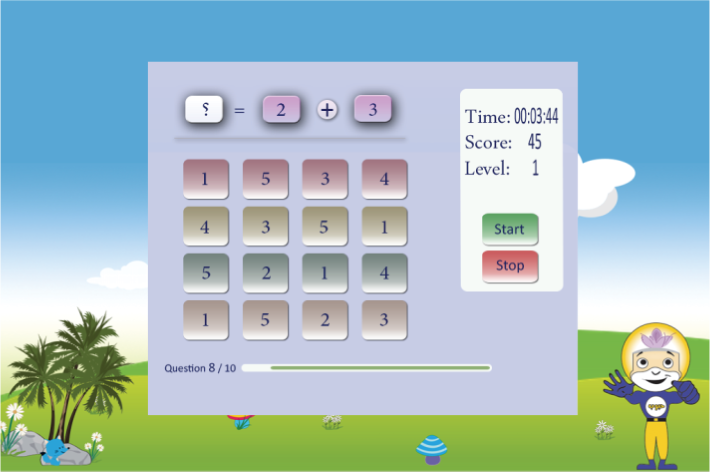
An example of Level 1 Arithmetic operation.
The evaluation process for children with ID takes different aspects into consideration in comparison to those for normal children due to their limitation in cognitive capabilities. We have collaborated with the Shafallah Center for Children with Special Needs in Doha, Qatar [34], to realize this evaluation experience. We started by introducing the system to the instructors of special needs children at the center. Training sessions were given to familiarize them with the system. Then, we chose participants and we classified them according to their background and cognitive state. Instructors helped guide us in defining measure scales.
6.1. Participants
The proposed edutainment system is tested on a set of 77 children with ID at the Shafallah Center. These children are classified within three main levels of cognitive disabilities: (1) mildly disabled, (2) moderately disabled, and (3) severely disabled. The three cognitive levels of the tested students are distributed as follows: 36 children have mild cognitive disabilities (15 females, 21 males), 34 have moderate cognitive disabilities (11 females, 23 males), and 7 are severely disabled (1 female, 6 males). Therefore, we have divided participants into 3 sets; the first group consists of children with mild disabilities (mild group), the second group consists of children with moderate disabilities (mod group), and the third group consists of children with severe disabilities (severe group).
6.2. Measures
All measures for the study reported here were collected using an observation form. Audio and videotapes were not allowed. Therefore, an assessment technique specific to the requirements of the edutainment system is developed with the help of instructors to evaluate the performance of the children. The assessment method takes into consideration behavioral and physical interaction. The observation form was used during the test to note the following constraints: timing, average scores per level, coordination level, motivation level of child, and free comments.
The time depicted here represents the average time (in minutes) that each participant took to complete an exercise. The scores per level parameters reflect the average grade of each participant. It is based on how many correct/incorrect answers they chose. We have assigned percentage grades between 0 and 100 for this measure.
The coordination parameter reflects the physical and cognitive abilities of the participant to step into the appropriate physical tile corresponding to the electronic tile on the computer screen. The motivation parameter reflects the emotional acceptance of the game. For both coordination and motivation parameters, we have assigned 10 for bad results, 70 for the good result, and 100 for the outstanding results. Their personal instructors, according to their usual abilities and backgrounds, evaluated these measures.
In our analysis, we considered the score and the coordination measurements as performance parameters. This reflects the cognitive and the physical abilities of participants, while the motivation is an emotional parameter.
6.3. Procedure
Due the short time frame that Shafallah Center allowed for the experiments, we gave participants a training session and a test session at the same day. We chose only 2 games to be played by the participants: the Memory game and the Math game. Testing and training were carried out for each group in the Shafallah Center, for about 1 h 30.
As described in Section 5, the games consist of three main levels of difficulty, engineered to suit the needs of the children in accordance to their intellectual levels. Level 1 of the game is the basic easy level, suited for mainly children with severe ID. Level 2 is the medium difficulty level, suited mainly for children with moderate ID. Level 3 is the difficult level and is suited mainly for children with mild ID.
In this study, children with severe and moderate ID were subjected to Levels 1 and 2 of the games, although children with severe ID are not expected to perform well on the Level 2 exercises. Children with mild ID were subjected to Levels 2 and 3 of the game and were expected to perform well in both but better in Level 2. Table 1 details the allocation of groups to specific edutainment games levels, for the Memory and Math games.
Game level allocation.

6.4. Results
Most of the children were not able to perform well on the Math games, with the exception of some children with mild cognitive disabilities whom were able to solve math puzzles on the basic Level 1 of the game. For this reason, results of the Math game were left out of the statistical evaluations. Mainly, we present here results of the memory game for the mentioned groups.
We report also that three participants (2 with moderate disabilities and 1 with severe disabilities) completely refused to accept or participate in the game; child with severe disabilities was not able to understand the rules of the game or solve any correct answers but nevertheless enjoyed stepping on the tiles and seeing/hearing the reaction of the game on screen. The two others who have moderate cognitive disabilities did not show any signs of motivation or concentration and simply got bored of the game and refused to participate. Note that the children who did not participate in the game were not included in the graphic evaluation representations below.
The relationships of the mental age, the timing, the coordination, and the motivation of participants with measured scores were investigated using person linear correlations. In this section, we start by presenting general view about age, timing, and performance results of all groups. Then, we will detail the results for every group. Finally, we discuss possible correlation between measures.
Table 2 presents correlation coefficients between measured data (average scores, coordination, and motivation), physical and mental age of participants, and the timing they take to finish the test. This helps us to know if there is dependence between parameters. When the coefficient is close to 0, there is no correlation, and when it is near to 1, there is correlation.
Correlations of physical, mental ages, and timing with average scores, coordination, and motivation.

The Age. The average mental age of participants is about 5 to 6 years. According to the correlation coefficients, the physical age does not affect measured parameters (average scores R(74) = 0,15; coordination R(74) = 0,04; and motivation R(74) = 0,02). Additionally, the correlation of mental age with measured parameters is not approaching significance (average scores R(74) = 0,50; coordination R(74) = 0,40; and motivation R(74) = 0,32). We conclude that correlation does not exist between the age, performance, and emotional parameters in this study.
The Timing. Although the correlation coefficients of timing with the other parameters were not significant but they were close together (with average score R(74) = −0,48; with coordination R(74) = −0,49; and with motivation R(74) = −0,47). These coefficients are negative because when the measured parameters (average score, for example) increase, the timing decreases. But we cannot be sure about an existing relationship between timing and other parameters.
As depicted in Figure 7, which represents the average timing for each group, the average timing is higher when the level of disability is advanced. To conclude about the timing measure, we choose to investigate these measures in detail for each observed group.

The average timing difference between the observed groups in (minutes: seconds).
The Performance. The histogram representation of Figure 8 shows the distribution of average score, in the abscissa axis, for all participants, in the ordinate axis. Compared to the “normal distribution” represented by red line, we can consider the general distribution left skewed. In fact, most participants scored between 55 and 65. And about 20% of participants scored with high points (70–100). However, we can see an edge peak in the left.
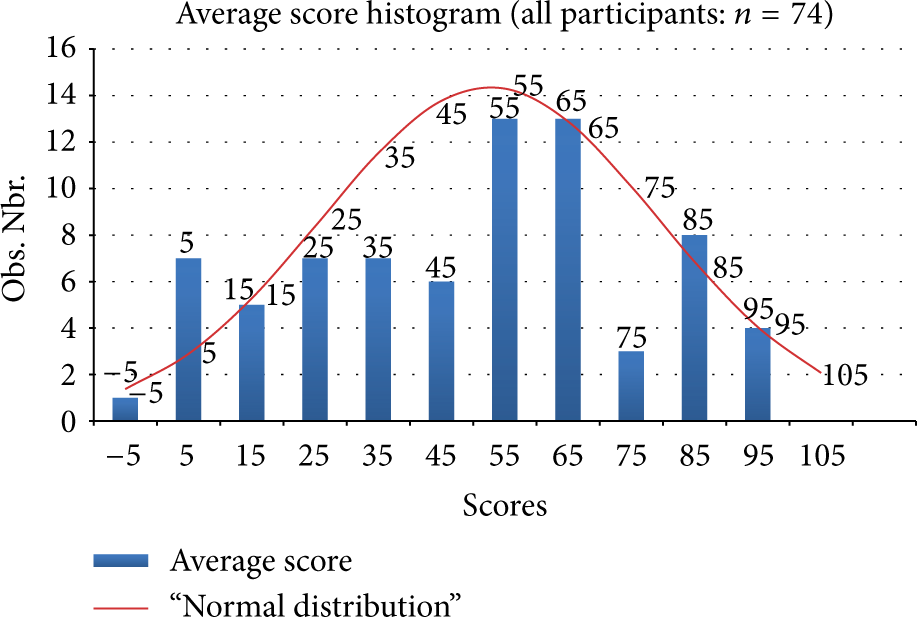
Average score distribution for all participants.
In order to observe groups that have diverse levels of disability, it would be interesting to process data for every group and then compare their performance results.
Detailed results for every group take into consideration scores for every level of games and the average timing. The graphical representation of these parameters is presented in the same graph with two ordinate axes (see Figures 10, 11, and 12). The primary axis on the left of the graph represents the score parameter, which is presented by a line chart (Level 1, 2, and 3 scores). The secondary axis, on the right of the graph, represents the timing value, which is presented by the column chart. Columns of timing for female participants are colored differently.
Figure 9 depicts results of the children with mild ID (mild group,

Mild ID scores: Level 2 students versus Level 3 students.
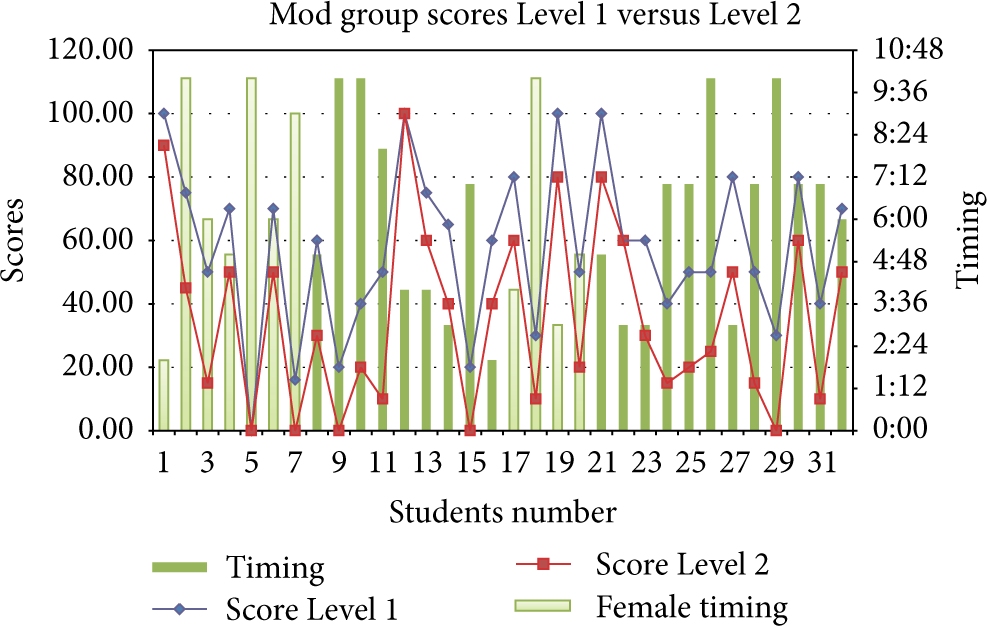
Moderate ID scores: Level 1 students versus Level 2 students.
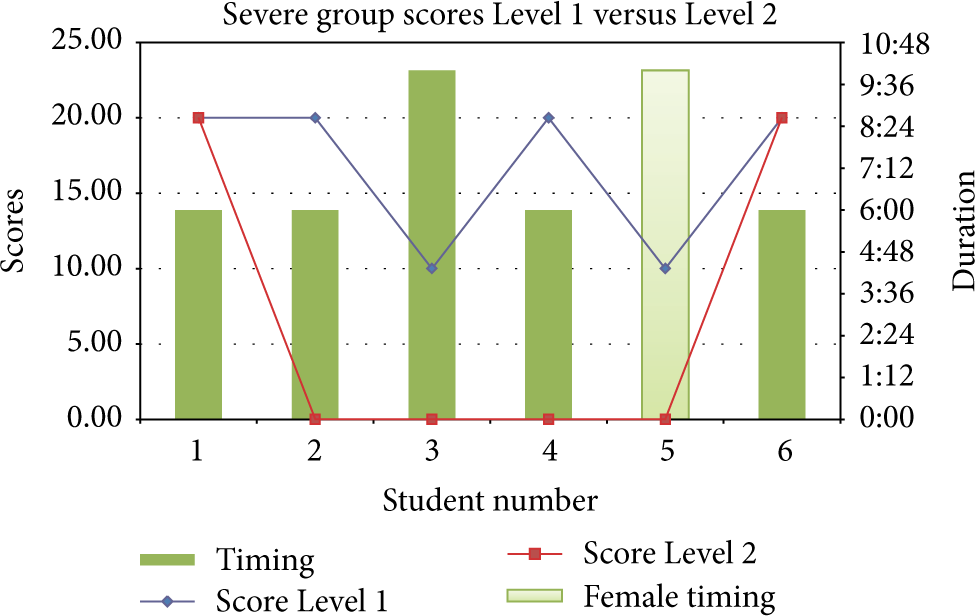
Severe ID scores: Level 1 students versus Level 2 students.
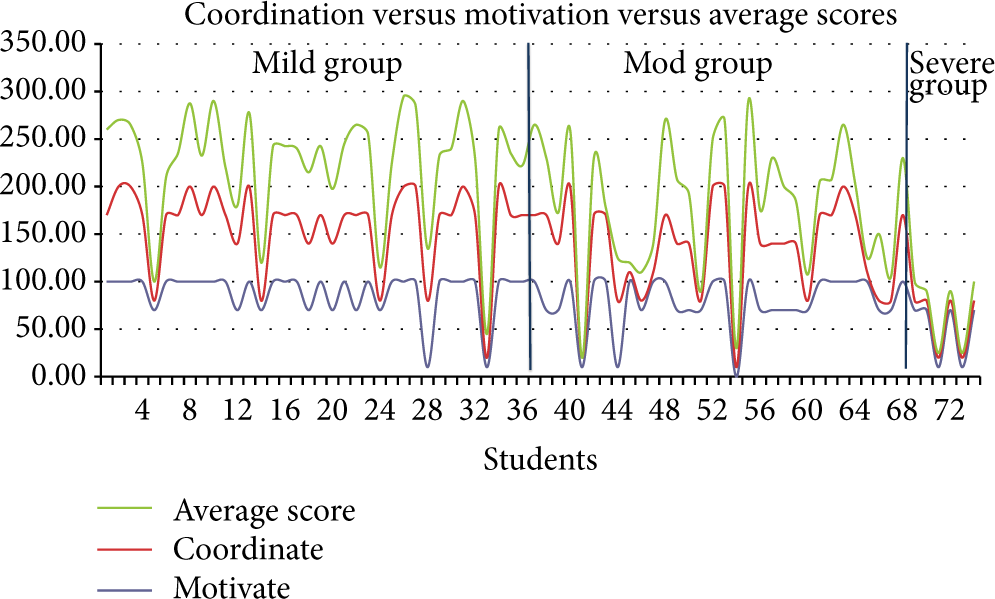
Coordination versus average scores.
Note the lack of correlation between the timing value and scores. Indeed, some participants took less time (>3 min) and scored well (e.g., students number 1-8-10-13-20-21-31), while others took more time (<10 min) and scored much less (e.g., students number 5-18-27-33). On the other hand, some participants needed more time (<10 min) and scored well (e.g., students number 12-16-28).
Figure 10 illustrates results in terms of percentile scores and relative timing, comparing the percentile score results of the children with moderate ID (mod group,
Figure 11 depicts results in terms of percentile scores and relative timing, comparing the percentile score results of the children with severe ID (severe group,
We have investigated the relationships between average scores and coordination and motivation measures. Correlation of average score with coordination (R(74) = 0,75) is more significant than correlation with motivation (R(74) = 0,49).
Figure 12 depicts coordination and motivation measures in relevance with average scores, comparing the performance of mildly (mild Group), moderately (mod Group), and severely (severe Group) disabled children. Here we can clearly see that as the coordination levels increase, the scores also increase for all levels of disability. However, as can be expected, children with mild cognitive disabilities performed best in terms of coordination and average scores.
Figure 13 illustrates the average scores, coordination, and motivation measures of females versus males. This graphic representation zooms in on gender differences with regards to technological games that require learning game rules, coordinating between floor tiles and screen tiles, concentration and memorization skills, and the effect of all the above on their ability to perform. Note that, of the tested children, 27 are females and 47 are males. As depicted in the below representation females fared better than males in all fields; they achieved higher average performance scores, coordination levels, and motivation levels. This allows us to conclude that while all the children enjoyed and fared well in the games, females are more likely to accept and participate in new technological exercises.

Female versus male ID students.
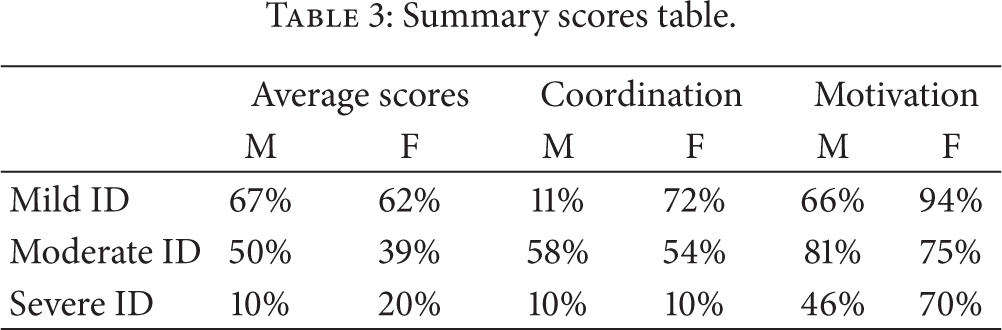
Table 3 demonstrates a summary of all the achievements in terms of the average scores, coordination, and motivation measurements, whilst highlighting the differences between the following groups of children: mild group, moderate group, and severe group, in addition the difference in each group between females and males. From the following table we conclude the following points: (1) children with mild ID perform better in all fields (keeping in mind that the mildly disabled children were subject to a more difficult level of games than the other children). (2) Regarding each observed groups, females performed slightly better than males and were more motivated than males. (3) All groups of children exuded high levels of motivation.
Summary scores table.
Finally, the children's instructors had many positive comments on the system, after having observed improved concentration, memorization, performance, and motivation levels. The instructors concluded this edutainment system would be extremely useful as an assistive learning tool in the classroom and can be implemented in various fields. Instructors also noted significantly higher levels of energy and positive emotions in the children, as a result of implementing physical activity in the learning process. Children were also happy to collaborate with each other and attempted teamwork was noted in many instances, surprisingly even among the most noninteractive students.
6.5. Limitations
During this experimentation, constrained by a time frame, we have collected data using only one tool, which is an observation form. We believe that more information can be collected that can improve the accuracy of the results, for example, by recording videos of testing sessions. It is worthwhile to note that while there have been some doubts about the ethical stance of testing systems on children, a recent study has thoroughly explored this issue and concluded that research with disabled children encourages researchers to find alternate communication methods and make advances in analysis of problems and finding usable solutions for children with ID [35].
Baseline information about participants’ performance has not been compared to our results which can help us to evaluate the visual/hearing memorization enhancement of participants. However, we have found interesting and significant results regarding the edutainment games’ usability and content. Indeed, the user interface was very attractive for participants; the content of the games has to be adjusted. For instance, the Math game was not suitable for all participants.
Despite the potential benefits of the usage of technology, multimedia, and educational software for individuals with ID, there is a substantial need of baseline information on a number of topics, including the basic computer skills of people with ID, the objectives for using computers, and the difficulties they experience while using these devices. Knowledge of these issues will help researchers and practitioners to form a concrete and accurate picture of this unique population and understand how to help them to make better use of assistive technology tools.
We found that 94% of the tested children exhibited high motivation levels, regardless of their performance in terms of score or coordination. Their high motivation levels encouraged them to play the games a second time, and 92% of children achieved higher scores and higher coordination the second time around. Their understanding of the game also improved, and concentration and memorization skills also clearly improved. This indicates that incorporating physical activity with solving exercises in a game-like manner motivates children to learn more and enhances their cognitive abilities. However, we need to assess the benefits of the edutainment system to the participants’ knowledge in a normal class to understand whether the system improved learning in other aspects of their education.
7. Conclusion and Future Work
In this paper, an exercise-based edutainment system designed to enhance learning ability of children with ID in a simple and entertaining manner has been presented. The system consists of computerized games that link between a screen and a set of physical tiles. The children playing a game can answer questions by jumping on the tiles that correspond to the screen game. This involves having the children use and enhance their coordination skills. The system incorporates a mixed pedagogical model that combines Mayer's cognitive theory of multimedia learning with Skinner's operant conditioning and involving physical activity within the learning process. The edutainment tool incorporates three different games: the Memory game, the Twin Match game, and the Math game. They are all intended to promote learning process, memorization, and physical movement while having fun. The games can easily be customized to suit the specific needs of children with different ID levels.
The system has been evaluated for children with different developmental disabilities at the Shafallah Center for children with special needs in Doha, Qatar. The collected results demonstrate positive impact for the children's cognitive capabilities in terms of scores, understanding guidelines, coordination, concentration, communication, and memorization skills. The mildly disabled children achieved an average score of 65%, the moderately disabled scored an average of 47%, and the severely disabled children had a low average score of 14% and were slower than other children. The mildly disabled children also fared best in terms of coordination, while the other groups lagged behind.
While general results show that there is no significant correlation between duration and average score, detailed results show that it can be significant, especially in the case of groups 2 and 3. We can conclude that a long duration is a sign of an existing cognitive attention from the children to perform significantly better after repetition, showing higher scores and coordination and to improve understanding of the guidelines of the games. We noticed that 92% of the children achieved higher scores after replaying a game, which indicates that practicing coordination and memorization affects children with ID positively, and even the severely disabled children were able to perform better.
Footnotes
Disclosure
The contents of the paper are solely the responsibility of the authors and do not necessarily represent the official views of the Qatar National Research Fund.
Conflict of Interests
The authors declare that there is no conflict of interests regarding the publication of this paper.
Acknowledgments
This publication was made possible by a Grant from the Qatar National Research Fund under its award NPRP 09-052-5-003. The authors also would like to thank the Shafallah Center for all the logistic supports to realize this study.