




Abstract
Balanced energy consumption in WSNs is the key to maximize network lifetime. After analyzing laws of energy consumption of WSNs, a heterogeneous node deployment model based on area topology control is proposed in this paper. It utilizes predetermined heterogeneous node deployment to balance area energy consumption ratio and the topology control algorithm based on area energy consumption ratio to maintain dynamic equilibrium energy consumption. Simulation results show that our model takes a superior performance on maintaining network coverage, balancing energy consumption, and maximizing network lifetime. Compared with similar WSNs deployment models, our model can be more efficient to prolong network lifetime and has advantages in reducing dependence on deployment accuracy, balancing dynamic energy consumption, and improving lifetime in poor network environment.
1. Introduction
Wireless sensor networks (WSNs) have the advantages of low cost, flexible deployment, and so forth and have been widely used in varied fields, such as environmental monitoring [1, 2], intelligent control [3], and military reconnaissance [4, 5]. In WSNs, energy efficiency is very important and also a challenge. The data traffic follows a many-to-one pattern [5], which makes nodes nearer to the sink node carry heavier traffic loads. Therefore, the nodes around the sink deplete their energy faster, leading to what is known as an energy hole around the sink node [6].
In order to avoid energy hole and prolong network lifetime of WSNs, optimization deployment model of WSNs is one of the main methods. Because nodes lack power and are weak in computing capacity, node deployment models adopt some optimization measures to make best use of node resources, such as adjusting number and location of nodes, changing data transmission path, and altering transmission radius. Earlier researches about optimization deployment model are mainly concentrated in the homogeneous sensor networks. Researchers focus on the optimal transmission path, adjustment transmission radius of nodes and optimal selection on position and number of nodes, and so forth. With the development of WSNs, the requirements of service in WSNs present heterogeneous characteristics, such as the various service function and different prices of nodes [5]. For example, when nodes are used for seismic monitoring with high resolution of images and videos, the price of sensing module is more expensive, and if homogeneous nodes are used to balance the energy consumption in such scenarios, resources will be wasted seriously. As the requirements of WSNs become variant, it is of more practical significance to study WSNs deployment model with heterogeneous nodes [7–9].
Halder and Bit [9] proposed heterogeneous node deployment scheme (HNDS) by location-wise predetermined sensor nodes (SNs) and relay nodes (RNs). HNDS enhanced network lifetime while maintaining coverage effectively. However, the SNs and RNs in HNDS should be placed at the precise location, which brought a heavy workload to deployment implement. Additionally, it assumed that the initial energy of nodes was identical and there was nonnormal energy consumption or accidental death. However, the possibility of nodes with identical initial energy is very small in practical application and abnormal energy consumptions or unexpected deaths of nodes often occur.
To overcome the above shortcomings, we propose a heterogeneous node deployment model based on area topology control in this paper. The simulated experimental results showed that our model could effectively maintain the same energy consumption ratio (ECR) in various areas of WSNs under the premise of maintaining desired sensing coverage and connected coverage. The main contributions of this paper are listed as follows. We have analyzed the influencing factors of energy consumption based on the hexagonal structure [3] and deduce the internal laws between the number of nodes and the area energy consumption ratio. Based on the analysis, we proposed a heterogeneous node deployment model, in which sensor nodes and relay nodes are deployed based on energy balancing strategy. Topology control algorithm based on area energy consumption ratio is designed to maintain dynamic equilibrium energy consumption, which effectively maintains the same ECR in different areas and prolongs the network lifetime.
The rest of the paper is organized as follows. In Section 2 literature review is elaborated. Hexagonal coverage architecture is presented in Section 3 and analysis on lifetime is presented in Section 4. Section 5 presents the node deployment model based on area topology control. In Section 6, the performance of coverage scheme is evaluated. We conclude and discuss future research directions in Section 7.
2. Related Works
The goals of research on deployment model of WSNs are mainly to decrease the cost and improve the QoS of WSNs. Energy is one of the scarcest resources in WSNs, so how to balance loads and average energy consumption is one of the important goals of optimal deployment model. According to the mobility of sink node, there are stationary sink node deployment model and movable sink node deployment model.
In the former models, the energy consumption of nodes closer to sink node is much more than the far ones; therefore, the solutions are mainly in balancing energy consumption among the nodes in different positions. Wu et al. [6] proposed a nonuniform node distribution strategy (NNDS) to resolve energy hole problem, but they did not mention anything about the minimum number of nodes required to be placed in the farthest layer from the sink to maintain connectivity and coverage. Shi et al. [10] proposed a topology control algorithm for data collection in sensor network towards achieving goal of prolonging network lifetime by adjusting transmission range of each sensor node. They have considered collaborative multipath data delivery and formulated the lifetime maximization problem as a max-fair-flow problem. Zhang and Shen [11] proposed a fully localized zone-based routing scheme to resolve problem of intracorona energy consumption balancing and designed an energy balanced data gathering protocol (EBDG) to achieve balanced energy consumption among nodes. Lin and Chen [12] proposed a corona division strategy to guarantee the energy equilibrium in WSNs and designed an energy equilibrium routing based on corona structure (EERCS). Regardless of adopting data fusion or data slice, EERCS can be used to realize the maximum energy equilibrium for a given area. Song et al. [13] proposed a circular node deployment scheme to maximize the network lifetime by analyzing energy consumption ratio and consultation mechanisms. Azad and Kamruzzaman [14] proposed a topology control algorithm for data collection in sensor network towards achieving longer network lifetime by changing transmission range of each sensor node. Jeon et al. [15] proposed a joint control scheme to maximize network lifetime in wireless sensor networks with joint contention and sleep control. Prabh et al. [16] proposed a distributed algorithm to form semilogical hexagonal topology in WSN deployments, which formed the hexagonal topology backbone in an arbitrary but sufficiently dense network deployment.
Because nodes near stationary sink node have excessive energy consumption, some researchers have proposed movable sink node deployment model. Wu et al. [17] proposed an energy consumption solution by changing sink node's position to balance the nodes’ workload in different areas. Luo and Hubaux [18] proposed an energy balanced program based on mobile agent cluster; the mobile agent could predict the energy consumption of the cluster and balance energy consumption by the cluster-route. Lin et al. [19] took researches on theoretical performance limits about mobile base station and proposed a theoretical solution to fill theoretical gap regarding the optimal movement of a mobile base station. Although moving sink node scheme can balance the consumption, it should add one and more moving sink nodes, which significantly increases deployment cost and additional energy consumption for moving sink nodes.
A variety of service requirements in different scenarios arouse heterogeneous characters of WSNs, and researches on heterogeneous node deployment model have become a hot topic. Smaragdakis et al. [20] proposed a heterogeneous node deployment with two-level energy, which would prolong network lifetime by clustering topology control algorithm. Cardei [21] proposed heterogeneous node deployment scheme with two types of nodes equipped with finite or infinite resource to prolong network lifetime. Sun et al. [8] proposed heterogeneous distributed sensor network topology control algorithm and constructed a heterogeneous node metric function to evaluate and adjust energy consumption ratio. Halder and Bit [9] proposed heterogeneous node deployment scheme (HNDS) by precisely deploying location-wise predetermined sensor nodes and relay nodes, but the deployment of a lot of nodes with precise location is very difficult in practice; additionally, HNDS can resolve some unbalanced energy consumption, such as abnormal energy consumptions or unexpected death of nodes.
3. Heterogeneous Coverage Model
3.1. Coverage Model
Hexagonal coverage architecture is one of the best coverage models to do exhaustive monitoring in WSNs applications circumstance [16], so we adopt it as basic coverage architecture in our model. A sink node is deployed in the center of the whole monitoring area, and its geometry location is defined as
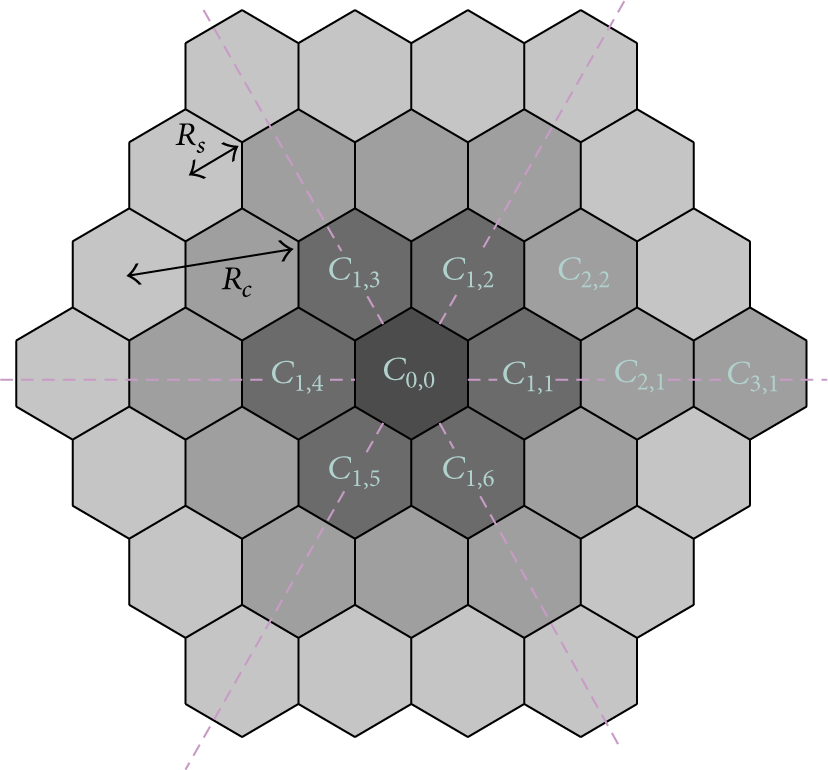
Hexagonal coverage architecture.
In order to facilitate implementation of the node deployment strategy, the cells are labeled as
In this coverage structure, there are six center lines of cells presenting such properties: the center lines of cells lie in six rays with source on sink node, as dotted line shown in Figure 1; i and j meet
In order to obtain much better resource utilization, a heterogeneous node deployment strategy is adopted in this paper. There are two types of nodes, that is, sensor nodes (SNs) and relay nodes (RNs). SNs are placed in the center of hexagonal cells and responsible for monitoring and sensing data and send data to the sink at constant time-interval via RNs; if SNs are of the innermost layer, that is, the first layer of network, they will send data directly to the sink node; RNs are randomly placed in the cell and responsible for relaying data and ensuring network connectivity. The number of RNs in a cell according to energy balanced consumption will launch the analysis in Section 4.3.
3.2. Coverage Analysis
There are two kinds of coverage specifications in WSNs, that is, sensing coverage and connected coverage. We denote
Definition 1.
Sensing Coverage Ratio (SCR) refers to the ratio of the being monitored area by sensor nodes and the whole required being monitored area [22]. Let η denotes SCR,
For simplicity, assume a SN with sensing radius
According to coverage model, the sensing data are forwarded layer by layer to sink node via RNs. In order to ensure that data can be relayed to sink node smoothly, it should ensure the connected coverage to meet the requirement of network.
Definition 2.
Connected coverage refers to the fact that any node in the WSNs can communicate with another node via single-hop or multihop relaying [23]. It reflects the ability of data relaying and communication in WSNs.
The connected coverage in our coverage model can focus on the fact that the data can be relayed layer by layer. Each cell has one or two adjacent cells of inner layer as shown in Figure 1. If
4. Lifetime Analysis
4.1. Lifetime
In presence of several existing definitions of network lifetime [5, 9, 11, 24], we consider network lifetime in terms of coverage of the network.
Definition 3.
Lifetime is the time period till the proportion of dead nodes exceeds a certain threshold, which may result in loss of coverage of a certain area. Let
In our deployment model, SNs are deployed in the center of cells to sense information and RNs are randomly deployed in cells to forward the sensing data to next layers until the sensing data reaches sink node. Therefore, according to the coverage analysis in Section 3.2, one can get the following conclusions. Only when SCR of each cell is not less than When the energy of RNs in one layer is depleted, the sensing data of its outer layer can not be forwarded to sink node, which means it is impossible to achieve connectivity of all nodes and network lifetime is terminated.
4.2. Energy Consumption Analysis
Without loss of generality, energy consumption model adopts rules with data acquisition periodically in this paper. We denote
The energy consumption on data processing and node dormancy are much less than data transmitting and sensing [24, 25], so we adopt the energy consumption with four parts: energy consumption for SNs to sense and transmit data, that is,
The energy consumption [24] for a node to transmit L-bits data over a distance

The energy consumption [24] for a node to receive L-bits data from distance

The energy consumption [24] for a node to sense L-bits data around distance

The major energy consumption of SNs for L-bits data in

The major energy consumption of RNs for L-bits data in

Denote

Denote

Denote

Denote

Denote

Obviously,
RNs are responsible for relaying data and ensuring network connectivity in

Assume the number of RNs in the ith layer is
Denote

Denote
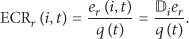
Denote

Denote

4.3. Energy Consumption Balancing Strategy
If the energy of SNs in a cell has exhausted, it will arouse SCR below

The sensing data are sent to sink node via RNs layer by layer in our node deployment, so when the energy of RNs in one layer is depleted, the data of outer layer can not be sent to sink node, which means the network lifetime is terminated. The energy consumption balance strategy for the RNs focuses on the fact that each layer has the same

The ideal network lifetime is that the energies of all nodes are exhausted simultaneously. Therefore, three conditions should be met for the goal: (1)
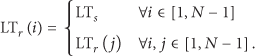
Substituting (1), (2), (3), (16), and (17) into (18), we can get


It can be concluded that, (1) to keep lifetimes of RNs and SNs being equal, the number of RNs, that is,
5. Node Deployment Based on Area Topology Control
5.1. Node Deployment Strategy
The advantage of heterogeneous deployment model is that the capabilities of nodes can be utilized completely by adjusting the number and location of heterogeneous nodes. As in the previous analysis, the deployment of SNs strategy is that one SN is placed in the center of cell. According to Section 3.2, the center position
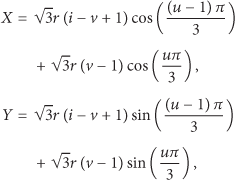
According to analysis in Section 3.2, RNs in the ith layer are deployed randomly and the numbers of RNs in each cell layer are roughly equal in the same layer. The number of RNs in the ith layer
5.2. Topology Control Algorithm
Accurate deployment on part of RNs and all of SNs was adopted to balance the energy consumption of each coverage area in HNDS [9], which greatly increased the difficulty to implement their node deployment. Meanwhile, the energy consumptions of nodes sometimes are dynamic and unpredictable, such as abnormal energy consumption and sudden failure of node, which bring new problem to balance ECR.
In order to reduce deployment difficulty, our coverage model adopts a simple deployment strategy as shown in Section 5.1. According to known coverage structure in Section 3.1, RNs in MLC are responsible for relaying data from three cells of the next outer layer and have only one cell of the next inner layer to receive their forwarding data. Thus, RNs of MLC will be overweighed and consume excessive energy and then are premature to die. Meanwhile, dynamic unbalanced energy consumption may make some areas take abnormal ECR and be premature to die. To resolve the problem of nodes’ premature death in some area, topology control algorithm based on area energy consumption ratio is proposed in this paper.
Definition 4.
Area energy consumption ratio is the ratio of total energy consumption in one coverage area
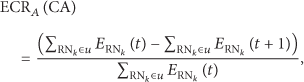
Topology control algorithm based on area energy consumption ratio is divided into three parts.
First, information initialization: after nodes deployment, each node will confirm its geometry position by positioning algorithm proposed in [26] and then can obtain information as following list:

Second, selection of cell active node: in order to get optimum energy utilization of RNs, the strategy that one RN is active and other RNs are asleep in one cell is proposed in our model. The active node is randomly generated. When a RN is selected as active node, it gets residual energy of all RNs and computes

Then information list is transmitted to nodes in adjacent cell and receivers renew their information list. When the energy of current active node is less than
Third, connected sets creation: the active nodes establish increment sequence of connection according to
The algorithm progress of topology control algorithm based on area energy consumption is shown in Figure 2.
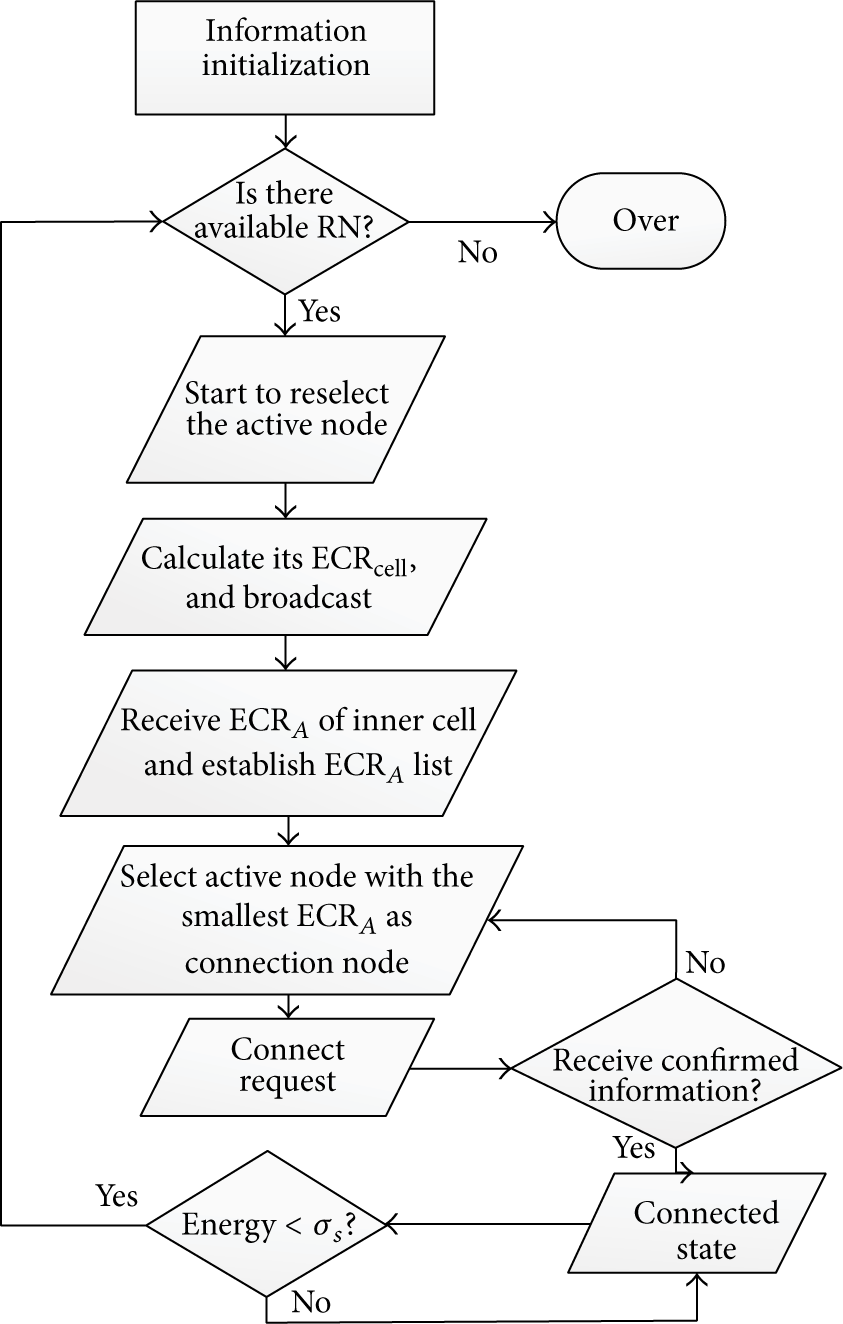
Algorithm progress of topology control based on area ECR.
6. Simulation Experiments
To verify the performance of our proposed deployment model, OMNet++ is adopted as the simulation platform for experiments and analysis, and the energy consumption parameters of [24] are adopted in the simulation experiments. Each SN can get 1000 bits data in a
Parameters and their corresponding values.

6.1. Energy Consumption Ratio
6.1.1. ECR in Different Layer
The ECR is one of the important indicators to evaluate superiority of deployment mode. If the
Table 2 shows the average ECR of each layer during the whole network lifetime. The average of each network layer's
Average ECR during whole network lifetime.

Figure 3 shows the

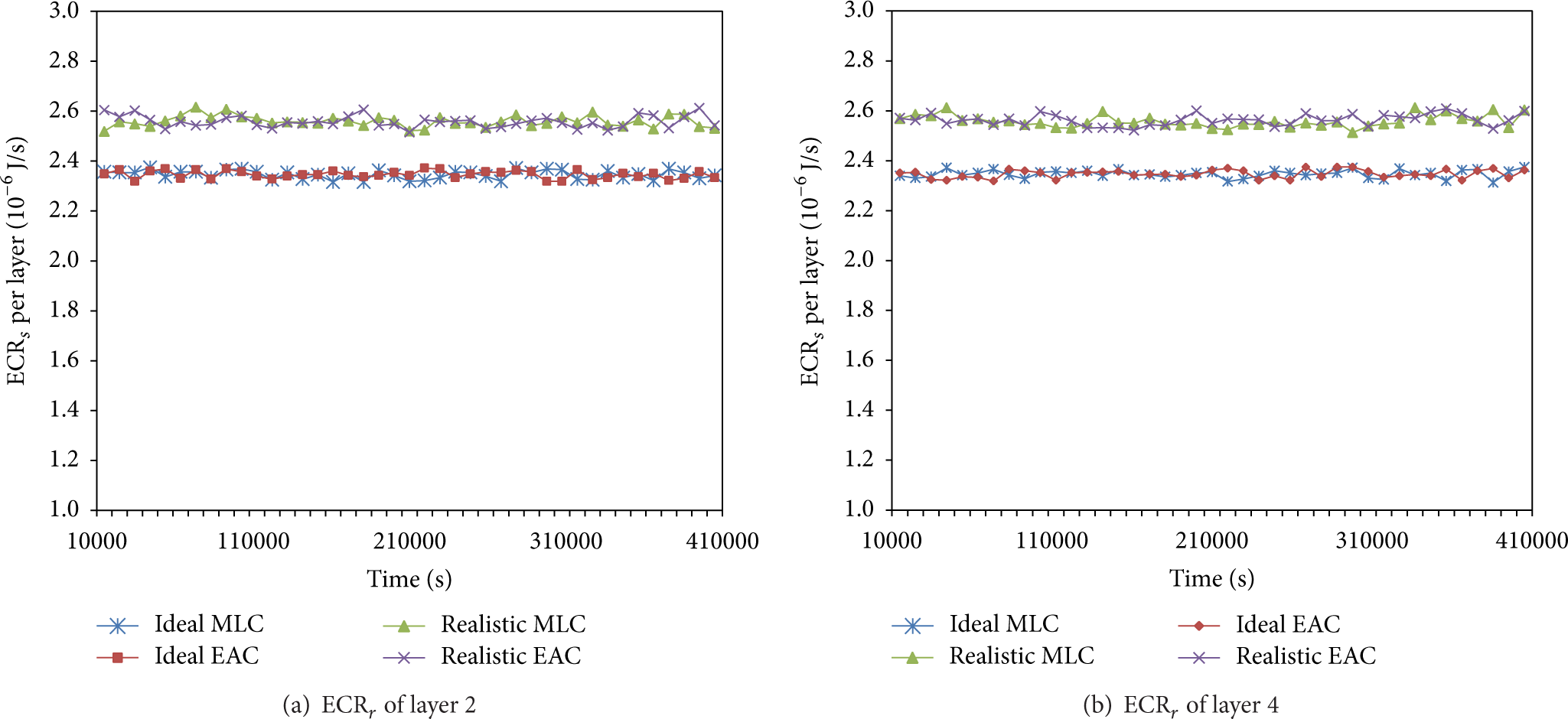
Figure 4 shows the
As shown in Figure 4, under Ideal Model simulation scenario, each layer's RNs’ ERC of our model is
6.1.2. Influence on ECR by Topology Control Algorithm
In order to verify influence on ECR by topology control algorithm based on area energy consumption, we plot a group of experiments under Realistic Model Scenario. There are two routing algorithms in experiments, that is, random routing algorithm and topology control based on area energy consumption ratio. We recorded RN's ECR of the second layer in each

Influence on ECR by topology control algorithm.
As shown in Figure 5, because RNs in MLC take excessive relaying tasks, the ECR of MLC-R is significantly higher than others and is depleted on 380 thousand seconds; contrarily, ECR of EAC-R is lower than MLC-R, and when RNs’ energies of MLC are depleted, the RNs of EAC take more relaying tasks and their ERC becomes higher suddenly. However, MLC-E and EAC-E have the approximately equal ECR, which proves that our topology control algorithm can effectively balance the ECR of MLC and EAC. Compared with MLC-R, MLC-E takes steady EAC during the whole lifetime, which proves that our topology control algorithm can effectively resolve problems generated by unexpected and unbalanced energy consumption.
6.2. Lifetime
The main goal of coverage model is to prolong the lifetime under the premise of maintaining network required coverage ratio. We plot a group of comparative experiments among NNDS [6], HNDS [9], and our model. NNDS is a homogeneous node deployment model; HNDS is a heterogeneous deployment model. The experiments adopt five-layer network structure in two experiment scenarios, that is, Ideal Model and Realistic Model.
Figure 6 shows the lifetime of three deployment models under Ideal Model simulation scenario. The different layers’ lifetimes in NNDS are different to each other. However, the lifetimes of different layers are fairly constant in our model and HNDS, which proves that the heterogeneous deployment can balance energy consumption among different layers. The lifetime of our model is longer than HNDS, which proves that the topology control algorithm based on area energy consumption ratio can dynamically balance area energy consumption and prolong the network lifetime.
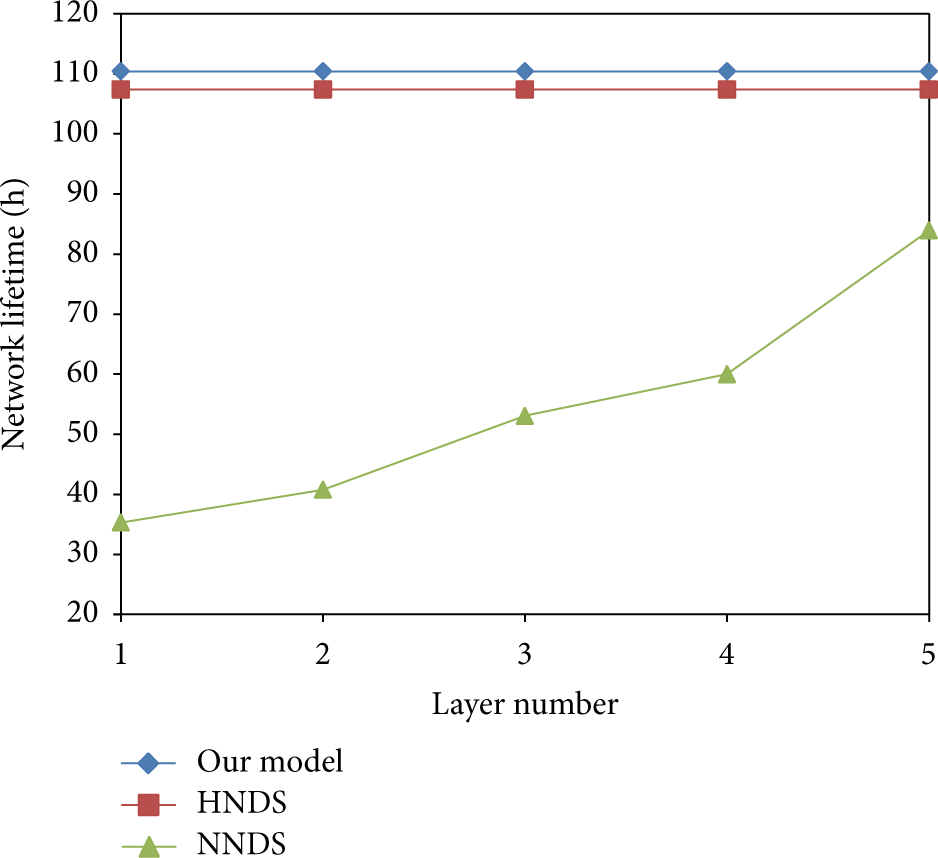
Lifetime of three models in Ideal Model Scenario.
Figure 7 shows the lifetime of three deployment models under Realistic Model simulation scenario. The different layers’ lifetimes in NNDS are also different to each other and are shorter than corresponding values in Figure 6, because there are some uncertain factors that affect node energy consumption in this scenario and NNDS does not take effective approach to balance unexpected energy consumption. The different layers’ lifetimes in HNDS take slight changes; on the contrary, the different layers’ lifetimes in our model are the same, owing to topology control algorithm based on area energy consumption to dynamically balance the energy consumption of each cell.

Lifetime of three models in Realistic Model Scenario.
Figure 8 shows the residual energy of each layer at the end of network lifetime under Realistic Model simulation scenario. Compared with HNDS and NNDS, there are less residual energies in our model and approximated residual energies in each layer. The residual energies are slightly increasing with the layer number increasing in HNDS and are severely increasing in NNDS.

Residual energy of each layer at the end of network lifetime.
7. Conclusion
After we deeply analyzed the related factors of WSNs energy consumption and network lifetime, a heterogeneous node deployment model based on area topology control was proposed in this paper. In order to improve network lifetime, this coverage model adopted heterogeneous node deployment to balance area energy consumption ratio and adopted topology control based on area energy consumption ratio to maintain dynamic equilibrium energy consumption. The experimental results show that our model has achieved the goal to keep same ECR in various areas of WSNs with the premise that sensing coverage and connected coverage meet certain requirements. Compared with similar heterogeneous deployment model, our model was easier to implement deployment program and further prolong the lifetime of WSNs; in particular it had more advantages in reducing dependence on accuracy of deployment, balancing dynamic energy consumption, and improving lifetime in poor network environment, which benefited from topology optimization based on area energy consumption ratio. The further work is to further research on the collaboration among heterogeneous nodes to improve resource utilization.
Footnotes
Notations and Descriptions
Conflict of Interests
The authors declare that there is no conflict of interests regarding the publication of this paper.
Acknowledgments
This work is supported by National Natural Science Foundation of China (Grants nos. 61272112 and 61170017), science and technology plan projects of Wuhan City (Grant no. 2013 010501010146), and Fundamental Research Funds for the Central University (Grant no. 2014211020202).