




Abstract
The problems of multiple-input multiple-output (MIMO) radar adaptive waveform design in additive white Gaussian noise channels and multitarget recognition based on sequential likelihood ratio test are jointly addressed in this paper. Two information-theoretic waveform design strategies, namely, the optimal waveform for maximizing the mutual information (MI) between the extended target impulse response and the target echoes and the optimal waveform for maximizing the Kullback-Leibler (KL) divergence (or relative entropy), are applied in the multitarget recognition application. For multitarget case, two adaptive waveform design methods for all possible targets based on the current knowledge of each hypothesis are proposed. Method 1 is the probability weighted waveform method. Method 2 is the probability weighted target signature method. The optimal waveform is transmitted and adaptively changed such that a decision is made based on the likelihood ratio after several illuminations. Numerical results demonstrate that the best waveform is the KL divergence-based optimal waveform using Method 1 as it has the lowest average illumination number and the highest correct decision rate for target recognition. By optimally designing and adaptively changing the transmitted waveform, the average number of illuminations required for multitarget recognition can be much reduced.
1. Introduction
Unlike the traditional phased-array radar that transmits a scaled version of a single waveform, multiple-input multiple-output (MIMO) radar can transmit different waveforms through its antennas and therefore provide more degrees of freedom in the radar system which lead to many advantages such as improved spatial resolution, better parametric identifiability, and greater flexibility to achieve the desired transmit beam pattern [1–6]. MIMO radar systems can be classified into two categories: statistical MIMO radar with widely spaced antennas [3] and colocated MIMO radar [5] which has close enough transmit antennas such that the target radar cross sections (RCS) observed by all the antennas are the same.
Optimal waveform design is of paramount importance for many kinds of active sensing systems such as radar, sonar, and communication. MIMO radar waveform design has attracted much attention for several years [6–20]. According to whether the waveform is designed directly or not, the MIMO radar waveform design problem can be divided into two categories. One is the optimal waveform design based on the ambiguity function [14–16]. In this case, the waveform is optimized directly to have a good autocorrelation or cross-correlation property which sharpens the ambiguity function. The other optimal waveform design problem optimizes the waveform covariance matrix instead of the waveform itself [17–20]. Mutual information (MI) was firstly introduced by Bell [21] in radar waveform design. Information-theoretic criteria have been widely used in waveform design from then on [8–11, 22]. In [9], it has been proved that the optimal waveform which maximizes the MI also minimizes the minimum mean-square error (MMSE) for target estimation in white Gaussian noise. The optimal solution performs a water filling operation [23] which allocates more power into the frequencies with large target power and low noise power. Kullback-Leibler (KL) divergence (or relative entropy) is also used in waveform design for target classification and detection [11, 24–28]. In [26–28], KL divergence was employed in sequential MIMO detection which reduces the average number of required samples. In this paper, MI and KL divergence are used as the criteria for extended target waveform optimization in white Gaussian noise channels.
Most of the above mentioned waveform design methods are nonadaptive. However, real environment is complicated and may change rapidly owing to the target movement, nonstationary interference, vast usage of various electronic devices, and so on. To make the radar more flexible to the changing environment, the transmitted waveform should change adaptively. For this purpose, cognitive or knowledge-aided radar system [29–31] was proposed, in which the radar is capable of adaptively and intelligently interrogating the environment using many different kinds of available knowledge, such as the a priori knowledge as well as the knowledge from previous measurements. Sequential hypothesis test enables the radar to adjust its transmitted waveform based on its previous observations [28, 32–34] and is thus suitable for a cognitive radar framework. In this paper, sequential hypothesis testing for multitarget recognition is considered. The closed-loop operation is illustrated in Figure 1. One of K possible targets is assumed to be present. At each illumination, the MIMO radar transmits a set of signals to interrogate the environment. The radar echoes are contaminated by ambient noise. The radar knowledge of the environment includes the noise power and the probability of each hypothesis. Based on the radar echoes, the radar knowledge of the environment is updated. Then the optimal waveform for the next transmission is designed according to the current knowledge of the environment. As the understanding of the environment grows iteratively, the transmitted waveform tends to be the optimal signal for the target and the corresponding environment.

Closed-loop operation.
In this paper, the waveform optimization methods based on MI and KL divergence for the extended target case are used in the aforementioned closed-loop MIMO radar system. We assume that only the probability of each hypothesis is changed during the illumination. The optimal waveforms for the K hypotheses are generated and stored in advance. During the illumination, the probabilities of the K hypotheses are updated according to the Bayes’ rule. Two methods are proposed to form the optimal waveform for all the K possible hypotheses. In Method 1, the optimal waveform is supposed to be the weighted sum of the K optimal waveforms for the corresponding hypothesis, where the weights are the probability of each hypothesis. In Method 2, the optimal waveform is the MI-based optimal waveform or KL divergence-based optimal waveform for the ensemble target signature. Therefore, the transmitted waveform is changing during the illumination based on the current knowledge of the probabilities. The combination of the two methods together with the MI-based optimal waveform and KL divergence-based optimal waveform will be compared to find out which one is more suitable in the multitarget recognition case. The main contributions of our work are as follows. On one hand, optimal waveform design for MIMO radar for one known target is extended to the case of multitarget case by using likelihood ratio test. Two adaptive waveform design methods, namely, the probability weighted waveform method and the probability weighted target signature method, are proposed to form the optimal waveform of multitarget. On the other hand, the optimal waveform for SISO radar multitarget classification problem is extended to MIMO radar. The result is consistent with that of the SISO radar, that is, the optimal detection waveform (maximum Kullback-Leibler divergence waveform for MIMO radar, eigenvalue optimal waveform for SISO radar) using probability weighted waveform method is more suitable for multitarget classification than the other methods as the former results in a smaller probability of error.
The remainder of the paper is organized as follows. The common MIMO radar signal model is presented in Section 2. Section 3 describes the sequential likelihood ratio test for the multitarget recognition problem. The MI-based and KL divergence-based optimal waveforms for MIMO radar are provided in Section 4, together with the two optimal adaptive waveform methods for the multitarget recognition problem. Finally, simulation results are presented in Section 5 to validate the optimal waveform strategy and their usage in the sequential likelihood ratio testing problem. We conclude the paper in Section 6.
2. Signal Model
In this section, we review the general discrete-time baseband signal model for the case of extended target [9]. The MIMO radar is equipped with P transmit antennas and Q receiving antennas. The extended target impulse response from the pth transmitter to the qth receiver is modeled as a finite impulse response (FIR) linear filter with order ν and denoted by

Suppose that the length of the observation signal is L, and assume that


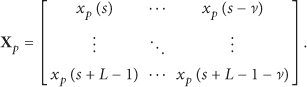
For all the P transmitted waveforms, we define


The target impulse response vector
The eigenvalue decomposition of the target covariance matrix is given by

3. Multitarget Recognition and Sequential Likelihood Ratio Test
The multiple extended targets recognition problem for MIMO radar is considered in this paper. Suppose that one of the K possible targets is known to be present and each is characterized as a complex-valued Gaussian random vector with zero mean and known covariance matrix

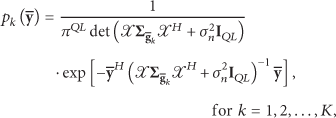
In a sequential probability ratio testing problem, a sequence of observations is obtained and at each time, a decision is made to either accept one of the hypotheses or to continue the test by making another observation [32]. The decision is based on the likelihood ratio. The likelihood ratio after the tth observation from hypothesis


The pdf of the kth hypothesis after the tth illumination can be obtained by (9). Note that the pdf of each illumination is different due to its dependence on the transmitted waveform. Therefore, this sequential testing problem is non-i.i.d. [32].
4. Waveform Optimization for Target Estimation and Detection
Two waveform optimization schemes are used in this paper, namely, the MI-based optimal waveform which was initially proposed in [9] and the KL divergence-based optimal waveform which is an application of the method proposed in [11] to the extended target case in AWGN channels. We simply show the results of the two optimal waveforms for a specific extended target case and propose the optimal waveform for the multitarget recognition problem based on the two optimal waveforms in this section.
4.1. Waveform Optimization for Target Estimation
The optimal waveform which maximizes the MI between the echo and the target impulse response will provide as much target information as possible for the radar system and thus lead to better estimation performance. In [9], the waveform which maximizes the MI is equal to the waveform which minimizes the minimum mean-square error (MMSE) in AWGN from the viewpoint of estimation. The optimization problem under total transmitted power constraint is given by [9]


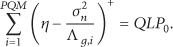
Note that the eigenvalues of the target covariance matrix do not need to be sorted here. The optimal waveform performs a water filling operation on the noise-to-target power, which allocates more power to the eigenmodes of larger target power.
4.2. Waveform Optimization for Target Detection
In this subsection, the method in [11] based on KL divergence is modified to the case for extended target in AWGN channels. Target detection can be modelled as a binary hypothesis testing problem according to the signal model in (6) as
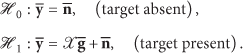
Based on Stein's lemma [11], the larger the relative entropy (KL divergence) between the two distributions of the hypotheses, the better the detection performance. The KL divergence from
Using the signal model and the assumptions above, the distributions of the received echo are


The optimal waveform design which maximizes the KL divergence from the pdf of


Substituting the pdfs in (16) and (17) into the KL divergence yields


Obviously,

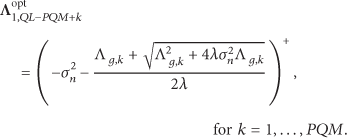
According to the proof in the appendix, the optimal waveform is found as


4.3. Adaptive Waveform Optimization for Multitarget Recognition
The former waveform optimizations are both for the specific extended target case. In the multitarget recognition problem addressed in this paper, which target is present is unknown at the beginning. We use two different waveform design methods for the multitarget recognition problem. Method 1 is the probability weighted waveform method. The K hypotheses are assigned to some probability. The optimal waveform is supposed to be the weighted sum of the optimal waveform for each hypothesis where the weights are the probabilities [33]; that is,


At each illumination, the probabilities of the K hypotheses are updated according to the Bayes’ rule as

For Method 1, the optimal waveform of multitarget is the weighted sum of the individual optimal waveforms for each hypotheses scaled by their corresponding update probabilities. The optimal waveforms for the K hypotheses can be designed in advance which reduces the time consumption of calculating the optimal waveform for the ensemble during the illumination process. Therefore, this method is more computationally efficient than Method 2, which is good for a closed-loop radar. For Method 2, the ensemble covariance matrix can be regarded as the current knowledge of the environment. All the hypotheses are integrated with the Bayesian representation of the target covariance matrix. The ensemble covariance matrix can be substituted into waveform design methods maximizing either mutual information or KL divergence.
5. Numerical Results
In this section, numerical results are presented to illustrate the performance of the two optimal waveform design methods applied to multitarget recognition problem. The MIMO radar system parameters are set to

The PSDs of the four targets.
5.1. Waveform Optimization for a Specific Target
The MI-based optimal waveform for the first target is illustrated in Figure 3(a), where the power constraint is

MI-based and KL divergence-based optimal waveform for the first target with
For different transmitted power


Comparison with the equal power allocation waveform.
Using the same method, the optimal waveforms with different transmitted power constraints for the other three targets based on either mutual information or KL divergence can be obtained. In the subsequent simulations, the waveforms are applied to the sequential likelihood ratio testing problem to recognize the true target in the four hypotheses.
5.2. Adaptive Waveform Optimization and Sequential Hypothesis Testing for Multitarget Recognition
In this subsection, Method 1 and Method 2 are used to adaptively design the optimal waveform for multitarget recognition using sequential hypothesis testing. Both the mutual information and KL divergence criteria are used in the waveform design stage. The tolerable error rate for the sequential hypothesis testing problem is assumed to be
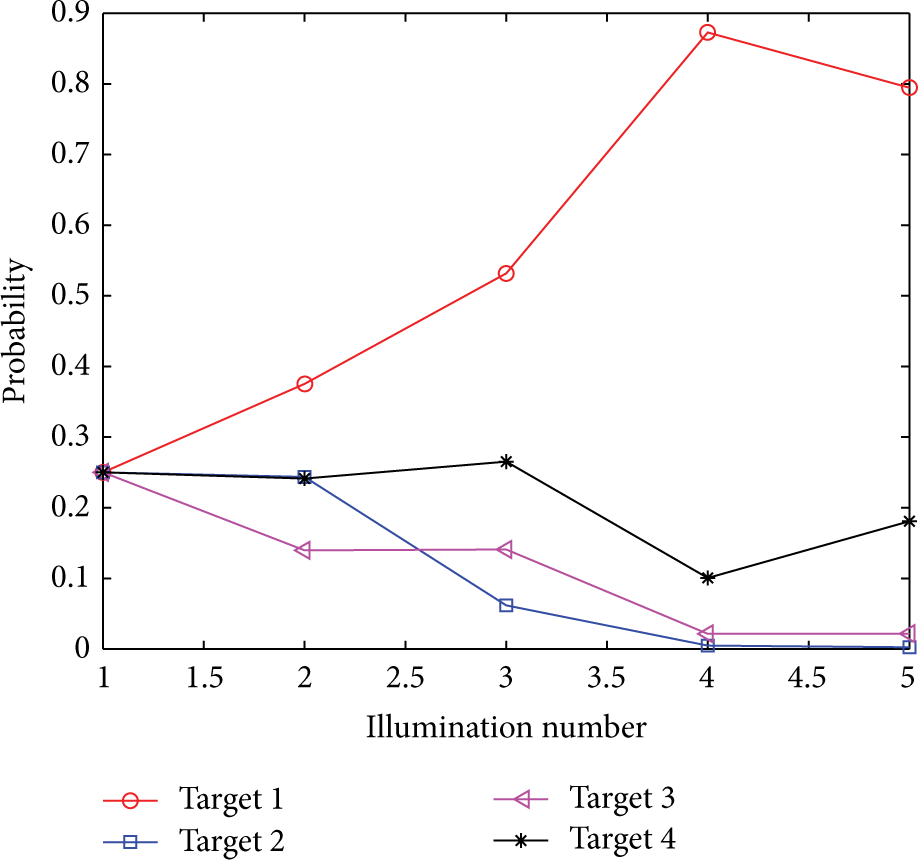
Probability of each hypothesis using the MI-based optimal waveform.
For different transmitted power

Comparison of the MI-based waveform, KL divergence-based waveform, and the equal power allocation waveform.
We also compare the probability of correct decision during the simulations. The probability is calculated by dividing the correct decision number by the total number of Monte Carlo simulations. The results are shown in Figure 6(b). The KL divergence-based optimal waveform using Method 1 has the best performance. Therefore, the KL divergence-based optimal waveform using probability weighted waveform method is more suitable to be used in the multitarget recognition problem which has the lowest average illumination number and the highest probability of correct decision compared with the others. This result is consistent with the result in [33], where single-input single-output (SISO) radar adaptive waveform design for target recognition was considered. For SISO radar, the best waveform for multitarget recognition is the SNR-based optimal waveform using probability weighted energy (PWE) technique, that is, Method 1 in this paper. Maximizing SNR for SISO radar is equivalent to maximizing KL divergence. Therefore, the optimal waveform for SISO radar is KL divergence-based optimal waveform using Method 1. In this paper, similar conclusions are obtained for MIMO radar.
6. Conclusion
In this paper, the MI-based optimal waveform and the KL divergence-based optimal waveform for MIMO radar for a specific extended target are studied. Sequential likelihood ratio test is used to make a decision in the multitarget recognition problem. Two methods are used to form the optimal waveform for multitarget recognition. In Method 1, the optimal waveform for multitarget is the weighted sum of the optimal waveform for each of the hypothesis, where the weights are the probabilities of the hypotheses. In Method 2, the knowledge of the multitarget is first calculated as the ensemble covariance matrix, where the probabilities of the hypotheses are also included. The ensemble covariance matrix denotes the current characteristic of the environment, which is used to design the optimal waveform. During the illumination, the probabilities change and thus the waveform adaptively changes. Simulation results show that the KL divergence-based optimal waveform using Method 1 is the best waveform for the multitarget recognition as it has the lowest average illumination number in order to make a decision with the highest probability of correct decision.
Note that the optimization constraint considered in this paper is only the transmitted power. More practical constraints like constant envelope, good range resolution, and so on will be discussed in future.
Footnotes
Appendix
According to [11, Lemma 2], given a
If
Using the properties of determinant and trace, we have
Problems (A.1) and (A.7) are almost the same. Therefore, we know that
To solve the optimization in (A.9), we first investigate the choice of the permutation matrix
We use the Lagrange multiplier method to solve (A.11). Let
Since
Conflict of Interests
The authors declare that there is no conflict of interests regarding the publication of this paper.
Acknowledgments
The authors would like to thank the editor and the anonymous reviewers for their comments leading to improvement of this paper.