




Abstract
In recent years, wireless sensor networks have been widely used in data acquisition, surveillance, event monitoring, and so forth. Topology control is an important issue in designing sensor networks. Considering the uncertainty of distance between nodes, a distributed topology control algorithm named as LRMST, which is based on the local minimum spanning tree (LMST) algorithm, is proposed by applying the 0-1 robust discrete optimization theory. Firstly, when only the cost coefficients are subject to uncertainty, it is proved that the robust counterpart of the 0-1 discrete optimization problem on n variables can be solved by solving at most
1. Introduction
Wireless sensor networks (WSNs for short) consist of a large number of sensor nodes which are characterized by the constrained battery, memory, and processing power. Recently, WSN has been popularly used in a wide range of applications such as environment monitoring, military target tracking and surveillance, natural disaster relief, biomedical health monitoring, real-time monitoring, vehicle tracking, and so on. WSN has attracted the attention of both the academic and the industrial research communities in the last few years.
As a critical issue in energy-efficient WSN design, topology control is carried out to form an optimized network topology structure by adjusting the communication range of nodes with the desired properties such as connectivity and coverage while reducing energy consumption and increasing network capacity [1]. This technology can enhance the efficiency of routing and MAC protocol, lay a foundation for the data fusion, time synchronization, and target localization, and prolong the survival time of the whole network [2–5].
WSNs are generally deployed in harsh environments to monitor the target field and detect the occurrence of important events. Since there are measurement error, actual interference, attacks, and other external factors that seriously affect the topology control problem, new robust topology control technologies have to be established for WSN under uncertain environments. In addition, given the energy constraint, the dynamic change of network topology and the relatively poor communication quality, another challenge, have to be faced for the WSN designers: the need to operate distributedly.
There are extensive literatures [2–9] that have discussed topology control algorithms, and they are designed with accurate distance generally. However, if we consider the existence of uncertain factors, the optimality of these algorithms is very difficult to guarantee. A more successful strategy can be a solution that is less optimal for a particular distance vector but obtains efficient solutions for all likely distance measurements. Therefore, the robustness of algorithm is involved.
In this paper, we use the robust discrete optimization theory to deal with distance uncertainty for topology control problem in WSN. Considering that the distance between nodes is uncertain, a distributed topology control algorithm named as LRMST (Local Robust Minimum Spanning Tree) is proposed. With the uncertainty increasing, the robust solution for the problem provides a significant performance improvement in the worst case at the expense of a small loss in optimality when compared to LMST algorithm.
The rest of the paper is organized as follows. We first introduce a literature review of related work in Section 2. In Section 3, some results based on 0-1 robust discrete optimization theory are given and proved. Topology control protocol of LRMST under uncertain distance is designed in Section 4. In Section 5, simulation results are considered. We conclude the paper in Section 6.
2. Related Work
Many topology control algorithms are proposed under the assumption that the distance between nodes is accurate. These methods available are based mainly on traditional optimization or heuristics, without giving full consideration of the effects produced by the interference, errors, and malicious attacks in modeling the networks, so the robustness is poor. In KN
The optimality of all above algorithms is guaranteed depending on the accuracy of distance between nodes. However, in many applications, the distance measurements are subject to uncertainty as they are indirectly estimated through signal strength or due to unfriendly conditions during the WSN's deployment or operation. On the other hand, since sensors have limited energy, when designing the topology protocol, distance is an important factor that influences the energy consumption because sensors transmitting data consume an amount of energy proportional to approximately the square of the distance [10]. The effect of ignoring distance uncertainty in the efficiency of the operation of WSN is unclear.
There are two principal methods that have been proposed to address data uncertainty over the years, one is stochastic programming, and the other is robust optimization. Dantzig [11] introduces stochastic programming as an approach to model data uncertainty by assuming scenarios for the data occurring with different probabilities. The two main difficulties with such an approach are as follows: (a) the stochastic programming model obtained is not easy to solve; (b) the exact probability distribution of uncertain data must be known, which in practice is very difficult to achieve. Robust optimization theory is an effective method for dealing with uncertain data. By using an uncertainty set to represent the uncertain data and translating the corresponding uncertain optimization model into a deterministic problem called its robust counterpart, the optimal solution of the robust counterpart, namely, robust solution, is given when uncertain data changes in the uncertainty set. In 1973, Soyster [12] proposed a linear optimization model to construct a solution that is feasible for all input data such that all uncertain input data can take any value from an interval. This approach, however, tends to find solutions that are overconservative. Nonetheless, the robust optimization theory is established in which we optimize against the worst instances that might arise by using a min-max objective. Later, Ben-Tal et al. carry out further research on the robust optimization theory [13–18]. Bertsimas and Sim [17] propose an approach to control the level of conservatism in the solution of a discrete optimization model. In our paper, we will extend and improve this approach to 0-1 discrete optimization problem and apply it to the robust topology control design.
For the first time, the robust optimization theory is used for solving the optimization model of WSN in the literature [19]. When the distance between nodes is uncertain, robust counterparts are given and solved of minimum energy consumption problem, maximum data extraction problem, and maximum network lifetime problem; the experiment results show that the robust optimization model has very good performance in practice. Consequently, combined with the theory and methodology of 0-1 robust discrete optimization, this paper will research the distributed topology control algorithm for WSN, aiming at solving the uncertainty problem for WSN in practical application scenarios. Belonging to problem-driven studies, this paper will have great theoretical and practical value in solving the uncertainty problem of topology control in practical applications of WSN.
3. 0-1 Robust Discrete Optimization Theory
Let

In this model, the decision variables are binary; that is,
We assume that data uncertainty affects only the elements of cost vector
Model of Data Uncertainty for Cost Vector
The goal of 0-1 robust discrete optimization is to give the optimal solution of the problem when cost coefficients change in the uncertainty set, and then the optimal solution is called robust solution. Robust solution ensures the optimality of the problem in the worst case; that is, all the uncertain cost coefficients change, but at this time it is too conservative. To control the conservatism degree of the robust solution, we introduce a parameter
Definition 1 (adjusting parameter
).
Let
The role of the parameter
Under this condition, the uncertainty set is

Having used an uncertainty set to represent the uncertain data, we should then translate the corresponding uncertain optimization model into a deterministic problem called robust counterpart and then give the optimal solution when uncertain data changes in the uncertainty set. We would like to find a solution

Without loss of generality, we assume that the indices are ordered such that
In the context of uncertain scenario, finding an optimal robust solution involves solving the above min–max problem (3). For many classical 0-1 discrete optimization problems, finding such a robust solution is NP-hard. However, the following theorem shows that if the deterministic 0-1 discrete optimization problem (1) has a polynomial solution, then the 0-1 robust discrete optimization problem (3) also has a polynomial solution.
Theorem 2 (see [17]).
Problem (3) can be solved by solving at most

Theorem 2 leads to the following conclusion. When only the cost coefficients are subject to uncertainty and the problem is a 0-1 discrete optimization problem on n variables, then we solve the robust counterpart by solving at most
The following Theorem 3 shows that the steps to calculate deterministic problems can be further reduced to solve problem (3).
Theorem 3.
Problem (3) can be solved by solving at most

Proof.
Let
For any feasible solution,


Suppose

As
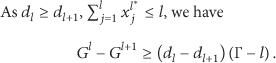
So that when
Theorem 3 shows that the optimal solution for problem (3) can be obtained by solving only one deterministic problem
4. LRMST Algorithm
In this section, based on 0-1 robust discrete optimization theory, a robust topology control algorithm named as LRMST is proposed to improve LMST algorithm.
4.1. Network Environment
Assume n sensor nodes are uniformly distributed in a two-dimensional region, and they have the same maximum transmit power
Nodes can acquire information about their neighbor nodes, including ID and the distance between them, and the distance can be obtained by some distance measurement algorithms. This can be accomplished by sending a beacon message at maximum transmit power.
Definition 4 (reachable neighbor set).
The reachable neighbor set of node

Distance given by a distance measurement algorithm can suffer from many uncertain factors, such as distance measurement accuracy and existing barriers between nodes. Therefore, it is reasonable to consider the distance uncertainty. We further suppose that its mean value and its range can be estimated, and the distance uncertainty model is the same as what is described in Section 3. Specifically, for each edge
4.2. Robust Minimum Spanning Tree (RMST) Algorithm
Definition 5 (minimum spanning tree).
Given a connected and undirected graph
The MST problem has direct applications in the design of networks, including computer networks, telecommunications networks, transportation networks, water supply networks, and electrical grids [20]. There are now two algorithms commonly used for finding an MST, namely, Prim's algorithm [21] and Kruskal's algorithm [22], and both are greedy algorithms that run in polynomial time. In LMST protocol, each node constructs its local MST. In order to enhance the robustness of LMST, we should achieve the robust counterpart of MST problem in the first place.
By taking the distance between nodes as edge weight, the optimization model for MST problem of the maximum power graph
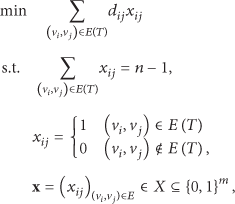
As we all know, WSNs are generally deployed in harsh environments. Distance between nodes is seriously affected by uncertain external factors, such as measurement error, actual interference, and attacks. Consequently, we pay more attention to the robust solution that is efficient for all likely distance measurements. When determining the value of adjusting parameter
Let

Problem (12) presents a robust model under distance uncertainty for the problem of MST, and Theorem 3 shows that the robust solution of problem (12) can be obtained by solving only one deterministic MST problem. Protocol RMST is summarized in Algorithm 1.
As analyzed in [21], the time complexity of Prim's algorithm is
Step 1. Let distance function and denotes the estimated distance, Step 2. Define the weight of each edge, Step 3. The minimum spanning tree T is given by running the Prim's algorithm according to the defined weights.
Definition 6 (neighbor set).
The neighbor set

4.3. Local Robust Minimum Spanning Tree (LRMST) Algorithm
Taking node u as an example, the LRMST algorithm is presented in Algorithm 2.
(algorithm for node u) (1) Information exchange send beacon upon receiving beacon (2) Topology construction build the local robust MST on nodes in let
(3) Determination of transmit power for each compute the minimum power
(4) Bidirectional topology formation similar to that of LMST, omitted here
5. Simulation and Performance Analysis
In this section, the proposed algorithm LRMST is compared with LMST algorithm in which bidirectional graph is formed by adding edges.
Firstly, the simulation environment is given. Nodes are evenly distributed in a 1000 m × 1000 m square area, the maximum communication radius of nodes is
In the first case, for
In order to compare the performance of two algorithms with deterministic data and uncertain data, here we give two main indexes [19]

The first ratio
Figures 1(a) and 1(b) show the topology generated by running LMST and LRMST algorithm in the first case

Comparison of the topology structure generated by LMST algorithm and LRMST algorithm.
The average node degrees of LMST algorithm and LRMST algorithm are compared in Figure 2, which are the average results of 50 simulations. The topology structure constructed by LMST algorithm in two cases

Comparison of the average node degree of LMST and LRMST.
Figure 3 indicates the values obtained from formula (14) after running LMST and LRMST algorithm, and they are the mean results of 50 simulations. We can see from Figure 3 that

Comparison of
6. Conclusion
Many topology control algorithms do not take into account the distance uncertainty; in fact, the distance is given by a distance measurement algorithm, which results in distance between nodes being uncertain. When the distance is uncertain, using the 0-1 robust discrete optimization theory, a distributed topology control algorithm is proposed. Simulation results show that LRMST algorithm is robust for uncertain data along with the increasing number of nodes, compared with LMST algorithm. This paper has introduced the robust optimization into the topology control technology of WSN for the first time, which provides a new idea for the future research. The robust discrete optimization theory can also be introduced into other research directions of WSN, such as location technology and routing protocol.
Footnotes
Conflict of Interests
The authors declare that there is no conflict of interests regarding the publication of this paper.
Acknowledgments
This work is supported by the National Natural Science Foundation of China (no. 61373174) and the State Key Laboratory of Complex Electromagnetic Environmental Effects on Electronics and Information System (nos. CEEME2012k0207B and CEEME2014k0302A).