




Abstract
An energy-efficient layered video multicast (LVM) scheme for “bandwidth-hungry” video services is studied in OFDM-based cognitive radio (CR) systems, where the video data is encoded into a base layer and several enhancement layers with the former intended for all subscribers to guarantee the basic quality of reconstructed video and the latter aiming at the quality improvement for the promising users with good channel conditions. Moreover, in order to balance user experience maximization and power consumption minimization, a novel performance metric energy utility (EU) is proposed to measure the sum achieved quality of reconstructed video at all subscribers when unit transmit power is consumed. Our objective is to maximize the system EU by jointly optimizing the intersession/interlayer subcarrier assignment and subsequent power allocation. For this purpose, we first perform subcarrier assignment for base layer and enhancement layers using greedy algorithm and then present an optimal power allocation algorithm to maximize the achievable EU using fractional programming. Simulation results show that the proposed algorithms can adaptively capture the state variations of licensed spectrum and dynamically adjust the video transmission to exploit the scarce spectrum and energy resources adequately. Meanwhile, the system EU obtained in our algorithms is greatly improved over traditional spectrum efficiency (SE) and energy efficiency (EE) optimization models.
1. Introduction
Recently, the fifth generation (5G) mobile wireless system has been under heated discussion [1, 2]. It is reported that the wireless traffic volume will increase by 1000-fold over the next decade [3], and hence there is an urgent need to design novel spectrum-efficient transmission paradigms. Cognitive radio (CR) [4] is one of the best technologies to improve the spectrum efficiency (SE) and has attracted many researchers' attention. The basic idea of CR is to bear data transmission among secondary users (SUs) by reusing licensed spectrum without harming the benefits of authorized users (also known as primary users, PUs). Orthogonal frequency division multiplexing (OFDM) supports a flexible spectrum management by dividing the available spectrum into fine-granularity subcarriers and hence is recognized as a promising technology for spectrum reusing [5]. As a result, it is meaningful to combine CR and OFDM together and investigate new transmission paradigm in OFDM-based CR systems.
Meanwhile, energy efficiency (EE) is also a key metric for 5G, in which energy consumption needs to be reduced on the order of several magnitudes [6]. Note that extra power consumption incurred by spectrum sensing makes the power saving issue more critical in CR systems [7, 8]. Until now, large amounts of researches have been conducted to study energy-efficient transmission in OFDM-based CR systems. For example, in our early work [9], the EE metric measured by the achieved transmission bits per Joule is adopted, and the optimal power allocation for EE maximization is derived using fractional programming. Subsequently, the model is improved with the minimum rate guarantee and subcarrier assignment taken into account in [10, 11], respectively. Then, the authors in [12] further consider channel uncertainty and study the EE maximization problem with a probabilistic interference control policy.
However, all these researches mentioned above focus on unicast transmission. Along with the proliferation of smart phones, mobile multimedia services, especially mobile video services, have been in the explosive growth [13]. CR can effectively alleviate the more and more serious spectrum scarcity issue and is one of the key candidate technologies in 5G. Hence, it is almost an inevitable trend to deliver the increasing popular video services in the future communication system without licensed spectrum. Even for networks which have already been allocated with some spectrum bands, integrating CR function into the networks, for example, Licensed-Assisted Access (LAA) [14], can provide more competent video transmission, improving the user experience greatly. Moreover, as secondary networks can only access the authorized spectrum opportunistically, its transmission capacity is limited by the prioritized access mode. Hence, it is more challenging to transmit “bandwidth-hungry” video services with QoS guarantee in CR networks. The achieved results can provide a good guidance for how to bear other types of services in CR networks.
Video multicast has become an indispensable part for wireless networks, and hence it is of great significance to study how to scalably multicast video in CR systems. Several kinds of multicast schemes have been proposed for video transmission in the literature, including conventional multicast (CM) [13, 15], multiple description coding multicast (MDCM) [16, 17], and layered video multicast (LVM) [18, 19]. In CM [15], all subscribers in a multicast group receive the intended content with the identical quality, and the transmission rate is limited by the least channel gain of all subscribers. To cope with this issue, MDCM and LVM introduce source coding to support distinguished video transmission for different subscribers. In MDCM [16, 17], the video data is encoded into multiple descriptions and transmitted at different rates. For subscribers of various channel conditions, different sets of descriptions are received to jointly recover video with different resolutions. Despite being attractive in terms of system throughput, MDCM cannot guarantee the successful reception of key information and hence applies poorly in practice. By comparison, in LVM [18, 19], the video data is encoded into a base layer (BL) and several enhancement layers (ELs). The BL is intended to all subscribers at a low rate and hence can guarantee a basic recovered video quality, while the ELs are transmitted at incremental rates and opportunistically received by subscribers with promising channel conditions to persistently improve the video quality.
To the best our knowledge, existing researches on video multicast in OFDM-based CR systems mainly focus on CM [13, 15] or MDCM [16, 17], and what is more, only SE maximization model is studied. In this paper, joint intersession/interlayer subcarrier assignment and power allocation problem for energy-efficient LVM are studied in OFDM-based CR systems. For existing energy-efficient transmission models [9–12], full-buffer traffic model is assumed; that is, there is always infinite data waiting for transmission, and EE maximization is studied with no consideration of service characteristic. For LVM, the final recovered video quality is not linear with the receiving rate. Therefore, a utility function is introduced in our model to depict the relationship between the user experience, that is, recovered video quality, and its receiving rate, and a more accurate performance metric, energy utility (EU), is designed to measure the sum user experience achieved per Joule.
In detail, the main contributions of this paper can be summarized as follows.
EU-Based Optimization Model. A novel optimization model is established for energy-efficient LVM in OFDM-based CR systems which aims at maximizing the system EU to balance the total recovered video quality and power consumption while guaranteeing multiple interference constraints for PUs. Spectrum Assignment Method for LVM. Both BL and EL subcarrier assignment algorithms are proposed to execute the intersession/interlayer subcarrier assignment in LVM. The BL subcarrier assignment aims at guaranteeing the basic video qualities for all multicast sessions with as fewer subcarriers as possible, while the EL subcarrier assignment tries to optimize the system EU by assigning subcarriers to the proper subscribers. Optimal Power Allocation Method for EU Maximization. For the multiconstrained EU-maximization problem, an optimal power allocation algorithm is presented by jointly utilizing fractional programming and subgradient method, which can be considered as the framework of optimizing energy-aware video multicast in OFDM-based CR systems.
The rest of the paper is organized as follows. In Section 2, we build the EU-based optimization model for LVM over OFDM-based CR systems. The subcarrier assignment for BL as well as EL and the EU-based power allocation are proposed and discussed by Section 3. Finally, simulation results are shown in Section 4, and conclusions are drawn in Section 5.
2. System Model and Problem Formulation
In this section, the spectrum division manner and the mutual-interference model are depicted firstly, and then the energy-efficient LVM transmission model is formulated with the objective of EU maximization.
2.1. OFDM-Based CR System
The considered CR system is composed of a primary network and a CR network, which are both deployed in a cellular fashion. The primary network consists of a primary base station (BS) and L PUs, while the CR network is made up of a secondary BS and K SUs. The whole licensed spectrum spans B Hz, and each PU occupies a disjoint fraction of the spectrum, denoted as
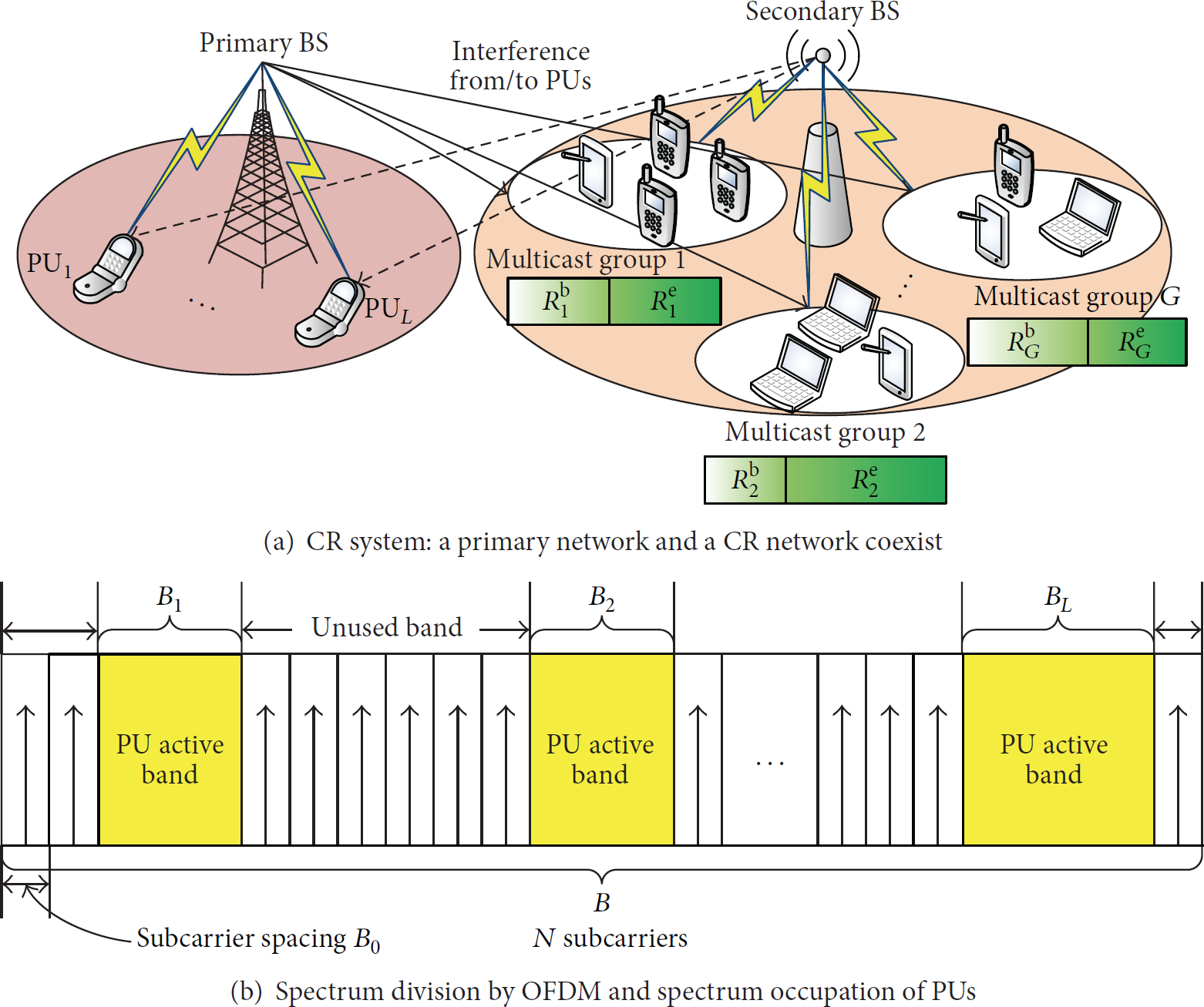
System scenario and spectrum distribution.
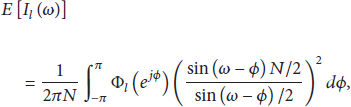
Since the sensed spectrum by CR network is licensed to the primary network, the privilege of PUs to use the spectrum must be guaranteed, which typically necessitates the interference control. Therefore, a common interference evaluation model is introduced from [20].
In [19], the power spectrum density (PSD) of subcarrier n is written as


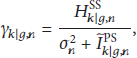
Meanwhile, the interference caused by the primary BS to SU k on subcarrier n is calculated as [20]

2.2. LVM Transmission Model
As shown in Figure 1(a), all K users are partitioned into G multicast groups according to the video contents they are interested in. The set and number of SUs in group g are denoted as

For CM, the lowest rate of SUs in a group is conservatively adopted to ensure the correct data reception of all SUs [15]. Thus, the data transmission rate of group g on subcarrier n is expressed as

In wireless transmission, the heterogeneity of the receiving channels for different SUs will seriously limit the performance for CM. In order to overcome the shortcomings, LVM [18, 19] is introduced and modeled in this paper. In LVM, video data are transmitted resiliently on different subcarriers to adapt to the diverse channel conditions. This is accomplished by coding the source data into a BL and several ELs, and as long as the BL is received, SU can decode the video stream with the basic quality. If more ELs are received, the decoded video quality is increasingly improved [21]. The essential difference between CM and LVM lies in that the former requires that all SUs in a group receive the video with the identical quality, whilst the latter allows the differential reception, depending on the individual channel quality. Therefore, LVM provides a new degree of freedom, that is, the transmission rates on subcarriers, to exploit different channel conditions.
Specifically, it is assumed that each video g, which is received by group g, is encoded into one BL with rate
In LVM, the BL data is of great importance to reconstruct the source video, and it is imperative that the BL can be received by all the SUs in a group. Hence, if subcarrier n is used by group g for the BL transmission, the transmission rate is equal to that of CM; that is,


2.3. EU-Based Problem Formulation
In LVM, the achieved rate cannot reflect the quality directly, and some metrics, such as peak signal to noise ratio (PSNR) and mean square error (MSE), may be more accurate to evaluate the received video quality. For generalizing the expression, the utility function

Apart from the video quality, the energy cost of video transmission over OFDM-based CR systems should be also considered. The total energy consumption in a timeslot includes three parts: the sense energy

In the existing work, EE is maximized to optimize the achieved rate by the unit energy consumption [9–12]. For the video transmission, it makes more sense to shift EE to EU. Therefore, the EU-based video transmission problem is formulated as

3. Optimized Video Multicast Transmission
In order to achieve the optimal performance, spectrum assignment
3.1. BL Subcarrier Assignment
For unifying the expression, let


With (14) and (15), the achievable rate
(1) (2) Initialize the set of BL-rate-unsatisfied groups the achieved rate (3) (4) Find group (5) Select subcarrier n to maximize the achieved rate as (6) Assign subcarrier n to group g for BL data transmission as (7) (8) Delete group g as (9) (10)
(11)
Either
3.2. EL Subcarrier Assignment
For EL subcarrier assignment, besides the task of assigning subcarriers to the appropriate groups, the data transmission rate
Theorem 1.
With the nondecreasing utility functions, for any subcarrier n assigned to transmit the EL data, the optimal rate
Proof.
See Appendix A.
Theorem 1 indicates that if subcarrier n is assigned to group g, then only the

(1) (2) Initialize the set of unassigned subcarriers (3) (4) Select subcarrier (5) Assign subcarrier n to group g for EL data transmission as (6) (7)
The objective of Algorithm 2 is to maximize the EU via subcarrier assignment for EL. At each iteration, subcarrier n is selected in order, and then, based on Theorem 1, the traversal of

3.3. EU-Based Power Allocation
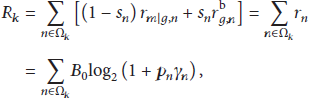
With the determined subcarrier assignment, the rate of SU
When determining subcarrier assignment, the ladder-profile power is simply assumed in (14) and (15) to evaluate the rate or utility in Algorithms 1 and 2. Thus, the power needs to be reallocated to maximize the EU for multicast video transmission, which is formulated as

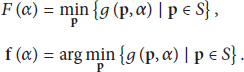
As in our previous work [9], fractional programming [25] is employed to deal with the objective function issue. With the positive parameter α, a new function


Let S denote the feasible region of
Lemma 2.

Lemma 2 indicates that the optimal solution to
Theorem 3.
If the utility function is nondecreasing and concave for each SU, problem
Proof.
See Appendix B.
The convexity of


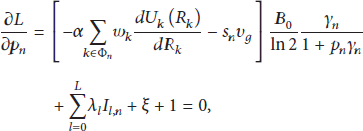

Once the optimal


With the optimal power allocation
(1) (2) Initialize α, and the tolerable error ϵ. Set (3) (4) Initialize the tolerable error (5) (7) Update (8) Compute e as (9) (10) Compute (11) (12)
The objective of Algorithm 3 is to maximize the EU by allocating power among subcarriers, whilst guaranteeing the BL rate requirements. In the inner loop, power allocation
In a practical system, the video is encoded into data layers at first, and then the BL data is mapped onto subcarriers by Algorithm 1. Sequentially, the EL data is arranged on the unused subcarriers by Algorithm 2, and the power, corresponding to the transmission rate, for each subcarrier is ultimately settled by Algorithm 3. Through all three algorithms, the EU is consecutively optimized to deliver the video to diverse receivers with the detected spectrum and limited energy.
3.4. Spectrum Scarcity Discussion
Typically, the video service is “bandwidth-hungry,” and wireless network states, including channel quality, service requests, and the numbers of SUs and PUs, remain ever-changing. Sometimes the sensed spectrum is not enough for supporting the BL rates of all the groups. For example, the available bandwidth is overly narrow due to the full occupation of the primary network, or the interference threshold is excessively tight because the CR network is geographically close to the primary network. For such cases, problem
In order to address the issue, the aggressive solution is to drop some SUs according to the service emergency or the requested rate of BL data, and in the next timeslot, more transmission opportunities are offered to these sacrificed SUs. The conservative solution is to relax the BL rate constraint
4. Simulation Results
In this section, channel fading gains from the secondary BS to SUs and PUs are modeled as consisting of six independent Rayleigh multipaths with an average channel power gain of 0 dB. The sensed spectrum is divided into
The noise power plus the interference power is identically set as
In the CR network, two video sequences, that is, Foreman and Harbour in [18], are dedicated to


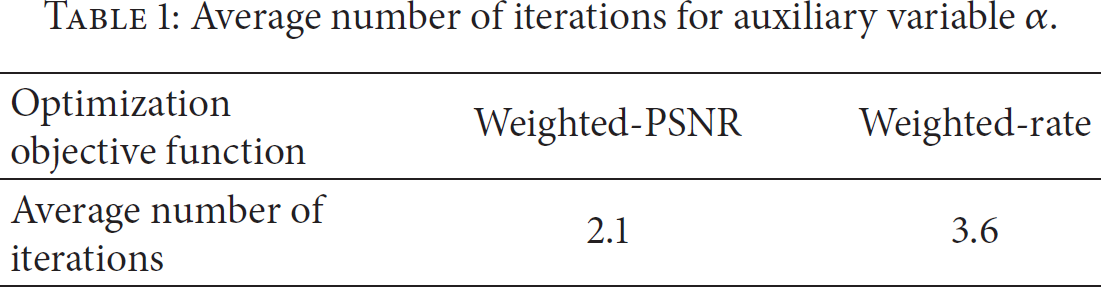
Figure 2 shows the convergence process of dual variables
Average number of iterations for auxiliary variable α.

The convergence process of dual variables in the energy-utility-based power allocation algorithm.
In Figure 3, the EEs of the CM [14] and LVM are demonstrated with the increase of the SU number in each group. That is, the utility function is chosen as

The energy efficiency comparison between the conventional multicast and layered video multicast.
In Figure 4, we compare three optimization objective functions, that is, the EU (the weighted-PSNR divided by the total energy consumption), the EE (the weighted-rate divided by the total energy consumption) [9–12], and the weighted-PSNR [18, 19], for the video transmission in terms of the achieved PSNR by the unit energy consumption. From Figure 4, it can be seen that because of integrating the energy cost into consideration the EE optimization achieves a significant performance gain over the weighted-PSNR optimization. Moreover, the EU optimization is considerably superior to the EE optimization thanks to the direct PSNR metric for the video quality. For example, with SINR = 15 dB, when the number of SUs is

The energy utility comparison among different optimization objective functions.
The proportion distribution is shown in Figure 5 for the SUs, who are classified into three categories according to the total received rate; that is,

The proportion distribution of SUs within three rate ranges.
5. Conclusion
This paper studies LVM transmission over OFDM-based CR systems, where multiple interference constraints are necessitated to carry out the performance protection for PUs. An EU-based optimization model, which is well tailored for green video delivery, is formulated, and then the BL and EL spectrum assignments are separately proposed for the complexity reduction. Furthermore, the EU-based power allocation algorithm is also proposed by jointly employing fractional programming and subgradient method. Simulation results show that the proposed power allocation algorithm can converge to the optimal solution rapidly, and LVM greatly outperforms CM, which is attributed to allowing the elastic data reception. Via the proposed algorithms, the sensed spectrum can be fully exploited by “bandwidth-hungry” video services, and the EU-based optimization notably surpasses the EE-based optimization in considering the video quality and energy consumption simultaneously. As the future work, multi-EL modeling and the sequential receiving issue for the video transmission will be considered to further explore the video multicast potential over OFDM-based CR systems.
Footnotes
Appendices
Conflict of Interests
The authors declare that there is no conflict of interests regarding the publication of this paper.
Acknowledgments
This work is supported by the National Natural Science Foundation of China (61471059), National High-Tech R&D Program (863 Program 2015AA01A705), Fundamental Research Funds for Central Universities (2014ZD03-01), Special Youth Science Foundation of Jiangxi (20133ACB21007), National Key Scientific and Technological Project of China (2013ZX03003012), and Postgraduate Innovation Fund of SICE for BUPT 2015.