




Abstract
Cooperative spectrum sensing (CSS) is a very important technique in cognitive wireless sensor networks, but the channel and multipath affect the sensing performance. For improving the sensing performance, this paper incorporates a modified double-threshold energy detection (MDTED) and the location and channel information to improve the clustering cooperative spectrum sensing (CCSS) algorithm. Within each cluster, the cognitive node with the best channel quality to the fusion center (FC) is chosen as the cluster head (CH), and each node uses the MDTED. The detective information is sent to CH, and CH makes the decision of the cluster. The decision information is sent to FC by each CH, and FC uses the “or” rule to fuse all clusters' decision information and makes a final decision. Since MDTED needs to transfer large traffic and occupy channel widely, this paper further optimizes the improved algorithm. Ensuring the detection performance, the cognitive nodes participating in the sensing are properly reduced. Simulation results show that the detecting accuracy of the improved algorithm is higher than conventional CSS, and the improved algorithm can also significantly improve collaborative sensing ability. For the optimization of cognitive nodes' number, the detection probability of the network can be obviously increased.
1. Introduction
Hybrid wireless sensor networks consist of wireless networks and wireless sensor networks (WSN), which is important to overcome the limitations of conventional sensor network where transmission range and data rate are quite limited. Wireless sensor network without support from the fixed infrastructure is known as ad hoc sensor networks. Due to the lack of infrastructure, the data is forwarded to the destination via a multihop fashion [1, 2]. In other scenarios, a set of base stations are connected by wired links and placed within the ad hoc sensor networks to form a wired infrastructure, aiming at enhancing the whole network performance. This resulting network is referred to as a hybrid wireless sensor network [3]. In this paper, we study a special hybrid wireless sensor network, cognitive wireless sensor network (CWSN).
WSN usually uses the unlicensed frequency band for transmissions; however, with the large scale deployment of network nodes and the increasing demand of the networks, the unlicensed band cannot meet the requirement at present. The problem can be overcome by incorporating cognitive radio (CR) into WSN [4, 5]. CR [6, 7] is an intelligent technology that can adjust, in real time, the transmission parameters based on spectrum hole. In CR systems, the cognitive node (CN) (also called second user, SU) senses spectrum holes that are not used by the authorization user (AU) and uses a part of or the whole spectrum holes as their communication channel. The nodes of CWSN equipped with CR devices are called the cognitive nodes (CNs) [8].
Spectrum sensing is the key technique of CWSN, currently, and the main spectrum sensing methods include matched filter, energy detection and cyclic spectrum detection, and covariance-based detection [9, 10]. The energy detection method includes the single-threshold and double-threshold energy detection, and they are, respectively, abbreviated as STED and DTED [10]. Although STED is simple, the detection performance of STED is poor in low signal to noise ratio (SNR). The DTED can greatly improve the detection probability compared with STED; however, DTED needs to transmit large amount of information and occupies wider control channel than STED.
Spectrum sensing technologies include single node sensing and cooperative spectrum sensing (CSS), and the latter is widely adopted at present. For further increasing the detection performance, CSS uses double-threshold values in energy detection [11]. For overcoming the influence of fading channel, CSS usually incorporates a clustering algorithm to improve detection performance [12–14]. Currently, clustering cooperative spectrum sensing (CCSS) algorithm mainly uses STED [12, 13]. In literature [14], the DTED is used, but the DTED does not make any decision for the energy values among two threshold values. In literature [15], a modified DTED (MDTED) sends these energy values to the fusion center (FC).
For the above questions, this paper incorporates the MDTED and location and channel information of CWSN to improve CCSS and optimizes the improved algorithm to overcome the increase of transmitting information and the wide use of control channel for the DTED.
2. Clustering Cooperative Spectrum Sensing Algorithm and Modified Double-Threshold Energy Detection
2.1. Clustering Cooperative Spectrum Sensing Algorithm
All cognitive nodes of the whole CWSN are divided into several clusters. For selecting cluster head (CH) in each cluster [12], the distances are calculated from all the cognitive nodes in each cluster to FC, and the node with the shortest distance to FC is selected as CH. The CH sends the cooperative sensing result of a cluster to FC. The clustering method not only ensures the accuracy of information transmission but also is able to save transmission channel bandwidth.
2.2. Modified Double-Threshold Energy Detection
As the MDTED [15] is shown in Figure 1, there are two thresholds,

Modified double-threshold energy detection.
Let
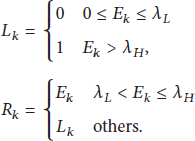
Assume that FC receives M local decision results and some energy values, and FC puts these energy values to conduct energy fusion and obtains a superior judgment W as follows:


The energy value

FC uses “or” fusion rule to get the final judgment as follows:

3. An Improved Clustering Cooperative Spectrum Sensing Algorithm
The conventional CCSS usually uses STED [12, 13] and even adopts DTED [14], but CN does not make any decision for
Based on the MDTED, this paper combines the location and channel information of CWSN to improve CCSS, and the system model is shown in Figure 2. The assumption is made that there are N cognitive nodes in CWSN, and all cognitive nodes

A model of clustering cooperative spectrum sensing.
In order to conveniently describe the algorithm,
Firstly, the reference node is selected in a cluster. The Euclidean distances between all nodes and FC are calculated, and then these nodes are sought out that the distance is the first
Secondly, the other
Finally, cluster heads are selected. The probability density function of Rayleigh distribution is written as follows:

The channel fading is calculated between all nodes in each cluster and FC by using formula (6), and a cognitive node is found out that the channel fading is the minimum in each cluster. The node is chosen as CH and is indicated as
For each node adopting the DTED, two parameters,


Let



Let


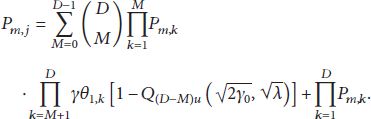
Since the channel between AU and nodes or between CH and nodes is Rayleigh channel, the cooperative detection probability and cooperative false alarm probability of a cluster in CH location can be expressed as follows:

Each CH sends the sensing result of a cluster to FC, and then FC fuses all received perceptive results to get the final judging result of the whole CWSN. The detection probability and false alarm probability of the whole network can be calculated by the following two formulas:

There are several parameters needed to be calculated for Rayleigh channel, which are used to get the detection probability of CCSS. According to (9), the detection probability

For Rayleigh channel, the probability density function of

According to (17) and (18),

Assuming that CH uses BPSK modulation to send 1 bit judging information to FC, the error rate is expressed as follows:

For Rayleigh fading channel, the probability density function of

The error rate of the network is expressed as follows:

4. Optimization for the Number of Cognitive Nodes Participating in Cooperative Spectrum Sensing in a Cluster
In Section 3, each node adopts DTED; however, DTED needs to transmit large amount of information and occupies wider control channel than STED. For this, this part further optimizes the improved algorithm in Section 3.
Based on the central limit theory, D can get larger values

Due to
Based on (9), when
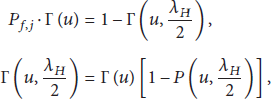

Depending on (8), (9), (11), (12), and (14), the cooperative detection probability of each cluster can be obtained as follows:

Depending on the numerical analysis,
5. Simulation
The assumption is made that there are only one AU and one FC in the system model. All nodes are divided into J clusters, and each cluster has D nodes. For each node, the noise and signal power are the same. Assume

The comparison for the collaborative detection probability of two algorithms.

The comparison for the collaborative false alarm probability of two algorithms.
It is obvious from Figure 3 that the collaborative detection probability of the network gradually increases as SNR increases, and the collaborative detection probability of the improved algorithm is higher than traditional CSS in the same SNR.
In Figure 4, the collaborative false alarm probability of the network gradually decreases as SNR increases, and the collaborative false alarm probability of the improved algorithm is lower than the traditional CSS in the same SNR.
For the optimization of the improved algorithm, assume
It is difficult to fix
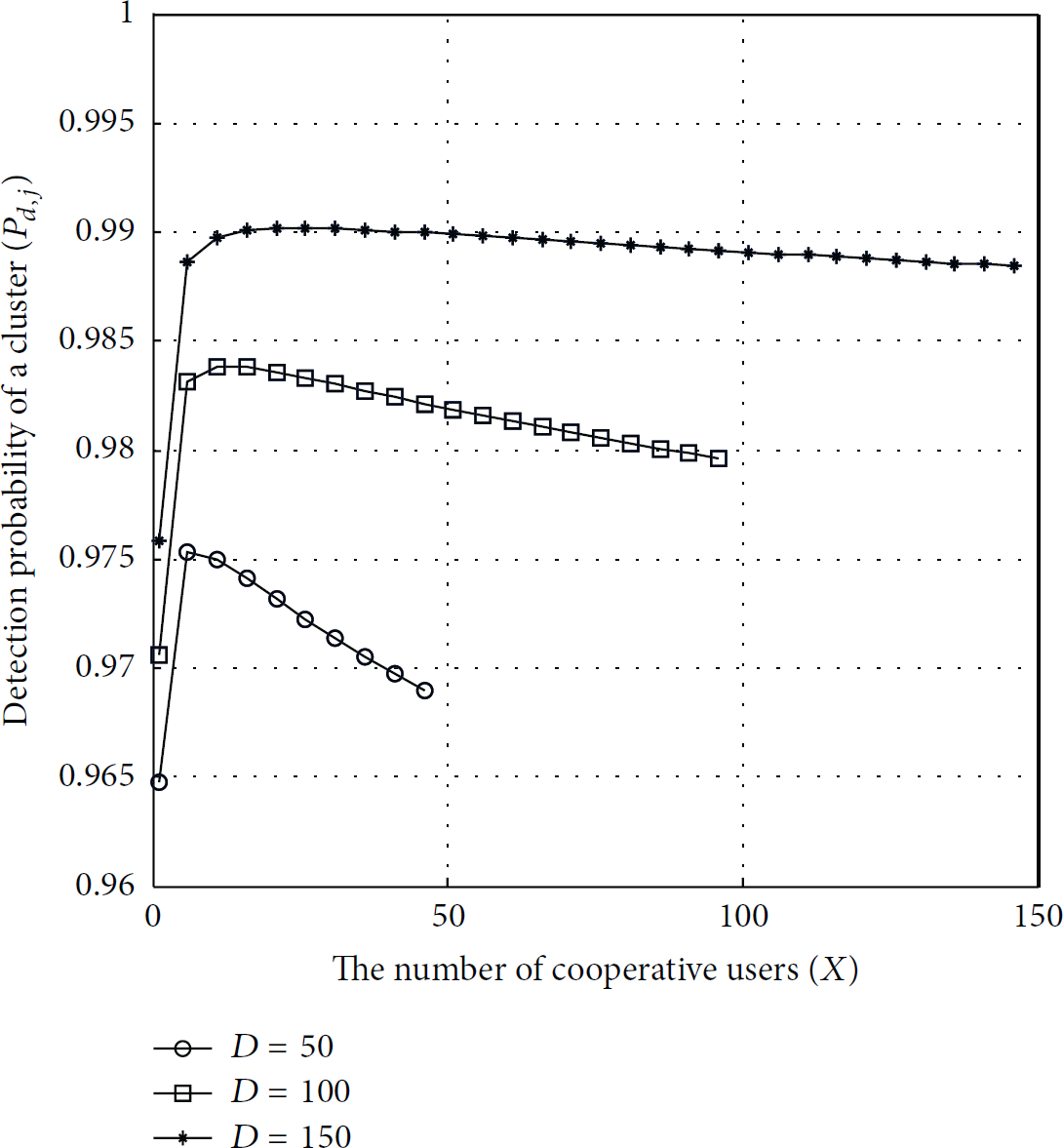
The relationship between the detection probability and the node number involved in the cooperative sensing.
To take

Taking
The comparison of

The comparison of
The relationship between the cooperative detection probability and the false alarm probability is shown as in Figure 8, in which

The relationship between
6. Conclusion
To conclude, this paper incorporates the MDTED and location and channel information of CWSN to improve a CCSS algorithm, which improves the sensing performance of CWSN. Furthermore, this paper also optimizes the improved algorithm by decreasing the node number participating in cooperative sensing in one cluster. The simulation results show that the improved method and its optimization are obviously increasing the detection performance. The further work is to seek
Footnotes
Conflict of Interests
The authors declare that there is no conflict of interests regarding the publication of this paper.
Acknowledgments
This work was supported by the National Natural Science Foundation of China (61261020), the Natural Science Foundation of Inner Mongolia, China (2012MS0903), PetroChina Innovation Foundation (2014D-5006-0603), and the Scientific Research Initial Fund for Higher Talents Program of Inner Mongolia University, China.