




Abstract
Transient pressure measurement system applied in an explosion field is usually characterized by non-real-time measurement due to the conflict between quick signal acquisition and limited communication bandwidth. The correct signal acquisition is launched by triggering, but the false triggering often leads to measurement failure due to the fact that the operating status of system cannot be real-time detected in an explosion condition. A distributed wireless measurement system with data extraction technology is proposed in this paper to improve the reliability of transient pressure measurement. A long-time signal acquisition is achieved by mass data storage to eliminate the trigger mode. On the other hand, an effective data segment is extracted by signal identification, which improves the efficiency of data transmission and data processing. A measurement system based on data extraction technology was designed and implemented in an explosion field, and the measurement node was characterized by sampling rate of 1 Msps, data storage of 128 Gb, effective data segment of 512 kW, and Wi-Fi wireless network coverage.
1. Introduction
Transient shockwave pressure measurement was an important means to evaluate the performance and power of explosive [1, 2]. Conventional measurement system was the assembled instrument consisting of sensor, signal amplifier, and data acquisition logger. Because the pressure measurement sites are numerous and distant, the limited channels and long signal wire of assembled instrument cannot achieve the performance requirements. Distributed measurement systems with data storage were used to improve the performance of measurement system [3, 4]. Each of the independent measurement stations integrates sensor, signal conditioning, A/D conversion, and data storage circuit into a compact structure, forming a measurement node. However, the network of distribution measurement system was difficult to survive in an explosive field. So the data collecting was inefficient due to the manually connecting data port. Moreover, the signal acquisition depended on self-triggering [5], which might result in measurement failure. Therefore, wireless communication was employed in distributed measurement system to realize remote monitoring and centralized control. However, the wireless communication rate is low comparing with other industrial buses [6–8], and it cannot satisfy the real-time measurement of transient pressure. On the other hand, the wireless network is difficult to survive in the explosive. As a result, the distributed wireless measurement system of transient pressure has two deficiencies. First, signal acquisition mode relying on trigger is likely to suffer a false triggering because of discontinuous monitoring network. Second, large amount of measurement data increases the burden of data transmission.
A data extraction technology is proposed in this paper to improve the performance of distributed wireless measurement system. Large capacity data storage is designed in a measurement node to achieve long-time signal acquisition, which gets rid of trigger mode. Moreover, effective data segment is extracted by signal identification, which reduces greatly the amount of data transmission.
2. Measurement System Structure
A distributed wireless measurement system for transient pressure is shown in Figure 1, which consists of many measurement nodes, a portable wireless access point (AP), and a host computer. Measurement nodes are fixed on the surrounding ground, which suffer the shock and vibration in the explosive range. Moreover, the wireless network performance is degraded due to the influence of ground effect [9, 10]. The locations of measurement nodes are changed according to different experimental requirements. Different from conventional wireless sensor network (WSN), the system focuses on improving communication rate instead of reducing power consumption and self-organizing function. So, Wi-Fi with IEEE 802.11 protocol is employed, which achieves communication rate of 54 Mbps. With the developing of Wi-Fi technology, the rate is expected to increase even higher. The long-distance network is implemented by increasing another trunking. The host computer is responsible for configuring parameters of measurement system and collecting all measurement data.

Distributed wireless measurement system for transient pressure.
The special operation mode of the wireless measurement network is shown in Figure 2. Any measurement nodes search firstly the network after turning on the power and connect to the network by license. The host computer configures parameters of each measurement node and checks system functions. After confirming the correctness, the wireless network is closed by host computer. Measurement nodes begin to perform signal acquisition and data storage at self-control status. When the explosion experiment is finished, the network is reestablished to implement data transmission.

Status conversion of wireless measurement network.
3. Data Extraction Technology
In the conventional dynamic measurement instruments [11, 12], high speed and small-capacity memory such as SRAM or SDRAM were used to realize high speed acquisition. The effective measurement time was short for the limited memory capacity; so working mode based on triggering was employed to capture the transient pressure signal, as shown in Figure 3(a). In order to obtain the data before triggering, measurement instrument begins to perform circulatory acquisition and data storage after initialization. While the system is waiting for a trigger, the working time is

Flowchart of measurement node. (a) Conventional system. (b) Proposed system.
Figure 3(b) shows the workflow of a proposed measurement node. Different from the conventional mode, there is no status of waiting for a trigger. Nodes enter directly sequential acquisition and data storage; the working time is
Specific method of data extraction is shown in Figure 4. The measurement data from A/D converter are carried simultaneously to the data memory and the identification module in FPGA. According to the rise time and the duration of acquired signal, the data is confirmed as an effective data segment. They are marked at corresponding address of the memory and the standard time. The identification criterion is that the rise time of signal is less than 1 ms and the duration is more than 100 μs, which reflects ordinary shockwave characteristic at different explosion power and measurement distance. For special measurement object, this identification criterion can be regulated by software interface. When explosion is over, the host computer which also served as a server sends an explosion time to each measurement nodes, and these nodes extract effective data segment and transmit to the server.
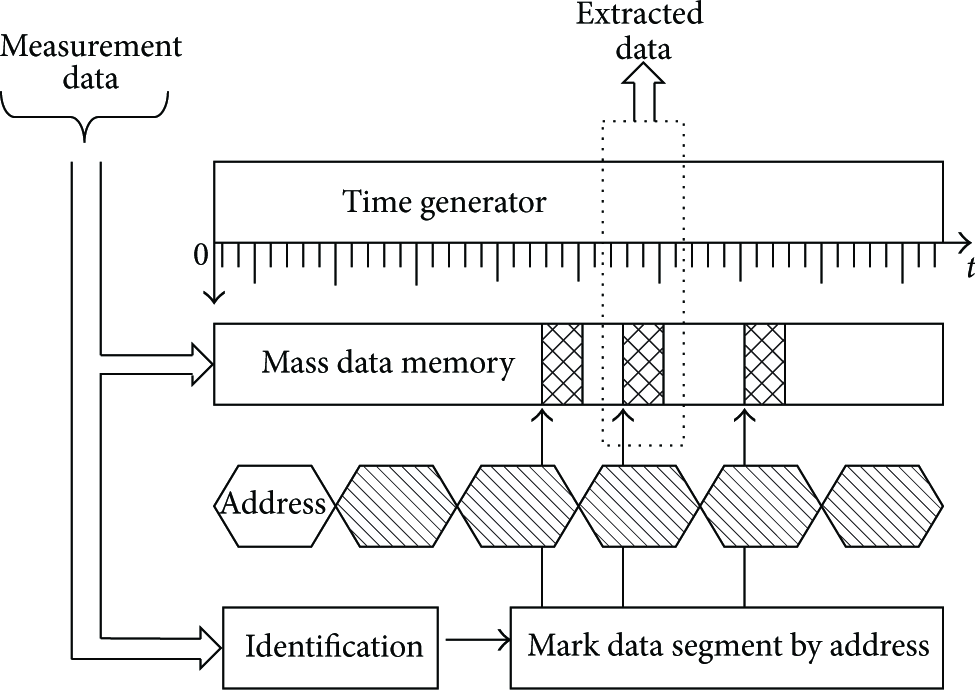
Method of data extraction.
4. Realization of Measurement Node
Measurement node is the key of system realization, and a FPGA-based measurement node is designed and implemented, as shown in Figure 5. ICP (Integrated Circuits Piezoelectric) pressure sensor is adopted for its consistent output of ±5 V at different measurement range, which facilitates the circuit design. Rise time of sensor is less than 1 μs, and resonant frequency is higher than 500 kHz. Measurement node consists of sensor, signal conditioning circuit, A/D converter, FIFO, flash memory, Wi-Fi module, and FPGA. FPGA is responsible for all the control, including gain control, ADC control, FIFO control, flash memory control, and Wi-Fi control. Moreover, measurement data tracking and identification are completed in FPGA by programming. The manufactured prototype is shown in Figure 6. The power consumption of measurement node is 1.1 W, and most of the consumption is from the Wi-Fi circuits.
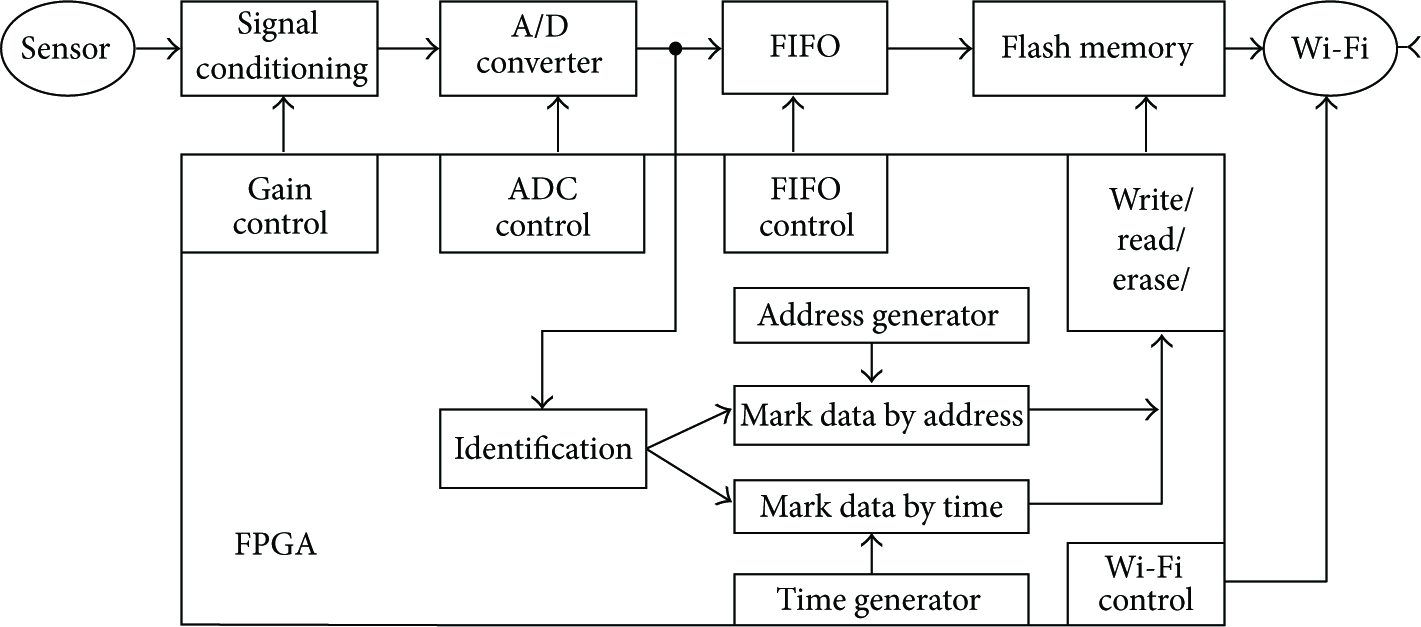
Block diagram of measurement node.

Prototype of measurement node.
4.1. Large Capacity Storage
The large capacity storage technology depends on memory, and semiconductor memory is popular for miniaturization and impact resistance. Memory of the proposed system should have the following characteristics: the average write rate is higher than signal acquisition of ADC; the memory capacity is enough for the long signal acquisition time
4.2. Identification and Mark of Data
The identification and mark of data are implemented in FPGA. The data change is tracked to confirm the rise and fall of signal. The rise time and duration are calculated and compared with the set standard value. While measurement data are written to memory, the corresponding address and time are generated in FPGA. When an effective data segment is confirmed, the data address before rising is marked as the first address of data transmission.
5. Experiment and Discussion
5.1. Shock Tube Pressure Experiment
The experimental equipment installation is shown in Figure 7. The time of shock wave arrival sensor 1 and sensor 2,


Photo of measurement system calibration with shock tube.
The experimental results indicate that the dynamic error is less than 5%, as shown in Table 1. The dynamic error is acceptable, and the reason of the most dynamic error includes instrument error of the shock tube, the calculation error of Rankine-Hugoniot equation, and the dynamic sensitivity error of the sensor.
Experimental results with shock tube.

5.2. Explosion Pressure Experiment
The measurement system was applied in explosion experiment to verify the reliability. Disposal of measurement nodes in experiment is shown in Figure 8, and 18 nodes were fixed on the ground of different distance from explosion center. Cylindrical shelters of 50 mm diameter were installed at distance of 500 mm in front of nodes. In order to ensure the safety, measurement nodes were turned on early before explosion for earlier evacuating.
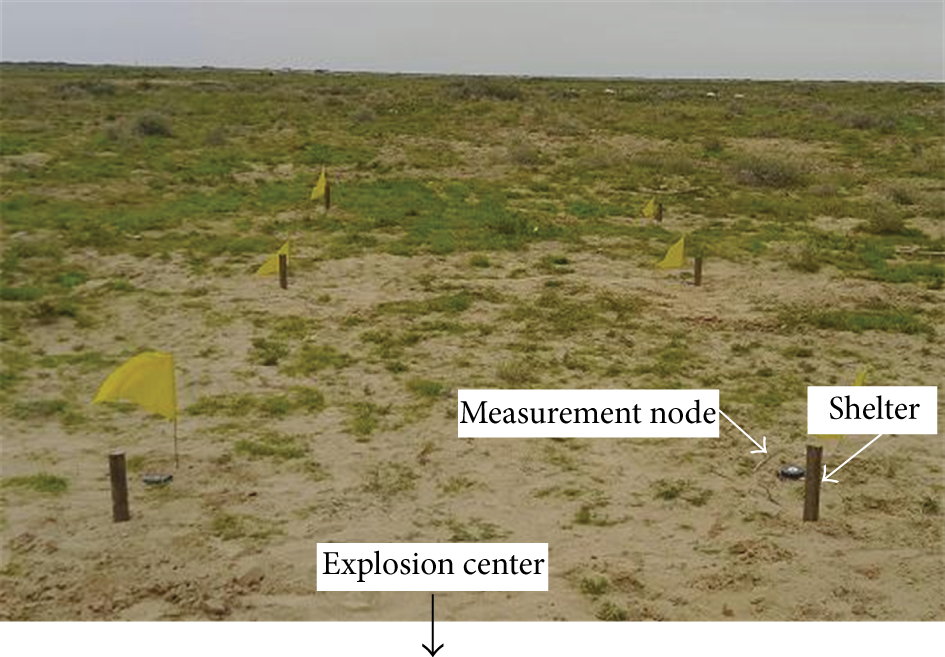
Disposal of measurement nodes in experiment.
The effective shockwave pressure signals were captured in several experiments. A special measurement result was chosen to illustrate the system reliability. During measurement nodes operation, there are small raindrops due to bad weather. In one of the nodes, two data segments were obtained as shown in Figures 9 and 10. The shockwave pressure curve is shown in Figure 9(a), which indicates that the shockwave pressure achieves 0.053 MPa (peak B) and the duration is 16.445 ms. There are noise signals (region A) within 34.974 ms before the arriving of shockwave. Figure 9(b) shows the partial enlarged view of noise signal. By analyzing signal characteristics and explosion circumstances, the noise source includes the fragments flying shock (region C), the electromagnetic fields, and the ground vibration (region D). Figure 10 shows the interference signal caused by the raindrops. For the conventional measurement instrument, the raindrops signal caused the false triggering, resulting in the measurement failure. For the proposed measurement node, the unexpected raindrops signal and pressure signal were recorded, and the effective data segment was extracted. The experimental results indicate that the measurement nodes obtain valid data under the condition of raindrops interferences.

Pressure measurement curves of experiment. (a) Shockwave pressure curve. (b) Partial enlarged view of pressure curve at region A.

Interference signal measurement curve of experiment.
The signal capture rate by many explosion experiments is employed to compare the performance. Experiments have been carried out twenty times, and the results showed that the signal capture rate of proposed measurement system achieves 100%, comparing with the 80% for that of the conventional one.
6. Conclusion
A data extraction method is proposed to the distributed wireless measurement system for the transient pressure. The long-time signal acquisition was realized by large-capacity data storage to improve measurement reliability. Moreover, small effective data segment was extracted to reduce the data transfers time. A wireless measurement system based on data extraction technology was manufactured and applied to explosion experiment.
Footnotes
Conflict of Interests
The authors declare that there is no conflict of interests regarding the publication of this paper.