




Abstract
As an important infrastructure of intelligent transportation system (ITS), vehicular ad hoc networks (VANETs) provide navigation and positioning, information services, driver assistance, in-vehicle entertainment, and other functions for the owners improving the development of the future smart city. Due to the high dynamic nature of VANETs, choosing a relatively stable and reliable transmission path to reduce the link breakage is obviously very important. In this paper, we propose an efficient prediction-based data forwarding strategy to ensure the reliability and efficiency of data transmission in VANETs. Besides the link lifetime prediction, we introduce a new metric named link utility used in the process of forwarder selection, in order to improve data forwarding efficiency. Link utility reflects the impact of relative velocity and distance between the vehicles on the efficiency of intervehicle data transmissions. It can be used to optimize packet routing and minimize number of hops especially in the high-density VANETs. Finally, we evaluate the performance of the proposed forwarding strategy through simulation confirming its feasibility and effectiveness.
1. Introduction
Vehicular ad hoc network (VANET) is an application of the Internet of Things (IoT) in the automotive field, providing driving safety and comfort [1]. Vehicles perform several roles in a VANET. They act as a data source to send local traffic information in VANET. They also act as intermediate nodes to relay packets for other vehicles. They may also be a data sink receiving the information. To improve the robustness of a VANET, additional infrastructure such as roadside units is introduced to help relay packets. However, due to the requirements of economy, technology, policy, and other aspects, restriction exists for the number of roadside units and their deployed locations. Therefore, the number of relays involved for information to travel across a VANET can be large, especially when the distance between the source and destination is long. The high number of relays poses risk to the successful delivery of information as vehicles are highly mobile and established links between vehicles can be broken quickly. To combat this problem, existing research works usually adopt the way of sacrificing the network capacity and bandwidth resources to improve network connectivity [2]. However, limited network resources in VANETs affect the network service experience significantly.
To ensure the reliability of information delivery in a VANET, it is important to design a packet transmission scheme that can reduce the impact of frequent link breakage on information dissemination and improve the path stability and lifetime [3, 4]. We observe that the robustness of a link between two vehicles often depends on their distance. The link tends to be robust when the two vehicles are closer and moving slower. While short links offer low risk of link breakage, forming a path with many short links increases end-to-end packet transmission delay and reduces bandwidth efficiency. A tradeoff between the robustness and performance exists in packet routing in VANETs.
Predicting the link lifetime is one potential method to balance the tradeoff. With the knowledge of lifetime of individual link, a path can be established with longer links that can ensure robustness within the packet forwarding period. Besides, as the lifetime of a link can be predicted, a replacement route can be created in advance to maintain the information delivery. In a VANET, the mobility of vehicles is restricted to predefined paths (i.e., roads) and speeds. These restrictions can provide useful information to make prediction on link duration. In this paper, we propose an efficient prediction-based data forwarding strategy to strike a balance between the reliability and efficiency of data transmission in VANETs. Based on the vehicle speed and location information carried in the periodic information packets for the conventional intervehicle interaction, our scheme predicts the duration of a link between two vehicles where packet forwarding remains robust. Our scheme uses a measure called link utility to capture the impact of relative velocity and distance on the efficiency of intervehicle data transmission. The utility value is used in the selection process of forwarding nodes to optimize the routing path. In addition, we also propose a variant of link utility prediction by introducing two-hop neighbor information to further improve the probability of choosing the reliable transmission paths. Finally, we evaluate the performance of the proposed forwarding strategy through simulation and confirm its feasibility and effectiveness. We study the effect of vehicle density and vehicle mobility, as well as packet size on average end-to-end delay, average number of hops, and packet delivery ratio.
The rest of this paper is organized as follows. In Section 2, we review the existing methods and research works related to link lifetime prediction in VANETs. Then we describe our proposed efficient prediction-based forwarding strategy and present the concept of link utility in Section 3. We study the performance of our forwarding scheme through simulation in Section 4. Finally, Section 5 concludes this paper and identifies some potential future works.
2. Related Work
Existing prediction methods of the link lifetime are mostly dependent on the transmission range, vehicle speed, and location. When two nodes or vehicles located within the transmission range of each other, the link between them is considered to be robust. On the contrary, when the distance between two vehicles is larger than the transmission range of vehicles, the link is considered broken as transmission fails.
In [5], the researchers exploited location and velocity information to predict the link lifetime and the route lifetime between a vehicle and a gateway connecting the Internet on highways. Then they proposed a prediction-based routing (PBR) protocol to establish a new route in advance before the existing route fails by using the predicted link lifetime. Two PBR variants were presented to reduce the frequency of routing failure with less control overhead. The first variant modified PBR to avoid the frequent switching of mobile gateway where a vehicle persistently accessed the same gateway until it was unable to construct a route. The second variant proposed choosing the gateway with the longest predicted route lifetime within a specific number of hops. The predicted link lifetime could be used to minimize route failure with a preemptive action.
Ouacha et al. [6] introduced a new metric in multipoint relays (MPRs) selection process to improve the routing protocol OLSR (Optimized Link State Routing Protocol). The new metric, which is named RTTQ (Remaining Time To Quite), exploited radio scoop and distance to predict the remaining lifetime of links between two vehicles. The MPR selection method was modified accordingly to consider the RTTQ, reachability, and node degree. The node whose RTTQ was greater than the threshold was selected as the MPR. Comparing to the standard version of OLSR, the new method had improved the MPRs lifetime by 25%.
The authors proposed a link lifetime prediction method to improve greedy and contention-based routing in mobile ad hoc networks in [7]. This method considered the location, speed, and direction of the source node, the destination node, and the neighboring node and provided a way to choose the node for forwarding. In their scheme, the selected next forwarding node must satisfy two conditions: it must be within communication range of the source node, and it must have a smaller distance from the destination node compared to the source node. The node with the longest link lifetime would be selected as the next forwarding node. This method assumed that the source node knew the knowledge of position of the destination. The simulation results show that the proposed stability-based greedy routing (SAG) based on link lifetime prediction offered lower end-to-end packet transmission delay.
In [8], Alsharif et al. considered using the minimum estimated link lifetime, the real-time traffic information, and the delay information for each road in order to improve the performance of routing with a guaranteed connectivity. In [9], a space-time planar graph approach was proposed to predict the road section (RS) connectivity, and then future lifetime of the path was derived.
Besides predicting link lifetime, there are some studies considering the effect of link quality such as channel fading, shadows, and other factors. In [10], the authors investigated the impact of fading channel on link duration property in VANETs. They partitioned the intervehicle distance into several nonoverlapping segments and proposed a modified Markov model to describe the effects of random movements under the path-loss transmission model, taking into account the possible situations that result in link breakages. A power-aware link quality estimation (PoLiQ) [11] was proposed to help select reliable forwarders and to improve the performance of multihop packet forwarding in vehicular ad hoc networks, considering the transmission parameters of the vehicles and beacon reception rates.
There are also investigations on the statistical characteristics of link lifetime. The authors in [12] studied the lifetime of individual link and derived a representative probability distribution for VANETs. The authors showed that the probability density function of the link duration is a log-normal distribution under two assumptions that a realistic radio transmission model is adopted and the probability distribution model of headway distance follows the log-normal distribution. In addition, through the simulation results, the relationship between the link duration and the acceleration was established. Moreover, an analytical model was presented in [13] for the probability distribution of link lifetime, considering both the single-lane and multilane highways with the assumptions of free-flow traffic pattern and uniformly distributed vehicle speeds. The impact of the transmission range, mobility, and node density on the link lifetime was investigated. Similarly, log-normal distribution was shown to provide a good approximation for the probability distribution of the link duration. In [14], the authors investigated the probability distribution of residual link lifetime (RLL) and derived a closed form expression considering constant velocity mobility.
In most existing investigations, vehicles select their neighboring node with the longest link duration as the next hop forwarder. We shall use this principle in the process of our link lifetime prediction. However, we observe that the chosen links are often short leading to formation of a path involving in an excessive number of relaying nodes. This outcome results in unnecessarily use of bandwidth and increased delay. Taking into account these problems, we introduce the concept of link utility prediction in the following section to strike a balance between reliability and efficiency. With our proposed method, the efficiency of data transmission is significantly improved while the reliability of the packet delivery is maintained.
3. An Efficient Prediction-Based Forwarding Strategy
Similar to the existing research woks [5, 7], our scheme uses the position and speed information obtained from the neighboring vehicles to predict the link lifetime. As shown in Figure 1(a), existing works that use link lifetime as a single metric for consideration often establish path with short links since a nearer neighbor with a lower relative speed always offers higher link reliability. The disadvantage is that the number of hops for packet transmission from a source to a destination will increase with increasing network density. Therefore, the efficiency of packet transmission is reduced.

Next-hop node selection method.
To overcome this problem, we propose an intervehicle link utility related to the distance headway and relative velocity to reflect the transmission efficiency. In the data forwarding process, considering both the predicted link lifetime and the link utility, the vehicle will choose a neighbor who has small relative velocity and large distance from the sender as the next hop forwarding node, as shown in Figure 1(b). Such data forwarding method is designed to obtain the reliable transmission links and the lower end-to-end delay. Furthermore, we also consider a variant of the link utility based on two-hop neighbor information to further increase the reliability of transmission. This ensures that the next hop node chosen by the sender can also find a reliable link to continue packet forwarding.
Generally speaking, the link durations between the vehicles moving in the opposite directions are shorter than between the vehicles moving in the same direction because of the larger relative velocity. Without knowing the location of the destination node, it should avoid using the vehicles on the reverse lanes as the next forwarders. In this paper, our aims are to study the link lifetime between the vehicles in the same direction and optimize the selection process of the next hop nodes. Similarly, we also ignore the curve in the road.
3.1. Link Lifetime Prediction
We first assume that given the close proximity, the source node and its next hop forwarding candidate has similar channel condition. Thus, we simplify the effect of the fading, shadows, and other factors affecting channel quality on the link lifetime. We use the path-loss model given in [15]

Let


An example of basic scenario.
The above formula provides a rough estimate. Besides the restraint of the maximum and minimum speed on the urban road, the vehicle speeds are limited by the speeds of the vehicles in front of and behind them. Normally, the vehicles will not make a sudden change in motion. Therefore, the accuracy of the prediction is adequate to determine whether the link is suitable for data transmission. Furthermore, for simplicity, we predict the duration of the link without considering the difference between the adjacent lanes in the same direction. This will lead to an underestimation of the link lifetime.
3.2. Link Utility Prediction
The link utility
Intuitively, when the sender and the next hop candidates have the same relative velocity, choosing the farther vehicle to forward messages can achieve higher transmission efficiency which should be encouraged. Such a case will produce a higher link utility. We also apply relatively high link utility value to the case where the next hop candidate has shorter distance and lower relative velocity. When the link lifetimes meet the requirement to successfully deliver a packet from the source to the destination, the node with the highest link utility will be selected as the next hop node. This consideration can also be applied to the case that the speed of the vehicle in front is low, and the vehicle behind can catch up or overtake the vehicle in front at a future time. The sender always favors the farthest vehicle for data forwarding.
Our proposed link utility is only used to compare the advantages and disadvantages of candidate forwarding nodes in the next forwarder selection process. Therefore, the link utility calculation only needs to capture the relationship between the variation trend of utility values, intervehicle distances, and relative speeds. Considering timeliness of the computation, we use piecewise linear functions with proper conditions [16] to calculate link utility. We shall describe the formulation of the link utility function in the following.
The function of the link utility can be represented by a surface related to the relative velocity and distance. We define T to be the minimum link lifetime required for successful data transmission and R the distance between the sender and the forwarding candidate. For the case where the distance between the two vehicles is near zero, we set

The change trends of utility values are shown in Figure 3. Let
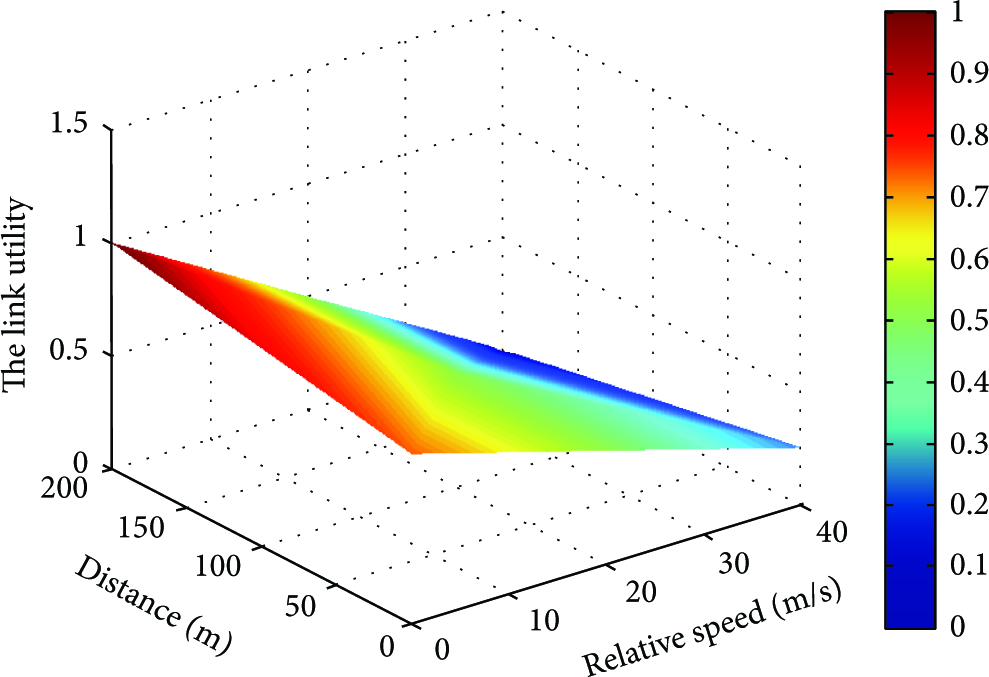
The change trend of link utility when
3.3. Link Utility with Two-Hop Neighbor Information
The link utility mentioned above reflects the efficiency of data transmission between the sender and its one-hop neighbors. As the decision is made locally, a path that is formed by locally optimal choice cannot ensure global optimal. To enhance the decision making, we consider including information beyond local context. One particular piece of information that is obtainable and critical for link reliability is the two-hop neighbor information. As a variant of the previous method, here we propose using two-hop neighbor information as a simple improvement of the link utility to further improve the probability of choosing reliable paths for data transmission and transmission efficiency. In this variant, each vehicle selects its neighbors whose the link lifetimes meet

3.4. Forwarding Protocol
In this section, we describe our proposed efficiency-aware data forwarding scheme which incorporates the link lifetime prediction method and the link utility. We assume that each vehicle is capable of telling its location, speed, and direction information and can learn or update such information through periodic beacon packets exchanged with other vehicles. Each vehicle maintains a local neighbor list to store the neighbor vehicle ID, time, position, speed, direction, predicted link lifetime, and link utility value. This list is updated when new beacon packets are received. If necessary, a vehicle should also calculate the largest link utility between itself and its potential neighbors (
After receiving a new forwarding packet, the vehicle first determines whether it is the destination. If not, it should check whether the destination ID is in its neighbor list and then decides whether the link duration between itself and the destination node is adequate to complete the transmission of the packets (
In the forwarding node selection, a vehicle or a sender first predicts every link lifetime between itself and its neighboring vehicles and selects the neighbor vehicles which have the link lifetimes greater than T and are ahead of it to compose the candidate forwarder set. Then, the sender calculates the utility values of the links between itself and its neighbor vehicles in the candidate set. Finally, the neighbor with the largest link utility value is selected as the next forwarding vehicle. In the absence of appropriate neighboring nodes with satisfactory link lifetimes to forward a packet, we propose that the sender node performs a short backoff and repeats the selection process after the backoff until a suitable forwarding vehicle is found.
4. Performance Evaluation and Simulation Results
The performance of the proposed forwarding strategy will be evaluated in this section through simulation. Since our proposed next forwarding node selection method can be used to improve the majority of the routing protocols in VANETs, we arbitrarily choose the epidemic routing protocol [17] as a base routing protocol for our study. We also investigate the performance of the routing protocols that implement only link lifetime prediction algorithm and the proposed forwarding strategy, respectively. The impact of vehicle density, vehicle speed, and packet size on protocol performance in terms of average end-to-end delay, average number of hops, and packet delivery ratio is studied.
For convenience, the routing protocol that uses the link lifetime prediction only is called the lifetime-based routing. The routing protocol that uses both the link lifetime prediction and link utility prediction is called the utility-based routing, and the improved routing protocol that uses both the link lifetime prediction and link utility variant is called the utility variant-based routing.
4.1. Simulation Environment Setting
We use the ONE simulator [18] for performance evaluation. The ONE is specifically designed for opportunistic network and allow creation of complex mobility scenarios. Since the grid scenario is more complex compared with the highway scenario, we evaluate the performance of our scheme and demonstrate the feasibility and effectiveness by using Manhattan mobility model [19]. Vehicles are randomly placed on a map size of 1000 m × 1000 m including four horizontal roads and four vertical roads. Accordingly, we apply a simple intersection forwarding mechanism. A forwarding node at the intersection divides its neighbors into groups according to their road IDs and then selects a next hop node from each road in the forwarding direction. In practice if the source knows the position of destination node in advance, this forwarding process can be further simplified, but it is not the focus of our scheme. The default value of vehicle density is set to 30 vehicles per kilometer. Since the vehicle speed is limited by the traffic regulation and the front and rear vehicles, in practice the vehicle running on the road is unlikely to suddenly accelerate, especially in high node densities. Moreover, it will take some time for a vehicle to accelerate enough to result in a significant impact on link lifetime. Considering the message propagation speed is much greater than the vehicle speed, we believe that the vehicle acceleration behavior is not enough to cause fatal influence to the performance of our forwarding protocol. In addition, to a certain extent the concept of effective communication range can also reduce the damage to transmission success rate due to the accelerating vehicles. Therefore, we assume that vehicle speeds are uniformly distributed between the minimum and maximum speeds. We set the maximum speed of 15 m/s (or 54 km/h) and minimum speed of 5 m/s (or 18 km/h) which are commonly used in urban environment. Each vehicle has the same transmission rate of 2 Mbps and the same effective communication range of
Simulation parameters.

4.2. Forwarding Protocol Parameter Setting
The choice of β and α parameters influences the change trend of link utility values. When the value of β is set close to 1 and α is set close to 0, the relative velocity has a greater effect on the link utility compared with the distance between the vehicles. In other words, the reliability has a higher factor for the selection of next forwarding vehicle. If the value of β is set close to α, the effect of the relative velocity on the link utility is smaller when the distance is very small, and its effect increases as the distance increases.
In the case where both β and α are set high, even with a large relative velocity, the link may still be selected if the distance is very small. However, the link utility value drops sharply when the distance increases. For a neighbor with low relative velocity, the probability of being chosen as a forwarding node is always high.
If both β and α are set to very small values, the candidate node has a very small chance to be selected as the forwarder when it has a short distance from the sender, even for the node with a small relative velocity. It means that we pay more attention to efficiency for the nodes near the sender. However, with the increasing distance from the sender, we have to pay attention to the reliability of the links. The node with small relative velocity will have a dramatic increase in link utility value and more likely will be selected as the next hop node. For a node with large relative velocity, the probability of being selected as the forwarder is low all the time, regardless of whether it is nearer to the sender.
Therefore, the predefined values of β and α should be configured depending on the communication environment and application requirements. In this study, we consider a general scenario with a relatively balanced proportion for the relative velocity and distance. We set
In our simulations, the default minimum time T required for successful data transmissions is set to 5 s. The value has been rounded up to nearest integer considering the additional time of data processing.
For the parameters of the link utility variant, we discuss the impact of the values of

The average end-to-end delay as a function of weight
4.3. Effect of Node Density on Performance
In this section we discuss the impact of vehicle density on the packet forwarding performance. The average node density λ is set ot the following values 10 veh/km, 20 veh/km, 30 veh/km, 40 veh/km, and 50 veh/km. The vehicle speed is uniformly distributed in the default range. The packet size is 1 MB.
As shown in Figure 5(a), the average end-to-end delays of the three routings that use the link lifetime prediction are significantly lower than that of the standard epidemic routing. Compared with the lifetime-based routing, our proposed schemes have lower average end-to-end delays. The utility variant-based routing has the lowest delay among them. Furthermore, the increasing node density results in the decreasing average delay for all schemes except the epidemic routing. This result confirms that unlike the standard epidemic routing, our proposed schemes maintain link reliability without compromising the delay performance.

The effect of node density on routing performance.
Similarly, as shown in Figure 5(b), the improved routings with our proposed forwarding schemes have lower hop counts than that of the routing protocol which is only based on the link lifetime prediction. This is because they use the proposed link utility and its variant in the forwarding node selection besides the predicted link lifetime. Therefore, under the same condition, the sender will choose a farther vehicle that meets the reliability requirement as the forwarding node, and this selection reduces the number of hops involved from the source to the destination. Moreover, the number of hops remains similar when two-hop neighbor information is added into the link utility calculation. This is because the introduction of two-hop neighbor information is designed to mainly improve link reliability, and its effect on the performance in terms of the number of hops is minimum.
Figure 5(c) shows the influence of node density on the packet delivery ratio (PDR). As illustrated in the figure, all four schemes achieve high PDR performance. The epidemic routing is a flooding-based routing protocol. To obtain the high message delivery probability, more nodes are involved in the forwarding process which reduces bandwidth utilization. For the other three routings which predict the link lifetime in the forwarding process, each vehicle selects only a neighboring node for packet forwarding. The increased number of neighboring nodes may increase the computational time, but it will not increase considerably the traffic for packet forwarding. Furthermore, as can be seen from Figure 5(c), when the node density is low, the utility-based routing has the similar PDR with the lifetime-based routing. However, the PDR of utility-based routing will be higher when the node density is high. The main reason is that higher node density provides more next hop candidates for selection which increases the chance of finding a more robust and efficient next hop forwarding node. We also see that the utility-based offers higher PDR performance with two-hop neighbor information as two-hop neighbor information provides additional information to compute the link reliability.
4.4. Effect of Vehicle Speed on Performance
In the following simulation experiments, we examine the impact of vehicle speed on the performance of proposed forwarding schemes. In this study, we use various speeds of 10 m/s, 15 m/s, 17 m/s, and 20 m/s for the maximum speed and keep the minimum speed unchanged at 5 m/s. Node density is set to 30 veh/km and packet size is 1 MB. The routing performance will be measured in terms of the average end-to-end delay, the average number of hops, and the packet delivery ratio. The corresponding results are given in Figure 6.

The effect of vehicle speed on routing performance.
From Figure 6, we observe that the utility-based routing protocol with the variant calculation always offers shorter average end-to-end delay and lower average number of hops than the other three routings, and the performance advantages increase as the maximum speed increases. Interestingly, all tested protocols offer very high PDR. The standard epidemic routing protocol achieves high PDR at the expense of more forwarding node involvement and high overhead. All our proposed protocols reduce overhead without compromising the PDR performance.
4.5. Effect of Packet Size on Performance
The relationship between packet size and protocol performance is given in this section with results plotted in Figure 7. We use similar parameter settings as previous experiments where the node density is set to 30 veh/km and vehicle speeds are uniformly distributed within the default range. We vary the packet size from 0.5 MB to 2.5 MB in steps of 0.5 MB.

The effect of packet size on routing performance.
All tested routing protocols exhibit the same trend in all performance studies. As the packet size increases, all protocols experiences higher end-to-end delay and lower PDR. This is because longer packets demand longer time to transmit and increase the load of the network. Interestingly, the average number of hops decreases as the packet size increases. In other words, smaller packets will be forwarded across more nodes. Compared with larger packets, the small packets need shorter link durations to be successfully transmitted and there is a wide selection of the forwarders. The large packets often spend more time waiting for the appropriate forwarding nodes.
5. Conclusions
In this work, we have proposed an efficient prediction-based data forwarding strategy to provide reliable and efficient data transmission in vehicular ad hoc networks. A novel link utility prediction algorithm is given by using the vehicle speed and location information. We showed that, in general, when our proposed forwarding scheme was introduced into a routing protocol, better end-to-end delay and packet delivery ratio performances were achieved. In addition, we also proposed a link utility variant with two-hop neighbor information to further improve the reliability of the selected transmission path. Finally, we investigated the impact of some key parameters. The simulation results showed that the routing protocols with our forwarding schemes achieved lower average end-to-end delay, especially in the high-density VANETs. The average number of hops between a source and destination pair was reduced without increasing the probability of packet loss caused by link breakage. The efficiency of data transmission was improved as indicated by the decreased end-to-end delay.
Footnotes
Conflict of Interests
The authors declare that there is no conflict of interests regarding the publication of this paper.
Acknowledgments
The authors gratefully acknowledge the support of the National Natural Science Foundation of China (NSFC) (61272504), the support of National S&T Major Program (2012ZX03005003), the support by Research Fund for the Doctoral Program of Higher Education of China under Grant no. 20130009110010, and the support by the Fundamental Research Funds for the Central Universities (2014JBM006).