




Abstract
A fundamental problem in wireless networks is the maximum link scheduling (MLS) problem. In this problem, interference is a key issue and past researchers have shown that determining reception using Signal-to-Interference plus Noise Ratio (SINR) is more realistic than graph-based interference models. Unfortunately, the MLS problem has been proven to be NP-hard for SINR interference models. To date, several approximation algorithms have been proposed to solve MLS under the SINR-based interference model. However, most of these works do not have either an approximation bound or a distributed version. To this end, we present a novel scheduling method with a constant approximation ratio which is much simpler and only 1/28 of it in past research. The improvement of constant ϕ also offers a better MLS set. In addition, based on our centralized method, we present a polynomial time, randomized, distributed algorithm, which only requires estimates of the number of links, and maximum and minimum link lengths. We prove its correctness and show that it can compute a MLS with time complexity of
1. Introduction
The capacity of a wireless network is directly proportional to the number of transmitting links in a certain time. This problem, called maximum link scheduling (MLS), can be succinctly described as follows: given a set of communication links L, derive a set S with maximum cardinality, where
Past research on MLS has used different interference models, most of which are graph-based, for example, protocol interference and RTS/CTS models [3]. In a graph-based model, interference-free communications can be achieved by applying a coloring method on a conflict graph [4]. This model has produced a number of interesting results; see [4–8], but they are limited due to the overly idealistic assumption. To this end, in recent years, a more realistic interference model based on Signal-to-Interference plus Noise Ratio (SINR) has gained a lot of interest. Here, a signal is received successfully if the SINR at a receiver is above a threshold, which is set according to hardware and coding method. For example, in IEEE 802.11b, the minimum SINR corresponding to 11 and 1 Mbps are 10 and 4 dB, respectively [9].
Recently, many models and protocols have been proposed to solve the link scheduling problem in wireless networks. They can be grouped into two types: scheduling the largest set of noninterfering links from a given set (maximum link scheduling) and scheduling a given set of links using the smallest time length (minimum length scheduling). These problems are well understood when a wireless network is represented as a graph, where, given an interference range for each node, concurrent transmitting links are required to be outside. Graph-based scheduling algorithms usually employ coloring on the resulting conflict graph [4]. However, their performance is not ideal when nodes’ reception is governed by a SINR model. This is well documented and has been shown theoretically as well as experimentally; see [10, 11].
The MLS problem over the SINR-based interference model is more challenging and has received a lot of interest recently. Goussevskaia et al. [12] proved that the MLS problem over the uniform power assignment is NP-hard and developed a
All the works reviewed thus far are centralized, and the studies do not clearly show how to develop a distributed version. The MIS algorithm in [17] is the first randomized and distributed MIS algorithm for the SINR-based interference model. But the time complexity of
The most closely related work to ours is the method in [14]. However, in [14], Halldόrsson and Wattenhofer apply the approach used in [1] to calculate the relative interference constant ϕ, their constant is much smaller than ours. For comparison, set α to
Henceforth, we design a centralized MLS schedule with a constant approximation ratio of
A randomized and distributed algorithm with polynomial execution time has also been designed. Our distributed algorithm only requires an estimate of the number of links and the maximum and minimum link lengths. We then prove its correctness and show it can compute a MLS with time
The remainder of this paper is organized as follows. In Section 2, we introduce the network model, some definitions and theories, and the problem formulation. In Section 3, we introduce our approximation algorithm and its distributed implementation. Lastly, Section 4 concludes the paper and presents further works.
2. Preliminaries
2.1. Network Model
Define a set of links as
We adopt the SINR-based interference model, where a receiver
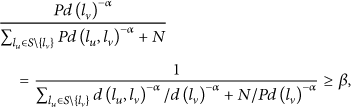
We assume all communications are carried out in synchronized fixed length, time slots. In each time slot, a node can either listen or transmit. We assume nodes are able to measure the total received power from other nodes. Here, we define the received power
2.2. Definitions and Theories
We define link diversity
In a distributed environment, nodes use their shared estimates of minimum and maximum possible link length to replace
A set I of nodes is said to be d-independent if the mutual distance of the nodes in I is greater than d [21]. A Maximal Independent Set (MIS) U is a d-independent set which is not a subset of any other d-independent sets.
Let R denote
Consider a link


Then, with a slight abuse of notation, we define the relative interference of set S to link

According to the definitions of relative interference, inequality (2) can be transformed as

As shown in inequality (5), the link
A summary of notations used in this paper can be found in Notations section.
2.3. Problem Formulation
The MLS problem is a maximization problem whereby, given an input set of communication links L, we seek a subset of links
3. Proposed Algorithm
We now present our constant approximation algorithm for MLS under the SINR-based interference model. We first introduce the centralized version and prove its correctness and approximation factor. After that, we present its distributed version.
3.1. The Centralized Algorithm
Our centralized algorithm for MLS is outlined in Algorithm 1. The algorithm is associated with a constant ϕ, whose value will be determined later on. Algorithm 1 greedily schedules links in nonincreasing order of link length; that is, shortest link is scheduled first. A link in L is selected into set S if and only if its relative interference from S is no larger than ϕ (line (8) of Algorithm 1). On the contrary, a link is discarded if its relative interference from set S is larger than ϕ (line (10) of Algorithm 1). This process repeats until all links in L are considered. Next, we prove the correctness of Algorithm 1 and derive its approximation factor.
(1) (2) (3) (4) (5) (6) (7) (8) (9) (10) (11)
3.1.1. Analysis
We begin our analysis by firstly presenting one key property for a pair of links; this property is captured by Lemmas 1 and 2. In particular, the property states that for a pair of links, for example,
Lemma 1.
Given a pair of links
Proof.
Since

Lemma 2.
Given a pair of links
Proof.
Since

Theorem 3.
Algorithm 1 provides a valid solution when
Proof.
Let
Using Lemmas 1 and 2 and the fact that the length of links in
First, we consider the distance between any senders

Next, observing that, for any senders
The total relative interference coming from


Using



According to inequality (13), when
Lemma 4.
Given links
Proof.
Considering the fact that for any sender


Then using the fact that

Theorem 5.
Algorithm 1 is a
Proof.
Before outlining our proof, we first introduce a method used by [2] to construct
By contradiction, assume
According to Lemma 4, for any


An illustration of Theorem 5.
3.2. The Distributed Algorithm
In this section, we present a randomized, distributed implementation for Algorithm 1. We then prove its correctness and calculate its time complexity.
Our distributed algorithm is illustrated in Algorithm 2, in which we set
(1) (2) (3) // (4) (5) (6) (7) // 1st (8) Senders of links in S transmit in this slot (9) (10) v senses the channel (11) (12) (13) // 2nd (14) Perform the MIS algorithm of [22] with mutual distances larger than (15) (16) (17) // 3rd (18) (19) v sends a REQUEST containing its ID and receiver's ID (20) (21) v listens to the channel in this slot (22) (23) v transmits an ACK (24) if (25) Add its link to S (26)
The algorithm then sweeps through the link classes in
In the first step, only links
The second step is used to select a MIS set from
After finding the MIS set for nodes in
For the third step, only links
3.2.1. Analysis
Theorem 8 follows directly from Lemmas 6 and 7. Lemma 6 shows that the relative interference experienced by selected links in
Lemma 6.
Given a link
Proof.
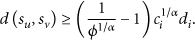
According to the first step of Algorithm 2, for any links
Considering the fact that for any pair of links in the same subclass
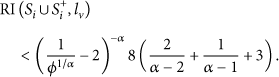
To summarize, we have that, for any pair of links
Lemma 7.
The two-slot transmitting/receiving mechanism in the third step of Algorithm 2 is correct.
Proof.
To prove the correctness of this lemma, we only need to show that all communications can be executed successfully in two slots, that is, interference-free. We prove this lemma by considering two cases: communications in the first slot and communications in the second slot.
In the first case, only senders

For the second case, only receivers

Theorem 8.
Algorithm 2 provides a valid solution.
Proof.
For any links
Lemma 9.
The total time to compute a MIS at each stage is
Proof.
Please see [22].
Theorem 10.
The time complexity of Algorithm 2 is
Proof.
As shown in Algorithm 2, the initializing step only takes one slot for all links. For links in
3.3. Remarks on Distributed MIS Algorithm
The second step of Algorithm 2 is to compute a MIS set which has been extensively studied and many distributed algorithms have been proposed [23–25]. However, most of these methods compute the MIS set by modeling it as a graph, for example, the unit disk graph (UDG). A SINR-based interference model is fundamentally different because the cumulative interference may result in a node v failing to receive a message even when only one neighbor of v transmits. Due to this difference, it is impractical to adopt a graph-based, distributed MIS algorithm for our problem, which assumes the SINR-based interference model.
To the best of our knowledge, the first MIS algorithm designed for the SINR-based interference model is proposed by Yu et al. [22]. It is a randomized distributed method that can compute the MIS set in time
4. Conclusion
In this paper, we have studied the maximum link scheduling problem under the SINR interference model. The goal is to maximize the set of concurrent links. To address this problem, we design a constant approximation algorithm under the assumption of uniform transmission power. With the same assumption, the constant approximation ratio of our algorithm is
There are still a number of open problems, such as power control, multihop traffic scheduling and routing, analog network coding, and models beyond SINR such as log-normal shadowing. As a future work, we are currently looking into a distributed algorithm with lower time complexity. The use of our solution in arbitrary power assignment and 3D space is also possible future works.
Footnotes
Notations
Conflict of Interests
The authors declare that there is no conflict of interests regarding the publication of this paper.